
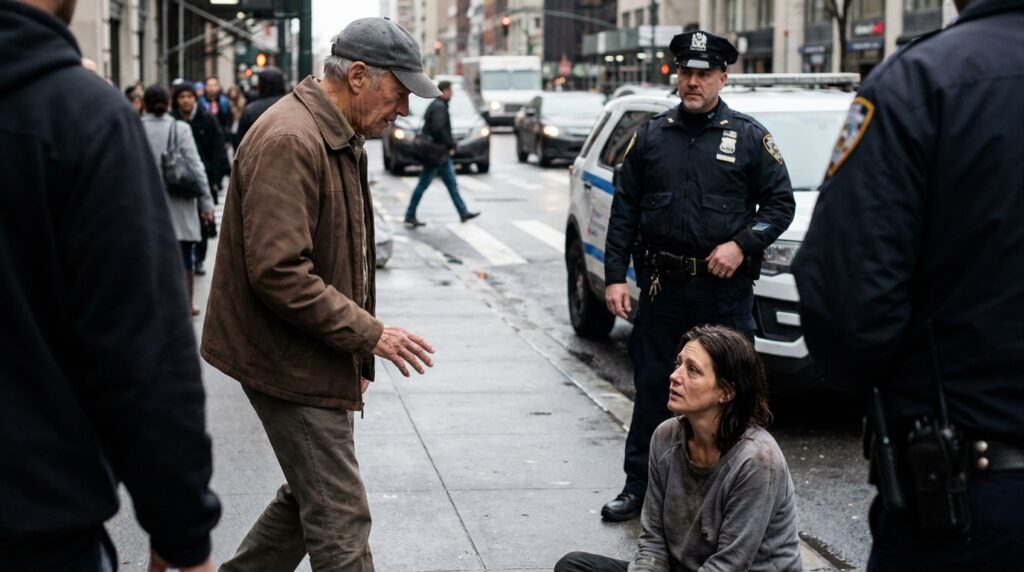
The Frayed Edge of Respect and the Silent Command of a Forgotten Soldier
CHAPTER 1: THE FRAYED EDGE
The right pocket of the brown cotton jacket was torn at the corner, just enough for the cold, salt-rimmed wind off the transit canal to bite at Arthur Vance’s knuckles. He didn’t pull his hand out. Instead, his thumb rolled over the tiny, sharp ridges of the brass insignia clutch resting loose in the seam. It was a minuscule piece of hardware, no larger than a shirt button, but the metal was dense, heavy with the weight of an era the city had spent thirty years paving over.
Around him, downtown moved with a frantic, unseeing velocity. People in slick nylon coats and heavy leather boots brushed past his shoulder, their eyes locked on the glowing screens held inches from their faces. To them, he was part of the masonry—a slow-moving calculation they had to steer around, a late-70s frame slightly bent by the decades, topped with a faded olive veteran’s cap that had lost its structured crown long before the kids on the corner were born. The daylight was thin, desaturated, casting long, pale shadows across the grease-slicked granite of the sidewalk.
He noticed the change in the street’s rhythm before he saw the cause. It was a subtle hitch in the flow of pedestrians fifty yards ahead, a widening circle of avoidance near the concrete parking island where the delivery trucks idled. The air smelled of burnt diesel and wet cardboard.
“Get up,” a voice barked from the center of the clearing. It was young, sharp with a manufactured malice that belonged to someone who had never had his skin torn by anything more serious than a chain-link fence. “We told you yesterday about setting up your trash in front of the bay door. Move it.”
Arthur didn’t alter his pace, but his spine straightened, a fraction of an inch at a time, the vertebrae settling into an old, familiar alignment that had nothing to do with age and everything to do with ballast. Through the gap between two stopped commuters, he saw her. The woman was small, her dark hair graying at the temples, clinging to her scalp from the damp mist. She wore a worn gray sweater that had frayed at the cuffs until her wrists showed, pale and shaking. She was on her knees, her fingers clawing at a split plastic bag as a trio of young men in heavy, dark sportswear crowded her perimeter.
Across the four lanes of asphalt, a dark municipal police cruiser sat against the curb, its engine pulsing a steady vibration through the soles of Arthur’s shoes. Inside, behind the tinted glass, the silhouette of a clean-shaven officer remained perfectly still. A hand moved near the steering wheel, casual, holding a paper coffee cup. The light bar on top remained dead.
The lead kid stepped closer, his heavy boot coming down directly on the corner of a waterlogged cardboard box the woman was trying to drag toward herself. The cardboard tore with a wet, heavy slap. “I said look at me when I’m talking to you.”
Arthur’s hand stopped moving inside his pocket. His thumb pressed down hard against the brass ridge until the pain was clean and localized. He looked at the officer across the street, whose face remained obscured by the glare of the low afternoon sun, then he looked back at the pavement where the woman’s head was bowed so low her forehead nearly touched the grit.
He didn’t think about his lungs or the dull ache in his left hip. He just took two elongated, measured strides out of the pedestrian stream and entered the clearing, his shadow falling across the split plastic bags before the lead boy could raise his foot a second time.

CHAPTER 2: TESTING THE BOUNDARIES
“I’m moving it, I’m moving it,” the woman whispered. Her voice was an uneven vibration, dry as winter grass. She didn’t look up at the three boys shadowing her, nor did she look toward the heavy, dark boots pinned against the corner of her rain-soaked cardboard box. Her small, cracked hands scrambled over the wet granite, trying to bundle three loose, water-damaged paperbacks and a plastic container back into the split seam of her gray sweater.
Arthur Vance stood less than five paces away, his boots anchoring him to the perimeter of the parking island. The desaturated daylight caught the pale, silvered edges of his gray hair where it escaped the brim of his veteran cap. To anyone watching, he was a static figure, an old man caught in the typical paralysis of a city sidewalk witnessing a typical city cruelty. But beneath the heavy brown cotton of his jacket, his chest rose and fell in short, silent cycles.
His eyes were not on the boys. They were fixed on the woman’s frayed collar.
As she leaned forward, the worn knit of her gray top parted slightly at the nape of her neck, revealing a faded, hand-stitched laundry tag—white thread on black cotton, marking a military surplus issuance number from an enlistment sequence forty years old. The sight of it sent a cold, precise spike of adrenaline through Arthur’s veins, sharper than the salt wind coming off the canal. His fingers inside his pocket tightened around the loose brass insignia clutch until the metal dug deep into the meat of his thumb.
The largest of the three youths, a boy with an expensive, unblemished technical jacket and clean-shaven temples, leaned his weight forward. He wasn’t looking for a fight; he was looking for compliance, the easy satisfaction of seeing a marginalized life recede further into the shadows. “You got five seconds before the rest of this goes into the gutter, lady. The trucks are backing in.”
“The trucks don’t come until four,” she muttered, her fingers hitching on a torn page.
“What did you say?” The boy took a half-step closer, his shoulder checking the air, his heavy-soled shoe grinding down harder on the wet cardboard. The structural fibers of the box gave way with a sickening, fibrous crunch.
Across the street, the idling police cruiser exhaled a plume of gray exhaust into the cold air. The silhouette behind the wheel shifted slightly, the paper coffee cup rising toward the driver’s mouth, slow and indifferent. The municipal grid was working exactly as it was designed to—ignoring what was inconvenient until it became a reportable metric.
Arthur felt the familiar, heavy pulse in his temples—the old rhythmic counting he used to employ before the artillery parameters were set. He noticed the layout of the sidewalk with absolute spatial clarity: the slick patch of grease near the boy’s left heel, the concrete barrier offering three inches of solid elevation behind the woman’s back, the loose gravel scattered across the granite that would rob an aggressive stride of its traction. The boys were balanced on their toes, their weight distributed for intimidation, not impact. They were soft. They were accustomed to the silence of bystanders.
He took a slow, deep breath, letting the cold air clear the taste of diesel from his throat. The texture of the world around him felt remarkably fragile—the fraying edges of the woman’s sleeves, the thin vinyl of the boys’ jackets, the brittle social contract that kept this city from tearing itself apart.
He didn’t yell. He didn’t raise his hands. He simply closed the distance between his position and the parking island, his rubber soles making no sound against the wet granite as he stepped directly into the path of the boy’s next forward movement.
The third youth, standing slightly to the rear, noticed the shadow first. He reached out, tapping the leader’s elbow with a single, gloved finger. “Hey. Watch out.”
The leader turned his head, his brow furrowing as his eyes drifted up from the pavement, past the worn brown cotton of Arthur’s jacket, finally settling on the shadowed bill of the olive veteran cap. A small, mocking smile began to form at the corner of his mouth, the instinctual reaction of a young predator encountering something it deemed ancient and defenseless.
“You lost, old man?” the boy asked, his voice dropping into a performative drawl meant to entertain his friends. He didn’t remove his boot from the woman’s ruined box.
Arthur remained perfectly still, his hands now resting loosely at his sides, out of his pockets. The brass clutch was gone from his fingers, left behind in the dark fabric of his coat, but his palms were steady, slightly curved, ready for the weight of whatever the street was about to demand.
“The woman asked you to let her clear her things,” Arthur said. His voice was quiet, almost conversational, but it carried a strange, resonant timber that didn’t vibrate in the throat—it seemed to come from the diaphragm, heavy and metered, bypassing the ambient hiss of the traffic like a low-frequency hum.
The boy laughed, a short, sharp barking sound, and took a full step toward Arthur, bringing their chests within six inches of contact. The smell of cheap vape smoke and mint gum rolled off him. “And who the hell are you supposed to be? Her lawyer?”
Below them, the woman froze, her fingers still tangled in the split plastic bag. She didn’t look up at Arthur, but her shoulders went rigid, her breathing suspending entirely as the circle of the street grew tighter, colder, and absolutely silent.
CHAPTER 3: THE WEIGHT OF THE ASPHALT
The lead boy didn’t wait for an answer. His left hand came up in a fast, loose arc meant to shove Arthur’s shoulder back, a careless display of physical leverage intended to re-establish control of the perimeter. It was a motion born of soft years and soft targets—wide, telegraphed, and heavily reliant on the assumption that an old man’s joints were as brittle as dry pine.
Arthur didn’t flinch. He didn’t drop into a theatrical stance. As the boy’s palm neared the frayed lapel of his brown jacket, Arthur simply shifted his center of gravity backward by two precise inches, letting the forward momentum of the youth slide past his chest. In the same micro-second, his right hand moved. It was a movement stripped of any superfluous flourish, an economy of motion preserved from a decade spent drilling men on the sun-baked dirt of Georgia bases. His fingers, rough and thick-knuckled, met the boy’s extended wrist.
He didn’t grip it to strike. He simply applied a downward, twisting pressure against the radial nerve while his left palm stepped into the meat of the boy’s elbow, deflecting the kinetic energy cleanly into the empty air toward the concrete barrier.
The boy’s sneakers lost their purchase on the grease-slicked granite. With a sharp gasp of interrupted breathing, his entire upper body lurched forward, his balance evaporating as his shoulder checked the cold edge of the parking barrier. He didn’t fall, but his momentum was thoroughly spent, his posture reduced to a clumsy, defensive scramble as he tried to regain his footing against the grit. The absolute lack of impact made the redirection worse; it felt less like a fight and more like running full speed into a rotating iron gate.
“Back off,” the second youth muttered, though he took a step away from the concrete barrier rather than toward it. His hands hung near the zipper of his technical jacket, his fingers twitching against the slick synthetic fabric. The performative confidence that had filled the space thirty seconds ago had gone entirely thin, replaced by the sudden, heavy silence of an unpredictable calculation.
Arthur didn’t pursue the advantage. He remained anchored in the interaction lane, his feet spaced exactly at shoulder width, his hands returning to a resting position at his sides. His breath remained steady, a quiet, rhythmic exhalation that barely misted in the damp canal air. Underneath the faded olive brim of his cap, his eyes remained level, observing the three of them not with anger, but with the cold, diagnostic assessment of a commander reviewing an undisciplined detail.
Below his waist, the woman let out a small, ragged breath. Her fingers were still locked around the split plastic bag, but her head had turned slightly. For the first time, Arthur saw her profile clearly in the desaturated gray light. Her eyes were wide, fixed on the scuffed leather of his boots. From the loose, sagging pocket of her worn gray sweater, the corner of a heavy, notched brass key protruded, its edges bright where the lacquer had been rubbed away by years of nervous handling. It was a specific pattern—a master locker key from the old supply depots at Fort Meade, a piece of brass that shouldn’t have been within five hundred miles of this sidewalk.
Arthur’s heart gave a single, heavy thud against his ribs, a dull ache that felt like an old wound waking up before a hard rain. He knew that key. He had signed the inventory ledger for the unit lockers that held those keys forty years ago, when a young, green sergeant named Miller had sworn to keep his family safe after their final deployment.
Across the four lanes of asphalt, the door of the municipal police cruiser finally swung open. The hinge gave a high, metallic squeak that cut through the low thrum of the idling engine. The middle-aged officer stepped down onto the roadway, his polished leather boots making a deliberate, heavy crunch against the scattered gravel. He didn’t draw his belt tools, but his hand rested casually on the top of his holster, his fingers tapping against the black polymer grip as he adjusted his uniform cap against the salt wind.
“Everything alright over here?” the officer called out. His voice was loud, flat, carrying the practiced authority of a man used to clearing a sidewalk by presence alone. He began walking across the traffic lanes, his eyes scanning the three youths before lingering on Arthur’s plain brown jacket with an expression of mild, bureaucratic annoyance. To him, the old man was an unnecessary complication—an interfering civilian who had turned a simple vagrancy clearing into an incident that required a written report.
The lead boy was back on his feet now, his face flushed red beneath his clean-shaven temples. He rubbed his right wrist where Arthur’s thumb had left a pale, momentary impression against the skin. “Old man’s crazy,” he spat, though his voice lacked its previous volume. He kept his distance from Arthur, his heels pinned against the safety of the curb. “We were just telling her to move her garbage, and he jumped us.”
The officer stopped at the edge of the sidewalk, his shadow falling across the wet granite between the boys and the parking island. The cold light caught the smooth, dark sheen of his uniform. He looked at the woman on the pavement, then at the split plastic bags, and finally turned his full weight toward Arthur.
“Sir,” the officer said, his voice dropping into a firmer, disciplinary register. “You need to step away from these men and let me handle the block. You shouldn’t be getting involved in this.”
Arthur looked at the officer’s clean-shaven jaw, then down at the small, notched brass key resting in the woman’s pocket. The world around them seemed to slow down, the textures of the city turning brittle and heavy, waiting for the first line of real authority to break the gray afternoon.
CHAPTER 4: THE INTERACTION LANE
“Step back from the curb, sir. Right now,” the officer repeated. His boots stopped exactly two inches from the spilled contents of the plastic bags, his stance wide and unyielding, a living wall of dark wool and polished synthetic gear. The smell of cold coffee and starch radiated off his uniform shirt. He didn’t look at Arthur’s face; his eyes remained pinned to the old man’s chest, evaluating the plain brown cotton jacket for any hidden bulges or shifting weights.
Arthur did not give ground. His rubber soles remained frozen against the granite seam of the sidewalk, his weight balanced so perfectly that the stiff wind off the transit canal couldn’t tilt his frame by a millimeter. The fading daylight glanced across his faded olive veteran cap, casting a dense shadow over his weathered brow. Beneath the brim, his eyes were cold, still pools reflecting the blue and red strobe patterns that had just begun to flash silently on the cruiser’s rear deck across the asphalt.
“You’re addressing the wrong element, Officer,” Arthur said. The gravel in his voice didn’t rise in pitch, but it deepened, taking on a resonant, diagnostic weight that caused the younger of the three street bullies to twist his neck toward the curb. “The disturbance was initiated by these three individuals. The woman was forced to the concrete. Your observation post across the street should have provided ample visibility of that sequence.”
The middle-aged officer’s jaw tightened, his clean-shaven skin turning a mottled, low-temperature red in the damp air. He adjusted his heavy duty belt with a sharp, leather-on-leather click, his fingers trailing down past the black polymer holster toward the non-standard, dull brass buckle holding his secondary gear pouch. The brass was notched, stamped with a specific logistics alphanumeric string—a salvage marker from the old Supply Depot 4 at Fort Meade.
“I don’t need a lecture on situational awareness from a bystander,” the officer muttered, his voice dropping into a dangerous, low-register rumble meant exclusively for Arthur’s ears. He stepped directly between Arthur and the three youths, his massive shoulder deliberately crowding the old man’s physical space, forcing him back toward the cold iron railing of the parking island. “I told you to clear the lane. This is your final instruction. If you interfere with a municipal code enforcement action again, you’re going into the back of the wagon. Do you follow my meaning?”
Below them, the woman shrank against the concrete, her palms scraping through the wet sand as she tried to pull her split bags beneath her shins. Her fingers caught on the loose leather strap of her small canvas pack, and for a split second, the heavy, notched brass key slipped from her sweater pocket, clicking sharply against the granite before her palm slapped down to cover it. The sound was tiny, an insignificant piece of metallic friction against the roar of a passing city transit bus, but the officer’s left boot shifted slightly at the noise. He knew that sound. He had spent ten years carrying the same specific weight of brass on his old duty harness before he took the city shield.
The lead bully took the officer’s intervention as an explicit license. He leaned over the officer’s shoulder, his smirk returning like a grease stain on cold glass. “Yeah, go back to the retirement home, old man. You missed your afternoon nap.”
Arthur’s right hand didn’t move toward his pocket, but his fingers uncurled completely, his palms turning slightly outward. His gaze remained locked on the officer’s collar line, where the fabric was slightly worn from the constant friction of a heavy tactical vest—the kind that wasn’t issued to city cops, the kind that belonged to the heavy security attachments at the regional logistics nodes. The entire layout of the street had become an entirely different kind of map. The officer wasn’t lazy; he was deliberate. He wasn’t ignoring the block because he was slow; he was waiting for the sidewalk to empty out so he could verify what the woman was carrying in the loose lining of her worn gray top.
“Officer,” Arthur said, his voice dropping an octave until it bypasses the ambient hiss of the traffic entirely, carrying the precise, metered cadence of a tactical command room. “Look at the white laundry tag inside her collar line. Then look at your own gear buckle. You’ve got an active service identification overlap on this pavement, and you’re treating it like a municipal ordinance violation.”
The officer froze mid-breath. His fingers stopped tapping against the polymer holster grip, his entire body going completely rigid against the cold wind. He didn’t turn his head to look down at the woman, but his eyes finally drifted up from Arthur’s chest, meeting the hard, unblinking glare beneath the olive brim of the veteran cap. For three long seconds, the only sound between them was the wet hiss of the city traffic and the low, steady vibration of the cruiser’s engine across the lanes of asphalt.
“Who are you?” the officer whispered, the bureaucratic authority draining out of his voice, leaving behind nothing but the raw, thin friction of an old soldier who had just recognized a ghost on his perimeter.
Arthur didn’t give him a name. He simply leaned forward by an inch, the brown cotton of his jacket brushing the officer’s dark wool sleeve, his presence entirely taking over the interaction lane. “The street is under observation, son. Get these three off my sidewalk before I have to re-classify this entire interaction.”
CHAPTER 5: THE SOUND OF ABSOLUTE SILENCE
“Hey, I asked you a question, old man,” the lead boy repeated, though his voice had thinned significantly, caught in the sudden cold draft that seemed to have settled over the asphalt lane. He looked between the officer’s rigid back and Arthur’s unblinking posture, his knuckles twitching against the slick synthetic fabric of his technical jacket. “You gonna let him push us around, officer? He threw my wrist. Look at the marks.”
The middle-aged officer didn’t turn around. He didn’t adjust his uniform cap. His left hand slowly drifted away from the black polymer holster grip, his fingers hanging limp, completely emptied of their practiced, municipal aggression. The dull brass buckle on his duty belt—the one stamped with the Fort Meade supply depot code—seemed to grow heavier against his waist. He stared directly into the dense shadow beneath the brim of Arthur’s olive veteran cap, his breathing shallow, uneven, like a man trying to hear a silent tripwire click in the dark.
“Shut up,” the officer said. The words were small, flat, stripped of the booming authority he had used to cross the traffic lanes.
The boy blinked, his smirk twisting into a line of sudden confusion. “What?”
“I said shut your mouth and walk away from this island,” the officer whispered, his head turning just enough for the desaturated gray daylight to catch the hard, deep-set lines around his jaw. His voice wasn’t a police order; it was a desperate warning, a quiet plea from a junior soldier who had suddenly realized he was standing in the direct line of fire of an entirely different kind of authority. “Get off this block. Right now. Both of you.”
The three youths looked at each other, the territorial confidence that had driven them to push the woman to the pavement entirely dissolving into the damp city air. The third boy, who had stayed near the rear of the clearing, didn’t wait for a second instruction. He turned his heel against the grit, his heavy rubber soles scraping a fast retreat toward the commercial storefronts behind the island. Within five seconds, the other two followed him, their quick, hurried footsteps fading into the low, wet rumble of the transit bus idling further down the avenue.
Arthur didn’t watch them leave. His eyes remained fixed on the officer’s collar line, tracking the tiny, microscopic tremor in the dark wool fabric. The world around them had gone completely still, the hurried pedestrians on the sidewalk seemingly frozen in place by the sudden, inexplicable drop in spatial pressure. The desaturated gray light seemed to gather in the deep creases of Arthur’s brown cotton sleeves, emphasizing the immense, heavy history contained within his ordinary civilian frame.
Below them, the woman let out a low, ragged sob. Her palms were still pressed flat against the wet granite, covering the notched brass locker key that had slipped from her pocket. She looked up through the tangled, graying strands of her dark hair, her eyes wide, glassy with a mixture of terror and a strange, dawning recognition that she hadn’t permitted herself to feel in forty years. The faded white laundry tag inside her collar was visible again, its neat, hand-stitched military identification string catching the thin light like an open accusation.
“Arthur?” she whispered. Her voice was weak, an ancient fracture breaking through the crust of her exhaustion. She didn’t use his rank; she used the name her father had spoken into the kitchen phone at three in the morning before the long deployments. “Is that… is that you?”
The officer’s head snapped down toward her, his eyes locking on the brass key protruding slightly from beneath her wet palm, then back to the faded olive cap on Arthur’s head. A devastating realization seemed to strike him, a paradigm shift so sudden that his knees seemed to lose a fraction of their rigid, uniform structure. He didn’t speak. He couldn’t. The entire decoy of a municipal code enforcement action had completely shattered on the pavement, leaving him exposed in front of a retired commander who had spent the last twenty minutes analyzing every crack in his discipline.
Arthur turned his weight away from the officer, his boots pivoting with a smooth, silent precision that ignored the dull ache in his left hip. He lowered his frame slightly, the heavy brown cotton of his jacket bunching at his waist as he formed a complete, unyielding physical shield between the street and the woman on the concrete. He reached down, his rough, thick-knuckled fingers gently closing over her trembling hand, not to move her, but to ground her against the cold sting of the asphalt.
“The lane is secure, Sarah,” Arthur said, his voice dropping into that low, resonant register that belonged exclusively to the quiet spaces behind the command tents. “Your father’s locker key stays in your pocket. No one on this sidewalk is touching your things again.”
The officer took a slow step backward, his boots clicking softly against the concrete barrier as he looked at the two of them. His hand rose instinctively toward his cap, his fingers twitching in the beginning of an involuntary military salute before he caught himself, his shoulder locking as he realized the absolute impossibility of what he was witnessing in the middle of a public city block.
CHAPTER 6: THE RETROSPECTIVE RITUAL
The cold, wet granite of the sidewalk did not change its texture under Arthur Vance’s palms, but the space between his boots and the parking island felt completely altered. The city traffic continued its wet hiss across the four lanes of asphalt, a distant rumble of diesel and rubber that seemed to bounce off an invisible, soundproof perimeter. The desaturated daylight was dying now, catching the frayed edge of Sarah Miller’s gray sleeve as her hand remained pinned to the wet concrete.
Beneath her trembling fingers, the notched brass key lay cold and heavy. Arthur did not pull it away from her. His rough, weathered hand simply rested over hers, his thumb sliding across the smooth, rubbed spine of the metal until he felt the micro-frictional indentation near the base—the specific locker stamp of the Fort Meade supply node. Forty years ago, he had watched her father, Sergeant Thomas Miller, scratch that exact notch into the brass using the file of a standard-issue multi-tool while sitting on an olive-drab crate in the humid twilight of a Georgia staging area. Thomas had been a man who trusted lockers more than banks, a soldier who kept everything that mattered—his service citations, his family records, his quietest memories—locked behind heavy wire mesh, waiting for a future that had ultimately run out of time.
Sarah looked up through the tangled, dark strands of her hair. Her face was a landscape of pale exhaustion, her skin grayed by the harsh climate of the street, but her eyes held a sudden, sharp lucidity that cut through the haze of the afternoon. A tear had tracked a clean line through the grit on her cheek, reflecting the silent, rhythmic red strobe of the police cruiser across the avenue. “He told me you’d be watching the sector,” she whispered, her voice cracking like dry timber under a heavy boot. “Before he went into the VA hospital… he said if the grid ever fell completely apart, I should look for the olive cap near the transit canal. I thought he was just dreaming about the old unit.”
Arthur felt a tightening behind his ribs, a dull, physical ache that had nothing to do with age and everything to do with the heavy ballast of a command he had never truly surrendered. He had spent six months tracking her pattern, walking this desaturated downtown corridor every Tuesday and Friday, keeping his distance to preserve her fierce, frayed pride while ensuring the local predators kept their radius wide. He had known her name before she hit the concrete; he had known her father’s voice before the kids on the corner were even a thought in the city’s lineage.
The middle-aged police officer stood completely immobilized two paces away, his massive frame trapped in the absolute collapse of his own authority. His uniform cap was tilted slightly from the wind, the dark wool fabric of his sleeves looking thin, almost fragile against the immense, historical weight radiating from Arthur’s posture. His eyes remained fixed on the white laundry tag inside Sarah’s collar, then drifted to his own dull brass belt buckle with its non-standard logistics stamp. The code matched the key. The code matched the man.
“Colonel,” the officer said, the word coming out not as a municipal protocol, but as a quiet, involuntary exhalation from the back of a throat that had forgotten how to salute. He took a half-step backward, his boots scraping softly through the wet sand on the curb. His right hand fell completely away from his holster, hanging limp at his side. “I didn’t… I didn’t verify the sequence. The district office just flagged this island for immediate clearance due to the transit shifts. I was just clearing the line.”
Arthur rose from the pavement with a slow, deliberate grace that defied the decades. He didn’t brush the wet grit from his brown cotton trousers. He stood at his full height, his spine locking into an unyielding, vertical plumb line that seemed to draw the entire street into alignment around him. He looked at the officer, his gaze level and absolute beneath the olive brim of his cap.
“The line is cleared, son,” Arthur said. The gravel in his voice was no longer conversational; it was the metered, low-frequency command that had once stopped heavy machinery in its tracks. “You will return to your vehicle. You will log this location as a secure sector under active veteran oversight. Then you will clear the avenue so this citizen can gather what remains of her dignity.”
The officer’s jaw moved once, a silent, subvocal hesitation passing through his features before his shoulder muscles went rigid. He didn’t argue. He didn’t ask for identification. The discipline etched into his own leather gear was too deep to ignore the presence of a man who had helped build the very depot he had served under. He snapped his heels together with a sharp, metallic click against the concrete barrier, his chin lifting by a single, respectful inch before he turned on his heel and walked back across the asphalt toward the idling cruiser.
Arthur looked back down at Sarah, who had begun gathering the split plastic bags, her fingers moving with a calmer, steadier rhythm now that the pressure had been driven from the sidewalk. The notched brass key was back in her pocket, tucked safely against the frayed knit of her sweater.
“Stand easy, Sarah,” Arthur said softly, his hand resting on the olive brim of his cap as the police cruiser pulled away into the gray city dusk. “The street is secure.”







