
The Cold Cadence of Forgotten Command and the Price of Unearned Arrogance

CHAPTER 1: THE WEIGHT OF THE TRAY

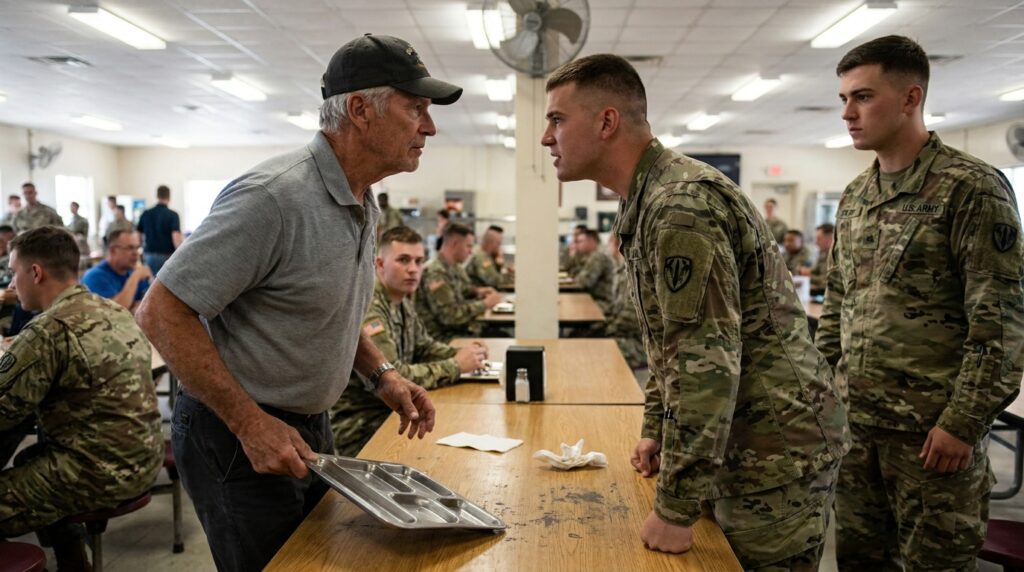
The fluorescent tubes hummed with a flat, industrial vibration that rattled the back of my jaw if I sat too still. Around me, six hundred active-duty bodies moved through the dining facility with the loud, unthinking momentum of machinery that hadn’t yet hit its first major breakdown. They smelled of sweat, damp canvas, and the cheap high-fructose syrup from the beverage dispensers near the line. To them, I was just a gray polo shirt, a dark cap pulled low to hide the thinning hair at my crown, and a pair of hands skin-mapped with liver spots resting flat on a Formica tabletop.

I looked at the leather folder sitting beside my half-empty water glass. The edge was frayed, exposing the gray cardboard binding beneath the hide. It was a heavy piece of business, the kind that didn’t exist in the digital tracking logs of the junior clerks at the front gate.

Then the air changed. It wasn’t a sound—the clatter of aluminum forks against thick ceramic plates remained constant—but a shift in the local gravity behind my left shoulder. Two pair of boots, their rubber lugs heavy and unpolished from a field rotation, stopped right at the perimeter of my chair legs.

“Hey old-timer, you’re in the wrong lane,” the kid in the clean camouflage said, his voice dropping into that specific, performance-grade register meant to carry across a room without triggering an NCO’s radar. “This mess hall is for real soldiers.”

He didn’t wait for me to look up. He shoved his tray down—a hard, metallic crack as the green plastic struck the exact boundary line where my water glass sat. The impact sent a thin sheet of water across the laminate, soaking into the edge of my old leather folder. His buddy, shorter with a razor-close high-and-tight haircut, stepped into the gap between the adjacent tables, blocking the path back toward the exit doors. They were testing the friction. They wanted a civilian to shrink, to apologize for taking up space in their world, to acknowledge that seventy years of life was a liability inside an active fence.

My fingers didn’t leave the laminate. I watched the water pool against the silver ring on my left hand—the metal was scratched down to the dull gray core, the old seal worn smooth from three decades of contact with steering wheels and steel desk edges.

The kid was leaning forward now, his chest three inches from my cap brim. He thought he had the corners covered. He thought the physics of the room belonged to him because his knees didn’t ache when the weather turned.

I took a slow breath, letting the institutional grease and hot coffee fill my lungs until the old rhythm took over—the one that doesn’t calculate fear, only distance and mass. My hands moved back from the wet Formica, clearing the tray by less than an inch. I didn’t look at his eyes yet. I looked at the pulse point vibrating at the base of his jawline, right where the stiff collar of his utility uniform met his skin. It was beating too fast for a boy who thought he was in control.

“You boys should think twice,” I said, my voice rising from the bottom of my throat like gravel turning over under a tire, “before making that mistake again.”

I didn’t rush the movement. I pushed up from the chair, letting the weight shift clean through my heels, rising until the dark cap brim cleared his shoulder line.


CHAPTER 2: THE SHIFT IN GRAVITY

The transition from sitting to standing was an exercise in calculated leverage. My knees didn’t pop, though the fluid in the left joint burned like cold oil. I let the center of my mass settle forward, my broad shoulders squaring under the faded gray polo shirt until the brim of my dark cap intercepted the harsh glare of the fluorescent tubes directly above the kid’s face. Up close, the green of his camouflage uniform wasn’t a solid tone; it was an intersection of sharp, digital squares designed to break up a silhouette in a forest, but inside the sterile, white-washed box of the dining facility, it just made him look loud. Monstrously loud.

He didn’t step back. His boots stayed glued to the red-speckled linoleum, but his weight shifted instinctively from his toes to his heels. His eyes, small and bright with the cheap adrenaline of a twenty-year-old who hadn’t seen anything bloodier than a training dummy, flicked down to my hands.

My left hand remained flat on the Formica, two inches from the heavy plastic lip of his tray. Between his fingers and mine lay a deep, irregular vertical scratch cutting through the lower half of the green laminate—a scar in the plastic where someone had dragged a combat knife or a broken cleaning rod years ago. It was grey with embedded grease. I didn’t take my eyes off that scratch. It was a fixed point in space.

“You’ve got a loose thread on your left shoulder tab, son,” I said, my voice dropping back into that low, flat cadence that doesn’t ask for permission to be heard. It was the tone used in briefing huts when the generators were failing and the fuel trucks were forty minutes out through the mud. “And your partner’s standing in the grease trap line. If someone comes out of the scullery with a rack of wet steel, he’s going to take a five-foot drop onto his spine.”

Behind him, the kid with the high-and-tight haircut made a small, wet sound in his throat—a half-finished grunt that died before it hit his teeth. His heels clicked back two inches. He’d recognized the rhythm. A civilian doesn’t talk about scullery racks or shoulder tabs with that specific, dry lack of emphasis. A civilian looks at the uniform; they don’t look at the maintenance of the man inside it.

The lead kid—the one whose tray was still pinning the corner of my old leather folder—tightened his jaw until the tendons pulled tight against his ears. He was committed now. Six hundred people were still chewing their meatloaf and Salisbury steak within earshot, but the immediate cluster of four tables had gone completely dark. A corporal two rows over stopped his fork halfway to his mouth, his eyes locked on the gray fabric of my shirt.

“I don’t care if you used to drive a truck in Nam, old man,” the lead kid muttered, but the edge had gone blunt. The words were there, but the spacing between them was uneven. He was looking for an exit sign that didn’t make him look like a coward in front of his squad. “This area is reserved for the third platoon rotation. You’re occupying space.”

“The space belongs to whoever’s holding the paper,” I said.

I reached down with my right hand, my fingers wrapping around the frayed edge of the leather folder. The water from his tray had soaked through the lower three inches of the hide, turning the tan pigskin a deep, bruised black. When I lifted it, the wet cardboard interior didn’t bend; it remained perfectly rigid, the weight of the thick administrative sheets inside keeping it square. I didn’t open it. I didn’t show him the red stamp on the first divider or the unique, seven-digit clearance string that wasn’t formatted like a standard Department of Defense serial number. I just set it back down on the dry section of the table with a dull, heavy thud that sounded like a brick hitting a mattress.

The shadow of the table edge caught the kid’s boots as he took his first true half-step backward. His fingers drifted off the green plastic tray, leaving ten distinct grease prints where his skin had been pressing down hard enough to whiten the nails.

“We’re on a schedule,” the shorter one behind him said, his voice lacks the sharpness it had thirty seconds ago. He was looking at the old silver ring on my left hand now—specifically at the deep structural gouges across the face where the metal had been compressed under extreme pressure. “Ramos, let’s go. The line’s moving.”

The lead kid—Ramos—didn’t look at his buddy. He kept his eyes on the bill of my cap, his chest rising and falling beneath his load-bearing vest with a short, shallow rhythm. He could feel the room turning. The silent weight of three hundred other junior enlisted men wasn’t supporting him anymore; it was waiting to see how far he’d sink before he found bottom. The sharp edges of the aluminum chairs around us felt closer now, narrowing the lane until there was only room for one of us to move forward without clearing a path with his elbows.

I didn’t give him the room. I took one slow step toward the center line of the table, my shoulder catching the light from the western windows where the dust motes hung like iron filings in the sun.

CHAPTER 3: THE LINE OF FRICTION

The step I took wasn’t large—maybe six inches of clearance into the gray space between our tables—but it locked my boots into the line of friction. Ramos didn’t drop his chin. The tactical vest across his ribs creaked as his breath hitched, a stiff, synthetic protest from the nylon weave. He was trapped between the instinct to hold his ground and the sudden, cold intelligence coming from his perimeter. His partner was already backing away, his heels rhythmically ticking against the baseboards of the tray return station.

“You’ve got thirty seconds before the shift whistle blew for the fuel pool mechanics,” I said, keeping my gaze level with the top button of his combat shirt. “When they hit that double door, they don’t look for individuals. They look for clearance. If you’re standing in the central aisle with your fingers on an unassigned tray, you’re the bottleneck.”

Ramos glanced down at his hand, which still hovered an inch above the green plastic tray. The irregular vertical scratch in the laminate seemed to split his reflection in two. He wasn’t stupid. He’d survived a deployment cycle or at least a high-stress garrison rotation; he knew that everything on a base this size moved by weight and velocity. But his pride was a physical drag, pulling his jawline down into a hard, stubborn wedge.

“We aren’t third platoon,” he muttered, his voice losing its public resonance, dropping into the dry sand of a private calculation. “We’re out of the support detachment. We don’t take the fuel pool whistle.”

“Then you’re five minutes late for the logistics log-in at building four,” I replied, my fingers tapping the corner of the leather folder. The water had soaked into the pigskin, but it stopped exactly where the standard barcode sticker should have been. The clean, white adhesive square was gone, peeled back down to the fiber years ago, leaving only a dark residue that caught the glare of the fluorescent tubes. A regular retirement file carried three separate tracking strips. This one was naked.

Ramos noticed it. His eyes traced the missing label, then flicked to the heavy silver ring on my left hand. The deep structural gouges across the face of the metal weren’t decorative; they were the precise signature of hydraulic equipment failures—the kind that happened when a hydraulic hatch dropped three inches too fast on a submarine deck or a heavy transport ramp.

“Who gave you that folder?” he asked, his posture dropping another two inches, the aggressive slant of his shoulders flattening out into the wary stance of a scout who just found an unmarked wire across the trail.

“The kind of man who doesn’t use the front gate,” I said.

The silence around us was no longer a localized bubble. The corporal two rows over had set his fork flat on the aluminum surface with a clean, metallic ring. Three other junior soldiers from the logistics crew turned their heads, their faces silhouetted against the bright, dusty glare of the western windows. They weren’t looking at a civilian anymore. They were watching a dynamic they couldn’t categorize, a breakdown in the daily cadence of the facility that carried the distinct smell of an inspection.

The shorter soldier, the one who’d been pulling Ramos toward the scullery line, stepped fully out of the lane. His boots made a sharp leather scuff against the linoleum. “Ramos. Seriously. Look at the cap. That’s an unpatched cover from the ninety-first group. They deactivated that unit before we were in middle school.”

Ramos didn’t move his head, but his fingers finally left the plastic tray, his hands dropping down to his sides where they hooked into the webbing of his belt. The grease prints he’d left on the green laminate began to fade, the thin film of moisture evaporating under the dry heat of the overhead blowers. He was looking at the bill of my cap now, searching for a name tape or a unit pin that wasn’t there.

“My grandfather was in the ninety-first,” Ramos said, the words coming out tight and defensive, a shield manufactured from family history to cover the retreat. “He went out through Fort Hood.”

“Then he knew how to clear a table when an officer walked into the box,” I said, my voice dropping an octave, carrying the dry, unyielding weight of an old-school logbook entry. “And he knew that when an older man stands up, you don’t keep your hand pinned to the grease line.”

The tension didn’t break; it simply rolled backward, transferring from the kid’s chest to the narrow space between the table legs. The air felt thin, full of the stale scent of industrial dishwashers and the metallic tang of old copper piping under the sinks. Ramos took his first full step back, his right boot crossing the center line of the linoleum tile. His partner followed immediately, his shoulder checking the edge of the adjacent partition with a low, wooden thud.

“We’re moving,” Ramos said to the room at large, though his eyes never left the silver ring on my finger. “We’ve got the logistics detail at thirteen-hundred.”

I didn’t answer him. I watched the space between us widen to three feet, then four, until the dark shadows of the warehouse doors behind the tray line absorbed their silhouettes. The green tray remained on the corner of my table, the irregular vertical scratch catching a single, cold line of fluorescent light like an open seam in the plastic.

I sat back down, my knees giving a short, silent click as the joint settled into the frame of the aluminum chair. The leather folder was still wet, the tan hide turning a darker shade of rust under my palm. The first phase of the friction was over, but the room hadn’t gone back to chewing. The silence stayed heavy, waiting for the secondary weight to hit the floor.

CHAPTER 4: THE ANCHOR INCIDENT

The scraping sound of Ramos’s boots faded into the general hum of the scullery, but the silence he left behind remained pinned to the table like an unexploded shell. I sat perfectly still, my weight balanced across the thin metal ribs of the chair. Around me, the six hundred men and women in camouflage didn’t resume their conversations. The clatter of flatware had downshifted into a cautious, rhythmic tapping—the sound of a garrison trying to look occupied while keeping its ears open.

My left hand remained flat on the dry Formica. Under my thumb, the rough texture of the pigskin folder felt cold where the water had failed to penetrate. Ramos had left his marks on the green tray, but the real weight was inside the leather. I slid my thumb along the lower seam, where the original stitching had been ripped out and replaced with heavy nylon thread—the kind they used to patch cargo nets on the logistics decks.

I didn’t open the folder. Not yet. Instead, I picked up the water glass, my fingers tracking the thin, cold rim. A single bubble of air was trapped inside the cheap glass, a minor imperfection that distorted the red-speckled pattern of the linoleum below.

“You’re going to miss the convoy log-in if you sit there looking at the wet paper,” a voice said from the aisle.

It wasn’t Ramos. This voice had the dry, metallic rattle of thirty years of filter cigarettes and salt fog. I didn’t turn my head. I watched the reflection in my glass as a pair of immaculate, starch-stiff utilities stopped where Ramos had been standing. The boots weren’t field-worn; the black leather was polished down to a mirror finish that reflected the sharp white squares of the overhead lights.

“The logistics log-in is a decoy,” I said, my voice staying inside the gravelly register I’d used on the boy. “The detachment hasn’t cleared building four since the morning shift change. They’re running the inventory logs out of the warehouse behind the fuel pool.”

The boots didn’t shift. The man standing in them let his breath out through his nose—a short, sharp hiss that sounded like a hydraulic valve settling into a groove.

“You always did have a bad habit of reading the operational logs from the wrong side of the wire,” he said.

I turned my cap bill an inch to the right, letting my gaze track up the crease of his trousers to the master sergeant chevrons on his sleeve. His face was the color of old boot leather, lined with the specific, deep creases that come from forty years of staring into the wind on carrier decks or concrete runways. He didn’t have a tray. He carried a short, brass-tipped swagger stick tucked under his left arm, the metal tip scratched down to the yellow core where it had rubbed against his load-bearing harness.

“The wire’s the same on both sides, Miller,” I said. “It just depends on who’s holding the cutters.”

I slid the leather folder across the table, stopping it exactly on the irregular vertical scratch Ramos had left behind. The wet corner left a dark, glistening trail across the Formica that looked like old oil.

Miller looked down at the folder. He didn’t touch it. His eyes didn’t linger on the missing barcode strip; they went straight to the lower corner where the nylon thread met the spine. Through the slight gap in the leather lining, a tiny fragment of dark red wax was visible—a fragment that carried a piece of a raised seal that wasn’t standard administrative issue. It was the mark of a command group that had been removed from the official history books before the kids in the scullery line were old enough to hold a rifle.

“They’re looking for this in Washington,” Miller said, his voice dropping into a transactional whisper that didn’t carry past the edge of my tray. “They’ve had three separate clerks going through the legacy logs at Fort Hood since Tuesday. They think you took the active deployment keys with you when you crossed the gate.”

“The keys are in the paper,” I said, my fingers tapping the scratched silver ring on my left hand. “And the paper stays with the folder.”

Miller’s hand drifted down toward his belt, his fingers hovering near the brass buckle of his harness. He looked around the room, his eyes scanning the rows of junior enlistees who were still pretending to eat their Salisbury steak. The corporal two rows over had turned his shoulder away, but his head was still angled toward our table, his ears tuned to the low frequency of our exchange.

“You’re a ghost inside this fence,” Miller said, his voice tightening until the rattle in his chest disappeared. “If the gate guard looks closer at that folder when you try to exit, you aren’t going to hit the highway. You’re going to hit the holding box in building one.”

“The gate guard looks at what he’s told to look at,” I said.

I stood up again, the movement smoother this time as my knees adjusted to the temperature of the room. I took the folder from the table and tucked it under my left arm, directly opposite where Miller held his brass-tipped stick. The weight of the administrative sheets inside pressed against my ribs like a cold iron bar.

“Tell the logistics crew to clear building four,” I said as I stepped past his shoulder into the central aisle. “The real shipment isn’t coming through the gate. It’s already on the rail line behind the scullery.”

Miller didn’t turn to follow me. He stayed planted by the table, his mirror-polished boots catching the last of the gray western light as the dining facility doors swung open ahead of me, letting in the sharp, cold smell of diesel exhaust and wet concrete from the vehicle yard outside.

CHAPTER 5: THE CONCEALED CONVOY

The transition across the dining facility threshold was a sharp drop in temperature. The heavy steel door banged shut behind me, shearing off the low hum of the cafeteria and replacing it with the wet, grinding rumble of the vehicle yard. Rain had begun to pick at the gravel ruts, turning the grey dust into a slick grease that clung to the edges of my civilian shoes. Under my left arm, the pigskin leather folder felt stiffer now, contracted by the cold dampness of the Texas line.

I didn’t take the main asphalt path toward the visitor parking lot. A man carrying seven digits of unmarked operational authority doesn’t walk under the white lens of security cameras when the shift change is active. Instead, I turned left into the shadow of the scullery drainage vents, where the grease trap pipe discharged a low, hot steam that smelled of scorched lard and chemical detergent.

My fingers traced the edge of the spine under my polo shirt. Behind the fragment of dark red wax, my fingernail caught a small, yellowed administrative routing slip stamped with an inverted three-digit precinct code—a layout that hadn’t been utilized since the logistics overhauls of ninety-two. The paper was crisp, resistant to the moisture. It was a decoy receipt, an old administrative mask designed to look like a standard dismissal file from an unlisted supply depot, but the weight of the underlying data sheets didn’t match the thin stock of an exit voucher.

“Step out of the corridor, sir,” a voice called from the shadow of a parked three-ton tractor.

The speaker didn’t step into the light. He remained behind the high, mud-splattered tire of the machine, his silhouette broken by the vertical lines of the hydraulic lines. A short, severe barrel—the dull black alloy of a standard-issue security carbine—angled toward the deck at a clean forty-five degrees. He wasn’t a gate watchman; he had the low-slung ammunition belt of an internal security detail.

“The alleyway is a fire lane,” I said, not slowing my stride by a single inch. My boots found a line of dry concrete beneath the trailer overhang. “And the three-ton tractor in front of you has an active fluid leak on the left axle housing. If you stand in that puddle for another ten minutes, the chemical compound will eat through the glue on your boot soles.”

A five-second silence followed, punctuated only by the rhythmic dripping of rainwater off the flat steel belly of the trailer. Then, the barrel dipped another two inches. A face shifted into the grey light between the cabin and the wheel—young, pale, with a dark bruise tracking down the side of his cheekbone where a gas mask strap had pulled too tight during a morning drill.

“This sector is under a rolling hold,” the soldier said, his voice lacks the hard, mechanical cadence of an official challenge. It sounded thin, vibrating with the damp cold of the motor pool. “Building four just pushed a priority flag down the wire. They’re checking the credentials of every civilian contractor on the grid.”

“They’re checking the wrong logs,” I said.

I stopped exactly three feet from the edge of his tire, keeping my left arm pinned to the leather folder against my ribs. My right hand remained visible, my fingers lightly hooking into the pocket of my polo shirt, near enough to the scratched silver ring to let the gray light catch the metallic ridges. “The administrative center in building four doesn’t handle the rail manifests. They’re looking for a serial number that starts with an eight. The folder I’m carrying doesn’t have an eight on the face.”

The soldier’s gaze moved from my cap brim down to the leather folder. He didn’t ask to touch it. A private doesn’t reach for an unindexed file when the bearer doesn’t look down to read his name tag. His eyes lingered on the missing barcode strip, then on the small yellow routing slip visible at the seam.

“They said someone from the old command group was coming through the gate,” he muttered, his fingers shifting along the polymer grip of his weapon. “They said the old group didn’t exist anymore.”

“The group doesn’t,” I said, letting the gravel in my voice scrape against the concrete wall of the scullery vent. “But the rail cars do. They’ve been sitting on the spur behind the fuel pool since the ninety-one deactivation. If the logistics crew doesn’t clear the switch by thirteen-hundred, the automated tracking system at Fort Hood is going to throw a red line onto the district commander’s screen.”

The kid’s chin came up half an inch. He knew about the red lines. Every private in the support detachment had spent three nights out of the month clearing system errors because some unlinked depot had failed to log a container swap.

“The rail line is locked,” he said, but his weight moved off his back leg, the tactical tension in his thighs draining into the mud. “The Master Sergeant has the keys at the checkpoint.”

“Miller doesn’t have the keys,” I said, turning my shoulder toward the dark opening of the rail spur fence fifty yards ahead. “He has the stick. The keys are where they’ve always been—in the leather.”

I didn’t wait for his clearance. I moved past the tire, my shoulder brushing the cold, greasy iron of the tractor frame as I stepped back into the open rain. The water hit the brim of my dark cap with a dull, rhythmic patter that sounded like a telegraph key ticking out an old cipher in an empty room. Behind me, the soldier didn’t bring the carbine back to the high-ready position. He stayed in the shadow of the wheel, his pale face a clean, still circle against the black machinery as the iron gate of the rail spur loomed through the grey mist ahead.

CHAPTER 6: THE COMMAND RECOGNITION

The high-pitched screech of a defensive radio jammer vibrated through the wet air before I reached the gravel path of the junction box. It was a familiar, dirty signal—the specific frequency used to blind civilian receivers whenever an unlisted locomotive cleared a high-security boundary. The sound cut right through the rhythmic slapping of my shoes against the mud.

I stopped at the corner of the switch house, a low concrete bunker with an unpainted tin roof that leaked rusty water over the lintel. The iron gate of the rail spur was pulled shut, its heavy diagonal bars crisscrossing the view of the empty tracks behind the scullery. Securing the central latch was a massive brass padlock, its face entirely unpainted, but the outer cylinder was split down the side by a clean, recent chisel mark. Someone had tried to force the cylinder within the last forty minutes, and they’d left the bright yellow shavings of brass sitting in the rain on top of the ties.

I didn’t reach for the lock. I reached into the upper lining of my leather folder, my fingers sliding past the decoy administrative routing slip until they pressed flat against the cold, raised metal of the red wax seal.

“You shouldn’t be down here, sir,” a voice cracked through the wet static of an unholstered radio speaker.

Miller stepped out from the narrow gap between the concrete bunker and the chain-link perimeter fence. His master sergeant trousers were soaked to the knee, the sharp grease-creases completely ruined by the driven sleet, but his posture remained as rigid as an iron stanchion. The brass-tipped swagger stick was gone, replaced by a heavy, waterproof document bag clipped directly to his load-bearing harness. His face under the dripping cap bill was grey, his mouth drawn into a thin, bloodless line.

“The gate guards just pulled the master log from building four,” Miller said, his words clipped by the chattering of his teeth. “The system didn’t flag your civilian entry because your ID card isn’t in the active personnel roster. But the network just threw a level-one system halt. The software is saying that the folder under your arm doesn’t contain retirement forms at all. It’s a live command ledger for the entire ninety-first group.”

“The ledger was never deactivated, Miller,” I said, keeping my back to the concrete wall to minimize my profile against the open yard. “The dismissal paperwork they showed the congressional committee in ninety-two was the actual mask. They needed to take the three-digit precinct logs off the official grid so the rail shipments could move without an interstate clearance.”

Miller took a short, dragging step forward, his polished boots sinking two inches into the grease-slick gravel. He didn’t look at my face; his eyes were fixed entirely on the split brass cylinder of the padlock between us.

“If that lock stays down, the automated signal at Fort Hood switches to black,” he whispered, his hand tightening around the strap of his document bag until the nylon webbing groaned. “They’ve got an MP unit coming down the perimeter road right now. They aren’t junior soldiers like Ramos, old man. They’re the section investigators. If they find you standing over a broken junction box with a live deployment ledger, the chain of command won’t cover you. They can’t.”

“The chain of command doesn’t know where the ledger is,” I said.

I pulled the leather folder clean from my shirt lining, letting the cold rain hit theTan hide. I turned it over, exposing the naked section where the barcode sticker had been removed. Without the administrative tag, the thick pigskin didn’t look like a government document; it looked like an old ledger a mechanic would use to track oil changes in a private garage. But when I pressed the silver ring on my left hand against the lower corner of the spine, a small, spring-loaded steel tab inside the leather casing clicked out with a sharp, hydraulic hiss.

The folder didn’t hold paper sheets. It held three layered aluminum plates, etched with micro-grooves that carried the mechanical encryption keys for the old rail switches.

Miller froze. His breath caught in his throat with a wet, rattling gasp that died out against the sound of the rain. His eyes tracked the gleaming edge of the metal plate as it slipped half an inch from the hide wrapper. He’d spent twenty years tracking logistical movements across three separate continents, and he knew exactly what an unindexed mechanical key looked like.

“They told us those were melted down at the Red River depot,” he said, his voice dropping below the level of the radio static, completely stripped of its garrison authority.

“Red River only took the housings,” I said, sliding the plate back into the hidden lining until the steel tab clicked shut. “The core stayed in the leather. Now, get your men away from building four. The MP unit isn’t coming to audit my credentials. They’re coming to secure the switch before the automated signal goes dead.”

The sound of an approaching engine—the deep, multi-layered roar of a heavy-duty security truck—echoed from the gravel lane behind the scullery vents. Headlights, yellow and diffused through the grey sleet, cut through the chain-link mesh, casting long, geometric shadows of the iron gate across our boots.

Miller didn’t move toward the lane. He looked at the scratched silver ring on my finger, then back at the concrete bunker, his jaw tightening until the old scar along his jawline turned white.

“The switch is manual,” he said, his hand finally dropping away from his harness buckle, his voice returning to that flat, unyielding cadence that belongs to a man who has decided to take the friction. “The house key is behind the electrical conduit. If you aren’t out of the box before the headlights clear the tractor, you’re on your own.”

I didn’t answer him. I stepped into the narrow gap behind the concrete wall, the sharp edges of the iron latch catching the fabric of my sleeve as the security truck’s tires ground to a halt less than thirty yards away.

CHAPTER 7: THE FINAL ALIGNMENT

The yellow halogen beams of the security truck slashed through the chain-link mesh, throwing long, skeletal bars of shadow against the concrete wall of the bunker. The engine didn’t idle; it surged with a heavy, multi-layered roar as the tires ground to a halt over the iron-shaving gravel less than thirty yards away. The sharp scent of hot engine oil and unburnt diesel fuel tore through the wet chill of the sleet.

I slid into the narrow gap behind the bunker’s eastern wall, my fingers tracking the cold, rough zinc of the electrical conduit. My fingernails caught on a heavy, non-standard mechanical iron lever hidden deep inside the recessed housing—an ancient manual switch that lacked any matching electrical wires or modern logic boards. It was raw physics, a mechanical override linked directly to the physical track wedges below the ballast.

The doors of the security truck slammed shut with a synchronized, heavy thud. Two distinct pairs of tactical boots hit the mud, the nylon fabric of their cold-weather gear whistling with every stride.

“Master Sergeant Miller,” a voice called out—sharp, professional, carrying the flat cadence of the district investigators. “We have an unindexed administrative alert on this sector. Building four reports a rogue file tracking key was brought through the civilian gate forty minutes ago.”

I didn’t listen to Miller’s response. I pulled the pigskin leather folder from under my arm, the wet hide stiff and freezing against my calloused palms. I didn’t look at the aluminum plates inside or the ancient red wax seal. Instead, I pressed the worn face of the scratched silver ring on my left hand hard into the brass cylinder of the padlock hanging from the gate latch. The deep structural gouges in the metal—the marks from thirty years of unvocalized labor—fit perfectly into the counter-sunk notches on the back of the lock housing.

It wasn’t a standard lock. It was a mechanical tumbler designed to recognize a specific geometric profile. With a sharp, metallic clack, the heavy brass cylinder split clean down the chisel line, dropping into the mud with a dull splash.

“Miller, who is that by the switch house?” the investigator shouted, the sound of a holster flap tearing open breaking through the steady patter of the sleet.

I reached into the open junction box and threw the heavy iron lever down. The resistance was absolute, demanding the full weight of my broad shoulders to force the rusted mechanism through its arc. Beneath the ties, deep inside the earth, thirty tons of structural steel groaned as the rail switch pivoted three inches to the left, locking the spur into a permanent, unalterable alignment.

The headlights of the security truck caught me full in the face as I stepped out from the shadow of the concrete wall. The blinding white glare washed over the faded gray polo shirt and the dark cap pulled low over my eyes. The section investigator stood in the center of the lane, his weapon raised, his body silhouetted against the brilliant light of his vehicle.

“Step away from the box, sir,” he commanded, his boots planted firmly in the ruts. “Identify yourself and drop the folder.”

I didn’t drop it. I held the leather folder square against my chest, my thumb resting flat on the hidden steel tab. The aluminum plates inside vibrated slightly—not from the wind, but from the deep, rhythmic thrumming of a heavy diesel locomotive moving along the spur from the darkness behind the scullery vents. The unlisted train was already clear of the inner yard, its wheels tracking smooth along the rails I’d just aligned.

Miller stepped into the light between us, his posture perfectly rigid, his master sergeant chevrons catching the glare of the halogens. He didn’t look back at me. He looked directly at the investigator’s badge tape.

“The individual is clear, Captain,” Miller said, his gravelly voice rising effortlessly above the engine roar. “He isn’t on your personnel roster because he doesn’t report to Fort Hood. The ninety-first group was never deactivated. The administrative file in building four was the decoy. This command sector has been under shadow deployment since ninety-two, and the ledger he’s holding is the active operational manifest.”

The investigator’s hand hesitated on the grip of his sidearm. He looked from Miller’s unblinking eyes to the clean, split brass of the padlock lying in the dirt, and then to the heavy silver ring on my left hand. The raw geometric reality of the situation—the perfect, unyielding alignment of the old infrastructure with the ledger under my arm—stripped the initiative clean from his chest. A man who has spent his life following tracking logs knows when he has stumbled onto a structure that sits entirely above his clearance level.

The deep roar of the locomotive passed behind us, its massive black silhouette cutting off the western light for three long seconds as it rolled toward the main line without slowing down. The automated system at Fort Hood didn’t flash red; the screens in Washington stayed dark, completely insulated from the transition by the physical encryption keys locked inside the pigskin hide.

I turned my cap bill back toward the open gate, my knees clicking silently as I took my first step away from the concrete bunker. The investigator didn’t move his weapon back to the ready position. He stood perfectly still in the freezing downpour, his mouth closed, his shoulders dropping two inches into a position of rigid garrison protocol as I crossed the gravel line and walked out into the dark vehicle yard toward the perimeter fence.

Similar Posts

Leave a Reply

Your email address will not be published. Required fields are marked *






