
The Weight of True Alignment: A Heartland Occupational Thriller

CHAPTER 1: THREE DEGREES OF VARIANCE

The brass edge of the spirit level was cold, even through the oil-stained leather of Miller’s gloves. He held the tool against the vertical flange of the I-beam, watching the green fluid settle. The bubble didn’t center. It sat hard against the left line, indicating a three-degree lean into the eastern marshland. Three degrees meant the upper joists would fight the bolts every inch of the way. It meant that in ten years, when the drywall settled and the winter wind came off the river, the welds would begin to scream.

“Still playing with your toys, grandpa?”

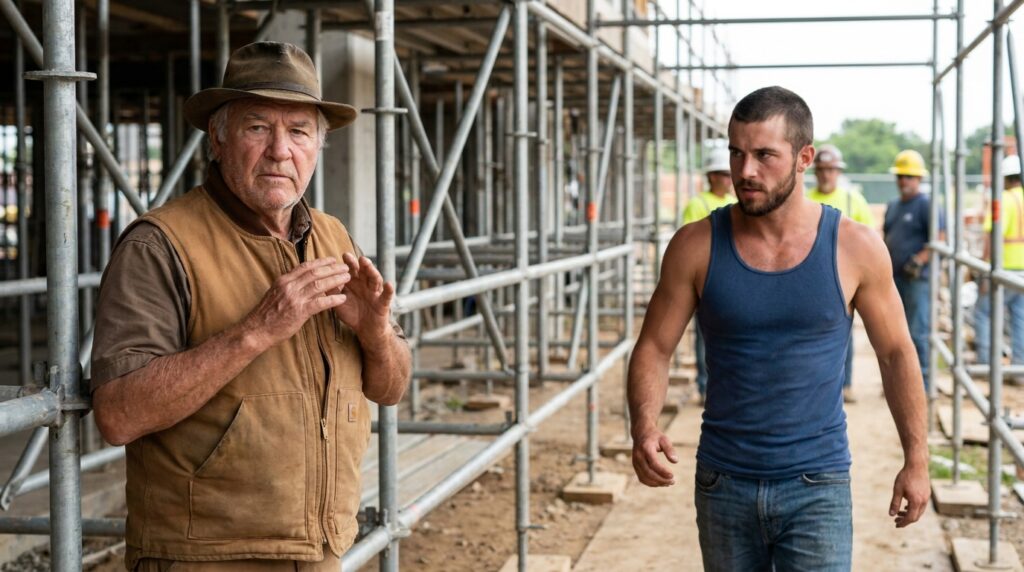
Garrity’s voice came from the concrete lip above. The kid was twenty-six, with the thick neck of an unworked steer and a blue tank top that showed off the tribal ink crawling up his shoulder. He wasn’t carrying a tool belt. In his right hand, he swung a five-pound drilling hammer by the very end of its fiberglass handle—loose, sloppy, dangerous. Behind him, the bearded one, Vance, was leaning against a stack of unbanded rebar, picking his teeth with a dry splinter.

Miller didn’t drop the level. He kept his thumb pressed against the brass casing, feeling the slight vibration of the diesel generator running two hundred feet away. “The column is out, Garrity. Tell your uncle’s crew to back the nuts off the foundation anchors and jack the base straight before the inspectors arrive tomorrow morning.”

“The inspector doesn’t check the plumb on the utility wings,” Garrity said, descending the raw wooden stairs with a heavy, deliberate stomp that shook the temporary risers. “He checks the signature on the green sheet. Your signature.” He stopped three feet away, his chest puffed out, the hammer swinging in a small, tight arc that brushed against his canvas work pants. “My uncle says we’re three days behind on the concrete pour. We pour the slab over these footings at 0600. Sign the log, Miller.”

Miller turned his head slowly. His gray eyes, narrowed under the brim of a faded brown hat, took in the geometry of the space. Vance had moved. The lean, bearded man was now shifting toward the left side of the pallet pile, his hands tucked into the pockets of his dark utility jacket, his posture blocking the path back to the foreman’s trailer. A classic two-prong containment. Sloppy execution—Vance was heavy on his heels, and Garrity was leaning too far forward on his toes, trusting his reach instead of his balance.

“You didn’t torque these bolts to specification either,” Miller said, his voice dropping into a dry, gravelly register that seemed to come from the gravel beneath his boots. He reached down, his stiff canvas vest creaking, and touched a single nut at the base of the column.

“We torquet them enough,” Garrity sneered, stepping directly into the neutral zone, his shadow blotting out the last sliver of the dusk light cutting through the scaffolding. “Nobody’s looking under the mud, old man. Now open the binder.”

Miller stood up. He didn’t lift his hands in a fist. He simply raised them to chest height, thumbs out, palms open, as if explaining a blueprint to a difficult client. His boots remained wide, anchored into the packed dirt.

“You boys really think age makes me an easy target?” Miller asked.

Garrity laughed, a short, sharp bark that died instantly as his right hand shot out to grab the collar of Miller’s vest. He committed his whole weight to the lunge, confident that seventy years of gravity would crumble under the impact.

He was wrong. Miller didn’t back down. As Garrity’s fingers brushed the canvas, Miller’s left hand snapped inward, his thumb trapping Garrity’s wrist while his right forearm rose like a hydraulic ram, striking the inside of Garrity’s elbow. The young man’s momentum became his executioner. With a swift, unhurried turn of his hips, Miller pivoted, clearing the line of force and driving his weight down through Garrity’s trapped arm.

The sound of Garrity hitting the dirt was dense, the breath exploding from his lungs in a wet gasp as his shoulder drove into the gravel. Before Vance could pull his hands from his pockets, Miller had already stepped over the fallen man, his boot locking Garrity’s wrist against the earth, his eyes already fixed on the second silhouette in the gray dark.

In the sudden, absolute silence of the empty site, the drilling hammer rolled away, its fiberglass handle clicking softly against a rusted iron scaffolding coupler.


CHAPTER 2: THE FRICTION OF SILENCE

“You’re going to want to breathe through your nose, Garrity. Deep and slow. The dirt in your lungs is the least of your problems right now.”

Miller’s voice was as steady as the foundation bolts he’d been inspecting. He didn’t look down at the man pinned beneath his boot. Instead, his gaze remained locked on Vance, who had frozen ten feet away. The bearded laborer’s hands were half-out of his pockets, caught in the paralyzed indecision of a man who had just seen a mountain move. The air between them tasted of iron and the dry, alkaline sting of kicked-up concrete dust.

“Let him up,” Vance rasped. His voice lacked the venom it had carried ten minutes ago. Now, it just sounded thin, like wire being stretched to the breaking point.

“In a moment,” Miller said. He shifted his weight slightly. The heavy leather of his work boot creaked against the grit on Garrity’s wrist. Below him, the younger man made a sound—a low, rhythmic wheeze that spoke of shattered pride and bruised ribs. Miller didn’t enjoy the weight, but he respected the necessity of it. In the high-iron trade, like in the service, once the chain of command is snapped, you don’t mend it with a handshake. You weld it back together with gravity.

Miller reached into his canvas vest and pulled out a ring of heavy brass keys. They weren’t his. He’d lifted them from Garrity’s belt during the pivot, a sleight of hand so practiced it felt like a ghost limb moving. He tossed them toward Vance. The keys arched through the twilight, a flash of dull gold before Vance caught them with a clumsy slap of his palms.

“The supply trailer,” Miller commanded. “The one with the yellow rigging. Open it.”

“That’s my uncle’s private stock,” Vance stammered, looking from the keys to the fallen Garrity. “He said nobody goes in there. Especially not an overseer.”

“Your uncle isn’t standing in the dirt right now. You are.” Miller increased the pressure on Garrity’s wrist, just enough to elicit a sharp hiss. “Move. Or I start wondering what else is out of plumb on this site.”

Vance hesitated, then turned and scrambled toward the darkness where the industrial trailers sat like rusted monoliths against the skeleton of the building. Miller watched him go, then finally stepped back, releasing Garrity. The younger man rolled away instantly, clutching his arm and coughing, his blue tank top now a mottled gray from the construction silt. He didn’t try to get up. He just sat there, staring at Miller with the wide-eyed, frantic look of a prey animal that had survived the first bite.

Miller ignored the stare. He walked toward the trailer, his gait heavy and methodical. The physical exertion hadn’t touched his heart rate. Decades of ruck-marches and cold-starts had turned his body into a machine that processed adrenaline as nothing more than fuel for focus. He reached the trailer just as Vance pulled the heavy iron handle. The door groaned on dry hinges, a sound like a metal-on-metal scream that echoed through the unfinished floors above them.

Vance stepped back as Miller approached the threshold. The interior of the trailer smelled of packing oil and something sharper—a chemical scent Miller recognized from a dozen motor pools across three continents. Cold, cheap preservative.

He didn’t need a flashlight. Even in the gloom, the wooden crates stacked to the ceiling told the story. These weren’t the standard shipping containers from the Midwest foundry they were supposed to be using. These were unbranded plywood boxes, held together by staples instead of screws. Miller pulled a small pry bar from his vest pocket—the tool he used to check for gaps in the masonry—and jammed it under the lid of the nearest crate.

The wood splintered with a dry, hollow snap. Inside, nestled in grease-stained brown paper, were rows of structural bolts. Miller picked one up. It had the heft of steel, and the head was stamped with the marks of a Grade-8 fastener—the three radial lines that signified high-tensile strength. But when Miller ran his thumb over the threads, he didn’t feel the bite of precision-machined iron. He felt a smoothness, a slight graininess that suggested cast metal rather than forged.

He took his brass level from his hip and tapped the bolt. The sound wasn’t the high-pitched ping of tempered steel. It was a dull, leaden thud.

“Rusted truth,” Miller whispered to the empty air.

“What is it?” Vance asked from the door, his voice trembling. He was watching Garrity, who was now standing shakily by the pallets, wiping blood from a scraped chin.

“It’s a funeral,” Miller said, dropping the bolt back into the crate. He turned to look at the two of them. In the fading light, his face looked like it had been carved from the very limestone they were building upon—ancient, immovable, and entirely devoid of mercy.

“You boys were worried about me signing the safety log,” Miller continued, stepping out of the trailer. He loomed over them, the rusted surfaces of the job site framing him like a king in a wasteland. “You should have been worried about why your uncle wanted me to sign it so badly. You aren’t just cutting corners. You’re building a cage.”

Garrity finally found his voice, though it was cracked. “We just do what we’re told, Miller. We get paid to move the iron, not question where it comes from.”

“Then you’re overpaid,” Miller snapped. He pointed toward the exit gate, where the suburban streetlights were beginning to flicker on. “Walk away. Both of you. If I see you on my site before the sun comes up, I won’t be using a defensive guard. I’ll be using the tools.”

Vance didn’t wait for a second invitation. He grabbed Garrity by the shoulder, hauling him toward the gravel drive. They moved with a frantic, stumbling speed, leaving behind the silence of a site that was suddenly much more dangerous than a simple construction project.

Miller didn’t watch them leave. He turned back to the rising skeleton of the building. He looked at the I-beams, the joints, and the thousands of hidden bolts already buried under the initial pours. He reached out and touched the cold, rough iron of the nearest vertical support. He could feel the friction of the settling weight, a microscopic grinding that told him the three-degree variance wasn’t a mistake. It was a planned failure.

He was the Sovereign Protector of this ground, and for the first time in forty years, he realized he wasn’t defending a build. He was standing in the middle of a crime scene.

CHAPTER 3: THE PARADOX OF PRESSURE

The unbranded bolt sat heavy in Miller’s palm, its leaden thud still echoing in his ears. Outside the open doors of the supply trailer, the night had fully descended, thick and gray, smelling of ozone and the damp silt from the nearby riverbanks. The suburban streetlights on the horizon cast long, skeletal shadows across the raw concrete slab of the unfinished ground floor.

Miller did not drop the counterfeit fastener. He moved deeper into the trailer, his dirt-caked leather work boots grinding the loose grit on the floor. His hands, thickened by decades of handling heavy metal and military equipment, traced the rough edge of a laminated safety clipboard hanging from a rusted iron nail near the back wall. This was the inspector’s secondary verification station—the quiet corner where paperwork came to die.

He flipped the plastic sheet up. Underneath lay the master ledger, its pages yellowed by the humidity of the trailer. The signature column was already filled out for the three weeks ahead, signed in a loose, looping hand that didn’t belong to any inspector Miller had ever met. It belonged to Henderson, the subcontractor who had brought Garrity and Vance onto the job site. Next to each pre-signed entry, the torque requirements for the structural connections were marked as verified at nine hundred foot-pounds.

Miller took a single, deep breath through his nose. His knuckles went white against the clipboard. A Grade-8 structural bolt tightened to nine hundred foot-pounds would hold a suspension bridge in a gale. But a cast-iron imitation, subjected to that kind of tension, wouldn’t just fail. It would warp, micro-fracturing along the threads until the metal reached its yield point. The structural three-degree variance he had measured earlier wasn’t a matter of lazy craftsmanship or poor alignment. The building was already under pre-stressed duress, the columns held together by metal that was slowly turning to glass.

He heard the gravel crunch outside before his ears registered the sound of an engine.

It was a low, industrial idle—the heavy, rhythmic thrum of an eight-cylinder diesel truck pulling up to the perimeter fencing. Headlights swept through the open double doors of the trailer, cutting across the unbranded plywood crates, painting the rusted iron interiors in a harsh, blinding white. Miller didn’t run. He pocketed the counterfeit bolt, dropped the laminated safety log back against the wall, and stepped into the shadow of the doorframe, his stocky frame blending with the vertical silhouette of the trailer’s iron rim.

The truck door slammed shut with a sharp, metallic ring that carried across the empty job site.

“Garrity?” The voice was thick, seasoned by cheap tobacco and decades of yelling over air compressors. Henderson. The subcontractor walked with a heavy, uneven stride, his boots slapping the wet earth as he approached the stack of wood pallets where the physical confrontation had occurred twenty minutes earlier. “Vance? Where the hell are you boys?”

Miller stepped out of the trailer’s shadow, his open hands hanging casual at his thighs, his posture anchored deep into the dirt. “They’re gone, Henderson.”

The subcontractor froze. He was a broad man, his canvas coat stained with grease and hydraulic fluid, his face mostly hidden beneath a greasy baseball cap. He looked at the empty spaces between the pallets, then down at the dirt where the drilling hammer still lay where it had fallen. His hand dropped instinctively to the heavy leather pouch on his hip, where a structural spud wrench hung from an iron loop.

“Miller,” Henderson said, his voice dropping an octave, the tone transactional and sharp. “What are you doing in my trailer?”

“Checking the plumb,” Miller said, his voice a flat, gravelly rasp that didn’t rise or fall. “And checking your inventory. The foundry manifest says we received two hundred crates of certified A325 structural steel from the Illinois plant last Tuesday. The crates in that trailer are unbranded pine. The bolts inside are pot metal with stamped heads.”

Henderson took two slow steps forward, his boots crushing a piece of discarded drywall with a dry, hollow crunch. The headlights from his truck caught the side of his face, highlighting the hard line of his jaw. “You’re an overseer, old man. Your job is to make sure the guys wear their hardhats and the timecards match the union clock. The steel isn’t your department.”

“When the iron leans three degrees before the floor joists are even set, it’s my department,” Miller said. He stepped forward, entering the light, his brown utility vest catching the glare. “You’re over-torquing them to hide the shearing. You’re trying to get the concrete poured over the footings before the county inspector looks at the stamps. Why?”

Henderson didn’t monologue. He didn’t bluster or threaten like his nephew had. He simply looked at Miller with a cold, calculating evaluation, checking the older man’s stance, measuring the distance between them. He was a professional, and he recognized the structural efficiency of the way Miller stood—how his weight was distributed, how his hands never crossed his center line.

“The build is bonded, Miller,” Henderson said softly. “The money is already in the escrow account. If we miss the concrete window tomorrow morning, the contract defaults back to the parent firm, and the local chapter loses the allocation for the entire winter cycle. My boys don’t eat if that concrete doesn’t pour.”

“Your boys are going to bury people under five hundred tons of structural failure if that concrete does pour,” Miller countered.

“Nobody’s burying anybody,” Henderson said. He reached down and unhooked the heavy iron wrench from his hip, the tool swinging with a dull, heavy momentum in his gloved fingers. “We’re going to sign that log, Miller. You and me. Right now. Because if we don’t, the company declares insolvency by midnight, and your retirement fund—the one you spent forty years building with the master trades—disappears into the bankruptcy court to pay off the liquidators.”

Miller stayed perfectly still. The information hit him not as a shock, but as a sudden, brutal alignment of pieces. The decoy was the cheap steel—the easy assumption that a corrupt subcontractor was pocketing the difference on materials. But Henderson’s mention of the bankruptcy court, of the timing of the default, pointed to a much larger machine.

“You think you’re saving the local allocation,” Miller said, his voice low, his gray eyes narrowing as he watched Henderson’s hand tighten on the iron wrench. “But you’re just the guy cleaning up the grease before the fire starts.”

“I’m the guy getting paid,” Henderson said. He raised the wrench, his shoulder dipping as he prepared to close the distance.

Miller’s internal calculation completed itself in a fraction of a second. He was sixty percent through the remaining structural lifetime of this project, and the path back to a clean build was completely blocked. Every win from this point forward would carry a cost that couldn’t be paid in sweat alone.

CHAPTER 4: THE INERTIA OF COLLAPSE

The heavy iron wrench swung with a low, flat whistle. It didn’t have the clean speed of a blade, but it carried the killing weight of solid forge-work. Miller didn’t try to catch it. He didn’t drop into a stance that suggested he had something to prove. He simply let the friction of his heavy leather soles do the work, pivoting back by two inches—just enough for the rusted tip of the tool to graze the stiff canvas of his utility vest.

The momentum pulled Henderson forward, his balance tilting into the empty air between them. Miller’s counter was instantaneous, driven by decades of muscle memory that bypassed his active mind entirely. He stepped inside the circle of the swing, using his stocky forearm to jam Henderson’s wrist before the subcontractor could recover his center. The impact was dull, a heavy collision of flesh and bone wrapped in work clothes.

“You’re rushing the work, Henderson,” Miller said, his gravelly voice dropping right into the space next to Henderson’s ear.

With a smooth, economical wrench of his upper body, Miller didn’t throw a punch; he simply driving the heel of his open palm into the crook of Henderson’s elbow while pulling down on the trapped wrist. The joint locked. The heavy tool slipped from Henderson’s leather glove, dropping into the dry earth with a heavy, dead thud. Miller followed through, utilizing the subcontractor’s own bulk to turn him, shoving him hard against the rusted side panel of the diesel truck.

The vehicle rocked slightly on its suspension, a low squeak from the undercarriage breaking the heavy silence of the job site. Henderson stayed against the metal, his breathing ragged, his hand clutching his elbow where the nerves were screaming. He didn’t try to swing again. He looked at Miller over his shoulder, his eyes wide with the sudden, cold realization that his physical leverage was non-existent.

“The log stays clean,” Miller said, his boots planted wide on the gravel, his hands returning to chest height in that same unhurried, professional guard. “And the pour doesn’t happen at 0600.”

“It’s already out of our hands, old man,” Henderson spat, wiping a smear of grease from his cheek with his sleeve. He pointed a trembling finger toward the truck’s open cabin. “Look at the routing manifest on the dash. Look at who signed the release order for the sub-grade. It isn’t my company. It’s the parent group’s logistics desk out of Chicago. They didn’t hire me to build this wing. They hired me to fail it.”

Miller kept his eyes locked on Henderson, but his mind reached into the cabin of the idling truck. The headlights were still cutting through the dark, reflecting off the raw plywood framing behind them, but the dashboard light illuminated a single sheet of blue carbon paper trapped under a plastic clip on the console.

He didn’t break focus. “You knew the steel was pot metal before you brought it on site.”

“I knew the price was thirty percent under market, and I knew the corporate office told me to use the supplier they specified or the contract would go to a non-union crew from the next county,” Henderson said, his voice rising in an aggressive, desperate whine. “They’re holding the pension guarantee over the local chapter’s head, Miller. If we don’t finish Layer 1 by the inspection date, they invoke the performance default. The whole fund goes to the insurance bondsmen to cover the delay penalties. It’s a closed loop.”

Miller felt the weight of the structure settle into his spine, not like a physical burden, but like a tactical trap that had been laid months before he ever walked onto the gravel. The discovery of the counterfeit bolts in the trailer was a decoy victory—a distraction that gave him the illusion of control. He had broken Henderson’s balance, neutralized his crew, and locked down the material logs, but the actual machinery of the collapse was entirely out of reach, buried deep within corporate ledgers three hundred miles away.

He stepped back from the truck, his boots crunching softly on the loose gravel. He reached into the open window of the vehicle and pulled the keys from the ignition barrel, cutting the low, rhythmic thrum of the engine. The sudden silence that dropped over the construction site was absolute, broken only by the distant, ironic whistle of the evening wind through the upper rows of unfinished scaffolding.

On the key ring, hanging next to the truck’s ignition fob, was a heavy brass master key stamped with the logo of the regional union administration office—the one that controlled the locking mechanisms for the main equipment vaults and the central records trailer down the road. It shouldn’t have been in Henderson’s possession.

“Where did you get this key, Henderson?” Miller asked, holding the brass implement up into the failing light.

Henderson didn’t answer. He just looked down at the dirt, his jaw clamped shut in the calculated silence of a man who knew he had already given away too much of the foundation.

“Get out of the truck,” Miller commanded softly. “We’re going to the office.”

Before Henderson could move, a sharp, deafening sound shattered the quiet from the eastern corner of the site. It wasn’t the sound of an engine or a voice. It was the dry, terrifying pop of high-tensile steel giving way under pre-stressed pressure—the initial shear of a foundational connection failure deep within the utility wing’s utility column. The structure was shifting early, the weight of the upper floor joists already winning the fight against the counterfeit metal.

The ground beneath their boots didn’t shake, but the silence that followed the snap was different now. It was the heavy, breathless suspension of a trap that had just begun to spring.

CHAPTER 5: THE YIELD POINT

“Get in the truck, Henderson. Now.”

Miller didn’t raise his voice, but the sound of it cut through the groaning of the shifting iron like a chisel through soft pine. The secondary pop—sharper this time, like a gunshot in a canyon—echoed from the darkness of the utility wing. Above them, a yellow hazard ribbon snapped, dancing frantically in the rising wind. The three-degree variance was no longer a static measurement; it was a living, breathing countdown.

Henderson didn’t argue. The sheer physical authority Miller had projected throughout the night had finally fused with the terrifying reality of the structural shear. He scrambled into the passenger seat, his boots slipping on the metal running board. Miller climbed into the driver’s side, jamming the heavy brass master key into the ignition. The engine roared to life, a guttural, vibrating beast that shook the cabin.

“The records trailer is two miles south,” Henderson shouted over the rattling dashboard. “But Miller, if you use that key, you’re breaking into a federal job site office. There’s no coming back from that. Not for your pension, not for your license.”

“The license is just paper, Henderson. The building is iron.” Miller slammed the truck into gear, the tires spitting gravel as he spun the vehicle away from the leaning scaffold.

In the rearview mirror, Miller watched the unfinished skeleton of the wing. In the strobe-like flickers of the site’s perimeter lights, he saw it: a slow, sickening tilt. The counterfeit bolts weren’t just breaking; they were exploding under the tension Henderson had forced into them. The decoy was failing, but as Miller pushed the truck onto the dark county road, the deeper, colder reality began to settle. Henderson had been a pawn, thinking he was saving a local chapter. But the master key in Miller’s hand—stamped with the union’s regional seal—proved the rot went to the very top. The insurance payout wasn’t just for a collapsed building; it was a liquidation event designed to erase the very fund Miller had spent forty years defending.

They reached the records trailer in under three minutes. It sat isolated in a fenced-off dirt lot, a silver box under a single buzzing halogen light. Miller didn’t wait for Henderson. He jumped out, the master key already gripped between his thumb and forefinger. He felt the grit of the lock as he shoved the brass home. It turned with a heavy, satisfying clunk.

Inside, the air was stale, smelling of old coffee and ozone from a humming server rack. Miller ignored the digital terminals. He went straight for the steel fire-cabinet in the corner. He used the spud wrench he’d reclaimed from the dirt to prize the drawer open, the screech of metal on metal a jagged cry in the small space.

He found the file: Project Phoenix – Liability Allocations.

Miller flipped through the pages, his eyes scanning the technical jargon and the financial spreadsheets. There it was. The “Yield Point” wasn’t a physical limit here; it was a fiscal one. The parent corporation had over-leveraged the pension fund to back the construction bonds. If the building stood, the interest ate the fund. If the building fell—specifically due to “unforeseen material defects” from an independent subcontractor—the insurance bridge triggered, the bond was satisfied, and the pension fund was legally “absorbed” into the bankruptcy settlement.

“They aren’t just letting it fall,” Miller whispered, the paper crinkling in his gloved hand. “They’re using my own life’s work to pay for the wrecking ball.”

“Miller, we have to go,” Henderson urged from the doorway, his eyes darting to the road. “The site sirens just started. The sensors in the foundation triggered the emergency broadcast. The cops and the corporate suits will be here in ten minutes.”

Miller didn’t move. He looked at the last page—a signature line for the final structural sign-off. It was blank. The one thing they needed to finalize the fraud was his name on that log. Without it, the “unforeseen material defect” became “criminal negligence” on the part of the corporation for ignoring an overseer’s warning.

He grabbed a heavy black marker from the desk. He didn’t sign his name. Instead, across the entire ledger, he wrote three words in massive, block letters: NOT TRUE PLUMB.

He shoved the file into the front of his canvas vest, feeling the weight of it against his ribs like a shield. He turned to Henderson, his gray eyes cold and fixed. “I’m not signing your lie, Henderson. And I’m not letting them have the fund. I’ve spent my life making sure things are aligned. Tonight, we’re going to make sure the truth is finally level.”

As they stepped out of the trailer, the first red and blue lights appeared on the horizon, reflecting off the rusted surfaces of the industrial yard. The friction of the night was coming to a head, the weight of decades of labor clashing against a single hour of rusted truth. Miller stood his ground, the master key still gripped in his hand, a Sovereign Protector who had finally found the one thing worth defending more than a building: the integrity of the men who built it.

CHAPTER 6: THE BLOCKADE

The first raindrop hit the hood of Henderson’s truck with the sound of a spent casing hitting concrete. Within seconds, the gray heartland sky opened up, turning the dry dust of the industrial lot into a slick, treacherous slurry. Miller didn’t hesitate. He slammed the truck into reverse, the transmission screaming in protest as he swung the heavy steel bumper across the only entrance to the records lot.

The tires churned into the mud, biting deep until the truck sat at a forty-five-degree angle, a three-ton barricade of rusted American iron.

“What are you doing?” Henderson yelled, his voice cracking as the first flash of a strobe light cut through the downpour. “That’s a private security detail, Miller. They’ll have local jurisdiction authority. You can’t just block the road!”

“I’m not blocking a road,” Miller said, his hands moving with surgical economy as he cut the lights but left the engine thrumming. “I’m securing a perimeter.”

He reached into the footwell and grabbed the heavy iron spud wrench he’d used to pry the cabinets. He didn’t tuck it away; he held it across his lap, the cold metal a familiar weight. Through the windshield, blurred by the frantic rhythm of the wipers, three black SUVs crested the rise of the access road. They didn’t have the markings of the county sheriff. There were no light bars on the roofs—only high-intensity LEDs mounted behind the grilles, pulsing in a rhythmic, predatory white.

The lead vehicle skidded to a halt inches from the driver’s side door of Miller’s truck. The headlights were blinding, turning the interior of the cabin into a cage of harsh white light and deep, jagged shadows. Miller squinted, his weathered face set in a mask of indifferent granite.

A man stepped out of the lead SUV. He wasn’t wearing a uniform. He wore a high-end technical jacket, dark and water-resistant, and held a tablet shielded by a plastic sleeve. He didn’t look like a guard; he looked like an auditor with an enforcement budget.

“Mr. Miller!” the man shouted over the roar of the rain and the diesel idle. “You are in possession of proprietary corporate data. That trailer is under a legal hold. Step out of the vehicle and hand over the Phoenix folder.”

Miller rolled the window down exactly two inches. The scent of wet asphalt and hot engine oil flooded the cab. “The folder stays with the overseer. This site is under a structural emergency. Until a federal inspector arrives to verify the shear-points on the utility wing, no property leaves this lot. Especially not the evidence.”

“You don’t have the authority to declare an emergency, Miller,” the man said, taking a step closer. Behind him, two more men stepped out of the secondary vehicles. They didn’t draw weapons, but their posture was a “Calculated Silence”—hands hovering near their belts, eyes scanning the truck’s glass for points of entry. “Your contract was terminated sixty seconds ago for gross insubordination and site sabotage. You’re a civilian on a restricted lot. Last warning.”

Miller looked at the man, then at the two figures flanking him. He noticed the way the lead auditor kept glancing at the regional union master key still hanging from the truck’s ignition. It wasn’t the files they were most afraid of—it was the fact that Miller had the key that unlocked the rest of the institutional rot.

“I’ve spent forty years listening to men tell me about authority,” Miller said, his gravelly voice vibrating against the glass. “Usually, they’re the ones who don’t know how to hold a level. If you want this folder, you’re going to have to find a way to move three tons of truck with those tech-jackets. Because I’m not moving, and the truth isn’t for sale.”

He rolled the window up.

“Miller, they’re going to break the glass,” Henderson whispered, shrinking into the passenger seat.

“Let them,” Miller replied, his eyes fixed on the lead SUV. “They’re calculating the liability of an assault. As long as I’m in this truck, I’m a structural obstacle. They hate obstacles they can’t fix with a spreadsheet.”

But then, the lead auditor’s tablet chimed. He looked down, his face paling under the strobe lights. He looked back at Miller, but this time there was no professional coldness. There was a flicker of genuine, predatory malice. He leaned toward the window, speaking loud enough for the glass to vibrate.

“Change of plans, Miller. We don’t need the folder. The Regional Office just authorized a ‘Controlled Demolition’ of the utility wing due to the ‘imminent public danger’ of your sabotage. The concrete trucks are being diverted to fill the records basement. By dawn, your evidence—and your reputation—will be under six feet of slurry.”

Miller’s grip tightened on the iron wrench. The friction of the night had just shifted from a defensive hold to a full-scale war of erasure. They weren’t going to fight him for the truth; they were going to bury it.

Similar Posts

Leave a Reply

Your email address will not be published. Required fields are marked *






