
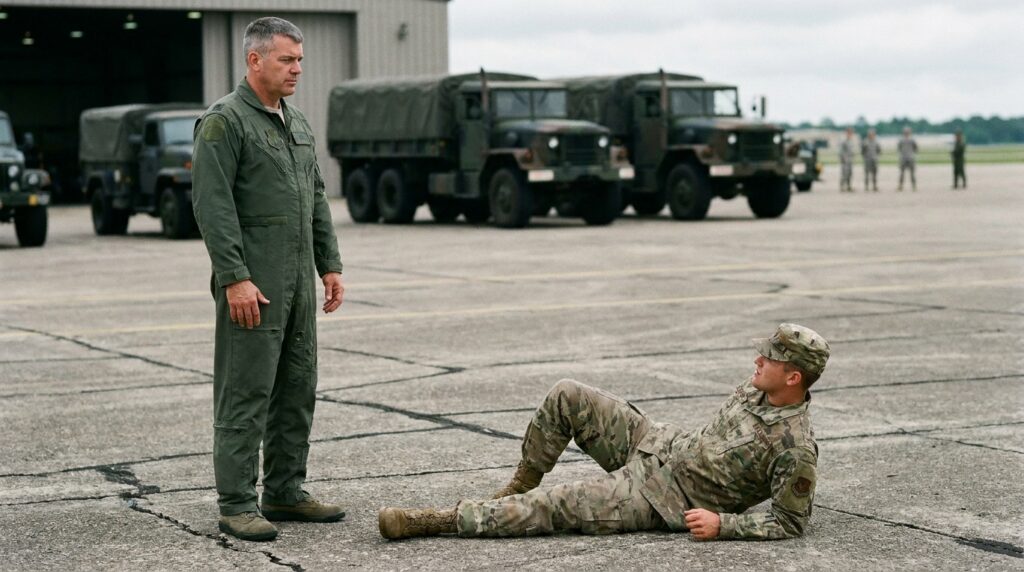
The Weight of Salt and Iron on the Gray Flight Line

CHAPTER 1: THE FRICTION OF EXHAUST

“You’re in my lane, old man. Your time was up a decade ago.”

The words didn’t carry the heat of real anger; they had the cold, flat edge of a calculation. The younger trainee stood less than three feet away, his chest expanded slightly beneath his stiff, unwashed camouflage uniform. His low-slung cap cast a sharp shadow across his nose, obscuring everything but a pair of unblinking eyes and a jawline tight with youth. Around them, the sun beat against the concrete training lane of the airfield, turning the air into a shimmering haze that smelled heavily of burnt kerosene and rusted steel.

The Senior Serviceman didn’t shift his boots. His hands remained loose, fingers lightly grazing the coarse green fabric of his flight suit. Beneath the material, his shoulders carried the steady, heavy pull of twenty-five years of service—a physical toll measured in compressed vertebrae and the faint, recurring itch of a legacy scar along his collarbone. He looked at the young man, his stern face showing nothing but the deep, dry lines carved by decades of high-altitude wind.

Behind the trainee, a row of three-ton military trucks sat idling in the midground, their diesel engines vibrating through the soles of everyone on the flight line. A handful of mechanics had stopped their wrenches. They didn’t move toward the confrontation; they simply leaned against the olive-drab tires, their faces pale under the harsh noon sun, watching the old man to see if his knees would give.

“The manifest says forty-two cases of logistics components,” the veteran said. His voice was a low, gravelly rasp, shaped by years of shouting over twin-turbine engines. He held a weathered aluminum clipboard in his left hand, the metal scratched down to the dull gray primer. “You’ve only cleared thirty-eight. Move the remaining four, or the flight doesn’t get logged.”

The trainee let out a short, dry breath through his nose—a sound that was half-laugh, half-dare. He didn’t look at the clipboard. Instead, his shoulder twitched forward, narrowing the distance between them until his breath fouled the air between their faces. “I don’t report to a ghost in a blank suit. The cargo is done. Move your feet.”

The Senior Serviceman felt the familiar, rhythmic click of the silver stopwatch inside his chest pocket against his ribs. Every gear on this airfield was grinding against old sand. He didn’t look at the mechanics watching from the trucks, nor did he look at the empty sky above the runway. He simply noted the tiny, impatient tremor in the trainee’s right forearm—the clear signal of a man about to make a physical mistake.

In his pocket, his finger touched a small, irregular scrap of metal—a sheared rivet from an old airframe he’d pulled out of his hull over a desert a lifetime ago. It was a cold reminder of what happens when a system loses its discipline. The young man’s fingers were closing into a hard fist, the knuckles turning white against the desaturated camouflage pattern of his trousers. The space between them was gone.


CHAPTER 2: THE CORROSION OF ALIGNMENT

“A six-degree drift isn’t an option on a low-observable approach, Trainee Miller. It’s a localized suicide vector.”

The air inside the simulation bay was thick with the scent of ozone and the stale, chemical humidity of hard-running cooling fans. Unlike the blinding glare of the flight line outside, the bay was a cavern of desaturated shadows, lit only by the sickly green phosphor glow of the tactical display grids. The Senior Serviceman did not lower the clipboard. His eyes, narrowed and flat as chipped flint, tracked the lime-green vectors cutting across the glass terminal screen.

Trainee Miller didn’t step back from the console. His fingers, stained with dry hydraulic fluid that had dried into the creases of his knuckles like rust, remained planted on the edge of the input deck. The metallic casing of the simulator was cold, its paint flaking off in tiny, gray scales wherever boots had kicked the base frame over the years. Miller leaned his weight forward, his shoulder joint locking with a stiff, defiant click.

“The new atmospheric data from the ridge line accounts for the drift, advisor,” Miller said, spitting the title out like a bit of loose tobacco. He pointed a grease-blackened finger at the flight path modification he’d scribbled directly onto the simulator’s plexiglass overlay. “We aren’t flying the old iron anymore. The airframes we’re running can pull through the sheer before the guidance computer even registers the drop. Your manual is out of spec by twelve thousand hours.”

The veteran didn’t answer immediately. He let the silence settle, a heavy, dead weight that filled the small space between them until the hum of the transformer sub-station beneath the floorboards seemed to vibrate in their teeth. From the perimeter of the dark bay, near the racks of decaying flight gear and salt-crusted oxygen masks, two base mechanics stopped sorting their copper washers. The light scratching of brass brushes against steel pins ceased entirely. The witness layer was thickening again, their eyes reflecting the pale green phosphor.

The Senior Serviceman reached out, his thick thumb tracing the edge of the plexiglass overlay. He felt the rough, jagged scoring where Miller’s stylus had gouged the plastic. It wasn’t just a modification; it was an erasure of standard safety margins. He pulled his silver mechanical stopwatch from his chest pocket, the turn-screw rough against his palm, its internal spring ticking with the dry, metronomic heartbeat of an era Miller considered dead.

“The guidance computer relies on the static ports along the belly,” the veteran said, his gravelly tone cutting through the cooling fans’ drone. “At four hundred knots in a thermal inversion over the valley floor, those ports don’t see air. They see vacuum. Your airframe won’t pull through the sheer, Miller. It will pitch until the tail-planes shear off at the root. I wrote that manual because I buried three men who thought the computer was smarter than the mountain.”

“That was thirty years ago,” Miller shot back, his jaw tightening until the tendons in his throat stood out like taut cables against his stiff collar. He didn’t check his position; he doubled down, his hand sliding closer to the primary control yoke as if to claim ownership of the simulated sky. “The tech has caught up. We don’t need the old guard holding the brakes when the tactical pace has doubled. Some of us are trying to prep for a real fight, not a memorial service.”

The insult hung in the damp air, sharp and unwashed. The veteran’s face remained a mask of weathered stone, but his internal calculations shifted three gears. He wasn’t looking at Miller’s arrogant glare; he was looking at the precise layout of the modified flight path coordinates. There was something wrong with the numbers. They didn’t just bypass the ridge line—they aligned perfectly with an unmonitored commercial corridor three hundred miles to the west, a sector completely outside this unit’s training mandate.

He reached down, his fingers brushing past Miller’s hand with the slow, deliberate friction of a heavy piston moving in its sleeve. He tapped the specific coordinate marker for the simulation’s turning point—a remote, dry lake bed marked on the glass as Sector Seven.

“Who gave you this atmospheric update, Trainee?” the veteran asked, his voice dropping into a deeper, cooler register that made the mechanics by the tool racks shift their boots.

Miller’s eyes flickered, a micro-second of hesitation breaking the symmetry of his confidence. He pulled his hand back from the yoke, his palm scraping against the oxidized aluminum edge of the console with a dry hiss. “It came through the standard data drop. Morning shift logistics report.”

“The morning logistics report was restricted to maintenance turn-arounds today,” the Senior Serviceman countered flatly, his thumb pressing down on the plexiglass until the plastic flexed under his weight. “This file has a high-altitude routing signature. It didn’t come from the ground crew.”

He picked up the loose simulator logbook resting on the top deck. As his thumb flicked through the yellowed pages, his eyes caught a fresh, crisp entry at the very bottom of the ledger—a sequence of numbers written in a sharp, blue ink that hadn’t completely cured against the greasy paper. The handwriting didn’t belong to any instructor on this base. It was a precise, block-letter script, identical to the notation style used on the logistics manifests he’d been analyzing on the hot flight line an hour before.

A cold draft passed through the bay as the heavy steel fire door at the back of the hangar groaned open. A figure stood in the bright, blinding slit of daylight, their shadow stretching long and distorted across the concrete floor toward the simulation console. The veteran didn’t turn his head to look, but his fingers tightened on the edge of the clipboard until the aluminum groaned. He knew the silhouette without seeing the face. The game wasn’t just happening on the tarmac anymore; the sand was already inside the turbines.

CHAPTER 3: THE TRACKS OF UNCLEAN STEEL

The heavy fire door did not slam behind the silhouette; it settled into its iron frame with a long, rusting scrape that cut through the low hum of the simulation bay. The Senior Serviceman did not turn his head toward the invading daylight. He kept his weight resting evenly on the balls of his feet, his fingers maintaining a slight, measured pressure on the edge of the aluminum clipboard. He knew the gait of the base commander—the slight imbalance in the left heel, the stiff click of structural leather against the gritty concrete floor.

“You’re tracking shadows on a clean terminal, advisor,” Commander Vance said. His voice carried the dry, mechanical rasp of an administrative officer who hadn’t breathed turbine exhaust in ten years. He stepped into the green phosphor perimeter of the console, his starched uniform showing sharp, geometric creases that felt entirely artificial against the flaking gray paint of the simulator. He did not look at Trainee Miller; he looked down at the scratched ledger. “The logistics update came through my desk. If there’s an issue with the flight paths, it’s an issue of execution, not source data.”

The veteran closed the logbook, the grease-stained paper giving off a small puff of dry dust that caught the green light. He let his thumb rest over the fresh blue entries. The block lettering remained fixed beneath his skin—a signature of unauthorized precision.

“The execution is secondary when the coordinates are warped, Vance,” the veteran murmured. He slid the silver stopwatch back into his flight suit pocket, the internal mechanism ticking with a cold, relentless friction against his chest. “Miller didn’t pull these numbers from a logistics queue. He pulled them from a live high-altitude feed. The unit’s server shouldn’t even have the decryption keys for Sector Seven.”

Miller shifted his boots, his heels grinding a small deposit of dried mud into the floorboards. “I told you, sir,” the trainee said, his tone smoothing out into a practiced, institutional deference as he looked at the commander. “The routing parameters were inside the morning packet. If the advisor can’t read the modern digital signatures, that’s not a maintenance fault.”

Vance waved a hand, a short, dismissive gesture that cut through the damp ozone smell of the bay. “Go clear the remaining pallets on the line, Miller. The flight logged for fourteen hundred needs to have its manifests locked. The advisor and I have historical data to reconcile.”

The younger man didn’t hesitate. He snapped his head down in a tight, performative nod, his eyes lingering on the veteran for a fraction of a second—a cold, sharp challenge that remained unanswered. He turned on his heel, his heavy rubber soles leaving a dark, oily smear on the concrete as he walked toward the exit lane. The mechanics by the tool racks didn’t watch him leave; they kept their attention fixed on the veteran’s stone face, waiting for the structural collapse that usually followed a commander’s intervention.

The Senior Serviceman waited until the fire door groaned shut a second time, cutting off the distant, high-pitched whine of the runway turbines. The silence that returned was thick, weighted by the dust of twenty years of identical arguments. He turned his eyes down to the floor, tracking the oily residue left by Miller’s boots.

“He was in the main maintenance hangar last night after the final lockdown,” the veteran said flatly.

Vance frowned, his hand coming down onto the simulator’s cold aluminum cowl with a heavy, metallic thud. “Trainees are authorized to conduct midnight pre-checks on the simulators, counselor. You know the base regulations. Stop looking for an ambush under every canopy.”

“He wasn’t on the simulator,” the veteran countered, his voice dropping into that quiet, gravelly register that always forced people to lean in. He walked three steps toward the rear of the bay, where the concrete met the raw sheet-metal wall of the adjoining maintenance wing. He knelt down, the fabric of his green flight suit stretching tight across his broad shoulders. “Look at the track along the deck plate.”

Beneath the edge of the tool locker, where the iron had rusted into a deep, flaky orange, a series of dark, dense grease marks cut across the dust. They weren’t the standard smudges left by a mechanic’s work boots. The pattern was a specific, chevron-shaped tread—the exact modern tactical sole issued to the current trainee class, but with a unique, jagged chip missing from the outer edge of the right heel. The identical mark he had noticed on the flight line an hour before.

The grease itself wasn’t common hydraulic fluid. It had a dark, purplish tint under the low light, thick with tiny, microscopic glints of shaved copper.

“That’s high-pressure sealant from the high-altitude telemetry bay,” the veteran murmured, his thick fingers tracing the dark residue without touching it. He stood up slowly, his joints making a dry, cracking sound that matched the environment. “The telemetry bay is locked at twenty-two hundred every night by your authority, Vance. Miller’s key-card shouldn’t register on that lock. Yet his heels were deep in the scraper pan.”

Vance didn’t move. His shadow stayed locked against the green terminal screen, his face obscured by the angle of the console. For a long moment, the only sound was the rhythmic, metallic pulse of the transformer below the floor. When the commander spoke, his voice had lost its administrative smoothness, replaced by a cold, transactional weight that felt like an iron gate dropping into a slot.

“The trainee is performing exactly as he’s been ordered to perform,” Vance said quietly. He didn’t look at the grease marks. “The data he’s loading isn’t a mistake, and it isn’t an accident. I suggest you go back to the flight line, verify the pallets, and leave the routing logic to the people who still have to fly the missions.”

The veteran felt the silver stopwatch in his pocket click against his ribs. The decoy was already on the table—the commander was covering for the boy, framing the entire friction as an internal command directive, a managed stress test for an old instructor. It was a clean, logical lie. It explained the access, the confidence, and the modified flight paths. But it didn’t explain the copper shavings in the grease. High-altitude telemetry didn’t use copper seals unless the transmitter was being overdriven to reach a civilian receiver far beyond the state line.

“The flight line is hot,” the veteran said, his face returning to its unyielding, stone-carved baseline. He picked up his clipboard, his fingers locking onto the cold aluminum frame. “I’ll check the four remaining cases myself.”

He walked past the commander without waiting for an acknowledgment, his boots finding the exact edge of the grease track. He didn’t need to look back to know Vance was watching him. He could feel the weight of the man’s gaze like a rusted iron sight fixed on the center of his spine.

CHAPTER 4: THE GEOMETRY OF FALLING

The transition from the shadowed maintenance bay to the active flight line was like stepping into an open blast furnace. The noon sun hammered against the concrete, baking the oxidized iron of the hangars and turning the air into a wavering, toxic mirage of diesel exhaust and hot tar. The Senior Serviceman didn’t squint. He let his pupils contract naturally, his boots grinding against the loose grit of the tarmac as he walked the fifty yards to the staging lane.

The four remaining logistics cases sat stacked on a wooden pallet near the idling transport trucks. They were standard olive-drab composite crates, stenciled with faded yellow alphanumeric codes indicating routine hydraulic spares. But as the veteran closed the distance, the structural logic of the scene began to fray.

The trucks were still running, their heavy chassis vibrating, but the load-masters were nowhere near the tailgate. The mechanics who had been watching the earlier exchange had multiplied; a dozen ground crew personnel now stood near the perimeter fences, their wrenches and rags hanging limp in their hands. They were waiting for a performance.

The veteran reached the pallet. He ran a thumb over the locking latch of the top crate. It wasn’t a standard steel-pin hasp. It was a dense, rectangular block of matte-black tungsten—a biometric magnetic seal used exclusively for compartmentalized telemetry hardware. You didn’t put magnetic seals on hydraulic spares. You didn’t load them on a daylight training manifest.

The silver stopwatch ticked against his ribs. Vance’s test, he thought, the pieces locking into a grim, pragmatic framework. Vance ordered the boy to run these specific crates. Push the old man until he breaks protocol, disqualify his advisory status, and push the new training doctrine through without oversight. It was a dirty, administrative ambush, written in the language of logistics.

“I told you to clear the lane.”

The voice came from over his right shoulder. Trainee Miller stepped out from behind the heavy steel bumper of the transport truck, his camouflage uniform already stained with dark patches of sweat. He had walked fast to beat the veteran here. The younger man’s chest heaved slightly, the arrogance in his jaw now fueled by the adrenaline of Vance’s implicit backing. He believed he held all the cards. He believed the base commander had given him a hunting license.

“These four crates require a biometric clearance code to log, Miller,” the veteran said. He didn’t turn around. He kept his eyes on the matte-black lock, feeling the intense ambient heat radiating off the composite casing. “They contain restricted telemetry hardware. They don’t belong on this manifest.”

“They go on the truck,” Miller snapped, stepping closer. The gravel crunched under his chevron-tread boots. “The manifest is whatever I say it is. You’re an antique with a clipboard. You don’t have the clearance to authorize a fuel top-off, let alone challenge my cargo.”

The veteran finally turned. He rotated on the ball of his foot, a slow, deliberate movement that grounded his center of gravity perfectly over the hot asphalt. He let the clipboard drop to his side.

Miller stepped directly into his personal space, breaching the invisible boundary of physical safety. The younger man was three inches taller, his shoulders broad and corded with fresh muscle. He angled his chin down, trying to cast his shadow over the veteran’s face, exhaling a breath that smelled of stale coffee and copper. The air between them grew suffocatingly tight.

“Don’t mistake restraint for weakness,” the Senior Serviceman said. His voice was a low, gravelly vibration, completely devoid of anger. It was the tone of a mechanic warning a novice not to touch a live wire. “You’ve pushed this far enough.”

Miller’s lips curled into a sneer. The audience of mechanics was watching. Vance’s protection was absolute. He thought he saw hesitation in the older man’s stillness.

“Make me,” Miller whispered, and drove his right hand forward, hooking his thick fingers aggressively into the collar of the veteran’s green flight suit, aiming to physically shove the older man back against the pallet.

The veteran didn’t block the hand. He didn’t throw a punch. He relied on the brutal, unforgiving physics of momentum.

As Miller’s weight committed forward, the veteran executed a flawless, single defensive pivot. He dropped his center of gravity by two inches, his left hand snapping up to clamp over Miller’s wrist like a rusted iron vise, locking the joint. In the exact same fraction of a second, the veteran twisted his torso, guiding the young man’s aggressive, forward-driving energy past him. He swept his right forearm sharply across the back of Miller’s triceps, creating a devastating fulcrum.

Miller’s feet left the ground. The heavy, uncontrolled mass of the younger man rotated completely in the air, his own kinetic energy weaponized against him.

He hit the asphalt with a sickening, hollow crack.

The impact knocked the breath from Miller’s lungs in a violent rush. He bounced once, the rough concrete tearing the fabric of his shoulder and scraping a layer of skin from his cheekbone, before he settled into a stunned, paralyzed heap on the flight line.

Silence slammed down on the airfield. The only sound was the idle of the diesel engines and the ticking of the stopwatch in the veteran’s pocket.

The Senior Serviceman stood fully upright, unbothered, his breathing perfectly even. He hadn’t even taken a full step backward. He looked down at the younger man. Miller was gasping, his eyes wide and completely blown out with shock. The arrogance had evaporated in a microsecond, replaced by the terrifying realization of how easily he had been dismantled. The gap in their capability wasn’t a matter of age; it was a matter of lethal, ingrained discipline.

Around the trucks, the mechanics froze. No one reached for a radio. No one stepped forward. The absolute dominance of the single movement had rewritten the hierarchy of the entire tarmac.

The veteran looked down at the trainee, his face carved from stone. He didn’t offer a hand. He didn’t offer a lecture. But as he adjusted his stance, his boot brushed against the bottom crate on the pallet. The violent impact of Miller hitting the ground had shaken the stack, and the matte-black magnetic lock on the bottom case had fractured, the casing splitting open.

Through the crack in the composite shell, the veteran didn’t see telemetry hardware for a training run. He saw rows of densely packed, silver solid-state drives wired into a high-gain transmission relay—the kind used to broadcast encrypted base logistics to an off-site receiver.

The internal mechanism of the veteran’s logic seized. This wasn’t just a political stress test orchestrated by Vance to humiliate him. Vance was a bureaucrat; bureaucrats didn’t smuggle black-market transmitters on daylight manifests. Someone in this unit was actively bleeding the base dry, and the arrogant boy bleeding on the asphalt was either the courier, or the perfect, loud distraction.

CHAPTER 5: THE FRICTION OF DEPARTURE

The shattered fragments of the matte-black tungsten seal glinted in the dust next to Trainee Miller’s scraping knuckles. The younger man remained pinned against the coarse asphalt, his ribs hitching as his lungs scrambled to reclaim the air his own momentum had squeezed out of them. A thread of dark crimson leaked from his scraped cheekbone, turning black as it mixed with the dry grease residue on the flight line. He did not reach for his cap. He did not look back up at the veteran.

The Senior Serviceman adjusted his aluminum clipboard under his arm, his boots planted exactly where they had been before the pivot. His knuckles were unblemished, but the rough green cotton of his flight suit hummed against his chest from the vibration of the idling transport trucks. He looked past the fallen trainee, his flint-like eyes moving along the row of olive-drab bumpers.

The witness layer had locked completely. The distant mechanics who had been leaning on their wrenches had vanished into the shadow of the truck beds, their silence absolute, frozen by the clinical finality of the drop. They had expected an argument; they had received a demonstration.

“I understand, sir.”

The words were barely a murmur, pushed out through Miller’s dry, split lips as his head lifted slightly from the pavement. The arrogance had been scrubbed clean from his tone, replaced by the raw, flat weight of institutional submission. He did not attempt to stand. He stayed grounded in the debris, his fingers curling into the loose gravel of the training lane, his entire authority structure turned to salt within a single fraction of a second.

The veteran didn’t offer an answer. He turned his heel away from the fractured composite crate, his gaze lingering on the silver solid-state arrays visible through the broken housing. He knew what happened to inspectors who stared too long at things they weren’t cleared to see. If Vance was monitoring this tarmac via the security lenses, then every second the veteran spent looking at that exposed transmitter was an admission of discovery. He needed to move before the perimeter gate closed.

He began walking forward down the training lane, his stride even, measured by the dry, metronomic tick of the silver stopwatch in his pocket. The heat off the tarmac beat against his shins, thick with the chemical stench of unwashed machinery.

Behind him, the airfield didn’t resume its noise. The mechanics remained fixed like rusted iron stanchions as he passed their stations. As his boots cleared the shadow of the final three-ton truck, a young specialist sorting brass fasteners snapped his spine straight, his right arm locking into a rigid, unprompted salute. The gesture rippled down the line—not out of regulation, but out of fear. They knew the flight suit was blank, but they had just seen the rank written in the asphalt.

The veteran reached the administrative threshold at the end of the line—a small, sun-bleached shack where the flight manifests were filed. The door was a slab of warped sheet metal, its handle rough with orange oxidation that left a metallic stain on his palm as he twisted it. Inside, the air conditioning was a dying rattle, failing to conquer the ambient heat.

He laid the aluminum clipboard onto the counter. The metal surface was pitted and scarred from decades of identical clipboards, the paint worn down to the bright, raw zinc underneath. He picked up the heavy black logging pen, his fingers stiff from the lingering adrenaline of the tarmac.

The trap had changed shape. If he logged the flight with the forty-two cases, he was certifying a smuggling run. If he refused the log, Vance would have the legal lever to terminate his advisory contract for insubordination before the hour was out. The active driver of the narrative couldn’t hide behind a standard report anymore; he had to move into the blind spot of the system.

He didn’t sign his name. Instead, he drew a single, clean line through the serial number of the bottom pallet—the one containing the fractured lock. He reached into his flight suit pocket and pulled out the old sheared airframe rivet he’d carried for thirty years. He dropped the small piece of iron onto the center of the ledger. It hit the paper with a dull, heavy thud, pinning the page open.

The door behind him creaked, the rusty hinges crying out under the weight of the wind off the runway. The veteran didn’t turn around. He could hear the high-pitched whine of an auxiliary power unit spooling up on the far side of the hangar—the pre-flight sequence for the fourteen hundred transport had already been pushed forward. They weren’t waiting for his signature. They were moving the cargo regardless of the audit.

He stepped back out onto the concrete porch of the shack. The sun had shifted slightly, throwing long, jagged shadows across the maintenance lane. Down the line, Miller was finally on his feet, his shoulder hitched high as two other trainees supported his weight, moving him toward the medical bay. But Vance wasn’t on the tarmac. The commander’s office window remained dark, the thick glass reflecting nothing but the desaturated glare of the western sky.

The veteran felt the stopwatch click against his ribs. The decoy secret—the idea that this was a petty institutional mutiny to run his old methods off the base—had been thoroughly shattered by the silver arrays inside the crate. He had won the physical confrontation against the boy, but every step he took now was drawing him deeper into a larger, more calculated system of systemic theft. The unit wasn’t just obsolete; it was compromised from the command desk down to the grease pans.

He cleared the porch, his boots finding the dirt track that led toward the primary communications bunker behind the secondary runway. He had less than twenty minutes before the transport taxied into the active lane. His active agency required him to cut the power to the telemetry grid before that aircraft could broadcast its encrypted coordinates to the civilian corridor, but as he reached the perimeter chain-link fence, he noticed the heavy brass padlock on the bunker door had already been sheared off. The lock hung loose, its cut face bright and free of rust, dripping with fresh, purplish hydraulic grease.

CHAPTER 6: THE CRUSH OF REVEALED LOGIC

The raw, unoxidized meat of the sheared brass lock was cold against the Senior Serviceman’s thumb. The purple telemetry grease on the shackle had not yet gathered the fine white dust of the airfield, meaning the cut was minutes old—executed while Miller was still bouncing on the concrete lane. The veteran pushed the heavy sheet-metal door inward, its hinges groaning with the dry, high-pitched scream of neglected iron.

The interior of the communications bunker was a narrow vault of unpainted concrete, suffocated by the smell of scorched wire insulation and the flat, chemical chill of an over-taxed refrigeration unit. There were no green phosphor screens here; the primary tactical server rack sat in the center of the floor like a black iron monolith, its cooling intake grilles choked with gray lint and metallic shavings.

Commander Vance stood behind the central terminal deck, his starched uniform sleeves rolled up twice to reveal forearms covered in pale, thin skin. His fingers were flying across a mechanical input matrix, the heavy plastic keys clicking with a wet, erratic rhythm. He did not look up when the door scraped the sill. He didn’t have the time to look.

“The fourteen hundred transport is already clearing its chocks, counselor,” Vance said, his gaze locked into the cascading columns of amber code reflecting off his glasses. “You left your piece of iron on my desk as if a vintage rivet could stall an active deployment line. It doesn’t work that way. The manifest is signed.”

The veteran closed the heavy door behind him, the latch clicking into its slot with an institutional finality that excluded the entire flight line. He walked three slow steps forward, his boots finding the gritty lane between the concrete structural columns. He pulled his clipboard down, letting the aluminum frame scrape against the edge of a steel battery housing with a sharp, metallic ring.

“The manifest is a dummy sheet, Vance,” the Senior Serviceman said. His gravelly voice didn’t rise, but it carried the unyielding density of a hydraulic press. “The bottom pallet didn’t hold hydraulic seals, and it didn’t hold a routine training stress test. It held high-gain solid-state arrays wired to an unmonitored commercial relay. You aren’t testing my training manual. You’re bleeding the high-altitude logistics data for the entire western corridor.”

Vance’s fingers froze on the input matrix. The sudden termination of the mechanical clicking left the vault completely silent, save for the rhythmic, low-frequency hum of the primary transformer under the deck plates. The commander slowly stood up straight, his spine popping twice against the starched fabric of his shirt. He turned his face into the amber light, his mouth compressed into a thin, white line that looked like an old knife wound.

“You always had a habit of over-complicating a simple extraction,” Vance murmured, his eyes tracking the veteran’s relaxed, balanced posture. He didn’t look threatened; he looked exhausted, his shoulders sagging under the weight of an invisible ledger. “Miller was supposed to drop you on the tarmac, file an incident report for physical insubordination, and have your advisory contract revoked by fifteen hundred. It was a clean administrative retirement. You weren’t supposed to examine the locks.”

“Miller’s momentum belonged to me the second he stepped into my space,” the veteran countered flatly. He reached into his pocket, his fingers passing the silver stopwatch to trace the jagged edge of the old airframe scrap. “But Miller didn’t shear the padlock on this bunker. He doesn’t have the hand for a high-tensile cutter. You did this before the pre-flight briefing even started.”

Vance let out a dry, rattling laugh that stayed inside his throat. He turned back to the console, his palm flat against the cold iron frame of the server rack. “You think I’m selling the farm to a foreign buyer? You think this is some spectacular intelligence breach? Look at the destination protocol on the amber screen, old man. Look at the network bridge.”

The Senior Serviceman leaned forward, his flint-like eyes cutting through the amber glare. The numbers on the terminal weren’t routing to a commercial satellite or a hostile intelligence network. The decryption keys were being fed directly back into the Central Command logistics repository in Washington—but through an unlogged, dark-site gateway marked Project Sentinel.

The decoy secret—the idea that Vance and Miller were a pair of rogue actors running a black-market data ring—shattered completely. The failure was broader, structural, and entirely legal.

“The unit isn’t being stress-tested, and it isn’t being exploited,” Vance said, his voice dropping into a flat, pragmatic whisper that carried the cold truth of a ledger balance. “The unit is being erased. Central Command has already classified the entire high-altitude training program as an obsolete operational liability. They don’t want the data preserved, and they don’t want the personnel reassigned. They’re collecting the live telemetry to build the autonomous replacement algorithms, and then they’re closing the gates permanently. I’m not a smuggler, counselor. I’m the executioner.”

The veteran felt the stopwatch in his pocket click. The revelation didn’t bring validation; it brought a heavy, devastating failure of purpose. The institution he had spent his life defending wasn’t being attacked from the outside; it was systematically dissolving itself to save on maintenance costs, using his own presence as a historical baseline to calibrate the machines that would replace his dead friends. Every manual he had written was being digested by the server in front of him.

“The fourteen hundred transport isn’t carrying spares,” the veteran said, his voice dropping into a low rasp that sounded like gravel grinding under a boot. “It’s carrying the primary backup cores. If that plane clears the ridge line, the base server goes cold.”

“And the old guard goes home,” Vance said, his finger hovering over the terminal’s primary execution key. “Sign the clearance, or don’t sign it. The system doesn’t care about the name on the aluminum clipboard anymore.”

The terminal screen suddenly flared from amber to a bright, violent crimson. A localized diagnostic alert began to wail from the lower rack—a piercing, mechanical scream that signaled a high-voltage override inside the telemetry lines. The server hadn’t just finished its export; the transmission line had been seized from an external source on the airfield, and the data was now being redirected away from the Washington gateway toward a blind, civilian IP address three hundred miles to the west.

Vance stepped back from the console, his face completely drained of color as the crimson light washed over his glasses. “That’s not my script,” he whispered, his hands trembling against his starched trousers. “Someone else is in the line.”

The veteran’s face returned to its hard, unyielding stone. He looked down at the purple grease on the floor, then out through the narrow viewing slit toward the runway where the transport plane was already increasing its turbine whine. The boy on the pavement hadn’t been the distraction—he had been the terminal node.

CHAPTER 7: THE PERMANENT LOCK DOWN

The screaming red glare from the tactical server rack turned the damp concrete walls into a pulsing, open artery. Commander Vance had completely retreated from the interface, his hands scraping uselessly against his starched trousers as the mechanical key matrix began to click on its own—a phantom input sequence triggered by someone else on the flight line. The sheer speed of the cascading code was melting the legacy safety algorithms, filling the small bunker with the sharp, rancid odor of scorched resin.

The Senior Serviceman didn’t waste motion on the commander. He stepped into the core lane of the server floor, his heavy boots crushing the fine layer of abrasive metal shavings that had settled over the deck plates. His aluminum clipboard slammed down onto the auxiliary terminal frame with a violent metallic ring, the metal buckling under his hand.

Through the narrow viewing slit of the bunker, the loud, dual-turbine whine of the fourteen hundred transport plane reached its peak escalation, the aircraft shifting its heavy weight onto its primary wheels to begin taxiing toward the active line. The silver solid-state arrays in the split crate were already broadcasting. Miller hadn’t been an idiot trainee running a private hustle, nor was he an institutional stress test. He was the local bridge, an unthinking conduit whose modified simulation flight paths had provided the precise topographical blind spot needed to bypass the base’s internal security parameters.

“The secondary interface is on the back panel,” Vance shouted, his voice cracking against the scream of the high-voltage override alarm. “But the breaker box has an administrative lock, counselor. If you force the manual drop, the entire server cluster blows its logic. There’s no retrieval after that. It erases thirty years of operational memory.”

The veteran didn’t look back. He shoved his thick hands behind the main iron frame of the monolith, his fingers finding the coarse, rusted edge of the emergency isolation housing. The sheet-metal casing was hot to the touch, its flaking gray paint blistering against his skin as he dug his knuckles into the narrow gap. He didn’t have twenty minutes to trace the code path; he didn’t even have twenty seconds. The plane was turning into the wind.

He pulled the silver mechanical stopwatch from his chest pocket. The internal mechanism was still ticking with its dry, unyielding regularity, completely unconcerned with the digital collapse around it. He laid the small steel disc directly onto the copper bus-bar of the manual override circuit.

The metal shorted instantly.

A sharp, brilliant arc of blue electrical fire erupted from the panel, hissing as it oxidized the grease on the terminals and casting violent shadows across the unpainted concrete walls. The heavy smell of ozone filled his throat like swallowed dust. The internal gears of the stopwatch seized, the mainspring snapping with a tiny, clean click against his ribs. The time had officially run out.

He threw his entire mass against the primary lever. The iron bar was rusted into its housing from decades of dry desert air, stubborn and unyielding under his initial pull. The veteran locked his boots into the deck, his chest expanding beneath the green flight suit as his muscles committed to the absolute limit of their structural capacity. The tendons in his throat stood out like steel cables, his knuckles scraping raw against the sharp galvanized edges of the chassis as he forced the dead mechanical linkage down.

The lever broke its rust with a loud, echoic thud that sounded like a rifle shot inside the vault.

The crimson light died. The wailing of the diagnostic override alarm dropped into a low, descending moan before the entire room plunged into absolute blackness. The cooling fans spun down, their dry bearings squealing into silence until the only remaining sound was the distant, muffled roar of the transport aircraft outside suddenly losing its telemetry guidance loop. The plane’s engines coughed, their thrust dropping back down to a clean baseline idle as the cockpit navigation systems went black on the tarmac.

The vault became a tomb of cooling metal and stagnant grease.

Vance was a silent shadow in the corner, his shallow, terrified breathing the only proof he hadn’t left the room. The veteran remained standing over the dead terminal, his hands resting on the iron housing, his fingers wet with his own blood and the dark oil of the lever. The silence was heavier than the heat outside. It was the absolute silence of a dead system.

He reached down in the dark, his hand finding the edge of his buckled aluminum clipboard and the small, sheared iron rivet that had rolled into the gutter of the counter. He took both items, his stride unhurried and precise as he walked back toward the sheet-metal door, pushing it open into the blinding glare of the afternoon sun.

The flight line was entirely frozen. The transport plane sat dead on the secondary taxiway, its nose wheel turned slightly toward the dirt shoulder, surrounded by three-ton trucks that had finally cut their diesel engines. Trainee Miller was sitting on the back of an ambulance fifty yards away, his shoulder wrapped in rough white gauze, his low-slung cap gone. He looked across the concrete at the Senior Serviceman walking down the lane. There was no defiance left in his eyes; there was only the quiet, empty reverence of a soldier who had realized the manual wasn’t written to limit him—it was written to keep him alive.

The veteran didn’t stop to look at him, nor did he look back at the administrative shack. He walked past the silent base personnel, his green flight suit stained with grease and iron scales, his face an unreadable monument of weathered stone. He had permanently locked the command structure. The replacement algorithms would have no data to digest today, and the legacy would remain exactly where it had been earned—deep inside the pavement.

Similar Posts

Leave a Reply

Your email address will not be published. Required fields are marked *






