
The Weight of Iron and Men: A Chronicle of Friction on the High Desert Border

CHAPTER 1: THE FRICTION LINE

“Again,” Miller said. The word was dry, tasting of the copper dust that blew off the tarmac two miles east.

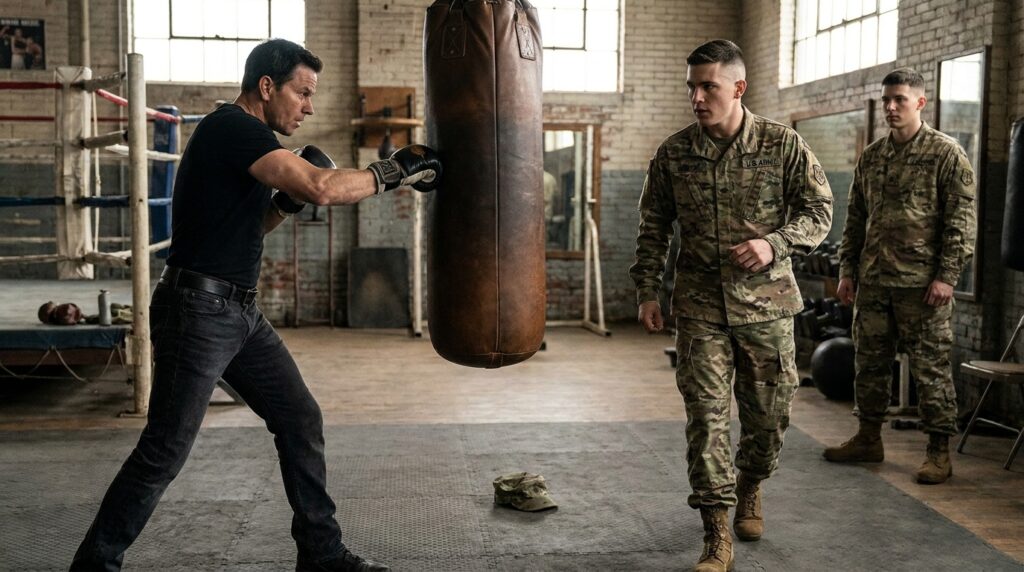
The heavy leather bag swung between them, a seventy-pound pendulum of packed canvas and old sweat. Corporal Vance didn’t reset his stance. He stood too close, his chest heaving against the olive-drab cotton of his standard-issue shirt, his shadow cutting long and sharp across the scarred plywood floor. A few feet back, Private Miller—no relation, just another kid with a base haircut and too much nervous skin—stood frozen, his fingers hooked into the strap of a dropped canvas cap that lay like a dead bird on the mat.

“You’re tracking wide on the left hook,” Miller muttered, his knuckles acheing inside his weathered wrapped bandages. “You leave the flank open. The base doesn’t teach you leverage, Vance. They teach you mass. Here, mass gets you caught.”

“I don’t need the lecture on leverage, old man,” Vance said. His voice had the flat, dangerous edge of a boy who hadn’t slept since the midnight muster. He didn’t drop his hands. Instead, he took a half-step forward, his boots crossing the chalk line Miller had drawn on the floor three winters ago. It wasn’t a boxer’s step. It was an occupation.

The silence in the gym always smelled of iron filings and liniment. Outside, the low hum of the transport planes taking off from Fort Meade vibrated through the single-pane windows, making the rusted mechanical scale in the corner click-click-click against its housing.

Vance didn’t wait for the whistle. He came in straight, a hard, unpolished right cross intended to push Miller back into the support pillars. It was the kind of punch a man threw when he wanted to see if the rumors about a civilian’s past had an expiration date.

Miller didn’t blink. His left foot shifted an inch to the blind side, his hips dropping into the floor like iron anchors. He caught the meat of Vance’s forearm with his lead elbow, a blunt, scraping deflection that turned the boy’s momentum into empty air. Before Vance could pull the shoulder back, Miller’s right hand came down—not a punch, but a heavy, downward palm strike against the crook of Vance’s collarbone, paired with a sweeping heel behind the trainee’s lead ankle.

The impact was short, dry, and clean.

Vance hit the canvas hard, the air leaving his lungs in a sharp whuff that sprayed a circle of dust off the gray mat. He skidded two feet, his shoulder pinning the heavy bag until it groaned against its overhead chain, casting a wide, rhythmic shadow over his stunned face.

Private Miller didn’t move to help him. He stayed in the corner, his eyes fixed on the black scuff mark Vance’s boot had left on the chalk line.

Miller stood over the boy, his own breath steady, his hands still raised in the loose, low guard of a man who spent twenty years learning that anger is just wasted fuel. The skin over his knuckles was yellowed with old grease from the gym’s furnace. He looked down at the uniform, at the brass pins that had dug into the mat, then reached down and picked up an object that had slipped from Vance’s pocket during the tumble.

It wasn’t a standard military ID or a pack of tobacco. It was a brass master key with the Fort Meade logistical seal stamped into the head, attached to a small aluminum tag that read Property Office – Section 4 (Demolition/Lease).

Vance looked up, his jaw tight, his chest working hard to find air under the swinging shadow of the canvas bag. He saw the key in Miller’s hand, and for a fraction of a second, the raw arrogance in his eyes cracked open to reveal something cold, calculated, and entirely old.


CHAPTER 2: THE RIPPLE IN THE DUST

“Give it back,” Vance said. The words didn’t leave his mouth so much as they scraped past his teeth.

He didn’t move from the floor. He stayed pinned beneath the slow, rhythmic sweep of the seventy-pound bag, his shoulder blades flat against the cracked canvas mat. The gray dust he’d kicked up in his fall settled back down, coating the sweat on his throat like fine salt.

Miller held the brass key between his thumb and forefinger. The metal was cold, ungreased, biting into the old calluses of his palm. The stamped letters—Fort Meade Logistical Seal—looked sharp and dark in the low afternoon light leaking through the gym’s high, dirt-streaked windows. Beneath it, the small aluminum tag tapped against his knuckle with a thin, metallic click.

“Section Four,” Miller read, his voice dropping into the lower register he used when the gym’s furnace started to choke on cold air. “Demolition and Lease. You boys carrying keys for civilian grid lines now?”

Vance didn’t answer. He rolled his hip, kicking his boots out to steady himself before forcing his frame off the mat. Every joint in the boy’s knees made a dry, popping sound that echoed in the empty space between the ring and the weight racks. Private Miller, still hovering near the bench with his chin tucked into his collar, made a small, involuntary movement toward the door—a tracker checking his exits.

“It’s base property,” Vance said, squaring his shoulders. His uniform shirt was torn at the seam under the armpit, revealing a patch of skin already darkening to a deep, iron-colored bruise where Miller’s heel had found his balance. “You hold onto that, it’s retention of military hardware. They’ll come in here with a warrant before the sun hits the ridge.”

“Let them come,” Miller said softly. He didn’t pocket the key. He walked over to the rusted mechanical scale near the entrance, his boots dragging slightly across the grit. He laid the brass piece on the metal tray. The scale groaned, the counterweight sliding an eighth of an inch along the grooved bar with a high-pitched screech that made the private jump. “Your commander, Captain Vance—he still running the logistics outfit out of the north cantonment?”

Vance’s face didn’t change, but his eyes tracked the key’s reflection in the dull chrome of the weight bar. “Captain Vance is third generation. He doesn’t look at maps this small.”

“He looks at this one,” Miller said. He turned his back to the boy, an intentional choice, a calculated risk based on the weight of the boots behind him. He could hear the grit shifting under Vance’s heels. The boy was measuring the distance to the iron bar, calculating the leverage of a blind strike. “The base has been expanding three hundred yards every fiscal year since the treaty was signed. You think I don’t see the orange survey stakes out behind the equipment shed? You think I don’t smell the diesel from the graders?”

“The town needs the base,” Vance said, his voice flat, transactional. The heat of the initial fight had cleared out, replaced by the heavy, functional cold of two men who realized they were standing on opposite sides of a property line. “This gym doesn’t generate forty dollars a week in civilian dues. The boys from the barracks are the only thing keeping the lights from flickering.”

“The boys from the barracks come here to learn how to keep their heads down,” Miller said. He stepped closer to Vance, his frame casting a wide shadow over the trainee’s torn shirt. “You didn’t come here to box today, Corporal. You came here to start a fire. Someone told you to push me until I broke your nose, didn’t they? A civilian assault charge on a uniform looks real clean on an eviction notice.”

Vance’s jaw tightened. A small vein near his temple throbbed against the short, bleached hair of his military cut. He didn’t deny it. He didn’t monologue. He just looked at the scuff marks his boots had left across the floor—the evidence of his failure to stay upright.

“You’re old, Miller,” Vance said, his voice dropping below the hum of the transport planes outside. “Your knees are dry rot. Your hands are full of salt. You can drop me three more times before the whistle blows, but the barracks don’t stop. There’s eighty more kids in my unit alone who want to see if the old man can still take a punch. They’ll come in pairs next time. Then four. Then twenty.”

“Let them come,” Miller repeated. He walked to the corner, picked up the private’s dropped canvas cap from the mat, and tossed it straight at the kid’s chest. The private caught it against his ribs, his face turning the color of old paper. “Get him out of here, Miller. Tell your sergeant he’s late for the evening roll.”

The private didn’t wait for a second command. He grabbed Vance by the elbow of his uninjured arm, pulling him toward the heavy wooden double doors that led out to the gravel parking lot. Vance didn’t resist, but as he reached the threshold, he stopped, his hand gripping the unpainted frame until the dry pine splintered under his thumb.

“The key stays on the scale,” Vance said back over his shoulder. “For now. But everything in this valley gets weighed eventually, Miller. Make sure your balance is straight.”

The doors banged shut, the old iron latch rattling against the strike plate until the vibration traveled down the studs and died in the floorboards.

Miller stood alone in the center of the room. The silence came back instantly, heavy and saturated with the smell of old grease and cold sweat. He walked over to the windows, watching through the grime as the two figures cut across the gravel toward the black asphalt road that divided the town from the reservation. They didn’t talk. They walked with their heads down against the desert wind, their shadows stretching out like long, dark fingers toward the base wire.

He turned back to the scale. The brass key was still there, a bright, foreign eye against the dull gray iron. He reached out, his thumb catching on the rough edge of the tag. Section Four.

He knew the logistics section didn’t handle civilian disputes. They handled logistics—land clearing, asset relocation, structural disposal. The boy hadn’t dropped that key by accident. It was a marker left on a boundary stone.

Miller walked to the heavy bag, his wrapped hands hitting the canvas once, twice, three times in a slow, mechanical rhythm that didn’t have any power behind it—just the weight of a man trying to keep his fingers from stiffening up before the night came in. Every time the bag swung back, the chain shrieked against the hook, a sound like iron tearing in the dark.

CHAPTER 3: THE BROKEN SCALE

The door frame didn’t give way with a crack; it groaned, a slow, metallic sigh of old iron screws shifting in dry pine.

Miller didn’t reach for the light switch. The fluorescent tubes overhead hummed like hornets even when they were dead, and the glare from the highway expansion project down the ridge provided enough desaturated white light to slice the gym into clean, jagged halves. He stayed on the threshold, his boots tracking cold gravel into the workspace, listening to the rhythmic click-tick of the corner scale as the wind outside rattled the external vent.

A figure was sitting on the low wooden locker bench near the water pipe.

It wasn’t Vance. The silhouette was slighter, the shoulders curved inward against the draft that always pooled around the concrete baseboards. Corporal Vance was six-foot-two of high-grade military issue; this was the other one, the silent witness, Private Miller. He sat with his hands tucked between his thighs to keep them from shaking, his standard-issue olive field jacket unbuttoned at the throat. On the floor between his boots sat Miller’s metal lockbox—the one usually hidden behind the spare canvas mats in the crawlspace.

“The lock was rusted,” the boy said. His voice didn’t carry the arrogance of the barracks. It was small, dry, the sound of paper scraping against stone. “A standard-issue combat knife takes the latch right off. You ought to keep better maintenance on your security, sir.”

Miller didn’t advance. He leaned his hip against the door frame, his hand resting on the smooth, worn leather of his pocketed wrapping tape. “You broke into a civilian establishment after taps, son. That’s forty-eight hours in the brig if your sergeant finds the grid coordinates. More if I call the county sheriff.”

“The sheriff won’t come,” the private said, finally looking up. The high-fenced stadium lights from the base hit his face, turning his skin the color of galvanized zinc. “The sheriff’s department signed the jurisdiction waiver for the north corridor last Tuesday. Anything within fifty yards of the highway centerline belongs to logistics now. That includes this foundation.”

The private didn’t move his hands from his thighs, but his chin jerked down toward the open box. A leather-bound ledger lay across the metal rim, its pages yellowed and frayed along the edges like dry tobacco leaves.

“I didn’t come here to steal your medals, Mr. Miller,” the boy muttered. “Vance is in the medical bay. They’re patching his collarbone, but the captain’s already filling out the paperwork. An unprovoked assault by a hostile civilian on a uniform. They have the statements signed by three other men who weren’t even in the room. They’re using the incident to trigger the emergency eminent domain clause.”

Miller took two slow, calculated steps forward. The floorboards didn’t bend under his weight, but the grit under his soles made a sharp, grinding sound. He reached down, his fingers closing on the cold metal rim of the ledger, lifting it from the boy’s lap. The paper smelled of old dampness and the faint, bitter tang of vinegar—the chemical footprint of cheap blue ink used forty years ago.

“This is my ledger,” Miller said, his voice flat, territorial. “My partner kept these books before the base laid the first strip of asphalt.”

“Look at the last five pages,” the private said, his voice tightening. “The entries from ninety-eight. The ones written in blue ballpoint. That’s not a civilian accounting script, sir. That’s a military logistical ledger format. Look at the column headers—Itemized Section Four Asset Relocation.”

Miller’s thumb caught the edge of the dry paper. He turned the pages slowly, the friction of the old sheets sounding like dead leaves in the silence of the room. His eyes tracked the faded entries. His late partner’s handwriting—thick, looping, undisciplined—stopped abruptly three-quarters of the way down a page dated November eleventh. Below it, a different hand had taken over. The script was small, precise, blocky, written with the mechanical regularity of an army clerk.

Every single line item after that date wasn’t listed as a membership fee or an equipment expense. They were listed as Lease Amortization Credits, paid out to an entity called M.D. Logistics & Development Holding Company.

“The captain didn’t send Vance here just to get into a fight,” the boy whispered, his eyes scanning the dark corners of the ceiling rafters. “They already knew what was in the books. They wanted you to touch him so they could seal the building before you had a chance to look at Layer Two. Your partner didn’t leave you the gym, Mr. Miller. He sold the ground right out from under the ring thirty years ago. You’ve been paying rent to a ghost.”

Miller didn’t drop the book. His knuckles turned white against the cracked leather cover, the iron-scented sweat of his palms dampening the old paper. He looked from the neat block letters of the military clerk toward the rusted mechanical scale in the corner. The brass master key Vance had dropped was gone from the tray, but a thin, oily smear remained on the metal where it had rested, catching the blue light of the base towers.

He could feel the structural logic of the valley closing in around him—a slow, heavy machine that didn’t use fists to break a man, but lines on a map and old ink that had dried before Private Miller was even born. The victory in the ring five hours ago didn’t mean anything. It was a false flag, a localized distraction while the real perimeter was being drawn around his ankles.

“You’re a long way from the barracks to be telling me this, kid,” Miller said, his eyes drilling into the private’s small frame. “Why aren’t you signing the captain’s statement?”

The private stood up, his knees shaking slightly as he pulled his field jacket tight around his ribs. He didn’t look Miller in the eye. He looked at the floor, at the chalk line that Vance had crossed. “My grandfather had a farm on the south ridge before they built the artillery range. He thought he had a deed too. He stayed until the dozers hit the porch because he couldn’t read the Section Four riders on the back of his tax receipt. I know what the clerk’s ink looks like when it’s done with a family.”

The boy moved toward the door, his shadow stretching out across the mats like a long, thin wedge. He didn’t say goodbye, and he didn’t ask for the box. When he pulled the door open, the desert wind hit the room again, making the ledger pages flip backward with a dry, frantic rattle that sounded exactly like iron scrap dragging across concrete.

Miller didn’t follow him. He sat down on the locker bench, the ledger heavy on his lap, his hand tracing the cold, blocky letters of the logistics company. The room was getting colder, the heat from the valley floor evaporating into the high desert sky, leaving nothing but the gray grit and the realization that the fence line wasn’t coming toward his property—it was already underneath it.

CHAPTER 4: THE AUDIT

The headlights didn’t fade when the ignition clicked off; they stayed pinned to the front double doors, casting the shadow of the structural beams backward into the ring like a row of black pikes.

Miller didn’t drop the hand wrap he was re-spooling. He stood behind the main counter, his fingers working the stiff, salt-crust canvas strip back into a tight cylinder. Through the unwashed glass, three figures cut through the high beam glare, their boots loud against the frost-bitten gravel. They weren’t wearing gym clothes. They wore the crisp, low-visibility fatigues of the base garrison command, their heavy webbed utility belts clicking against their sidearms with every second stride.

The man in the lead didn’t knock. He hit the unlatched door with his forearm, letting the cold high-desert draft push the raw smell of diesel and sulfur into the room ahead of him. Captain Vance—the resemblance to the boy on the mat was written in the thin, unyielding ridge of his nose and the grey, transactional quality of his eyes—stopped five feet from the counter. His boots left wet, gray slush marks across the floorboards.

Behind him stood two garrison MPs, their arms crossed over their chest plates, their faces identical under the brims of their stiff utility caps.

“You’re operating outside the city municipal code, Miller,” Captain Vance said. He didn’t raise his voice; it had the flat, dry drone of a man reading a parts manifest. He laid a heavy manila folder on the counter, the cardboard corner catching on a split in the pine. “The safety audit for the North Border corridor was finalized at midnight. This structure failed the reinforcement evaluation. You’ve got six hours to clear out the gear before the physical barricades go up at the centerline.”

Miller didn’t look at the folder. He kept his eyes on the captain’s cuffs, where the starched fabric was stained with a light smear of dark hydraulic grease from the motor pool. “The municipal line ends at the culvert, Captain. Your grandfather knew that when he signed the right-of-way easement back in sixty-two. The gym sits twenty feet inside county jurisdiction.”

“The county sold the grid lines to the infrastructure authority three months ago,” Vance replied. He reached into his pocket and produced a small, notched key—not brass like the one Corporal Vance had carried, but cold, unplated steel with a logistical serial number stamped into the throat. He dropped it on top of the folder. It slid three inches before stopping against Miller’s roll of tape. “Your partner didn’t leave you a deed, Miller. He left you a liability. The M.D. Logistics lease was terminated for non-payment when the highway expansion was funded. This isn’t an eviction. It’s an asset recovery.”

One of the MPs shifted his stance, his heavy boot heel grinding a piece of loose gravel into the floor with a dry, splintering crunch.

Miller looked down at the steel key. It was shaped specifically to fit the old mechanical double-bolt safe built into the concrete wall behind the ring—the safe he hadn’t opened since his partner’s funeral because the combination mechanism had rusted shut during the floods of ninety-eight. The base didn’t just have the ledger information; they had the physical keys to the internal lockboxes. They had been inside the foundation before the first punch was ever thrown.

“The boy was a setup,” Miller muttered, his fingers tightening around the wrapped canvas until his knuckles turned the color of lard. “You sent your own blood in here to take a beating just to get the report on the wire.”

Captain Vance didn’t flinch. His face remained flat, a mask of desaturated gray under the fluorescent tube that buzzed against the beam. “Corporal Vance is an infantry replacement. He has a duty to test his readiness against local variables. His medical report says he has a cracked clavicle and a localized concussion from an unprovoked civilian strike. That report is already on the federal magistrate’s desk. If you’re still inside this frame when the graders start at dawn, the MPs won’t be carrying folders.”

“You’re tearing down the only room in this valley that doesn’t smell like cordite,” Miller said. He stepped out from behind the counter, his knees making a dull, scraping sound against his trousers. He didn’t raise his hands, but his stance was low, his weight balanced between his heels, his left side tucked forward to shield his liver. “You want the ground because the highway needs the grade, or because you can’t stand looking at something you don’t own from the tower?”

“The tower doesn’t care about your ring, Miller,” Vance said, turning back toward the door. He didn’t look to see if his men were following; he knew their boots were already moving in lockstep behind him. “The machine goes where the line is drawn. You’ve been fighting the fence for thirty years, but the fence always wins because it doesn’t get tired. Read the folder. Or don’t. The dozers start at five.”

The double doors swung open, letting in the loud, mechanical roar of a low-flying transport plane that blocked out the stars as it climbed toward the salt flats. The glare from the patrol vehicle’s high beams swept across the gym floor one last time, illuminating the old leather bag, the scuff marks on the mat, and the iron scale that still vibrated from the passing engine.

Miller didn’t pick up the manila folder. He walked to the back wall, his hand tracing the cold, pitted concrete where the old safe sat behind the spare canvas. The steel key Vance had left on the counter seemed to radiate an old, metallic chill that filled the entire room, a physical reminder that the trap hadn’t been set yesterday. The foundation was built on top of it. He looked down at his own hands—the wrapped fingers, the yellowed calluses—and realized he wasn’t the protector of this space. He was just the last tenant who hadn’t been told the lease was dead.

CHAPTER 5: THE UNEASY LINE

The teeth of the gear didn’t want to catch. Miller put his shoulder into the iron crowbar, his boots slipping on the grit-coated floorboards as he forced the tip deep into the seam of the concrete-set safe.

The small steel key Captain Vance had left behind was already twisted out of true, jammed tight into the dual-cylinder lock. It took three heavy, metallic raps with a five-pound mallet to shear the internal pins. When the heavy door finally split from the frame, it didn’t swing clean; it fell outward with a blunt, bone-jarring thud, striking the floor and sending a gray plume of masonry dust over Miller’s boots.

Inside the cavity sat a single flat bundle wrapped in oil-cloth, tied off with rotted hemp twine.

“You’re running out of clock,” a voice said from the threshold.

Miller didn’t drop the crowbar. He turned his head slowly. Corporal Vance stood in the entry, his left arm pinned tight against his ribs by a rough canvas sling that smelled of the base clinic. His face was a map of yellowing purple bruises, the skin around his eye split and held together by three black nylon sutures. Behind him, the high desert horizon was turning the color of wet slate, the first cold orange glare of dawn catching the exhaust plumes of three yellow earth-movers idling at the culvert line three hundred yards down the road.

“The platoon’s already moving the survey stakes to the eastern wall,” the boy said, his boots dragging as he walked toward the ring. He didn’t look like a conqueror; he looked like a piece of equipment that had been run through the gears and left out to dry. “The captain signed the detail order at four. They aren’t waiting for the county clerk to log the dispute.”

Miller used his wrapped thumb to tear the hemp twine off the oil-cloth. The fabric was stiff, saturated with old petroleum that had turned to a black, tar-like crust over thirty winters. He pulled back the layers, revealing the original land registration certificate from nineteen sixty-one.

The paper didn’t feel like the municipal ledger. It was thick parchment, watermarked with the state surveyor’s seal. But across the bottom third, stamped in the same precise, blocky clerk’s script that the private had warned him about, was a formal corporate lien assignment. His partner’s signature wasn’t at the bottom. The man who had signed the transfer was Miller’s own older brother—the one who died in the first deployment across the salt flats, whose name was etched into the brass plaque outside the garrison headquarters.

The holding company didn’t belong to a nameless real estate syndicate. The charter document inside the cloth listed the primary shareholders. The principal beneficiary was the base’s private deployment fund—a trust managed by the rotating garrison commanders to support the families of the fallen.

Miller stood in the center of his gym, the parchment heavy between his fingers, watching the orange dawn hit the canvas of the ring. The internal monologue was an empty room. The sovereign protector wasn’t defending a legacy from an invading machine; he was occupying an asset that had been purchased with his own family’s blood before he ever put on his first pair of gloves. The captain wasn’t trying to steal the land for a highway; he was recovering a leased parcel to fund the next line of replacements.

“He didn’t tell you either, did he?” Miller asked, his voice dropping into the low, mechanical hum of the nearby engines.

Vance stopped at the ring apron, his right hand gripping the rusted turnbuckle until the iron wire groaned. He looked at the watermarked parchment, then out through the grease-stained glass at the yellow graders currently cutting the fence line. “The captain said the asset had to be cleared before the deployment roster was finalized. He said it was family business.”

The boy’s shoulder dropped against the ring post. He was a third-generation uniform, built to follow the line on the map, but his eyes were fixed on the chalk line on the floor—the boundary where his individual pride had been broken by an old man who didn’t even own the mat he stood on. They were both cogs in the same rusted machine, grinding against each other while the gears turned somewhere far above the valley floor.

“Get in,” Miller said.

Vance looked up, his bruised brow furrowing. “The dozers are at the gate, Miller.”

“Get in the ring,” Miller repeated. He tossed the oil-cloth bundle onto the counter and stepped over the bottom rope, his knees clicking in the early morning stillness. He didn’t pick up his gloves. He just held up his wrapped hands, the canvas dirty, stained with the gray oil of the safe door. “We have twenty minutes before the blade hits the foundation. You want to learn how to guard that flank or do you want to go back to the barracks with a broken collarbone and an empty sheet?”

Vance stood still for three seconds, his breath coming in short, white puffs in the unheated room. Then, using only his right hand, he hooked his boot over the middle rope and dragged his frame into the square. His uniform shirt was still torn, the dark blood from his split eye dry against his collar. He didn’t adopt the rigid stance of the base manual. His hips dropped, his feet finding the wood beneath the canvas, his single free hand rising to protect his chin.

They stood three feet apart under the swinging shadow of the heavy bag as the first diesel exhaust rattle hit the side walls of the building, shaking the loose glass in the frames. They didn’t strike. They just held the line, two men waiting for the impact of a world they couldn’t turn around, finding the only balance they had left on a piece of floor that belonged to neither of them.

CHAPTER 6: THE GRADERS SHADOW

The iron didn’t sound the same when it hit concrete instead of timber.

Miller dropped the twenty-pound dumbbell into the bed of the rusted wheelbarrow, the impact releasing a sharp, metallic ring that bounced off the curved corrugated steel walls of the abandoned Quonset hut. This close to the motor pool, the silence was thicker, choked by the heavy, oily stink of dead batteries and the grey water that pooled in the drainage channels near the perimeter fence.

“The gate guard didn’t check the tarp,” Vance said.

He was leaning against the rusted frame of a non-operational three-ton truck, his right hand working a grease-gun into the hinge of a makeshift pulley system he’d rigged to the overhead rafters. The canvas sling was gone from his arm, replaced by a tight wrap of olive-drab utility tape that bound his shoulder to his ribcage. Every time he pulled the lever, his jaw went tight, the black nylon sutures near his eye pulling against the skin like tiny wires.

“The guard doesn’t look at salvage vehicles coming in,” Miller said, his voice flat, rhythmic. He hauled another load of iron plates from the barrow, stacking them on a low pallet made of rotting cedar ties. “They only look when the scrap goes out. To them, we’re just moving junk from one ditch to a smaller one.”

Through the high, curved ribbing of the hut’s entrance, the horizon was still choked by the yellow dust of the old gym’s demolition. The sound of the graders hadn’t stopped; it had just grown distant, a low, mechanical growl that vibrated through the concrete slab beneath their boots every time the blade hit a major foundation tie.

Miller walked over to the center of the floor where Vance had cleared a twelve-by-twelve square in the grease crust. It wasn’t a ring. There were no turnbuckles, no canvas mats to catch a heel—just four lengths of rusted chain hooked to the corners of old fuel drums that had been filled with gravel to keep them from rolling. On the side of the lead drum, a white stencil read: LOG-4-DEPT-RESERVE.

“The captain’s clerk came by the barracks after the noon muster,” Vance muttered, his right hand never leaving the grease-gun. “They’re assigning the Section Four details to the evening shift. They want the old lot completely graded and seeded with gravel before the magistrate’s inspectors arrive from the county seat on Friday.”

“The inspectors won’t look at the dirt,” Miller said. He stepped inside the chain square, his boots making a dry, sliding sound against the oil film. “They’ll look at the ledger entries we pulled from the safe. The captain knows that. That’s why he’s rushing the fence line.”

“He’s not just rushing the fence,” Vance said. He finally dropped the tool, the iron clattering against the frame of the truck. He reached into his field jacket with his uninjured arm and pulled out a single sheet of yellow carbon paper, the edges stained with the purple ink of a base mimeograph. He didn’t offer it to Miller; he just laid it flat on the top of the stenciled fuel drum. “The deployment orders for the north sector came down at fourteen hundred. My name’s at the top of the transfer list. I’m scheduled for the transport line next Thursday.”

Miller didn’t pick up the paper. His eyes stayed on the boy’s shoulder, noticing the slight, involuntary tremor in the deltoid where the muscle was trying to protect the cracked bone underneath.

“That’s seven days,” Miller said softly.

“Seven days,” Vance repeated. He took a half-step into the chain square, his boots crossing the oil-stained line Vance had scrubbed into the concrete. His guard came up slow, heavy, the left hand lagging three inches lower than the right to compensate for the torque on his collarbone. “He knows I can’t clear the medical evaluation with this arm. If I refuse the transport, it’s a structural discharge. I lose the commission, and my family’s name stays on the Section Four rider as a default.”

The hum of the base generator two sectors over kicked in, a high, rhythmic whine that made the grease in the drainage channels ripple.

Miller looked down at his own wraps. The white cloth was gone, replaced by the same gray industrial tape Vance was using—the only material available in the salvage yard that could hold a wrist straight when the bone started to soft-shoe. The landscape here had no edges, no civilian definitions. They were inside the iron engine now, training a boy to stand upright on a floor that belonged to the very logistics unit that was trying to erase him.

“We don’t have time for the left hook,” Miller said, his voice dropping into the flat, transactional register of the old gym. He didn’t drop his hands into a defensive frame; he took a short, lateral step, his elbow checking the air an inch from Vance’s wounded shoulder. “If you throw the hook, the torque pulls the clavicle out of the socket before the knuckle hits the leather. You work the lead straight. You let the mass of the truck do the pushing.”

Vance didn’t answer with words. He adjusted his heels, his weight shifting back onto his good leg, his eyes narrowing as he watched the gray tape on Miller’s knuckles rise to meet him in the desaturated glare of the corrugated ceiling. Outside, the dust from the old foundation rose high enough to blot out the ridge lights, leaving the hut in a deep, iron-scented twilight that felt less like a preparation and more like a siege.

CHAPTER 7: THE DEPLOYMENT ROSTER

The straight lead hit Vance’s palm with a flat, dry thud that didn’t vibrate through his spine. He stayed planted, his right boot digging into the grease crust on the concrete slab, his jaw locked against the cold draft filtering through the Quonset hut’s split seams.

“Lower,” Miller said. He didn’t drop his hands. His own gray-taped knuckles remained poised inches from Vance’s left eye, catching the desaturated glare of the perimeter floodlights outside. “You’re leaning into the rotation again. If you shift the weight before the arm clears the hip, you’re giving away the baseline. The captain doesn’t look for the punch; he looks for the shoulder to drop.”

Vance exhaled, a grey plume of breath that settled over the stenciled fuel drum between them. “The line officers don’t use baselines, Miller. They use the manifest. The transport trucks are already backed up to the Section Four supply depot. They’re loading the field gear now.”

Miller took a short lateral step, his boot heel scraping against a discarded iron bolt on the floor. He didn’t offer a word of comfort. Comfort was an entry in a civilian ledger that had been canceled thirty winters ago. “Then you keep the jab short. You make them come to the center line. If they want the name on the roster, they have to carry it out of this grid.”

A sudden mechanical screech from the far end of the salvage yard cut through the hum of the base generator. It wasn’t the graders this time. It was the heavy iron arm of a knuckle-boom crane, dropping a stack of olive-drab supply crates onto the gravel apron sixty yards from the hut’s entrance. The impact shook the unbolted corrugated sheets of the roof, sending a fine shower of rusted scale down onto the cedar-tie pallet.

One of the crates skidded off the stack, its unlatched lid slamming against the concrete sill of the hut. It didn’t break open, but the heavy steel banding sheared with a sound like a pistol shot, scattering a handful of loose document duplicates across the damp floorboards near Miller’s feet.

Miller didn’t move toward the door. He stayed inside the chain square, his eyes fixed on the boy’s guard. But Vance’s gaze had already dipped to the floor, where the wind was tumbling a yellow carbon receipt against the base of the stenciled drum.

“Don’t look down,” Miller barked. “The moment the eyes drop, the perimeter’s gone.”

“It’s the Section Four manifest,” Vance whispered. He didn’t drop his hands, but his stance went rigid, the muscle in his deltoid shivering against the olive utility tape. “That’s the transfer duplicate from the logistics office. Look at the stamps, Miller. Look at the ink.”

Miller looked down without shifting his hips. The paper was identical to the yellow copy Vance had brought into the hut the day before, but this one carried a secondary identification block at the margin. It wasn’t signed by the base clerk. The hand that had verified the asset relocation was the same sharp, blocky script Miller had spent the previous night tracing in his old partner’s ledger—the handwriting of the clerk who had processed his brother’s deployment benefits back in ninety-eight.

Directly below the transfer authorization, under the column marked Compensation Offset, sat a single entry: Deed Reference Ledger – Grid Block 12 (Civilian Exemption).

The paper didn’t list an equipment allocation or a barracks assignment. It was a liquidation schedule. It detailed a direct transfer of funds from the M.D. Logistics & Development Holding Company to a private account held under the surname Vance—not the boy’s name, but the captain’s personal trust. The gym’s land hadn’t just been leveraged to a ghost shell company; the lease payments Miller had scraped together every winter had been systematically routed to clear a personal debt the captain’s father had accrued during the land clearing thirty years ago.

The decoy secret—the idea that the base simply needed the centerline for a highway expansion—cracked wide open, leaving nothing but the cold, greasy reality of a localized shakedown. The captain hadn’t weaponized the uniform to protect the base; he had weaponized the logistics unit to bury the evidence of a three-generation embezzlement scheme before the county inspectors could pull the grid records.

“He knew,” Vance said, his voice dropping into the flat, dead tone of a soldier who had found the bottom of a trench. “The captain didn’t put me on the roster to protect the unit’s readiness. He put me on it because my grandfather’s name is on the original lien transfer. If I cross the salt flats on that transport next Thursday, the account closes automatically under the service waiver. There won’t be a record left for the county to inspect.”

Miller walked out of the chain square, his boots heavy as he reached down to pick up the yellow carbon duplicate. The paper was damp, sucking up the cold moisture from the concrete slab until the purple ink began to bleed into the margins like old grease. The equal intellect of the antagonist wasn’t a matter of strategy; it was the simple, brutal leverage of a man who owned both the pen and the fence.

“The transport leaves from the north cantonment,” Miller said, his hand closing over the paper until it crumpled into a tight, hard ball. “The gate requires a Section Four clearance code to pass before the whistle blows.”

“I have the clearance,” Vance said, his right hand rising slow and deliberate until the knuckles were level with Miller’s chest. The purple bruises around his sutures looked black in the dimming light. “But the captain holds the muster roll. He’ll be at the staging point at five tomorrow morning to sign the physical assets over to the convoy. He won’t be carrying documents, Miller. He’ll be carrying the garrison guard.”

“Then we don’t look at the guard,” Miller said, walking back into the square and setting his heels into the oil crust. He didn’t check the entry behind him. He didn’t count the days left on the carbon sheet. “You have six days before the truck moves, Corporal. But you only have twelve hours before the captain signs that roll. Bring the hands back up. We’re tracking the center line now, and every inch we lose belongs to him.”

The crane outside whistled as it dropped its final load, the heavy iron gears grinding against the brake pads with a sound that filled the Quonset hut like the ticking of a colossal, rusted watch. The light off the ridge was completely gone now, leaving nothing but the desaturated white glare of the camp towers to split the floor into two clean, cold halves that didn’t touch.

CHAPTER 8: THE COLD JUNCTION

The iron handle of the staging gate didn’t have any grease left inside the sleeve. When Miller wrapped his fingers around the bar, the cold came straight through the industrial tape, biting into the bone of his palm like a blunt chisel.

Beside him, Vance didn’t look at the perimeter towers. His boots were frozen solid at the ankles, tracking a thin line of white frost into the dark corridor between the transport containers. His right shoulder was set low, pinned tightly against his ribs by three extra wraps of the gray utility binding, but his lead hand remained tucked under the lapel of his field jacket—holding the crumpled yellow carbon duplicate against his heart.

“The convoy’s idling,” Vance whispered. His breath was small, turning to ice before it reached the wire mesh. “Third truck from the intersection. That’s the Section Four transport. The captain’s car is already parked behind the fuel point.”

Miller didn’t take his eyes off the centerline. Fifty yards ahead, through the desaturated haze of the exhaust fumes, a single black sedan sat under the high beam of a terminal floodlight. Captain Vance stood beside the open hood, his starched fatigues crisp despite the sub-zero wind coming off the salt flats. He held a clipboard under his left arm, his right hand moving a mechanical pen across a thick stack of master master sheets.

Behind him, two garrison guards stood with their boots planted in the freezing slush, their rifles slung low across their chests, their faces hidden by the shadow of their cold-weather hoods.

“The clearance code won’t open the cab,” Miller said, his voice flat, territorial. He stepped over a rusted tie-rod on the gravel track, his weight balanced between his heels. “Once the signature hits that sheet, the boy belongs to the sector roster. The county line won’t matter.”

“He’s signing the asset transfers now,” Vance muttered. He took a short step forward, his boot heel making a sharp, brittle tick against a frozen pool of hydraulic oil. “If we don’t hit the junction before he turns the page, the file seals.”

Captain Vance didn’t look up when the gravel shifted. His pen didn’t stop its rhythmic, mechanical clicking against the aluminum board. “You’re five minutes outside the assembly window, Corporal,” he said. His voice carried the exact, flat drone of the safety audit. “The unit’s already logged into the manifest. Your gear was crossed off at four.”

“The gear’s in the truck,” Vance said, his stance settling into the low, heavy frame Miller had beaten into his ribs inside the Quonset hut. “But the signature line on page four isn’t clean, Captain. The Section Four rider doesn’t have the county clearance stamp.”

The captain stopped his pen. He turned his head slow, his gray eyes catching the blue glare of the terminal tower as he looked past the boy’s shoulder toward Miller. The two guards didn’t raise their weapons, but their hands moved simultaneously toward the heavy nylon webbing of their chest plates—the calculated counter-move of an institution that didn’t tolerate variables at the gate.

“The civilian line is closed, Corporal,” the captain said, his voice dropping below the vibration of the idling diesels. “The court magistrate verified the lease termination at midnight. There is no grid block twelve left on the map.”

“The grid block’s gone,” Miller said, stepping out from the shadow of the container until his gray-taped knuckles were visible under the floodlight. He reached into his coat—not for a weapon, but for the yellowed, watermarked parchment he’d taken out of the concrete safe five hours ago. He laid it flat on the hood of the sedan, directly over the polished chrome of the logistics emblem. “But the signature on the assignment isn’t my partner’s, Captain. It’s my brother’s name. The deployment trust has been paying out to an inactive ledger for twenty-eight years. That’s not a municipal lease termination. That’s a federal audit trigger.”

The silence came back hard, freezing the exhaust plumes into stationary clouds between the trucks.

The captain’s fingers didn’t move on the clipboard. His face remained a mask of desaturated gray, but the ridge of his nose went white as the skin tightened over the bone. He didn’t monologue. He didn’t call the guards. He just looked at the watermarked watermark on the state surveyor’s paper, his mind calculating the cause-and-effect loop of a three-generation fraud being exposed to a garrison court-martial.

“The trust is a closed asset,” Captain Vance said, his voice dropping another register until it was just a dry rasp against the wind. “The service waiver protects the account records during an active deployment cycle.”

“Not when the replacement is standing in the square,” Vance said. He stepped up to the sedan, his uninjured hand coming down on top of the master muster sheet, his thumb covering the purple ink line where his name had been stenciled. “The medical evaluation form isn’t in the folder, sir. If I don’t sign the physical readiness waiver, the transport can’t cross the reservation line without an internal inspection. And the inspector is already sitting at the county seat.”

The equal intellect of the antagonist met its limit not in force, but in the friction of his own ledger lines. The captain looked from the boy’s sutured eye to the old parchment on the hood, realizing that the old man and the recruit hadn’t come to the gate to fight his guards. They had come to lock the gears of his machine from the inside.

“The convoy leaves in three minutes,” the captain said, his eyes drilling into Vance’s face. “If your name comes off that sheet, Corporal, you’re assigned to the salvage yard for the duration of your contract. No commission. No family allotment. You’ll be shifting scrap with the civilians until the iron rots.”

“The scrap stays where it is,” Vance said. He didn’t drop his hand. He looked past the captain’s shoulder toward the highway ridge, where the yellow graders stood dark and silent against the rising gray sky. “We’ve already cleared the space.”

Captain Vance didn’t scream. He didn’t smash the pen. With a slow, mechanical precision that took ten seconds, he pulled the master sheet from the clipboard, folded it twice along the starched seam, and slid it into the side pocket of his field jacket. He turned his back to them, his hand jerking once toward the lead transport truck.

“Clear the corridor,” the captain muttered to the guards. “The Section Four detail is deleted from the manifest.”

The trucks began to move, their heavy tires grinding the frozen slush into gray pulp as they rolled toward the north gate. Miller stayed by the sedan until the tail-lights faded into the salt flats haze, his hands still raised in the loose, low guard of a man who knew the fence wasn’t gone—it had just stopped moving for the winter.

Vance didn’t look at the empty staging track. He walked back toward the gate, his boots heavy but steady on the gravel, his gray-wrapped hand tucked into his pocket beside the crumpled duplicate. They walked side by side out of the reservation line, their shadows long and rusted against the cold concrete of the highway approach, two men who had traded their walls for a boundary line they could finally hold together.

Similar Posts

Leave a Reply

Your email address will not be published. Required fields are marked *






