
The Slow Gravity of the Unbroken Line: A Chronicle of Wood, Canvas, and Leftover Light

CHAPTER 1: THE TENSION OF THE LEVEL

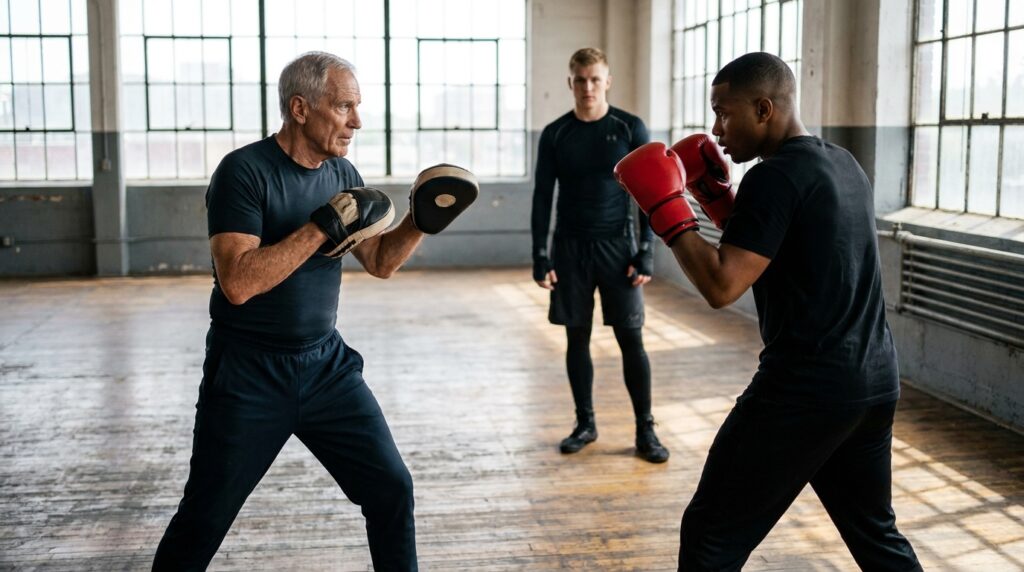
“Your weight is on the wrong heel, Julian,” Thomas said. His voice didn’t carry the rasp of the old trainers who shouted over the speed bags; it was thin, dry, and flat, like paper sliding across a workbench.

The younger man didn’t drop his hands, but his shoulders twitched—a fraction of an inch of wasted energy that Thomas’s eyes caught before the movement even finished. Around them, the open floor of the gym smelled of linseed oil and forty years of dried vinegar used to clean the mats. The morning sun came through the high, unwashed windows in long, heavy shafts, highlighting the gray dust swirling between their chests.

Julian reset. His dark hair was damp at the temples, his dark eyes fixed on the three square inches of canvas directly between Thomas’s feet. He was twenty-eight, skin tight over muscle that had been built for the short, explosive bursts the television networks liked. “The manual from the state athletic board says the lead foot should stay sixty degrees off the median line,” Julian muttered, his breathing rhythmic but shallow. “For maximum torque on the counter.”

“The state board doesn’t have to carry its own weight in the tenth,” Thomas said. He didn’t move his feet. His hands stayed up, the old cowhide gloves scarred white along the seams where the stuffing had shifted over decades. His knuckles were thick, distorted by calcium deposits that made his fingers look like ancient garden roots. He looked eighty, maybe older in the harsh white light from the street side, but his hips were locked into a stillness that made him seem rooted to the floor joists. “Try it again. Don’t look at my face. Watch the left shoulder. It tells you everything three seconds before the hand moves.”

In the middle distance, near the heavy bags that hung like rows of salted meat, the blond boy—Leo—sat on a wooden milk crate. He had a yellow legal pad on his knees, but his pencil wasn’t moving. He was nineteen, his limbs still raw and uncoordinated, waiting to see if the old man’s world was a temple or a tomb.

Julian stepped in. He didn’t use the modern bounce; he tried to slide his boot along the canvas the way Thomas had shown him during the winter, but the impatience was still there, a tiny tremor in his thigh. He threw the double jab—sharp, whistling through the dry air—intended to force the old man’s head down.

Thomas didn’t duck. He didn’t have the knees for it anymore. Instead, he gave up two inches of ground, his rear boot catching the edge of the sparring lane with absolute certainty, his right forearm rising just enough to catch the wrist of Julian’s second punch. The impact was dead—a flat thwack that didn’t rattle the bone but absorbed the momentum entirely. Before Julian could pull the hand back to his cheek, Thomas’s left glove was already resting against Julian’s ribs. It didn’t strike. It just stayed there, pressing gently against the gray cotton of the younger man’s shirt, right over the liver.

“If I turn the hip there,” Thomas whispered, the skin around his eyes tightening into a web of gray lines, “you don’t go home to your family tonight. You spend the evening looking at the ceiling of the clinic.”

Julian froze. The sweat from his forehead dripped onto the canvas between them, making a tiny, dark circle on the beige weave. He looked down at the old glove pressed against his flank. His chest rose and fell three times against Thomas’s leather knuckles before he finally lowered his guard. The intense, competitive heat that had carried him through twelve professional fights seemed to drain out through his heels, replaced by something much older and quieter.

“The leverage,” Julian said, his voice dropping into the small space between them. “The weight isn’t in the shoulder at all. It’s coming from the floor through the knee.”

“You’re looking for the punch,” Thomas said, drawing his hand back and sliding it into his apron pocket to hide the tremor that always started after a hard contact. “The punch is just the end of the line. The line starts under the floorboards.”

He turned away toward the small, scarred desk near the entry, where the water ledger and the property tax notices lay under a rusted cast-iron paperweight. As he crossed the threshold of the ring, his left heel dragged slightly—a dull, rhythmic scrape against the wood that he couldn’t quite disguise anymore.

“Thomas,” Julian called out, his posture remaining disciplined, his hands still half-formed into loose fists by his sides. “The commission representative came to my apartment last night. He had the new schedule for the regional tournament. They’re removing the traditional weight divisions for the under-card. Everything is moving to the four-round showcase format.”

Thomas stopped, his back to the ring. His old flannel shirt was threadbare at the shoulder blades, showing the sharp projection of his spine. On the corner of his desk sat a small, green glass bottle filled with clear mineral oil, used for softening the leather ropes. Next to it was an envelope with a blue legal seal from the city inspector’s office, unopened since Tuesday.

“They don’t want the craft, Julian,” the old man said, without turning around. “They want the blood to look bright under the television lamps.”

“They’re offering six thousand just to clear the medicals,” Julian said. The words came out heavy, like stones dropped into a well. “I can’t pay the sparring fees for next month if I don’t sign the waiver by Friday.”

Thomas reached down, his stiff fingers wrapping around the green bottle. He turned it slowly, watching the thick oil coat the glass inside. In the reflection of the window behind the desk, he could see Leo standing up from his milk crate, his face pale, his eyes moving between the old man and the younger fighter as if trying to find the point where the line broke.

“Come into the office,” Thomas said, his voice dropping an octave as he noticed the blue envelope had been moved three inches to the left since he went home the night before. Someone had already looked inside it.


CHAPTER 2: THE BLUE FOLD

The floorboards inside the office didn’t have the canvas covering to deaden the sound; they were bare pine, sanded down by forty years of boot heels until the knots in the wood rose up like smooth, dark knuckles. Thomas let his weight settle onto the swivel chair behind the desk. The spring beneath the seat gave a short, high metallic protest—a sound he had lived with since the summer of nineteen eighty-four.

Julian didn’t sit. He remained in the doorway, his large frame blocking the weak light coming from the main floor. The leather of his training gloves hung from his wrists by the unknotted laces, dangling like shot birds.

Thomas didn’t look at the younger man. His focus remained on the desk blotter, a faded green expanse of felt that had turned the color of stagnant pond water under the decades of sun. The blue envelope sat precisely three inches to the left of its usual spot. In the thin layer of gray dust that settled over the desk every morning from the street traffic below, there was a clean, crescent-shaped void where the paper had rested. On the corner of the blue stock itself, a faint white smudge remained—the unmistakable residue of zinc-oxide athletic tape.

“You have a light hand on the rope, Julian,” Thomas said softly, his thumb moving over the smudged corner without pressing down. “But you leave a heavy mark on the desk.”

Julian didn’t shift his stance. His jaw tightened, the muscle along his cheekbone bunching under the smooth, dark skin. “The door wasn’t locked. It hasn’t locked right since the frost in November.”

“The lock works fine if you lift the knob while you turn the key,” Thomas replied. He picked up the green glass bottle of mineral oil, unscrewed the rusted cap with his thumb, and let three drops fall onto a piece of fraying flannel cloth. He began to work the oil into the wood of the desk, his movements slow, circular, and deliberate. “What were you looking for?”

“I wanted to see the date on the notice,” Julian said. The subtext in his voice was thin, guarded, like a man walking on river ice that had begun to rot from beneath. “The boys down at the fourth-street annex said the city is pulling the occupancy permits for every building on this block that doesn’t have the new copper risers. They said the inspection reports are already logged.”

“The annex is run by men who sell supplements and lease locker space to lawyers,” Thomas said. The cloth made a rhythmic, dry hiss against the pine. “They don’t know the difference between a structural violation and a polite suggestion.”

“They know how to read a ledger,” Julian shot back. The silence that followed was sharp, transactional. Julian stepped into the room, the dangling gloves brushing against the door frame with a dull thud. “They’re offering four thousand dollars to anyone who signs over their remaining lease options before the first of July. If we wait until the board files the formal injunction, we get nothing. The equipment stays here. The ring stays here.”

Thomas stopped his hand. The flannel cloth remained flat under his palm. Through the grimy glass partition that separated the office from the training floor, he watched Leo. The blond boy was still sitting on his milk crate, his fingers picking at a loose thread on the hem of his faded gray sweatshirt. Leo was looking at the floorboards, but his head was tilted toward the office, his ears strained to catch the cadence of the conversation through the thin wood.

“The ring was built by a man who died before your father had his first tooth,” Thomas said, his voice dropping into that low, flat register that allowed no room for negotiation. “The corner posts are solid iron railroad steel. They don’t belong to the city, and they don’t belong to the annex. They belong to the floor.”

Before Julian could answer, the bell above the street entrance chimed—a single, clean note that sounded entirely out of place against the low hum of the morning traffic outside.

Neither man moved. Through the partition, Thomas watched a figure cross the threshold into the gym. The man wore a dark charcoal coat that hadn’t been bought off a rack, its wool smooth and heavy enough to hold its shape against the morning dampness. He didn’t have gym bags or a towel; he held a small, slim leather portfolio under his arm like a clerk from a probate court. He stopped near Leo’s crate, his eyes sweeping over the high windows, the unvarnished rafters, and finally fixing on the small, illuminated box of the office.

“He’s early,” Julian whispered.

Thomas looked up at the younger fighter, his old eyes narrowing behind their heavy lids. The gray light from the window caught the white hairs along Thomas’s jaw line, making them look like wire. “You told him to come here.”

“He wanted to see the floor,” Julian said, his voice dropping into the sparse, defensive tone of a man who had already made his choice but needed the old man to give it a name. “He’s the matchmaker for the showcase group. He’s the one who signs the vouchers for the medical clearances.”

The man in the charcoal coat didn’t wait to be invited. He walked across the canvas apron, his leather dress shoes clicking with a strange, high-pitched clarity that seemed to insult the worn textures of the gym. He entered the office without knocking, his presence immediately filling the narrow space with the scent of expensive bay rum and cold wool.

“Thomas,” the man said. He didn’t offer a hand. He knew better. He had the sharp, analytical face of someone who spent his life calculating the depreciation of old assets. “The air hasn’t changed in here since ninety-two.”

“The air is clean, Mr. Garrity,” Thomas said. He didn’t stand. He kept his palm flat against the oiled wood of his desk. “Julian tells me you have some papers for him to sign.”

Garrity looked between the two men, his gaze lingering for a fraction of a second on the blue envelope with the white chalk smudge. A small, cold smile touched the edge of his mouth—the look of a man who recognized a trap that had already been sprung. He set his leather portfolio down on the corner of the desk, directly over the clean spot where the envelope had originally rested.

“Not just for Julian,” Garrity said softly. He unzipped the portfolio with a single, smooth pull that sounded like a small tear in the room’s silence. He didn’t produce a massive document; he drew out a single sheet of heavy white bond paper, folded into three equal parts. “The syndicate doesn’t want the boy without the lineage, Thomas. A fighter from the fourth-street annex is just a body on a poster. But a fighter from this room—a man who still knows how to catch a jab on the forearm instead of the jaw—that’s something we can sell to the television buyers in Chicago. We call it the heritage block.”

Thomas looked at the folded paper. The texture was too smooth, too clean, completely devoid of the oil stains and sweat circles that marked every real document in his life. “And what does the heritage block pay?”

“Enough to clear the code violations on the plumbing,” Garrity said, his voice dropping into a rhythmic, comforting drone that had likely closed a hundred title transfers in the new downtown developments. “Enough to ensure that when the city comes with the padlock next month, you aren’t standing on the sidewalk with your ledgers in a cardboard box. We take the building. We keep the facade. We keep the ring in the center of the room as a design feature for the new athletic club. Julian gets his clearance, and you get to go home to that house by the river without having to worry about the roof next winter.”

Julian turned his face toward the window, his eyes fixed on Leo, who hadn’t moved from his crate. The young observer was watching them through the glass, his pencil now held tightly between his teeth.

“You talk like a man who already bought the lumber,” Thomas said. He reached out, his thick, distorted fingers touching the edge of the folded paper. He didn’t unfold it. He just felt the thickness of it, the weight of the ink.

“The lumber was bought six months ago, Thomas,” Garrity replied, his tone perfectly even, completely free of malice. “The city just took this long to file the blue notices. We’re doing you a favor. We’re letting you exit while the level is still true.”

Garrity turned his portfolio around, sliding a heavy silver pen across the green felt until it clicked against Thomas’s mineral oil bottle. “Sign the authorization for the transfer of the lease option. Julian’s already signed his intent for the four-round showcase.”

Thomas looked at Julian. The younger man wouldn’t meet his eyes. He stayed focused on the glass partition, his breathing loud and heavy in the small room.

Thomas picked up the silver pen. The metal was cold, heavier than the wooden pencils he used for the water log. He didn’t sign. Instead, he used the point of the pen to lift the corner of the blue envelope that sat beneath Garrity’s portfolio. He slid the blue paper out from under the leather, turned it over, and pointed to the small, printed reference code in the lower left-hand corner of the city inspector’s seal.

The code was SR-09-Ames.

Thomas looked at Garrity, then back at Julian. The white smudge of zinc tape on the envelope wasn’t the only mark on the paper. Beneath it, written in a small, meticulous cursive that Thomas hadn’t seen in over fifteen years—the handwriting of his estranged former pupil who had left for the Chicago promotional circuits—was a three-digit extension number that didn’t belong to any department in the city hall.

“Julian,” Thomas said, his voice so quiet it didn’t even register on the partition glass. “Who told you which drawer to look in for this notice?”

CHAPTER 3: THE LEDGERS WEIGHT

Garrity let his breath out through his teeth—a tiny, sharp hiss that signaled the limits of his professional patience. He reached down and smoothed the wool of his lapel, his fingers steady but his eyes cold. “The department extension is matters of record, Thomas. It’s on the notice because it’s public information. Anyone who knows how to ask the clerk can get it.”

“Julian didn’t ask a clerk,” Thomas said. He didn’t raise his voice, but the stillness in his frame grew more pronounced. He slid the silver pen back across the desk until it tapped against Garrity’s leather portfolio. “Julian doesn’t go to city hall. He doesn’t like the stairs.”

Julian didn’t deny it. His large shoulders lowered slightly, the leather training gloves swinging in a small, miserable arc against his trousers. He looked at the floorboards, his thumb picking at the edge of his wrist wrap where the thread had unraveled into a gray tangle. “Marcus called me,” Julian said, his voice flat with the exhaustion of a secret that had grown too heavy for its frame. “Three weeks ago. Before the blue notices were even printed.”

The name hung in the cramped office like the smell of old liniment. Marcus had been the best of them—the one whose footwork had been so light that the canvas never squeaked beneath his toes. He had left fifteen years ago for the televised cards in Chicago, trading the slow precision of Thomas’s temple for the immediate heat of the promotional stables.

“He said the city was going to clear the block anyway,” Julian continued, his gaze drifting toward the glass partition where Leo still sat, watching the silhouette of their choices. “He said if we let the contract go to the commercial fitness developers, the ring would be broken down for firewood. He said Garrity could secure the heritage clause. We could keep the floor true.”

“Marcus hasn’t seen this floor since the night he broke his right carpal against the post,” Thomas said. He stood up, his knees making a dry, cracking sound that seemed to mimic the old timber of the room. He walked past Garrity, not looking at the suit or the portfolio, and reached for the tall, green-painted wooden locker behind the desk. The hinges groaned as he pulled the door back, revealing rows of canvas-bound logbooks dating back to the winter of nineteen seventy-eight.

He didn’t search. His hand went directly to the nineteen ninety-five ledger—the year Marcus had fought for the state title before the promoters took him north. The cover was spotted with ancient oil stains, the binding held together by strips of black friction tape that had turned sticky and soft with age.

“Thomas,” Garrity said, his voice regaining its smooth, administrative edge. “We aren’t here to look at old bout sheets. The waiver needs to be logged with the tournament registrar by five o’clock if Julian wants his name on the regional draw.”

Thomas ignored him. He laid the heavy ledger across the green felt blotter, right over the folded white bond paper Garrity had brought. The weight of the old book made a deep, hollow sound against the pine. He flipped the pages with his thick, scarred thumb until he reached the final entry for November of that year.

There, tucked between the yellowed ledger paper and a faded clipping from the evening sports page, was a rectangular slip of blue paper. It was a check from the Midwest Athletic Syndicate, dated fourteen years prior, made out to Thomas Vance in the amount of twelve thousand dollars. The corner was crimped and dark with dry rot, but the signature at the bottom was clear: Marcus Ames.

In the memo line, written in that same tight, cursive hand that appeared on the blue city notice, were three words: For the post.

Julian stepped closer, his head tilting down as he saw the paper. The light from the high window caught the blue ink, showing how the color had faded into a dull, watery purple over a decade of darkness. “What is that?”

“That’s the money Marcus sent to pay for his contract release when he went to Chicago,” Thomas said. He didn’t touch the check. He kept his fingers resting on the margins of the ledger page, where the daily attendance of his long-dead fighters was recorded in faded blue rows. “He thought I was holding him back because I wouldn’t let him take the six-round showcase bouts before his chin was ready. He thought the twelve thousand would settle the score.”

“You never cashed it,” Julian whispered.

“If I cash it, he becomes a product,” Thomas said simply. “A product belongs to the man who bought the paper. A fighter in this room doesn’t belong to anyone but the floor.”

Garrity took a step backward, his leather shoes clicking against the threshold of the office. His face hadn’t lost its composure, but his portfolio was already zipped, held tight against his ribs like a shield. “The syndicate has already cleared the zoning variance with the precinct captain, Thomas. The uncashed check doesn’t alter the title status of the lease. The property remains under non-compliant occupancy.”

“The check doesn’t alter the lease,” Thomas agreed, his voice rising just enough to carry through the glass partition into the gym where Leo was now standing up from his crate. “But it alters the match. Julian isn’t signing the showcase waiver.”

Julian looked up, his face dark, his chest rising against the cotton of his shirt. “Thomas, I told you. The entry fees—”

“The entry fees are paid,” Thomas said. He reached back into the green locker and pulled down a small, gray steel cash box with a rusted handle. He set it on top of the ledger. When he lifted the lid, there were no bundles of bills or neat rolls of coin—only a stack of small, white receipts from the regional tournament registrar, each one stamped with the official blue seal of the commission, dated three days ago.

Julian reached out, his thick, taped fingers picking up the top slip. His eyes scanned the validation code, his lips moving silently as he read the amount: Four hundred and fifty dollars. Paid in full.

“Where did you get the clearance money?” Julian asked, his voice losing its edge, dropping into a tone that was almost small, like a child looking at an old debt he didn’t understand. “The register from last month didn’t have twenty dollars left after the water tax.”

Thomas didn’t answer. He turned back to the window, his reflection showing the deep lines around his mouth, the gray eyes that had seen forty lines of fighters come through the door and vanish into the streets. Through the glass, he watched Leo. The blond boy had picked up his legal pad, his pencil held over the page, waiting for the first instruction of the afternoon session.

“Marcus didn’t send Garrity here to buy the building for the syndicate, Julian,” Thomas said, his breath leaving a small, circular cloud of fog on the pane. “Marcus sent him because he knows my heart doesn’t have another winter in it. He wants the room before the wood goes cold.”

Garrity didn’t offer a rebuttal. He looked at his watch, a thin gold circle that caught the direct sun from the high sash, then looked at Julian. “The car will be outside the annex until four, son. If you change your mind about the heritage contract, the waiver is still in the folder.”

He turned and walked out of the office, his charcoal coat swinging around his heels as he crossed the canvas floor. The heavy street door clicked behind him, the bell giving a short, metallic rattle that died instantly in the high rafters.

Julian stood by the desk, the white registration receipt still held between his large, scarred fingers. The silence in the office was complete, save for the slow, regular scrape of Leo’s boots as the boy moved toward the ring ropes, waiting for someone to tell him where the day went.

“We have thirty-two days until the regional draw,” Thomas said, his hand reaching for the green mineral oil bottle again. “Your weight is still on the wrong heel.”

CHAPTER 4: THE FRAYED WRAP

“Again,” Thomas said.

The word was heavier now, catching slightly on his breath before it cleared his lips. The overhead bank of fluorescent tubes—the three that didn’t flicker—cast a dull, yellowed glare over the canvas. It was past eleven. Outside, the rain had turned the street asphalt into a dark mirror, the occasional rush of tires publicizing a world that didn’t care about thirty-two days or regional draws.

Julian didn’t punch. He stood in the center of the ring, his hands dropping to his waist, his skin slick with a cold, greasy sheen of sweat that didn’t dry in the damp air. His knuckles were wrapped in raw gauze, no tape, the edges already turning gray from the dust of the old ropes. “The left knee won’t hold the pivot, Thomas. It’s slipping on the seam.”

“The canvas isn’t slipping, Julian. Your hip is late,” Thomas said, his hands deep in his cardigan pockets. His right palm was clamped tightly around a small, square piece of iron—the key to the small wooden medicine chest by the water basin. For three decades, that chest had held nothing but smelling salts and liniment. Tonight, it held a small white bottle with a prescription label made out to a name Thomas didn’t use anymore, stamped by a clinic three miles outside the city line. He had left the key in his pocket so Leo wouldn’t see it when the boy cleaned the desk.

From the apron, Leo watched. He wasn’t sitting on his crate anymore; he was standing by the turnbuckle, his hand resting on the top rope. His fingers felt the split in the hemp where the protective plastic sleeve had worn away years ago. “The delivery van from the industrial supply company stopped downstairs at nine,” Leo said quietly. His voice had the flat, uninflected rhythm of a boy who had spent too many hours watching old men wait for things to break. “They had a work order for the utility meters. They said the account was flagged for administrative review.”

Thomas didn’t look at him. “The meters belong to the building, Leo. Not the floor. Hit the bag, Julian.”

Julian took a long, dragging breath, his feet making a damp shlack sound against the canvas weave as he reset his stance. He threw a single, short hook into the air—not the explosive swing he used to clear the preliminary cards, but the tight, internal arc Thomas had beaten into his shoulders through the winter. It was accurate, precise, but when his trailing heel came around to lock the weight, a sharp, dull click echoed from the wood beneath his boot.

Julian didn’t fall, but his balance tilted two inches to the flank. He caught himself against the middle rope, the hemp groaning under his weight.

“The joist gave,” Julian said. He didn’t look at Thomas; he looked down at the spot where the canvas had dipped into a shallow, permanent hollow near the center line. “It’s not the knee. The pine under the ring is rotting out from the washroom pipe.”

“Then you fight on the margins,” Thomas said. He stepped closer to the edge of the ring, his face staying in the long shadow cast by the unlit fixture over the corner post. “The center belongs to the man who can afford to stand there. You spend your time on the ropes. You use the bounce of the steel cables to turn his shoulder.”

“There isn’t any bounce left in these cables, Thomas,” Julian said, his voice dropping into the transactional coldness that always came before a fighter walked out of a room for the last time. He reached up, caught the knot of his gauze wraps with his teeth, and pulled the cloth loose with a single, violent jerk. The gray cotton uncoiled along his forearm like a dead snake. “Marcus called again. From the hotel near the arena. He said the commission isn’t going to recognize the entry slips from the gray box. He said the registrar’s office returned the money to your account on Tuesday afternoon.”

The small iron key in Thomas’s pocket felt suddenly twice as heavy, pressing cold against his hip bone. He didn’t move his hand from the cardigan pocket. “The slips have the blue seal.”

“The blue seal was retired in January, Thomas,” Julian said, his face looking old, the dark lines under his eyes matching the shadows in the rafters. “They use the digital bar-codes now. The clerk at the window only took your cash because she didn’t want to explain the regulation to an old man who used to have his name on the wall.”

Leo stepped over the top rope, his thin frame sliding into the ring with a silence that seemed almost uncanny compared to Julian’s heavy movements. He didn’t look at the registration slips or the old ledger that still lay open on the desk in the distance. He looked at the floorboards near the corner post where the wood had turned a dark, spongy purple from the dampness.

“The name on the contract isn’t the syndicate,” Leo said, his hand reaching into his pocket to draw out a small, crumpled piece of carbon paper he had pulled from the wastebasket behind the desk before the afternoon session. “The corporate name on the city injunction is Ames Properties LLC. It’s Marcus. He’s the one who bought the code liens from the bank.”

Thomas let his hand drop out of his pocket. The iron key clicked against a loose coin, a small, lonely sound that didn’t make it past the ring ropes. He looked at the carbon paper in Leo’s hand, the purple ink smeared where the boy’s thumb had held it against the light.

“He always had a quick hand with the ledger,” Thomas said, his voice completely level, completely free of anger. It was the voice he used when a fighter had taken three clean jabs to the mouth and still wanted to argue about the score. “He knew exactly how much the canvas cost per square yard.”

“He doesn’t want to sell it to the fitness club,” Julian said, his eyes finally rising to meet Thomas’s face through the yellow light. “He told me he’s turning the whole second floor into a historical archive. A museum for the state association. He offered me a position as the chief technician for the youth program. He said you could keep the chair behind the desk as long as you wanted. But the ring… the ring has to come down to make room for the display cases.”

Thomas walked to the corner post, his thick, distorted fingers tracing the rough iron where the railroad steel had been welded to the floor bracket forty years before. The weld was ugly, thick with gray slag, but it had held through four different floods and three changes of the city code.

“The youth program doesn’t need a technician, Julian,” Thomas said softly, his thumb finding a small, cold crack in the base of the iron weld. “They need a floor that doesn’t move when they step on the median.”

He didn’t look back at them. He reached up and pulled the light chord over the corner post. The three yellow fluorescent tubes went dark with a short, metallic pop, leaving only the weak gray light from the rain-soaked street to illuminate the three men standing on the rotting timber.

“Go home, Julian,” Thomas said into the grayness. “Your hands are dirty.”

CHAPTER 5: THE REMAINING LINE

The rain had stopped by six, leaving the morning light looking thin, white, and salt-scoured as it hit the floorboards. The gym was cold—colder than it had been during the night—because Thomas hadn’t turned the dial on the radiator behind the desk.

He sat on his milk crate near the corner post, his wool cardigan buttoned unevenly at the neck. In his hand, he held an old pair of heavy leather shears, the blades nicked and darkened by decades of cutting through canvas straps and worn skipping ropes. At his feet lay a twelve-inch strip of the ring’s border weave, peeled back like a gray scab to expose the raw joists beneath.

Leo stood outside the ropes, his small toolbox resting on the floor beside his boots. He didn’t ask if Thomas had slept. He could see the state of the old man’s skin—dry, greyish, and transparent enough to show the slow, thin pulse in the hollow behind his jawbone.

“Julian’s bags are still in the back locker,” Leo said. He spoke into the middle of the room, his voice small against the vast emptiness of the high rafters. “He came by at five before the shift started at the freight yards. He didn’t take the wraps.”

“He doesn’t need them anymore,” Thomas said. He didn’t look up from the shears. His thumb moved over the rusted screw that held the blades together. “When a man signs the showcase line, the syndicate provides everything brand new in plastic bags. They don’t like the look of stained cotton on the cameras.”

Leo knelt down by the edge of the hole Thomas had cut. He reached his hand into the dark gap between the floorboards, his fingers touching the side of the railroad post where the iron met the structural pine. When he pulled his hand back, his fingertips were stained a dark, greasy red—not blood, but the thick oxide sludge of iron that had been sweating in the dark for forty years.

“The weld didn’t break last night,” Leo whispered, looking at his fingers. “The base is completely solid. It’s just the timber around the bolt holes that’s gone soft.”

“Marcus knew that,” Thomas said. He dropped the shears onto the canvas beside him. The heavy iron blades made a dull, flat sound that didn’t bounce. “He was the one who helped me drag the posts up the back stairs from the scrap yard in eighty-two. He had a blister on his shoulder that didn’t heal until the spring. He remembers the weight of the metal better than he remembers the fights.”

A shadow crossed the high frosted glass of the entrance door. The bell didn’t ring this time; the handle was turned slowly, with the careful hesitation of someone who knew exactly which hinge was prone to squeaking.

The door opened two inches. Marcus Ames didn’t look like the photographs on the back wall—the black-and-white prints where his face was sharp, hungry, and slick with grease. He wore a heavy gray overcoat that looked too long for his frame, his hair clipped short and turning silver at the ears. He didn’t have his gloves or his gear bag; his hands were tucked deep into his pockets, his shoulders rounded in the way of retired lightweights whose rib cages had shrunk from years of making weight.

He didn’t step onto the canvas. He stayed on the narrow linoleum border near the coat rack, his leather loafers dry and silent.

“The registration office told me you were here, Thomas,” Marcus said. His voice was thicker than it had been on the tape recordings of the Chicago cards—slower, with a faint, rhythmic whistle from a broken septum that had never been reset quite right. “They said you tried to log the old blue vouchers.”

Thomas didn’t stand. He kept his palms flat against his knees, his old gray eyes fixed on the silver hair near Marcus’s temple. “The vouchers were paid for, Marcus. The money was taken out of the ledger pool in ninety-five.”

“The ledger pool has been closed since the athletic board went to the commission format, Thomas,” Marcus said softly. He stepped forward one pace, his eyes moving over the high rafters, the unwashed glass, and finally dropping to the hole Thomas had cut near the turnbuckle. A tiny, sad twitch passed over his mouth—the look of a man recognizing a scar he had helped create. “I didn’t send Garrity to take the floor from you. I told him to buy the option so the commercial group couldn’t clear the rafters out for the loft apartments. They were going to put a laundry mat where the bags hang.”

“A laundry mat has a level floor,” Thomas said.

“The museum will have a level floor too,” Marcus replied, his voice dropping into the guarded vulnerability of an old student who still expected the stick across his knuckles. He took his hands out of his pockets, revealing palms that were smooth, white, and completely free of the calluses that marked everyone else in the room. “The association approved the endowment. We’re keeping the names on the brickwork. We’re keeping the heavy bags by the window. We’re just putting the glass cases over the ring so the kids from the high school can see what the tournament looked like before the corporate sponsors took the television rights.”

Leo looked up from the joist, his fingers still stained with the red iron rust. “The ring isn’t a display case, Mr. Ames.”

Marcus looked at the boy, his expression neutral, entirely free of the promoter’s heat that Julian had described. “When the floor collapses into the basement next winter, son, it won’t be a ring either. It’ll be forty tons of kindling and two iron posts under a pile of plaster.”

He turned his focus back to Thomas, his hand reaching into the internal pocket of his overcoat. He didn’t pull out a contract or a blue notice. He drew out a small, leather-bound notebook with a fraying elastic band—the small daily record Thomas had kept during the title tournament in eighty-nine. Marcus set it gently on the edge of the canvas apron, six feet away from the old man’s crate.

“The doctor at the clinic called me, Thomas,” Marcus said into the silence. “The name on the prescription was Vance, but he knew the handwriting on the check I used to clear the account last month. He said you haven’t been back for the adjustments since the frost.”

Julian had been wrong about the check in the locker room ledger; Thomas hadn’t bankrupted himself for Julian’s entry fees. The money in the gray steel box had come from the Chicago registry, filtered through Marcus’s corporate shell to keep the old man’s heart moving through the cold months.

Thomas looked at the small leather notebook on the apron. The faded blue cover was identical to the ones in his green locker, but the edges were clean—Marcus had kept it in a cedar box or a desk drawer away from the grease and the grease-smoke of the training floor.

“The line has to stay unbroken, Marcus,” Thomas said, his voice dropping so low that Leo had to lean forward to catch the rhythm of the words. “If you put the glass over the canvas, the boy doesn’t know where the torque comes from. He thinks it’s just something you buy at the sporting goods store.”

“There aren’t any boys left who want to spend three months learning how to turn the heel, Thomas,” Marcus said. His voice didn’t have any weaponized weight behind it; it was just tired—as tired as the floorboards beneath them. “They want the four-round showcase because the contract pays for the car insurance. You can’t fight the insurance companies with an iron post.”

He turned back toward the door, his loafers making no sound at all against the gray linoleum. He didn’t look at the ring again. “The movers are coming on Tuesday morning with the crates for the archive, Thomas. The lease transfer is already logged at city hall under the heritage exemption. You don’t have to sign anything. The city took the options for the back taxes three weeks ago.”

The bell above the entrance door gave its small, short chime as he stepped out, the latch clicking home with an absolute, administrative finality that left the room completely still.

Thomas picked up the leather shears from the canvas. He didn’t cut the next section of the border. He just laid the heavy iron blades across his lap, his old, distorted thumbs resting on the rusted screw, watching the thin white daylight shift across the floorboards until the shadow of the corner post reached the wall.

Leo didn’t open his toolbox. He sat down on the edge of the ring apron, his boots dangling over the dark space where the joists were rotting out, his face turned toward the high windows where the city was already starting to wake up.

“Thomas,” Leo said after the long silence had filled the room again. “The left post is still true.”

Thomas didn’t look at him. “Get the oil, boy. The leather on the turnbuckle is getting dry.”

CHAPTER 6: THE PACKING MANIFEST

The white pine crate hit the canvas with a flat, hollow boom that rattled the water glasses in the back office. It didn’t belong to the gym; it was clean, stamped with the blue ink of an industrial logistics firm, its corners reinforced with bright zinc brackets that hadn’t yet lost their factory sheen.

Two men in matching gray uniforms stood in the center of the ring, their boots clean, their movements businesslike and efficient. One of them held a digital clipboard, his thumb scrolling through a line item list with the indifferent rhythm of an inventory clerk checking a warehouse manifest.

“Item forty-two,” the younger one said. His voice was bright, clear, and totally devoid of the low, raspy cadence of the fighters who usually filled the room. “The double-end bag fixture. Iron bracket, cast in forty-eight. The registry has it marked for structural preservation.”

Thomas didn’t look up from his desk. He sat with his hands resting on his knees, his cardigan unbuttoned to the third hook. The green felt blotter was gone, rolled up and placed into a long cardboard tube that sat behind his chair like a spent shell casing. The bare pine of the desk looked pale and vulnerable in the gray morning light, the dark circles where the mineral oil had soaked in over forty years appearing like ink stains on old skin.

“Don’t touch the grease cup on the swivel,” Thomas said. His voice was thin, but it carried across the floorboards with a strange, flat authority that made the clerk with the clipboard pause for half a beat. “If you wipe the tallow off the needle, the bearing will score the housing before the afternoon is out.”

The clerk looked at his screen, then down at Thomas. He didn’t argue; he just made a tiny, clinical swipe with his thumb to log the note. “The preservation spec sheet says everything gets degreased and sealed with acrylic spray before the display casing is dropped, sir. For the moisture control.”

Beside the ring post, Leo was standing with his arms crossed over his chest. His gray sweatshirt was frayed at the cuffs, his hands tucked deep into his pockets to keep from reaching for the tools on his milk crate. He had spent the previous two hours watching them wrap the speed bag platforms in heavy layers of bubble plastic, the sharp snap-pop of the air pockets sounding like small, distant firecrackers against the high ceiling.

“They’re taking the corner stools, Thomas,” Leo said. He didn’t look at the movers; his eyes were fixed on the old man’s profile through the office partition. “The ones with the iron legs. The ones we painted before the Golden Gloves card in April.”

“They’re on the inventory, kid,” the older mover said, his hand already wrapping a long strand of brown packing tape around the legs of the stool. The adhesive made a high, tearing screech that filled the empty spaces of the rafters, a long, agonizing sound that seemed to pull the remaining heat out of the room. “Everything attached to the structural perimeter goes into the Layer 1 layout. Orders from the Chicago office.”

Thomas stood up from his chair. His left hip gave its familiar, dry pop, but he didn’t lean against the desk to steady himself. He walked out of the office, his slippers making a soft, scraping sound against the bare pine floorboards until he reached the edge of the canvas apron.

The movers had laid out a large sheet of oiled paper on the floor, and on top of it sat the contents of the green locker. The canvas-bound logbooks from nineteen seventy-eight through nineteen ninety-five were stacked in neat, chronological columns, their taped spines looking dark and sticky under the industrial lamps. Next to them lay the old brass numbering stencils—the ones Thomas had used to mark the sparring lanes and the locker designations when the gym had first expanded after the war.

Thomas knelt down. It was a slow, painful movement that required him to place one hand flat on the canvas for leverage, his thick fingers sinking into the gray weave. He looked at the row of brass stencils. The numbers were cut in a heavy, block style, the edges worn smooth by decades of being brushed with black stencil ink and kerosene.

The number 1 was missing.

He didn’t say anything. His eyes moved to Leo’s toolbox, which sat five feet away near the water basin. The lid was closed, but a tiny fraction of an inch of yellowed brass showed beneath the lip—a sharp, metallic corner that hadn’t been there when the morning started.

The clerk with the digital clipboard noticed the pause. He looked down at the paper manifest, his pencil hovering over the column. “We’re missing the primary lane marker, Mr. Vance. The brass plate for Lane 1. It was listed in the preliminary probate survey Marcus’s people filed last month.”

“The lane marker was zinc, not brass,” Thomas said, his hand reaching out to touch the ۱۹۸۲ ledger book, his fingers tracing the frayed black tape on the binding. “It rotted out during the water line break in ninety-eight. I threw it in the scrap box before the inspectors came.”

The clerk looked at the ledger, then at the old man’s face. There was a long, heavy silence in the room—the kind of silence that used to precede the first bell of a main event, where everyone knew someone was lying but nobody had the contract to prove it.

“I’ll mark it as a depreciation loss,” the clerk said, his thumb clicking the screen twice. “The archive group will just use a laser etch on the floorboards to indicate the original layout anyway. It looks cleaner under the track lighting.”

Julian’s training wraps were still hanging from the overhead pipe near the washroom—two long, gray banners of unwashed cotton that had gone stiff from the salt of his sweat. One of the movers reached up with a pair of long-handled wire cutters to snip the hanging twine, but Leo stepped across the ring apron before the blades could close.

“Leave those,” Leo said. His voice was sharper than Thomas had ever heard it, the tone thin but hard, like a cold wire drawn tight between two posts.

The mover stopped, the cutters hovering an inch from the string. He looked at the clerk, who shook his head with an expression of mild boredom. “The wraps aren’t on the historic schedule, kid. They’re just site refuse. If they aren’t in the box by noon, they go in the dumpster out back with the old mats.”

“I’ll take them,” Leo said. He reached up and pulled the gray cotton down himself, his fingers rolling the stiff fabric into a tight, hard ball that he shoved into the pocket of his sweatshirt. He looked down at Thomas, his chest rising and falling in short, defensive bursts. “They’re my size anyway.”

Thomas didn’t tell him to put them back. He stood up from the floor, his old frame looking smaller against the large white packing crates that now lined the walls like blocks of unquarried stone. He looked toward the high street windows, where the silhouette of a long black sedan had just pulled up against the curb, its wipers making a slow, regular sweep across the dark glass.

“Marcus is at the arena registry,” Thomas said, his hand reaching down to pick up the old pair of heavy leather shears from the canvas. He didn’t put them in a packing box; he slid them into the deep side pocket of his cardigan, the iron blades heavy against his thigh. “They’re logging the weight cards for the four-round showcase right now.”

He walked toward the street door, his coat still hanging from the peg by the light switch. He didn’t turn back to look at the ring or the movers who were already lifting the second crate onto the pine frame.

“Leo,” Thomas called out as his hand touched the brass door knob. “Bring the toolbox. The arena floor has a two-inch drop on the eastern corner, and the registrar won’t have the level with him.”

CHAPTER 7: THE SHOWCASE SHADOW

“He didn’t check the wraps,” Leo said.

His voice didn’t rise above the low, constant hum of the arena’s ventilation system. They were standing in the tunnel beneath Section 114, where the walls were poured concrete painted the color of a wet sidewalk. Above them, through forty inches of reinforced flooring, came the dull, rhythmic thud of the crowd—not the sharp, localized heat of the neighborhood gym, but a vast, mechanical roar that sounded like a long train passing over a trestle.

Thomas stood with his back against a rack of folded metal chairs. His old wool coat was damp around the collar from the walk through the parking lot, the hem gray with road spray. He didn’t look at the ring visible through the mouth of the tunnel—a bright, square platform of pristine white vinyl bathed in four thousand watts of blue television light.

“The commission doesn’t look at cotton anymore, Leo,” Thomas said, his hand remaining in his pocket, his fingers resting against the cold iron of the leather shears. “They look at the medical release code on the wristband. If the screen is green, the boy goes up the steps.”

Ten feet down the corridor, Julian was sitting on an overturned plastic water tub. He already wore the showcase kit—the high-gloss satin trunks with the corporate logo printed along the left hip, the blue gloves that smelled of fresh vinyl and petroleum adhesive. A man in a white polo shirt with no name badge was shaking a silver can of fast-drying cooling spray over Julian’s right shoulder, the chemical hiss sounding sharp and clinical in the narrow tunnel.

Julian didn’t have his gaze on the tunnel mouth. He was looking at his own boots—brand-new leather with white nylon laces that hadn’t yet been stained by canvas dust or floor grease.

“They changed the gloves, Thomas,” Julian said without lifting his head. His breathing was heavy, even, but there was a shallow hitch in his throat when the cooling spray hit the skin over his collarbone. “They’re eight-ounce. The padding is all shifted forward over the second knuckle. You can’t catch a jab with the heel of the hand because the wrist cuff is rigid plastic.”

“Then you don’t catch it,” Thomas said, taking three slow steps down the concrete corridor until his shadow fell across Julian’s boots. The light here came from long banks of modern light panels that made the skin look gray, revealing every tiny pit and scar on Julian’s face like a high-contrast negative. “You let the hand go past your ear. You give him the two inches of air he wants, and when his elbow locks out, you slide your hip inside the median.”

The man with the cooling spray stopped his hand, his brow furrowing as he looked at Thomas’s threadbare cardigan and the old slippers sticking out from the bottom of his trousers. “Hey, pop. Corner personnel have to display the digital pass on the lanyard. The inspector’s checking badges at the gate.”

Thomas didn’t look at the man. He kept his eyes on Julian’s shoulder, where the skin had turned a pale, artificial white from the chemical frost. “Where’s Marcus?”

“In the hospitality box,” Julian muttered. He reached down and pulled the white nylon laces of his left boot until the leather creaked under the pressure. “With the regional director. They’re signing the exhibition permits for the fall schedule.”

The arena bell rang—a sharp, electronic buzzer that lacked the brass resonance of the old gym timer. It was a clean, digital chirp that died instantly in the concrete tunnel.

“Showcase four,” the man in the white polo shirt said, snapping the plastic cap back onto his spray can. “Let’s go, Ames. They’re running five minutes behind the satellite window.”

Julian stood up. His large frame seemed almost too wide for the corridor, the satin of his trunks rustling with a high, paper-thin sound as his thighs cleared the metal chairs. He looked at Thomas for two seconds—not with the anger of the previous week, but with a deep, silent confusion, like a man who had climbed a ladder only to find the roof had been removed.

“The floor doesn’t move, Thomas,” Julian said softly. “It’s two inches of plywood over steel girders. It feels like concrete.”

“A floor that doesn’t move belongs to the building, Julian,” Thomas said, his hand staying in his cardigan pocket, his thumb feeling the rusted screw of the shears. “It doesn’t give anything back to the heel.”

Julian turned and walked toward the light. The man in the polo shirt followed him, his digital clipboard glowing blue against the dark wool of the corridor walls.

Leo didn’t follow. He stayed by the metal chairs, his hand rolled into a tight fist inside his sweatshirt pocket where Julian’s old, unwashed cotton wraps were still coiled. He could see the back of Julian’s head as the fighter emerged into the white glare of the arena—the way the television cameras swung around on their long hydraulic arms to catch the gloss of the satin before the boots even touched the bottom step of the ring.

“He’s going to use the double jab,” Leo said. His voice was flat, certain, the cadence matching Thomas’s perfectly. “The boy from the annex has a three-inch reach on him, and he’s built for the straight counter. If Julian tries to lock the heel on the vinyl, he’s going to slip on the logo ink.”

Thomas turned his head slowly, his old eyes catching the reflection of the blue arena light in Leo’s pupils. The blond boy wasn’t looking at the crowd or the screens hanging from the center rafters; he was watching the angle of Julian’s left knee as the fighter settled into the blue corner.

“Go down to the apron, Leo,” Thomas whispered. His breath was shallow now, his shoulder blades pressing hard against the concrete wall behind him. “Take the toolbox with you.”

“The inspector said no unbadged personnel within the perimeter,” Leo said, his fingers tightening around the brass number stencil in his pocket.

“The inspector looks at the wristband, kid,” Thomas said, his eyes closing for three seconds as a slow, dull ache began to spread from his left shoulder down into the meat of his thumb. “He doesn’t look at the floor. If the heel goes down, you tell him where the line starts.”

Leo didn’t ask another question. He picked up the gray steel toolbox by its rusted handle, the old tools inside making a sharp, heavy clatter that sounded like an iron gate closing in the subterranean quiet. He walked down the corridor toward the blue glare, his shoulders low and squared, his boots making a regular, uncompromised sound against the concrete until the light took him.

Thomas stayed in the tunnel shadow. He reached into his pocket and drew out his hand, his old fingers looking white and bloodless under the light panels. He didn’t have the key to the medicine chest anymore; he had left it on the pine desk for Marcus to find when the crates were empty.

Through the mouth of the corridor, the electronic buzzer sounded a second time, followed by the first collective roar of twenty thousand people who had paid twenty dollars each to watch the blood look bright under the lamps.

CHAPTER 8: THE EMPTY FLOOR

The glass cases arrived exactly twenty minutes after the morning light cleared the sills. They were four feet high, rectangular, and made of heavy, triple-layered plexiglass that had been polished until the edges disappeared into the gray space of the room.

Marcus stood by the entry desk, his overcoat unbuttoned, his silver pen held between two fingers as he watched the installation crew drill small, nickel-plated expansion shields directly into the floorboards. The high, drilling scream of the steel bits through the old pine sounded small here now—the rafters were entirely empty, the canvas stripped away down to the bare timber, revealing the long, pale lines where the ropes had shaded the wood from forty years of soot and sun.

“The lane markings are uniform,” Marcus said, his voice level but dry, the septum whistle giving his words a faint, mechanical rasp. “We’ll place the nineteen eighty-nine trophy set in the eastern sector, right over the joint where the old waterline used to sit. It’s what the historical board requested for the catalog.”

Thomas didn’t answer from his chair. He was sitting behind the desk, his hands resting flat on the bare wood. The small iron cash box was gone, replaced by a single white envelope containing the municipal deed receipt—the official notice that the building had been reclassified as a state heritage resource under the Ames shell name.

“The boy didn’t take the position, Marcus,” Thomas said softly.

Marcus stopped his pen. He didn’t turn his head toward the desk, but his jaw muscle moved under the silver stubble at his ear. “Garrity said he cleared the medicals for the autumn card in Detroit. The contract was worth twelve thousand if he took the preliminary broadcast slot.”

“He cleared the medicals,” Thomas agreed, his fingers moving over the pale void where the green felt blotter used to rest. “But he left the satin trunks in the locker box at Section 114. Leo took his tools out of the cellar at midnight. They’re down at the freight annex now, using the platform by the loading bay where the floor has a two-inch tilt.”

Marcus turned slowly, his loafers making a short, leather-on-wood click that sounded flat without the canvas deadening. He looked at Thomas’s eyes—the gray, heavy lids that didn’t blink when the workers lifted the first plexiglass housing over the iron railroad post.

“The freight annex doesn’t have an occupancy permit for training, Thomas,” Marcus said, his tone dropping into that guarded, transactional lower register that had closed fifty television dates in Chicago. “The precinct captain will have the blue tags on the bay doors before the week is out.”

“The captain doesn’t walk the loading platform after the four o’clock horn,” Thomas replied. He reached into his cardigan pocket, his fingers tracking the cool, flat surface of the missing brass marker—the number 1 that Leo had hidden inside the toolbox before the movers arrived. “And the boys down there don’t use the digital wristbands. They use the old hemp ropes they pull from the grain barges. They’re rough on the wrists, but they don’t break when you lock the heel.”

Through the large street windows, the silhouette of the neighborhood had begun to blur under a thin, midday mist. The modern fitness annex across the street had its blue neon signs on already, the bright, artificial glow reflecting off the polished plexiglass cases like teeth in the gray room.

The foreman of the installation crew stepped down from the platform, his boots leaving clean, rubber-soled prints on the bare timber where the ring’s center used to be. He held a small, black electronic level against the top of the glass case, waiting for the digital readout to turn green.

“It’s dead level, Mr. Ames,” the foreman said, his voice echoing slightly in the hollowed rafters. “The foundation under this corner has a six-inch sag from the old sewer connection, but we shimmied the base frames with lead blocks. The glass won’t rattle when the heavy trucks go by outside.”

Marcus looked down at the floorboards between his feet. Right there, where the foreman’s rubber boots had left their gray marks, was a deep, crescent-shaped indentation in the pine—the permanent scar left by Marcus’s own trailing boot the night he had thrown the short counter that won him the state selection in ninety-five. The wood inside the indentation was dark, stained with old sweat and oil that no industrial sander could ever completely leach out of the grain.

“Leave the lead shims out on the eastern side,” Marcus said suddenly.

The foreman looked up, his thumb still resting on the level’s calibration button. “Sir? If we drop the level, the top plates will have a quarter-inch lean toward the window. The tracks won’t slide right when you open the casing for the tour groups.”

“Leave it,” Marcus repeated. He slid his silver pen back into his overcoat pocket, his face staying in the long, gray shadow cast by the unpainted cedar post near the entry. “The tour groups can walk on the median. They don’t need the glass to be straight to see the ink on the ledger sheets.”

He walked toward the exit, his long coat brushing against the bare pine door frame with that soft, dry whisper of expensive wool. He didn’t offer a hand to Thomas, and he didn’t look at the green wooden locker that stood empty against the back wall. He stopped at the threshold, his fingers resting on the brass knob for three seconds before he pulled the door open.

“The archive will keep the name on the glass, Thomas,” Marcus said into the cold room, his voice catching on the nasal whistle as the wind from the street hit his face. “But the light won’t stay in here past November. The heating lines are on the same circuit as the annex.”

“The light doesn’t belong to the circuit, Marcus,” Thomas said, his old hands remaining flat on the pale desk, his eyes fixed on the indentation in the center floorboards where the shadow of the rafters had begun to lengthen toward the sills. “It stays under the wood until the next line comes up the stairs.”

The door clicked home, the small brass bell giving its short, dead rattle before the quiet took the room again, heavy and level and true.

Similar Posts

Leave a Reply

Your email address will not be published. Required fields are marked *






