
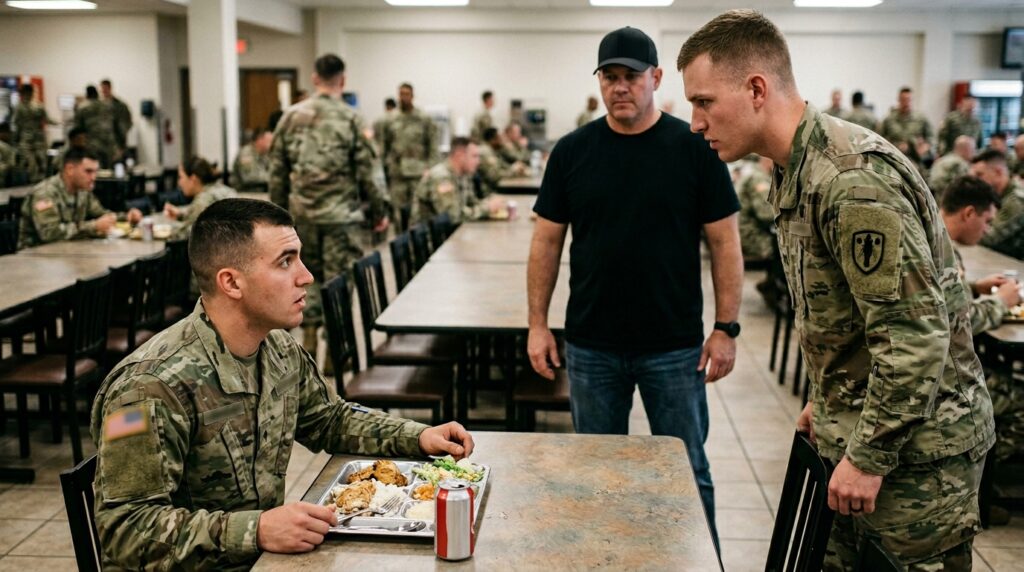
The Wear and Tear of Unspoken Orders and the Price of Civilian Alliances in the Gray Desert
CHAPTER 1: THE FRICTION OF ALIGNMENT
“I’m just trying to finish my meal, what’s your problem?”
The words left my mouth flat, devoid of the heat he wanted. My thumb stayed pressed against the condensation on the soda can, feeling the precise point where the aluminum buckled under the small pressure of my grip.
Miller didn’t move. He stood tall enough to block the fluorescent light humming directly above the table, casting a long, desaturated shadow over my lukewarm Salisbury steak. His camouflage utility uniform was stiff with heavy starch, a perfect contrast to the faded, grease-stained hem of my own collar. He leaned in just enough for me to smell the stale wintergreen tobacco on his breath, his knuckles whitening as he planted them on the edge of the laminate table.
“Your problem is you think you’re a ghost, Miller,” he said, his voice dropping an octave to keep from carrying across the concrete floor of the dining facility. “You think because you came back from the sandbox with a clean file and a closed mouth, the rest of the platoon doesn’t see what you’re doing. You missed formation by two minutes yesterday. You didn’t sign the log at the arms room. You’re fraying at the edges, and it’s going to get someone hurt.”
It was a beautiful lie. The arms room log hadn’t been checked since the winter inspection, and everyone in the third squad knew it. This wasn’t about two minutes or a signature. It was about the training incident at the concrete canyon thirty days ago—the one where the lieutenant broke protocol and three trucks ended up with cracked axles that never made it into the official maintenance reports. They wanted to know if I had saved the digital manifests on my personal drive.
“Step back, Miller,” I muttered, my eyes tracking the small, jagged scar just below his left earlobe. I calculated the distance between my plastic fork and his throat, then dismissed it. The cost was too high. The Uniform Code of Military Justice was a machine designed to grind down the first man who swung.
“Make me.”
The space between us suddenly vanished, but it wasn’t my move. A heavy, oil-scented mass wedged itself directly into the interaction lane.
A black t-shirt, thick with the smell of diesel and dry earth, filled my vision. It was Vance, the civilian maintenance contractor who spent his days rebuilding the hydraulic lifts in the logistics warehouse. His solid, forty-five-year-old frame didn’t bounce when Miller’s chest hit his shoulder. Vance didn’t look at me, and he didn’t look at Miller. He just kept his arms slightly extended, palms open but unyielding, a human wedge separating the active duty heat.
“Back off, both of you,” Vance said. His voice had the dry, gravelly rattle of a man who had retired twenty years ago as a master sergeant and no longer cared about the bars on a man’s chest or the rank on his sleeve. “This floor is wet. If either of you slides on it, the commander’s going to have my boys cleaning up the paperwork until midnight. Take it outside the gate.”
Miller stared at the back of Vance’s grease-stained cap for three seconds. The silence between them was purely transactional; Miller was weighing the optics of pushing past a civilian base employee in a room full of thirty silent witnesses who were currently pretending to study their phones. Slowly, Miller stood up straight, his hands leaving the table with a sharp, sticking sound.
“He’s all yours, old man,” Miller spat, casting one final, freezing glance down at my tray. “But the logbook doesn’t lie. Check your locker before shift tomorrow, ghost.”
He turned on his heel, his boots clicking in a rhythmic, military cadence against the gray floor tile until the double doors of the facility swung shut behind him.
Vance didn’t move until the doors stopped vibrating. Then, without looking down at me, his hand reached into his back pocket and pulled out a small, heavy plastic object, dropping it into the center of my tray right into the gravy. It was a broken digital data key from the logistics office—the specific model used to authorize the release of sealed tactical gear from the secure storage bunkers. It was scorched around the copper contacts, as if someone had tried to burn the serial numbers off with a lighter.

CHAPTER 2: THE WEIGHT OF THE LOCKER
The data key sank into the lukewarm brown grease of my Salisbury steak with a heavy, wet plop. A small drop of gravy splattered against the rim of my plastic cup, but I didn’t wipe it away. My eyes stayed locked on the scorched green fiberglass of the circuit board sticking out from the congealing mess. The copper pins were twisted, melted down into bubbles of shiny slag by something far more localized and intense than a common lighter. That was the unmistakable signature of a high-amperage battery short, the kind you get when you deliberately jam a metal screwdriver into a logistics terminal to erase a hard drive’s memory cache before the inspectors arrive.
Vance was already moving away before the gravy had stopped settling around the key. His heavy work boots made a dry, rhythmic scraping sound on the grit-dusted linoleum as he headed toward the double doors, his hands shoved deep into the pockets of his oil-darkened canvas trousers. He didn’t look back to see if I was going to fish it out. He didn’t have to. In the motor pool and the logistics bays, Vance didn’t waste movement on gestures that didn’t have a practical consequence.
I reached down, my fingers slipping on the slick surface of the tray as I pinched the clean end of the key. The plastic was warm—not from the food, but from the pocket of Vance’s jacket. I pulled it free, wiped the thick grease against the rough edge of a paper napkin, and slid it into the small coin pocket of my uniform trousers. The metal edge bit into my hip through the thin cotton lining, a tiny, persistent reminder of the friction that had just entered my circle. Miller’s parting threat echoed in the quiet space behind my eyes: Check your locker before shift tomorrow, ghost.
The company barracks smelled of floor wax, damp laundry, and the specific metallic tang of gun oil that seemed permanently baked into the concrete walls. It was three in the afternoon, the dead space of the duty day when the building was entirely empty save for the shift-workers sleeping off their night guard. The long hallway was a tunnel of desaturated olive drab doors and pitted steel lockers, each one bearing a strip of faded masking tape with a rank and a last name.
When I reached locker forty-two, I didn’t need to punch in the combination.
The heavy master padlock hung open, its hardened steel shackle swinging loosely from the latch like a broken jaw. The gray paint around the locking mechanism was scored and bright where a flat-head crowbar had peeled the metal skin back. They hadn’t even tried to make it look like an inspection. This was an eviction notice written in pry-marks.
I pushed the door open with the toe of my boot. The sound of the tinny metal hinges scraping against the frame seemed loud enough to wake the dead in the lower bays. Inside, my world had been systematically turned inside out. My spare sets of operational camouflage pattern uniforms had been yanked from their hangers, the pockets turned inside out, the small velcro patches for my name tape ripped free and scattered across the bottom shelf like dead leaves. My extra pair of rough-out leather boots had been kicked into the back corner, one of the laces sliced through near the brass eyelet.
I didn’t reach in right away. I stood perfectly still, my chest rising and falling in the slow, deliberate rhythm they teach you on the long-range surveillance courses to keep your heart from rattling your ribs. I looked at the floor of the locker first, scanning the dust layer for what was missing rather than what was broken.
The olive-drab assault pack was gone. Inside it had been my personal log from the overseas rotation—not the official operational journal that went to the battalion clerk, but the small, threadbound field notebook where I’d jetted down the actual grid coordinates of the three logistics trucks that had split their frames in the wadi during the lieutenant’s unauthorized night maneuver. That book wasn’t evidence of a crime; it was evidence of incompetence, the kind that costs three hundred thousand dollars per chassis and takes six months to clear through the regional maintenance depot.
But they hadn’t just taken the book.
On the middle shelf, sitting perfectly upright on top of my folded wool socks, was a single, pristine box of standard-issue 9mm ammunition. The cardboard was clean, the factory seal unbroken, but the lot number stamped on the side was missing its final three digits, crudely scraped away with the tip of a pocket knife. My personal weapon wasn’t in the barracks—it was locked in the arms room three blocks away—which meant the only reason this box was sitting in my ruined locker was to create an immediate, reportable violation for contraband ammunition during the command sergeant major’s random inspection tomorrow morning.
A floorboard creaked behind me at the end of the bay.
I didn’t turn around fast. I let my hand drop naturally toward my right pocket, my fingers brushing against the scorched data key Vance had given me. Through the rusted screen of the fire door at the end of the hall, the silhouette of a man passed across the frosted glass, his outline blocked by the wide brim of a patrol cap. He didn’t stop, his footsteps disappearing down the concrete stairwell with the heavy, unhurried weight of someone who knew exactly how much time he had before the shift changed.
My locker wasn’t a crime scene; it was a clock. The moment the ammunition was found, the unit wouldn’t just confiscate it; they’d lock me in the brig under an administrative hold while they combed through my digital footprint, finding every excuse to erase the records from the concrete canyon. Miller wasn’t working alone. To get an unsecured box of ammunition out of the supply cage without a signature required an active signature from the master sergeant’s desk.
I reached into the locker, grabbed the clean box of nine-millimeter rounds, and shoved it deep into my cargo pocket next to the scorched key. I didn’t bother straightening the torn uniforms or fixing the latch. If they wanted the space to look like a warning, I’d leave it exactly as they intended.
Ten minutes later, I was crossing the gravel equipment yard behind the logistics depot, the sun dropping behind the corrugated iron roofs of the maintenance sheds and turning the sky the color of a bruised shin. The air here was thicker, smelling of old coolant, sulfur, and the dry, powdery dust that blew off the artillery ranges five miles to the west.
The lights inside Bay Four were dim, the amber glow of a portable halogen lamp casting long, skeletal shadows beneath the chassis of a disassembled five-ton truck. Vance was there, his back to the door, his thick forearms covered in a dark film of hydraulic fluid as he used a massive pipe wrench to break the seal on a rusted steering knuckle. The sound of his effort—the metallic grunt of the tool, the dry scrape of his boots against the oil-spotted concrete—filled the cavernous space.
“The locker’s cleaned out, Vance,” I said, staying just outside the yellow circle of the halogen lamp.
The old man didn’t stop pulling on the wrench. His shoulders bunched under the black cotton of his shirt, the muscles knotted like old cedar roots. “They take the notebook?”
“Yeah.”
“Then you’re behind the line,” Vance said, his voice flat as he finally broke the seal on the bolt with a sharp crack that echoed off the tin ceiling. He wiped his greasy palms on a rag that looked like it had been salvaged from an old field jacket. He turned around slowly, his gray eyes catching the yellow light. “Miller didn’t take that book for his own reading, son. He took it because the logistics officer needs to show an intact inventory before the pre-deployment loaders arrive on Monday. And right now, that data key in your pocket is the only thing that says those three trucks didn’t just vanish off the books due to administrative error.”
He reached into the tool chest behind him, his fingers bypassing the clean chrome sockets and selecting a long, heavy iron pry-bar that had been ground down to a wicked, flat point at one end. He didn’t hand it to me; he just laid it across the hood of the dead truck between us.
“We have about three hours before the night guard locks the outer perimeter gate,” Vance murmured, looking down at the heavy iron tool. “The logistics office keeps the physical backup drive in the old generator bunker behind the motor pool. If you want your life back, you’re going to have to help me turn a few bolts that aren’t on the daily maintenance schedule.”
CHAPTER 3: THE DECOY IN THE GENERATOR BUNKER
The iron pry-bar felt cold, its sandblasted texture catching the thin sweat on my palms as we moved down the shadow lane behind the motor pool. The night air was thick with the scent of uncombusted diesel and the damp, metallic breath of old earth. Vance walked with a low, unhurried stride that kept his boots from crunching into the crushed limestone gravel. He carried a heavy canvas toolkit that jingled like dull coins with every fourth step.
The old generator bunker was a squat concrete pillbox built during the Cold War, its flat roof overgrown with wild ryegrass and rusted chain-link reinforcement. The steel door faced away from the active lanes of the base, tucked into a recess where the base drainage canal cut through the perimeter wire. A single padlocked latch held it shut, the iron coated in layers of flaking red oxide dust.
Vance stopped five feet back, his gray eyes scanning the dark horizon before he nodded toward the hinge. “Don’t touch the lock. The administrative clerk marks the keyhole with a pencil graphite sliver. If it snaps, they know someone turned the cylinder. Take the upper pin out instead.”
I jammed the flat point of the iron bar behind the top hinge plate. The rust resisted at first, biting into the steel with a high-pitched, grinding squeal that made the hairs on my neck stand up. I threw my weight against the lever, my boots digging into the loose dirt until the pin yielded with a wet, heavy chunk, dropping straight into the weeds below. We swung the steel door out from the top just enough to clear the frame.
Inside, the bunker smelled of old battery acid and dead mice. A massive, obsolete diesel generator occupied the center of the room, its massive iron block dark and oily like a sleeping animal. Tucked behind the exhaust manifold was a modern gray field desk, its top holding a sealed Pelican case with a braided fiber-optic cable running down into the concrete foundation.
Vance clicked on a small penlight, filtering the beam through his greasy fingers so only a narrow sliver of yellow light illuminated the lock on the plastic case. “This is the local hub mirror for the logistics database. The command section thinks the only terminal is in the main office, but every manifest changes here first before it syncs with the regional server at midnight.”
He didn’t use a tool for the case. He pulled a heavy master data key from his own shirt pocket—not scorched like the one he dropped in my food, but bright, polished copper. He slid it into the side port, and the small LED indicator on the box shifted from red to an amber amber blink.
“Look at the screen,” Vance whispered.
The lines of text were small, green phosphor characters scrolling across a desaturated liquid crystal display. It wasn’t a list of broken vehicles or cracked axles. The columns showed specific stock numbers—AN/PVS-14 monocular night-vision devices, thermal sights, laser designators—all marked with a triple-zero disposal code.
“That’s forty crates of tier-one optics,” I muttered, my fingers tightening on the edge of the metal desk. “The manifest says they were destroyed during the field exercise at the concrete canyon. It has my platoon leader’s digital signature on the line.”
“They weren’t destroyed,” Vance said, his voice dropping into a hard, rhythmic drone. “They were transferred to a civilian freight line out of the north gate three nights ago. Miller wasn’t hunting you because of a notebook, kid. He was hunting you because your platoon’s logs show those trucks were carrying empty crates into the canyon hours before the exercise even started. This is straight black-market theft. They’re stripping the inventory and selling it to private security firms before the deployment orders hit the wire.”
The realization hit my stomach like a cold stone. It made perfect sense. The missing gear, the ruined locker, the planted ammunition—it was all an elaborate shell game to frame me as a rogue supply clerk who had compromised the logistics network for personal profit. Miller was the muscle, the lieutenant was the signature, and I was the designated fall guy.
But as I stared at the green text, something didn’t align. The green line didn’t end with the lieutenant’s authority. The high-level decryption protocol used to unlock the local server required a security clearance three levels above a platoon leader. Below the deletion line, a secondary, handwritten ledger code was scratched into the plastic casing of the terminal box itself: Project Iron Forge – Phase Two.
“Vance,” I said, pointing the penlight at the scratched plastic. “That’s a regimental logistics marker. A lieutenant can’t authorize a Phase Two movement.”
Before Vance could answer, the small amber light on the Pelican case went entirely dark. The steady hum of the fiber-optic hub died, leaving the bunker in a thick, absolute silence that felt heavy enough to choke.
From the gravel road outside, the low, throbbing rumble of a heavy engine approached, the headlights cutting through the gaps in the door frame and painting long, jagged bars of white light across the concrete ceiling. The vehicle didn’t speed past; it slowed down, the tires crunching to a halt directly outside our open hinge.
The doors of the truck clicked open, followed by the distinctive, metallic clack-clack of two tactical utility belts shifting as men stepped out onto the gravel.
“Check the canal side,” a voice called out through the dark. It was Miller’s voice, cold and entirely devoid of the cafeteria’s theatrical anger. “The maintenance office said Vance’s badge just logged into the secondary hub. If they’re inside, don’t use the radio. Just pin them to the wall.”
I looked at Vance, but the old veteran was already dropping his penlight into his pocket, his hand silently wrapping around the iron pry-bar on the deck. The decoy secret of a simple supply theft had just vanished, replaced by the shadow of an organized base-wide net that already knew our exact location.
CHAPTER 4: THE MOTOR POOL BACKALLEY CONFRONTATION
The white light of the truck’s high-beams leaked through the rusted gaps in the concrete bunker door, slicing the dark interior into bright, vibrating bars of dust. Outside, the engine purred with a smooth, synchronized mechanical rhythm—the signature of a pristine, fleet-maintained command vehicle, not a standard tactical truck.
Vance pushed his thumb against my chest, his grip firm as he guided me toward the shadowed pocket behind the massive, disused generator block. The iron block was cold against my shoulder blades, smelling of old, petrified lubricants and flaking primer. We didn’t breathe. Every scuffle of leather against the grit-strewn foundation felt amplified ten-fold within the narrow pillbox.
“They’re not here to talk,” Vance breathed, his lips barely moving against the side of my ear. His fingers shifted down to the ground iron bar in his left hand. “The local network hub logs everything in real-time. The moment we tapped that terminal, a silent alarm tripped at the provost marshal’s office—or straight to the major’s desk. They can’t let us walk out with those ledger entries.”
The heavy steel door scraped against the gravel outside as it was pushed inward from the top hinge we had disabled. A flashlight beam split the dark, casting a brilliant, bouncing circle across the gray Pelican case and the empty field desk.
“Terminal’s warm,” Miller’s voice cut through the dark, tight and professional. The theater from the cafeteria was completely stripped away now. He wasn’t playing the role of a disgruntled peer anymore; he was an operative cleaning a spill. “The mirror data key is missing from the slot. They didn’t just look; they copied.”
“They didn’t go out the front,” a second voice answered from the threshold—deeper, carrying the distinct inflection of an older man who spent his days in air-conditioned command suites rather than the motor pool. “The canal trail is clear. They’re still in the footprint.”
Vance didn’t hesitate. He took two steps out from behind the generator block, his boots making no more noise than a shadow, and pushed his weight against the structural release valve on the side of the ancient fuel cell. A heavy, dark stream of unrefined heating oil glided out across the concrete floor, slicking the path between the field desk and the door frame within three seconds.
“Go,” Vance hissed, shoving me toward the emergency vent hatch behind the generator—a narrow, square portal designed for coal intake forty years ago.
I scrambled through the iron opening, the rusted frame biting through the sleeve of my camouflage uniform and scraping a jagged white line across my forearm. I dropped four feet into the soft, rain-soaked silt of the drainage ditch outside, the smell of rotten vegetation and brackish runoff filling my nose. Behind me, inside the bunker, a sharp, metallic crash echoed as someone’s boot slid on the oil-slicked concrete floor, followed by a heavy curse and the dull thud of an iron bar connecting with a fiberglass case.
I didn’t look back to see if Vance followed. I kept my head below the level of the canal bank, my knees pumping through the thick weeds until I reached the gravel expanse behind the third-tier maintenance bays. The air here was desaturated, stained by the yellow sulfur lamps of the distant perimeter fence.
A single vehicle sat idling at the edge of the gravel lot, its low-beams cutting a pair of dusty yellow tunnels through the rising mist. It was a dark, unmarked pickup truck with government plates. The driver’s side door was unlatched, swinging open just an inch.
I kept my hand on the cargo pocket containing the box of nine-millimeter rounds and the copper key, my heart hammering a rhythmic cadence against my ribs as I approached from the blind spot behind the vehicle’s rear quarter panel. I reached through the gap in the window, my fingers finding the cool plastic of the glovebox latch. It popped with a soft click.
Inside, beneath a stack of clean vehicle logs, sat a manila folder with a fresh, blue-ink stamp: Administrative Separation – Non-Judicial Punishment.
I pulled the top sheet out under the faint glow of the dashboard light. My name tape was printed at the top. The charges weren’t about stolen night-vision gear or a training incident at the concrete canyon. The document described a systematic pattern of psychological instability, culminating in the intentional sabotage of logistics equipment and the theft of small-arms ammunition from the company cage. It was signed by the battalion commander, dated for the upcoming Monday—the exact morning the deployment loaders were scheduled to arrive.
The whole thing was already written. The mystery wasn’t a secret black-market ring operated by corrupt soldiers like Miller; it was an official command policy. The unit hadn’t lost forty crates of night-vision devices to common thieves; they had diverted them to fund an unvetted, off-the-books tracking program in the eastern sector, using the untraceable sales to bypass the congressional budget cuts. I wasn’t being framed because I was a witness; I was being used as the pre-planned accounting write-off for the missing equipment.
“You should have stayed at your table, ghost,” a voice said from the shadow of the truck’s tailgate.
Miller stepped into the dull illumination of the low-beams. He wasn’t carrying a weapon in his hand, but his right arm was tucked casually behind his hip, his shoulder slightly dropped in a classic retention stance. His face was pale under the sulfur light, his mouth set in a hard, pragmatic line that looked entirely like my own mirror reflection.
“The major signed those papers three days ago,” Miller said, his voice flat as the idling engine between us. “It doesn’t matter what you found in that bunker. The manifests are already locked in the primary cloud at the department level. You’re a line item that doesn’t balance anymore, Miller. If you walk out that gate, you’re just a deserter with a pocket full of stolen property.”
I looked down at the paper in my hand, the crisp white sheet fluttering slightly in the cold desert wind. The physical evidence I held—the key, the box of rounds, the manifest print-outs—meant nothing within a machine that possessed the legal authority to rewrite my identity before the sun came up. The tactical victory Vance and I had fought for in the generator room was an illusion. The infrastructure of the base was already closing around me like a rusted trap.
“Where’s Vance?” I asked, my voice dropping into the same flat, transactional tone Miller used.
Miller didn’t answer. He just took one slow step forward, his boot grinding a piece of loose limestone into fine white powder against the oil-spotted gravel.







