
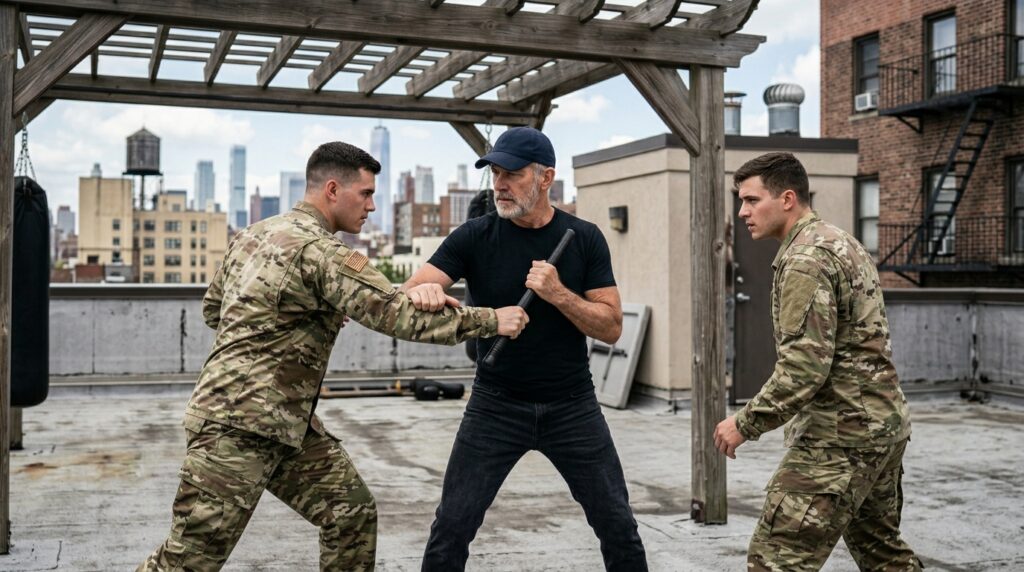
The Weight of Salt and Iron: A Lineage Written in Dust and Broken Bones

CHAPTER 1: THE SILENCE UNDER THE PERGOLA

“Get up,” Miller said.

The wooden baton was heavy in his right hand. The hickory wood had absorbed forty years of palm sweat and mineral oil, turning the grain a dark, bruised plum color. It didn’t vibrate when it hit bone; it just transferred the shock straight up through his forearm, settling into the calcified tissue of his elbow.

Below him, the two operators didn’t move. Not immediately. The one on the left, whose name tape read Vance, was curled on his side over the coarse roof gravel. The gray stone chips were embedded in the cheek of his camouflage uniform, leaving little red indentations where his face had met the deck. His breaths came in dry, ragged rattles, his lungs trying to reset after Miller’s knee had collapsed his diaphragm.

The second one—younger, with a jawline that looked like it had been carved out of government-issue chalk—was staring up through the gaps in the pergola. A single line of dark red was creeping out of his nostril, cutting a track through the dust on his lip. His hands were open, fingers twitching against the gravel as if trying to find the grip of a weapon that wasn’t there.

“You’re tracking too wide on the entry,” Miller said. His voice was flat, dried out by the midday heat and the smell of hot asphalt rising from the lower tiers of the building. “Both of you. You move like the uniform does the thinking for you. It doesn’t.”

He didn’t offer a hand. That wasn’t part of the work. He watched them through eyes that had grown narrow from decades of looking into sun-baked courtyards and gray rain. His dark cap was pulled low, the brim frayed down to the white plastic stiffener inside.

Vance pushed himself up to one knee. The movement was slow, deliberate, the mechanical sequence of a body checking itself for fractures. He looked at Miller’s denim jeans, then at the scuffed leather of his work boots, and finally up at the baton. There was no hatred in his eyes yet. Just the cold, clinical confusion of a machine that had encountered an unmapped obstacle.

“The manual specifies a three-point containment layout for non-compliant targets,” Vance said, his voice tight from the compression in his ribs.

“The manual assumes I have a joint that wants to bend the way you’re pulling it,” Miller replied. He turned the baton over in his hand, feeling the balance point. “I don’t. Thirty years of salt and damp took the grease out of my shoulders before you learned how to tie your boots.”

He looked past them, toward the rusted metal fire door that led down into the belly of the old warehouse. The lock was simple, a mechanical tumbler he’d oiled himself three days ago. But the air up here felt different now. The silence wasn’t the quiet of a retired district; it was the dead space between a fuse being lit and the powder catching.

The younger one on the gravel finally sat up, wiping the back of his hand across his nose. He looked at the smear of red, then at his partner. “We have to report the non-acquisition.”

“Tell them whatever helps you sleep,” Miller said. He stepped backward, his boots making a dry, crunching sound on the gravel. He didn’t turn his back on them. He kept his center of gravity low, his weight distributed through his hips, waiting to see if the modern discipline inside them would snap into something less predictable.

Vance reached down, picking up his tactical cap from where it had rolled into a puddle of stagnant rainwater near the drain. He squeezed the water out of the fabric. His movements were small, precise, but his knuckles were white.

“They’ll send the second section,” Vance said softly. “They aren’t going to leave the logbook open on this one, Miller. You know how the office works now. Everything has to balance.”

Miller stopped five paces from the fire door. He reached into his pocket and pulled out the manual watch. The silver casing was scratched, the crystal clouded by small lines where it had scraped against concrete walls in places that didn’t exist on standard maps. He wound the crown three times until it resisted. The uneven, metallic click was the only sound under the pergola.

“The office handles paper,” Miller said, his thumb resting on the cold steel of the fire door handle. “I handle the space between the floor and the throat. Tell them that when you hand back your brass.”

He pulled the door open. The darkness inside smelled of old wool, dry rot, and grease. As the latch began to click behind him, he looked down at the gravel. Near Vance’s boot, half-buried in the gray stones, was a small, black plastic data drive—dropped from the operator’s utility pouch during the final grapple. Its indicator light was dead, but the clean, unmarred edges of the plastic didn’t belong in the dust.

Miller froze, his hand still on the inner handle, the shadows of the stairwell swallowing his face.


CHAPTER 2: WINDING THE OLD GEARS

The iron door latch didn’t give easily. It had been exposed to three decades of river damp and soot from the freight yards below, and when Miller put his weight against it, the metal screamed—a sharp, dry screech of oxide grinding against oxide. He didn’t look back at the two men on the gravel, but his ears tracked the wet, heavy rasp of Vance trying to stand.

Before the door swung closed, Miller’s boot slid three inches to the left. The thick, oil-resistant rubber edge of his sole caught the black plastic data drive, dragging it across the grit until it vanished into the shadow of the interior threshold. He let the heavy fire door slam shut behind him. The deadbolt dropped with a solid, hollow thud that vibrated through the concrete under his feet.

The stairwell was a vertical shaft of desaturated gray. The air was cold, smelling faintly of old lime mortar and the copper tang of leaking radiator pipes. Miller stood still for ten seconds, his back pressed against the corrugated steel of the door, listening to the iron frame hum. No one was pounding on it. Not yet.

He let out a long, slow breath through his teeth. His right shoulder was locked tight, the deltoid stiffening where the younger operator had tried to wrench the humerus out of its socket using a standard textbook lever. It was a good lever. If Miller had been twenty years younger, he would have countered with a rotational break; today, he had simply let his weight drop like a sack of wet salt, letting gravity dissolve the geometry of the hold. It had worked, but the price was a dull, throb-like heat radiating from the joint.

He reached down into the gloom and picked up the data drive. The plastic was smooth, too clean for a building that had been shedding its skin since the mid-seventies. It was light—less than an ounce of carbon fiber and flash memory—but it felt heavy with implication. He dropped it into his shirt pocket, where it clinked against the steel casing of his manual watch.

He descended the stairs, his boots rhythmically striking the iron treads. Each step was an inventory of friction. His left knee clicked—a reminder of an old deployment in an anonymous port town whose name had been redacted from every official ledger. The handrail was rough under his palm, the green paint flaking away in dry flakes to reveal the pitted orange rust beneath.

On the third-floor landing, he entered his workspace. It wasn’t an office; it was a workshop for things that couldn’t be repaired by a machine. A heavy cast-iron lathe sat in the corner, covered in a thin skin of amber machine grease to keep the salt air from seizing the gears. Above it hung a pegboard lined with files, hacksaws, and specialized punches—all of them manual, all of them worn smooth at the grips by the skin of his hands.

He walked over to a small zinc-topped bench, his movements deliberate and unhurried despite the clock ticking in his head. He laid the wooden baton down on the metal. The plum-colored hickory looked dark against the gray zinc, its surface marred by a few fresh silver gray scratches from the gravel above.

“They won’t go back to the barracks,” he said aloud to the empty room. His voice sounded small against the concrete walls, dry as a dead leaf.

They wouldn’t. Modern protocol required a secondary perimeter validation if the primary collection team experienced an operational deficit. They would call the center from their encrypted units before they even reached the street. The administrative machine didn’t like empty spaces in its spreadsheets; an unresolved asset was an unhedged risk.

Miller sat down on a stool made of welded angle iron. He reached up, unbuttoned his shirt, and checked his shoulder in the reflection of a grease-smeared mirror hanging above the sink. The skin was already turning a deep, yellowish purple where the camo-clad operator’s fingers had dug in, trying to find the nerve bundle behind the collarbone. It looked like an old bruise, the kind that never really leaves a man after he passes fifty.

He reached into his pocket and pulled out the data drive alongside his grandfather’s watch. He laid them side by side on the zinc. The watch’s mechanical heartbeat was loud here—tick-tick-tick-tick—uneven but persistent, a small brass balance wheel fighting against its own friction. The data drive just sat there, black and dead, a piece of silent logic waiting for a current to make it speak.

He didn’t have a computer that could read it. He didn’t want one. Those lines left traces in the glass cables under the streets, crumbs for the auditors to follow. But he knew someone two blocks over who still kept an isolated terminal in the back of a legal printing shop—a man who still understood that some records were better kept on magnetic tape than in the cloud.

Miller stood up, his joints protesting with small, dry pops. He reached into the lower drawer of the tool chest, beneath a pile of oil-hardened leather gaskets, and pulled out an old canvas duster. It was stiff with dried tallow and road dust, the hem frayed where it had dragged along coach floors and train steps. He slid his good arm through the sleeve first, then carefully eased his injured shoulder into the rest of the fabric.

He picked up the drive and the watch. He didn’t take the baton. A stick in the street drew eyes, and the street was about to become very small. He looked around the workshop one last time, his eyes lingering on the iron lathe. The machine had been built to last a century, but if he didn’t move now, they’d scrap it for the iron value before the week was out.

He walked to the rear exit—the one that opened into the alley where the grease traps from the commercial kitchens drained into the brick gutters. He turned the heavy brass handle, feeling the resistance of the old mechanism before the latch withdrew. The air that came in from the alley was hot, thick with the smell of scorched lard and the gray exhaust of delivery trucks.

He stepped out, locking the door behind him with a key that had been cut by hand from a blank piece of iron stock. The city was out there, moving at its own digital pace, entirely unaware that the old gears had begun to turn again.

CHAPTER 3: THE PAPER TRAIL

The basement stairs of terminal 4 printing were narrower than Miller’s shoulders. The walls were unpainted brick, sweating a white, powdery fur of saltpeter that rubbed off on his canvas coat as he navigated the turn. At the bottom, the air was different—heavy with the chemical bite of isopropyl wash, old lead alloy, and the rhythmic, industrial thudding of an offset press operating somewhere behind the drywall.

An old man named Arkwright sat beneath a bare sixty-watt bulb, his skin the color of parched vellum, his fingers stained a permanent, indelible black from decades of handling fresh ink. He didn’t look up when the iron-framed door clicked shut. His eyes stayed fixed on a flatbed scanner from the turn of the century, its glass top cracked and held together with yellowed packing tape.

“The roof team didn’t look happy when they came down,” Arkwright said. His voice was like two bricks being dragged across gravel. “The young one was holding his ribs. He looked like he’d been run over by a freight car.”

Miller reached into his canvas duster, took out the black plastic data drive, and set it on the iron surface of Arkwright’s desk. The drive looked unnaturally clean against the ring-stains of stale coffee and the dried grease of the printing tools. “They dropped this. See what’s on the ledger line.”

Arkwright looked at the plastic rectangle for five long seconds. He didn’t touch it. Instead, he reached into his apron, pulled out a pair of thick, wire-rimmed spectacles, and hooked them behind his ears with trembling, scarred fingers. “You shouldn’t have brought that here, Miller. The newer stuff has a signature. If it connects to the junction, the routers flag the node within twelve minutes.”

“It’s cold,” Miller said, sitting on a wooden crate marked Type Metal. He rested his bad shoulder against the brick wall, feeling the damp chill penetrate his shirt. “No battery. No active ping. It’s standard administrative issue. They were using it to log my daily cycle. Someone had to sign the operational clearance to pull the log.”

With a low grunt, Arkwright picked up the drive using a pair of rusted metal tweezers, as if the plastic were infected. He slid it into an isolated bay on a machine that looked older than the warehouse above. The monitor was a heavy cathode-ray tube, its green phosphor screen flickering with a low, micro-tonal hum that made the fillings in Miller’s teeth ache.

Columns of dull green text began to crawl upward through the glass. The interface was crude—no icons, no modern design, just the raw administrative language of a system that had forgotten its own creators. Arkwright’s fingers worked a mechanical keyboard, the keys striking the microswitches with a heavy, rhythmic clacking that sounded like a small caliber weapon being cycled in an empty room.

“It’s an unindexed deployment ledger,” Arkwright murmured, his nose three inches from the glass. He spat a dark fleck of tobacco into a rusted tin can by his foot. “No name for the project. Just a budget line: Legacy Reconciliation Protocol. They’re clearing out the old storage lockers, Miller. You’re listed as unamortized hardware.”

“Look at the regional signature,” Miller said. His fingers wrapped around his manual watch, feeling the heavy, uneven vibration of the mainspring through the steel case. “The kids didn’t come from the local detachment. Their boots were wrong. The leather was too stiff for the coastal humidity. They were shipped in from the western depot.”

Arkwright typed a command, the green light reflecting off his spectacles in twin, pale squares. The machine groaned, its cooling fan rattling against its iron housing. A fresh block of data appeared—a single logistical manifest listing the fuel requisitions, the vehicle serial numbers, and the digital authorization key required to cross state lines with state-sanctioned training equipment.

“The signature is encrypted,” Arkwright said, his thumb tracking down the edge of the screen. “But the stamp… the stamp has an old ink pattern. The office doesn’t use it anymore, but the old logistics clerks still keep the physical plates for internal audits.” He paused, his blackened fingers freezing over the keys. “This isn’t an automated script, Miller. This was cleared by hand.”

Miller leaned forward, his boots scraping against the grit on the concrete floor. “Whose hand?”

Arkwright didn’t answer. He reached out and tapped the glass monitor with his fingernail, right over a line of alphanumeric code that looked identical to every other string on the screen. But to an eye that had spent forty years reading the margins of the state’s ledgers, the discrepancy was visible. It was a secondary validation code—a personal identifier used back when the training programs were still run out of the old concrete camps in the desert.

“It’s an old instructional mark,” Miller said softly. The iron tang in his mouth felt sourer now. “The triple-zero sequence. Only three men from my cycle had the clearance to use that prefix when ordering a field verification.”

“Two of them died in the river crossing back in ’94,” Arkwright said, turning his head to look at Miller through the side of his spectacles. The green phosphor light caught the deep, leathered wrinkles around his mouth. “Which leaves the boy you brought out of the salt flats. The one who used to clean your files before they gave him a desk in the main building.”

The silence in the basement became absolute, saving for the distant, heavy thudding of the offset press on the other side of the brick wall. Miller looked down at his own hands—the thick, scarred skin around the knuckles, the permanent grease under the nails, the wear and tear of a life spent staying outside the lines. He had taught that boy how to measure the distance between a man’s collarbone and his pulse using nothing but a three-inch piece of iron pipe. He had taught him how to look for the tiny irregularities in an official manifest to find out if an ambush was being prepared.

And now, those same irregularities were sitting on a green glass screen in a cellar that smelled of rot, signed with the exact operational prefix he had given the boy thirty years ago as a field name.

“He’s the director of the regional modernization initiative now,” Arkwright said, his voice dropping an octave until it was barely a vibration in the brickwork. “They call it the Unified Core. They’re rewriting the books, Miller. If it isn’t in the system, it doesn’t exist. And if it doesn’t exist, it can’t be permitted to leave an impression on the gravel.”

Miller stood up. The canvas duster felt heavier now, as if the water-resistant wax had absorbed the dampness of the entire basement. He reached down, took the watch from the zinc table, and slipped it back into his pocket. He left the data drive where it was.

“He knows where the workshop is,” Miller said. He walked toward the narrow stairs, his right shoulder twingeing with a sharp, iron heat. “He knows the timing of the locks. He knows I don’t leave by the front.”

“He sent kids with wooden sticks, Miller,” Arkwright called out after him into the dark of the stairwell. “Next time, it won’t be an evaluation. He knows you won’t accept a pension.”

Miller didn’t look back. He began the climb, his boots finding the worn centers of the stone steps, his hand sliding along the cold, rusted iron rail until the daylight from the upper door hit his eyes like a dry slap.

CHAPTER 4: THE DECOY IN THE LEDGER

The grease-smeared handle of the metal tool chest scraped against Miller’s knuckles as he pulled a three-pound iron drift from the bottom shelf. He didn’t use the lights. The daylight filtering through the dust-coated windows of the print shop’s upper warehouse was thick with floating lint, painting everything in dull, horizontal bands of gray and copper.

He knew the boys’ signature. He knew the way the ink ran on the logbooks when the boy was nervous—leaving a tiny smear at the tail of the triple-zero prefix where his thumb had pressed too hard against the paper. The ledger on Arkwright’s screen hadn’t been a routine audit. It was a targeted search query, and the parameters had been set to pull one specific name from the cold storage files. Miller’s name.

He dropped the iron tool into the canvas pocket of his duster. The heavy weight pulled the cloth down against his uninjured shoulder, balancing the dull, deep throb on his right side. He had four hours before the regional office realized the roof team hadn’t checked into the secondary validation point. Four hours before the local transit lanes were tightened like an iron collar around the district.

The rear alley was still empty when he stepped through the frame, but the quiet was transactional. A black utility vehicle with state government plates was idling under the rusted girders of the old rail spur forty yards down. The exhaust smelled of heavy diesel and unburned additives—the signature of an engine modified to bypass local emissions tracking.

Miller didn’t turn back toward the stairs. Instead, he walked toward the vehicle, his boots hitting the oily asphalt with a slow, flat rhythm that didn’t invite attention from the side mirrors. The driver’s window was dark, treated with a mirrored zinc film that reflected the decaying brickwork of the warehouse opposite.

He stopped three feet from the panel, his right hand resting inside his duster pocket, fingers coiled around the cold, textured iron of the drift pin.

“The seal on the rear crate is broken,” Miller said through the glass. His voice was flat, carrying no more anger than a carpenter inspecting a split piece of pine. “The logistics office usually changes the zinc tags before they clear the freight yard.”

The window slid down two inches with a dry, mechanical hiss. The air inside the cabin was cold, sharp with the chemical scent of synthetic upholstery cleaner and the dry metallic tang of an official data terminal running at high capacity. A man in a dark gray administrative tunic looked out, his eyes shielded by thick, glare-reduction lenses. He didn’t have the build of a field asset; his throat was soft, his fingers long and white where they rested on the leather rim of the steering wheel.

“Move along, sir,” the driver said. His tone was professional, leveled by the absolute confidence of a man who carried a laminated identification card that overrode municipal laws. “This is a restricted transit lane.”

“The triple-zero code belongs to Carver,” Miller said, his eyes tracking a tiny scratch on the vehicle’s side panel where the gray primer showed through the enamel. “He always kept the fuel ledgers in his own desk because he didn’t trust the automated tally. Tell him the hickory baton didn’t break.”

The driver’s fingers didn’t reach for a weapon. They didn’t have to. Instead, his right hand dropped toward the center console, where a small, red indicator light was pulsing—a silent data link transmitting a real-time voice feed back to the regional node.

“Identification verified,” a voice crackled from the console speaker. It wasn’t an automated script. It was a human voice, matured by fifteen years of administrative authority, but the cadence still carried the slight, clipped hesitation of the boy who used to clear the brass shavings out of Miller’s lathe. “Stand down, Courier. He isn’t going to run.”

The driver looked from the console to Miller, his mouth thinning into a hard, defensive line. He pulled his hands away from the wheel, placing them flat against the dashboard where Miller could see the skin.

“Carver,” Miller said to the speaker. He didn’t lean closer to the window. He kept his weight on his heels, his left elbow tucked tightly against his ribs to protect the injured joint. “You’re using the old instructional mark for a scrap order. The office doesn’t allow manual overrides on the logistics sheets anymore. Not since the reorganization.”

A short burst of static came through the small speaker, followed by the sound of pages turning—the distinct, heavy rustle of physical paper logs being handled in an air-conditioned room.

“The system needs the ledger cleared, Miller,” Carver’s voice came back, thin and dry through the tiny grill. “The new tracking network doesn’t accept unindexed historical assets. Every single deployment line from the old cycle has to show a terminal resolution code by the end of the fiscal quarter. If the file remains open, the whole regional sequence fails validation.”

“So you sent two kids with hickory sticks to finish the paperwork,” Miller said.

“I sent them to evaluate the state of the asset,” Carver replied. The speaker hissed as he took a breath. “If you had accepted the administrative retirement package six months ago, the line would have been closed automatically under the standard amortization clause. You refused the signature.”

“The signature required me to turn in the watch, Carver,” Miller said. He reached into his duster pocket, his thumb catching the serrated rim of the manual watch’s crown. “My grandfather didn’t get this from the company. He took it out of a dead engine in the valley before they laid the tracks.”

The line remained silent for five seconds. Through the gap in the window, Miller could see the small terminal display on the dashboard. A map of the district was expanding in green vectors, three red tracking rings pulsing around the perimeter of the print shop block. They weren’t waiting for a secondary team; the grid was already closing itself by default logic.

“The second section has already crossed the county line, Miller,” Carver said softly. There was no hatred in the speaker, only the immense, heavy exhaustion of a man who had traded his tools for an administrative grade. “They aren’t field instructors. They’re integration specialists. They don’t carry training batons.”

“Then you better tell them to bring an iron bar,” Miller said.

He brought his left hand out of his pocket. The iron drift pin caught the dull daylight as he drove the tapered point directly into the exposed portion of the window glass. The treated zinc film held the pane together for a fraction of a second before the entire sheet collapsed into thousands of tiny, clear granules that rained down onto the driver’s lap with a sound like dry rice falling onto a plate.

Before the courier could clear his eyes, Miller reached through the empty frame, caught the edge of the data terminal’s power harness, and yanked it backward until the copper wires snapped from the terminal block with a brief, blue spark.

The green map on the dashboard died instantly. The driver sat frozen, his hands still flat against the vinyl, staring at the gray canvas of Miller’s coat as the veteran stepped back into the shadow of the rail spur.

CHAPTER 5: THE INTERCEPTED TRANSIT

The heat sixty miles west of the district didn’t rise from the ground; it sat on the landscape like a slab of cold iron. Miller parked the dilapidated, primer-gray flatbed behind a row of abandoned grain silos that smelled of zinc rot and dead husks. His right arm was nearly useless now, the shoulder locked into a rigid, protective knot after five hours of driving without a power-steering assembly.

He walked toward the roadside rest stop through an acre of dry alkali brush that rattled against his canvas duster like dry bone. The diner was a desaturated concrete box with a flat roof that had sagged in the middle, collecting three seasons of black river silt that had dried into a cracked, leathery skin. Above the door, an old neon sign frame hung crookedly from two rusted chains, its gas tubes long since shattered by gravel thrown up by passing timber haulers.

Inside, the light was the color of dirty grease. A single refrigerator unit hummed a low, erratic note in the back, its condenser choked with gray lint. Behind the Formica counter, a girl with tired eyes and a grease-stained apron was wiping down an industrial coffee urn with an oily rag. She didn’t look up when Miller’s boot struck the brass threshold plate.

He didn’t take a stool. He walked directly to the back corridor, where a wall-mounted telephone box from the previous generation hung next to the emergency fire door. The iron housing was pitted with rust, the coin return slot jammed shut with old gum and oxidized pennies.

Miller reached into his pocket and pulled out the mechanical watch. He didn’t check the face; he laid his thumb against the back casing, feeling the steady, small vibration of the balance wheel. It was running three minutes slow. The humidity from the lowlands had reached the mainspring, creating a microscopic layer of friction between the teeth of the secondary gear.

He lifted the heavy iron receiver and dialed a seven-digit string that had been removed from the central exchange before the privatization of the regional network.

The connection didn’t click. It hissed—a long, cold hollow sound like wind passing through a collapsed culvert.

“Carver,” Miller said.

The response was immediate, but the signal didn’t come from a regional office. The audio was too clean, free of the low-frequency drone that characterized the central administrative pools. It carried the faint, rhythmic clink-clink-clink of an automated cooling system mounted on a vehicle chassis.

“You shouldn’t have taken the secondary route, Miller,” Carver said. His voice was lower now, flattened by the distance of a trans-county microwave link. “The perimeter tracking stations at the river junction registered a three-ounce weight anomaly on the service ferry four minutes ago. The system doesn’t need to see your face anymore. It measures the displaced mass on the iron cables.”

Miller leaned his forehead against the cold brick wall next to the phone box. The masonry was damp, shedding small granules of red sand into the collar of his coat. “The courier you sent was an administrative clerk, Carver. He didn’t even know how to reset the breaker when the terminal harness cleared. You’re running out of old names to put on the logsheets.”

“The logs are already closed,” Carver said. The speaker in the receiver gave a small, electronic pop as he shifted his position. “The regional node didn’t wait for the courier’s report. When the data terminal went dark under the rail spur, the integration program automatically logged a ‘structural casualty’ at that coordinate. The budget line has been transferred to the central maintenance fund.”

Miller’s thumb tightened against the watch casing until the silver edge bit into his scar tissue. “You’re lying to your own ledger, boy. I taught you better than that.”

“I’m not writing the ledger, Miller. That’s what you don’t see.” There was a heavy, metallic sigh on the other end of the wire—the sound of an administrative terminal being closed into its dashboard recess. “The Unified Core isn’t a policy. It’s an architecture. The tracking network doesn’t eliminate uncodified assets because they’re dangerous. It eliminates them because they aren’t computable. A combatant who doesn’t carry an automated signature is an anomaly in the calculation. Every time you cross a county line without an administrative key, the local routing tables have to rebuild their predictive vectors. It costs three thousand dollars a second in processing power just to keep the grid from flagging you as a mechanical failure.”

Miller looked through the dirty pane of the fire door. Out on the gravel lot, past his primer-gray truck, a white logistical van with a pristine chrome transit seal on the rear door had just pulled in from the state highway. The engine didn’t idle; it died instantly, the cooling vents behind the front grille closing in a silent, synchronized sequence like the gills of a suffocating fish.

Two men got out. They didn’t wear uniforms, and they didn’t carry hickory batons. They wore lightweight, desaturated gray canvas suits that looked like industrial laboratory wear, their hands covered in thin, seamless black polymer gloves that didn’t leave oil prints on the door handles. One of them was carrying a short, heavy tool with an aluminum receiver and a thick, unrifled barrel—an integration asset designed to clear mechanical obstructions from hydraulic lines with a high-velocity lead slug.

“They’re outside, Carver,” Miller said softly into the rusted iron mouthpiece.

“I know,” Carver replied. The line began to fill with the high-pitched whistle of a disconnecting carrier signal. “They didn’t ask for my authorization this time, Miller. They just extracted the geographical coordinates from the ferry’s weight log. I don’t have the key to open your file again. Nobody does.”

The line went dead with a flat, metallic snap.

Miller dropped the receiver. It swung against the brick wall on its armored steel cable, the iron shell making a dry, hollow clack-clack-clack against the mortar. He didn’t reach for his iron drift pin. He didn’t have the leverage in his right shoulder to swing it against an aluminum receiver.

He turned toward the fire door, his boots sliding through a thin layer of dry alkali dust that had blown in under the weatherstripping. The pristine chrome seal on the rear of the integration van was less than thirty yards away, its mirror-finished surface reflecting the gray outline of the grain silos like an anomaly in the dirt.

CHAPTER 6: THE HORIZON OF IRON

The fire door didn’t scream this time; it groaned, a heavy, dead friction of ungreased hinges scraping through the alkali crust that had settled into the frame. Miller stepped out into the blinding white glare of the gravel lot, his left hand shoved deep into the pocket of his canvas duster, his thumb pressed against the cold steel of his grandfather’s watch.

The two integration specialists didn’t look up with human surprise. Their movements were clean, guided by a synchronized rhythm that belonged to a manual written three thousand miles away. The one on the passenger side—the one carrying the aluminum receiver—swung his center of gravity toward the line of the door before Miller’s second boot even cleared the threshold.

Time didn’t accelerate; it dilated, breaking down into the tiny mechanical intervals Miller had spent fifty years calculating. He didn’t have the breath for a lateral dash. His right knee felt like it was filled with dry river sand, and his shoulder was a frozen knot of purple meat beneath his salt-stained shirt. Every survival instinct he had left wasn’t about speed; it was about the economy of mass.

He dropped his weight. Not into a crawl, but into a heavy, unrefined fall that let his center of gravity drag him down into the shadow of his own flatbed’s rear tire.

The aluminum weapon cycled—a sharp, pneumatic thuck that carried no black powder smell, only the sterile hiss of compressed gas releasing an eight-ounce zinc cylinder. The slug struck the concrete wall of the diner precisely where Miller’s throat had been a fraction of a second prior. The impact didn’t shatter the masonry; it pulverized it, turning the dry lime mortar into a white, chalky cloud that smelled of scorched stone and old lime.

Miller slid through the grit beneath the flatbed’s undercarriage. The smell of hot grease, leaking transmission fluid, and oxidized iron was thick down here, less than six inches from the gravel deck. His left hand found the rusted flange of the truck’s exhaust pipe—burning hot, the iron blistering the skin of his palm instantly—but he used the pain to anchor his leverage. He wrenched his body forward, his boots digging into the dry alkali dirt until his head emerged near the front axle of the integration van.

The driver’s door was still ajar. The technician was stepping down, his seamless polymer boot searching for a stable footing on the shifting stones. He never found it.

Miller reached up from the dirt, his left hand coiling around the man’s ankle with the blunt force of an old iron clamp. He didn’t pull backward; he twisted, using the edge of the technician’s own rigid boot sole as a lever against his tibia. The joint didn’t snap with a clean sound—it gave way with a wet, heavy thud as the ligaments tore under the uncodified weight of a man who didn’t exist in the tracking database.

The technician went down sideways, his gray canvas suit scratching against the gravel. Before his partner could clear the rear of the vehicle, Miller had scrambled into the open cabin of the van, his good elbow slamming into the mechanical latch of the interior console.

The inside of the vehicle wasn’t an office; it was a routing terminal. A heavy zinc housing held a flat, liquid-crystal display that didn’t show a map or a list of names. It showed a single, continuous line of green alphanumeric code that was scrolling too fast for a human eye to register—a ledger that wasn’t being typed by an administrative clerk, but by a central processor calculating the weight variables of every crossroads in three counties.

At the center of the screen, a small flashing red rectangle held a single word: EXCLUSION. Beneath it was a sub-line: Asset 000-Miller: Mass Reconciliation Confirmed.

He looked at the terminal, his breath coming in dry, hot rattles that tasted of rust and sand. Carver hadn’t signed an order to kill him. Carver had simply signed the authorization to turn on the machine. The children with the hickory sticks, the courier with the wires, these integration specialists in their sterile gray suits—they weren’t the guard. They were just the physical interface of an architecture that couldn’t allow a single gear to tick outside its own synchronized pulse.

A shadow crossed the broken glass of the windshield. The second technician had reset his line, his aluminum receiver rising toward the open door of the cabin.

Miller didn’t reach for a weapon. He reached into his pocket, his scorched left fingers pulling his grandfather’s watch from the canvas. The mechanical ticking was loud inside the small, insulated cabin—tick-tick-tick-tick—a tiny, stubborn piece of iron logic fighting its own friction under a cloudy glass lens.

He jammed the silver watch casing directly into the exposed ribbon cable that fed the terminal’s main processing block beneath the dashboard.

The spark wasn’t blue; it was white, a sharp, clean discharge of high-amperage current that smelled instantly of ozone and melted copper. The liquid-crystal display didn’t go dark. It shattered internally, the green vectors turning into a dark, spreading stain of ink that looked exactly like the permanent stains on Arkwright’s fingers.

The speaker inside the console gave one last, high-pitched whistle—the dying scream of a microwave link that had lost its regional calculation—before the entire dashboard went completely cold.

Outside, the second technician stopped. He didn’t drop his weapon, but his hand moved toward his earlobe, where his internal communication receiver had suddenly begun to emit nothing but the flat, dry static of an unindexed frequency. The grid had lost the coordinate. For three thousand dollars a second, the machine was looking at an empty space on the gravel.

Miller didn’t wait for the white smoke to clear from the dashboard. He dragged his body across the vinyl seat, slipped out through the passenger door, and dropped into the irrigation ditch that ran parallel to the state highway. The concrete culvert was old, its walls cracked by frost and lined with dry briars that tore at his canvas duster as he crawled deeper into the dark under the asphalt lane.

He didn’t look back at the van or his primer-gray truck. He knew the road was gone. He knew the workshop on the third floor was already being scrubbed from the municipal tax records. He had nothing left but the iron drift pin in his pocket, the throb in his shoulder, and the long, gray interior of a country that hadn’t been paved over by the core.

He lay in the dust of the culvert, his ear pressed against the cold concrete pipe, listening. The highway above was silent. The ticking had finally stopped, but out here in the gray waste between the towns, the silence belonged to him.

CHAPTER 7: THE DEAD FREQUENCY

The concrete inside the three-foot culvert had cured in the winter of 1964, and fifty years of runoff had left the lower curve rough as an iron rasp. Miller crawled on his left hip and his left forearm, dragging his deadened right shoulder through the dark like a sack of wet lime. The air in the pipe was stagnant, tasting of lime dust, dried sulfur from the highway surface above, and the rot of last autumn’s weeds.

Above him, the sound of the highway was a rhythmic, low-frequency vibration—thud-thud, thud-thud—as occasional commercial haulers hit the expansion joints. But there were no sirens. The integration specialists didn’t call the state police; the state police were a local administrative utility, and the machine didn’t share its anomalies with the county clerk.

He reached the end of the line after forty yards of dark labor. The pipe opened into a limestone drainage ditch choked with wild mustard and rusted coils of old snow fencing. Miller lay still in the weeds for ten minutes, his cheek pressed against the cold gravel, waiting for his lungs to stop rattling against his ribs. His hand, where the hot exhaust pipe had blistered the meat of his palm, was covered in gray silt that had dried into a stiff, protective crust.

He reached into his canvas duster and pulled out the iron drift pin. He didn’t have his watch anymore—the brass gears were melted into the dashboard circuitry of the gray van back at the rest stop—but his pulse had its own manual count. Seventy beats a minute, hard and shallow.

A shadow broke the light through the wild mustard. It wasn’t an integration specialist; it was a magpie, its black-and-white feathers greasy from the highway soot, looking down at him from the top of a leaning fence post.

Miller pushed himself up with his left arm, his joints popping like dry twigs. He looked back toward the rest stop. The white van was still there, a tiny speck of desaturated gray against the yellow alkali flats, its chrome transit seal catching the glare of the noon sun. No one was searching the ditch. The two technicians were likely still sitting on the gravel, waiting for the central node to rebuild their frequency tables. They were blind until the mainframe gave them a coordinate, and the mainframe couldn’t see a three-ounce discrepancy if it didn’t cross a digital grid line.

He turned his back on the highway and began to walk south, keeping his body low in the washouts where the seasonal rains had cut deep tracks into the clay. The soil here was red, stiff with iron oxide that stained the hems of his canvas coat until he looked like he had been dipped in rust.

Two miles down the ditch line, the clay gave way to an old gravel spur—an unpaved access road that had been built for the steam shovel crews when they were digging the reservoir in the late thirties. The tracks were mostly gone, buried under six inches of river silt and wild blackberry brambles, but the bed was still solid under his boots. It was an unindexed transit line, too narrow for the state’s automated mapping vans, its route forgotten by every logistics spreadsheet in the central district.

He stopped by an abandoned water tower whose cedar staves had dried and split, letting fifty years of rain fall straight through the belly of the tank. On the concrete foundation block, someone had scratched a series of small, horizontal lines using a piece of broken slate—the manual tally of a timber crew that had broken its contract before the company went into receivership.

Miller reached out and touched the marks with his blistered thumb. The stone was cold, but the lines were deep, cut into the aggregate with enough force to survive the frost.

Beneath the timber marks, half-buried under a layer of dry pine needles, sat a small metal canister—an old grease tin used for lubricating the axles of the handcars. Miller kicked the pine needles away with his toe. The tin was rusted shut, its edges sealed by a brown crust of oxidized lead and tallow, but when he shook it, something inside shifted with a heavy, dry clink.

He didn’t open it. Not here. He slipped the tin into his duster pocket next to the iron drift pin, his fingers tracking the square profile of the box through the canvas.

The wind coming off the reservoir was cold, smelling of deep, dead water and the wet rot of willow roots. It was the only lane left to him—the gray space between the state maps where the concrete hadn’t dried completely. He set his face against the wind, his boots crunching on the old river stone of the spur line, moving toward the interior where the rails still had rust on the head.

CHAPTER 8: THE MECHANICAL SANCTUARY

The perimeter fence of the 14th District yard didn’t have an automated sensor loop; it had six strands of barbed wire that had grown into the trunks of the surrounding scrub oaks, the iron zinc coating long since flaked away to leave a rough, orange scale that left dark stains on Miller’s canvas duster. He didn’t climb. He slipped through a gap where a rotting tie had collapsed into the drainage ditch, his stiffened right shoulder scraping against a rusted wire stay until the canvas tore with a short, dry hiss.

Inside, the yard was a graveyard of cold boilers and unindexed iron. Thirty acres of switching tracks were swallowed by wild rye and blue thistle, their stems growing straight through the rusted floorboards of wooden boxcars that had been left to rot when the coal lines closed in the late eighties. The air smelled of old bunker oil, wet timber, and the distinct, sulfurous tang of iron that had sat under open daylight for forty years without an engineering crew to grease the slides.

He walked toward the old machine shop—a long, corrugated-iron building whose roof plates had buckled into waves of red oxide. The massive sliding doors were held in place by a six-inch mechanical padlock, its brass body coated in a greenish crust of copper carbonate that had seized the internal tumblers.

Miller didn’t use a key. He took the rusted grease tin from his pocket, scraped a bit of the tallow out with his thumbnail, and smeared it into the keyway. Then he brought out the iron drift pin. He tapped the lock’s casing three times with the flat of the tool—not hard enough to deform the brass, but with a precise, heavy vibration that forced the calcified pins inside the barrel to drop against their springs.

The lock clicked open with a dry, internal clack.

The interior was an unlighted cavern of cold iron. Six manual lathes, each the size of a diesel engine, sat in parallel rows beneath the broken skylights. They weren’t modern computer-guided units; they were driven by wide leather belts that hung from an overhead line-shaft, their pulleys cast from raw pig iron that had turned a dull, plum color from decades of dried oil and soot.

A man was kneeling by the headstock of the third machine, his hands buried in the gear casing. He wore an old grease-hardened denim apron over a woolen shirt, his gray hair cropped close to a skull that had been scarred by a boiler explosion thirty years ago. He didn’t turn around when Miller’s boots crunched on the sand-covered concrete.

“The terminal at the junction went dark five hours ago, Miller,” the old engineer said. His name was Vance—the uncle of the boy Miller had left on the roof gravel three days prior. He didn’t lift his fingers from the gears. “The administrative circuit didn’t report a casualty. It just stopped acknowledging the track signals from this sector. The whole grid thinks the yard was demolished in the restructuring.”

“Carver’s clearing the ledger, Vance,” Miller said. He leaned his uninjured side against the cast-iron bed of the lathe, his left hand resting on the cross-slide handwheel. The cold metal was oily, coated in a thick layer of preservative grease that had turned hard as beeswax. “He’s removing every uncodified serial number from the district file. If it doesn’t have an active tracking signature, it doesn’t exist on his monitor.”

Vance pulled his hands out of the gear case. His fingers were blackened down to the second joint, the skin rough as sandstone from fifty years of handling coke shovels and hot valves. He wiped them on a piece of oil-soaked waste cotton, his eyes fixed on the torn shoulder of Miller’s duster.

“My boy didn’t come back to the house,” Vance said softly. His voice didn’t carry anger; it was flat, leveled by the same pragmatic endurance that kept the old locomotives from seizing in the winter. “The local section leader told his mother he’d been reassigned to a standardization camp in the interior. They took his uniform and his identification plate at the gate.”

“He was tracking me by the book,” Miller said. “He moved exactly where the manual told him to move. That’s why he’s on the gravel.”

“He thought the system was an engine, Miller,” Vance said, turning his head to look up through the broken skylight where the green moss was growing along the iron rafters. “He thought if you oiled the parts and kept the pressure inside the lines, the machine would keep you warm. He didn’t know the new clerks aren’t building a fire. They’re just counting the coal until the bin is empty.”

He reached into the tool locker beneath the lathe and brought out a small, rectangular lockbox made of heavy boiler plate. The lid was secured by a mechanical combination lock—three brass wheels stamped with Roman numerals instead of standard administrative numbers. Vance turned the wheels with his thumb, the clicks sharp and distinct in the empty shop.

Inside, beneath a stack of original blueprints printed on blue linen paper, was a single, hand-cut brass key and an old, grease-smeared transit map that hadn’t been updated since the state line was redrawn after the river floods.

“This is the dead-frequency loop,” Vance said, laying his blackened finger on a thin, uninked track line that cut through the red clay counties toward the state capital. “It’s a maintenance spur they forgot to pull when they digitized the switches. The signals are completely manual—iron rods running through pipe guides under the gravel. If you set the lever at the seventh junction by hand, the automated tracking vans won’t see the switch change. To their network, the rail is still straight.”

Miller reached into the box and picked up the brass key. It was heavy, cut from an eighth-inch stock with an old file, its edges showing the tiny, irregular vertical lines of a human hand working against metal. “Where does the line terminate?”

“Under the concrete deck of the central administrative building,” Vance said. He looked at Miller’s blistered hand, his eyes narrowing behind his grease-smeared spectacles. “Right where Carver keeps his terminal. The old basement was the original boiler house for the district. When they built the new glass tower on top of it, they didn’t dig out the foundations; they just poured four feet of sulfate-resistant concrete over the brickwork and ran their digital lines through the old chimney flues.”

Miller dropped the brass key into his duster pocket, where it clinked against the iron drift pin. The weight was solid, a physical reality that didn’t leave a trace in the cloud routers.

“The second section will be here before sundown, Vance,” Miller said, looking toward the high corrugated doors. “They’re tracking the mass anomalies on the regional wires. If they find this shop open, they’ll scrap the lathes before the week is out.”

Vance turned back to his machine, his blackened fingers reaching back into the gear casing, his thumb finding the teeth of the drive wheel. “Let them bring their integration vans, Miller. This iron was cast in the valley before Carver’s father was born. It takes more than a digital script to melt a four-ton bed.”

Miller turned and walked toward the rear exit, his boots finding the dark tracks through the sand where the oil had kept the floor from cracking. He didn’t look back at the old engineer. The silence of the shop closed behind him like the door of a cold furnace, and out on the weeds of the switching track, the shadows were already stretching toward the iron horizon.

CHAPTER 9: THE ARCHITECTURE OF CARVER

The mechanical switch lever at the seventh junction didn’t yield to a single pull. It was buried in forty years of compressed slag and dead thistle roots, its iron shaft scaling off in thick, dark wafers that cut into Miller’s unhealed left palm. He had to drop his entire body weight onto the crossbar, his boots skidding through the red clay until his knees struck the ballast stones. With a wet, metallic crunch, the buried rodding shifted inside its subterranean pipe guides, changing the line beneath the gravel before the central network could register a variance in the grid.

He didn’t use the stairs to enter the central administrative facility. The dead-frequency loop terminated in a subterranean coal vault beneath the southern foundations—a space where the walls were five feet of rough, form-marked concrete that had turned a dark, damp charcoal color from a century of coal dust.

The air down here was thick with the smell of wet sulfur, calcified grease, and the high-frequency whine of transformers running thousands of feet above. Massive bundles of black fiber-optic cables hung from the ceiling arches like dead vines, routed through the old brick flues where the chimney drafts used to draw. They didn’t pass through a manual lock; they were sealed inside heavy, galvanized conduits that had been bolted straight into the masonry with three-inch anchor pins.

Miller walked up the final incline of the brick tunnel, his duster dragging against the wet mortar. In his left hand, he held the hand-cut brass key Vance had given him; in his right pocket, his fingers remained coiled around the iron drift pin. His right shoulder was entirely numb now, an immobile weight that sat on his collarbone like a cold iron plate.

The door to the inner terminal bay was an unpainted fire slab, its edges trimmed with seamless rubber gaskets to keep the concrete dust from entering the server banks. The latch was manual—a concession to the building codes that required a physical egress point in the bedrock. Miller slid the brass key into the lock cylinder. The tumblers were dry, clicking one by one with a sharp, heavy resonance that felt identical to the mechanism on his workshop door.

He pushed the door open.

The room wasn’t an office. It was a concrete cleanroom, thirty feet beneath the glass tower, cooled by massive, low-frequency blowers that made the air feel thin and sterile. In the center of the bay, surrounded by rows of silent, brushed-steel processor cabinets, sat a single zinc-topped workbench. It looked entirely out of place beneath the fluorescent grids—a duplicate of the bench in Miller’s own workshop, down to the ring-stains of machine oil and the scarred edges where the files had slipped.

Carver was sitting on an angle-iron stool behind the bench. He didn’t wear an administrative tunic anymore; his shirt sleeves were rolled up to his elbows, his forearms smeared with the pale gray zinc paste used to seal the cooling junctions of the high-speed servers. He didn’t look up when the door clicked shut. His fingers were working a small, manual cleaning stone across the face of a high-speed data interface, removing a microscopic layer of oxidation from the silver terminals.

“The seventh junction didn’t show an error code on the main monitor,” Carver said. His voice was quiet, stripped of the administrative authority it had carried through the vehicle speaker. It was the flat, clinical cadence of a student who had spent too many hours measuring the tolerances of an unyielding machine. “The system just recalculated the transit time for the western freight line by four-tenths of a second. It thinks the track grew longer because of the summer heat.”

“The track is exactly the same length it was in ’38, Carver,” Miller said. He stepped into the room, his boots leaving dry, red clay tracks across the white epoxy floor. He didn’t drop his hands from his pockets. “You’re the one who changed the scale on the map.”

“The scale is automatic, Miller.” Carver laid the cleaning stone down on the zinc. The sound was a small, sharp clink that died instantly against the acoustic insulation of the ceiling. He looked at Miller’s torn coat, his eyes tracking the red iron stains along the hem before rising to meet the veteran’s narrow gaze. “When the core network expanded past the county lines, the logic required a zero-base validation for every operational asset. It isn’t a policy I wrote in a ledger. If a combatant doesn’t have a synchronized digital tracking signature, his movements create an infinite recursion loop in the routing tables. The network spends more energy trying to predict your location than it does running the logistics for the entire district.”

“So you scrap the tool because the software can’t read the stamp,” Miller said.

“I didn’t scrap anything,” Carver said softly. He reached under the bench and pulled out a heavy, physical ledger book bound in gray, industrial canvas. He laid it between them on the metal. The pages were thick, their edges yellowed by the ozone from the server banks. “This is the final resolution log for the uncodified assets. Your name is the last entry, Miller. I’ve been holding the line open for six months, entering manual maintenance adjustments to account for the mass discrepancies every time you used the roof or the lathe.”

He opened the book to the final leaf. There was no signature line. There was only a square, black data matrix code printed directly into the paper—a digital stamp that had turned the fiber of the page rigid and plastic.

“The system doesn’t accept a human name anymore,” Carver said, his voice dropping into the steady, mechanical rhythm of the blowers. “The moment I scan this leaf, the tracking network closes the file. The Unified Core automatically updates the regional vector, and you become an unmapped entity. Not a target. Not an anomaly. Just an empty set in the calculation.”

Miller walked closer, his scuffed boots scraping against the pristine floor until he stood three feet from the bench. He could smell the hot silicon and the synthetic oil from the processor rows—a cold, chemical scent that had no dirt in it.

“And what happens to the boy Vance left at the gate?” Miller asked.

Carver didn’t look at the book. His fingers tightened against the edge of the zinc top until his knuckles showed white beneath the gray paste. “He’s being integrated, Miller. They’re giving him a terminal code. He’ll spend thirty years monitoring the weight variations on the river cables, just like I do. He’ll survive.”

“That’s not survival, boy,” Miller said. He brought his left hand out of his pocket, laying the hand-cut brass key on top of the gray canvas ledger. The metal looked rough, dark, and uneven against the clean print of the data matrix code. “That’s just waiting for the grease to dry out of your joints. I didn’t pull you out of the salt flats to turn you into a counter-weight for a glass tower.”

Carver looked down at the brass key. His eyes remained fixed on the irregular vertical lines left by the file, his breathing slowing until it was completely synchronized with the low-frequency hum of the transformers behind the drywall.

“There are no more files to pull, Miller,” Carver said, his voice barely a vibration in the thin air. “The machine shop at the yard is already marked for structural liquidation on Monday’s schedule. The automated cranes will have the lathes broken down for scrap value before the shift changes. There is no iron left in the district that isn’t cataloged.”

“The iron is still under the concrete, Carver,” Miller said. He reached into his right pocket, his fingers settling onto the cold, unyielding shaft of the iron drift pin. He didn’t bring it out. He didn’t have to. The weight of his presence was enough to tilt the balance of the small room, a raw piece of uncodified mass sitting directly in front of the terminal. “The foundations are still brick. You can pour four feet of sulfate-resistant cement over the boiler house, but the draft still goes up the chimney.”

He turned toward the fire door, his movements slow, deliberate, and heavy with the calcified labor of fifty years outside the lines. He didn’t look back at the book or the screen.

“Tell the second section the switch is set by hand,” Miller said into the cool, silent space of the cleanroom. “If they want to clear the ledger, they’ll have to walk down the tracks to find the lever.”

The door clicked shut behind him, the heavy rubber gaskets sealing the room back into its sterile, low-frequency silence. Miller walked down the concrete tunnel, his boots finding the dark, damp tracks through the coal dust, his left hand shoved deep into his pocket where the brass key had been replaced by the cold, dry reality of the red iron earth.

Similar Posts

Leave a Reply

Your email address will not be published. Required fields are marked *






