
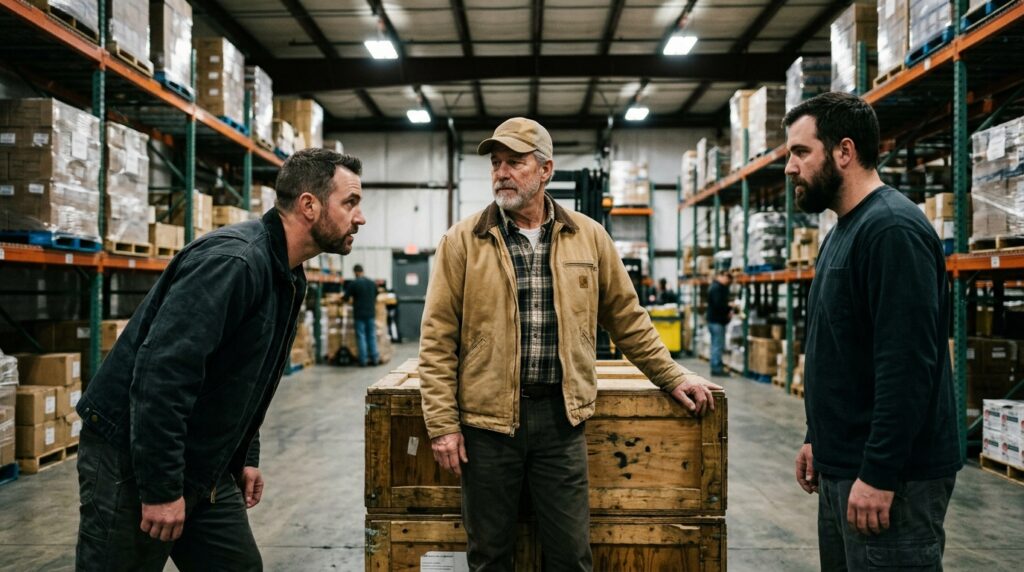
The Quiet Weight of the Line: A Study in Friction, Steel, and Restrained Force
CHAPTER 1: THE DISCREPANCY
The forklift exhaust hung thick in the rafters, smelling of burnt oil and cold, wet pine. It was 03:15, the hour when the concrete floor absorbed the worst of the Ohio moisture and gave it back as a dull ache in the knees. Miller didn’t look up from his metal clipboard when the heavy footsteps stopped three feet from his desk. He knew the gait. It was wide, heavy-heeled, and deliberately loud—the stride of a man who used his weight to clear a path before his mouth could open.
“The manifest for the north-corridor haul is short,” Miller said. His voice was level, the timbre dry like gravel turning over in a drum. He adjusted his tan canvas cap, pulling the stiff bill low over eyes that had tracked logistics grids across three continents before these boys were old enough to handle a tire iron. “Twelve pallets of grade-four fasteners aren’t on the dock, Vance. They’re signed off in the ledger, but the lane is clear.”
Vance leaned his palms onto the rusted edge of the metal desk, his dark utility jacket bunching at the shoulders. His short dark beard was flecked with graying sawdust from the uncrating bay. He didn’t drop his head to look at the paper. Instead, he stared directly into the shadow beneath Miller’s cap, his breath coming in short, humid plumes.
“The numbers match what left the yard,” Vance muttered. His tone carried the flat defiance of someone who had spent months checking boundaries and finding only soft administrative resistance. “We don’t recount what’s already strapped. You’re slowing the line, old man. The drivers are timing out on their logs, and nobody’s staying behind to clean up the back-up just because your pencil doesn’t line up with the floor.”
Behind Vance, near the shadow of the primary sorting grid, the second one stood. Garrett. He didn’t speak, but his boots made a distinct scraping sound against the grit-strewn concrete as he shifted his weight, closing off the natural lane leading toward the breakroom.
Miller’s thumb moved down the side of the aluminum board, his calloused skin catching on a small, sharp burr in the metal. It was a three-millimeter defect in the casing. In his pocket, the heavy casing of his digital stopwatch pressed against his thigh—a small, steady weight that kept him anchored to the exact seconds ticking away toward the end of the shift. He didn’t rise from his stool. He didn’t adjust his posture. He simply looked at Vance’s left thumb, noting the white-knuckle pressure where the younger man was forcing his weight onto the desk.
“The yard didn’t log them because they never came through the gate,” Miller said softly. He drew a single, thin pencil line through the empty tracking field. “The lock on the trailer was a secondary seal. Not the corporate yellow.”
Vance’s jaw tightened, the muscle shifting beneath his beard like a piston under pressure. He didn’t look back at Garrett, but his shoulders dropped an inch closer to Miller’s face. “You’re seeing things that aren’t your business. Sign the bill, Miller. Let the haul move.”
Miller didn’t take the pen. He reached down, his fingers brushing the cool, oil-slicked canvas of his jacket pocket until they touched the metal stopwatch casing. Through the gap between two massive stacks of heavy wooden crates to his left, he caught a brief, irregular glint of yellow light—not from the overhead lamps, but from a hand-held torch moving silently in an unlit sector of the north bay where no crew was scheduled to work.

CHAPTER 2: THE CALIBRATED LINE
The yellow glint vanished behind a wall of corrugated steel before Miller’s next breath could catch the dust. It left only the cold, unblinking glare of the overhead warehouse lights, each tube humming at a pitch that vibrated against the fillings in his teeth. Vance hadn’t seen it. Vance was still leaning into the desk, his weight grinding his palms against the pitted iron trim, his entire focus narrowed to the three inches of space separating his chest from Miller’s clipboard.
“I’m waiting on that pen, old man,” Vance said. The words came out flat, clipped by the rising heat under his collar. His dark utility jacket rustled as he shifted his stance, his boots finding a firmer purchase on the grit-slick floor. “The drivers don’t get paid to watch you cross out numbers.”
Miller kept his fingers light against the stopwatch in his pocket. The steel casing was cold, its internal gears moving with a precision that didn’t care about the sweat gathering on Vance’s temples. He didn’t blink. He had seen men use this exact lean in assembly areas from Fort Hood to the supply docks at Subic Bay—the heavy-shouldered tilt meant to simulate a collapsing roof. It only worked if the man underneath it believed the ceiling was real.
“The drivers can shut off their rigs,” Miller said. He didn’t raise his voice. He kept it in the low register used for loading lists and equipment checks—a sound that didn’t carry past the immediate circle of their boots. “The freight stays on the concrete until I check the seals myself. Garrett, move away from the junction box.”
Behind Vance, the second man didn’t move. Instead, Garrett’s hand slid down the strap of his tool belt, his fingers curling around the heavy handle of a steel banding cutter. The click of his knuckles against the iron tool was loud in the cavernous expanse of the aisle. The message wasn’t subtle. It was the friction of the floor testing the supervisor’s leverage, a quiet assessment of how much weight an old man’s spine could carry before the corporate rules cracked.
“Garrett isn’t taking orders from a man whose pension is already under review,” Vance sneered, his face dropping lower until Miller could smell the stale chicory coffee on his breath. “You’ve got six months until the company hands you a gold watch and a tracking number, Miller. Don’t make those six months hurt. Sign the bill.”
Miller’s gaze shifted past Vance’s shoulder, tracking the darkness of the unlit northern sector. The flashlight hadn’t reappeared, but there was a distinct rhythmic thud—the muffled, rubbery strike of a manual pallet jack lifting a heavy load without its hydraulic grease. A standard warehouse crew didn’t work in the dark, and they didn’t work silent. Whoever was behind those crates knew exactly which cameras were down for the weekly maintenance cycle.
The calculated calculation inside Miller’s head didn’t take more than a second. If he signed, the trailer rolled, the discrepancy disappeared into the system, and the line kept moving. If he stood up, the circle closed.
“The gate log shows three arrivals after midnight,” Miller said, his voice dropping into an even slower, colder cadence. He let his left hand slide out of his pocket, placing his calloused thumb directly on the disputed signature line of the manifest, covering the ink space completely. “None of them carried a yellow seal. If you want this bill cleared, Vance, you bring me the yard foreman’s pink carbon. The one he keeps in the locked box behind the scales.”
Vance’s hand twitched against the iron desk. His fingers curled into half-fists, the skin over his knuckles turning the color of skimmed milk. “The foreman’s home in bed. You know that.”
“Then the truck waits until six,” Miller replied. He finally looked up, his grey eyes catching the white light of the fluorescent tube directly above them. The weathered lines around his jaw tightened, transforming his face from that of an aging clerk into an unyielding piece of iron framework. “And you and Garrett can explain to the regional manager why twenty tons of grade-four fasteners are sitting in the turnaround lane while the diesel burns.”
Garrett took a half-step forward, the steel banding cutter swinging slightly against his thigh with a dull, heavy clink. “He’s bluffing, Vance. The old bastard doesn’t want the paperwork any more than we do.”
Vance didn’t answer right away. He stayed down, his eyes scanning Miller’s face for the slight flutter of the eyelid or the twitch of the throat that signaled a man preparing to scramble backward. He found nothing but the flat, dead stare of a supervisor who had spent forty years counting things that didn’t belong to him. The silence between them stretched, thick with the smell of forklift exhaust and the heavy, metallic dust that never settled.
Then, from the dark north sector, a sharp metallic snap echoed through the rafters—the distinct sound of a high-tensile steel security strap being sheared by someone who didn’t care about the noise. Vance’s head didn’t move, but his pupils dilated, a sudden, sharp tremor passing through his jaw. He knew the sound. And he knew Miller had heard it too.
Miller shifted his weight on the stool, his hand leaving the clipboard as he prepared the leverage in his heels. “That wasn’t a pallet jack, Vance.”
CHAPTER 3: THE CORRIDOR BLOCKED
The sound of the sheared steel band did not repeat. It didn’t need to. The single mechanical snap vibrated through the web of rusted iron trusses overhead, settling down into the soles of their boots like a small, sharp tremor. Vance’s fingers flinched on the desk, scraping against a flaking patch of orange oxidation before he forced his palms flat again, trying to deaden the resonance.
“That could be anything,” Vance said, his voice dropping an octave, fighting the warehouse hum. “A pallet settling under its own weight. A cold pipe.”
“A cold pipe doesn’t sever four-inch high-tensile strapping, Vance.” Miller didn’t look back at the dark north sector. His eyes remained fixed on Vance’s throat, watching the steady, rapid pulse twitching just above the collar of his utility shirt. “And a settling pallet doesn’t require a hand-held torch to drop its clearance. Garrett, let go of the banding cutter. You’re leaking grease on the manifest.”
Garrett didn’t drop the tool, but his knuckles went white against the pitted rubber grip. He looked at Vance, his head tilting toward the cross-aisle. “The old man is trying to tie us up here while the terminal timer counts down. We need to move the freight now, Vance. The truck in the turnaround isn’t waiting until the morning whistle.”
Miller stood up from his stool. He did it deliberately, utilizing the slow, unhurried levers of his hips and spine—a motion that carried no aggressive signal but left his boots firmly planted at the center of the concrete lane. He was a head shorter than Vance, his tan work jacket oil-stained and frayed at the cuffs, but his posture was straight, balanced down through his heels in the way of men who had spent thirty years standing on the rolling steel decks of transport ships.
He picked up the metal clipboard, his calloused thumb resting against the clean, uninked margin of the sheet.
“The truck in the turnaround isn’t your concern anymore,” Miller said, his tone dry as lime dust. “If that driver drops his clutch before the seal is verified, his registration gets flagged at the state line checkpoint. You know the protocol for unlogged cargo leaving an interstate facility. It isn’t an administrative fine. It’s corporate theft under federal transit codes.”
Vance smiled, though the skin around his eyes remained tight and dry. He stepped back from the desk, his hands sliding into the deep pockets of his dark utility jacket. “You think the front office cares about twelve pallets of zinc-coated bolts? They don’t even audit the north bay until the end of the fiscal quarter. By then, these numbers will be buried under five thousand tons of scrap variance.”
“They’ll audit it tomorrow if the logistics tracker shows an unregistered signature,” Miller replied. He walked past the edge of the desk, his boots making a deliberate, rhythmic crunch against the concrete dust. He didn’t head toward the dark sector where the flashlight had been. He headed toward the primary transport line, where a massive yellow pallet jack sat parked across the mouth of the narrow aisle.
The lane was tight. On either side, heavy wooden crates rose fifteen feet into the shadows, their rough-sawn pine faces gray with age and marked with faded black grease stencils from long-defunct manufacturing plants. Vance and Garrett followed, their heavy work boots tracking his cadence, their shadows long and distorted against the corrugated metal siding of the warehouse wall.
Garrett stepped ahead, his shoulder brushing the rough edge of a crate as he took up a position five feet from the parked pallet jack, effectively forming a second wall across the only clear exit route to the main loading dock. “The aisle is closed for maintenance, Miller. Shift manager’s orders. We’re moving three pallets of industrial wire from the overflow rack.”
Miller stopped. His hand stayed in his pocket, his fingers curled around the smooth, heavy casing of his digital stopwatch. He didn’t look at Garrett. He looked at the pallet jack itself. The iron tongue of the jack was coated in a fresh, amber-colored grease that hadn’t yet collected the gray film of warehouse dust. It was the specific lubricant used for the high-capacity hydraulic lifts in the secure terminal—the ones reserved for heavy machinery and sealed government freight.
“The shift manager doesn’t authorize maintenance during the three-to-six window,” Miller said softly. He reached out with his left hand, his index finger tracing a clean line through the fresh grease on the lift bar. “And this jack belongs to the bonded vault in Bay Seven. It doesn’t leave the cage without a three-point signature from the regional safety director.”
Vance stepped up behind Miller, his presence cutting off the air from the main corridor. The smell of his stale coffee and the sour scent of damp wool filled the tight space between the crates. “The vault was re-keyed Tuesday, old man. The rules changed while you were out on medical leave. We don’t need three signatures to shift dead weight.”
Miller turned his head slightly, his analytical gaze catching the slight, rhythmic vibration of the yellow jack’s hydraulic cylinder. It wasn’t dead weight. The jack was under full pressure, its seals whistling with a faint, high-frequency hiss that only someone who had spent forty years listening to the machinery of transit lines would notice. The load it was holding wasn’t wire. It was dense, small-volume freight that sat low to the floor, hidden beneath a coarse burlap tarp that was tied down with standard corporate yellow twine—but the zinc-coated lead seal that should have locked the knot was missing.
“You didn’t re-key the vault, Vance,” Miller whispered, his voice steady against the hiss of the hydraulic fluid. “You just stopped checking the logs altogether.”
Vance’s face darkened, his jaw shifting as he took a final step forward, his chest nearly touching the frayed shoulder of Miller’s tan jacket. “Sign the manifest, Miller. This is the last time I’m asking nicely before we clear the lane ourselves.”
CHAPTER 4: THE MEASURED PIVOT
“The lane isn’t yours to clear,” Miller said.
He left his left hand inside the canvas pocket, the fingers steady against the cold steel back of the stopwatch. His right hand remained perfectly flat against the coarse grain of the nearest wooden crate. He could feel the dry, ancient sap of the pine splintering slightly beneath his thumb—a tiny, localized point of friction in a world that was suddenly narrowing down to the exact distance between three sets of boots.
Vance didn’t offer another warning. The time for administrative bluffing had passed the moment Miller pointed out the unsealed yellow twine. The larger man moved with the raw, heavy momentum of an ungreased piston, his right arm swinging upward in a sudden, violent arc to collar-grab Miller’s jacket and shove him flat against the vertical timber supports of the rack. It was a standard floor move—the heavy-shouldered rush meant to pin an older man before his heels could find leverage on the concrete dust.
Miller’s eyes didn’t track the hand. They tracked the mass of Vance’s chest, watching the shift of the dark utility fabric that signaled the exact instant the weight left the younger man’s back leg.
The calculation was entirely silent, automatic, and paid for by twenty winters of basic service repetition. Miller didn’t raise his hands to block. He didn’t drop his clipboard. As Vance’s shadow broke his personal space, Miller executed a minimal, three-inch pivot on the ball of his left heel, sinking his weight slightly into his hip while drawing his right shoulder back along the face of the crate.
The kinetic economy was absolute. Vance’s fingers grazed the rough canvas of Miller’s lapel but found no resistance to anchor against. The momentum of twenty-two hundred pounds of meat and velocity carried Vance blindly forward into the empty sector where Miller’s chest had been a micro-second prior. His heavy work boot skidded through the amber grease slick near the hydraulic tongue of the jack, his arms flailing outward in a wide, desperate circle to catch the rough edge of the wooden stack.
A loud, hollow boom echoed through the aisle as Vance’s shoulder slammed into the gray pine timbers, jarring the top shelf until a shower of iron dust and dried rust scales drifted down through the beams like soot.
Garrett reacted instantly, his boots scraping the concrete as he swung the steel banding cutter upward, but the movement died before the tool could clear his belt line. Miller had already stepped into the newly opened space, his posture perfectly upright, his tan cap still level over his forehead. He hadn’t changed his breathing. His left hand was still in his pocket, and his right arm was relaxed at his side, the aluminum clipboard steady against his thigh.
The space between them settled into an immediate, freezing silence. The distant hum of the exhaust fans felt miles away, buried beneath the heavy, unblinking pressure of the overhead industrial lights.
Vance remained pinned against the crate for three full seconds, his chest heaving as he struggled to pull his weight back over his center of gravity. His face had turned a deep, dark red under the gray dust from the beams, his knuckles scraped and white where they had dragged across the splintered timber. He looked down at the floor, then slowly turned his head to look at Miller’s boots. They hadn’t moved more than half a pace from the original line.
“Are we done here?” Miller asked.
The words were sparse, dry, and entirely devoid of performance. He didn’t use the sharp, ringing volume of a drill instructor; he used the flat, unbothered tone of an inspector who had just found a faulty gasket on an auxiliary pump.
Garrett didn’t move. The steel cutter hung loose in his fingers, its long handles trembling slightly against his thigh as he looked from Vance’s wide, unbalanced stance back to the old supervisor’s steady gray eyes. The younger man’s mouth opened slightly, his tongue running over his lower lip as his brain tried to reconcile the speed of the shift with the frayed canvas jacket standing before him. He had seen men fight in the taverns near the transit yards, but he had never seen someone disappear from an attack without changing his pulse.
Vance pulled himself away from the crate, his right shoulder dropping lower than his left as he tried to wipe the grease from his sleeve. The arrogance had leaked out of his posture, leaving behind a raw, hollow confusion that made his utility jacket look too large for him. He didn’t lunge again. His eyes kept darting to Miller’s left hand, trying to see what weapon or leverage was hidden inside the pocket, completely unaware that the only thing Miller was holding was the time.
“You’re tracking this wrong, Miller,” Vance muttered, his voice cracked by the dry sulfur in the air. He didn’t look into the shadow of the bill. He looked at the floor three feet in front of it. “You don’t know what’s inside these boxes.”
“I know exactly what’s inside them, Vance,” Miller said, his thumb finally shifting to press the top crown of the stopwatch inside his pocket. The tiny mechanical click was lost in the silence. “And I know the transit logs aren’t the only things you’ve been cutting.”
Behind them, far down the main corridor near the loading docks, the first low whistle of the morning air brakes sounded—the 03:45 arrival from the regional distribution center. The shift was changing, the floor was about to fill with fifty men with clipboards and lunch tins, and the dark aisle was suddenly the smallest room in the state.
Miller turned his back on them. It wasn’t a gesture of trust; it was the calculated indifference of a man who had already verified the clearance. He walked toward the manifest desk, his boots making a steady, unhurried crunch through the rust scales.
CHAPTER 5: THE COLD SILENCE
The metal legs of the stool scraped against the concrete grit with a sound like a bone saw as Miller sat back down. He pulled the aluminum clipboard across the dented iron surface of the desk, his pencil point hovering precisely above the unverified entry for the north-corridor haul. Behind him, the low, mechanical wheeze of the 03:45 transport rig settling into Bay Four sent a rhythmic vibration through the corrugated iron siding of the office wall.
Vance and Garrett had not followed him out of the narrow lane. Their heavy boots remained stationary down the dark corridor, their low, furious murmurs swallowed by the sudden overhead groan of the main exhaust grid kicking into its first morning cycle.
“The log is still open, Miller,” a new voice said.
Miller didn’t raise his head. He recognized the specific, soft slide of thin-soled leather shoes on the platform steps behind him. It wasn’t a floor worker. It was Hendrick, the administrative assistant from the facility office—a man whose clothes never carried the scent of treated pine or forklift grease. Hendrick held a cold ceramic mug in his left hand, the steam from the dark liquid rising to dissipate in the dry, drafty air beneath the light tubes.
“The log stays open until the yellow seals match the gate ticket,” Miller said, his tone flat, retaining the hard, mineral texture of the loading docks. He pulled his left hand out of his jacket pocket, letting the scuffed steel digital stopwatch drop onto the desk with a sharp, heavy clink. “Vance is handling freight that hasn’t cleared the regional desk. Go back upstairs, Hendrick. This isn’t a billing error.”
Hendrick didn’t leave the platform. He stepped down until his leather soles reached the concrete floor, his eyes darting toward the dark aisle where Vance’s shadow was finally beginning to move back toward the light. “The office wants the manifest stamped before the shift change, Miller. The regional office called down at midnight. They aren’t looking for a line audit tonight. They want the turnaround clear.”
Miller turned his head slightly, the stiff bill of his tan canvas cap catching the hard glare of the fluorescent tube above. His weathered jaw looked as if it had been chipped out of a dry riverbed. “Which regional office? The one in Columbus, or the private line that handles the scrap variance?”
Hendrick’s hand tightened on the handle of his ceramic mug, the knuckles turning a smooth, bloodless white. He didn’t answer. He looked past Miller toward the yellow pallet jack parked near the wooden crates. The hydraulic cylinder was still hissing, a tiny pool of amber fluid gathering around the small steel pressure release valve at the base of the lift.
Vance emerged from the dark corridor first. His dark utility jacket was torn at the shoulder seam, the white padding showing through the blue-collar fabric like salt in a wound. His face was gray with concrete dust, his jaw set in a hard, rigid line that looked entirely dead to the noise of the incoming trucks. He didn’t look at Miller. He looked directly at Hendrick.
“The old man won’t sign,” Vance said, his voice husky with the sulfur dust from the racks. “He thinks he’s tracking a federal transit code. He’s got his finger on the bill.”
“Miller,” Hendrick said, his voice dropping into a lower, more transactional register that didn’t carry past the iron edge of the desk. “Leave the clipboard. The company has an automated adjustment policy for the grade-four fasteners. It’s covered under the primary operational insurance.”
Miller leaned forward, his calloused thumb sliding down the aluminum frame of the clipboard until it pressed against the small, notched hinge at the top. He released the clamp. The master paper sheets flipped up, revealing the greasy, yellow carbon copy hidden beneath the standard company forms—the specific unlogged manifests that had been filled out by hand, using a heavy, dark ink that hadn’t come from any terminal computer.
“This isn’t an insurance adjustment,” Miller whispered, his voice cutting through the high-frequency hum of the light tubes like an iron file. He pointed a scarred index finger at the bottom signature line of the yellow carbon. The ink was fresh, but the name wasn’t Vance’s, and it wasn’t Hendrick’s. It was a block-letter imprint that matched the private corporate seal of the logistics terminal’s primary bondholder. “The siphon is running directly out of the secure bays. Twelve tons of fasteners don’t disappear into a scrap variance unless the master circuit is dead.”
Garrett came out of the lane then, his heavy tools clinking against his thigh, his eyes wide and bloodshot as he checked the main entrance doors behind the desk. The morning shift was already arriving at the main gate; the distant rumble of employee cars parking on the gravel lot was a steady, rhythmic thud against the foundation. The time was 03:52. The circle was widening, the isolated quiet of the night bay dissolving into the public pressure of fifty oncoming workers.
“We don’t have the time for this,” Garrett muttered, his hand trembling as he wiped his forehead with a grease-stained rag. “The gate is opening. The crew is coming through the turnstiles.”
Vance didn’t move toward the gate. He took three slow steps toward the desk, his eyes fixed on the yellow manifest paper under Miller’s hand. The physical defeat in the aisle had left a hard, sour residue in his chest, but the presence of Hendrick seemed to restore a different kind of leverage to his shoulders. “You’re an inventory manager, Miller. You count what’s here. You don’t ask where it goes after it leaves the dock.”
“I count what stays,” Miller replied. He rose from his stool, his boots planted firmly in the concrete dust. He picked up his scuffed stopwatch, his thumb sliding over the steel back casing before he slipped it into his jacket. “And I’m going down to Bay Seven to check the secondary seal on the vault.”
Hendrick stepped directly into his path, his leather shoes making a small, hollow sound against the concrete. His face was completely smooth, but his lower lip was dry. “The vault is locked, Miller. The keys are in the front office. You don’t have the clearance.”
Miller didn’t back up. He let his gray eyes lock onto Hendrick’s forehead, his posture straight and unyielding against the administrative pressure. “Then I’ll use the manual override on the circuit breaker. If the line is short, the terminal drops its power until the inspectors arrive from the state line.”
Vance took a short, sharp breath, his hand sliding back toward the handle of his utility belt. The room tone had changed again, the stale air thick with the smell of high-voltage ozone and the first cold draft from the opening loading dock doors.
CHAPTER 6: THE DISPUTED BOXES
Hendrick’s leather shoes didn’t yield an inch of the pitted gray concrete floor. His hand remained wrapped around the handle of his ceramic mug, the cold surface of the clay sweating grey drops against his knuckles. “The override is an emergency protocol, Miller. If you pull that lever, the main feeder line reports an immediate load failure to the municipal substation. The state troopers will be at the gate before the security lights cycle.”
“Let them roll,” Miller said.
He stepped wide, his heavy canvas-coated shoulder catching Hendrick’s chest just enough to force the clerk back against the iron rim of the manifest desk. The collision was dry, short, and entirely transactional. Miller didn’t look at Hendrick’s face; his focus stayed locked on the high-voltage distribution locker forty feet down the line, its gray enamel surface peeling from decades of industrial dampness.
Vance didn’t try to loop his arm this time. The lesson from the narrow bay was still rattling through his right shoulder, his dark utility jacket hanging loose where the seam had split under the crates. Instead, he lunged laterally, slamming his entire weight into the iron handle of the yellow pallet jack parked across the threshold. The wheels screamed against the concrete dust as the heavy frame swung around, the front steel plate pinning the toe of Miller’s boot against the lower rail of the cargo rack.
The pain was an immediate, blinding heat that shot up Miller’s shin, but his face didn’t break. His left hand simply tightened around the stopwatch inside his jacket pocket, the mechanical edge of the casing sinking into his palm until his own blood stopped the sliding gear.
“You’re done auditing, old man,” Vance hissed, his breath hot against Miller’s neck as he strained against the iron frame of the lift. “The bill is gone. Garrett threw the yellow sheets into the incinerator hopper five minutes ago. There’s no manifest to show the state police.”
Miller looked down at his pinned foot, then slowly turned his head to look at the burlap tarp covering the low-volume cargo on the jack. The yellow twine was knotted tight, but under the weight of the collision, the coarse fabric had shifted three inches to the left. Through the tear in the weave, the glint wasn’t zinc-coated fasteners. It was the machined, dull luster of solid copper industrial armature bushings—the core capital assets of the facility’s primary milling line, stamped with the original 1984 foundry mark.
The logic click inside Miller’s head was cold and heavy. They weren’t siphoning a surplus order to pad a shift bonus. They were stripping the factory’s operational marrow.
“The incinerator doesn’t burn carbon ink fast enough, Vance,” Miller whispered. He didn’t pull his foot back. He reached down with his right hand, his calloused fingers locking around the release valve of the jack’s hydraulic tongue. “And Hendrick didn’t get these manifests from the regional desk.”
Hendrick dropped his mug. The ceramic broke into four flat pieces on the concrete, the dark chicory coffee spreading through the dust until it touched the edge of Miller’s pinned boot. “Miller, let go of the pressure valve. You don’t know who owns that steel.”
“The company owns it,” Miller said.
“The company hasn’t paid its transit tax since October,” Hendrick replied, his voice losing its smooth administrative edge and cracking down to the dry gravel beneath. He took a short step back toward the platform steps, his fingers twitching against his empty palm. “The bank isn’t auditing the inventory tomorrow, Miller. They’re locking the gate. The owner is liquidating the bay before the receivers arrive at noon to chain the doors. Vance isn’t stealing from the line. He’s trying to get his last three weeks of back pay before the checks clear as red ink.”
The warehouse hum seemed to drop into a dead, freezing hole. Behind them, the turnstiles at the main gate began to click—a rapid, rhythmic rattle as the first twenty workers of the morning shift punched their cards into the old mechanical time-clock. The voices of men talking about coffee and the weather drifted down the high corridor, completely ignorant of the three men standing in the pool of oil and broken clay.
Miller’s hand stayed on the iron release valve. His mind raced over forty years of logistics grids, calculating the weight of the machines, the cost of the transit lines, and the quiet face of the owner who had signed his pension voucher three months ago. The decoy secret—the regional siphon—shattered into gray dust, leaving behind a raw, systemic rot that his clipboard couldn’t fix.
Vance let go of the jack handle. His hands fell to his sides, his shoulders dropping until his chin nearly touched the frayed collar of his utility shirt. “My boy’s got an operation scheduled in Cleveland next month, Miller. If this terminal goes black before the insurance cycles, the policy dies with the corporation. We just needed the copper to clear the balance.”
Miller didn’t turn the valve. He looked down the long, empty bay toward the distribution locker, its master circuit stamp missing from the casing, its gray doors locked with a common padlock that any bolt cutter could clear. The victory he had won beside the cargo crates felt small, cold, and entirely compromised. He had protected the line, but the line was already dead under the floorboards.
“The morning crew is on the floor,” Garrett said from the shadow of the columns, his voice shaking as the first forklift engine cranked to life in the adjacent bay. “What do we do with the truck?”
Miller slowly pulled his foot out from beneath the steel plate. The leather of his boot was torn, the gray canvas of his sock darkening with grease and the first seep of dark blood. He picked up his metal clipboard from the desk, the bare aluminum frame reflecting the hard white light of the fluorescent tube above.
“The truck stays,” Miller said.
CHAPTER 7: THE RUSTED TERMINAL
“The truck stays,” Miller repeated.
His boots made a ragged, uneven sound against the concrete dust as he walked past Vance toward the primary terminal exit. The puncture in his boot leather was leaking a narrow trail of dark, heavy fluid that mingled with the wet gravel at the threshold. Outside, the Ohio morning had broken as a low, yellow fog that smelled of sulfur, frozen mud, and the exhaust of fifty idling commuter cars.
The chain-link gate at the perimeter fence was already rattling. A dark blue sedan with state government plates sat idling twenty feet from the scales, its windshield wipers cutting clean arcs through the cold moisture. A man in a heavy charcoal overcoat stood beside the hood, his hands shoved deep into his pockets, his eyes fixed on the gray iron trusses of the loading bays. It wasn’t the bank. It was Arrington—the district logistics coordinator who had overseen the state transit grid back when Miller was still logging supply columns out of Fort Meade.
Vance and Hendrick walked three paces behind Miller, their utility jackets gray under the wet light of the dawn. The warehouse behind them was already humming with the morning shift, the roar of the first forklift blade lifting a pallet of sheet metal echoing out through the open bay doors like a low roll of thunder.
“Arrington’s been at the scale house since three,” Hendrick said, his voice dropping into the flat, exhausted cadence of a ledger that had been closed too many times. He didn’t look at Miller’s boots. His gaze remained locked on the blue sedan. “He knew the asset count wouldn’t check out. He’s got the terminal liquidation keys on his ring.”
Miller didn’t answer. He reached down and pulled the cold steel stopwatch from his canvas pocket one last time. He didn’t look at the dial; his thumb simply traced the deep, jagged scratch along the back casing where the metal had caught on an armored transport hatch twenty-four years ago. He let the lanyard drop over his fingers, the weight hanging steady against his hip.
He reached the rusted iron latch of the main gate. The metal was pitted, rough with orange oxidation that left a sharp, blood-colored residue across his calloused palm as he threw the lever back. The hinges groaned—a loud, metallic screech that brought a sudden, absolute silence to the first three rows of cars waiting in the turnaround lane.
Arrington stepped forward, his leather soles crunching methodically through the wet limestone gravel until he stood within two feet of Miller’s cap bill. “The office in Columbus went dark at midnight, Miller. The owner’s signature didn’t clear the clearinghouse.”
“The copper is still on the jack, Arrington,” Miller said. His voice was very slow, the gravel in his throat completely dry. He pointed the edge of his aluminum clipboard toward Bay Seven. “Twelve tons of machined bushings. The foundry marks are clear. They haven’t been loaded.”
Arrington looked past Miller’s shoulder, his gray eyes tracking the split shoulder seam on Vance’s dark jacket, then settling on Hendrick’s empty, coffee-stained hands. He took a long, slow breath of the humid morning air, his chest rising beneath the wool overcoat. “The asset receiver is three miles down the road with the highway patrol, Miller. They aren’t counting the copper. They’re locking the chain. The corporate entity is dissolved as of four-fifteen this morning.”
Vance took a short step forward, his knuckles raw and bleeding where they had dragged across the splintered pine stacks inside. “The crew’s insurance runs through the end of the month, Arrington. The papers were filed.”
“The papers were filed by a shell desk in Delaware that hasn’t had a live phone line since Tuesday,” Arrington replied, his tone as indifferent as an incoming manifest. He didn’t look at Vance. He kept his eyes on Miller’s weathered face. “The facility is scrap, Miller. The land goes to the county for the tax lien. You’ve got twenty minutes to clear the inventory logs before the seal is placed on the office door.”
Miller looked back at the long grid of the warehouse. The corrugated steel walls looked small under the vast, yellow expanse of the morning sky, their seams bleeding rust down onto the foundation blocks. Fifty men were currently unbuckling their tool belts near the time-clock, their voices rising in a sudden, sharp wave of confusion as the facility’s primary circuit box gave a loud, hollow pop and the overhead light tubes died, leaving the interior in the gray, flat gloom of the dawn.
The line had stopped. The numbers didn’t matter anymore.
Miller didn’t drop the clipboard. He walked back to the metal desk at the center of the bay, his torn boot trailing a faint smear of oil and blood across the floor. He picked up the manual ledger—the heavy, canvas-bound book that had recorded every structural pound of steel that had crossed the threshold since the day the concrete was poured.
He didn’t sign the clearance. He didn’t stamp the variance. With a single, heavy movement of his calloused thumb, he tore the entire yellow tracking sheet out of the binding and folded it twice until the block-letter imprint of the liquidation owner was buried inside the fiber. He slid the paper beneath the back plate of his steel stopwatch, snapping the casing shut until the mechanical gears locked against the ink.
“The inventory is clear, Arrington,” Miller said, his gray eyes unblinking beneath the tan cap as he walked past the three men into the open turnaround lane. “The logbook is empty.”
He didn’t wait for the state troopers to clear the turnstiles. He didn’t look back at Vance or the yellow jack parked in the shadows. He walked down the center of the wet gravel road toward the highway, his posture straight, his hand resting light and solid inside his pocket against the old metal that had outlasted every company he had ever served.







