
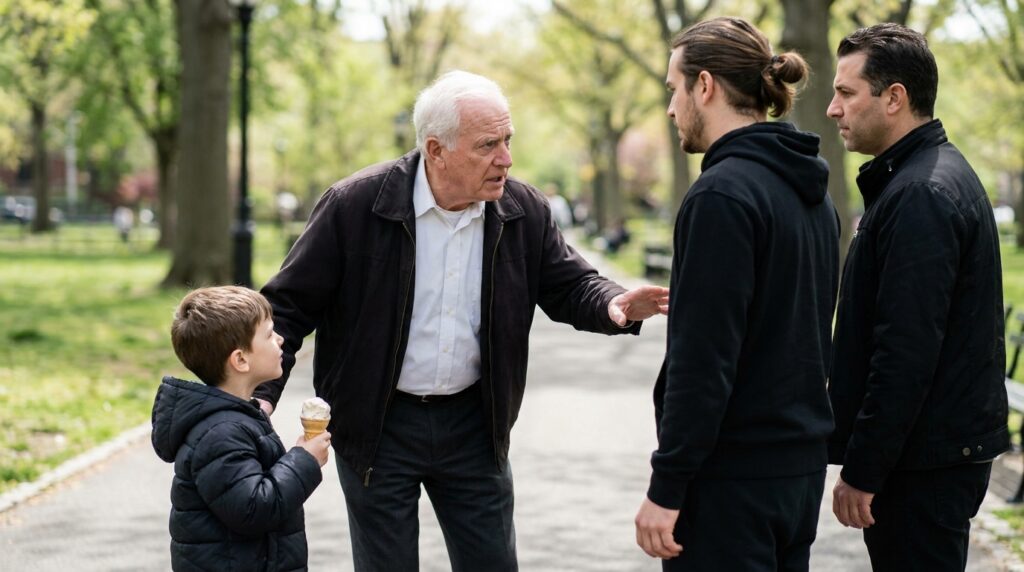
The Steel Beneath the Fraying Collar: A Crimson Account of Restraint and Command Presence

CHAPTER 1: THE WATER IN THE MIRROR

The glass of water on the diner table hummed two seconds before the heels struck the linoleum. Samuel didn’t look at the door. He didn’t have to; the silver reflection in the napkin dispenser showed the angle of entry—twenty degrees off-center, fast enough to disturb the heat rising from the pie case but slow enough to suggest observation.

“Eat your crust, Leo,” Samuel said. His voice was low, filtered through forty years of salt air and command decks, stripped of everything except the necessary weight.

Leo dug his spoon into the vanilla ice cream, his small thumb smudging the glass bowl. The boy was seven. He still smelled of laundry detergent and fresh cut grass, entirely unaware of how the air changed when two men in black cotton fleece stepped into a room with their weight forward on their toes.

Samuel watched them through the polished chrome of the salt shaker. The tall one had his hair tied back in a knot that sat too high on his skull. His jacket strings were long, swinging like plumb lines as he scanned the booths. His companion was shorter, thick-necked, carrying his arms slightly away from his ribs—a classic posture for someone who believed his chest was wider than it actually was.

They weren’t looking for grease or sugar. They were looking for the soft edge of the afternoon.

“Grandpa,” Leo whispered, his spoon hovering. “The man is staring.”

“The ice cream is melting, Leo. Focus on the plate.” Samuel reached down, his thumb automatically testing the ironed seam of his trousers. The silver collar stay beneath his collar pressed into the skin right at the throat, a hard little reminder to keep the spine locked.

The tall youth stopped three feet from the stool. He didn’t buy a soda. He didn’t ask for a menu. He simply leaned his hip against the counter, his eyes dropping to the small boy’s dark puffer jacket. Samuel noted the distance—forty inches. Close enough for an aggressive reach, too close for a civilian who understood the social boundary of a Tuesday diner.

“Nice day for a walk,” the tall one said. The words were simple, but the delivery was wet with the arrogance of a boy who had never faced an unblinking line of men. “Park’s nice this time of day. Lots of space to get lost.”

Samuel took his napkin. He folded it once, precisely, creating a sharp white rectangle that sat exactly parallel to the edge of the Formica. He didn’t look up into the youth’s eyes yet; he looked at the base of the throat, where the pulse was jumping against the dark cotton of the hoodie. A high pulse meant a fast decision was coming. It meant the adrenaline was already leaking into the blood.

“We like the park,” Samuel said softly.

“Yeah?” The shorter one moved up, his boots squeaking on the tile. “Maybe you should stay on the sidewalk, old man. The dirt gets slick.”

Samuel stood up. He didn’t use the counter for leverage. His knees didn’t click. His white shirt stayed tucked, the dark wool of his jacket dropping into place over his shoulders like a standard issue tunic. The movement was smooth enough to make the tall one step back an inch—a micro-retreat his brain wouldn’t register for another ten minutes.

“Let’s go, Leo,” Samuel said, reaching for the child’s small hand. As he turned toward the cash register, his eyes caught a tiny brass pin pinned to the inside of the youth’s open pocket. It was a fouled anchor, scratched and tarnished, missing its crossbeam. Samuel’s heart didn’t skip, but his mind instantly logged the item number.

The past didn’t stay buried in the sand; sometimes it walked into a diner with its hood up.

CHAPTER 2: THE ANCHOR IN THE MULCH

“You’re walking too fast, Grandpa.”

Leo’s fingers were small, sticky with the vanilla trail that had escaped his cone, but his grip was solid. Samuel adjusted his stride, cutting three inches from his pace until the heavy rubber of his soles clicked in a perfect four-four rhythm against the concrete of the Jefferson Park entrance. The sun here didn’t warm; it bounced off the chain-link border of the tennis courts, sharp and white, slicing the shadows into clean, hard geometric bars across the gravel.

Behind them, ninety yards back, the diner door’s bell didn’t ring, but the silver reflection on the park’s steel rules told him the perimeter was already compromised. Two pairs of boots had left the linoleum. They were tracking thirty paces behind, their cadence loose but intentional. They were closing the lateral exit lanes.

Samuel didn’t turn his head. He adjusted his dark wool jacket, his thumb brushing the rigid line of the collar stay beneath his chin. The metal stay was cold against his throat, a small knife of discipline forcing his chin up, his eyes level, his peripheral vision locked on the flanking treeline.

“Hold the ice cream flat, Leo,” Samuel said. His voice stayed flat, low enough to stay between them, high enough to command the boy’s attention without triggering panic. “Watch the edge of the path. Don’t look at the trees.”

“Are those men from the restaurant coming to play?”

“No,” Samuel said. “They aren’t here to play.”

The park was typical for this corner of the county—desaturated turf, wood-chip mulch that smelled of damp cedar and old rain, and a line of green municipal benches bolted into the concrete footings. To a civilian, it was a park on a Tuesday afternoon. To Samuel, it was a bottleneck. The path ahead narrowed between two old oaks whose roots had buckled the pavement into a series of jagged, concrete teeth. If they crossed the root-line, the youths would have the high ground and the sun at their backs.

He felt the change in the wind before he heard the steps accelerate. The air grew thinner, carrying the faint, chemical scent of cheap laundry soap and the sour tang of nervous sweat.

The tall youth with the high skull-knot broke right, his black hoodie billowing as he stepped off the concrete onto the mulch, his boots crunching through the cedar chips to cut off the diagonal escape route toward the swings. The shorter one stayed on the pavement, his weight forward, his hands deep in his pockets, his elbows flared out like broken wings.

Samuel stopped. He didn’t drop his hands. He didn’t pull Leo behind him yet; that would signal a defensive posture, an admission of vulnerability. Instead, he simply anchored his heels into the seam of the concrete, his feet exactly shoulder-width apart, his center of gravity dropping two inches.

“Lost your way, old man?” The Lead Aggressor spoke from the mulch. The sun caught the side of his face, highlighting the erratic twitch of a muscle just beneath his left jawline. He was leaning in, his shoulders curved into a predatory arch, trying to use his sixty-four inches of height to shadow the elderly man.

Samuel looked at the youth’s collar. Not the eyes—the eyes were full of useless, emotional noise. He looked at the point where the trapezius met the neck, calculating the muscle tension. The youth was breathing through his mouth, his chest rising too fast.

“The path is public,” Samuel said. His voice was transactional, clear as a bell in the chilly air.

“The path belongs to whoever’s using it,” the shorter one said, moving up on the left. He took his hands out of his pockets. In his right palm, he was toggling something small and metallic. It wasn’t a blade; it didn’t have the weight. It was the brass pin Samuel had seen in the diner—the fouled anchor with the missing crossbeam. The hinge was broken, the pin-back scraping against the boy’s thumb with a rhythmic, mechanical click.

Samuel’s mind processed the sound in micro-seconds. That specific pin hadn’t been issued since the winter of ninety-two. It wasn’t an online surplus buy; the specific wear on the brass indicated it had been worn against wool for a long time before it was discarded.

“That’s an inspector’s mark on that brass,” Samuel said, his tone shifting from civilian caution to an icy, analytical precision that made the shorter youth’s thumb freeze against the metal. “The crossbeam didn’t break. It was clipped by a master-at-arms in San Diego. Thirty years ago.”

The Lead Aggressor’s eyes narrowed, the arrogance faltering for a fraction of a second as he looked from Samuel to his companion’s hand. “The hell are you talking about?”

“He’s talking crazy,” the shorter one muttered, but his weight shifted back onto his heels. His elbow dropped three inches, losing its aggressive flare. “He’s just an old man.”

“Your boots are loose,” Samuel said, his gaze returning to the tall youth’s chest. “Your laces are dragging in the mulch. If you try to swing your right leg, you’ll catch the loop on that root behind you. You’ll go down on your left hip before your hand leaves your pocket.”

The tall youth didn’t move, but his jaw locked. The silence between them grew thick, punctuated only by the distant, rhythmic squeak of a child’s swing two hundred yards away. A jogger in a gray sweatshirt was approaching from the western loop, her pace slowing as she noticed the rigid geometry of the group on the path.

Samuel didn’t look at the jogger. He kept his focus on the space between himself and the Lead Aggressor—exactly thirty-six inches now. The tactical baseline had been established. The youths had the youth and the numbers, but they were standing in an environment Samuel had mapped before they were born.

“You don’t know who we are,” the tall one whispered, his voice losing its wet confidence, replacing it with a hard, defensive rattle.

“I know exactly what you are,” Samuel said, his right hand slowly tightening around Leo’s small, sticky fingers, preparing for the barrier step. “You’re thirty seconds away from a mistake you can’t afford.”

CHAPTER 3: THE POINT OF IMPACT

The cold cream struck the concrete path with a heavy, wet slap.

Leo’s small fingers slipped completely from the sugar cone, his hand freezing mid-air as the double scoop of vanilla split across a jagged fissure in the walkway. White liquid pooled instantly into the gray dust, catching the harsh glare of the noon sun. The boy did not cry out. He simply sucked in a short, sharp breath through his teeth, his small shoulders bunching toward his ears as he shrank away from the two tall figures blocking the exit lane.

“Look at that,” the Lead Aggressor said, taking a deliberate step forward. His black hoodie fabric rustled, a dry, synthetic hiss in the park silence. His shadow stretched directly across the white puddle, severing the path between Samuel and the open grass. “The kid’s clumsy, old man. Can’t even hold his own sugar.”

Samuel did not look down at the melting cream. His eyes remained locked on the V-shaped notch where the tall youth’s neck met the shoulder blade. He felt the silver stay beneath his collar push firmly into his throat as he shifted his weight forward, his right boot moving two inches out to form a diagonal brace. The geometry was simple: if the shorter youth moved left to flank them by the green bench, Samuel would have the pivot line to cut off the lane before the boy could be reached.

“The boy didn’t drop it,” Samuel said. His voice was a flat bar of iron, dropped into the space between them without a single tremor. “Your friend shifted his hip. You crowded his perimeter.”

The shorter companion let out a dry, high-pitched chuckle that ended abruptly when Samuel’s gaze cut toward his right hand. The brass pin with the broken hinge was still clacking against his thumb, a frantic, mechanical click-click-click that betrayed the kid’s rising pulse. The adrenaline was tracking high now; the skin around the youth’s eyes looked gray under the bright sun, a sign of shallow breathing and a racing heart.

“You speak real pretty for a guy who should be sitting in a nursing home,” the Lead Aggressor sneered. He reached down, his fingers dipping into the pouch pocket of his black hoodie. His shoulder dropped three inches—the exact angle required to draw an object from a tight seam. “Maybe we don’t like old men telling us where our boots are supposed to go.”

“You have six ounces of folded parchment in that pocket,” Samuel said. He didn’t raise his voice, but the precision of the statement hit the air like a rifle shot. The tall youth’s hand stopped inside the black cotton, his fingers locking around whatever lay beneath the fleece. “It’s standard three-ply bond paper, folded into a tight envelope. You’ve been carrying it for three weeks, judging by the frayed edge showing at the corner of your pocket.”

The shorter youth stopped clicking the brass anchor. He looked at his partner, his forehead creasing into deep, nervous lines. “Jason… how does he know that?”

The Lead Aggressor—Jason—didn’t answer immediately. The arrogance in his face didn’t fade, but it hardened, turning into something brittle and dangerous. He slowly pulled his hand out of the pocket. He wasn’t holding a blade. He was holding a document, its edges stained with sweat and grease, yellowing around the official blue ink stamped across the top margin.

“You think you’re smart?” Jason whispered. His jaw was working, a hard knot of muscle bouncing below his ear. “You think you know what this is?”

“It’s a general discharge under other than honorable conditions,” Samuel said, his eyes scanning the layout of the paper without shifting his head. “United States Navy. Issued out of San Diego. The serial number on the header starts with a seven-zero-four. I know the font because I signed four hundred of them before your mother chose your name.”

A sudden blast of wind came off the tennis courts, carrying the scent of hot asphalt and old chain-link. It caught the edges of the sweat-stained paper in Jason’s hand, making it rattle like dry leaves against his knuckles. Behind them, the jogger in the gray sweatshirt had completely stopped forty yards away, her phone held at chest height, her eyes tracking the rigid, unmoving triangle of bodies on the path.

Samuel felt Leo’s small hand tighten around his left index finger. The child’s skin was cold, sticky with vanilla, but he wasn’t trembling. He was waiting for the command. He had been taught how to stand when the deck shifted.

“My brother didn’t deserve it,” Jason said. The wet, bullying tone was entirely gone now, replaced by a raw, jagged heat that came from a deeper place. He took another step forward, the front of his black sneaker crushing the edge of the dropped sugar cone, grinding the white cream into the dirt. “He spent four years in the engine room while guys like you sat in the light. Then he comes home with nothing but a broken shoulder and a piece of paper that says he’s trash. And then he disappears.”

“Your brother was an engineman third class,” Samuel said, his voice dropping into a register that made the shorter companion step back two full feet into the wood chips. “He didn’t get trash, Jason. He got caught taking three cases of brass fittings out of the secure locker at North Island. He took the fall for a chief petty officer who promised to look after his mother, but the chief died of a stroke three days after the mast.”

Jason froze. The document in his hand shook once, a sharp, white vibration against the dark backdrop of his hoodie. “How… how do you know his name?”

“Because I’m the one who denied his appeal,” Samuel said. He reached down, his thumb smoothing the ironed edge of his pocket, his fingers lingering near the seam where his own identification lay hidden. “And I’m the reason your mother’s rent was paid from an anonymous trust in Chicago every month until she passed last November.”

The park seemed to lose its sound. The playground swings still creaked in the distance, but the space between the oak trees felt entirely sealed, a white-hot tactical cell where the past had finally caught up with the pavement.

Jason’s fingers loosened. The paper didn’t fall, but it tilted downward, the blue ink of the official stamp catching the vertical glare of the noon light. His companion stared at him, his mouth slightly open, the brass anchor completely silent in his palm.

“You,” Jason whispered, his eyes finally shifting from Samuel’s collar to the hard, unblinking gray of the old man’s eyes. “You’re him.”

CHAPTER 4: THE PERIMETER LOCK

“You’re him,” Jason repeated. The name didn’t fall from his mouth; it tore loose, heavy and jagged, catching on the dry air.

The wind shifted again, dragging a loose scrap of tinfoil across the concrete path with a sharp, metallic scratch. Samuel did not move. His spine remained straight, the rigid edge of the metal collar stay digging a millimeter deeper into his throat as he maintained his thirty-six-inch anchor lane. His eyes didn’t drop to the yellowing paper in Jason’s hand, nor did they soften. In the calculation of tactical perimeters, an emotional opponent was double the danger—erratic, blind to the physics of leverage, and prone to sudden, catastrophic acceleration.

“Never touch him again, do you understand me?” Samuel said.

The warning wasn’t loud. It carried no civilian panic, no defensive franticness. It was a flat, low-frequency command issued from the center of his chest, the exact vocal pitch used to halt a multi-ton landing craft before its hull ground into a hidden reef. The sheer density of the tone hit the two youths like a physical cross-check, stopping Jason’s forward tilt mid-stride.

Jason’s fingers tightened on the sweat-stained discharge papers until the bond paper groaned. “You sat behind a gray steel desk and broke my brother’s life with a fountain pen. You think paying our rent fixes that? You think a check in the mail buys off thirty years of him drinking himself into a ditch behind the shipyard?”

“Your brother broke his own life when he signed the log for crates he knew were empty,” Samuel said. His left hand remained down, his index finger pinning Leo’s small, cold palm against the wool of his trousers. The boy stood motionless, his side-parted hair blowing across his forehead, his face pale but completely steady beneath his gray hood. “He chose the chief over the crew. I chose the crew.”

“He was twenty, you old bastard!” Jason took a long, sweeping step to the left, his black sneakers skidding across the concrete dust. His shoulder flared, his arm lifting as the crumpled document rattled in his fist. He was trying to break the vertical plane of Samuel’s barrier, trying to force the elderly man to turn his back to the shorter youth who still hovered by the cedar mulch.

“Jason, look at his hand,” the shorter companion whispered. His voice had lost its dry gravel texture, rising into a thin, nervous rattle. He had stopped clicking the broken brass anchor. His eyes were pinned to the precise angle of Samuel’s right elbow, which had risen exactly three inches—not an invitation to fight, but a textbook mechanical reset that closed the throat lane and exposed the hard bone of the forearm. “He’s not moving. Jason, he’s not moving an inch.”

“Shut up!” Jason roared. The skin across his cheekbones was white, the blood pooling in two dark, angry blotches beneath his eyes. He lunged across the thirty-six-inch line, his right hand flashing out of his pocket—not toward Samuel, but reaching down to grab the collar of Leo’s puffer jacket. It was a bully’s reflex, a desperate attempt to regain status by controlling the weakest object in the field.

Samuel didn’t think; the neural pathways had been carved into his marrow before the asphalt on this path had cured.

He didn’t swing. He didn’t execute a civilian punch. He stepped forward with his left boot, his heel striking the concrete with a hollow crack that shattered the park’s silence. His entire frame shifted sixty degrees into the aggression lane, his right arm rising in a short, brutal arc that caught Jason’s wrist from the inside out. It was a pure defensive deflection—bone hitting bone with the dry, heavy thud of an oak limb striking a fence post.

The momentum of Jason’s rush carried him directly into the unyielding wall of Samuel’s chest. The old man’s shoulder didn’t give; his posture remained locked by the steel stay at his neck. The impact sent a violent vibration through the paper in Jason’s hand, tearing the frayed left corner completely free. The tiny scrap of white bond paper fluttered into the dirt, landing less than an inch from the white puddle of melting cream.

Jason grunted, his breath escaping in a sharp, wet gasp as his wrist was forced upward and away from the child. The physical leverage was absolute. Samuel didn’t follow through with a blow. He maintained the contact, his thumb locking onto the pressure point behind Jason’s wrist bone, freezing the youth’s arm in mid-air.

“Stay away from him and leave now,” Samuel commanded.

The words were spoken three inches from Jason’s face. The youth could smell the stale black coffee on Samuel’s breath, could see the tiny, pale scar running along the old man’s jawline—a legacy of a metal splinter from a ruptured steam line in seventy-eight. The sheer proximity of the disciplined gray eyes froze the blood in Jason’s veins. The numerical advantage was gone. The illusion of youth and strength collapsed against forty years of unyielding institutional weight.

Behind them, the jogger had backed up into the shadow of the public restroom, her phone still raised, her mouth open in a silent O as three other residents—a utility worker in an orange vest and two elderly women with a stroller—stopped dead on the perimeter grass. The entire park had grown small, its focus pulled tight into the two-foot space between the veteran’s white collar and the boy’s black hoodie.

Jason’s chest heaved. He looked down at his own wrist, trapped in a grip that felt like a rusted vice left in the rain. The document hung limp from his fingers, its official blue stamp catching the blinding noon glare. His companion didn’t move to help him; the shorter boy had dropped his hands to his sides, his knees slightly bent, his gaze fixed on the ground as if waiting for the ground to open.

“You’re an old man,” Jason whispered, but the venom was gone, replaced by a cold, hollow exhaustion. His shoulder slouched, his weight shifting back until he was leaning away from the barrier line. “You’re just… an old man.”

“Then you have nothing to fear,” Samuel said, his grip loosening just enough for the youth to pull his arm back. “Move.”

CHAPTER 5: THE COLLAPSE OF THE BARRIER

The tall youth did not swing again. His boots didn’t slide forward into the cedar mulch; they ground backward, leaving two jagged gray streaks across the sun-bleached concrete of the walkway.

The shorter companion had completely stopped moving, his palms flattened against the thighs of his black cargo pants. The broken brass anchor pin lay static in his hand, its broken hinge glinting once like a drop of oil in the dirt. On the grass perimeter, forty yards out, the jogger’s phone remained steady at chest level, its black camera lens catching the harsh, flat noon light. The utility worker in the orange vest had stepped off the gravel path, his heavy work boots sinking into the sod as he watched the triangle of bodies lock into absolute stillness.

“You’re shaking, Jason,” Samuel said. His voice didn’t rise above the level of the cold wind pushing through the oak limbs. It stayed low, an unyielding current that left no room for negotiation. His thumb remained braced against the inner tendon of the youth’s wrist, feeling the frantic, disorganized hammer of the pulse beneath the skin. “Your chest is moving three inches too high. You’re thinking about the camera behind you, and you’re thinking about the forty-six seconds it takes for a park vehicle to reach this gate from the main road.”

Jason swallowed. The movement of his throat was a sharp, clicking click against his high collar. The white skin around his jaw had gone tight, turning the gray blotches beneath his eyes a dark, bruised violet. “You don’t own this block. You don’t get to stand here and look at me like I’m a report on a desk.”

“I own the consequences of the report,” Samuel said. He slowly withdrew his right hand, his fingers releasing the pressure point but remaining exactly four inches from the youth’s sleeve. The tactical distance was still closed. “Your brother didn’t disappear behind the shipyard, Jason. He left the state on a greyhound bus three hours after the master-at-arms cleared his locker. I bought the ticket. I signed the authorization for his travel voucher out of my personal account.”

Jason’s posture dropped another inch. His shoulders curved forward, the heavy fleece of his black hoodie bunching around his neck until the high knot of his hair tilted toward the concrete. “You’re a liar. He sent letters from San Diego for six months. He said he was working the docks.”

“The letters were routed through a freight forwarding firm on Harbor Drive,” Samuel said, his eyes tracking a tiny blue ink smudge that had transferred from the yellowing document onto his own thumb. The ink was old, a specific shade of indigo used only by the branch office in ninety-two. “The firm belongs to my former logistics chief. Your brother wasn’t on the docks, Jason. He was in a rehabilitation facility in Idaho, getting the grease out of his blood before the liver gave out.”

The shorter youth took a short, sharp step backward, his boots kicking up a small cloud of cedar dust. “Jason… the old man’s right about the dates. Remember the postmarks on those envelopes? They didn’t have a city stamp. They just had the numbers.”

“Shut up,” Jason muttered, but the sound lacked its previous edge. It was dry, hollowed out by the realization that the target he had selected wasn’t an isolated elder on a casual walk, but a deliberate anchor that had been sitting in the center of his family’s life for three decades. He looked down at the torn corner of the discharge paper lying in the dirt, the blue ink of the official stamp severed neatly across the line of his brother’s name.

Samuel didn’t offer a hand to retrieve the paper. He kept his spine locked against the hard, vertical pull of the silver stay beneath his chin. The cold metal was a constant wedge against his throat, a warning that any display of empathy right now would dissolve the command structure he had spent thirty minutes enforcing. An old soldier didn’t offer comfort until the lane was entirely clear of threats.

“The trust in Chicago didn’t close when your mother died,” Samuel said. His voice dropped another note, the sound tracking below the level of the wind. “The remainder was transferred to a technical institute in the city under your name three months ago. The enrollment forms are sitting in a blue folder on the kitchen table in your apartment. The one your brother signed before he took the job in the timber country.”

Jason froze. His eyes widened, the pupils shrinking to tiny black dots against the glare of the concrete. He didn’t look at Samuel; he looked at his companion, whose face had gone completely slack.

“The blue folder,” the shorter one whispered, his hands dropping entirely into his pockets. “The one from the logistics company. Jason, you said it was junk mail.”

“He’s tracking us,” Jason whispered, his voice rising into a thin, ragged panic that caught the attention of the onlookers on the grass. The utility worker took two steps closer, his eyes scanning the grandfather’s unmoving posture. “He’s been watching the house. He’s been sitting in that diner every Tuesday waiting for us to cross the fence.”

“I don’t watch houses,” Samuel said, his right hand moving back down to lock around Leo’s cold, sticky fingers. The boy didn’t move; his eyes remained fixed on the white pool of melting ice cream at his feet, his jaw set in the same rigid line as his grandfather’s. “I manage perimeters. And your perimeter is currently leaking, Jason. The jogger behind you has been on a line with the precinct dispatcher for ninety seconds.”

A low, dual-tone siren wail drifted over the treeline from the eastern avenue—not a full emergency response, but the short, authoritative chirp of a municipal unit clearing an intersection.

Jason looked at the path ahead, then at the grass where the utility worker stood with his arms crossed over his orange vest. The numerical advantage had evaporated; the social pressure of the park had solidified into a grey wall of witnesses who had recorded every micro-second of the posture collapse.

“Alright,” Jason said, his voice dropping into a flat, defeated rattle as he stepped backward off the concrete path, his sneakers sinking into the loose wood chips. He didn’t pick up the torn corner of the document. He didn’t look at his companion. “Alright, we’re leaving.”

Similar Posts

Leave a Reply

Your email address will not be published. Required fields are marked *







