
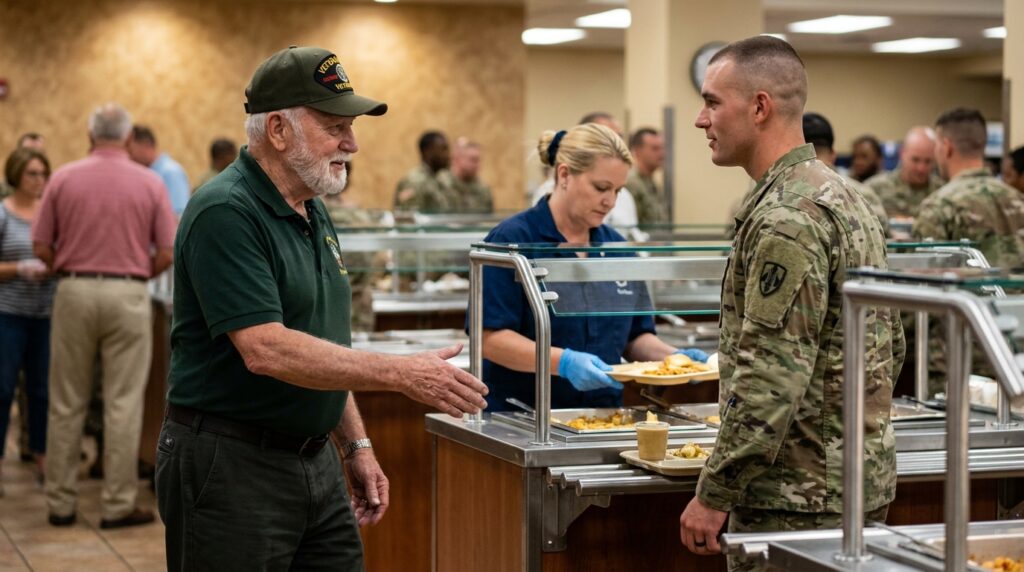
Grounded Iron: The Veteran Who Broke the Automated Grid
CHAPTER 1: THE FRICTION OF PERIMETERS
The wind off the flats tasted of iron filings and dry clay, the kind of heat that didn’t just sit on a man’s shoulders but dug into the small of his back like a blunt spade. Thomas “Mac” McCall adjusted the brim of his black veteran cap, the fabric thin and stiffened by twenty years of salt sweat and laundry starch. His fingers, wide-knuckled and scarred across the right thumb from an old winch snap, pressed into the rough edges of the single manila envelope tucked under his arm. The paper was crisp, too white for this valley, bearing the blue ink of an administrative order he intended to contest.
Before him, the perimeter gate of Fort Meade didn’t swing; it slid on heavy, grease-blackened tracks with a low, hydraulic groan that vibrated through the soles of his old boots. The modern world didn’t use guards with clipboards anymore. There was a gray pillar, housing an optical lens that pulsed with a dull, infrared rhythm.
“Card unreadable,” a synthetic voice flatly stated from a small grille beneath the lens. “Re-insert credential or present secondary verification.”
Mac didn’t move his hand from his side immediately. He let his gaze settle on the camera lens, seeing his own white beard reflected as a small, silver smudge in the curved glass. The young private three paces back—a kid with a chest like a fence post and a digital camouflage uniform that looked like it had never seen a grease pit—shifted his weight. The carbine slung across the boy’s chest clinked against his tactical vest, a sharp, metallic tick that Mac’s ears registered before his mind did.
“System’s picky about the old barcodes, sir,” the private said. His voice was polite but thin, the tone of someone dealing with a stalled vehicle on a busy highway. “If it doesn’t take the chip, I have to log you as a civilian visitor. That means the logistics lane. You’ll be waiting until the noon convoy clears.”
Mac didn’t turn his head. He kept his eyes on the glass eye of the gate. “The chip is good, son. It’s just the reader’s lens is coated in limestone dust from the quarry trucks down the road. It can’t see the depth of the groove.”
He reached into his pocket, his movements deliberate and slow, ensuring the private could see every inch of his arm. He drew out a small, oil-stained brass thumbnail tool—a pocket spacer from his days with the 4th Engineers. With a steady hand that belied the dull ache in his shoulder, he scraped the edge of the tool across the scanner’s glass screen, clearing a thin line through the baked-on gray grit.
He slid the card in again. The mechanism clicked, a heavy iron bolt releasing somewhere inside the housing with a sound like a hammer striking an anvil. The gate shuddered open three inches.
“Go on through,” the private murmured, his posture relaxing just enough to let the rifle swing free. “But the administrative office moved over to the old motor pool grid, sir. It’s a mile walk past the fuel bladders. Most people take the shuttle.”
“The shuttle has a hydraulic leak in the front seal,” Mac said, his voice gravel-dry and low. “I could smell the fluid from the highway. I’ll take the dirt path along the wire.”
He stepped through the gap before the gate could fully cycle, his boots crunching into the crushed gravel of the interior perimeter. The air inside smelled different—more diesel, more hot copper, the scent of an engine being run past its hours. He didn’t look back at the private or the lens. He looked toward the long, low silhouette of the dining facility in the distance, where the corrugated roof shimmered under the midday sun like water on a hot skillet. His knee clicked with every third stride, a rhythmic reminder of a bridge that had come down too fast in ’72, but his grip on the envelope didn’t loosen.
The dust here was older than the buildings, but it still held the same weight.

CHAPTER 2: THE GRIT IN THE GEARS
“State your business, uncle, because you’re about six inches from an active staging lane and my drivers don’t look down when they’re backing up four-ton rigs.”
The voice came from beneath the shadow of a raised hydraulic tilt-cab. A motor pool sergeant, his sleeves rolled tight against forearms blackened with graphite grease, stepped into the light. He carried a heavy impact wrench by the battery pack like a iron pendulum, his eyes narrow, indexing Mac’s faded cap and the white beard that marked him as an anomaly in the high-velocity grid of the modern 4th Engineers.
Mac didn’t flinch. He stayed his boot right on the edge of the yellow tactical line painted across the sun-baked asphalt. Beneath his feet, the ground thrummed with the high-register whine of pneumatic lifts and the dull, wet thud of automated pressure washers cleaning the undersides of uncrewed logistics platforms.
“I’m looking for the administrative annex,” Mac said, his voice holding that low, unhurried gravel that seemed to drag against the crisp air of the base. He nodded toward the low-slung, corrugated tin structure at the far end of the grease pits. “The gate guard said it was moved to the old maintenance bays. Looks like they expanded the drone tracks instead.”
The sergeant spat a dark stream of tobacco juice into an oil separator tray. The iron tool in his hand clicked against his belt ring. “Annex is around the back, through the old welding shop. But if you’re here about the pension audit or the historical plates, you’re burning daylight. They’ve got three clerks handling two thousand files, and the digital network has been down since the 0600 shift change. Everything’s backed up to the wire.”
“I’m not here for a check,” Mac murmured, his left fingers tightening slightly on the manila envelope under his arm. The paper was already absorbing the heavy, aerosolized sheen of transmission fluid that hung over the yard. “I’m here about the deed to the old redoubt. The one the regimental association built by the creek.”
The sergeant’s expression didn’t soften, but his stance shifted. The tip of his heavy boot tapped against a rusted iron drainage grate between them. “The old timber fort? Nobody’s been down there since the winter training cycle of ’14, old man. It’s inside the restricted automated polygon now. They’ve got the perimeter sensors wired to the main tactical net. If you go poking around down there with that envelope, the automated rovers will have you zip-tied before you can clear your throat.”
“The land was deeded in perpetuity,” Mac said. He didn’t say it with anger; he said it with the flat, unyielding certainty of a surveyor measuring cold iron. “The regiment laid the timber themselves. I helped notch the corner posts when we came back from the valley in ’75.”
“Per perpetuity doesn’t pay for the bandwidth on the new satellite arrays,” the sergeant replied, his voice dropping into a transactional flatness. He glanced over his shoulder as a massive, blocky autonomous transport vehicle—devoid of a driver’s cab, its smooth armor plate painted a flat, desaturated desert tan—shuddered to life inside the bay. The machine emitted a high, piercing whistle as its brake lines bled air, the smell of hot synthetic rubber instantly filling the space between the two men. “They’re clearing everything out from the creek up to the ridge. Building the new automated repair cells. If your name’s on that paper, you’re just a line of code they haven’t deleted yet.”
Mac looked past the sergeant’s shoulder, watching the driverless machine crawl forward on its massive, solid-rubber tires. It moved with an eerie, calculated precision, completely ignoring the humans standing near its path. But Mac’s eyes weren’t on the guidance sensors mounted to its hull; they were fixed on the frame beneath the chassis. The welds were thin. They were clean, automated, and beautiful, but they lacked the heavy, double-beaded overlap that a human hand gave to iron when it knew the frame had to carry three times its rated weight through mountain mud.
“The welds on the rear stabilizer arm are cold,” Mac noted quietly, pointing a blunt, scarred finger toward the undercarriage of the passing machine. “The robot didn’t hold the heat long enough on the corner joints. A hundred miles of washboard road in the high country, and that entire axle housing is going to tear right through the floorboards.”
The sergeant paused, his gaze tracing the path of Mac’s finger. For a second, the hard, metric-driven shell of the modern non-commissioned officer cracked. He looked at the machine, then at Mac’s old engineering pin pinned to his dark polo shirt—the tiny, crossed brass castles that were partially tarnished with green oxidation.
“That’s the manufacturer’s spec,” the sergeant said, though his voice lacked its previous administrative bite. “The computer logs the heat variance. If it says it’s within tolerance, we sign off on the bay.”
“Computers don’t have to change a tire in a ditch at midnight while the rain is turning into sleet,” Mac said. He turned away from the bay, his boots grinding a fresh layer of gray dust into the concrete. “Which way did you say the welding shop was?”
The sergeant didn’t answer right away. He looked at his wrench, then back toward the Annex. “Through the double doors with the rusted hinges. But watch your step on the threshold. The concrete’s heaved two inches from the frost, and nobody’s come down with a grinder to smooth it out.”
Mac walked down the lane, the heat from the drone’s exhaust washing over his back like the breath from an old furnace. Every surface here was covered in that fine, abrasive powder—the mixture of disintegrated mountain stone and pulverised iron that signified a place where things were being broken down faster than they could be repaired. He reached the double doors, his hand finding the rusted iron handle. It was cold despite the midday sun, the metal pitting against his palm like the teeth of an old saw.
When he pulled, the door dragged against the concrete with a loud, shrieking screech that echoed across the open yard, a sound that no automated machine had ever bothered to lubricate. Inside, the darkness smelled of old ozone and cold grease, the familiar shadows of his youth waiting for him in the corners.
CHAPTER 3: THE ECHO CHAMBER
The heavy iron door scraped to a halt, leaving only a narrow vertical band of blinding desert sunlight behind him before the gloom of the old welding shop swallowed Mac whole. It took his eyes five full seconds to find the contours of the floor. The air inside didn’t circulate. It was dense with forty years of settled iron dust, dead birds, and the stale, mineral tang of cold cutting oil that had seeped so deeply into the concrete base it had become part of the foundation.
He took two deliberate steps forward, his boots feeling for the two-inch frost heave the motor pool sergeant had mentioned. His sole found the edge of the cracked slab. He paused, transferring the manila envelope from under his arm to his right hand, adjusting his grip so the paper wouldn’t tear against his thick knuckles.
The cavernous bay was silent, yet it felt loud to Mac. To a young man, the emptiness would look like desertion; to Mac, it was a graveyard of kinetic history. Along the far wall stood the ancient anvil blocks, their iron faces scarred and dimpled from thousands of cold-shaping strikes. Above them hung the empty silhouettes of crescent wrenches and pipe tongs, outlined in pale gray dust where the tools had once shielded the wood from decades of diesel exhaust.
A sharp, metallic snap echoed from the rafters. Mac’s chin lifted.
It wasn’t a structural failure. It was the rhythmic, cooling contraction of the corrugated tin roof under the noon heat, but beneath that sound came another—a faint, rhythmic scratching. Near the central power distribution box, a loose copper grounding strip, four inches wide and thick as a boot sole, hung by a single rusted screw. The desert wind leaking through the broken high-bay windows caught the metal tail, dragging it back and forth across the raw steel casing of the junction box. Scritch. Scritch.
Mac walked toward the junction box, his breath shallow to avoid kicking up the fine soot near his feet. The box was an old Westinghouse model, painted olive drab, its heavy latch secured with a brass padlock that had turned completely green from moisture. He reached out with his left hand, his bare fingers brushing the cold, pitted face of the lock. The metal felt dead, disconnected from the vibrant, humming grid outside.
“They don’t even know it’s ungrounded,” he muttered to the empty room.
Had the automated transport units outside drawn power from this sector, a single spike would have blown the solid-state logic boards to cinder. The new army built grids on software, but they forgot that the earth still demanded a physical path for the lightning. He leaned his shoulder against the damp brick wall, the rough mortar biting through the cotton of his dark green polo shirt. The cold from the stone began its slow crawl into his old joints, a familiar ache that felt more real than the clean, sterile synthetic scent of the gate checkpoint.
He looked down at the manila envelope. The edges were softening from the sweat of his palm. Inside lay the physical survey from 1976—the original hand-drawn blue lines showing the boundaries of the 4th Engineers’ historical redoubt. The base commander’s office had sent a digitized notice to the regimental association’s dead-letter box, a bloodless three-line decree stating the structure was slated for “expedient mechanical clearance” due to tactical grid optimization. They didn’t call it demolition. They called it clearance, as if forty years of hand-fitted timber could be brushed away like loose sand.
A shadow crossed the narrow slit of light behind him.
Mac didn’t turn around. He listened to the weight of the boots. They weren’t the light, synthetic-soled tactical boots the gate guard wore. These were heavy leather, the heels worn down on the outside edge—the walk of someone who spent eight hours a day standing on concrete lines, enforcing schedules.
“You’re trespassing in a condemned sector, sir,” a woman’s voice said from the doorway. The tone was sharp, structured, and entirely devoid of curiosity. It was the voice of a gatekeeper who had already decided the outcome of the interaction before opening her mouth.
Mac turned slowly, his boots dragging through the dust. The woman standing in the sliver of sunlight was in her late thirties, her blue service uniform immaculate despite the grit of the yard. She held a black clipboard tight against her ribs like a piece of personal armor, her pen clicked open and held between her first two fingers like a weapon. Her hair was pulled back so tightly into a bun that it seemed to pull the skin of her temples taut.
“The door wasn’t locked,” Mac said simply.
“The door is designated as an unmonitored opening within a restricted logistics zone,” she replied, stepping into the bay. Her eyes didn’t look at Mac’s face; they went straight to the old veteran cap, then down to the manila envelope. “The dining facility management office has already flagged your vehicle at the outer gate. This sector is off-limits to personnel without active digital credentials. I’m going to have to ask you to return to the civilian reception area immediately.”
Mac didn’t move. He let his gaze rest on her clipboard, noticing the small, modern barcoded logistics manifestation sheets pinned under the iron clip. “You’re the facility manager from the DFAC.”
“I manage the logistical throughput for the entire third quadrant, which includes the dining facility, the maintenance annex, and the automated staging lanes,” she said, her voice rising slightly to compete with the scritch of the loose copper strip behind Mac. “My name is Captain Miller. And right now, you are disrupting the operational velocity of my noon company rotation. Follow me out, please.”
Mac looked back at the Westinghouse box, then back to her. “Your third quadrant has an ungrounded main line, Captain. If that drone transport out there hits the inductive charging pad while the atmospheric humidity is above forty percent, your whole throughput is going to drop to zero.”
Miller’s jaw tightened, the skin around her knuckles turning white against the plastic edge of her clipboard. “The systems are self-diagnostic, sir. If there was an error, the tactical net would have logged it. Now, for the last time, move toward the exit.”
Mac didn’t answer. He adjusted the manila envelope under his arm, his movements so calm they seemed to drain the kinetic authority right out of her stance. He walked past her, his shoulder clearing hers by two inches, his boots leaving a slow, deliberate trail of heavy prints in the gray dust as he headed out into the blinding glare toward the dining hall.
CHAPTER 4: THE DIALECT OF EFFICIENCY
“The intake fans are pulling five hundred cubic feet per minute too fast,” Mac said, his boots catching the textured aluminum transition strip at the entrance of the dining hall. The threshold was worn to an unsafe sheen, the cross-hatched traction lines ground down by thousands of standard-issue heels until the metal was bright and slick as winter pond ice.
Captain Miller didn’t check her stride. The door behind them hissed shut, an oversized hydraulic cylinder slamming into its housing with a dull, oil-muffled thud. “The ventilation metrics are calculated automatically by the central infrastructure node, sir. It accounts for thermal loading when the heavy companies rotate off the transport lines. I don’t adjust the belts.”
“They aren’t adjusting the belts either,” Mac muttered. He adjusted the manila envelope under his arm, his fingers feeling the distinct ripple of the copper-plated brads holding the heavy paper backing together. “They’re just letting the bearings dry out. You can hear the high-register chatter over the steam tables. Two more weeks of three-shift operations and that intake motor is going to freeze solid, and you’ll be feeding five hundred infantrymen in a room that smells like burnt copper and old cabbage.”
The interior of the facility was a vast, low-ceilinged vault of institutional gray. The air was a thick, moving wall of pressurized cold, smelling of bleached linoleum, scalded metal, and the heavy, lard-thick scent of automated gravy warmers. It was an environment designed to discourage lingering. The tables were long, unyielding banks of molded gray polymer, bolted directly to steel stanchions that were chemically anchored into the slab. There were no chairs, only circular tractor seats that swiveled exactly ninety degrees before hitting an iron stop.
Miller walked two paces ahead of him, her black clipboard resting against her hip like an extension of her pelvic bone. As she pulled ahead, the harsh fluorescent overheads caught the back of the board. Mac’s eyes, trained by forty years of reading part numbers off pitted cylinder blocks, locked onto a small, hand-scrawled sequence stenciled in white paint marker across the black plastic: RE-EXP-GRID-44-B. It wasn’t an army logistics code. It lacked the standard federal stock prefix, looking more like an internal project marker from a contractor’s field ledger.
“Your office isn’t back by the welding shop,” Mac noted, his stride remaining slow, rhythmic, and heavy despite her attempt to stretch the distance between them. “And that’s not a standard supply manifestation on your board. That’s an asset clearance ledger.”
Miller stopped so suddenly her heels made a short, dry bark against the non-skid flooring. She turned her head just far enough for Mac to see the rigid muscle under her jaw twitch. “My clipboard contains the operational routing for the afternoon company, Mr. McCall. If you have an issue with the base infrastructure or the regional alignment, you can file a hard-copy complaint at the civilian liaison hub outside the secondary wire. My job here is to ensure this line moves at forty-four plates per minute.”
“Forty-four,” Mac repeated, his voice dropping into a dry, hollow register that seemed to anchor itself in the concrete beneath them while the frantic noise of the cafeteria whirled around them. “In ’75, we fed the whole battalion out of two trench stoves during the spring flood. We didn’t have a clock on the counter, but nobody went back to the line with an empty tin.”
“The modern regiment doesn’t use tin, and they don’t have time for a conversation,” Miller said. She pointed the tip of her black pen toward the long stainless-steel serving track where the first elements of an active-duty platoon were already beginning to filter through the turnstiles. “They have exactly twenty-two minutes from the time their boots hit the log-in pad to the time they load into the automated transport modules for the ridge exercises. Every second you spend standing here with that envelope is a second my staff loses on the wash-cycle transition.”
Mac looked past her toward the serving line. The counter was an unvarnished rib of heavy-gauge stainless steel, its surface deeply scored by the longitudinal scratches of millions of metal food trays sliding from left to right. Behind the glass shielding, industrial-sized steam inserts held identical square bricks of yellow egg and gray-brown sausage patties, the heat rising in thin, shimmering waves that blurred the faces of the kitchen staff.
The kitchen workers moved with the mechanical cadence of factory laborers, their blue nylon gloves flashing in the steam as they dropped portions onto the divided polymer trays with a rhythmic splat-clink. There was no talking between the servers and the soldiers. The troops moved in a silent, dense column, their camouflage uniforms damp from the field, their eyes fixed on the back of the neck of the man in front of them. The only sound was the collective, low drone of their boots and the constant, high-pressure scrape of the plastic trays sliding along the steel track.
“They look tired,” Mac said softly, his eyes tracing the line of slumped shoulders and dust-bitten necks. “They look like they’ve been running on dry gears for three days.”
“They’re meeting readiness parameters,” Miller said, her pen clicking twice in rapid succession—a short, sharp signal of absolute impatience. “And you’re blocking the access lane for the heavy weapons platoon. Step out of the corridor, sir. Now.”
Mac looked down at his own old boots, gray with the limestone dust from the gate, then up at the rigid face of the manager. He didn’t step back toward the exit. Instead, he took three slow, deliberate paces forward, his hand reaching out to grasp the cold rail of the serving line, inserting his old, weathered frame directly into the gap between two incoming squads.
The line behind him stalled with a soft, collective rustle of nylon and webbing, the rhythm of the room breaking like a chain hitting an obstruction.
CHAPTER 5: THE BOTTLENECK
The steel rail beneath Mac’s palm vibrated with a rhythmic, high-efficiency thrum. Behind him, thirty sets of heavy, mud-caked combat boots ground to an abrupt halt against the gray non-skid flooring. The sudden silence that rippled through the weapons platoon was heavy, filled with the dull clink of tactical buckles and the coarse, uneven breathing of men who had spent twelve hours digging gun pits in the limestone flats.
“Sir, you are creating a structural delay in the primary serving lane,” Captain Miller’s voice snapped from behind his right shoulder. Her steps were rapid, a sharp, metallic sequence of heel-strikes that ended right at the lip of the stainless steel counter. She didn’t look at the soldiers waiting in the stalled queue; her eyes were locked onto the small digital overhead monitor that displayed the real-time throughput numbers. The digital counter had just dropped from forty-four to zero.
Mac didn’t lift his fingers from the metal track. He leaned his weight forward, his chest inches from the thick sneeze-guard glass that separated the active troops from the industrial ladles. “I’m getting a cup of coffee, Captain. The gate guard said the pot was always on for the regiment.”
“The regiment operates on an automated sustenance schedule, Mr. McCall. We do not maintain open-pot hospitality for unverified civilians during active company rotations,” Miller said, her black clipboard cutting through the steam rising from the sausage inserts. Her pen hovered over the top page, her fingers turning white from the force of her grip. “Look behind you. You are holding up an entire deployment element. Every thirty seconds this line remains stationary costs the transport pool four hundred gallons of idling fuel at the staging pad.”
Mac turned his head slowly, his weathered features catching the harsh reflection of the overhead fluorescent panels. The young specialist immediately behind him was six feet two, his face gray with limestone dust and his knuckles raw from cold iron. The kid’s eyes weren’t angry; they were dead-tired, staring at the old unit patch pinned to Mac’s dark green polo shirt with a faint, unreadable detachment.
“You tired, son?” Mac asked, his voice low and scraping like gravel turned over by a spade.
The specialist didn’t answer. He adjusted the nylon strap of his carbine, his jaw working a piece of flavorless gray gum. In the modern line, junior troops didn’t speak to civilians when a company officer was within four paces. The discipline was rigid, but to Mac, it smelled like exhaustion.
“He doesn’t have time to answer you,” Miller intervened, her voice rising an octave to cut through the low drone of the facility’s HVAC system. “And you don’t have the authority to interrogate my personnel. Step out of the queue into the management corridor immediately, or I will have the automated gate locks engaged. We are on a twenty-two-minute rotation.”
A faint, high-frequency tone pulsed from the small communications handset clipped to Miller’s shoulder strap. Pip… pip… pip. It was the specific alert frequency of the base’s regional development office—the same office that had issued the digital clearance notice tucked inside Mac’s crumbling manila envelope. The sound was rhythmic, consistent, and completely mechanical, vibrating against her crisp blue fabric like an insect trapped in a jar.
Mac looked at the handset, then back to the stenciled code on the rear of her clipboard: RE-EXP-GRID-44-B. The pieces didn’t fit the story she was telling about efficiency. A dining facility manager didn’t get direct telemetry updates from the engineering expansion grid unless the space beneath her feet was part of the ledger.
“You’re clearing the old redoubt because the foundations are granite,” Mac said, his words falling flat and heavy into the space between them. “The new drone tracks need six feet of solid stone to anchor the magnetic charging loops, and the creek bed is too soft. You aren’t managing a lunch line, Captain. You’re clearing the sector’s history before the contractors arrive on Monday.”
Miller’s face went entirely still. The pen in her hand stopped its nervous clicking. The junior troops in the queue didn’t move, but the air in the immediate three feet around the counter became thin, pressurized by an unstated realization. She didn’t deny it; she simply slid her thumb down the side of her clipboard, covering the stenciled lettering with her palm.
“The expansion of the base infrastructure is an open-source project approved by the regional department,” she said, her voice dropping into a transactional whisper that didn’t carry past the specialist’s ears. “But your paperwork won’t stop the machinery, Mr. McCall. The final signatures were logged into the main system at midnight. The old post is dead weight. Now, clear the lane.”
Mac’s hand remained on the rail, his skin looking like old, tanned leather against the polished silver of the counter. “The post isn’t weight, Captain. It’s the only thing keeping this hill from sliding into the flats when the October rains come. We built those retaining walls with dry-stack limestone because concrete cracks when the valley shakes. Your automation isn’t going to hold the mud.”
“That’s for the engineers to determine,” Miller said, her fingers reaching toward her handset. “Security, this is Quadrant Three Hub. I have an administrative bottleneck at the primary serving line. Requesting an extraction team to the civilian corridor.”
The cafeteria worker behind the counter, a woman with pale hair tied back under a blue net, froze mid-scoop, her industrial spoon hovering two inches above a tray of steaming potatoes. The metal track remained cold, the line remained stationary, and the low, mechanical pip from Miller’s radio continued to measure the seconds of their standstill.
CHAPTER 6: THE STONE LINE
Captain Miller’s hand dropped from her shoulder mic, her fingernails clicking against the hard plastic casing with the short, dry snap of a firing pin dropping on an empty chamber. She didn’t look at Mac’s eyes; she kept her focus squarely on the dark green fabric of his collar, where the oxidized regimental pin sat crooked against the cotton weave.
“The extraction team is clearing the secondary gate block now, sir,” she said, her voice flattening into the dead, uninflected cadence of an automated logistical readout. “They will escort you to the visitor perimeter. If you resist, your vehicle will be impounded under code forty-four baseline protocols. We cannot accommodate history when the transport window is closing.”
Mac didn’t shift his boots. He let his forearm settle more heavily onto the cold, polished lip of the food counter, the rough edge of his manila envelope scraping along the stainless steel with a sound like iron filings being dragged across a saw blade. To his left, the heavy weapons specialist remained stock-still, his breathing slow and heavy, the faint scent of diesel exhaust and damp canvas radiating from his field jacket. On the column behind the kid’s shoulder, a bare patch in the gray paint marker showed where an old, hand-notched iron wrench hanger had been cleanly sheared away from the structural steel to make room for a new, synthetic fiber-optic junction box. The replacement box was clean, blue, and lacked a single scratch, but the steel behind it was pitted with rust that no one had ground out.
“The lane isn’t closing because of my boots, Captain,” Mac said, his gravelly tone slowing the room’s momentum down further, stretching the silence until the kitchen worker behind the glass lowered her ladle completely into the hot mash. “The lane is closing because your digital net is calculating the weight of these boys based on their gear manifests instead of their skin. Look at his left heel.”
Mac tapped his thick, scarred thumb against the metal rail, pointing toward the specialist’s combat boot. The leather near the ankle crease was dark, stained through with a wet, heavy sludge that didn’t belong to the dry limestone quarry outside the fence line.
“He’s been out in the lower creek sector since midnight,” Mac continued, his gaze drifting from the boot back to Miller’s tight jaw. “The drainage channels along the old timber fort are already backing up because your sub-grade contractors dumped six tons of crushed gravel into the natural runoff lane to level the drone pad. The water’s got nowhere to go but under the roadbed. If those heavy transports hit the asphalt three miles out, the whole grade is going to slide into the marsh before your first drone even clears the rail.”
Miller’s fingers tightened around her black clipboard, the plastic backing groaning slightly under the physical stress. Her eyes flicked down toward the specialist’s boots, then rapidly back up to the digital overhead monitor. The throughput counter stayed at zero, its red LED numbers pulsing with a steady, robotic glare.
“The sub-grade leveling was engineered by regional logistics, Mr. McCall,” she said, her transactional tone dropping an octave, becoming sharp as a fresh razor blade. “They use ground-penetrating radar grids to map the shifting baselines. They don’t look at mud on a boot.”
“Radar doesn’t smell the sulfur when the old clay beds break,” Mac murmured. He shifted his grip on the envelope, the paper yielding to the sweat of his palm, revealing the pale blue edge of a surveyor’s stamp from 1976. “The old engineers didn’t use radar. We used two-inch iron rods and three-pound sledges to find where the stone was true. We knew that ridge was sitting on an underground seam that would swallow concrete if you didn’t vent the pressure through the timber ditch.”
The specialist’s head turned three degrees to the right. His eyes, previously bloodshot and fixed on the food trays, locked onto the oxidized brass castles pinned to Mac’s polo shirt. His jaw stopped working the piece of gray gum. A faint, oil-smeared line ran across the kid’s forehead where his helmet liner had rubbed the skin raw, a human detail that no diagnostic software could index.
“You were with the Fourth in ’75, sir?” the specialist asked. The voice was raw, cracked from hours of shouting over the roar of automated earth-movers down by the creek.
“We laid the south culverts,” Mac said, his eyes meeting the kid’s with a slow, unblinking gravity. “We kept the water out of the motor pool before your sergeant’s father had his first set of stripes. And we didn’t leave the grade until the timber was notched three inches deep into the granite bedrock.”
“The south culverts are designated as historical structural surplus under the current expansion ledger,” Miller interrupted, her pen clicking again, the rapid tick-tick-tick sounding like a clock running out of spring tension. She stepped into the narrow gap between Mac and the serving line, her clipboard held vertically like a shield to break the alignment between the old veteran and the young soldier. “Specialist, you are under direct orders to maintain tactical silence during line delays. Move your tray down to the bread station.”
The specialist didn’t move his boots. He looked at Miller’s clean blue uniform, then down at the white marker notation on the back of her clipboard: RE-EXP-GRID-44-B. The kid’s knuckles, thick with dried grease and field dirt, closed around the edge of his molded polymer meal tray until the gray plastic began to white-out under the pressure.
“The water’s already up to the hubcaps on the staging rigs, Captain,” the specialist said quietly, his tone matching Mac’s slow, unhurried weight. “The sergeant told us the pumps were just backed up on the filter line, but the grease pits down in bay three are filling up from the bottom.”
The kitchen worker behind the glass let out a short, muffled breath, her hand dropping the handle of the ladle until it clicked against the stainless steel rim of the potato insert. The low drone of the facility’s central HVAC seemed to drop another gear, the vibration in the floorboards growing more distinct, more mechanical, as the heavy trucks three miles out continued to idle on an asphalt road that was already losing its teeth to the clay below.
Mac didn’t smile. He simply adjusted the manila envelope under his arm, his thumb resting against the rough paper edge like a wedge driven into a split log, waiting for the extraction team to arrive at the door.
CHAPTER 7: THE REVERBERATION LANE
The concrete beneath the serving line didn’t just thrum anymore; it groaned. A low-frequency harmonic vibration traveled up the stainless-steel tray tracks, through Mac’s palms, and anchored itself squarely in his collarbone. Far out past the secondary perimeter fence, the weight of the driverless rigs was already beginning to find the soft under-crust where the sub-grade gravel met the ancient limestone aquifer.
“Step away from the counter, Specialist,” Captain Miller said, her tone no longer detached. It had reached the sharp, dry register of a cable pulling too tight under a winch. She took a half-step toward the young soldier, her black clipboard slanting downward like a wedge meant to pry him out of the lane. “You’ve been out on the perimeter wire too long. Your telemetry has already been logged for the 1300 transport cell. If you miss your window because of an unauthorized exchange, your name goes directly to the company commander’s desk.”
The specialist didn’t pull back his tray. The gray polymer under his hands creaked, the friction of his wet, mud-caked gloves leaving thick streaks of gray grease along the polished lip of the metal line. He looked at Mac, completely ignoring the captain’s clipboard.
“The old retention wall by the south culvert,” the kid said, his voice flat, dry, and gravel-edged from the limestone dust. “The engineers who built it left a mark on the cornerstone. A set of crossed towers with a number four stamped right into the center of the iron plate. My grandfather had that same stamp on a leather tool belt in his workshop.”
“We forged those plates out of old boiler scrap behind the depot,” Mac said, his words falling slow and heavy between the clatter of plastic cups at the far end of the hall. “We didn’t have the budget for brass, so we used what the rail yard left behind. If that foundation is shifting now, it means your automated drainage loops are backing up water into the dry-stack stone. The wall isn’t failing because it’s old, son. It’s failing because it’s being choked.”
“That’s enough,” Miller snapped. She turned her torso completely, her arm extending as she slammed the edge of her clipboard down onto the metal track right between Mac’s old knuckles and the specialist’s tray. The sharp clack of plastic against steel echoed through the immediate three tables, causing a group of junior supply clerks to look up from their ration bowls. “This is an active military installation dining facility, not a regimental reunion. Security is already clearing the corridor. Mr. McCall, you have precisely ten seconds to remove your hands from this rail before I have the MPs file a formal interference charge under section twelve.”
Mac looked down at her clipboard. In the harsh glare of the fluorescent tubes, the white paint marker notation—RE-EXP-GRID-44-B—was perfectly visible between her fingers. Just below it, a small digital receipt from the base commander’s engineering account showed a balance allocation transfer that didn’t match standard maintenance line items. It was marked SURPLUS CLEARANCE DIVESTMENT.
The decoy secret was right there, printed on thermal paper: they weren’t just clearing the old timber fort for a drone loop. They were treating the entire historic regiment’s acreage as a fiscal asset to be cleared, liquidated, and converted into modern automated infrastructure credits before the congressional audit team arrived in the fall. The administrative machinery wasn’t broken; it was working exactly as intended, using Miller’s efficiency metrics to starve out the last physical remnants of the line’s history.
“You’re running the clock to hide the ledger, Captain,” Mac said softly, his voice remaining below the noise of the room but holding a weight that made the cafeteria worker behind the glass lower her head to look through the sneeze-guard. “You need the company out of the bay and onto the trucks before the water comes through the foundation of bay three. Because if the staging area floods before the clearance order is logged, the regional department pulls the funding for the entire quadrant.”
Miller’s face lost its remaining color, the skin around her nostrils turning the same dull, desaturated gray as the linoleum floor. Her hand didn’t move toward her radio this time. It stayed flat on the clipboard, her fingers pressing into the paper until the clearance receipt began to crinkle.
Before she could speak, the double-leaf doors at the far end of the kitchen line shrieked open.
Two base security personnel—not the young gate guards, but senior non-commissioned officers wearing the heavy, black tactical vests of the garrison provost—stepped into the service alley. Their boots didn’t squeak; they had the dull, heavy thud of leather that had been oiled until it was dead to the air. The lead sergeant carried a thick nylon restraint bundle at his belt, his eyes immediately scanning the line until they indexed Mac’s faded veteran cap.
“Quadrant Three Manager,” the lead sergeant called out, his voice cutting through the hum of the steam tables like a circular saw hitting a knot in the pine. “Identify the bottleneck.”
Miller didn’t answer immediately. She looked at Mac, then flicked her eyes toward the specialist, whose boots hadn’t shifted an inch from the yellow tactical line. The entire weapons platoon behind them was silent now, a dense, dark ridge of camouflage and wet canvas that had stopped moving entirely. The high-start velocity of her forty-four-plates-per-minute line had collapsed into a complete physical standstill, the red LED counter above the counter flashing 00 like a warning light on a stalled engine.
Mac didn’t look at the guards. He reached into his dark green shirt pocket, his thick fingers drawing out the original 1976 blueprint sheet from the manila envelope, unfolding the stiff, yellowed linen right over the stainless-steel track, directly on top of her asset clearance manifestation.
“The main drainage valve is four feet beneath the kitchen floorboards, Captain,” Mac said, pointing to a small, faded blue ink circle on the old linen. “Right under that non-regulation steel drop-bolt on your security door. If you don’t drop that bolt and clear the silt by hand in the next ten minutes, you won’t need security to clear this room. The back-pressure from the creek is going to take out your whole automated serving line from the bottom up.”
The lead security sergeant stopped five paces away, his hand resting on his utility belt, his eyes dropping to the faded regimental markings on the linen map.
CHAPTER 8: THE COLD COGNITION
The lead security sergeant’s black tactical boot came down directly on the yellow line, the thick rubber sole making no sound against the non-skid floor, but the weight of his frame altered the shadows across Mac’s unfolded map. His gloved hand didn’t go to his holster; it hung loose near his utility belt, his knuckles thick and scarred from cold field labor. He looked at the blueprint, then his eyes flicked slowly up to the faded olive-drab veteran cap sitting low on Mac’s white-bearded head.
“This sector is closed to civilian transit, sir,” the sergeant said. His voice was a flat, low rumble that carried the rhythm of a man who had spent twenty years shouting over active engine bays. “The manager logged an execution delay. We’re here to clear the corridor.”
“The corridor isn’t the bottleneck, Sergeant,” Mac said, his thumb remaining pressed against the faded blue circle on the linen sheet. Beneath his palm, the paper was damp, absorbing the thick, sulfur-heavy moisture that was beginning to seep through the seams of the stainless steel counter tracks. “The bottleneck is four feet beneath your heels. Your automation is pushing sixty thousand gallons of wastewater back into the lower foundations because the culvert valve hasn’t been cracked since the winter freeze.”
Captain Miller stepped forward, her black clipboard cutting between the sergeant and the map like an iron wedge. “The infrastructure is monitored by the quadrant net, Sergeant. The visitor is using an outdated topographical survey to disrupt the company transit schedule. Execute the extraction protocol so we can clear the redline.”
The security sergeant didn’t reach for Mac’s arm. Instead, his gaze settled on the small, tarnished brass regimental pin attached to Mac’s collar—the twin crossed castles of the 4th Engineers. He didn’t move for three seconds, the silence stretching until the clink of a tray at the far end of the hall sounded like a hammer strike. He looked down at the young weapons platoon specialist standing behind Mac, then reached out with his left hand, his thumb catching the edge of the specialist’s tactical pack.
Pinched into the heavy nylon webbing of the kid’s field gear was a small, hand-filed iron washer, its center stamped with the exact same twin-castle emblem, but the edge was notched with three distinct cold-chisel marks—the signature of the old third battalion maintenance pool.
“Third battalion,” the sergeant said, his voice dropping into a different register, one that lacked the bloodless flatness of the garrison regulations. He looked at Mac again, his eyes narrowing as he read the features beneath the brim of the cap. “McCall. You’re the Mac who laid the deep footings for the old redoubt after the reservoir broke in ’76.”
“We used dry-stack limestone and two-inch anchor iron,” Mac murmured, his voice retaining that slow, deliberate gravel that seemed to drag against the sterile, air-conditioned draft of the hall. “We didn’t use software, son. We used three-pound sledges until the iron bit into the granite bedrock. And we left that drainage loop clear so the hill wouldn’t slide into the motor pool when the flats filled up.”
“The ledger has already processed the clearance order for that acreage, Sergeant,” Miller said, her pen clicking twice, the sound sharp and metallic against the plastic edge of her board. “The historical designations were removed by direct command at midnight. The funding line for the new drone loop is contingent on the physical clearance of that quadrant by the end of the shift. If the extraction isn’t logged within five minutes, the entire sector falls out of readiness parameters.”
“The staging pad’s already bubbling, Captain,” the specialist spoke up from behind Mac, his knuckles turning white as he gripped the gray polymer meal tray. “When we loaded the mortars into the rigs ten minutes ago, the rear axles were sinking two inches into the asphalt. It’s not limestone dust out there. It’s wet clay coming up through the foundation seams.”
The security sergeant looked back toward the kitchen service door, where the heavy steel drop-bolt sat crooked against the frame. A thin, dark line of gray water was beginning to ooze from the base of the metal threshold, pooling silently in the grooved tracks where the stainless steel trays were supposed to slide. The smell of old river silt and iron grease was rising now, thick enough to cut through the synthetic scent of the industrial gravy warmers.
“The quadrant net isn’t logging a structural variance,” Miller insisted, though her thumb was now pressing hard against the small communications handset on her shoulder, her eyes fixed on the red LED counter that remained frozen at zero. “The sensors are calibrated for weight-displacement, not moisture.”
“The sensors are sitting in dry plastic sleeves three feet above the pipe line,” Mac said, his blunt finger tracing the blue ink line down to the kitchen perimeter edge on the linen map. “They can’t see the silt because they’re looking at the voltage, not the stone. If you don’t drop that bolt and clear the old iron gate by hand, the back-pressure from the ridge is going to lift this whole floor slab before the noon trucks can clear the gate.”
The sergeant took his hand off his utility belt. He didn’t look at Miller’s clipboard. He stepped past her frame, his heavy boots making a wet, sucking sound against the linoleum as he approached the kitchen security door. He reached down, his gloved fingers grasping the rusted handle of the iron drop-bolt. The metal didn’t slide; it was jammed tight, held in place by forty years of lime scale and the immense hydraulic pressure of the water building up behind the brickwork.
“It’s locked down under the clearance spec, Sergeant,” Miller said, her voice rising as she followed him. “You don’t have the maintenance override code for that portal.”
“I don’t need a code for old iron, Captain,” the sergeant growled. He looked back at the weapons platoon specialist. “Specialist, drop that tray and get a two-man crowbar from the utility locker behind the grease pits. The old man’s right. The line’s about to blow.”
The dining hall went entirely still, the forty junior soldiers in the queue freezing mid-stride as the chain of command broke in real-time over the counter.
CHAPTER 9: THE INTERGENERATIONAL HORIZON
The iron drop-bolt gave a sudden, high-register shriek as the structural stone behind the kitchen partition settled another millimeter. It wasn’t a loose gasket or a dry fan belt this time; it was the distinct, wet groan of a concrete foundation losing its grip on the sub-grade earth. A two-inch geyser of gray, silt-choked water breached the rubber seal at the base of the kitchen door, spraying across the security sergeant’s boots and spreading across the linoleum floorboards in a greasy, dark fan.
“Specialist, double-time that bar,” the sergeant barked, his fingers slipping on the wet, rust-pitted handle of the main bolt. His tactical vest creaked as he threw his full body weight against the lever, his boots sliding back through the dark muck now pooling in the tray tracks.
The young soldier didn’t wait for a written authorization or a digital signal from the management node. He dropped his polymer meal tray onto the counter with a loud, hollow rattle, bypassed Captain Miller completely, and dove into the maintenance corridor. Within five seconds he returned, carrying a five-foot steel pinch-bar, its hexagonal shaft nicked and dark with generations of black gear grease. His knuckles, raw from the morning wire detail, locked onto the iron bar alongside the sergeant’s gloved hands.
“Get under the bracket,” Mac directed, his voice remaining low, unhurried, and anchored to the slab while the alarms on Miller’s shoulder monitor began a frantic, three-tone pulse. Beep-beep-beep. He didn’t step back from the spreading water. He reached down, his blunt, scarred fingers sliding into the silt to guide the sharp wedge of the pry-bar directly into the frozen seat of the sluice valve housing. “The gate’s a three-quarter slide, son. If you force the top flange without clearing the lower groove, you’ll shear the bronze pins and lock the channel for good.”
“This is an unmapped violation of active maintenance safety baselines,” Miller said, her voice dry and thin as she retreated three paces up the dry side of the serving aisle. She held her clipboard vertically against her throat now, her eyes tracking the red LED throughput monitor as it flickered from 00 to a flashing system failure code. “Security, report to the hub that the infrastructure grid has experienced an uncoordinated structural breach. The deployment trucks must be re-routed to the north grid immediately.”
“The north grid’s running on the same clay vein, Captain,” the specialist said through his teeth, his shoulder muscles knotting beneath his damp camouflage jacket as he threw his bulk against the steel bar. “If this floor shifts, the north line drops its pressure before the trucks can even prime their pumps.”
Mac leaned his palm onto the top of the pinch-bar, adding the slow, calculated leverage of his own heavy frame to the young men’s effort. He didn’t look at the flashing monitors or the officer’s clipboard. His eyes were fixed on the point where the tool met the rusted iron bracket, watching for the micro-second the metal began to white-out from stress.
“Now,” Mac murmured. “Give it the weight.”
The iron bolt gave way with a sound like a pistol shot echoing through a concrete pipe. The rusted shaft sheared cleanly at the lower weld, and the kitchen security door swung back six inches, released from the immense hydraulic back-pressure of the blocked culvert. A six-inch wall of brackish, sulfur-scented river water surged over the threshold, carrying with it decades of settled limestone gravel, rotting leaves from the creek bank, and old, hand-forged iron spikes from the original 1976 retaining wall.
The security sergeant stumbled back, his boots splashing through the flood as it leveled out across the seventy-foot width of the dining hall. The kitchen workers retreated into the dishwashing bays, their blue nylon gloves raised as the water claimed the lower storage shelves.
But the floor stopped groaning.
The sudden release of the pressure through the manual valve had cleared the sub-grade backup, sending the volume down the historical overflow channel Mac had notched into the granite bedrock fifty years before. The low-frequency thrum beneath the tray tracks died out, replaced by the steady, hollow roar of water rushing safely through the dark stone channels toward the flats below.
The security sergeant wiped a streak of gray silt from his chin, his gaze dropping to the old blue linen blueprint that still lay on the stainless steel counter, its edges soaked through with the very water they had just released. He looked at the specialist, then back at Mac, whose faded veteran cap was the only dry thing left within twenty feet of the line.
“The line held,” the sergeant said quietly. He didn’t use the garrison title. He stood up straight, his hands dropping to his sides in an unprompted, instinctive position of attention that no digital protocol had commanded.
The weapons platoon behind them remained perfectly still, thirty sets of muddy boots submerged in two inches of rushing silt water, their faces locked in absolute, reverent silence as they looked at the old commander who had known the depth of the stone before their names were ever entered into the ledger.
Miller lowered her clipboard, her fingers trembling against the plastic edge as she realized that the forty-four-plates-per-minute metric had been broken by something that couldn’t be calculated by a network node.
CHAPTER 10: THE TRUE BEARING
The water did not retreat so much as it found its proper level, draining down the historical sluice with a long, hollow gurgle that sounded like an old machine finally settling into its housing. The six-inch wall of gray, silt-choked river water that had threatened the facility was gone, reduced to a thin, shimmering skin of dark moisture that coated the linoleum and filled the tray tracks with coarse river sand.
Mac did not shake the dampness from his boots. He remained standing at the center rail, his palms flat against the cold stainless steel, his thumbs tracing the deep longitudinal scores ground into the metal by decades of service. The yellowed blueprint from 1976 remained pinned beneath his hand, its edges dark and translucent from the flood, yet the blue surveyor lines remained sharp, mapping out the stone under-structure that had just saved the quadrant from its own efficiency.
Captain Miller stood entirely still against the gray partition wall, her clean blue uniform trousers splattered with mud up to the knee. Her black clipboard was lowered to her side, her fingers loose against the plastic edge. The small digital receipt marked SURPLUS CLEARANCE DIVESTMENT had unglued from the plastic backing in the rush, sliding down into the silt near her heel where it lay unreadable, an administrative ghost drowned by forty years of buried runoff. Her shoulder handset had stopped its three-tone pulse; the automated network had gone completely quiet, unable to log a structural recovery that had been executed without an entry code.
“The staging pad’s stabilized,” the security sergeant muttered, his boots making a heavy, leaden slosh as he stepped back from the open kitchen portal. He looked down at the hand-stamped leather insignia on his own old utility belt, then lifted his eyes to the weapons platoon specialist who was still holding the five-foot steel pinch-bar. “The regional desk just updated the grid status. The pressure indicators in bay three are dropping back to the white line. The water’s out of the grease pits.”
The specialist did not drop the bar. He turned toward Mac, his face still gray with the limestone dust of the outer wire, but his posture had broken from the rigid, metric-driven distance of the modern queue. He took two steps through the thin mud, his thick, grease-stained gloves coming together over the metal counter as he reached out toward the old engineer.
“Good to see you, son,” Mac said, his voice dropping into that gravelly, deeply restrained tone that carried no anger, only the timeless weight of a man who had spent his life ensuring the line didn’t break. “Looks like they’re keeping you busy.”
The young soldier didn’t respond with a formal military salute or an administrative acknowledgement. He reached across the silver food track, his thick arms closing around Mac’s slight, weather-beaten shoulders in a deep, unvarnished embrace that broke every line of garrison protocol. The rough canvas of his field jacket ground against the green cotton of Mac’s polo shirt, the small, oxidized brass castles pinned to Mac’s collar pressing into the kid’s tactical vest like an anchor finding its seat in the mud.
The entire dining hall froze. The forty junior soldiers waiting in the stalled column lowered their arms, their eyes locked onto the center counter where the old civilian and the active-duty troop held the connection. The cafeteria worker behind the glass stood mid-motion, her hand resting on the rim of the empty potato insert, the fluorescent glare above casting the reflection of the embrace across the polished silver tracks like a shadow on old iron.
Mac held the young man for three long breaths, his bare hand patting the wet fabric of the kid’s shoulder webbing, feeling the solid, human heat beneath the damp gear.
“I’m proud of you,” Mac whispered into the gray dust of the specialist’s collar, his voice holding the slow, unmistakable certainty of the old battalion lore. “Keep taking care of each other. The stone’s still there under the mud, but you’ve got to keep the ditch clear.”
The specialist pulled back slowly, his eyes bloodshot from the field but clear of the exhaustion that had slumped his shoulders ten minutes prior. His knuckles tightened on the handle of his slung carbine, his chin rising into a true, unmanaged line of respect.
“Thank you, sir,” the kid said, his voice cracking slightly against the roar of the water fading in the sub-floor channels. “That means a lot. More than the ledger.”
Miller did not raise her pen. She watched the specialist step back into the yellow tactical lane, his boots aligned perfectly with Mac’s old prints in the sand. The red LED throughput counter above her head flickered once, then died out entirely, leaving the wall blank. She looked at Mac’s faded veteran cap—the black fabric salt-stained and low on his head—and for the first time since the gate had recycled, she did not demand his digital credentials. She simply shifted her clipboard to her left arm, her fingers covering the stenciled project marker as she stepped backward into the shadow of the administrative corridor, leaving the line to find its own velocity.
Mac folded the wet blueprint with deliberate care, the linen heavy and cold against his wide knuckles. He tucked the sheet back into the damp manila envelope, smoothed the paper down against his hip, and turned toward the aluminum transition strip at the exit. The walk back past the fuel bladders would be long, and his knee would click with every third stride through the limestone dust, but as he pushed open the heavy outer door, the wind off the flats tasted less like iron filings and more like the open ridge.
CHAPTER 11: THE EXCLUSION SEQUENCE
The ignition cylinder in Mac’s ’84 GMC didn’t click; it ground through three degrees of cold resistance before the starter caught the flywheel with a sound like iron spikes being rattled in a zinc bucket. The old V8 engine turned over heavily, coughing once through a leaking exhaust manifold before settling into a low, rhythmic rattle that vibrated the rusted floorboards directly under Mac’s left heel. A thin, gray cloud of unburnt fuel drifted past the driver’s side mirror, catching the white glare of the perimeter security floods before the valley wind tore it into the wire.
Mac let his hand rest on the gear shift knob, the black polymer ball split down the center and held together by two wraps of weathered gray duct tape. He didn’t drop the truck into reverse. He looked past the pitted chrome hood ornament toward the primary civilian liaison gate fifty yards ahead, where the dual automated boom arms stood vertical against the gray afternoon sky like iron fingers pointed at the ridge.
On the dashboard, clipped to an aftermarket steel bracket he’d machined himself in the seventies, a small black auxiliary radio receiver began to flash. It wasn’t receiving an audio signal. Instead, the small liquid-crystal display—usually reserved for regional logging frequencies—was pulsing a sharp, three-digit alphanumeric sequence in amber light: ERR-44-DIS.
“They’re fast with the ledger,” Mac murmured, his voice dry as wood shavings inside the vibrating cab.
He reached into the manila envelope on the bench seat beside him, his fingers bypassing the damp blueprint to touch his laminated field pass. The plastic casing was cold, the digital barcode across the bottom edge scratched by twenty years of being tossed into toolboxes. When he had passed through the secondary wire three hours ago, the gate terminal had processed the pass in four-tenths of a second, its blue light confirming his entry into the regimental archive sector. Now, the small terminal at the exit barrier was pulsing a steady, defensive yellow.
He engaged the clutch, the heavy steel pedal resisting his boot with forty pounds of spring tension, and let the truck roll forward along the limestone gravel lane. The tires hummed against the crushed stone, a low, high-pressure crunch that died out the moment the front bumper cleared the inductive loop embedded in the dirt ten feet from the gate box.
The automated boom arm didn’t drop, but the small digital screen on the mounting post didn’t change to green either. As the truck’s shadow crossed the yellow line, a mechanical chime sounded from the gate speaker—a short, digital chirp that lacked any human inflection.
Pass identity 04-McCall invalid for current company cycle, the automated voice stated through the weathered plastic grille. Administrative access has been systematically redistributed under regional development directive forty-four. Please remove your vehicle from the tracking loop.
Mac didn’t put his boots on the gravel. He rolled down the driver’s window, the manual crank sticking twice as the glass scraped against sand trapped in the rubber weatherstripping. The air coming off the flats was turning cold, smelling of the turned clay from the drone tracks and the sharp, chemical tang of the automated line’s curing concrete.
“The pass was signed by the garrison commander in ninety-two, son,” Mac called out to the empty gate booth. The tinted glass of the structure was dark, reflecting nothing but the gray underside of the low-hanging rain clouds. There wasn’t an MP behind the counter; the modern gate was entirely transactional, managed by a central node six miles away in the underground bunker. “It’s a life-tenure variance for the historical oversight team.”
The gate terminal didn’t pause to parse the statement. The amber light on the post shifted to a hard, unblinking red, and a low, pneumatic hiss escaped from the base of the barrier as the secondary spike-strip rose two inches out of the asphalt groove ahead.
Vehicle identification registered as an unmapped obstruction, the speaker droned. The local network has logged a five-minute countdown before automated extraction protocols are engaged. Your presence within the perimeter code is no longer calculated in the unit throughput.
Mac looked at his dashboard receiver. The ERR-44-DIS indicator had stopped flashing; it had turned solid, a permanent digital lockout that didn’t just close the gate—it erased his security profile from every terminal in the quadrant. The base commander wasn’t just hiding the funding ledger anymore; the system was actively cleaning its teeth, removing the one living set of eyes that could identify where the old retaining walls were buried before the machinery arrived to clear the stone.
He looked back in his rearview mirror. Behind his truck, past the long gray roofline of the dining hall, the ridge was already beginning to disappear into the evening mist. A single drone, small and black against the clouds, rose from the lower creek sector, its four rotors making a high, angry snarl that didn’t carry the weight of an engine but cut through the air like a knife through canvas. It hovered over the south culvert for three seconds before pivoting toward the north flats, its digital cameras mapping the water that was still draining through the channels Mac had built by hand.
Mac didn’t argue with the machine. He shifted the truck into reverse, the gears clanking home with a heavy, ungreased thud, and backed the GMC off the tracking loop until the red light on the terminal subsided into its defensive yellow rest-state. He turned the wheel hard to the right, heading down the gravel perimeter road that ran parallel to the outer wire—the unpaved lane that led toward the old county road where the network couldn’t reach his spark plugs.
The ledger had isolated the line, but Mac knew the water was still moving underneath the road, and the old iron didn’t need a barcode to rust.
CHAPTER 12: THE OUTPOST MARKS
The creek road didn’t have an administrative designation on Miller’s clipboard; it was a rough slash of clay and river gravel, choked with unmanaged elderberry bushes and the low, gray branches of swamp oaks that dragged against the GMC’s side mirrors with a steady, dry shriek. Mac kept the headlamps dark. He didn’t need the filaments to find the low water crossing; his left front tire knew the exact point where the buried limestone ledge dropped six inches into the silt, the chassis groaning as the iron axle housing kissed the river stone.
He cut the ignition two hundred yards before the tree line. The silence that rushed into the cab was thick, smelling of wet willow bark and the heavy, metallic stink of stagnation from the blocked south culvert up-valley. He didn’t drop the door latch with a snap. He reached down, his blunt thumb guiding the internal rod until the locking claw released from the rusted striker with a soft, grease-muffled tick.
His boots met the mud without a crunch. The earth here was soft, too wet for June, holding the distinct, unvarnished cold of an aquifer that had been forced out of its natural stone channel by the new drone-grid concrete blocks a mile north. Every stride toward the old timber fort felt like stepping through a bog of wet filings.
The redoubt didn’t look like an official military asset anymore. It sat in the shadow of the ridge, a low, notched rectangle of white oak logs that had turned the color of an old iron kettle under forty years of frost and river fog. The corner joints, cut three inches deep with double-bitted axes in ’75, were still tight, the fibers of the wood holding their grain against the weather. But as Mac approached the southern face, his boot caught on a thin, synthetic wire stretched six inches above the wild oats.
He didn’t pull back. He froze his weight on his rear heel, his eyes dropping to a small, fiberglass stake driven into the black loam right at the corner post.
The stake was painted a bright, non-regulation pink, its top capped with a small, unblinking infrared lens that hummed with a low, battery-driven register. Stenciled along the side of the plastic shaft was a clean, fresh alphanumeric sequence: RE-EXP-GRID-BLOCK-04. It was the same marker Mac had read off the back of Miller’s clipboard inside the dining hall, but here the paint was fresh, the chemical smell of the synthetic lacquer still sharp enough to cut through the heavy scent of decaying marsh grass.
A short, dry snap of dry pine branches came from the darkness near the old smithy shed.
Mac didn’t reach for a tool. He turned his shoulders slowly, his bare hands dropping down to his sides, his open palms facing the brush to show the flat, wide skin of an engineer who didn’t carry tactical metal. The shadow that detached itself from the elderberry clump was wide, the silhouette broken by the blocky outline of a standard-issue field pack and the long, thin barrel of an unslung carbine held at a loose low-ready.
“The sensor net logged your truck the moment you cleared the county road, sir,” the voice was low, cracked from grit, and entirely human.
Specialist Miller—the weapons platoon kid from the serving line—stepped into the gray light of the clearing. He had his helmet off, held against his thigh by the chin strap, his forehead still marked by the raw red line where the liner had rubbed his skin during the mortar detail. Behind him, trailing two paces back in the wet grass, came the lead security sergeant from the dining hall, his heavy black tactical vest unbuckled at the ribs to let the heat out.
“They’ve already driven twenty stakes from the bridge to the ridge line, Mr. McCall,” the sergeant said, his boots sinking two inches into the clay near the corner post. He reached out, his thick gloved finger tapping the fiberglass marker. “The contractors are moving the scrapers down from the north pad at 0500. They aren’t waiting for the Monday shift change. The base commander signed the expedience waiver before the water was even out of the cafeteria floor.”
Mac walked over to the notched corner post, his fingers finding the deep, hand-chopped groove where the iron anchor rod had been driven into the granite foundation block forty-four years before. The log was solid, but right beneath the bark, a clean, circular core-drill hole had been extracted—two inches of ancient oak pulled out to test the structural density for the mechanical clearance teeth.
“The computer says the timber’s surplus,” the specialist murmured, his jaw working a fresh piece of flavorless gray gum as he looked up at the old roof beams. “They’re listing the whole redoubt as an unrated fire hazard in the master ledger to bypass the historical registration loop. My grandfather’s name is on the ledger sheet inside the main gate house, but they’ve already archived the files to the secondary cloud server. You can’t even open the screen without a command token.”
“The files don’t hold the logs,” Mac said, his voice dropping into that low, slow register that seemed to match the dark movement of the creek beside them. He pointed down at the base of the corner post, where a tiny, hand-stamped copper strip had been nailed into the oak below the mud line. “The old third battalion didn’t file their clearances with a clerk. We buried the iron seals right under the limestone bedding plates. If those scrapers hit this corner with their blades down, they aren’t going to just tear up the wood—they’re going to strike four hundred pounds of solid industrial tool steel we left behind to ballast the frame.”
The sergeant paused, his eyes following Mac’s finger down into the black water pooling around the footing stone. “A ballast plate?”
“We didn’t have the concrete for a deadman anchor,” Mac said, his hand sliding across the rough, weathered grain of the oak log until it found a deep cold-chisel mark hidden beneath a growth of gray lichen. “So we used six lengths of heavy rail from the old depot track, bolted together with two-inch bridge pins. If that scraper driver hits that iron at fifteen miles an hour, his hydraulic rams are going to come right through his floorboards before he even knows he’s off the path.”
The specialist looked back toward the ridge, where the high-register whistle of the autonomous transports down in the motor pool was still rising and falling against the wind like an animal caught in a fence. “They aren’t using human drivers tomorrow, sir. The scrapers are running on the same automated guidance loops as the logistics rigs. They don’t look down for iron. They just read the coordinates from the main node.”
“Then the node’s going to lose its teeth,” Mac muttered. He reached into his pocket and drew out the old oil-stained brass thumbnail tool, his thumb turning the metal over and over against his scarred palm. “Because the coordinates don’t know that the iron we buried in seventy-five is grounded straight into the main regional power loop for the old sector grid.”
The sergeant looked at the tool in Mac’s hand, then back toward the flashing pink stake. The silence that fell over the tree line wasn’t administrative; it was the heavy, cold calculation of three men who knew that the machine was running blind on top of old steel.
CHAPTER 13: THE ANCHOR TRANSMISSION
The glass envelope of the old RCA vacuum tube did not light up with a clean, contemporary flash; it began with a low, dull orange coil that took twelve seconds to bake the dust off the copper cathode grid. Mac didn’t take his thumb off the heavy black toggle switch on his workbench panel. Beneath his worn sleeve, the pulse in his wrist timed itself against the steady, three-cycle thrum of the 1964 signal generator hummed inside its zinc casing.
“The grid line is clear,” Mac said, his voice dropping into the hollow space between the unpainted pine rafters of his basement shop. The air down here smelled of parched insulation, linseed oil, and forty years of cold iron filings settling into the damp mortar of the stone walls. “The frequency’s setting at twenty-two megacycles. If they haven’t scrapped the receiver in the old maintenance house, the needle’s bouncing right now.”
He let his fingers slip from the toggle, his skin rough against the worn black bakelite handle. On the concrete slab between his boots, the ancient, braided copper ground wire—thick as a shovel handle and bolted into the house’s water main line—gave a short, dry pop as a static charge discharged into the limestone. It wasn’t modern data; it was raw inductive friction, the kind of electricity that lived inside old pipes and thick frames, entirely blind to the base commander’s digital firewall.
From the speaker grille of the transceiver—a heavy, steel-faced cabinet painted in faded olive drab—a wave of white noise broke into the small room like river gravel sliding down a tin chute. Then, beneath the static hiss, came three distinct, manual clicks of a radio key.
Click… clack… click.
“We’re on the line, Mac,” the voice that came through the paper cone was thin, older than the gravel in the driveway, cracked from decades of inhaling crane exhaust and diesel grease. It was Miller’s grandfather, Frank, sitting three miles away on the civilian side of the creek wire in an old timber shed that no network rover had ever indexed. “The boy says the scrapers are already idling at the boundary gate. Their automated fuel lines are primed for the five o’clock notch.”
“The scrapers are running on the regional development baseline code,” Mac said, his words slow, unhurried, and precise as he leaned his forearms against the scarred wooden edge of his bench. “They think they’re clearing surplus timber, Frank. They don’t know the rail steel we drove under the footings is tied straight into the old quadrant grid grounding line. If those automated blades strike that iron while the power loop is hot, the back-surge will travel up the control rails and blow every solid-state logic board from the gate to the motor pool.”
“The commander’s got an automated bypass code on his terminal,” Frank’s voice crackled, the signal fading for a second as a drone passed over the valley ridge three miles out. “He can reroute the loop if the system flags an inductive spike.”
“He can’t reroute iron he doesn’t have a map for,” Mac murmured. He reached down and slid the original blue linen survey from 1976 across the grease-stained wood, his thick thumb tracking the blue line down to the redoubt cornerstone. “The digital ledger lists this sector as cleared asset space, Frank. The network can’t protect a line it already deleted to balance its own budget. When that blade hits the rail, the machine is going to ground itself through its own guidance antenna.”
The line fell silent for five seconds, the static hiss from the speaker rising and falling with the low drone of the valley wind against the basement window panes.
“The boys are staying at the post,” Frank said quietly, his tone holding that same unyielding pragmatism that had built the south culverts during the spring floods. “The sergeant and my boy. They’ve got their field gear packed into the old timber notch. They aren’t clearing out for the automated rovers.”
“Tell them to keep their boots off the wet stone,” Mac said, his thumb tightening on his brass thumbnail tool until the cold edge bit into his scar tissue. “When the arc drops, the moisture in that clay vein is going to carry the voltage thirty yards down the ditch. If they’re on the limestone bedding plates, they’ll feel the sting right through their soles.”
“They know how to stand clear of old iron, Mac,” Frank replied, followed by a long, heavy breath that vibrated the receiver’s cone. “We all do.”
Mac didn’t answer with a closing protocol. He reached out and flipped the main breaker down, the heavy copper blades releasing from their spring clips with a sharp, definitive snick that cut the orange light inside the vacuum tube instantly. The hum in the floorboards died out, leaving the cellar in the deep, gray dark of the afternoon storm.
He didn’t put the blue linen map back into the manila envelope. He left it open on the bench, its yellowed lines mapping a grid that no software could see, its true bearings anchored four feet deep in the granite bedrock of the valley floor, waiting for the scrapers to hit the line at dawn.
CHAPTER 14: THE COLD ARCH
The automated scraper didn’t slow down when its six-foot manganese-alloy blade bit into the first layer of wild oats at the perimeter edge. Inside the uncrewed control cab, where a human driver’s seat had been replaced by a gray aluminum manifold box, three solid-state optical gyros hummed with a high, steady whine, correcting the machine’s drift as the massive three-hundred-horsepower engine pushed its twenty-ton frame down the coordinate line.
Mac stood four paces outside the drip-line of the old smithy shed, his black veteran cap tilted low against the steady, cold drizzle that was turning the clay tracks into a slick, desaturated gray soup. His bare hands were shoved deep into the pockets of his oil-stained canvas coat, his right fingers turned the small brass thumbnail tool over and over against his skin—a rhythmic, manual click that matched the slow thrum of his truck’s idling V8 out on the county road.
Beside him, the weapons platoon specialist didn’t move. His boots were planted firmly on the dry wood of an old oak skid, his hands clasped low over his tactical vest, his dead-tired eyes fixed on the front corner of the timber redoubt where the first pink fiberglass stake had already been snapped in half by the scraper’s left tire.
“The terminal box isn’t logging the deceleration,” the specialist murmured, his jaw working his piece of gum with a slow, mechanical precision. “The node thinks the ground’s just hard clay. It’s pushing sixty percent more torque to the drive axles to maintain the five-mile-an-hour pace.”
“It’s about to find out how hard the clay is,” Mac said softly.
The blade struck the first lengths of the buried 1976 rail steel six inches below the sod.
It wasn’t a dull thud or a grinding crunch. The collision made a short, metallic crack that sounded like an iron anvil being split by a sledge, followed instantly by a brilliant, blinding blue arc that erupted from the base of the scraper’s blade. The high-voltage surge didn’t travel down the insulated chassis lines; it followed the physical path Mac and the old third battalion had laid forty years before, jumping the gap between the wet iron rail and the pristine, vacuum-sealed copper grounding cables tied directly into the quadrant’s main regional power transformer.
For a micro-second, the entire clearing was lit with a harsh, neon-white glare that turned the rain-lashed timber of the fort the color of old bone. Then came the pop.
Down at the primary management hub five hundred yards away, the blue fiber-optic junction boxes Mac had seen inside the welding shop didn’t just short-circuit; their synthetic housings split wide open with a sharp, pneumatic hiss as two thousand volts of inductive back-pressure traveled up the control rails. The insulation on the modern data cables didn’t melt; it vaporized, leaving a long, traveling cloud of white, bitter ozone smoke that rolled out from under the eaves of the dining facility and drifted across the stalled logistics lanes.
The scraper’s engine didn’t stall. The solid-state logic boards inside the gray manifold box simply ceased to exist as functional circuits, their silicon tracks turning to black carbon in the space of a single heartbeat. The massive machine gave a long, pneumatic shudder as its safety valves lost their digital hold, its air brakes locking down with a deafening, metallic shriek that tore two-inch grooves through the wet gravel before the frame came to a complete, dead standstill six inches from the fort’s corner post.
The silence that followed the blowout was absolute, heavier than the rain.
The high-register whistle of the autonomous transports down in the motor pool died out on a single, dropping note, replaced by the low, wet rattle of Mac’s old GMC clicking out on the gravel road. Every overhead floodlight along the secondary wire flickered twice, turned a dull, chemical yellow, and went dark, leaving the entire third quadrant under the raw, desaturated gray of the valley mist.
The security sergeant stepped out from the shadow of the log doorway, his heavy black vest unbuckled, his eyes tracking the thin line of gray soot that was rising from the scraper’s guidance antenna. He looked down at the pool of black water around the machine’s front tire, where a tiny, low-voltage spark was still bridging the gap between the sheared manganese blade and the rusted iron rail below the mud.
“The network’s completely blind, Mr. McCall,” the sergeant said, his voice dropping into that transactional flatness that belonged to men who knew how to measure damage without a diagnostic monitor. “The main terminal box down at the gatehouse just dropped its link to the central node. They won’t have a backup connection initialized before the 0600 company rotation.”
Mac took his hands out of his coat pockets, his wide knuckles cold from the rain. He walked over to the stalled machine, his boot kicking a chunk of charred synthetic insulation out of the track, his gaze settling on the iron frame where the vintage bakelite inspection stamp impressions from ’75 were now faintly visible through the blistered paint marker.
“They wanted forty-four plates a minute,” Mac murmured, his voice low and scraping like gravel turned over by a spade as he looked back at the young specialist. “But they forgot that when the grid drops its load, the only thing left holding the hill is the iron you can touch with your bare hand.”
The specialist didn’t answer with a regulation phrase. He stepped off the oak skid, his heavy combat boots splashing through the dark, silt-heavy water as he took his place beside the old engineer, their twin shadows falling across the cold, silent blade of the machine that had run out of code.
CHAPTER 15: THE VERIFIED FOUNDATION
The modern workstation screen didn’t blink down to a safe standby mode; it died instantly, its blue liquid-crystal display snapping to a flat, non-reflective slate gray that left Captain Miller’s office in absolute darkness. The persistent, high-frequency pip-pip-pip from her shoulder communications handset cut out with a short, static pop, replaced by a deep, dead silence that settled over the third quadrant administrative bay like silt falling to the bottom of a river channel.
Miller didn’t move her fingers from the edge of her desk. She sat in the dark, her breath short and shallow, listening to the unfamiliar sound of her own mechanical wrist watch ticking against the cold polymer top. Outside her door, the constant, three-shift industrial thrum of the facility’s HVAC intake fans had vanished, leaving only the low, erratic drum of the evening rain beating against the corrugated tin eaves.
“The backup loop isn’t initializing,” she murmured to the dark corner.
She reached toward her utility drawer, her palm feeling past the slick, useless edges of her digital encryption tokens until her skin scraped against the cold, heavy iron handle of an ancient manual flashlight she’d kept from her first field posting. She clicked the slider forward. The zinc-plated cylinder gave a weak, yellow beam that flickered twice before settling into a narrow cone that cut through the aerosolized grease hanging in the room.
She didn’t track the red redline metrics on her clipboard anymore. She walked toward the rear wall of the bay, where a heavy, olive-drab steel fire locker stood recessed into the concrete structure—a piece of unrated historical surplus that the digital contractors had labeled as structural dead weight during the modernization audit of ’22. The locker’s double doors were held shut by a three-point internal brass rod system, the handle pitted with green oxidation that came up from the creek damp below the floor.
Her palm found the grip. It required twenty pounds of physical torque to break the scale, the metal groaning with a long, ungreased screech that echoed through the silent corridor like an anvil strike. Inside, the shelves weren’t lined with synthetic binder cases or barcoded logistics folders. There were three layers of thick, moldering canvas ledger books, their hand-inked spines dark with decades of finger oil and dust from the old motor pool.
Behind the lower ledger box, dangling from a hidden wire latch that no optical scanner had ever mapped, hung a single, heavy brass-rimmed mechanical key.
Miller took the key, its weight solid and cold against her palm, and pulled the bottom canvas binder from the rack. The vellum pages inside were thick, smelling of old cedar shavings, damp river salt, and the distinct, vinegar-like tang of 1970s blue carbon paper. She didn’t look at the maintenance lines; she turned the heavy sheets until her yellow light caught the original hand-inked signature block at the bottom of page forty-four.
Frank Miller, Master Sergeant, 4th Engineer Battalion (Combat).
Right beneath her grandfather’s faded black ink signature was a secondary, hand-stamped red wax seal bearing the crossed-castle emblem of the regiment, over-struck with a permanent federal survey notation: RESERVE DEED RECORD—ACREAGE PERPETUITY REGISTERED 1976. It wasn’t a digital asset clearance file; it was a physical title covenant, a permanent statutory restriction that legally barred the base commander from divesting or mechanically clearing the redoubt ground for commercial or automated contract testing.
The decoy secret she had been protecting on her black clipboard—the asset liquidation ledger meant to balance the regional deployment budget—was an administrative fiction. The network node hadn’t cleared the historical preservation deed; it had simply omitted the file from the active code parameters because the automated database was blind to any document that couldn’t be indexed by an infrared barcode.
A heavy boot-heel struck the non-skid flooring outside her office door.
The security sergeant stood in the opening, his black tactical vest unbuckled at the throat, his hand holding a manual oil lantern that cast long, amber shadows across the gray linoleum. His face was streaked with gray soot from the exploded scraper box up-creek, but his posture was entirely steady, his chin held in that unprompted position of attention that didn’t require a metric signal to enforce.
“The commander’s just arrived at the gatehouse terminal, Captain,” the sergeant said, his voice a low rumble that dragged against the quiet of the bay. “He’s got his personal command token out, trying to force a manual override on the primary spike-strip, but the gate terminal’s completely dead. The old man’s out there on the asphalt with the boys from the association. They aren’t clearing the wire.”
Miller looked down at her grandfather’s signature on the vellum page, then down at the heavy brass key in her palm. The cold iron of the fire locker behind her felt real, rooted into the bedrock of the valley, while the dead terminal on her desk looked like nothing more than a piece of molded plastic catching the gray light of the window.
“He’s trying to run a line that doesn’t have a foundation, Sergeant,” she said, her voice dropping into that slow, unhurried pragmatic register that had lived in her family before the base had ever laid its first concrete pad.
She closed the canvas ledger with a dull, heavy thud that kicked up a tiny cloud of cedar dust into the yellow beam of her light. She didn’t pick up her black clipboard or her clicked pen. She tucked the old canvas folder under her left arm, her fingers tightening across the rough cloth spine as she walked past the dead workstation toward the corridor, her boots leaving a fresh, distinct trail of mud tracks along the dry side of the aisle.
The network was down, but the title was in her hand, and the stone was still holding the hill.
CHAPTER 16: THE RECKONING AT THE WIRE
The cold rain didn’t hit the gatehouse asphalt with a splash; it fell in a heavy, continuous sheet that turned the limestone powder near the outer wire into a thick, gritty paste. At the center of the dark lane, the automated barrier arms remained dead, locked horizontally across the roadbed like two iron bars frozen mid-swing. Beside the unpowered gate housing, the base commander’s staff car sat with its nose angled directly at the perimeter line, its high-intensity LED headlamps casting two cones of stark white light that illuminated every bead of moisture on the rusted chain-link fence.
Mac didn’t lean his back against the GMC’s fender. He stood straight on the wet asphalt, his canvas coat soaked through at the shoulders, the weight of the water pulling the dark green fabric taut across his chest. His right hand remained steady inside his pocket, his bare thumb pressed firmly into the grooved edge of the old brass spacer tool. Behind his boots, a dozen old men—the retired masters of the 4th Engineers association—formed a silent, unyielding crescent across the lane, their faded veteran caps dark from the storm, their hands resting on manual pry-bars and old steel wrenches brought from their home shops.
The staff car door clicked open with a short, precision-engineered thud.
Colonel Vance stepped into the downpour. His uniform was immaculate, the silver eagle insignia on his collar bright under the perimeter floods, but his boots made a wet, clumsy slosh as they found the silt-covered pavement. In his right hand, he clutched a sleek, black digital command token, its internal display screen dark and lifeless, dangling uselessly from a synthetic nylon lanyard like a dead pendulum.
“You’re obstructing an active tactical egress point, Mr. McCall,” Vance said, his voice flat, sharp, and biting as the cold wind coming off the flats. He stopped five paces from Mac, his eyes tracking the line of old men before settling on the faded unit patch pinned to Mac’s collar. “The quadrant network is down, the staging loop is compromised, and I have three logistics companies stalled on the ridge road. Move these civilian vehicles off the pad immediately, or I will have the garrison security elements clear the line by force.”
“The security elements are down by the creekbed, Colonel,” Mac said, his gravelly tone slow and unhurried, holding its ground against the roar of the rain-lashed wires. “They’re watching the water drain out of bay three through the old manual sluice. And they aren’t loading any trucks until they know where the stone is true.”
“The stone is an unrated variable,” Vance snapped, his fingers tightening around the dead plastic of his token until the edges creaked. “The expansion grid was signed off by regional logistics at midnight. The automation doesn’t recognize a statutory title claim from 1976. This base operates on live operational capability, not historical sentiment.”
“It’s not sentiment that took the teeth out of your scraper, sir,” Mac murmured. He nodded toward the dark ridge line where the silhouette of the twenty-ton machine still sat frozen near the log fort. “Your computer looked at the acreage and saw a blank ledger line, but the rail steel we buried under those footings forty-four years ago didn’t care about your software spec. It carried the voltage straight back to your main transformer because you didn’t have a man on the ground to check the path.”
A heavy set of footsteps splashed through the muck behind the colonel’s shoulder.
Captain Miller stepped into the white glare of the headlamps. She didn’t have her black clipboard anymore. Under her left arm, she carried the thick, moldering canvas ledger book from the old fire locker, its vellum pages protected from the downpour by her own blue service jacket. She didn’t look at Vance’s dead token; she walked straight to the edge of the barrier post, her boots finding the exact same wet tracks Mac’s old soles had ground into the gravel.
“The clearance order was never verified through the statutory registry, Colonel,” Miller said, her voice dropping into that cold, pragmatic flatness that belonged to the family line. She opened the canvas binder right over the dead gate terminal, her hand pinning the hand-inked page forty-four against the wet plastic under the rain. “The regional development office omitted the covenant because it wasn’t indexed in the modern barcode layer. The perpetuity clause is still active on the land deed. My grandfather signed the restriction, and the 4th Engineers still hold the true bearing on the cornerstone.”
Vance’s jaw went completely rigid, the skin around his temples turning the color of parched bone as his eyes traced the hand-stamped red wax seal on the damp vellum. He looked at Miller, then at the silent crescent of old men who stood behind Mac, their faces weathered as the limestone cliffs above the flats, their bare hands holding the old iron tools like stakes driven into a claim.
The network didn’t come back on. The red LED monitors on the gate posts remained dead slate, the automated voice from the grille silenced by the arc-fault up-creek. The only sound left in the quadrant was the steady, deep roar of the water rushing safely through the ancient limestone channels below the pavement, a physical foundation that no administrative command could delete from the earth.
The colonel lowered his hand, the black command token slipping from his fingers to dangle inert against his side. He looked at Mac, his gaze holding the cold, sharp cognition of an officer who had just realized that the machine he led was sitting on top of an iron grid it couldn’t command.
“The logistics companies will have to route through the lower valley road,” Vance said quietly, his tone losing its high-velocity edge, flattening into the gray desaturation of the storm. He turned back toward his car, his boots dragging through the silt as he retreated from the wire. “Clear the sand out of the gate track, Captain. We’ll verify the deed parameters at the Monday shift change.”
Mac didn’t watch the staff car turn around. He reached out and closed the manila envelope over his blueprint, the linen safe beneath the thick paper backing, then turned his face up toward the ridge where the wind was finally beginning to clear the mist from the oaks. The line had held, not because of the code or the clock, but because the old iron had found the stone, and the men who laid it were still standing on the ground.







