
The Tactical Calculation of an Unyielding Man in a World That Forgets

CHAPTER 1: THE SPATIAL THRESHOLD

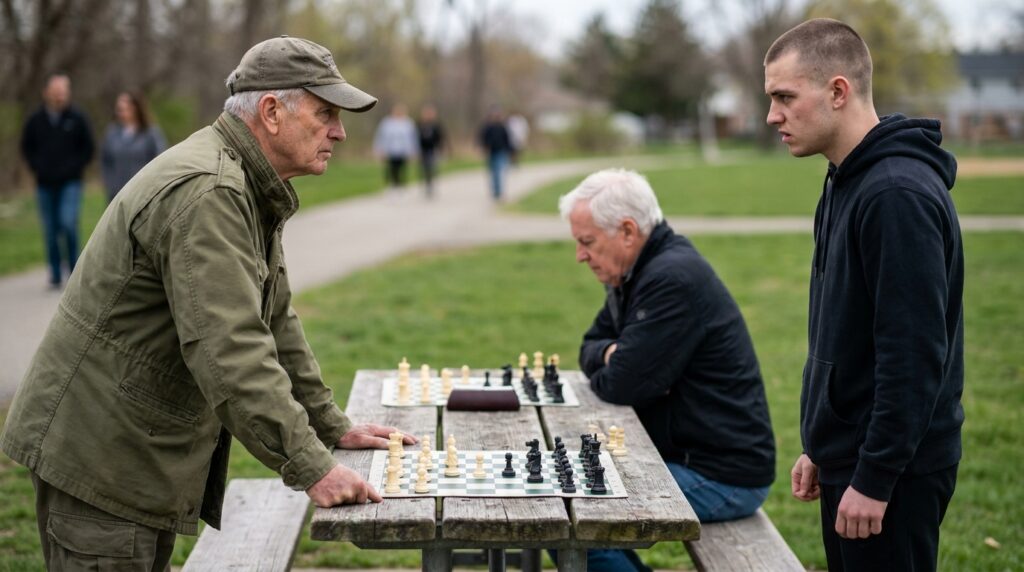
The shadow fell exactly across Frank’s remaining bishop, cutting the clean morning light into two distinct, jagged halves. It was a calculated intrusion, a heavy mass blocking the sun from the eastern side of the concrete table. Frank did not lift his chin. His eyes, trained by decades of looking through the brush rather than at it, tracked the dark fabric of an oversized hoodie and the invasive lean of a tall, athletic torso crossing the painted grid of the chessboard.

“Old man, your time on this table is up,” Tyler said, his breath carrying the faint, chemical tang of cheap energy drinks. “Grab your pieces and clear out.”

Beside Frank, Arthur’s fingers went rigid around a white knight. The polymer piece clicked against Arthur’s ring, a tiny, frail sound that signaled immediate submission. Arthur looked down, his short white hair catching the edge of the shade, his posture instantly collapsing into the standard shape of a bystander hoping to go unnoticed.

Frank’s thumb slid downward along the front of his weathered olive jacket, finding the cold, circular silver ring that served as a zipper pull. He didn’t pull it. He simply held the metal against his pad, measuring the steady, rhythmic pulse in his own hand against the erratic, high-energy shifting of the youth standing opposite him. Tyler’s weight was on his toes—an athletic build, early twenties, a freshly shaven buzz cut that caught the harsh glare of the municipal court lamps. He was leaning too far forward, crossing the vertical centerline of the table, his hands stuffed aggressively into his pockets to project absolute dominance.

To Frank, the park had ceased to be a public recreation area the moment Tyler’s shadow hit the concrete. It was now a corridor of narrow tolerances. He analyzed the environment with the cold, strategic pursuit of a man who spent his youth calculating fields of fire on wet grass. To his left, a chain-link fence offered no exit; to his right, a rusted green trash can restricted lateral movement to less than three feet. The path behind him was clear, but stepping back meant ceding the boundary.

“We’re in the middle of a game,” Frank said. His voice was flat, dry as old pine, lacking the high pitch of panic or the forced gravel of a man trying to sound tough.

“I don’t care about your game,” Tyler laughed, a sharp, transactional bark meant for the benefit of the three teenagers lingering near the basketball courts thirty yards away. He pulled his right hand from his pocket and planted it flat on the concrete, less than two inches from Frank’s pawns. The fingers were thick, unscarred, moving with the careless entitlement of youth. “You’re slow. You’ve been sitting here since eight. Move.”

Frank noticed the slight tremor in Tyler’s left shoulder—not fear, but the raw, unchanneled adrenaline of an aggressor who hadn’t yet met resistance. The boy was open, his weight entirely committed to the forward lean, his balance dependent on the friction of his sneakers against the smooth park concrete. Frank looked directly into Tyler’s eyes, seeing the shallow reflection of the city skyline behind him. He didn’t look at the hand on the table. He didn’t look at the teenagers watching from the court. He kept his spine straight under the olive fabric of his jacket, his breathing deep and silent.

A sudden, metallic scrape echoed from Tyler’s wrist as a heavy, scratched tactical watch dragged across the concrete edge, its bezel catching a small, fresh notch in the stone that hadn’t been there yesterday.


CHAPTER 2: THE CALCULATED ANCHOR

“You’re not deaf, old man. I said get your hands off the stone,” Tyler’s voice dropped an octave, the artificial bravado hardening into an explicit physical threat. His weight shifted forward another inch, his torso angling down until the synthetic fibers of his dark hoodie brushed the upper rim of Frank’s faded olive-drab sleeve.

Frank didn’t pull his arm back. To retreat an inch was to cede the physics of the table entirely. Instead, he kept his left palm planted flat against the rough, cold aggregate of the bench, using the concrete as a structural anchor to stabilize his spine. His thumb remained locked onto the circular silver ring of his zipper pull, the cold metal digging into his skin, a small, localized sting that kept his focus sharp and segregated from the rising heat in the park.

“The board stays where it is,” Frank said. The words were small, sparse, and entirely transactional. He wasn’t appealing to Tyler’s sense of fairness; he was establishing a hard baseline.

Arthur’s breathing had become a shallow, erratic stutter. Out of the corner of his eye, Frank tracked the older man’s hand. The white knight was still clamped tightly in Arthur’s fingers, but his wrist was trembling, the small piece of plastic vibrating against the painted concrete grid. Arthur’s eyes remained glued to the center of the board, his jaw tight, completely locked in the silent paralysis of a bystander who knew that a single wrong movement could turn a verbal dispute into a hospital stay.

Tyler let out a low, humorless whistle, a signal aimed squarely at the basketball courts behind him. The distant squeak of sneakers on asphalt died instantly. The three teenagers in baggy shorts stopped their drill, the orange ball bouncing twice before settling into the weeds by the chain-link fence. They didn’t run over—not yet—but their postures changed, heads tilting forward, shoulders dropping into the loose, expectant slouch of spectators waiting for a predictable execution.

“You think because you’ve got that vintage jacket on, people owe you something?” Tyler leaned closer, his athletic frame casting a total eclipse over the white pieces. The smell of high-fructose syrup and stale sweat became heavy, crowding out the scent of dry grass and damp earth. “This isn’t your neighborhood anymore. You old heads come out here, taking up space, moving one piece every twenty minutes. We got leagues trying to run on these courts. We got real business. You’re an obstruction.”

Frank didn’t look at the teenagers by the fence. He didn’t look at Tyler’s chest. His eyes remained locked on the sharp line of Tyler’s jaw, watching the minor twitching of the masseter muscle. He was calculating the distance—exactly twenty-two inches between his own chest and the young man’s sternum. The rusted green trash can to his right was an immediate constraint, blocking any lateral slide. If Tyler lunged, the only viable vector of movement was straight through the center.

“Your business isn’t on this table,” Frank said, his voice retaining its dry, pine-flat consistency.

“It is now,” Tyler sneered. He didn’t drop his hands into a stance, but his right arm cleared his pocket entirely, the heavy, scratched tactical watch on his wrist catching the morning light with a cold, metallic glint. The deep, jagged notch in the watch’s steel bezel looked fresh, its edges sharp and unpolished, contrasting with the worn, smooth finish of the rest of the casing. It was an expensive piece of equipment for a street kid—military grade, rated for depths that didn’t exist in a municipal park.

Frank’s eyes tracked the watch for a fraction of a second, registering the specific discrepancy. A kid looking for quick cash didn’t buy an eight-hundred-dollar diver’s watch just to scratch it against park concrete. There was an institutional origin to that steel, a standard-issue weight that didn’t match the casual lawlessness of Tyler’s dark fleece hoodie.

Tyler’s fingers curved, his hand hovering directly above Frank’s remaining rook like a claw. “Last warning, old man. Take your plastic trash and walk, or I’m flipping the stone.”

The threat was clear, the spatial threshold entirely violated. Frank felt the cool air of the park grow static, the distant city traffic fading into a background hum as his internal clock slowed down to match the rhythm of an active perimeter. He didn’t call for help. He didn’t look for a park ranger. He simply shifted his weight from his hips to the balls of his feet, his heels clearing the gravel by less than a millimeter, his body transforming into a compressed spring beneath the loose, faded green of his military jacket.

Arthur’s white knight finally slipped from his slick fingers, clattering loudly against the concrete and rolling toward the edge of the table where the shadow met the light.

CHAPTER 3: THE PARALLEL PERIMETER

The white knight rattled against the hollow concrete bench before spinning onto its side, the molded plastic head pointing directly toward Tyler’s muddy sneaker. Neither Frank nor Tyler broke eye contact to track its trajectory. The small, sharp impact sounded unusually loud in the sudden vacuum of the park’s eastern corner. Arthur’s empty fingers remained suspended in mid-air, trembling slightly, curved into the exact geometry of the piece he had just lost control of.

Tyler didn’t stomp on the piece. He simply let his right hand hover closer to the center of the board, his fingers twitching with the rhythmic anticipation of a predator waiting for a clear target indicator. “Your friend knows when to drop his armor,” Tyler said, his tone carrying a transactional frostbite. “Now it’s your turn, old head. Take the bag or I’m clearing the table with your chest.”

Frank didn’t look at the hand. He was tracking the perimeter expansion. Out of the periphery of his vision, two more figures stepped off the asphalt basketball courts, their movements timed too perfectly to be accidental. They didn’t approach with the loose, chaotic stride of local teenagers looking for a fight; they maintained a specific, diagonal approach vector that kept them exactly forty-five degrees off Frank’s blind shoulder. One of them wore a heavy nylon windbreaker despite the rising morning heat, his right hand hooked into the strap of a dark canvas gym bag slung low across his hip.

The cold silver ring of Frank’s zipper pull remained hard against his thumb. He noticed the second youth’s left wrist. A matte-black steel casing protruded from beneath the elastic cuff of the windbreaker—an identical high-grade tactical bezel, bearing the same sharp, unpolished notch across the outer ring as Tyler’s watch.

The repetition was a significant data point. One expensive military diver’s watch on a street-level agitator could be a lucky score from a local pawnshop or a fence. Two identical watches with identical structural damage indicated an inventory—a batch of standard-issue hardware distributed from a single, centralized source. The street kid wasn’t running an independent extortion scheme; he was wearing a uniform disguised as casual athletic wear.

“The table is public property,” Frank said. His voice was low, hitting the exact mid-range frequency that kept the sound localized between the two men. “The city charter is posted twenty yards behind you. Section four.”

“The city doesn’t collect the rent on these slabs,” Tyler replied, his jaw tightening as he crossed the centerline of the painted board completely. His chest was now less than twelve inches from Frank’s face. The heavy scent of synthetic fleece and synthetic stimulant grew oppressive, a physical wall intended to force a backwards lean. “We run the schedule out here. You want to sit here and stare at plastic for three hours, it costs fifty bucks a week. Or you can take your pension check and buy a card table for your living room.”

Frank evaluated his defensive parameters. The rusted green trash can to his right eliminated any possibility of a lateral step-and-pivot. The concrete picnic bench was anchored deep into the ground by double-reinforced iron rebar, making it an immovable obstacle behind his calves. If he remained seated, his lever arm was halved, his hips pinned beneath the lip of the stone table. To regain structural parity, he needed to alter his vertical alignment before Tyler’s hand made contact with the pieces.

Behind Tyler, the two secondary observers had halted their advance, locking themselves into spatial anchors near the edge of the gravel walkway. They weren’t looking at the chess game. Their focus remained split—one watching the park entrance near the avenue, the other tracking the blind spot behind the public restrooms. They were setting a cordon. It was an institutional tactic, a systematic isolation of a target in a public space to ensure no independent witnesses could interfere with the extraction.

“Who issued the watches, Tyler?” Frank asked.

The question was brief, delivered without an emotional edge, but the effect was immediate. Tyler’s hand froze two inches above the black rook. The superficial arrogance in his eyes flickered, replaced for a microsecond by a hard, calculating suspicion. His fingers straightened, his palm flattening out as his weight shifted slightly from his toes back toward his mid-foot—a defensive adjustment to an unexpected threat vector.

“You talk too much for a guy with an old heart,” Tyler muttered, his voice losing its theatrical bark, dropping into the cold, flat register of an operative whose operational cover had just been touched by a sharp edge. He didn’t look back at his partners, but his shoulders rose, closing off his neck as he prepared to bridge the remaining distance by force.

Arthur let out a soft, terrified exhalation, his body shrinking back until his spine pressed hard against the iron chain-link fence behind him. The white knight lay forgotten in the dust by Tyler’s shoe, its plastic seam split open from the impact against the stone.

CHAPTER 4: THE VERBAL LINE

“Leave us alone and walk away before this gets worse,” Frank said.

The sentence left his lips without a trace of vibration. It was a calibrated assessment, a hard limit drawn down the precise middle of the concrete slab. The words hung between them, flat and sharp, carrying the heavy structural certainty of an operational warning.

Tyler didn’t back out of the lane. The micro-flash of suspicion that had crossed his features a second earlier hardened back into an aggressive, unearned sneer. He lowered his face until his buzz cut almost touched the upper edge of Frank’s olive-drab cap. “You don’t draw lines out here, old man. You don’t have the rank.”

Frank’s left hand remained flat on the aggregate bench, his thumb holding the cold silver ring of his zipper pull. He didn’t look at Tyler’s face. He tracked the two secondary observers at the perimeter. They had shifted their angles again, their boots crunching softly against the loose gravel path. The one with the low-slung canvas gym bag had dropped his hand down to the heavy zipper of the main compartment, his fingers hooked into the metal teeth. He wasn’t looking at the basketball courts anymore; his entire focal plane was locked on the back of Frank’s skull.

The geometry of the interaction lane was fixed. Frank calculated the variables with the cold, internal economy of a machine. If he remained on the bench, his defensive lever was split by the lip of the table, his knees pinned by the heavy stone supports. The young man’s weight was still centered forward, his hands drifting back toward his hoodie pockets to reset his posture for an explosive downward movement.

“This is the last warning,” Frank added, his voice dropping into a localized whisper that barely carried past the edge of the painted chessboard.

“I don’t take warnings from museum pieces,” Tyler muttered. He lifted his right hand, his fingers spreading out over the black pieces, his heavy tactical watch scraping across the concrete edge with a sharp, metallic screech. The deep notch on the steel bezel lined up exactly with the edge of the stone, a cold reminder of the institutional source backing his movements. “Your time expired twenty years ago.”

Out of the left side of his vision, Frank saw the canvas bag on the perimeter open slightly. A flash of rigid, blue-lined cardboard protruded from the interior—not a weapon, but a thick, bound municipal ledger bearing a gold-leaf emblem that looked exactly like the city seal used by the parks department administration office. It was a standard-issue record book, the kind used to track lease allocations and vendor licenses across the district, but its presence inside a street kid’s gym bag didn’t match the standard operational profile of a casual extortion racket. They weren’t just taking cash; they were auditing the space, keeping a precise log of every vendor, player, and resident who used the tables.

Arthur let out a sharp, involuntary click from the back of his throat, his entire frame flattening against the chain-link fence behind them until the wire mesh creaked under his weight. The plastic pieces in his pocket rattled, a faint, rhythmic sound that emphasized the total silence of the surrounding courts. The three basketball players by the fence had stepped entirely onto the gravel, their arms crossed, their bodies forming a secondary cordon that closed off the path back to the main avenue.

Frank felt the cold metal of his zipper pull go warm against his thumb. He didn’t brace himself by gripping the stone tighter. He let his muscles go loose, his heels clearing the dust entirely as he adjusted his hips for an immediate, vertical elevation. He knew the young man’s reaction time would be delayed by exactly three-tenths of a second—the time it took for the human eye to process a sudden change in height from a target it had already categorized as passive.

“Fifty bucks, old head,” Tyler said, his fingers tightening until they brushed the crown of Frank’s black rook. “Or I drop this table on your legs.”

The threshold was gone. The parameters had converged into a single, kinetic point. Frank didn’t look back at the bag, and he didn’t check his blind spot. He locked his focus onto the small, pulsing vein at the side of Tyler’s throat, measuring his own breath against the impending fracture of the boundary.

CHAPTER 5: THE DISPLACEMENT MARCH

The transition was not an explosion; it was an unyielding correction of mass. When Tyler’s knuckles grazed the black rook, Frank’s center of gravity shifted forward, his heels striking the gravel with a singular, dense crunch. He didn’t cock his arm or draw back a fist. The economy of his prior training permitted no decorative preparation. He simply rose fully into the vertical plane, his lean frame straightening beneath the olive-drab jacket with the geometric certainty of an iron lever.

Tyler’s reaction time lagged by exactly three-tenths of a second. His gaze was still pinned to the chessboard when Frank’s left palm, flat and hard as a cured structural plank, made contact with the apex of Tyler’s right shoulder. Simultaneously, Frank stepped deep into the young man’s stance, his right boot sliding between Tyler’s sneakers to delete his lateral footing.

It was a standard-issue forward-pressure displacement—minimalist, defensive, and completely unconcerned with spectacle. Frank didn’t strike the chest; he drove his entire body weight through his palm, treating Tyler’s athletic torso not as a target for anger, but as a heavy obstacle to be cleared from a narrow trench. The friction of Tyler’s rubber soles against the park concrete failed under the sudden, continuous accumulation of leverage. His spine went rigid, his chin snapping up as his lungs expelled a sharp, involuntary hiss of air.

“I warned you already,” Frank’s voice cut through the space, a clipped command tone that carried no heat, only the weight of absolute finality. “Now back off and go.”

Tyler stumbled backward two paces, his boots catching the edge of the gravel walkway. His arms flailed briefly to capture his lost balance, his dark hoodie twisting violently around his neck. He didn’t drop into a brawler’s guard; the sheer physical reality of being manually moved by a man three times his age had shattered his internal script. He stood five feet from the table, his chest heaving, his face flushing a deep, dark crimson beneath his fresh buzz cut.

From the perimeter, the two secondary observers didn’t rush forward to bridge the distance. They froze, their boots locked in the dust, their faces dropping the loose arrogance of street-level enforcers. The one with the low-slung gym bag let his fingers slip from the zipper teeth, his eyes darting frantically from Frank’s upright posture down to the scratched tactical watch on Tyler’s trembling wrist. The symmetry of their cordon had collapsed; Frank had completely cleared the interaction lane, reclaiming the table and the surrounding four feet of public territory.

Frank stood behind his pieces, his breathing deep and even, his thumb returning to the cold silver ring of his zipper pull. He didn’t chase the retreat. He didn’t drop into a defensive crouch. He simply held his ground, his eyes locked onto the small, pulsing vein at the side of Tyler’s neck, monitoring the young man’s internal debate between pride and survival.

But the victory was a false flag. As Tyler stepped back, his heel caught the strap of the canvas gym bag dropped by his partner during the initial freeze. The bag rolled over, its heavy zipper splitting completely under the strain of its contents. A thick, bound cardboard ledger slid into the gravel—not filled with casual gang tallies, but bearing the crisp, gold-leaf municipal emblem of the city parks department administration office. Beside it, a stack of official precinct incident reports fell open, each one stamped with the private signature of the community liaison officer from the local precinct.

Frank’s eyes tracked the documentation in the dirt, registering the paradigm shift in less than a heartbeat. This wasn’t a standard park shake-down for pocket change. The names of every regular elderly chess player, including his own and Arthur’s, were systematically cross-referenced with red ink marks and eviction dates. The street kids weren’t acting on local entitlement; they were working under a structured, institutional mandate designed to systematically clear the older residents from the district’s public spaces.

“Hey—we’re done here,” the youth with the windbreaker muttered suddenly, his voice thin and panicked as he lunged down to grab the scattered documents, his tactical watch scraping loudly against the loose stones. He didn’t look at Frank; he shoved the ledger back into the split canvas, his movements frantic, entirely stripped of his previous tactical discipline.

Tyler broke eye contact first, his jaw twitching under the pressure of the surrounding silence. He looked at his partners, then down at the split plastic knight near his shoe, his unearned confidence completely neutralized by the revelation of the ledger. “Fine,” he spat, his voice tight and reluctant as he stepped back toward the main avenue. “Fine. I’m leaving.”

Arthur remained pinned against the chain-link fence, his white hair messy, his knuckles white as he watched the three youths withdraw down the gravel path toward the parked cars outside the gate. The park around them returned to its regular, dull city hum, but the air between the concrete tables remained charged with the cold, unpolished truth that had just spilled into the dust. Frank did not sit down. He kept his eyes on the avenue, his thumb resting against the cold metal of his jacket ring, realizing the perimeter he had to defend extended far beyond the edges of the painted board.

CHAPTER 6: THE DROP LOGISTIC

“They aren’t just street kids, Frank,” Arthur whispered, his voice thin, dry, and scraping like loose gravel against a boot sole. “Look at what they left in the dirt.”

Frank didn’t move from his position behind the white pieces. His eyes stayed tracked on the avenue, watching the black sedan swing wide away from the curb, its tires spitting gray aggregate against the chain-link perimeter fence before disappearing into the urban grid. The physical conflict had concluded, but the tactical envelope had instantly mutated. The three figures were gone, but the heavy, dark canvas gym bag lay stranded on the walkway, its zipper a torn track of jagged silver teeth twisted around the blue cardboard binding of the municipal ledger.

Frank stepped around the concrete table. Every movement was calculated to maintain a wide field of vision, his spine straight beneath the faded olive jacket, his thumb resting lightly against the circular zipper pull. He knelt beside the bag, his knees tracking parallel lines in the dust. He did not touch the canvas immediately; he used the edge of a plastic pawn to peel back the split fabric, exposing the documents underneath.

The gold-leaf municipal emblem on the ledger’s spine was authentic, the crisp lines of the city seal pressed deep into the heavy fiberboard. But it was the stack of paper beneath it that pulled Frank’s attention into a tight, cold focus. These were official precinct incident reports, pre-stamped and pre-signed by the community liaison officer—Officer Miller, the very man assigned to monitor the neighborhood’s public safety meetings. Each document had the names, addresses, and daily park hours of every regular elderly resident filled out in precise, red ink columns.

The strategy was immediate, legal, and completely compromised. It wasn’t a standard protection racket run by neighborhood thugs; it was a systemic eviction protocol masked as administrative cleanup. The street kids were merely the kinetic arm of a bureaucratic meat-grinder, gathering field data to justify permanent exclusions based on staged public disturbances. Frank’s tactical displacement of Tyler wasn’t a victory—it was the exact trigger the precinct needed to finalize the files.

“We need to take this to the desk,” Arthur muttered, his hand finally dropping the split white knight back into his pocket with a hollow click. “If Miller signed these, his captain doesn’t know. We can expose them.”

“Miller didn’t sign these in a vacuum, Arthur,” Frank said. His voice was flat, lacking any emotional resonance, the cold logic of a scout realizing the entire ridge line was held by the opposing force. He picked up the top incident report. The ink was fresh, but the paper itself carried a specific, industrial watermark—the private stationery of a major commercial real estate developer currently bidding on the park’s eastern perimeter for a high-density luxury high-rise.

The setup was a false bottom. The street-level extortion ring was a decoy to draw the attention of the neighborhood watch, keeping them focused on petty crime while the institutional machinery quietly cleared the title for the dirt beneath their benches. Frank looked down at his own name marked with a double red asterisk on the ledger’s baseline. His background, his service history, his routine—everything had been tracked, analyzed, and cataloged not to steal fifty dollars a week, but to eliminate the last physical obstacle to a multimillion-dollar land transfer.

The sound of an approaching siren cut through the park air from the west—low, rhythmic, and perfectly timed. It wasn’t a random patrol response. The vehicle was moving without a sense of urgency, winding through the side streets with an operational predictability that suggested a pre-arranged schedule.

Frank stood up, his joints popping softly under the heavy olive jacket. He stuffed the ledger and the reports back into the split canvas bag, zipping the remaining functional tracks closed with a single, sharp tug. The perimeter was closing fast. He couldn’t stay at the table, and he couldn’t walk out the main gate with a bag full of stolen precinct documentation. The tactical victory he had achieved five minutes ago had transformed into a structural trap, forcing him into a blind retirement before the cruisers sealed the avenue.

“Gather the pieces, Arthur,” Frank said, his eyes scanning the narrow three-foot clearance between the green trash can and the rear fence line. “The game isn’t over. They just changed the board.”

Arthur looked at Frank, his white hair catching the dust kicked up by the distant siren, his face pale as he realized the sovereign territory they had defended for ten years was already bought, paid for, and targeted for demolition.

CHAPTER 7: THE REVERSED GAMBIT

“Don’t move, Frank,” Arthur breathed, his weight freezing as the high-pitched hum of the siren cut out, replaced by the heavy, rhythmic thrum of an idling V8 engine just behind the perimeter bushes. “The cruiser’s at the gate.”

Frank didn’t drop the canvas gym bag. He held the worn strap in his left hand, the rough nylon fabric biting into his palm with a reassuring friction. He didn’t run. Running was an amateur mistake that altered the spatial geometry to the observer’s advantage, granting them immediate probable cause. Instead, he turned his torso toward the park entrance with measured deliberation, his chin up, his spine locked straight beneath the weathered olive jacket.

The white doors of the patrol car swung open, and Officer Miller stepped out into the morning heat. He didn’t draw his sidearm, but his right hand rested loosely on the polymer grip, his thumb unholstering the retention clip with a metallic click. On Miller’s wrist, the silver bezel of an expensive, high-grade tactical watch glinted in the sun—marked by the exact same unpolished, jagged notch that Frank had observed on Tyler and the other youth.

“Drop the bag, old man,” Miller said, his boots grinding against the loose gravel as he closed the thirty-foot gap. He didn’t look at Arthur, and he didn’t look at the spilled chess pieces. His eyes were pinned entirely on the blue cardboard edge protruding from the split zipper of the canvas bag. “We received a report of an active assault and property damage at this table. You’re matching the description.”

Frank stood his ground behind the concrete picnic bench, utilizing the stone as an immovable barrier between his lower lanes and Miller’s advance. He didn’t raise his hands in submission, nor did he drop them into an aggressive posture. He kept them waist-high, his thumb remaining anchored to the cold silver ring of his zipper pull.

“The description belongs to the boys you put on the payroll, Miller,” Frank said, his voice flat, dry, and lacking the pitch of hesitation. He didn’t appeal to Miller’s uniform; he addressed the structural logic of the documentation in his hand. “The ones tracking our hours in the municipal registry. The ones clearing the park so your real estate backers can clear the title.”

Miller’s stride didn’t break, but his jaw masseter muscle twitched violently—the identical physiological response Frank had observed in Tyler when the tactical calculation changed. The officer’s eyes narrowed into tiny, sharp points, his gaze shifting for a microsecond to the park perimeter, checking the empty avenue behind his cruiser. The street was quiet; the morning traffic had cleared, leaving only the dull hum of distant industrial activity.

“You’ve been sitting out here too long, Frank,” Miller said, his tone dropping from an official authority bark into the cold, sharp register of an equal intellect recognizing a threat. He stopped exactly four feet from the opposite side of the chess table, his torso leaning forward slightly, duplicating Tyler’s invasive posture. “Nobody cares about some old service files or a couple of plastic pieces in the dirt. The district is moving on. If you don’t walk out of here on your own feet, you’ll leave in the back of the wagon with a felony obstruction charge.”

Frank evaluated the final parameters. He was an octogenarian facing an armed, thirty-year-old patrolman in an isolated public park. The tactical calculation was heavily asymmetric. If Miller reached for his holster, Frank’s response window was less than half a second. But Frank wasn’t fighting for a physical victory; he was playing the long-form strategy he had refined over decades of service.

He didn’t pull the bag away. He simply reached inside the split canvas with his right hand, his fingers bypassing the ledger to grip the small, silver dictation recorder he always kept in his inner pocket to log his chess opening sequences. He pressed the brass playback button, his thumb steady against the cold casing.

“Fifty bucks, old head,” Tyler’s recorded voice cut through the heavy park air, clear, transactional, and unmistakably distinct from the device’s tiny speaker. “Or I drop this table on your legs. We run the schedule out here… the city doesn’t collect the rent on these slabs.” Then Frank’s own recorded voice followed, dry and unyielding: “Who issued the watches, Tyler?” followed by Tyler’s flat response: “You talk too much for a guy with an old heart.”

The audio played out into the small space between Frank and Miller, the magnetic tape static sounding like teeth scraping against steel. Miller’s hand froze on the polymer grip of his sidearm. His eyes tracked the small silver recorder, then dropped down to the stack of pre-stamped incident reports visible through the torn canvas bag—reports that bore his own unique signature, tied directly to the extortion threat caught on the digital track.

“The federal marshals monitor the real estate allocation funds for this district, Miller,” Frank said, his voice retaining its dry, pine-flat consistency. He didn’t shout; he delivered the data point like a mortar coordinate. “I filed the inquiry three weeks ago when the first vendor was cleared from the corner. They aren’t looking for a street gang. They’re looking for the signature on the authorization form.”

The silence that followed was dense, heavy, and absolute. The blue and red emergency lights from the cruiser’s rooftop bar continued to rotate, casting long, rhythmic shadows of crimson and violet across the weathered concrete of the table and the cracked plastic pieces in the gravel. Miller didn’t draw his weapon, and he didn’t reach for his cuffs. The athletic posture collapsed slightly, his weight shifting from his toes back to his heels as the systemic reality of the trap closed around his own perimeter.

Arthur slowly stood up from the chain-link fence, his white hair catching the flash of the emergency lights, his steadying fingers reaching down into the dirt to retrieve the split white knight. He wiped the gray dust from the plastic head and set it down precisely on the central king’s file of the painted board.

Frank didn’t offer a final speech, and he didn’t wait for an apology. He turned his back to the cruiser, picked up his olive-drab cap from the bench, and pulled it low over his gray hair. He walked out through the narrow three-foot clearance by the green trash can, his stride upright, rhythmic, and unyielding, leaving Miller standing alone in the rotating lights beside an unfinished game.

Similar Posts

Leave a Reply

Your email address will not be published. Required fields are marked *






