
The Measured Weight of an Old Armor Left Too Long in the Sun
CHAPTER 1: THE ACCRUAL OF FRICTION
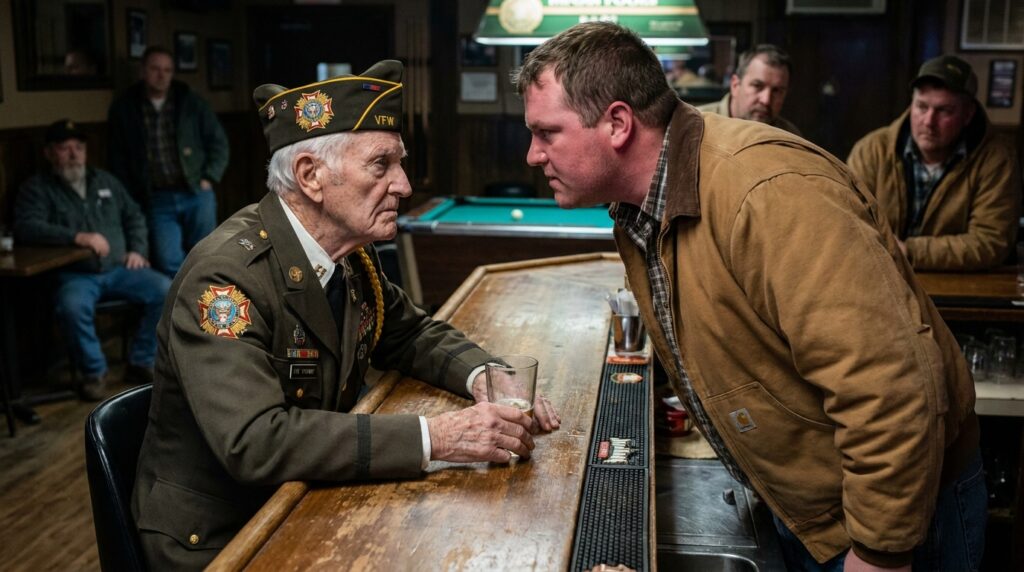
The cold iron edge of a buckled belt shouldn’t rattle against a barstool unless a man’s center of gravity has already shifted toward violence.
Calvin didn’t look down at the buckle, nor did he look at the stocky forearm currently occupying the six inches of air directly above his own left sleeve. The wool of his service jacket was old, heavy with the scent of cedar chests and the dry, alkaline dust of a parade ground he hadn’t seen since the winter of ninety-two. The brass buttons were tarnished to the color of wet sand, but they were still secure, held by thick nylon thread he’d sewn himself with a curved sail-maker’s needle.
“You’re in the wrong booth for a circus, old man,” the voice beside him was thick with the grey fat of cheap lard and twenty years of unchallenged local weight. It belonged to Miller, a man whose family name was still stenciled onto the rusted grain hoppers outside the town line. Miller smelled of diesel exhaust and stale tobacco—the kind of labor that didn’t know the difference between building something and simply wearing it down.
Calvin let his fingers remain flat on the zinc counter. The glass of ditch-water and cheap whiskey sat three inches from his thumb, its condensation leaving a grey ring on the unvarnished oak underneath. The wood was deeply grooved by forty years of sliding mugs and metal coins, split along the grain lines where the moisture had gotten in during the wet seasons. He didn’t lift the glass. To lift the glass was to change the angle of his elbow, and an altered elbow meant giving up the clear three-inch channel between his ribs and the counter’s lip.
“The jacket’s clean,” Calvin said. His voice didn’t have the gravel of a theatrical threat; it had the dry, rhythmic rasp of an old pump handle left out in the weeds behind a well-house. “The road’s clean too, if you walk it straight.”
A couple of three-and-a-half-inch framing nails were rolling around in Miller’s open jacket pocket, clicking together like dry teeth every time the younger man leaned another half-inch forward. In the reflection of the mirror behind the rows of dark amber bottles, Calvin could see the rest of the room. The two men by the jukebox hadn’t moved their quarters from the glass top, but their boots had turned ten degrees toward the bar. The bartender, a boy with the graying temples of someone who had inherited a debt rather than a business, was wiping the same spot on the beer tap with a rag that had long since ceased to be dry.
“My uncle had a coat like that,” Miller said, his shoulder dropping slightly, the brown duck fabric of his work coat bunching where the grease from an auger line had stained it black. “Died in a ditch in Biloxi before he ever saw a boat. Took three weeks to get the smell out of the upholstery. I don’t much care for the smell of old wool.”
Calvin watched the condensation on his glass. A single drop, heavy with the salt of the room’s humidity, broke from the rim and ran down the side, cutting a clean path through the film of grease on the exterior. He timed it by the steady hum of the compressor in the coolers below—three seconds for the drop to reach the zinc.
“You’ve got three inches of clear wood between your hip and mine, son,” Calvin murmured. He didn’t turn his head. He could see the small white scar just below Miller’s left ear, the jagged kind left by a broken fan belt or a sloppy hook. “That’s about two inches less than a man needs to keep his teeth where they were born.”

CHAPTER 2: TESTING THE METAL
“A man who spends too much time looking at the floor usually finds what he’s looking for,” Miller said. He didn’t drop his arm. Instead, he rotated his wrist, bringing a thick, blunt thumb down onto the zinc counter. The friction of his calloused skin against the metal made a sharp, dry scraping sound that cut straight through the low hum of the beer coolers. “And right now, you’re looking at a lot of old dirt.”
Calvin didn’t blink. The desaturated light from the neon sign overhead—a sputtering blue tube that hummed in a broken three-beat rhythm—cast long, gray shadows across Miller’s face, emphasizing the deep, grease-stained lines around his mouth. This was the testing phase. In the field, a perimeter wasn’t breached with an immediate rush; it was probed with small, repetitive movements designed to map the defense’s reaction times. Miller was mapping.
“I’ve seen enough dirt to know what stays buried,” Calvin replied. He shifted his weight by a fraction of an inch, his boot leather creaking against the grit on the floorboards. The movement was internal, a tightening of the oblique muscles that anchored his spine against the backrest of the stool. “And what rots when it gets rained on.”
Miller laughed, a short, dry bark that lacked any real humor. He shifted his bulk, his hip crowding closer to Calvin’s left side, the rough brown duck fabric of his work jacket scraping against the faded wool of Calvin’s service coat. “You talk real authorized for a man who doesn’t have a badge or a tractor. This whole town’s tired of the phantom routine, Calvin. We got people trying to run a business here, and then you walk in looking like a walking monument that forgot to get buried.”
Calvin didn’t answer with words. He let the silence stretch, heavy and thick with the smell of iron and sour malt. In the reflection of the amber bottles, he watched the bartender’s hands. The young man had stopped wiping the tap. His fingers were locked around the edge of the zinc sink, his knuckles turning the color of skimmed milk under the low-wattage bulbs. He knew the weight of Miller’s family name in this valley; he knew who owned the paper on the roof over his head.
Miller leaned in further, his breath hot and smelling of cheap tobacco and charred meat. “Let’s see the brass, old man. You got all these ribbons pinned to your chest like they mean something down at the bank. Let’s see what happens when we start counting ’em.” He reached out, his thick fingers hooking toward the lower edge of Calvin’s lapel, his intention clear—to pull the fabric forward, to break the older man’s posture, to turn the uniform into an interrogation.
Calvin’s hand didn’t move from the bar counter, but his thumb slid an eighth of an inch to the left, touching the small, stiff ridge in the seam of his trousers where a notched brass key was stitched into the lining. It was a mechanical anchor, a physical reminder of things that remained locked. The metal was cold against his skin through the pocket cloth, a stark contrast to the stifling, grease-heavy air of the tavern.
“The medals aren’t for counting,” Calvin said, his voice dropping an octave, losing its dry rasp and hardening into something flat and level, like a iron plate dropping onto stone. “And your fingers are too dirty to touch that wool.”
Miller’s hand froze an inch from the tarnished brass buttons. His eyes narrowed, the small white scar beneath his ear turning a dull, angry purple as the blood rushed to his jaw. He didn’t pull back. The lack of deceleration in Calvin’s posture was a variable he hadn’t accounted for in his initial probe. In his experience, age always brought a softening, a slight roll of the shoulders, an instinctive tuck of the chin to protect the throat. Calvin sat as straight as a steel surveyor’s stake driven into frozen clay.
“You think you’re the only one who knows how to hold a line?” Miller whispered, his voice tightening as he dropped his center of mass, preparing to use his stocky build to force Calvin off the stool by sheer leverage. “This valley doesn’t owe you a clearing, old man. We’ve been paying your rent in silence for ten years. It’s about time we checked the inventory.”
Beyond Miller’s shoulder, the two regulars by the pool table had stopped their game entirely. One of them held his cue vertically, the blue chalk on the tip catching a stray beam of light from the dangling shaded lamp. The green felt of the table looked old, frayed at the pockets where the iron brackets had worn through the wool—a rusted boundary waiting for a body to break it. Calvin tracked the distance between the edge of that table and his own left heel. Forty-two inches. A single clean pivot on the ball of the right foot would clear the stool and establish the necessary friction against the floorboards to counter a forward rush.
“The inventory’s closed,” Calvin murmured, his eyes locking onto the exact point where Miller’s work jacket bunched at the armpit—the structural weakness in the younger man’s stance. “Think about your knuckles before you open it.”
CHAPTER 3: THE WEIGHT OF THE THRESHOLD
“The inventory doesn’t open for men who bleed as easy as you do, Miller,” Calvin said.
The silence that followed was not empty; it was the heavy, pressurized quiet that settles inside an engine block right before the piston snaps. The low hum of the beer cooler seemed to vibrate through the soles of Calvin’s boots, a dull reminder of old generators humming in buried concrete bunkers. Miller didn’t back off. The younger man’s chest rose, the thick duck fabric of his work jacket straining against a broad, solid frame built from generations of unchallenged rural authority. He didn’t understand leverage; he only understood bulk.
“You’ve been talking down from that stool for ten years, old man,” Miller spat, his voice dropping into a throat-clearing rasp that signaled the end of his patience. “But the ground down here is exactly the same for everybody. Let’s find out how much of that coat is just empty wool.”
Miller’s left hand left the zinc counter, a quick, heavy arc intended to hook Calvin by the collar of his service uniform jacket and drag him down onto the oil-stained pine floorboards. It was a projection of raw mass, unguided by technical discipline—the classic opening movement of a man who spent his life wrestling tractor tires and fence posts.
Calvin didn’t lean away. To retreat was to give up the structural rigidity of the barstool. Instead, he allowed his left shoulder to drop slightly, inviting the contact, absorbing the friction of Miller’s calloused palm against the coarse fabric of his sleeve. The moment Miller’s weight committed forward, Calvin’s right hand moved. It was a brief, economical economy of movement, a single arc that had nothing to do with anger and everything to do with physics. His thumb remained hooked near the small ridge where the brass key lay hidden, using that localized tension to anchor his wrist.
With his left arm pinned, Calvin used the counter’s iron edge as a fulcrum. He didn’t strike; he simply reset his hips, planting his heel into a knot in the floorboards where the wood had dried out and splintered over fifty winters. The grease on the floor provided a dangerous slide, but Calvin’s boots had deep, cross-hatched rubber soles that caught the grain of the fir. He reached up, his right fingers finding the structural gap beneath Miller’s armpit—the soft junction where the brown work coat met the flannel shirt.
“The road is closed,” Calvin murmured, his breath steady, his eyes locked on the tiny white scar beneath Miller’s ear.
Miller’s momentum was already too massive to check. He had anticipated a soft collapse, the brittle yielding of an octogenarian’s frame. Instead, he encountered a structure that felt like an iron hitching post driven deep into the bedrock. Calvin’s forearm became a rigid bar, transferring the kinetic energy of Miller’s own rush back into his collarbone. The friction was immense—the sound of heavy cotton ripping along a seam, the sharp clink of the three-and-a-half-inch framing nails shifting inside Miller’s pocket.
The younger man’s balance vanished. His boots skidded across the dark circle of grease near the taps, his center of gravity tilting toward the open floor behind him. Calvin didn’t pursue. He simply sustained the pressure for three inches, a disciplined defensive shove that utilized Miller’s own overextended mass to clear his immediate front. The physical reordering of the space was instantaneous. Miller’s bulk drifted back into the gray shadows where the light from the neon beer sign couldn’t reach, his hands clawing at the empty air as his heels caught the edge of the frayed green felt.
The pool table sat exactly where Calvin had mapped it—forty-two inches from his stool. The corner bracket was made of cast iron, rusted to a dark cocoa color and pitted by decades of spilled beer and sweat. It was an unyielding boundary, a hard edge that didn’t care about family names or regional land holdings. When Miller’s hip struck the timber frame, the sound was like an axe hitting an old stump—a hollow, splintering thud that rattled the heavy slate slab underneath and sent three pool balls rolling into the pockets with a sequence of dull, iron clicks.
The bartender didn’t shout. The regulars by the jukebox froze, their hands suspended over their pockets, their faces pale under the desaturated yellow light of the dangling lamps. Nobody moved to help. In this valley, when an established weight was suddenly shifted, men waited to see where the dust settled before they chose a side.
Calvin remained on his stool, his left hand returning to the zinc counter, his fingers resting within an inch of the gray condensation ring. His heart rate hadn’t spiked; his breathing remained a slow, rhythmic draw through his nose, smelling the iron filings and the sour malt that had risen from the floorboards during the disruption. His service uniform jacket was still straight, the brass buttons aligned, though a faint smell of old cedar had been knocked loose from the wool by the exertion.
On the floor beside the pool table, Miller lay among the sawdust and the dry husks of peanuts, his breath coming in short, ragged gasps as his brain tried to calculate how forty-two inches of space had disappeared so quickly. His brown work coat was pulled up around his chin, the pockets inverted, the framing nails scattered across the oak boards like old teeth.
“You’re done here, Miller,” Calvin said, his voice flat, level, and entirely devoid of heat. “Go home and fix your fence.”
CHAPTER 4: THE REVERSAL OF FRICTION
“Alright,” Miller said. The word was wet, broken by the taste of copper and the dust that had accumulated on the floorboards since the last sweep. He didn’t try to lift his shoulders off the pine. His hands stayed flat against the grit, his fingers twitching slightly as the scattered framing nails settled into the grooves around him. “Alright, I get it.”
Calvin didn’t lower his chin. His gaze remained anchored to the small white mark behind Miller’s ear, treating the man’s sudden compliance as another variable to be measured rather than a victory to be celebrated. In his experience, a perimeter that collapsed too quickly was usually an invitation to an ambush. He let his right hand drop back to his knee, his fingers skimming the stiff seam where the notched brass key remained sealed. The iron in the air was thicker now, stirred up by Miller’s heavy landing against the pool table’s rusted corner casting.
“You’re done here, Miller,” Calvin repeated. The rasp in his throat didn’t fluctuate. It carried the dry, mechanical rhythm of an old windlass locking into a greasy sprocket. “Take your iron off the floor.”
The regular by the jukebox—the one holding the cue vertically—slowly lowered the timber shaft until the rubber bumper clicked against his boot. His partner didn’t make a sound. The silence in the room had changed its texture; it was no longer the passive waiting of a crowd watching a bully work. It had become the hard, desaturated quiet of men who had just seen a machine they didn’t understand operate with perfect economy.
Miller rolled onto his flank, his work coat bunching around his ribs like a torn tarp. He gathered his boots under his weight, the friction of his heavy rubber soles against the grease-spotted wood making a low, rhythmic grunt. He didn’t look at Calvin as he reached out to gather the framing nails. His fingers scraped against the floorboards, collecting the silver spikes two at a time, his knuckles gray with wood dust and old soot. When he finally stood, his center of gravity was broken, his shoulders sloping inward to protect the cracked rib where the timber frame had caught him.
He didn’t speak again. He walked toward the screen door, his boots dragging through the sawdust near the threshold, leaving two dark, uneven tracks that ended at the gravel lot outside. The door didn’t slam; the spring was old, rusted to a dull orange coil that pulled the cedar frame back into the jamb with a soft, hollow click.
Calvin watched the reflection in the amber bottles until the gray shape of Miller’s truck cleared the gravel turn at the county road. Only then did he allow his shoulders to drop a quarter of an inch. The ache in his left hip was a slow, grinding heat—the price his eighty-year-old bone paid for holding ninety pounds of rushing mass against a zinc counter. It wasn’t an injury; it was simply the friction of survival.
The bartender didn’t approach immediately. He spent thirty seconds picking up an empty pint glass, his fingers unsteady against the rim, before he moved down the duckboards to where Calvin sat. He didn’t use the wet rag this time. He set a fresh glass on the oak counter, the base clicking against the wood exactly two inches from Calvin’s left thumb.
“On the house, Calvin,” the boy said, his voice thin, lacking the grease of his usual tavern hospitality. “He won’t be back before the weekend.”
Calvin looked at the glass. The amber fluid inside was clear, but it didn’t interest him. His eyes were tracking a small, square edge of white paper that had worked its way out of his own breast pocket during the brief physical exertion. The wool had stretched where the brass buttons were sewn, and through the gap in the fabric, the corner of the document looked dry, brittle, and yellowed by thirty years of stale air.
He reached up with two fingers, his movements deliberate, and pulled the paper free. It wasn’t his name on the header. The faded typewritten letters spelled out Caleb Vance—a name that didn’t exist in the county records, followed by a stark, red ink stamp that marked the file as a dishonorable separation from the service.
The bartender’s eyes dropped to the paper, his expression hardening as he read the classification through the low-wattage light of the dangling lamp. The reverence that had settled into the room after the throw seemed to evaporate, replaced by a colder, sharper curiosity. In a blue-collar valley, a uniform was an armor, but a fraudulent paper was a lie that no amount of leverage could fix.
“That’s not your name, Calvin,” the boy murmured, his hand retreating from the fresh glass until it rested on the iron edge of the cash drawer. “My father said you came out of the ninety-second with a citation. This says something else.”
Calvin didn’t tuck the document back into the seam. He let it lie on the zinc, the yellowed edge curling upward under the heat of the neon tube above them. He could hear the regulars by the pool table shifting their feet, their boots clicking against the floor as they moved closer to the bar channel, their silent compliance turning into something heavy and transactional. The false bottom of his life had just cleared the surface, and the price of his victory over Miller was about to be collected in full.
“The paper belongs to the coat,” Calvin said, his rasp dropping into the quiet space between them. “The coat belongs to the room. If you want to check the inventory, son, you better make sure you can carry the weight.”
From the back of the room, near the darkened hallway that led to the office, a phone began to ring—a dry, mechanical bell that had no business waking up a tavern at this hour. The bartender didn’t move to answer it. He kept his eyes on the yellowed paper, his knuckles locking onto the iron handle of the register as the first real danger of the night began to knock against the wall.
CHAPTER 5: THE PRICE OF AUDIT
“Let it ring,” Calvin said.
The bartender’s hand remained frozen three inches above the iron lever of the register, his eyes darting from the yellowed document on the zinc counter to the dark hallway where the mechanical bell continued its rhythmic, metallic strike. Every vibration of the telephone seemed to draw more dust from the uninsulated drywall. The regulars by the pool table didn’t go back to their quarters; they stood like old fence posts in a shifting fog, their shadows long and hard against the grease-stained floor.
“It’s the seven-four exchange,” the boy whispered, his voice dry, stripping away the defensive casualness he usually maintained behind the bar. “Nobody calls out of that exchange unless they’re looking for the timber records or the marshal. You know what’s on that paper, Calvin. If Miller’s old man got to a phone before he reached the county road—”
“I know exactly what’s on the paper,” Calvin interrupted. He didn’t lift his fingers from the oak edge. The slow, rhythmic ache in his left hip had sharpened into an iron spike, but his spine remained flat against the vertical support of the barstool. He reached out with his left hand, the coarse wool of his sleeve rasping against the zinc, and turned the paper ninety degrees so the typed name—Caleb Vance—faced the kid directly. “Read the date at the bottom. Not the stamp. The ink.”
The bartender leaned closer, his breath hitching as he checked the tiny, purple ribbon-tinted digits in the corner of the document. “Nineteen sixty-nine. That’s before the valley pool was logged out.”
“That’s before your father had a mortgage on this roof,” Calvin said. He slid his thumb down to his trouser seam, his skin catching the hidden ridge where the notched brass key remained sealed in its dark oilcloth wrapper. “A man doesn’t carry a dead brother’s bad paper for fifty years just to show it to a clerk. He carries it because it’s the only receipt that doesn’t have a government tracking number on the back.”
The phone stopped ringing on the eighth stroke, its sudden absence leaving a hollow, pressurized quiet that made the hum of the beer coolers sound twice as loud. The smell of sour malt seemed to rise through the cracks in the floorboards, thick and greasy, clinging to the back of Calvin’s throat. He didn’t look back toward the screen door, but his ears tracked the distinct crunch of dry limestone gravel outside—not a truck’s heavy dual-axle rumble, but the light, uniform tread of a sedan with balanced tires.
One of the regulars near the jukebox cleared his throat, a sharp, wet sound that cut through the silence. “Calvin, there’s a light bar on the roof of that car. It ain’t the sheriff.”
Calvin didn’t turn his head. He watched his reflection in the amber bottle across the zinc. He could see the small white scar beneath his own chin, the silver tissue left by a fragment of an intake valve that had shattered during an unlogged run through the delta forty-five years ago. The world outside this valley thought it could audit a man’s inventory by looking at a ledger, but a real inventory was written in the friction of iron against bone.
The screen door opened. The rusted spring didn’t click this time; someone held the cedar frame against their palm, allowing the humid evening air to flood the tavern floor with the scent of wet asphalt and ditch-weed. The silhouette that stepped into the desaturated light wore a gray, unstructured uniform jacket—no brass buttons, no ribbons, just a black plastic name-tag that sat perfectly level over the left pocket.
“Calvin Vance?” the man asked. His voice wasn’t loud. It had the smooth, oiled delivery of an inspector who spent his life checking serial numbers on state property. He didn’t look at Miller’s scattered framing nails or the dent in the pool table’s timber frame. His eyes went straight to the yellowed paper lying on the zinc counter.
“The name’s on the wood,” Calvin said, his rasp level and unhurried. He didn’t move his hand away from the glass. “You’re about six miles past your regional boundary, counselor.”
The officer stepped forward, the heavy leather of his duty belt creaking with a dry, mechanical squeak that matched the rhythm of his stride. He stopped two feet from the stool, his bulk blocking the light from the neon sign, throwing Calvin’s face into deep, desaturated shadow. He didn’t reach for his holster, but his fingers remained hooked near the iron ring of his flashlight—a heavy, three-cell club that had seen service on harder roads than this one.
“The state doesn’t have boundaries when the paper’s fraudulent, Mr. Vance,” the man said. He reached down with two fingers, his nails clean and clipped, and touched the yellowed edge of the discharge. “This file was flagged out of the regional repository three hours ago. A man down at the depot said someone was trying to verify a service record with a dead name.”
The bartender took a step back, his boots dragging on the duckboards, his hand dropping completely away from the cash register. “He didn’t show it to nobody here,” the boy lied, his voice cracking slightly under the pressure of the gray uniform. “It just fell out of his coat when he—”
“Shut up, son,” Calvin said, not looking back. He kept his eyes locked on the officer’s plastic name-tag. It read Miller. Not the stocky bully who had gone over the pool table, but the older brother—the one who had gone to the capital ten years ago to work the administrative logistics for the district court. The inventory wasn’t just a local dispute anymore; the family was using the state’s teeth to collect the debt Miller had dropped in the sawdust.
“Your brother needs to learn how to fall,” Calvin murmured, his right hand finally leaving his knee. He didn’t reach for the paper. Instead, his fingers slid into the hidden fold of his trousers, his nails catching the heavy thread that sealed the notched brass key. With a single, sharp pull born of old, calloused strength, he snapped the nylon line. The key slid into his palm, cold, heavy, and smelling of the lubricating grease he’d used to keep it from rusting inside his clothes since the year the river froze over. “He thinks because a man’s old, his leverage goes soft.”
The officer’s eyes shifted to Calvin’s closed fist, his posture stiffening as his weight shifted back onto his heels. He recognized the mechanical precision of the movement—it was the same lack of deceleration that had sent his brother across the green felt thirty minutes ago. “You’re carrying more than a bad record, aren’t you, old man? Let’s see what else is in the lining of that coat.”
The regulars didn’t step forward. The room remained perfectly static, a desaturated tableau of old iron and dry timber, while the phone in the back began its dry, mechanical ring for the second time, louder now, like an alarm indicating that the main valve had just failed.
CHAPTER 6: THE IRON AUDIT
The thread didn’t snap with a clean pop; it unraveled with a slow, fibrous drag that Calvin felt all the way through the calloused skin of his index finger. The notched brass key lay in his palm, cold, flat, and coated in a thin, greenish film of oxidized tallow and old grease. It was an unyielding wedge of metal, five inches long, its teeth ground down manually with a hand file to match an iron lockbox that had never existed on any public inventory.
The state officer—the older Miller brother—didn’t draw the three-cell flashlight from his belt, but his shoulder dropped three inches, his center of gravity tilting over his boots to match Calvin’s leverage. He knew the family name wouldn’t hold a perimeter if the old man decided to clear his front for a second time. The desaturated glow of the blue neon beer tube caught the side of his plastic name-tag, casting a thin, sharp shadow across the gray fabric of his shirt like a pencil line drawn on slate.
“The lining’s empty, counselor,” Calvin said. His voice was a dry, hollow rattle now, the rasp of a dry well-pump scraping against gravel at the bottom of the casing. He didn’t drop the key. He held it flat against the zinc, the iron scent of his skin mixing with the stale malt that rose from the pine floorboards. “Everything I ever carried is sitting right on top of the wood.”
The younger Miller—the one who had taken the pool table frame with his ribs—wasn’t outside in his truck anymore. His silhouette appeared behind the mesh of the screen door, his broad, stocky frame leaning against the cedar jamb to relieve the pressure on his left flank. He didn’t push the door open. He stood in the humid night air, smelling of diesel smoke and wet limestone, watching his brother try to collect an account that had been running for fifty-four winters.
The officer looked down at the brass key, then at the yellowed separation paper bearing the name Caleb Vance. His hand remained level over the cash register, his fingers twitching in a slow, administrative calculation. “The state has a record of the lockbox, Mr. Vance. It’s been sitting in the basement of the depot at the junction since the seventy-two flood. They call it an unassigned repository. No name, no allocation. Just a three-digit stamp on the iron.”
“The stamp’s three-eight-two,” Calvin murmured. He didn’t lift his whiskey glass. The gray condensation ring had dried completely, leaving a salt-crust on the unvarnished oak counter. “And there’s nothing in that iron but six ledger books written in purple ribbon ink. No names. Just numbers and lat-long coordinates for six coordinates in the delta.”
The bartender took a breath, a short, wet rattle through his nose that broke the stagnant air behind the beer taps. He looked at the paper, then at the key, his face turning the color of skimmed milk under the low-wattage bulbs. “Caleb was your brother, wasn’t he, Calvin? The one who went down in the valley pool before the timber lines were cut.”
Calvin didn’t look at the boy. He kept his eyes locked on the gray uniform jacket before him, tracking the slight, rhythmic movement of the officer’s breathing. Time seemed to slow down, dilating until the intervals between the mechanical rings of the telephone in the back hallway felt like minutes. He could feel every individual thread of his wool coat—the weight of it, the heat it held against his ribs, the old cedar smell that had survived three decades of dark closets.
“Caleb didn’t go down in the pool,” Calvin said. The words came out slow, heavy, like iron plates dropping into wet clay. “Caleb was nineteen when he panicked at the crossing. He signed the separation papers because they told him it was the only way to avoid the stockade at the junction. I took his name because the command structure didn’t issue receipts for the things we did on the other side of the line. The ninety-second didn’t exist on the state pool, counselor. If you audit that ledger in the cellar, you aren’t going to find an account for the Miller family. You’re just going to find the names of the men who didn’t come back to sign the vouchers.”
The officer’s hand dropped an inch away from his belt. The administrative arrogance in his jaw didn’t collapse; it simply stiffened, turning into the hard, silent recognition of a man who had finally found the boundary of his own authority. He looked at the key on the zinc, then at his brother’s broken silhouette against the screen door. The state pool was an engine that ran on paper, but the iron Calvin was holding had been forged before the ledger was even printed.
“The file says dishonorable,” the officer whispered, his voice losing its oiled, transactional tone, dropping into the raw, flat register of the valley. “My father said a man who carries that kind of stamp doesn’t have a right to a seat at the table.”
“Your father spent the war maintaining the air compressors at the depot, Miller,” Calvin said. He didn’t look up as he slid the brass key back across the oak, leaving a thin, greenish trail through the wood-dust. “He knew how to hold a pressure line, but he never had to live inside the tank. The paper’s a lie. The brother’s dead. The coat’s exactly as heavy as it was when I put it on in sixty-nine.”
The room stayed frozen. The two regulars by the jukebox didn’t move their quarters; their boots remained aligned with the floorboards, their eyes fixed on the yellowed paper that had ceased to be an interrogation and had become a monument. The bartender slowly reached out, his hand steady now, and picked up the fresh whiskey glass he had set down fifteen minutes ago. He didn’t offer it on the house; he simply set it directly on top of the typewritten name, pinning the old lie under four ounces of amber fluid.
Outside, the phone in the back hallway gave one final, truncated clink before the line went dead, the silence returning to the tavern floor like a layer of dry, unbrushed soot. Calvin closed his fist over the empty seam in his trousers, feeling the loose threads where the nylon had torn away, a small, ragged gap that would remain open long after the light bar on the sedan had cleared the gravel lot.
CHAPTER 7: THE JUNCTION RUN
The second-gear synchro didn’t catch until the lever was forced four inches past the gate, its iron teeth barking against the flywheel with a dry, metallic shudder that rattled the dashboard pins. Calvin didn’t lift his boot from the clutch. He held the steering wheel—a thick, cracked circle of black vinyl wrapped in electrical tape—with his left hand, while his right thumb remained anchored against the notched brass key now tucked into his service jacket’s interior pen slot.
The headlights of the old high-bed pickup were dim, their yellowed glass lenses pitted by decades of river-gravel and road salt, throwing two uneven cones of light across the limestone dust of the county road. Ahead, three hundred yards through the low hanging river fog, the red taillights of the gray sedan danced along the ridges of the washboard dirt. The elder Miller wasn’t using his light bar. He was running flat, his rear tires kicking up a thick, choking cloud of gray powder that smelled of dried silt and old sulfur.
Calvin didn’t close the distance. To crowd a state vehicle on a single-lane timber road was to invite a PIT maneuver from a car that carried three times his braking capacity. Instead, he timed his speed by the low, rhythmic thumping of his own left rear tire—a recap that had been separating from the carcass since the spring rains. Every four rotations, the rubber gave a dull, hollow thwack against the wheel well, a mechanical clock tracking the miles left before the tread turned to rags.
On the floorboards beside the gearshift, a small, notched iron oil-can rolled with every turn of the road, its brass spout clicking against the rusty seat frame. The can was empty, but the residue inside had turned to a sticky, black varnish over twenty years, smelling of tallow and heavy gear oil. It was the same fluid Calvin had used to grease the lock box hinges back when the depot at the junction still had a station master.
The road began to tilt downward, dropping into the gap where the valley pool had been logged out in the early seventies. The trees here were different—second-growth scrub pine that grew thin and crowded, their branches scraping against the truck’s side mirrors with the sound of dry fingers dragging across canvas. The fog was thicker near the bottom, tasting of river moss and the wet, iron-heavy mud that never truly dried out between the pilings.
In the small rectangle of the rearview mirror, Calvin watched the tavern light fade to a dull orange smudge against the ridge line. The regular patrons would still be standing by the zinc counter, their eyes fixed on the fresh glass of whiskey that was currently holding down the edges of his brother’s bad paper. They wouldn’t talk about the throw; they wouldn’t talk about the name Caleb Vance. In a valley that lived on the margin of the timber quotas, men didn’t discuss an old debt until the collection truck had already cleared the county line.
The sedan ahead slowed its pace, its brake lights flaring into two bright, blood-colored discs through the gray mist. The road was narrowing here, preparing for the crossing at the old iron bridge—a three-span Pratt truss built before the first war, its deck made of unanchored oak timbers that rattled like loose teeth whenever a load crossed the channel.
Calvin let his foot slide off the accelerator. He didn’t use the brakes; the shoes were thin, and the heat would fade them to nothing before he reached the junction depot. He allowed the engine’s compression to drag the truck down, the heavy four-speed transmission whining in a high, mechanical register that echoed off the clay bluffs to his right. Through the windshield, he could see the gray sedan’s nose dip as it hit the approach timbers, the sound of the loose wood hitting the iron stringers rolling back through the fog like a series of distant, muffled shots.
“Six miles to the repository,” Calvin murmured to the dark cab. His rasp was dry, his tongue catching on the salt of his own skin.
He reached down, his fingers finding the iron spout of the rolling oil-can, steadying it against the transmission hump as the truck’s front tires took the first oak plank. The vibration was massive, a loose, shuddering judder that started in the steering box and traveled straight up his arms into the stiff wool of his shoulders. The bridge didn’t have a guardrail—just two rusted iron channels, four inches high, that had been bolted to the timber deck when the logging trucks still used the run. One wrong calculation on the wheel, one slide on the slick, river-wet wood, and the high-bed would go over the lip into thirty feet of black water that had been silted up by fifty years of gravel washing.
Beyond the bridge, the road split. The left fork went up toward the high ridge where the Miller family kept their equipment yards; the right fork dropped into the old ditch where the railroad tracks had been pulled up in seventy-six. The sedan’s right turn signal didn’t flash, but the car’s mass leaned heavily into the ditch run, its rear bumper scraping the limestone outcrop as it cleared the bridge frame.
Calvin followed. He didn’t adjust his mirror. He didn’t need to see what was behind him; the only inventory that mattered was currently rolling through the weeds three hundred yards ahead, and the lock was already waiting for the key in his pocket.
CHAPTER 8: THE COLD IRON OVERPASS
The sound didn’t begin with a roar; it began with the high-pitched, tooth-grinding shriek of two-inch structural steel scraping across an ungreased fifth-wheel plate.
Calvin didn’t touch the horn. He dropped his right boot onto the floorboards, pinning the worn rubber of the brake pedal against the bare cab metal until the drums behind his heels began to smell of scorched lining and old asbestos. The high-bed truck slewed three feet to the left, its recap tire giving a final, tearing thwack against the iron box before the front bumper dropped into the dead weeds at the approach of the bridge channel.
Through the yellowed fog, the obstacle sat square across the iron lane. It was a three-axle Peterbilt timber hauler, its long steel bunks empty of logs but black with the sticky residue of pine sap and heavy transport grease. The truck belonged to the Miller yard—the faded yellow stenciling on the diesel tank was identical to the lettering on the grain hoppers at the town line. It had been backed into the bridge throat at a forty-five-degree angle, its massive rear differentials locking the lane from the rotten oak pilings to the sheer clay bluff on the right.
The driver’s door of the logging rig didn’t swing wide. It cracked six inches, the cab light inside throwing a dim, grease-smeared yellow triangle onto the rusted exhaust stack.
“The road’s out, Calvin,” a voice called out through the mist. It wasn’t the elder brother from the state office. This was the younger Miller—the stocky one who had taken the pool table corner with his lower ribs. His voice was thin now, shallow, the words coming out between the short, uneven hitches of a man whose chest had been bound tight with industrial tape beneath his work jacket. “The marshal’s office put a padlock on the repository gate twenty minutes ago. My brother called it in from the sedan. You don’t have an audit lane left.”
Calvin didn’t leave the cab. He kept his left hand flat on the wrapped vinyl of the steering wheel, feeling the steady, shuddering thrum of the engine rattling through the column into his wrist bones. The empty oil-can on the floorboards slid forward, its brass spout clicking against the iron brake arm with a dull, rhythmic frequency.
“You’re standing on state timber timber-rights, son,” Calvin said through the open window. His rasp didn’t carry across the gap; it cut through it like an ungreased saw blade hitting a hemlock knot. “And that rig’s sitting inside a six-mile district boundary that doesn’t belong to your family’s yard.”
The stocky man stepped down onto the fuel tank step, his right hand gripping the iron grab-handle with a stiff, unyielding tension that showed the strain in his bound torso. He didn’t have his framing nails this time. His jacket was unbuttoned, and through the gap in the brown duck fabric, the handle of a heavy sixteen-ounce ball-peen hammer hung from his belt loop, its steel head rusted to the color of dry clover.
“The yard owns the paper on the bridge approach, old man,” Miller said, his boots crunching into the wet limestone gravel as he dropped into the road channel. He didn’t come closer than ten feet. He knew the economy of Calvin’s reach now; he knew that forty-two inches of space could disappear before a man could reset his hips. “My brother’s got the district records on the sedan seat right now. The name Caleb Vance don’t have an allotment in this valley. It never did. You’ve been living out of an unassigned slot since the day they closed the pool.”
Calvin looked at the reflection in his side mirror. The gray sedan hadn’t followed them down the ditch run; its headlights were gone, replaced by the faint, blue-tinted pulse of a single beacon sitting on a high ridge three miles back toward the county seat. The regional auditor wasn’t checking serial numbers anymore. They were setting a perimeter, closing the valves one by one until the only water left in the pipe was the water Calvin was standing in.
He reached down into his jacket pocket, his calloused fingers passing the notched brass key to find a small, square piece of lead pencil he kept in the lining seam. He didn’t draw it out. He used the lead to trace the five teeth of the brass wedge by feel, matching the grooves to the mental blueprint he’d carried since the winter the ninety-second command went black.
“The slot isn’t empty, Miller,” Calvin murmured, his eyes locking onto the yellow rig’s fuel line—a braided steel hose that hung two inches below the frame rail, just clear of the mud-guards. “It’s just got a heavier bolt on the door than your brother’s key can turn.”
He shifted the transfer case into low-range, the secondary lever giving a dry, mechanical clunk as the gears meshed in the grease. The truck’s front end rose an inch, its low-speed torque straining against the pinned brakes as the rubber soles of his boots found the friction point on the clutch.
“You back that yellow iron out of the throat,” Calvin said, his voice dropping into that flat, level iron register that left no room for calculation. “Or I’ll use your differential to clear the channel.”
The stocky man didn’t reach for the hammer on his loop. He looked at the high-bed’s front bumper—a four-inch steel channel bolted directly to the frame rails with six-inch agricultural rivets—and then at the steady, unblinking glare of Calvin’s yellowed lenses through the dust-streaked windshield. The equal intellect of the valley was transactional; Miller knew his family’s rig could block the bridge, but he also knew the old man behind the wheel didn’t have an endpoint that included turning around.
“The marshal’s going to ask for the inventory, Calvin,” Miller shouted over the whine of the low-range gears, his body shifting back toward the cab step as the truck’s bumper began to inch forward through the weeds. “And he’s got a longer ledger than you do.”
“Let him bring it,” Calvin said. “I’ve got the key right here.”
CHAPTER 9: THE TOTAL INVENTORY
“The gate padlock doesn’t change the alignment of the tumblers, Miller,” Calvin said.
The iron door of the unassigned repository didn’t give way with a clean swing. It ground against the damp concrete floor of the cellar, its heavy steel plates pitted by sixty years of river damp and coal dust from the old railroad line. The smell inside was immediate—not the sour beer and pine sap of the tavern, but the ancient, desaturated scent of frozen iron, dry ledger paper, and the bitter grease used to seal military packing crates before the records went black.
The elder Miller brother stood exactly three feet from the iron cabinet, his gray state uniform jacket unbuttoned at the throat to let the chilled cellar air hit his skin. His flashlight—the heavy three-cell club—lay flat on top of the green-painted metal, its yellowed beam slicing through the floating coal dust to illuminate a single, three-digit stamp stamped directly into the steel: 382. He wasn’t reaching for his belt loop anymore. His hands were braced against his hips, his posture displaying the heavy, flat exhaustion of an administrator who had run out of tracking numbers.
“The marshal’s vehicle just cleared the county line bridge, Calvin,” Miller said. His voice didn’t have the administrative oil left in it; it was flat, thin, and dry as a winter leaf scraping across asphalt. “He’s got the district audit team with him. If those ledger books are still in the cabinet when the log is signed, the whole valley pool goes into receivership. My family’s yard won’t have enough credit to buy fuel for the haulers by Tuesday morning.”
Calvin didn’t look at the stairs behind him. He could hear the low, rhythmic ticking of his truck’s cooling manifold through the open foundation grate—a steady mechanical countdown echoing off the wet limestone walls. He stepped into the light of the flashlight, his boots dragging through a thin crust of gray saltpetre that had grown along the floorboards over fifty winters. The coarse wool of his service uniform jacket was stiff with the river fog he’d driven through, the tarnished brass buttons catching the yellow beam like old coins dug out of a garden.
“Your yard has been running on unassigned timber quotas since seventy-six, counselor,” Calvin murmured. He reached into his pocket, his calloused thumb sliding along the cold edge of the notched brass wedge. He didn’t use an economy of movement; he laid the key flat on top of the green steel, directly beside the flashlight casing. The film of oxidized tallow on the metal was dark green, smelling of old ordnance. “Your father didn’t build that business out of credit. He built it out of the six books sitting behind this latch.”
The younger Miller—the stocky one—remained near the bottom of the masonry steps. His chest was still bound tight beneath his duck jacket, his breathing coming in short, shallow hitches that rattled his ribs every time he shifted his weight against the damp stone wall. He didn’t look at Calvin with the raw local dominance he’d used at the zinc counter. His eyes were fixed on the five file-cut teeth of the brass key, tracing the manual adjustments Calvin had ground into the metal with a hand tool when the delta run was closed.
“The names aren’t in there, are they?” the stocky one asked, his voice cracking under the pressure of the subterranean quiet. “My brother says it’s just numbers. Just coordinates and shipment logs with no government headers.”
“The names don’t need a voucher,” Calvin said. He didn’t wait for the elder Miller to move. He gathered the key into his fingers, slid the heavy brass tang into the narrow vertical keyway below the stamp, and turned his wrist.
The mechanical shift inside the door was massive—a slow, scraping clunk of ungreased iron bars sliding out of their floor sockets. The friction was so heavy it vibrated through the soles of Calvin’s boots, a dull, physical reminder of the weight his brother Caleb had dropped when he signed his separation papers at the junction depot.
The door swung six inches, its top hinge giving a high, metallic shriek that cut through the low rumble of the river outside. Inside the shelf, six uniform volumes sat side-by-side in the dust. Their covers weren’t leather; they were made of heavy, gray pressed fiberboard, water-stained along the margins and bound with iron rivets that had turned the paper around them the color of dried blood. There were no institutional labels. No department insignias.
The elder Miller reached out a clean, clipped finger and touched the spine of the first book. “If the marshal takes these, Calvin… Caleb’s name goes into the public ledger. The separation stays dishonorable. The whole state will see the fraud.”
“The state only sees what fits in the column, son,” Calvin said, his rasp dropping into that final, level iron register that left no room for administrative argument. He reached past the officer’s hand, his old fingers locking around the gray fiberboard bindings, and pulled all six volumes into the crook of his arm. The weight was substantial—the literal mass of forty-five years of unrecorded labor, paid for with the silence of a dead brother and a coat that had never been taken off. “Caleb didn’t die for the ledger. He died so the yard could keep its tractors rolling while the rest of us were cleaning the grease out of the delta. The audit’s over.”
From the top of the stairs, the first blue flash of the marshal’s light bar cut through the cellar grate, throwing a rhythmic, rotating shadow across the limestone foundation like a blue sickle cutting through the dark. The sound of balanced tires crunching onto the depot gravel was uniform, cold, and final.
Calvin didn’t tuck the books into his coat lining. He held them openly against his chest, his boots turning toward the masonry steps with the same unhurried, perfectly balanced stance he’d used when Miller first crowded his space at the bar counter. The false bottom of the valley had been cleared away, and the absolute reality of the ninety-second command was about to walk up into the cold night air to face the ledger.







