
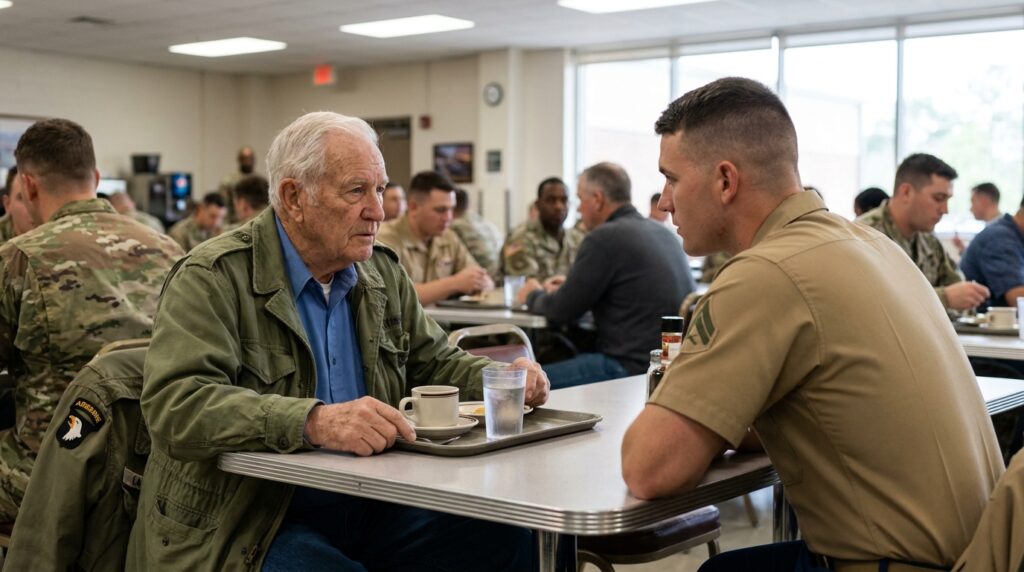
The Cold Geometry of Regret: A Novel of Unspoken Authority and Lost Discipline

CHAPTER 1: THE BRASS THRESHOLD

“The system doesn’t back-date civilian claims from the mid-seventies, sir,” the clerk said. Her fingers didn’t stop tapping against the plastic edge of her keyboard. She wasn’t looking at him; she was looking at the small digital clock at the bottom right of her dual-monitor display. “If you didn’t update the signature block before the fiscal rollover, you’re essentially a ghost in the database.”

Calvin Vance did not shift his weight. He kept his feet spaced exactly twelve inches apart, his heels parallel to the tape line on the gray linoleum floor. It was a stance his lower spine remembered better than the names of his grandchildren.

“The signature is valid,” Calvin said. His voice was a dry, gravelly hum, scraped clean of any pleading cadence. “The authorization came out of Fort Bragg when the command structure was still analog. Look under the secondary ledger.”

The clerk let out a short, rhythmic breath through her nose—the universal currency of low-level base bureaucrats dealing with the left-over personnel of forgotten deployments. She clicked a mouse three times, the sound sharp and metallic in the air-conditioned sterile chill of the personnel detachment office.

“Nothing,” she lied. She didn’t want to dig into the archival directories. To her, the old man in the faded green field jacket was just an afternoon bottleneck, a collection of deep wrinkles, unpolished brass zippers, and a stubborn refusal to clear the window. “You’ll have to request a physical file pull from St. Louis. Come back in six to eight weeks.”

Calvin looked at the reflective tint of the glass barrier separating them. He could see his own reflection—the stark white hair clipped close at the temples, the skin around his jaw tight but sagging slightly at the throat. He also saw the shadow of three active-duty soldiers waiting in line behind him, their starched tan utility uniforms smelling of fresh laundry detergent and gun oil. They were leaning against the security rope, their fingers hooked into their belt loops, their eyes fixed on the back of his head with an undisguised, restless impatience.

“Six weeks,” Calvin murmured. He didn’t argue. In his line of work, arguing was an admission of a weak position. If the database was blind, he would find an alternate entry point. He reached down, his fingers locking onto the worn edge of his brown leather folder, and pulled it back toward his chest with a smooth, unhurried economy of motion.

“Next,” the clerk called out, her voice already rising an octave to welcome the youthful, valid identification card of the specialist standing behind Calvin.

The young soldier didn’t wait for Calvin to turn. He executed a sharp, deliberate side-step, his shoulder brushing against the rough canvas of Calvin’s sleeve as he passed. It wasn’t an accident; it was a calibrated assertion of space, the subtle crowding out of a civilian element that no longer contributed to the active readiness of the post.

Calvin let the friction happen. He absorbed the impact through his shoulder without breaking his balance, his eyes narrowing slightly as he logged the specialist’s unit patch—the crossed rifles of the infantry, pristine and perfectly centered. He turned toward the double doors leading to the central quadrangle, the heavy smell of institutional grease and burnt coffee drifting from the mess hall across the alleyway. His stomach gave a small, hollow pull. He needed a place to sit, a flat surface to re-examine his documents, and a tactical assessment of who was running the administrative office from behind the curtain. He pushed through the heavy brass-plated doors, entering the midday glare of the base cafeteria.


CHAPTER 2: THE GEOMETRY OF THE CAGE

The threshold of the mess hall smelled of scorched lard and the sharp, chemical tang of floor sealant. It was a massive, low-ceilinged cavern of acoustic tile and fluorescent tubes that vibrated with a steady, low-frequency hum. Calvin Vance tracked the room from south to north, his eyes decoding the landscape before his boots took their second step on the polished terrazzo. To an ordinary civilian, it was a midday rush—four hundred hungry bodies in tan and olive drab pushing toward the steam tables. To Calvin, it was a grid of interlocking fields of fire, blind spots, and transit lanes currently occupied by personnel whose collective situational awareness had been dulled by routine.

He kept his brown leather folder tucked under his left bicep, his thumb resting lightly against the notched brass key-tag that lay hidden beneath his paper ration voucher. The metal was cold. It had a small, deliberate file mark across the third tooth—a detail not found on standard issue base keys. It was a minor anomaly, a micro-discrepancy that had stayed in his pocket since he crossed the guard gate three hours ago.

Calvin moved toward the tray line with a measured, rhythmic stride. The tray he lifted from the stainless steel stack was standard brown Formica, its edges nicked and scarred by thousands of industrial dishwasher cycles. He selected a single small plate of generic meatloaf, a mound of gray-white potatoes, and a heavy glass tumbler of water. Every movement was calculated to draw zero attention; he was an old man seeking a quiet corner to digest bad news from a database. Yet, as he turned away from the cashier counter, he noted the subtle shifting of bodies forty feet ahead.

A group of four active-duty soldiers occupied the long table flanking the eastern exit lane. Their starched tan utility uniforms were pristine, the creases sharp enough to draw blood, but their posture was sloppy with the loose, unearned confidence of men who believed their immediate environment was entirely under their control. The youngest of the group—a specialist with an athletic, heavy-shouldered build and a high-and-tight haircut that revealed a thick, reddening neck—was leaning back on two legs of his metal frame chair. His boots were extended into the middle of the walking lane, a passive-aggressive blockade for anyone trying to navigate the row.

Calvin didn’t alter his vector. He walked toward an empty seat at the far end of their table, his boots making no sound against the floor.

As Calvin neared the extended boots, the heavy-shouldered specialist didn’t move them. Instead, he let the front legs of his chair drop onto the floor with a loud, deliberate slap that caused the water in Calvin’s glass to ripple in precise concentric circles. The other three soldiers at the table stopped talking. Their silence was sudden, sharp, and coordinated.

“You’re tracking dirt onto a clean floor, old-timer,” the specialist said. His voice wasn’t loud, but it possessed a flat, testing quality—the kind of tone used by a junior non-commissioned officer trying to see exactly how much weight a civilian would carry before they bent. He didn’t look up at Calvin’s face; he stared directly at the faded green fabric of Calvin’s sleeve, where the silhouette of an old, unstitched airborne patch left a darker, unweathered shadow in the canvas.

Calvin set his tray down on the laminate surface. The sound was a dull, heavy thud. He didn’t sit. He remained standing, his feet spaced twelve inches apart, his long, lined fingers resting lightly on the cold aluminum trim of the tray. He could see the specialist’s eyes—there was a slight, unnatural dilation in the pupils, a glassy sheen that didn’t match the standard fatigue of a morning detail. Underneath the starched collar of the tan uniform, a muscle in the young man’s jaw was twitching in a rapid, irregular rhythm. It was a physiological tell. The boy wasn’t just arrogant; he was vibrating on a current of internal panic, using physical aggression as a hard outer shell to keep something from spilling out.

“The table is public, Specialist,” Calvin said. His voice was low, gravelly, and entirely flat, devoid of the defensive spike the young soldier was clearly angling for.

“Public for base personnel,” the soldier replied, his hands planting firmly on the tabletop as he leaned forward, his torso invading the twelve-inch perimeter of Calvin’s workspace. The scent of him shifted—underneath the laundry soap, there was the sour odor of cold sweat and something synthetic, like burnt copper. “Not for administrative tourists who can’t find the exit gate. You’re in the wrong lane. Move your tray before someone moves it for you.”

The three soldiers beside him didn’t laugh. They watched with a rigid, uncomfortable intensity, their eyes darting toward the main aisle as if checking the distance to the nearest supervisor. They weren’t participating, but they weren’t stopping it either; they were locked into the specialist’s orbit, bound by a collective compliance that felt more like shared fear than camaraderie.

Calvin looked down at the specialist’s hands. The knuckles were white where they pressed against the laminate. Beside the young man’s thumb lay a small, official-looking document folder with a red security strip—a standard unit disciplinary file. Calvin’s eyes registered the serial prefix on the tab before the specialist subtly slid his forearm over the paper to obscure it. The prefix didn’t belong to a standard base company; it was a division-level holding action code.

The jigsaw pieces inside Calvin’s head began to align, the sharp edges of the scenario clicking into place with a cold, mathematical certainty. The specialist wasn’t defending his table; he was hiding a fire that had already been lit behind the scenes, and an old man with an obsolete uniform was the easiest target to burn for distraction.

Calvin reached for his glass of water, his fingers steady, his gaze remaining locked onto the specialist’s twitching jaw. He didn’t move the tray. He simply cleared his throat, the sound like gravel turning over in a cement mixer.

CHAPTER 3: THE ANATOMY OF THREAT

“Drink the water if you’re thirsty, old man, but do it somewhere else,” the specialist said. His left hand flat-lined against the Formica, his fingers spreading like out-of-spec industrial clamps. The twitch in his jaw had stabilized into a rigid, hard-set lock, the muscles over his cheekbones white and bloodless under the glare of the fluorescent tubes.

Calvin Vance let the cool glass slide an eighth of an inch between his calloused fingertips. He did not lift it to his lips. To break eye contact now would be to cede the physical corridor he had established with his own posture. His green field jacket felt heavy across his shoulders, the coarse wool lining retaining the chill of the personnel building while the humid air of the mess hall grease traps clawed at his neck.

“The space is adequate for two,” Calvin said. His gravelly pitch remained unmodulated, dropping beneath the high-volume chatter of the adjacent tables where a dozen junior personnel were arguing over a training rotation. “And the folder you’re covering with your sleeve indicates your unit has an open administrative hold. Red stripe. Serial block zero-nine.”

The specialist’s torso stiffened, his shoulders squaring until the starched canvas of his tan uniform bunched behind his neck. The three soldiers flanking him stopped tracking the room entirely. One of them, a lean private with grease under his fingernails from the motor pool, cleared his throat and made a subtle, five-inch retreat with his stool. The perimeter was widening, not out of respect, but out of the primitive survival metric that governs small units when an undetected mine is clicked underfoot.

“You don’t read the labels on my desk,” the specialist whispered. The low velocity of his voice carried the distinct scent of stale adrenaline and the synthetic, bitter residue of chemical stimulants. “You don’t look at my uniform. You don’t exist on this post anymore, pop. You’re a ghost with a tray. Now pick it up and walk before I lose my patience.”

Calvin logged the distance between them: twenty-two inches. The table edge was precisely waist-high on the specialist, who was now standing on the balls of his feet, his weight shifting forward into a dynamic incline. It was a textbook tactical posture for an unannounced physical check—an intimidation wedge designed to force a civilian backward into the transit lane where they would lose their balance against the incoming flow of personnel.

“The division code on that folder is a holding action for an Article 32,” Calvin continued, his internal monologue cold, rapid, and wholly transactional. He wasn’t guessing; he was reading the structural anatomy of the young man’s desperation. The drug dilation in the pupils, the unanchored aggression, the red-striped file hidden like contraband—it wasn’t a show of force. It was a structural cover-up. “An administrative isolation for unauthorized substance distribution within the motor pool. You aren’t defending a table, son. You’re trying to keep that jacket from being stripped down to the threads before the general’s clerk signs the morning log.”

The specialist’s face lost its remaining color, replaced by an ugly, dark flush that started at the starched seam of his collar and rushed into his cheeks. The accusation was accurate enough to strike the bone. The equal intellect rule dictated that an adversary with their back against a structural wall would not retreat; they would double the leverage of their error to suppress the threat.

“Shut up,” the young soldier hissed. His right hand left the table, his fingers hooking into a rigid, curved claw as his arm pulled back six inches—the universal mechanical chambering for a collar grab or a heavy, close-quarters shove. “You don’t say another word about my file. You don’t even breathe toward this table.”

The two remaining soldiers at the table stood up, their movements clumsy with panic. They didn’t draw closer to support the specialist; they stood as human barriers, their eyes tracking the high-definition security bubbles hanging from the acoustic tiles fifty feet away. They were calculating the structural cost of being associated with a public assault in a base facility.

“Miller, don’t,” the lean private from the motor pool muttered, his voice a thin, dry warning that went entirely unheeded. “Sit down. The duty sergeant is at the western kiosk.”

The specialist, Miller, didn’t look back. His focus had narrowed into the high-risk, low-visibility blindness of a cornered animal. He stepped around the corner of the Formica table, his heavy combat boots squeaking against the polished terrazzo as he entered Calvin’s primary interaction lane. His chest was now six inches from the veteran’s shoulder, his larger, athletic frame completely eclipsing the light from the eastern window line.

Calvin didn’t alter his stance. His heels remained locked on the parallel axis. He felt the cold iron of his hidden brass key against his ribs, a reminder of why he had entered the gate. He wasn’t here to survive a minor bureaucrat or a broken soldier; he was here because the Pentagon’s readiness committee had noted a systemic rot in the lower-tier commands. This boy wasn’t the rot—he was just the fruit.

“Step back, Specialist,” Calvin said, his gravelly voice dropping an octave until it resonated inside his own chest cavity. It wasn’t an order from a superior rank; it was the final mechanical detent before a heavy spring is released.

Miller’s right hand shot forward, his fingers targeting the green canvas of Calvin’s lapel. The movement was fast, driven by a surge of unmetered chemical energy, but the trajectory was linear, predictable, and devoid of the disciplined weight that comes from real operational exposure.

CHAPTER 4: THE ANATOMY OF GLASS

Miller’s right hand never touched the green canvas.

The movement was broad, aggressive, and weighted with an unmetered trajectory that assumed a body in its eighth decade would simply collapse under the incoming mass. Calvin Vance did not step back. To yield an inch would be to surrender the structural axis of his spine. Instead, as the specialist’s fingers clawed within two inches of his lapel, Calvin’s left hand rose along the inside tracking lane—a short, vertical arc that met Miller’s forearm precisely at the intersection of the radial nerve and the wrist bone.

The contact was not a strike; it was a cold, frictionless deflection. The edge of Calvin’s hardened palm intercepted the young soldier’s momentum, absorbing the kinetic rush and redirecting it downward into the open space beside the Formica table. Before Miller could adjust his balance or recover his center of gravity, Calvin shifted his right heel three inches to the flank, creating a sudden vacuum in the interaction lane.

With his left hand locking Miller’s wrist in a descending spiral, Calvin slipped his right forearm under the specialist’s overextended armpit, forming a classic mechanical lever against the young man’s shoulder joint. It was a sequence governed entirely by physics, leverage, and the cold economy of movement. Calvin simply straightened his knees, utilizing the natural compression of his lower spine to lift Miller’s center of mass just enough to strip his boots of their purchase on the terrazzo.

A sharp, heavy thud vibrated through the floorboards as Miller’s athletic frame hit the polished linoleum.

The impact was localized but total. The specialist landed flat on his shoulder blade and hip, the air escaping his lungs in a ragged, involuntary gasp that sounded like tearing vinyl. The heavy brown plastic food tray on the edge of the table flipped, sending the glass tumbler of water shattering across the floor in a bright, radial splash of pressurized shards and wet laminate. The meatloaf and potatoes slithered into the grease trap of the aisle.

The entire eastern quadrant of the mess hall ceased to exist as a source of noise. The scrap of forks against stainless steel trays vanished; the low-frequency hum of three hundred voices cut out instantly, leaving only the mechanical vibration of the ventilation system overhead.

Calvin remained completely upright. His breath was rhythmic, his chest rising and falling without the ragged acceleration of panic. His hands returned to his sides, the fingers slightly curved but steady. He looked down at the specialist, who lay on his back, his face a mask of shock, his lips parted but silent as his brain struggled to reconcile the velocity of his descent with the white-haired man standing unbothered above him.

“Experience still matters, son,” Calvin said. His voice was a dry, gravelly stone sliding across ice, carrying through the absolute silence of the room. “Remember that before you choose your next lane.”

Miller did not move. He stayed pinned to the floor by the sheer psychological weight of the reversal, his fingers twitching against the wet linoleum as a puddle of spilled water pooled beneath his starched tan collar. His three companions remained frozen on their stools, their hands hovering in mid-air like low-tier actors caught in a sudden frame-stop.

Calvin turned his gaze slightly to the right, his eyes fixing on the small document folder with the red security strip that had skittered off the table during the drop. It lay face up near Miller’s left boot. The division code was now fully visible, unmasked by the specialist’s arm. But as Calvin’s eyes mapped the alphanumeric sequence, his internal calculation encountered a severe structural anomaly.

The prefix wasn’t just an administrative hold for a drug infraction. The primary routing number on the bottom of the red strip belonged to the Office of the Inspector General, Sub-Directorate for Readiness Procurement.

The realization hit Calvin with the cold, localized precision of an iron spike. The drug file was a decoy—a localized cover-up engineered by someone much higher in the food chain than a rogue specialist in the motor pool. Miller wasn’t the origin of the rot; he was the courier. And the folder he had been desperately trying to hide wasn’t his own disciplinary record—it was an active intelligence log tracking the illegal diversion of heavy transport assets from the base depot.

Before Calvin could bridge the gap between the document and his original parameters, a sharp, rhythmic clicking sound echoed from the main entrance of the facility. The sound of high-gloss leather heels against terrazzo.

A senior figure was moving through the frozen crowd, his stride unhurried but absolute. Calvin did not look up immediately; he logged the tracking lines of the room as the surrounding personnel began to shift their weight, their postures automatically tightening into the rigid conformity of a command inspection. The trap was changing shapes, and the absolute final reality of why Calvin had been called to this base remained locked behind a new curtain of starched khaki and silver brass.

CHAPTER 5: THE COLD REALIGNMENT

The steady, deliberate click of the leather heels did not stop until it reached the edge of the puddle of spilled water.

Calvin Vance did not adjust his posture. He remained centered over the fallen specialist, his eyes tracing the clean, unpolished lines of the senior officer’s trousers that had entered his narrow field of vision. The starch in the newcomer’s khaki was uniform, lacking the hurried creases of the cafeteria workers or the sweat-stained margins of the junior enlisted pool. This was administrative authority carved out of climate-controlled headquarters, carrying the faint, cold scent of high-grade paper and floor wax.

“Stand down, Specialist Miller,” the voice said. It was thin, precise, and entirely devoid of theatrical volume. It was the tone of a man who assumed every molecule in the room would obey his physical presence without validation.

On the floor, Miller scrambled for purchase, his combat boots slipping once against the wet linoleum before he hauled his athletic frame into a rigid, trembling stance. His face was entirely pale now, the chemical flush replaced by the stark, hollow terror of a soldier who had just committed an actionable transgression under the eyes of the division command. He didn’t look at Calvin. He kept his eyes locked three inches above the silver eagle insignia pinning the collar of the colonel who stood between them.

“Sir,” Miller rasped, his right hand snapping into a salute that vibrated with static tension. “The civilian was… he was interfering with division-level documents, sir.”

Colonel Arthur Vance—no relation, though they shared the same gray, lean facial architecture characteristic of the regional recruitment boards—did not return the salute. He held a slim, black leather briefcase in his left hand, the thumb of his right resting against a bright silver latch marked with a three-digit security rotation wheel. His eyes didn’t waste movement on the shattered glass or the spilled tray; they scanned the red-striped folder lying near Miller’s boot, then shifted smoothly to Calvin’s face.

“Get your personnel out of this hall, Specialist,” Colonel Vance said. He didn’t look back at the three soldiers still frozen at the table. “Report to the transit guard at Bay Three. Your unit file has been re-routed.”

Miller hesitated for a single micro-second, his eyes darting toward the red-striped folder on the floor as if weighing the risk of reaching for it. The colonel’s gaze didn’t waver. It was a cold, impenetrable wall that offered zero room for negotiation. Recognizing the absolute finality of the command, Miller dropped his arm, spun on his heel, and marched toward the western exit with his three silent companions tracking behind him like ghosts.

The mess hall began to breathe again, but the volume remained low, an anxious murmur that stayed twenty feet away from the two men standing in the center of the wet tile.

Calvin reached down and picked up his leather folder from the dry edge of the table. His fingers were steady, the unpolished brass zipper of his jacket catching slightly as he pulled the canvas straight. He knew the colonel hadn’t arrived by accident; the timing was too precise, the interception too synchronized with the moment the red security strip had been unmasked.

“You’re outside your assigned grid, Calvin,” the colonel said. He spoke in a muted undercurrent that didn’t travel past the immediate table lane. He stepped closer, his polished leather shoes leaving a faint tracking line through the moisture on the floor. “The audit was scheduled for the logistics compound, not the general detachment mess.”

“The logistics compound is a shell, Arthur,” Calvin replied, his gravelly voice dropping into the same transactional frequency. He didn’t offer a salute; his relationship with this command structure had been severed from the official rosters forty years ago, replaced by a gray, unwritten protocol. “The administrative clerk at the counter is running an archaic directory system to bottle up old files. And your specialist on the floor wasn’t hiding a drug stash. He was carrying an asset diversion log stamped by the procurement sub-directorate.”

The colonel’s thumb didn’t move from the briefcase latch, but the muscles around his knuckles tightened until the skin grew translucent. The equal intellect rule dictated that an officer of this grade would have a counter-move already mapped, but the discovery of the procurement log in a public cafeteria was an unexpected variable that threatened the structural isolation of the post.

“The log is part of an ongoing internal inquiry,” Colonel Vance said, his voice clipped and dry. “It’s classified under a division hold. You weren’t cleared to access the serial prefixes.”

“I don’t need clearance to read a label that falls at my feet,” Calvin said. He tucked his leather folder back under his arm, his fingers logging the cold weight of the brass key-tag through the leather. “The Pentagon didn’t send me down here to verify your inventory sheets, Arthur. They sent me because your division is bleeding transport assets into the civilian sector, and the signatures on the gate receipts match the routing keys in your office.”

The colonel’s gaze narrowed into a sharp, defensive edge. The shadow of the administrative building seemed to lengthen through the cafeteria windows, cutting across the polished Formica tables. The decoy secret—the idea that this was a simple case of low-level theft or localized misconduct—had shattered on the floor along with the glass tumbler. The ultimate reality was far heavier: the corruption wasn’t an infection from the bottom up; it was an operational design directed from the very command desks tasked with the audit.

“You’re an old man with an expired ID card, Calvin,” Colonel Vance said, his voice dropping into a razor-thin whisper that carried the cold finality of an institutional threat. “The gate guards can strip that field jacket off your back before you reach the perimeter. You have no rank here. You have no status.”

Calvin looked through the plate-glass window toward the sun-baked quadrangle outside, where a formation of fresh recruits was marching in perfect, mechanical synchronization.

“The rank isn’t on the jacket, Arthur,” Calvin said softly. He didn’t back away. He let his right hand settle into his pocket, his thumb catching the serrated tooth of the key-tag. “And the signature block that opened the gate for me this morning didn’t come from your base commander. It came from the chairman.”

The colonel did not reply. He turned his head slightly toward the main doors as the sound of a second set of vehicles idling in the courtyard rattled the structural glass of the facility. The situation was expanding beyond the margins of the roadmap, and the next physical step would carry them both directly into the command room where the final accounts were kept.

CHAPTER 6: THE COMMAND RECORD

The structural glass of the cafeteria facade hummed against Calvin’s shoulder blade as the twin turbocharged diesels of two blacked-out utility transport vehicles cycled into high idle in the courtyard. The high-frequency vibration traveled through the cold aluminum window frames, through the canvas of his field jacket, and settled directly into the rigid line of his jaw.

Colonel Arthur Vance didn’t break eye contact. His fingers, still locked over the silver dial of his briefcase, had gone completely bloodless. The administrative confidence that had carried him through the cafeteria aisles had stiffened into the brittle posture of an officer who realized his defensive perimeter was no longer structurally sound.

“The Chairman hasn’t signed an active field deployment order for an independent auditor in this sector since the realignment,” Colonel Vance said. His voice was a thin, clipped rasp that barely cleared the static hum of the refrigeration units behind them. “You’re pulling levers that don’t connect to the current board, Calvin. The database handles everything now.”

Calvin didn’t look down at his pocket. He simply moved his thumb across the worn, filed notch of the brass tag, feeling the sharp serrations give way to a smooth, flat edge where the unencrypted verification cipher was stamped.

“The database only records what your logistics clerks feed into the transmission blocks, Arthur,” Calvin said. His gravelly pitch was slow, measured, and weighted with the mechanical finality of an anvil dropping into dust. “It doesn’t count the heavy tractor units leaving the north depot at 0200 hours under black-out regulations. It doesn’t track the hull serial numbers that disappeared from the maintenance yard while you were signing off on the regional scrap accounts.”

He slid his left hand into his folder, pulling out a single sheet of analog carbon paper—not the clean, white laser-printed sheets of the modern base offices, but the deep indigo, smudge-edged duplicating sheet he had manually pulled from the gate log three hours prior. He laid it flat across the damp Formica table, right over the dark stain where Specialist Miller’s lunch had spilled.

“The signature block on the gate manifest isn’t a digital key, Arthur,” Calvin murmured. He tapped the blue line at the bottom of the column. “It’s a manual override code from the old mobilization desks. The ones your high-speed technicians forgot to delete when they digitized the inventory. It’s a dead man’s switch. And it routes every discrepancy directly to the Joint Chiefs’ audit division.”

The colonel’s gaze dropped to the blue carbon lines. The numbers didn’t lie; they matched the procurement sub-directorate prefixes on the red-striped folder that was still sitting by the edge of the puddle. The equal intellect rule left no room for dramatic denials; the colonel recognized the cold geometry of the trap he had built for himself. The drug charges levied against Miller were a calculated layer of insulation—a decoy designed to destroy a junior soldier’s credibility before he could blow the whistle on the transport assets being funneled off the base. But the old man standing across from him hadn’t come to look at a rogue specialist. He had come to isolate the terminal point.

“The base commander will lock this entire sector down before you reach the outer wire with that log, Calvin,” the colonel whispered, his shoulder checking the space behind him as if locating his terminal security details. “You’re a civilian on an expired voucher. The institutional logic of this post will swallow you before that paper hits a secure terminal.”

“The paper isn’t the transmission vector, son,” Calvin said.

From the courtyard outside, the rhythmic, metallic clatter of heavy side-doors sliding open cut through the low ceiling of the hall. Four figures in dark blue tactical utility uniforms—not base military police, but federal marshal couriers carrying secure communications cases—crossed the concrete threshold, their boots clicking in perfect unison against the terrazzo as they moved toward the table lane. The lead courier didn’t stop to verify the room; he walked directly to Calvin’s flank, his right arm snapping into a rigid, unquestioned salute that brought the remaining murmurs in the cafeteria to a freezing halt.

“Sir,” the courier said, his voice flat and professional. “The command vehicle is synced. The terminal link to the Pentagon is open.”

Calvin didn’t look back at the uniform. He reached into his pocket, pulled out the notched brass tag, and dropped it onto the carbon sheet next to the colonel’s briefcase. The heavy metal made a sharp, clinking ring against the laminate, sliding two inches before coming to a rest against the silver security dial.

“Your directory is clear, Arthur,” Calvin said softly, his lined face catching the stark, shadowless glare of the midday sun through the glass panels. “The audit is finished. Pick up your briefcase.”

Colonel Vance stood motionless for three seconds, his eyes tracking the silver insignia on his own collar in the reflection of the glass, then down to the small piece of brass that had dismantled his entire command pipeline. The unearned arrogance that had defined the base personnel since Calvin had crossed the threshold was entirely gone, replaced by the crushing, silent weight of an old authority that had outlived its name. He reached out, his hand trembling slightly as he picked up the red-striped folder from the floor, and stepped into the center of the courier escort.

Calvin Vance didn’t follow them out immediately. He waited until the black utility vehicles cleared the security gate, their diesel exhaust leaving a faint, blue haze across the concrete yard. He slowly pulled the zipper of his green jacket up until it clicked against the brass collar stop, adjusted his leather folder under his arm, and walked toward the exit lane, his boots making no sound against the clean floor.

Similar Posts

Leave a Reply

Your email address will not be published. Required fields are marked *






