
The Iron Lineage: A Cold War Ghost and the Modern Machine of War
CHAPTER 1: THE FRICTION OF METALS
“Pick it up.”
The gravel in Arthur’s voice didn’t just scrape; it carried the weight of a thirty-year burial.
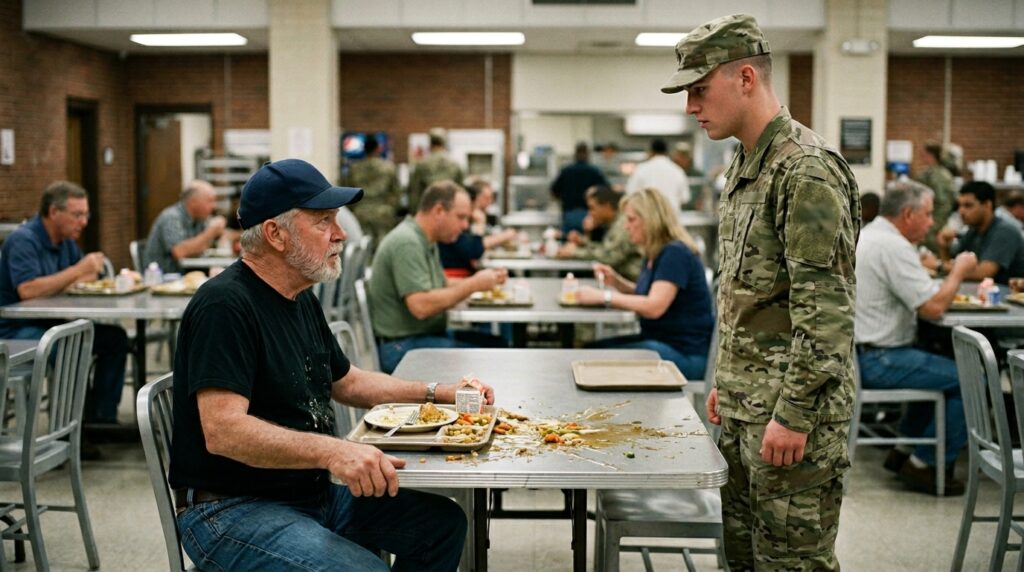
The kid didn’t move. He stood there in his pristine digital camouflage, the fabric stiff and smelling of unwashed warehouse starch, his patrol cap perfectly aligned two inches above his brow. On his tray, the plastic bowl of institutional chili had flipped cleanly, painting the chest of Arthur’s black cotton shirt in an ugly, greasy smear. The smell of scorched onions and wet tin rose between them, mixing with the sharp bleach odor of the cafeteria floor.
Around them, the low hum of five hundred active-duty soldiers scraping forks against plastic trays slowed down. A fork dropped onto a laminate table four rows over with a distinct, ringing chime.
“I said,” Arthur repeated, his fingers tightening against the lip of the formica table until the yellowing skin over his knuckles turned the color of lard, “pick it up, son.”
“It was an accident, sir,” the boy said. His voice was too loud, defensive in the way only a private first class with six months off the bus could manage. He looked around for an audience, his boots shifting on the wet tile. “The floor’s slick. You don’t need to—”
Arthur didn’t wait for the rest of the sentence. The modern army taught these kids how to read spreadsheets and grease the tracks of transport vehicles that cost more than Arthur’s hometown. They didn’t teach them about the weight of a hand that had spent three winters clearing bunkers with nothing but an entrenching tool and a short-barreled Colt.
The table didn’t slide; it lifted. Arthur rose with a dry, mechanical hitch in his left hip—the old shrapnel wound from Hue groaning against the sudden leverage. His faded navy cap tumbled off his gray hair, hitting the spilled chili with a soft thud.
The young service member’s eyes widened, his hand dropping instinctively toward a hip that held nothing but a nylon webbing belt.
Arthur closed the distance before the kid could chamber air. His left hand caught the stiff collar of the digital blouse, twisting the fabric until the boy’s throat met the brass eyelets of his own dog tags. With his right, Arthur hooked the back of the kid’s knee—a movement so ancient, so buried beneath decades of cheap beer and factory shifts, that it felt less like a thought and more like an old engine catching spark after a frost.
The impact was heavy. The kid’s back hit the industrial tile with a hollow, wet slap that knocked the breath clean out of his lungs.
In a fraction of a second, Arthur was down, his sixty-eight-year-old frame settling like a sack of iron ore across the boy’s ribs. His right forearm pinned the soldier’s throat, pressing just hard enough against the carotid artery to make the world blur at the edges.
“You should have left well alone,” Arthur hissed. The heat of his own breath bounced off the clean, shaven jawline of the boy beneath him. “You think that uniform makes you heavy? I’ve buried men twice your size in dirt that didn’t have a name.”
The kid’s fingers clawed at Arthur’s thick, calloused wrists—the skin there split from years of turning wrenches on diesel combines. But the grip didn’t break. The boy’s chest heaved, his eyes rolling back slightly until they locked onto Arthur’s. The arrogance was gone. In its place was the cold, white terror of a horse that had smelled the slaughterhouse.
“Sir,” the boy choked out, his chest collapsing under the old man’s unyielding mass. “Sir… apology. My fault.”
Arthur stared down at the smooth face, the pristine skin that had never seen a sun that wasn’t monitored by an air-conditioned command tent. The silence in the dining facility was absolute now. The entire room had frozen into a landscape of green cloth and pale faces.
Arthur felt the small, sharp edge of his Zippo lighter pressing into his thigh from his front pocket. The metal was hot against his skin. He looked down at the boy’s nametag, stitched in neat black thread: VANCE.
Then, from the double doors near the scullery, the sharp click-clack of high-gloss lowquarters began to accelerate toward them.
Arthur didn’t look up. He let his forearm sink a millimeter deeper into Vance’s throat, catching the sudden, frantic tremor in the boy’s pulse.
“Don’t look at them,” Arthur whispered, his voice dropping below the register of the approaching boots. “Look at me. You remember this smell. Because the next time you drop something in front of me, I won’t just take the floor.”
In the corner of his eye, the silver reflection of an MP’s badge caught the fluorescent light, turning the world the color of old tin.

CHAPTER 2: THE PERIMETER LINES
The heel of the MP’s black leather boot caught the edge of the service tray Arthur had upended, sending a half-eaten loaf of cornbread skittering across the grease-filmed tile.
“Hands where I can see them. Old man, get off him now.”
The voice was young but trained to mimic the blunt, flat bark of a drill instructor. Arthur didn’t snap his head around. He let his weight linger for one more breath on Vance’s ribcage, feeling the boy’s shallow, terrified inhalations rattle against his own shin. He slowly rolled his weight off the soldier, his left knee popping with a sound like a dry branch snapping underfoot. The floor was cold through his worn jeans, slick with spilled grease and the wet, gray grit tracked in from the motor pool outside.
Arthur rose by sections, his spine stiffening until his weathered build reached its full six-foot frame. He didn’t raise his hands like a captive; he simply turned them palms-out at his sides, the flaking rust-colored oil stains from his morning shift at the salvage yard embedded deep within the creases of his palms.
Two military policemen stood in the aisle, their nylon duty belts creaking with the weight of plastic handcuffs, heavy radio blocks, and black steel batons. The lead investigator, a corporal with a face like an unbaked biscuit, had his hand hovered over his holster.
“Step back from the soldier,” the corporal ordered, his boots crunching on the dry salt crystals scattered near the entryway.
Arthur looked past him. The entire cafeteria had become a gallery of silent, watching faces—hundreds of young men and women in identical digital patterns, their eyes shifting between Arthur’s faded navy cap, which lay ruined in a pool of congealing chili, and the dark, wet grease stain covering the chest of his black shirt.
“The boy dropped his tray,” Arthur said. His voice was low, carrying the vibration of a low-idle diesel engine. “He needs to learn how to carry his load.”
Vance scrambled to his feet behind Arthur, his breath coming in ragged, whistling gasps. He didn’t look at Arthur. He was frantically tucking his olive-drab undershirt back into his trousers, his hands shaking so violently he missed the belt loop twice.
“Sir, he… he just came at me,” Vance muttered, his voice cracking as he looked at his peers. The shame was setting in now, thicker than the fear. A private first class pinned by a gray-bearded civilian in front of the third battalion was a career-killing stigma.
“Shut up, Vance,” the corporal snapped. He looked at Arthur, his eyes lingering on the thick, square set of the old man’s shoulders and the distinct, deliberate spacing of his feet—a classic defensive stance that no civilian factory ever taught. “We know who you are, old-timer. You’re Arthur Vance—no, wait. Arthur’s the name on the truck out front. You’re Miller, aren’t you? The one from the scrap yard near the old ammunition dump.”
Arthur didn’t give him the satisfaction of a blink. “The name’s on the registration.”
“Yeah, well, the base commander’s got a standing order about off-base personnel creating disruptions inside the perimeter,” the corporal said, his hand finally dropping away from his weapon as he realized Arthur wasn’t going to lunge. He reached into his pocket and pulled out a pair of heavy plastic flex-cuffs. “We’re going to take a walk down to the gate house until we get this cleared up.”
“You aren’t putting those on me,” Arthur said. The words weren’t a threat; they were a statement of property. He looked down at the corporal’s boots. The leather was too shiny, synthetic. It didn’t have the deep, oil-soaked smell of real hide. “I’m walking out the same way I came in. On my own leather.”
The second MP, older, with three stripes on his sleeve and a face lined by two tours in the desert, placed a hand on the corporal’s shoulder. He looked at Arthur’s hands, then at the faded navy anchor logo stamped on the rusted Zippo protruding from Arthur’s pocket.
“Let him walk, Corporal,” the sergeant said quietly. “He’s going to his truck. We’ll follow him to the line.” He turned his eyes directly to Arthur. “But you don’t come back inside this gate, Miller. Not for the cafeteria, not for the commissary. You’re done using the base facilities. Consider yourself barred.”
Arthur reached down, his fingers brushing the wet tile as he retrieved his cap. He didn’t bother shaking the chili from the brim; he just gripped it by the crown, the wet cloth heavy and cold against his thumb. As he turned to leave, his boot brushed against Vance’s unzipped canvas kit bag, which had tumbled from the bench during the scuffle.
Through the gap in the nylon zipper, something caught the light. It wasn’t the standard-issue aluminum flashlight or the olive-drab cleaning kit. It was a heavy, five-pointed brass spanner wrench, its surface covered in thick, green oxidation, stamped with a specific eight-digit serial number that Arthur hadn’t seen since the winter of 1974 at the nuclear storage depot.
Arthur’s eyes narrowed, his internal calculation shifting gears instantly. That wrench didn’t belong to a modern transport unit. It was an ordnance tool for high-yield casing bolts—something that shouldn’t exist on an active active-duty logistics base in 2026 unless someone was digging into the old cold-war subterranean bunkers near the ridge.
He looked up at Vance. The boy was staring at the open bag, his face turning an unwholesome shade of gray. He quickly kicked the bag shut with his boot, but the metallic clink of the brass tool against his canteen was unmistakable.
“Movin’ along, Miller,” the sergeant warned, his hand guiding Arthur toward the exit.
Arthur walked out through the double glass doors, the heavy, humid air of the southern afternoon hitting him like a wet wool blanket. The gravel parking lot was filled with the glare of windshields under a desaturated sky. Fifty yards away, his sixty-nine Ford pickup sat like an island of flaking blue paint and pitted chrome among rows of aerodynamic plastic sedans.
He could hear the MPs behind him, their radios spitting static and code strings into the heat. He didn’t look back until his hand closed around the pitted iron door handle of his truck. The metal was hot enough to sting, the latch releasing with a dry, ungreased groan that echoed across the asphalt.
He climbed into the cab, the cracked vinyl seat whistling as it compressed under his weight. He threw the ruined navy cap onto the floorboards and pulled the Zippo from his pocket, his thumb rolling the flint wheel until the yellow flame danced in the stagnant air. The smell of lighter fluid didn’t mask the smell of the cafeteria grease on his shirt.
Through the rearview mirror, he watched the MP cruiser pull up behind him, its roof lights remaining dark but its engine idling with a low, predatory purr. They weren’t arresting him. They were herding him.
Arthur turned the key. The starter ground three times, a harsh, metal-on-metal screech, before the big V8 caught, clearing its throat with a plume of blue smoke that settled over the gravel. He shifted into reverse, the transmission clunking with the heavy, unyielding resistance of an old machine that refused to die.
As he backed out, he saw Vance standing by the cafeteria doors, his kit bag slung over his shoulder, watching the truck with an expression that wasn’t anger. It was the look of a man who had just realized he was holding a live shell with a short fuse.
Arthur turned the wheel, pointing the truck’s rusted nose toward the perimeter fence where the highway ran north into the dry, red-dirt scrub. The real trouble wasn’t the spilled food or the barred access. The trouble was that five-pointed wrench. Someone was reopening the holes in the ground that Arthur had spent thirty years trying to forget, and they were using kids like Vance to do the digging.
CHAPTER 3: THE NIGHT VISIT
“You shouldn’t have come here, kid.”
Arthur didn’t pull his hands out of the sink. The well water was ice-cold, running over a split engine block gasket he was cleaning with an old wire brush. The smell of kerosene and well water filled the narrow space of the trailer, thick enough to compete with the musk of wood rot behind the baseboards.
Vance stood in the doorway, his silhouette cutting off the pale moon-glow that managed to penetrate the rusted screen. He had stripped off his camouflage blouse; now he just wore the olive-drab undershirt, dark with sweat at the collar, and his grease-streaked trousers. In his left hand, he held Arthur’s faded navy cap. The cloth had been rinsed, but the stiff salt outline of the cafeteria chili remained like a scar across the brim.
“You dropped this when you hit me,” Vance said. His voice lacked the cafeteria’s edge. Without the battalion watching, he sounded like what he was—a twenty-two-year-old kid from an Ohio coal town who was realizing the machinery he signed up to fix had teeth. “And you left your tailgate down. A man from the scrap yard could lose his tools that way.”
Arthur shut off the tap. The pipe rattled in the drywall with a dry, shuddering thump. He took a grease-blackened rag from the counter and wiped his hands slowly, focusing on the rough skin around his knuckles where the hair had been scarred away by a battery explosion twenty years ago.
“The tools on my truck stay where I put them,” Arthur said, turning around. He didn’t offer the boy a seat. The trailer didn’t have many—just a single vinyl bench that served as his kitchen table and his workbench. On the formica surface lay an old grease-gun and three five-pointed brass nuts that matched the spanner wrench from Vance’s bag. “Why are you here, Vance?”
The boy stepped into the room, the floorboards groaning under his combat boots. He laid the cap down on the edge of the sink, his fingers lingering on the faded fabric.
“My unit commander came down to the MP station after they let you go,” Vance said quietly. He kept his eyes on the floor, tracking the dark trails of iron dust Arthur had tracked in from the salvage yard. “He didn’t ask about the fight. He didn’t ask if I was hurt. He wanted to know if you looked into my bag. He wanted to know if we talked before the tray went over.”
Arthur picked up the grease-blackened rag again, rolling it into a tight cylinder between his palms. “And what did you tell him?”
“I told him it was just an old man with a bad temper.” Vance looked up then, his eyes wide and hollow under the single yellow bulb hanging from the ceiling. “But he didn’t care about that. He had a file on his clipboard, Miller. A real old one. It had the red flag-tags on the corner—the kind they use when an inventory line goes missing from the reserve stocks. He said if you came within five hundred yards of the sector four perimeter again, the gate guards aren’t supposed to call the local cops. They’re supposed to detain you under an internal logistics warrant.”
Arthur felt his chest tighten, an old, familiar sensation that had nothing to do with age. It was the feeling of the wire drawing close. He looked at the window behind the sink. Out in the dark scrub, three miles past his property line, the silhouette of the ridge cut a black tooth against the stars. Below that ridge lay the entrance to the old Cold War ammunition depot—a place that was supposed to be filled with dry sand and concrete aggregate thirty years ago.
“The captain’s an engineer,” Arthur said, his voice dropping into the low register he used when calculating the tolerances on a heavy crane lift. “He don’t have the clearance for an internal warrant. Not unless someone at the supply depot gave it to him.”
“He had the wrench’s serial number on his desk, too,” Vance muttered. He reached into his pocket and pulled out the five-pointed brass tool, setting it down next to the nuts on Arthur’s table with a heavy, metallic clink. “They’re clearing out the lower cells under sector four. They told us it was a routine decommissioning—just pulling out old copper lines and zinc plates. But they’re moving the crates at night, Miller. Heavy crates. The kind that require the old three-ton hydraulic lifts. And they’re using our logistics manifests to log them out as scrap iron.”
Arthur walked over to the table. His thumb brushed the rusted surface of the brass tool, feeling the cold, greasy residue of preservation compound. This wasn’t scrap. It was active ordnance storage equipment, preserved in cosmoline.
“They’re using your battalion to clean the house before the inspectors come from the district office,” Arthur said, his mind clicking through the logic like an old accounting machine. “They give you a fake manifest, you haul the crates to the commercial railhead, and when the audit happens, the missing inventory gets blamed on a Cold War discrepancy.”
“But why you?” Vance asked, his voice rising slightly before he checked himself, looking toward the dark screen door. “Why did the captain have your name flagged? He told the MPs you were discharged back in ’78 for black-market diversion. He said you were part of an old ring that stole fuel bladders from the depot.”
Arthur laughed—a short, dry sound that had no humor in it. He reached into his pocket and pulled out the rusted Zippo, his thumb flicking the wheel until the flame lit the deep lines around his mouth.
“In ’78, kid, I was the only sergeant who wouldn’t sign the delivery receipts for fuel that never arrived at the line,” Arthur said. “They didn’t discharge me. They put me in a room with three officers from the logistics branch and told me my file was being archived under a classified quarantine. They told me if I stayed in this county and kept my mouth shut about the empty tanks, my pension would hit the bank every first of the month. If I talked, the file would become a dishonorable discharge for theft.”
He clicked the Zippo shut, the dark settling back into the corners of the kitchen.
“The file your captain’s holding is the lie they built thirty years ago to keep me on the porch,” Arthur said, his hand closing around the brass spanner wrench. “And now they’re using it again because they’re doing the exact same thing they did back then. Only this time, they’re using your name on the modern electronic manifests.”
Vance went pale, his hand dropping away from his pocket. “I signed the digital logs for three trailers yesterday afternoon. They told me it was just old zinc casing panels.”
“You signed for whatever’s inside those bunkers,” Arthur said, stepping toward the door. “Which means when the audit line goes red, you’re the one who goes to the brig, not your captain.”
Before Vance could answer, the gravel road leading up to the trailer groaned. The sound of a heavy vehicle, its headlights doused, running over the dry washboard ruts at the edge of the property line, rattled the small tin windowpane above the stove.
Arthur caught Vance by the shoulder, his grip like an old iron clamp, pulling the boy away from the center of the room.
CHAPTER 4: THE SALVAGE CORNER
The blue Ford pickup rattled through the corrugated gate of the salvage yard, its dry leaf springs screaming as Arthur jumped the drainage ditch without tapping the brakes. Behind them, the county road remained dark, but the high-intensity halogen beams of a pursuing utility vehicle cut through the pine line, casting long, frantic shadows across the acres of crushed chassis and rusted industrial scrap.
Arthur cut the ignition before the truck had fully ground to a halt against a mountain of compacted oil drums. The engine died with a wet, heavy cough. The sudden silence was filled only by the ticking of the cooling manifold and the hard, frantic breathing of the boy in the passenger seat.
“Out,” Arthur ordered, his voice flat, devoid of the panic that was turning Vance’s knuckles the color of chalk. “Grab your kit bag. Move.”
They hit the dirt together. The ground underfoot was a frozen crust of caliche, mixed with the fine, abrasive glitter of iron filings and broken windshield glass. This was Arthur’s sanctuary—a three-acre labyrinth of decomposing heavy machinery, yellowing cranes with seized hydraulics, and piles of structural steel beams flaking away into red dust under the open sky. He knew every blind corner, every unstable stack of engine blocks, and every path that was too narrow for a modern tactical vehicle to squeeze through.
Vance stumbled, his boots sliding over a rusted length of leaf spring. His fingers clutched his canvas kit bag against his ribs like it was an explosive device. Inside, the heavy five-pointed brass spanner wrench clinked against a tactical data slate he had pulled from his locker before slipping past his unit’s guard post.
“They tracked my phone,” Vance choked out, his eyes darting toward the perimeter fence where a set of headlights washed across the wire. “That wasn’t the local sheriff’s department out on the asphalt, Miller. That was a high-mobility transport vehicle from the base. They’re already outside.”
“Then lock your ears down and follow my heels,” Arthur snapped. He grabbed the front of Vance’s shirt, hauling the boy behind the massive, pitted counterweight of a dismantled Link-Belt excavator. The steel plate was cold enough to stick to the skin, its surface scaled with thick layers of industrial rust that shed under the pressure of Arthur’s shoulder.
Through the gaps in the machinery, two distinct shapes broke through the entrance. One was a white county patrol unit, its roof lights spinning in a slow, rhythmic rotation of red and blue that painted the rusted car hoods like a slaughterhouse floor. The other was a desaturated olive-drab utility truck with military markings on the quarter-panel.
Two men stepped into the glare of the high beams. Sheriff Henderson—a man Arthur had known for twenty years through the simple trade of scrap batteries—walked with his gun belt slung low, his hand resting on the leather holster with a loose, reluctant familiarity. Next to him was a younger man in a sharp, crisp active-duty patrol uniform, his chest barred with the tactical web gear of an investigator from the base logistics command.
The investigator carried a thick, waterproof binder under his arm. He didn’t look at the junk; he looked at the ground, his flashlight beam tracking the heavy tire ruts Arthur’s Ford had left in the caliche.
“Arthur!” Henderson’s voice boomed across the yard, deadened by the mounds of rubber tires and iron frames. “Don’t make this a county matter, Art. We got an active inquiry from the base commander’s office. They’re missing serialized gear from the sector four inventory lines, and your name came up on the historical index. Just come on out and let’s look at the paperwork.”
Behind the excavator, Arthur didn’t move a muscle. His right hand was buried in his pocket, his thumb slowly rolling the flint wheel of his Zippo without striking a spark, using the metallic click to ground his pulse.
“They have the manifest, Miller,” Vance whispered, his face pressed against the flaking orange paint of the counterweight. He held up the data slate, its screen glowing with a dim, green luminescence. “Look at this. It’s the Layer 1 file. The captain uploaded it to the base security network an hour ago. It’s an old investigation record from 1978. It says you were the logistics coordinator for an unlogged convoy that moved sixteen tons of casing hardware out of the depot during the freeze. It says you were never cleared—that you’ve been running an active fence operation out of this yard for thirty years.”
Arthur looked at the glowing screen. The document looked authentic. It had his old rank, his social security number, and the official stamps of the logistics command. It was a perfectly constructed decoy—a file designed to explain away any modern discrepancies by pointing to a three-decade-old ghost. If the regional auditors found an empty bunker tomorrow, the captain could simply point to this file and say the inventory had been leaking into Arthur’s scrap yard since the Carter administration.
“It’s a clean frame,” Arthur murmured, his jaw hardening until the muscles in his neck strained against his collar. “They built the floorboards long before you were born, kid. They just needed someone to step on them so they could drop the ceiling.”
“But it’s a lie!” Vance’s voice rose to a harsh whisper. “The electronic signatures on the modern trailers… they aren’t from thirty years ago. They’re active. They were updated last Tuesday by the captain’s own login. Look at the sub-routing codes. The cargo isn’t scrap zinc. The shipping tags are flagged for transport to a private military logistical port in Savannah. They’re selling the old storage casings back to the contractor who built them.”
“Quiet,” Arthur hissed.
The crunch of caliche was getting closer. The base investigator had separated from the sheriff, his tactical light cutting a cold, white line through the dark corridor between a stack of flattened sedans and an old combine harvester. The beam bounced off a rusted iron axle just six feet from where Arthur stood.
“Miller!” the investigator called out, his voice precise, transactional. “You’re violating a federal logistics quarantine. The file in my hand has a flag-warrant from the regional procurement office. If Private Vance is with you, he’s currently listed as absent without leave under suspicion of material diversion. Every minute you keep him here adds five years to the line at Leavenworth.”
Arthur watched the investigator’s shadow stretch across the dirt. The man was professional, but he didn’t know the terrain. He was walking directly toward the section of the yard where Arthur stored the heavy semi-truck differentials—three-ton blocks of iron balanced precariously on rotting oak pallets.
Arthur reached down, his fingers closing around a discarded iron tierod half-buried in the caliche. He didn’t look at Vance. He didn’t look at the file on the slate. The decoy secret was out; they wanted to pin the modern theft on an old man’s historical leverage. But the absolute final truth—the reality that the command itself was actively liquidating the base’s old strategic reserves while using the private’s modern digital signature to clear the books—was still locked behind the captain’s private terminal inside sector four.
With a sudden, deliberate surge of movement, Arthur swung the iron rod, slamming it against the rusted trip-lever of an old crane boom twenty feet to their left.
The impact was deafening. The rusted steel cable snapped with a sound like a rifle shot, and a two-ton iron bucket dropped five feet into a pile of scrap tin, sending a shower of orange sparks and sharp, metallic shrieks echoing through the yard.
“Movement by the fence!” the investigator shouted, his flashlight instantly snapping away from Arthur’s position toward the source of the noise.
Arthur grabbed Vance by the webbing of his kit bag and hauled him backward into a narrow, dark channel between two junked buses, their boots moving silently through the deep iron dust as the net closed behind them.
CHAPTER 5: THE CORE TRUTH
The crash of the crane bucket bought them less than thirty seconds.
Arthur shoved Vance through the rusted, skeletal rear frame of a transit bus, his rough hands catching the boy’s canvas pack before it caught on the jagged edge of the window frame. The scent of flaking zinc paint and decayed horsehair upholstery rose from the broken seats as they squeezed through the interior. Outside, the flashlight beams of the investigator and the sheriff danced frantically across the scrap mountains, reflecting like broken blades against the walls of oily steel drums.
“They’re bypassing the yard perimeter,” Vance whispered, his breathing thin and shallow as he held the illuminated data slate against his knees. “The captain just pushed an update to the gate lock registry. They aren’t waiting for a civil warrant anymore. They’ve listed the entire yard as a contamination hazard zone under active base jurisdiction.”
Arthur didn’t answer. He led the boy down a three-foot canyon flanked by twenty-ton industrial press plates, their surfaces heavily scaled with layers of red-orange rust that crumbled under the touch of his sleeves. He knew where the lines converged. At the dead-center of the salvage yard sat the hull of an old diesel switcher locomotive, its raw steel flanks pitted by forty years of high-plains winters. It was an unyielding island of solid iron, too heavy to scrap, too dense to move.
“Give me the slate,” Arthur ordered. His voice was a flat rasp, barely louder than the dry rustling of the weeds growing through the floorboards.
Vance handed the heavy, rubber-cased terminal over. His fingers were slick with the cold grease from the bus frame. “We can’t change the digital logs, Miller. The security handshake requires an active garrison token. We’re locked out from the root level.”
Arthur didn’t look for a keyboard. He adjusted his grip on the heavy brass spanner wrench he had taken from Vance’s kit bag, using the heavy square head of the tool to pry away the protective rubber gasket around the terminal’s external interface port. Beneath the casing lay a raw, five-pinned copper diagnostic array—a hardwired design configuration mandatory for every piece of field hardware manufactured by the procurement branch between the years of 1972 and 1989.
“They change the software every six months,” Arthur murmured, his thick thumb tracing the notched edge of the interface port. “But they never replace the base iron. It costs too much to pull the wiring harnesses out of the walls.”
He set the slate flat against the locomotive’s iron coupling block. With a slow, calculated application of mass, Arthur pressed the ancient brass wrench directly into the pins of the modern digital slate. The tool didn’t fit cleanly, but the heavy brass teeth forced the copper points into contact, shorting the battery bus into the logic loop.
The screen flickered. The neat, modern digital manifests vanished, replaced by a series of low-level system diagnostic lines that scrolled in flat, green monochrome across the glass.
“Look at the sub-line headers,” Arthur said, pointing a grease-stained finger at the bottom row. “The ones they hidden behind your name.”
Vance leaned in, his face illuminated by the green glare. The air between them was cold, smelling of old winter oil and the fine, gritty iron dust stirred up by their boots. His eyes tracked the alphanumeric strings, his jaw slowly slackening as the psychological architecture of the fraud laid itself bare.
The manifests didn’t just show missing zinc casings from sector four. They detailed thirty years of systematic, unrecorded clearances. Every time a regional budget audit approached, the logistics command had run the exact same routine: pulling heavy, high-value components out of the subterranean cells, logging them as long-term material decay, and using the archived records of long-dead or quarantined soldiers to cover the physical transport lines out of the gate.
“They didn’t build this to frame me,” Vance said, his voice dropping into a hollow, flat realization. “The file on you from ’78… it wasn’t an archive. It was a template. They’ve been using your old serial number to close out the unbalanced ledgers every seven years since the Berlin Wall came down.”
“And now they’re moving the active stock out through Savannah before the new electronic blockchain tracking system goes live next month,” Arthur said. He pulled the wrench back, the slate’s screen freezing on a final, unedited shipping manifest. At the bottom of the clearance line, the digital signature wasn’t the captain’s name. It was an automated systemic routing code belonging to the regional defense logistics center itself—a bureaucratic machine that had been eating its own tail for three decades to protect a multi-billion-dollar procurement deficit.
“It’s the whole branch,” Vance whispered, his back hitting the rusted steel of the locomotive. “If I turn myself in… if I show them this…”
“They won’t read it, kid,” Arthur said, his hand closing around the brass spanner until his knuckles went pale. “They’ll just archive you next to me.”
The crunch of caliche sounded directly behind the locomotive cab. A sharp, white beam of light cut across the coupling block, catching the edge of the slate and Arthur’s weathered hands.
“Arthur Miller! Step away from the equipment!”
Sheriff Henderson stood at the mouth of the alley, his service revolver drawn but held low at his thigh, his eyes tracking the old veteran with an expression that was more exhaustion than anger. Behind him, the base investigator had his hand resting on a compact tactical carbine, his face dark with the cold, unblinking certainty of a man who carried the entire weight of the state in his pocket.
“The warrant’s been upgraded, Art,” Henderson said, his breath fogging in the cool night air. “The base commander just issued an emergency property recovery order. We have to take the slate, and we have to take the boy.”
Arthur didn’t drop his hands. He stood his ground in front of the switcher locomotive, his body blocking the terminal, his faded navy cap pulled low over his gray brow. The grit in his throat felt like dry iron filings as he looked the investigator dead in the eye.
“The paperwork in your binder’s thirty years old, son,” Arthur said, his voice carrying the slow, deliberate rhythm of a heavy iron shear cutting through plate steel. “And the names on the modern manifests don’t belong to the boy. They belong to the building.”
The investigator didn’t move his weapon, but his finger tightened against the guard. “The records are proprietary, Miller. What you think you see on that screen doesn’t exist under civil evidence laws. Step away from the vehicle.”
Arthur didn’t move. He reached into his pocket with his left hand, slowly pulling out the rusted Zippo. He didn’t strike the wheel. He just held the small, heavy square of chrome between his fingers, the metal cold and scored by a thousand small impacts, a mirror image of the unyielding landscape around them.
“We aren’t stepping anywhere,” Arthur said.
The silence that followed was heavy, filled only with the distant hum of the highway and the slow, rhythmic ticking of the truck’s cooling engine across the yard, an unhealed lineage of iron and blood that had finally run out of road.
CHAPTER 6: THE TRIPLINE OVERRIDE
The investigator’s finger didn’t hesitate; it took the slack out of the carbine’s trigger.
But Arthur had already dropped his center of gravity. His thick boot, caked in red clay and iron filings, slammed into the exposed tie-rod of a stacked pair of semi-truck differentials directly to his left. The rotting oak pallet supporting forty-eight hundred pounds of unhoused iron gears didn’t snap—it disintegrated into a spray of dry, gray splinters.
The mountain of iron shifted with a groaning screech that set the teeth on edge.
“Sheriff, down!” Henderson screamed, his instincts from thirty years of rural policing overriding the base investigator’s rigid stance. He lunged backward into the corridor between the flattened sedans just as the first iron casing hit the caliche.
The ground shuddered. A two-ton gear assembly crashed precisely between Arthur and the investigator, spitting a cloud of choked caliche dust and pulverized rust that instantly blinded the halogen high beams. The carbine flared once, twice—the muzzle flashes sharp, orange punctures in the gray fog—but the copper jackets flattened themselves against the solid steel flank of the switcher locomotive with a series of clean, ringing pings.
“Vance, the lever!” Arthur bellowed through the grit.
The boy didn’t need the blueprint explained. He lunged through the rotted cab door of the locomotive, his boots crunching on the broken window glass littering the floorboards. His hands, slick with cold oil sludge, caught the heavy, counterweighted mechanical emergency brake handle—a three-foot bar of solid cast iron that had been frozen in the full-release position since the yard was decommissioned.
Arthur scrambled up the ladder behind him, his palms catching the flaking scale of the handrails. He didn’t look back to see if the investigator had cleared the wreckage. He threw his entire mass against Vance’s shoulder, their combined weight driving the iron handle down into the floorboards with a dry, screaming crack.
Beneath the chassis, the ancient pneumatic release valves—long since emptied of air but still linked by heavy steel tension rods—tripped with a mechanical hammer-blow. The locomotive didn’t roll, but the sudden shift in its four-hundred-ton foundation caused the entire stack of oil drums behind it to slide forward like a deck of cards.
Thirty fifty-five-gallon drums filled with heavy, unrefined crankcase sludge cascaded into the narrow channel, blocking the investigator’s line of sight with a wall of black, dented steel.
“Through the floorboards,” Arthur hissed, his hand catching Vance’s collar and steering him down through the rusted inspection hatch in the locomotive’s deck. “There’s an old drainage culvert beneath the inspection pit. It cuts straight under the perimeter fence to the creek bed.”
They dropped down into the dark, the air instantly turning cold and thick with the stagnant stench of decayed leaves and old battery runoff. Above them, they could hear the investigator shouting into his tactical radio, his voice clipped and breaking through the static as he called for perimeter containment units to seal off the highway gate.
Arthur didn’t look back. He crawled on his knees through the two-foot concrete pipe, the rough aggregate biting into his palms, his right hand still tightly gripping the heavy five-pointed brass spanner wrench like a lifeline. Behind him, Vance dragged the canvas kit bag, the green glow of the data slate still pulsing through the mesh like an unblinking eye.
They broke out fifty yards later into the dry, sandy bed of the Big Creek wash. The air here was clear, smelling of sage and dry red clay, but the sky above the ridge was already turning an unnatural, bright white as the base searchlights began to sweep the perimeter wire.
Arthur stood up, his joints groaning against the cold dampness of the culvert. He looked down at his Ford pickup, which still sat idling against the oil drums inside the gate, its headlights casting long, useless streaks into the dust. They couldn’t go back for the truck. They couldn’t go back to the trailer.
“Miller,” Vance said, his voice shaking as he wiped a streak of black grease from his forehead. “They’ve got the road covered. The investigator’s truck… it’s an active satellite node. Even if we slip past the line, they can flag every state trooper within two hundred miles using the automated logistics network.”
Arthur pulled the Zippo from his pocket, his thumb flicking the wheel until the yellow flame lit the deep, hard lines around his mouth. He looked down the wash toward the dark, jagged shape of the ridge three miles north.
“They aren’t looking for us on the state road, kid,” Arthur said, clicking the lighter shut. “They think we’re trying to clear the county. But the only place that data slate connects to a clean line is inside the old system itself.”
He pointed the brass wrench toward the base of the ridge, where the dark mouth of an abandoned Cold War auxiliary tunnel lay buried behind twenty years of scrub oak and rusted chain-link.
“We’re going back into the ground,” Arthur said. “Before they have time to change the padlocks.”
CHAPTER 7: THE WIRE TERMINAL
The auxiliary entrance to sector four was an iron wedge driven straight into the limestone base of the ridge. Twenty years of scrub oak and invasive briars had braided themselves through the heavy chain-link perimeter fence, their dry roots splitting the concrete retaining walls into a web of gray fractures.
Arthur jammed the heavy brass spanner wrench into the master padlock of the pedestrian gate. The lock was an old American Ordnance model, its casing pitted with white zinc rot from decades of exposure. He didn’t pick it; he used the flat handle of the wrench as a pry-bar, leveraging his sixty-eight-year-old frame until the internal tumbler sheared with a dull, iron tock.
“Get inside,” Arthur muttered, shoving Vance through the gap before the chain-link could rattle against the galvanized posts.
The air inside the auxiliary shaft didn’t move. It was five degrees colder than the wash, thick with the smell of calcified limestone, rotting insulation, and the distinct, sulfurous tang of ancient copper-oxide wiring. A single strip of emergency guide wire ran along the curved concrete ceiling, its small bulb housings dark and dead.
Vance pulled the data slate from his canvas pack, its screen throwing a stark, green square against the sweating walls. The light caught the fine, airborne dust stirred up by their breathing, turning the air between them into a shifting curtain of gray particulate.
“The internal battery is at twenty percent,” Vance said, his voice echoing flatly down the concrete tube. “The base logistics mainframe is already dropping the sector sub-routers. If we don’t find a hardwired connection terminal within the next ten minutes, the slate’s handshake token will expire completely.”
Arthur walked with his hand flat against the wall, his fingertips feeling the small, cold ridges of the copper conduits. He wasn’t tracking a map; he was tracking the physical logic of a building layout he had memorized before the private’s father had finished basic training.
“Three hundred yards,” Arthur said, his boots clicking rhythmically on the wet aggregate floor. “There’s an old communications vault behind the auxiliary generator bay. It was built to bypass the main command post in case of a surface strike. The line runs straight to the Western Defense Area hub without hitting the active gate switchboards.”
They moved deeper, the tunnel sloping downward at a strict ten-degree grade. The walls changed from rough concrete to large, interlocking sheets of corrugated iron, their surfaces flaking into deep, dark scabs of rust that shed under the pressure of Arthur’s sleeves. The only sound was the wet, metallic slap of water dripping from the ceiling into a central drainage gutter.
They reached the generator bay—a cavernous vault filled with the dead, black carcasses of two twelve-cylinder diesel engines. The iron blocks were covered in a thick layer of dried preservation grease that had turned the color of dried blood. Behind the second engine block sat a square galvanized junction box, its door secured by three five-pointed security bolts that matched the nuts Arthur had kept on his kitchen table.
“Hold the light,” Arthur ordered.
He didn’t wait for Vance to position the slate. Using the square head of the brass wrench, Arthur broke the first bolt with a short, heavy thrust of his shoulder. The rusted thread tore free with a sharp, metallic screech that sounded like an animal trapped in a pipe. He took the second and third down in less than twenty seconds, throwing the iron door open to reveal a dense, unbundled nest of thick lead-jacketed communication lines.
At the center of the array sat an old tactical interface block—a massive block of black bakelite and brass screw terminals, completely unburdened by modern microprocessors.
“Plug it in,” Arthur said, pointing the wrench at the raw diagnostic terminal at the base of the block.
Vance’s hands were shaking as he pulled the raw copper jumper wires from his pack, his fingers clumsy against the brass terminals. He clamped the modern data slate’s digital interface clips directly onto the Cold War iron. For three long seconds, the terminal remained dark. Then, with a low, internal click from the slate’s battery relay, the green screen began to flash in a frantic, hyper-kinetic scroll.
“Handshake confirmed,” Vance breathed, his face leaning closer to the glass. “We’re underneath the base firewalls. The regional mainframe thinks this terminal is an automatic test loop from an offline site.”
“Find the clearance logs,” Arthur said. He stood with his back to the box, his eyes fixed on the dark tunnel mouth they had just left. His thumb was back on the Zippo, rolling the wheel over and over without drawing a spark, his ears tuned to the deep, resonant acoustics of the shaft.
Vance’s fingers tapped the screen. “I have the core files… the ones from last Tuesday. The logistics captain didn’t just clear the casing inventory under your old serial number, Miller. He used a second authentication stamp to authorize an emergency rail shipment of forty-eight tactical container units out of the lower ordnance cells.”
“What’s the stamp name?”
“It’s not a name,” Vance said, his voice dropping into a tight, hard whisper. “It’s a command identification number. General Staff Logistics Division, Washington. It was authorized through a defense logistics account that was supposedly deactivated in 1994.”
Arthur’s thumb froze on the lighter casing. The cold grease on his shirt felt heavy against his skin. The decoy file—the lie about a small-scale, local theft ring running out of his salvage yard—wasn’t just the captain’s insurance policy. It was a secondary layer of protection for an unlisted, multi-state procurement conduit that went all the way to the top of the logistics branch. The captain wasn’t a rogue operator; he was a gatekeeper for a systemic liquidation program that had been using the base’s forgotten subterranean reserves to fund unvouched programs since the end of the Cold War.
Before Vance could download the sub-routing codes, a sharp, mechanical chime rang out from the bakelite interface block.
A bright red light flashed at the top of the data slate’s screen.
“Handshake interrupted,” Vance said, his finger tapping the glass frantically as the green text began to dissolve into strings of garbled system code. “They didn’t catch our terminal node. They just pulled the master breaker for the entire sector four circuit from the central command bunker. The connection is dead.”
From the darkness of the tunnel slope above them, the heavy, metallic echo of a heavy steel door being forced open rattled down the corrugated iron walls. It wasn’t the loose, scrambling sound of civilian searchers. It was the synchronized, rhythmic crunch of heavy combat boots running down a hard surface in a five-man wedge formation.
Arthur caught Vance by the strap of his pack, tearing the terminal clips away from the brass block before the short-circuit could cook the slate’s internal memory storage.
“The line’s gone, kid,” Arthur said, shoving the data slate back into the canvas bag. “They aren’t trying to preserve the records anymore. They’re dropping the house.”
He looked down the darker, narrower auxiliary exit that cut deeper into the ridge, toward the old railhead where the automated supply trains used to load under the mountain. The air from the lower levels was warm, carrying the distinct, suffocating smell of scorched copper and old dynamite dust.
“We have to hit the rail line before they seal the outer culverts,” Arthur said, his hand closing around the brass spanner wrench until his skin split against the rough metal edge. “Because if they catch us down here in the dark, there won’t be enough left of us to fill a file.”
CHAPTER 8: THE DEPOT TERMINUS
The iron floorboards of the lower transit deck vibrated with a rhythmic, sub-audible shudder. Above them, the heavy steel security doors at the top of the rail shaft groaned as hydraulic rams forced the cross-bolts home, sealing the upper auxiliary bays into darkness.
Arthur pushed Vance down the iron ladder onto the gravel ballasting of the subterranean loading platform. The air here was hot, stagnant, choked with the smell of scorched carbon brushes, ancient brake shoe dust, and the sulfurous bite of decaying wet batteries. A single, low-powered yellow service engine—a forty-ton diesel yard switcher from the same era as the machinery in Arthur’s scrap piles—idled near the mouth of the tunnel. Connected to its rusted iron coupling bar were three flatcars, each loaded with a massive, weathered steel tactical container unit.
“The container stencils,” Vance panted, his flashlight beam slicing through the blackness to hit the side of the lead car. “Look at the paint, Miller.”
Arthur stopped, his heavy boots sinking into the dry basalt ballast. The stencils weren’t modern digital decals. They were faded white lead-paint markings, oxidised into flaky gray outlines over forty years of subterranean storage: ORD-SEC-04-1978. Beneath that designation was the hand-painted platoon mark Arthur had stenciled himself during the winter freeze before they locked him out of the garrison—a small, uneven cross inside a broken circle.
The captain’s men hadn’t just used Arthur’s name for the modern electronic files. They were physically moving the exact same cold-war inventory units that Arthur had refused to falsify receipts for thirty-eight years ago. The fraud had never stopped; it had simply remained in the dark, waiting for the asset value to rise high enough to justify the transport logistics.
“They aren’t scrap,” Arthur said, his low voice cutting through the steady, mechanical rattle of the switcher engine. “They’re active tactical casing units. The core frames for the old intermediate-range assemblies. They’re worth forty thousand apiece on the industrial salvage market just for the high-purity nickel lining.”
“The security team’s through the hatch!” Vance shouted, his heel slipping on a grease-slicked tie as a bright white beam of a tactical spotlight sliced down from the gantry level.
A voice boomed through the subterranean vault, amplified by the concrete geometry of the shaft. “Miller! Vance! Stand down! The line is sealed at the rail terminus!”
Arthur didn’t look at the light. He vaulted onto the footboard of the idling switcher engine, his calloused hands catching the cold, ungreased iron throttle lever. The handle was encrusted with a thick layer of petrified oil sludge that cracked like dried bone under his palm. He reached down with his right hand, jamming the five-pointed brass spanner wrench into the manual bypass slot of the pneumatic brake distributor valve—a mechanical override no modern computer log could track or countermand.
“Get in the cab!” Arthur roared.
Vance scrambled over the iron coupling plate just as a volley of high-velocity rounds punctured the sheet-iron engine housing with a series of sharp, violent clangs. The smell of raw, hot diesel fuel instantly filled the air as a copper jacket severed a primary return line, spraying a fine mist of fuel across the glowing exhaust manifold.
Arthur threw his mass against the throttle. The old six-cylinder prime mover didn’t scream; it dug into the iron, its massive steel wheels spinning against the rusty rails in a shower of brilliant green sparks before the traction sand caught. The forty-ton locomotive lurched forward, its transmission clunking with a heavy, bone-jarring impact that threw Vance against the iron control desk.
The train surged into the darkness of the out-bound culvert, leaving the tactical lights of the security team behind in the smoke.
The tunnel was narrow, its concrete walls passing less than three inches from the cab’s iron mirrors. The air became an abrasive vortex of heat, flying rust scales, and the choking blue exhaust from the damaged engine. Arthur held the throttle full-open, his left hand bracing his weight against the iron frame, his face blackened by the greasy soot blowing back through the broken windshield.
Beside him, Vance held the data slate up. The screen was flickering wildly, the battery icon dropping into a single red pixel as the engine’s alternator failed to charge the hardwired circuit.
“The automated switch at the county line railhead,” Vance shouted over the deafening roar of the un-muffled exhaust. “The captain’s computer has it set to the derailment spur! If we don’t clear the signal line before we hit the surface, the train’s going into the limestone quarry ditch!”
“Give me the slate,” Arthur said.
He didn’t look at the screen. He took the heavy brass spanner wrench from the distributor valve and used the square head to smash the glass face of the terminal, exposing the raw silicon board beneath. With a single, deliberate movement born of forty years of mechanical pragmatism, he jammed the copper points of the tool into the mainframe chip, fusing the circuits with a final, bright blue spark that smelled of burning tin.
The terminal died, but the hardwired override signal was sent.
Through the opening of the tunnel ahead, the desaturated white glare of the southern dawn broke through the haze. The train slammed through the rotted wooden perimeter gates of the sector four boundary line, breaking into the open air of the salvage yard’s northern spur.
The switch was set straight. The heavy steel wheels hit the main line with a long, ringing scream, turning away from the quarry ditch and pointing the nose of the locomotive toward the wide, open red-dirt flats where the federal rail hub lay ten miles north.
Arthur let go of the throttle, his hand shaking slightly as the cold wind off the wash hit his face, washing away the smell of the subterranean grease. He looked down at the brass wrench in his hand, its teeth now scarred and blackened by the electrical arc. The decoy file was broken; the modern machine had tried to use an old man’s ghost to clean its books, but the ghost had taken the train.
He looked over at Vance, whose hands were still clamped to the iron desk, his eyes wide as he watched the rusted car chassis of the county line blur past the windows. They were out of the ground, but they were on the main track now, and the lineage of the machine they had stolen was waiting for them at the terminus.







