
The Fraying Edges of Memory and the Weight of Stillness on an American Pier
CHAPTER 1: THE TENSION AT THE EDGE
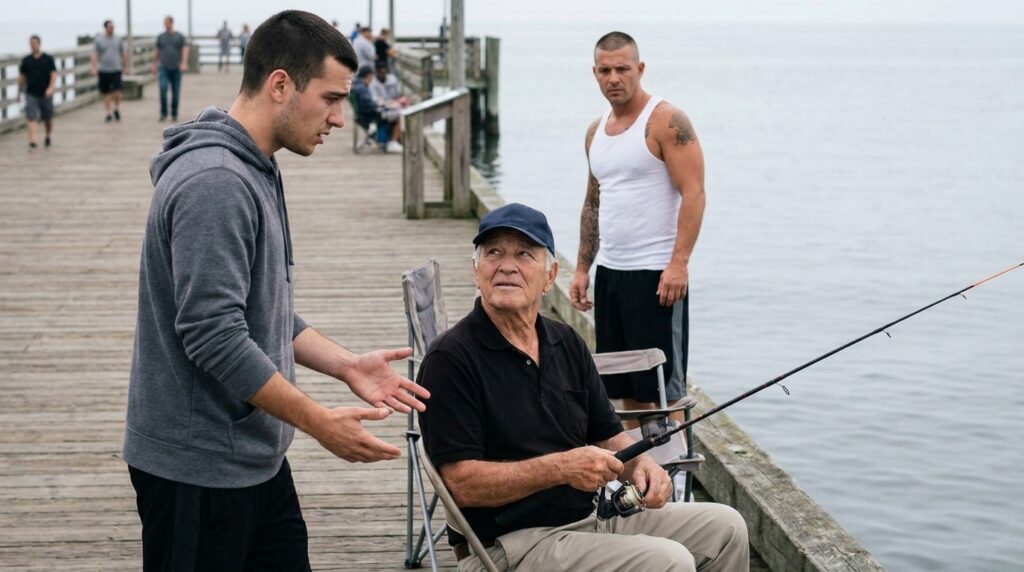
The wood beneath the legs of the aluminum chair was always damp at dawn, thick with the gray, greasy residue of old bait and salt-crust that never truly dried. Thomas “Mac” McCall did not look back when the first pair of heavy boots scraped against the pine planks behind him. He kept his eyes fixed on the point where his monofilament line cut the gray face of the Atlantic—a clean, diagonal seam that vibrated with the rhythm of the tide running hard against the pilings below. His thumb rested in the split foam of the rod’s handle, his skin matching the rough, pitted texture of the synthetic grip.
“You’re crowding the deep lane, old man,” a voice said. It was thick, heavy with the flat vowels of the coastal lowlands, coming from somewhere just above Mac’s left shoulder.
Mac didn’t move his chin. He counted three seconds by the small, rhythmic slaps of dark water against the green-slimed timber beneath his boots. The shadow fell then, wide and hot, blocking the pale orange sun that had just begun to warm the canvas back of his shirt. It belonged to the large one with the buzz cut and the faded ink stretching down his forearm—a boy named Miller who worked the fuel docks but spent his afternoons looking for things that didn’t belong to him.
A second set of footsteps approached, lighter, shifting from heel to toe with an unstudied agility. A younger face, clean-shaven under a gray cotton hood, moved into Mac’s peripheral vision. The newcomer’s hands were out, palms flat against the air, a defensive wall built out of clean intentions and early-twenty-year-old certainty.
“Hey,” the boy in the hoodie said, his voice rising just enough to make two nearby men stop their casting. “He’s got a right to the rail. The guy spent decades serving this country, let him enjoy some peace.”
The words hung in the salt air, heavy and clumsy. Mac felt the skin across his knuckles tighten. It was the specific phrasing that grated—the soft, protective pity that transformed a living man into a fragile historical monument. Behind them, Miller didn’t move; his chest simply expanded under his white tank top, his jaw locking into the rigid moral logic of a local who believed the deep-water edge belonged only to those who still had rent to pay and fish to sell.
Mac let his breath out through his nose, slow and cold. He didn’t use the rod for leverage. He simply shifted his weight forward, his old work boots finding their purchase on the wet pine at a precise, forty-five-degree angle. When he stood, the aluminum frame of the chair gave a single, metallic click that seemed to quiet the entire length of the pier.
He didn’t look at Miller. He looked down into the eyes of the boy in the gray hoodie, his spine straightening with an ancient, institutional memory that erased the stoop in his shoulders. The movement was small, but it closed the distance between them, turning the young man’s protective stance into an unnecessary obstacle.
“I appreciate that,” Mac said. His voice wasn’t loud, but it had the dry, gravel-scraped authority of a dry-dock klaxon. “Now let me handle things my way.”
The young man’s mouth stayed open for a fraction of a second, the speech-shaped movement drying up instantly as he looked into Mac’s eyes. Behind him, Miller took a slow half-step back, his boot heel catching on a rusted iron cleat. The heavy, muscular confidence in the white tank top seemed to leak out through the tattoos on his arms, his gaze dropping to the floorboards as he felt the sudden, dangerous stillness radiating from the old man’s frame. Mac reached down, his calloused thumb tracing the edge of an old bronze buckle on his tackle box, his eyes never leaving the lane he had just reclaimed.

CHAPTER 2: THE TEXTURE OF SILENCE
The silence that followed Mac’s voice didn’t rise from the river mouth; it seemed to drop from the iron girders of the bridge half a mile upstream, heavy and damp, pressing the heat back down into the river-mud. Miller didn’t speak. A man like that—built out of cheap gym weight and the easy authority of small-town docks—understood the physics of a threat long before he understood the words. He looked at Mac’s right hand. It wasn’t balled into a fist. It was simply wrapped around the vintage fiberglass fishing rod, his knuckles the color of salted tallow, the thumb anchored in the deep split of the foam grip with a stability that suggested thirty years of grey sea.
Miller’s shoulder dropped first. The movement was small, a single inch of deflating muscle beneath the thin cotton of his white tank top, but it was enough to change the air between them. He didn’t look at the younger boy in the hoodie either; he looked down at his own work boots, his tongue tracking the inside of his lip as if searching for a taste he had forgotten.
“Yeah,” Miller muttered, his voice flat, stripped of the heavy timber it had held thirty seconds ago. “Whatever. Fish are biting small anyway.”
He turned on his heel, his left boot heel catching the edge of a rusted iron cleat with a short, metallic chime that sounded like a small bell ringing underwater. His associate, the silent one who had stayed five paces back in the shadow of the bait shack, didn’t wait for him. They moved down the pier together, their strides long and uneven, their boots drumming a hollow, double-time rhythm against the loose pine planks until the sound lost its edge against the wider rumble of the highway behind the marsh.
The boy in the gray hoodie remained. He hadn’t dropped his hands yet; they stayed up, fingers slightly curved, like an actor who had forgotten his next position after the curtain had already started to fall. His breath came fast, the gray fleece of his chest rising and falling against the pale, low-slung sun.
“You didn’t have to do that, sir,” the boy said. He took a half-step back, his eyes tracking the sharp line of Mac’s jaw, then down to the faded navy blue cap pulled low over the old man’s brow. “I had him. Those guys from the fuel dock, they think they own the deep water. My name’s Jesse. My dad—he always said guys from your unit didn’t take grease from anyone.”
Mac didn’t answer. He didn’t offer his hand, nor did he look into the boy’s face long enough to let the connection stick. He let his weight sink back into the aluminum frame of the folding chair, the metal tubes giving a low, familiar groan as they took his lean bulk. The world was full of Jesses—earnest, soft-skinned boys with too much history in their heads and not enough salt in their blood, looking for old men to turn into stories they could carry around like pocketknives.
“Your line’s slack,” Mac said, his chin jerking toward the water.
Jesse looked down at the river, his mouth half-open as if he wanted to pull another sentence out of the air, but the cold weight of Mac’s stillness stopped him. He nodded once, a sharp, jerky movement of his neck, and retreated four paces to his own bucket, his movements quiet now, his fingers clumsy as he picked up his reel.
Mac waited until the boy’s back was turned before he reached down to the left side of his chair.
The tackle box was a heavy, three-tiered steel cabinet from the late sixties, its green enamel long since scrubbed away by sand and bilge water until only the dull gray primer remained. The brass hinges were thick with green verdigris, swollen by forty years of sea air until they required a specific, lateral pressure of the thumb to release.
Mac didn’t open the main lid. He slipped his fingers beneath the canvas skirt he had stitched around the base to keep the lead weights from rattling against the boat decks. His skin brushed against something that didn’t belong to the standard inventory of three-ounce sinkers and rusted swivels. It was a small square of heavy oilcloth, stiff with paraffin, wrapped tight around a hard, notched shape.
He didn’t look at it. His fingers knew the shape by heart: a short bronze key with three square teeth and a drilled eyelet that held a single strand of wire-core cord.
Beneath the oilcloth, where the canvas met the zinc bottom of the box, the structural lining felt thin. Too thin. For three weeks, the bottom layer had felt slightly higher than it should have been—less than a quarter of an inch, just enough to alter the center of gravity when he lifted the box by its leather handle. He pressed his thumb against the metal plate behind the lower tray. It didn’t give, but through the iron-pitted wood of the pier planks beneath his boots, he felt a vibration that had nothing to do with the incoming tide or the diesel trucks on the bridge.
It was a triple pulse—short, dry, regular as a clock—traveling up through the green pine pilings from the deep silt forty feet below the rail.
Mac closed his hand around the bronze key, his thumb tracing the notches until the metal bit into his skin. He looked over his shoulder at Jesse, who was leaning over his line, his eyes fixed on the gray water with the intense, vacant devotion of the young. Beyond him, at the foot of the pier where the asphalt met the gravel, a dark blue sedan with government plates and no dealer markings was idling under the salt-cedars, its exhaust rising in a thin, blue smudge against the marsh grass.
The car had been there since five. It would stay until the sun cleared the top of the bridge girders, and then it would move to the boat ramp three miles south.
Mac pulled his hand out from beneath the canvas skirt, his palm empty now, the key tucked back into the dark seam of his pocket. He took the fiberglass rod in both hands, checking the tension of the drag with a short, three-inch pull of the line. The monofilament hummed, a high, clear note that cut through the low hiss of the river.
“Jesse,” Mac said, his voice flat against the wind.
The boy turned instantly, his gray hood falling back from his ears. “Yes, sir?”
“Go up to the shack. Get two packs of salt-herring. The heavy brine.” Mac didn’t look back as he spoke, his eyes already returning to the gray line where his lead was anchored in the mud. “And don’t talk to the man in the blue car.”
CHAPTER 3: THE WEIGHT OF THE LINING
Jesse didn’t run, but he moved with a sudden, eager stiffness that made his gray hood flap against his shoulder blades as he retreated down the long walkway. His sneakers left small, dark wedges of dampness on the gray pine planks where the salt-spray had pooled. Mac didn’t watch him reach the dirt lot where the sedars grew, nor did he look back toward the blue sedan idling by the boat ramp. He simply leaned forward until his forehead almost touched the cold fiberglass of his rod, his eyes fixed on the slackening belly of his fishing line as it sagged with the shifting of the river current.
The tide was nearly flat now. The little slaps against the green timber below had slowed to a long, oily heave, the kind of quiet that usually brought the bottom-feeders out of the deeper mud.
Mac slipped his hand back down into the shadow of his folding chair, his fingers navigating the wet canvas skirt of the steel tackle box by touch alone. The cold brine had begun to stiffen the fabric, making the heavy canvas weave feel like coarse sandpaper against his knuckles. He pressed his thumb against the lower rim of the box where the zinc hull met the brass structural molding. With a small, practiced twist of his wrist, he didn’t lift the tray—he slid the entire secondary compartment sideways, a fraction of an inch at a time, until the internal latch gave a soft, oily click.
Inside the false bottom, beneath three layers of lead sinkers that smelled faintly of tallow and oxidized tin, lay a second layer of stiff oilcloth. This wrapper was older than the one holding the key. The paraffin had turned white and flaky along the creased edges, dusting his fingers like dried salt when he pulled the corner back.
It wasn’t paper inside. It was a bound log—thin, twenty pages at most, bound by three rusted copper staples that had left dark orange stains on the heavy watermarked linen.
Mac opened the first sheet with his thumb, his gaze remaining fixed on the water while his fingers mapped the raised lettering of the navy registry mark at the top of the page. He knew the sequence without looking: DD-882, Command Courier Log, September 1984. His mind didn’t drift back to the engine room or the grey rollers of the North Atlantic; it stayed right here on the wooden rail, tracking the physical vibration that continued to pulse through his boots—three short beats, a long pause, then three more.
The ink on the page was purple, the fading dye of an old spirit duplicator that had survived four decades in a dark drawer. His eyes dropped to the line items under the third watch column. A single name was scratched in the margin with a fine-point ballpoint pen, the letters small and hurried, as if written while the ship was pitching in heavy seas: V. Vance – Courier First Class.
Mac took a slow, deep breath of the low-tide air. Vance.
He looked down the length of the empty pier toward the small white shack where the salt-herring was kept. Jesse was standing by the screened door, his hand raised to shield his eyes from the glare of the water as he waited for the clerk to open the freezer locker. The boy had the same slight hitch in his left shoulder that the older Vance had carried when he came down the ladder into the command room with the leather dispatch bag chained to his wrist. A family shape, preserved across forty years of land-locked life, showing up on a dilapidated public dock three states away from the nearest naval shipyard.
The blue car by the cedars didn’t move, but the driver’s side window slid down three inches, a dark horizontal slit breaking the smooth reflection of the marsh grass on the glass.
Mac closed the log, his fingers sliding the oilcloth wrapper back into the zinc groove until the latch re-engaged with a dry, metallic snap. The weight of the box felt different now—not heavier, but off-center, the internal balance altered by the simple fact of his knowing what lay behind the lead weights. He didn’t feel the small, human satisfaction of a mystery solved; he felt only the familiar, cold tightening in his stomach that usually preceded a shift in the wind during a late-season gale.
The boy hadn’t just stumbled onto the pier to watch an old man fish. He had been brought here by an old ledger, or by a name dropped over a kitchen table in a house that smelled of old uniforms and damp wood.
A shadow broke the light on the water to his left. A common tern dropped from the telephone wires by the road, its wings folding into a clean gray V as it hit the surface without a splash, rising a second later with a three-inch silverside twisting in its beak. Mac watched the bird carry its meal toward the salt-cedars, its flight heavy and low against the rising heat of the morning.
He reached into his pocket and pulled out the notched bronze key, his thumb finding the three square teeth again. The wire-core cord was stiff, the metal strands inside the braided nylon starting to rust through where the salt had found a gap in the plastic coating. The key didn’t belong to any lock on his tackle box, nor did it fit the small padlock on the bait shack at the foot of the hill. It was an ordnance key, the kind used to clear the manual override switches on the old underwater tracking stations along the coastal shelf before the satellites took over the watch.
He looked down at the wooden planks beneath his feet, tracing the grain of the pine until it disappeared under the green scum of the water line. The pilings weren’t standard telephone poles; they were heavy timber balks, twelve inches square, treated with creosote that still smelled like coal tar when the sun hit them straight on. They went down deep into the mud, deep enough to anchor something more permanent than a public walkway for weekend fishermen.
Jesse was coming back now, carrying two white plastic tubs of brine-herring against his chest, his boots making a quicker, more rhythmic sound against the wood as he hurried to beat the incoming heat. Mac tucked the bronze key back into his pocket, his hand lingering on the frayed wool of his trousers until his fingers were completely still.
“Got the heavy brine, sir,” Jesse said, stopping two paces back, his face flushed under the gray hood. He set the tubs down with a wet splash that sent a circle of gray salt-water across the planks. “The guy in the car—he didn’t say anything. He just watched me walk past the grill.”
Mac didn’t look up from his line. “He’s paid to watch, son. Sit down and bait your hooks. The water’s about to turn.”
CHAPTER 4: THE GAP IN THE DECKING
“He spent decades serving this country, let him enjoy some peace.”
The words did not drop smoothly into the low-tide heat; they cracked across the open timber planks like a dry hemlock branch snapping under a boot. Jesse was already moving before the final syllable cleared his teeth, his gray fleece hoodie bunching around his collarbones as he swung his weight between Mac’s aluminum chair and the heavy, tattooed bulk of Miller. His hands were spread wide, fingers hooked over the empty air—not a fighter’s stance, but the clumsy, defensive blocking movement of an unguided boy trying to construct a wall out of pure posture.
Miller didn’t hit him. He didn’t even drop his hands into his pockets. He simply leaned his sternum forward until the white cotton of his tank top was three inches from Jesse’s nose, his thick jaw tightening into a pale ridge that smelled faintly of sour beer and fuel dock grease. Behind them, the second man—the one with the grease-darkened cap who had stayed near the bait shack—shifted his boots by two inches, his shoulder dropping into a slight, predictive lean that Mac recognized from forty years of close-quarter skirmishes.
Mac did not scream an order. He did not let the fiberglass rod rattle against the iron rail. He simply kept his fingers buried in the deep split of the foam handle, tracking the faint, rhythmic pulse beneath his soles—the three short clicks of the sub-surface array, regular as a dead man’s watch, vibrating through the creosote pilings.
“You don’t know who you’re talking for, kid,” Miller said, his voice dropping into a flat, level rasp that barely carried over the lapping of the water against the green timber. “The old man doesn’t need a shadow. He’s been clogging up this end of the rail since the spring thaw, and his bucket’s always empty. We got six lines to drop before the slack water ends. Move your skin.”
Jesse didn’t give an inch. His sneakers squeaked on the salt-damp pine, his eyes darting toward Mac for a split second—a quick, desperate appeal for verification, for the historic validation he had read into an old log or a piece of family kitchen-table gossip. He wanted the uniform to appear. He wanted the medals to rattle in the pocket of the old black polo shirt.
“I know exactly who he is,” Jesse said, his throat tight, his ribs expanding hard against the gray fleece. “My father was on the Vance. He told me what happened at the intercept. He told me who stayed on the deck when the lines parted.”
A cold, dead weight settled behind Mac’s ribs. The boy wasn’t just a stray. He was an inheritance.
The blue sedan at the foot of the gravel path didn’t start its engine, but the dark horizontal slit of the driver’s window slid down another inch, the black void within the glass framing the pale, featureless shape of a hand lifting an old-model brick radio to a mouth. The antenna caught the morning glare for a micro-second, a sharp silver needle cutting through the salt-cedars.
Mac let his breath out through his mouth, his tongue tracking the dry salt on his lips. The boy had just cracked the decoy wide open in front of the wrong ears. The whole pier was an ear. Every rusted bolt in the structural framing was tied to something that didn’t care about old sailors or the sons they left behind.
“Jesse,” Mac said. The name was small, but the gravel-scraped tone of it made the boy’s shoulders jump. “Step back from the rail.”
“But sir, he’s—”
“I said step back.” Mac didn’t look up at him. He kept his gaze locked on the small, lead sinker resting on the wood beside his boot—a three-ounce egg of oxidized zinc that had turned the color of an old tooth. “The fish aren’t under the wood today. They’re out in the channel. You’re wasting your bait on the pilings.”
Miller let out a short, wet grunt that was half-laugh, his heavy shoulders dropping as he read the old man’s compliance as simple fear. He reached down, his thick, scarred fingers gripping the top bar of Mac’s folding chair with a casual, crowding pressure that threatened to tilt the aluminum frame into the iron rail. “Listen to the grandfather, kid. He knows when the tide’s too heavy for him.”
The second man by the bait shack took three long, unhurried strides forward, his hand slipping into the loose pocket of his windbreaker where something heavy and square—too square for a knife, too flat for a standard reel—made the nylon sag.
Mac felt the bronze key in his own pocket press against his hip bone as his weight shifted. The notches were cold against his skin through the fraying canvas of his pocket lining. The false bottom of the green steel tackle box was only four inches from his heel, the purple-inked courier log sitting behind the lead weights, a direct trail that went straight back to the destroyer that had supposedly been scrapped in a Taiwan yard twenty years ago. If they touched the box, the whole line would unravel before the tide could clear the mouth of the river.
He didn’t move his hand toward his pocket. He didn’t look at Miller’s knuckles where they clamped the aluminum rail of his chair. Instead, he looked at the gap in the decking between his boots—a half-inch space where the wood had rotted away around a massive iron drift-pin. Down in the dark green wash, ten feet below the slime line, a heavy copper ground wire ran straight down the side of the piling, its insulation stripped away in neat, three-inch bands to let the salt water complete the circuit.
The triple pulse came again. Three short. A long void. Then the heavy, thrumming hum that made the monofilament line sing its high, clear note.
“Jesse,” Mac said, his voice dropping into that rhythmic, institutional cadence that had once cleared the lower decks of the DD-882 during a fire in the magazine. “Take your buckets and go back to the asphalt. Now.”
The boy looked down at him, the earnest certainty in his face fracturing into something small and confused, his mouth opening to subvocalize a protest that never came. He saw Mac’s eyes then—not the cloudy, fading gaze of an eighty-year-old pensioner, but the cold, slate-gray stare of a man who had spent forty years looking through the fog for things that were designed to kill him.
CHAPTER 5: THE UPRIGHT SHIFT
Jesse’s boots didn’t move backward, but his knees went rigid under the fleece pants, his weight locking into the wood like an unseasoned timber that was about to fracture under a crosswind. The second man—the one who had stepped away from the bait shack—closed the remaining gap with three flat, heavy strides. The nylon of his dark windbreaker gave a sharp, artificial hiss as his arm swung forward, the weight in his right pocket swaying like a pendulum against his thigh.
Mac stood up.
He didn’t pull against the iron rail to raise his frame, nor did his boots slide on the slime-filmed pine planks. He simply straightened his knees with a smooth, unhurried precision that belonged to an era when hundreds of tons of gray steel were balanced against a single centerline. The stoop left his spine in a single second. The change wasn’t an explosion; it was a realignment of gravity that made the aluminum chair behind him rattle once against its stays and then fall perfectly silent.
He let his right hand drop away from the fiberglass fishing rod. The line stayed cast in the gray water, but his fingers were empty now, the skin across his knuckles gray and tough as cured leather as he turned his chest directly into Miller’s shoulder.
“You’re on my deck, son,” Mac said. His voice didn’t rise to meet the wind, but it had the clear, low-frequency timber of an engine-room hatch being dropped into its rubber seating. It went straight down into the planks, cutting through the thin slap of the river against the wood.
Miller’s hand stayed frozen on the top rail of the folding chair. His fingers looked short and pink against the scuffed green zinc plate of Mac’s vintage tackle box, the tribal ink on his forearm twitching where the muscle met the tendon. He didn’t drop his jaw, but his eyes did a quick, mechanical calculation—tracking the width of Mac’s collarbones, the perfect vertical line of his spine, and the heavy, scuffed leather of the work boots planted at forty-five degrees near the center seam of the pier.
The second man stopped five paces back, his right hand still buried in the windbreaker pocket. The heavy, square outline inside the fabric didn’t shift, but his head tilted three degrees to the left, his gaze moving past Mac’s shoulder toward the gravel lot where the blue sedan sat under the salt-cedars.
The driver’s side door of the sedan had opened. A man in a plain gray windbreaker and dark trousers was standing behind the door frame, his hand resting on the roof of the vehicle while his eyes remained fixed on the far end of the pier. He wasn’t looking at Miller, and he wasn’t looking at the boy in the hoodie. He was looking at the green steel tackle box sitting by Mac’s heel.
“We’re just dropping lines, old man,” Miller muttered. The flat, local vowels were still there, but the weight behind them had dissolved into an uncomfortable, thin rattle. He didn’t release his grip on the chair, but his arm went soft, the muscle in his shoulder dropping into a defensive hunch as if he were trying to minimize his size against the gray sun.
“You’re dropping nothing here,” Mac said. He took a single half-step forward, his boot heel coming down on the very edge of the gap where the copper ground wire vanished into the green wash below. The vibration under his soles had stopped its triple pulse. It was a solid, continuous thrum now—the sound of a sub-surface array switching from its passive search cycle into a hard, directed sweep that was cooking the water ten feet beneath the walkway. “Take your gear and get behind the gate.”
Jesse looked between them, his face pale under the gray cotton hood. The romantic certainty that had brought him to the rail—the family stories of a legendary commander who had held a breaking destroyer together with nothing but discipline—was entirely gone now. He looked down at the green steel tackle box, then at the square shape in the second man’s pocket, his fingers trembling where they clutched the rim of his plastic bait bucket. He was beginning to smell the salt-tar and the old oilcloth, the real odor of a machine that didn’t have a place for a boy’s pride.
The second man in the windbreaker gave a short, single shake of his head toward Miller. He didn’t pull his hand out of his pocket, but he turned his heels back toward the bait shack, his boots making a light, whispering sound against the dry wood as he broke the perimeter.
“Come on,” the second man said to Miller, his voice entirely flat, stripped of any local color. “The current’s too fast here anyway. We’ll use the south wall.”
Miller didn’t answer immediately. He let his fingers slide off the aluminum frame of Mac’s chair, one by one, leaving five clear smears of grease on the clean metal. He took two slow steps backward, keeping his chest turned toward Mac until he cleared the five-pace line, then turned and followed his partner down the long, hollow walkway. Their shadows stretched out behind them, long and distorted against the weathered wood, until they vanished into the glare of the gravel lot.
The man by the blue sedan didn’t get back into his car. He watched the two dock-workers pass the salt-cedars without looking at them, then closed his door with a dull, heavy thud that carried across the marsh like a small pistol shot.
Mac didn’t sit back down. He reached down and took the fiberglass rod in his left hand, his thumb finding the split foam handle again, his skin absorbing the high, clear vibration of the taut line cutting the channel. The river was turning now, the gray face of it breaking into small, greasy ridges as the incoming tide met the flow from the upper basin.
“Sir,” Jesse said, his voice barely a whisper against the hum of the line. “The Vance… my father said the log was never logged. He said they left it in the box because the Navy didn’t want the signatures on the manifest.”
Mac looked at the boy, his gray eyes showing absolutely nothing but the flat reflection of the low-tide brine. “Your father talked too much to a boy who couldn’t keep his mouth shut on a public rail, Jesse. Pick up your bucket.”
CHAPTER 6: THE ANCHORED LINE
“My father didn’t talk,” Jesse said. The words came out thin, dried out by the glare that was now baking the top of the gray wooden rail. He didn’t lift his bait bucket. He just stood there, his sneakers slightly overhanging the gap where the creosote piling met the top decking, his fingers frozen into five small hooks against the plastic handle. “He died with his teeth shut, sir. But he kept the duplicate manifest in the cellar behind the water heater. I found it after the funeral. I found your name.”
Mac didn’t turn his head. He watched his line—the thin green thread of monofilament—as it cut the shifting brown water of the channel. The tide had fully turned now, running up-river with a heavy, silent power that pulled the dead marsh grass away from the bank and swirled it around the pilings in long, oily ropes.
Below his boots, the thrum was no longer a pulse. It was a single, unbroken tone—a high, mechanical frequency that resonated through the rusted iron drift-pins and into the aluminum legs of his chair. The array was locked on. Somewhere three miles out, past the sandbar where the gray rollers broke, a hull was moving through the deep trench, and the creosote logs beneath this public fishing dock were tracking its speed by the inch.
“A manifest is just paper, son,” Mac said. His voice was very quiet now, stripped of the command-deck rasp, matching the long, flat hiss of the river. “It doesn’t tell you what the water does to a man after forty years.”
He reached down, his movements slow and unhurried, and clicked the latch on the green steel tackle box. He didn’t slide the false bottom. He didn’t touch the paraffin-crusted oilcloth or the purple-inked courier log that carried the signatures of dead seamen. He simply took a single, two-ounce lead pyramid sinker from the top tray, his thumb testing the rough seam where the zinc had cooled in the mold.
The blue car at the edge of the lot had started its engine. The exhaust came out gray and heavy against the salt-cedars, the vehicle turning slowly on the gravel, its tires crunching the white clam shells with a dry, rhythmic crackle that sounded like teeth breaking. It didn’t drive toward the highway. It stopped at the throat of the wooden walkway, its nose pointed directly at the rail where Mac sat.
The man in the gray windbreaker was gone from the door, but the reflection on the windshield was blank, silvered by the midday light until the front seat was nothing but an empty slate.
“They’re going to take the box, aren’t they?” Jesse asked. He took a half-step closer, his gray shadow falling across the open tin trays of swivels and rusted hooks. He wasn’t looking at the car; he was looking at the way Mac’s hands didn’t shake as he tied the lead pyramid to the end of his line with a neat, five-turn clinch knot. “That man from the sedan. He’s been at the fuel dock three times this week asking about the old slips.”
Mac pulled the knot tight, using his teeth to nip the tag end of the nylon. The salt taste was sharp on his tongue—bitter, old, like the iron grease that used to coat the ladder-rungs of the DD-882.
“They can have the box,” Mac said, his fingers releasing the line. “The box is just where we keep the names so we don’t forget how to say them. The rest of it—the part your father didn’t put in the cellar—that stays under the wood.”
He stood up then, not with the sharp, defensive posture he had used to freeze Miller, but with a slow, heavy extension that seemed to take the entire weight of the pier up with him. He looked down into the water through the half-inch gap in the planks. The copper ground wire was vibrating so hard it had cleared a two-inch circle of green slime off the timber face, the bare metal shining like a new penny in the dark wash below.
The array wasn’t a secret he was guarding from the men in the car. It was the other way around. The car was there to make sure the array didn’t stop singing—to make sure the old man who sat on the aluminum chair every morning didn’t forget to keep his thumb on the wire-core cord that completed the circuit between the mud and the sky. They were all anchored to the same piling. Miller with his territorial greed, Jesse with his dead father’s pride, and the man in the sedan with his radio—all of them just foam on the surface while the machine did its work in the dark.
“Go home, Jesse,” Mac said, his hand coming down on the boy’s shoulder for the first time. The wool of the gray hoodie was rough under his palm, damp with the river mist, but the muscle beneath it was warm. “Tell your mother you found an old man who remembers the watch. That’s enough for a duplicate manifest.”
The boy looked at Mac’s hand, then up at the navy blue cap, his jaw moving once as if he wanted to pull the intercept back out of the history books, to make the destroyer reappear in the middle of this muddy coastal river. But the stillness in Mac’s face stopped him. It was the absolute, unblinking composure of a man who had already seen the end of the narrative long before the first line was cast.
Jesse nodded once, his eyes wet against the glare. He reached down, picked up his plastic bucket by the wire handle, and walked back down the center seam of the planks. He didn’t look at the blue sedan as he passed it; he kept his chin down inside his gray collar, his boots making a light, fading scuff against the pine until he hit the gravel and turned toward the town.
The blue sedan waited until the boy cleared the sedars, then its lights flickered once—a brief, amber flash of the parking lamps.
Mac sat back down in the aluminum chair. He didn’t open the tackle box again. He took the fiberglass rod in both hands, his thumb finding the deep split in the synthetic foam grip, his skin absorbing the steady, high-frequency hum that was traveling up from the silt forty feet below. The line was taut. The lead pyramid was anchored deep in the river mud, holding against the full weight of the Atlantic as it rushed into the mouth of the channel.
He pulled his cap low against the noon sun and kept his watch.







