
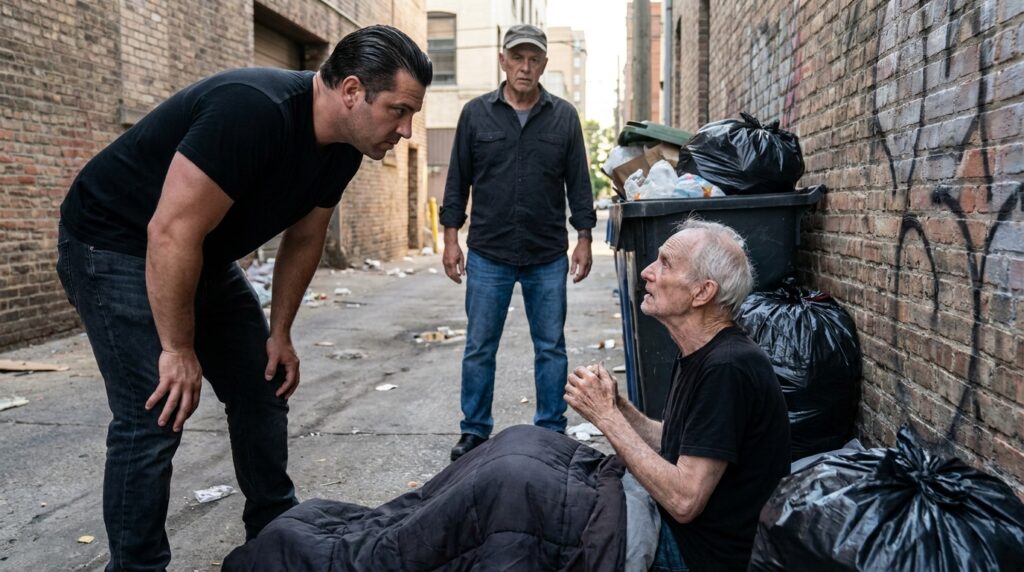
The Calculus of Iron and Ash: A Crimson Standoff on Frayed City Asphalt

CHAPTER 1: THE FRICTION OF EXILE

“Move those dynamic boots six inches back,” Miller said. The gravel beneath his work boot didn’t roll; it ground down into powder against the cracked asphalt. “Do it before the grease on this alley floor gets slick with something else.”

The enforcer didn’t move. He was a wall of cheap cotton and dense muscle, his black shirt smelling of industrial laundry detergent and stale sweat. He stayed leaned in, his shadow completely swallowing the bundle of gray blankets and the frail, trembling knees of old man Isaiah. A flies’ nest swarmed around a split garbage bag three feet away, their buzzing the only steady rhythm in the dead air between the brick buildings.

“He’s a ghost, Miller,” the younger man spat, not looking up, his slicked dark hair catching the desaturated noon light that managed to squeeze between the fire escapes. “You’re guarding a graveyard. The district board signed off on the clear-out. He’s got till five o’clock to drag his rot somewhere else.”

“The board doesn’t own the easement under his heels, Vance. I built the foundation for that warehouse on the corner thirty years ago. I know where the city property line stops and where the blood lines begin.” Miller stepped into the gap. The heat radiating off the brick wall was dry, smelling of rusted iron and old mortar. He let his thumbs hook into the belt of his jeans, just above the hip, keeping his hands empty but visible.

Isaiah didn’t speak. His fingers, gray-skinned and thick-nailed like old roots, were dug into the pocket of his oversized woolen coat, turning something over and over. A metallic click-clack came from the fabric—the rhythmic, obsessive spinning of an old brass radiator valve key. He looked at the grease on Miller’s boots, his breath coming in shallow, raspy whistles through a throat dry from city dust.

Vance straightened up slowly. He was a head younger and thirty pounds heavier, his knuckles scarred from the mechanics’ yards down on Fourth. “The people on this block are tired of looking at him, Miller. We’ve got a clinic scheduled for these footings. Real families. Not some old relic holding onto a secret that died before the concrete dried.”

“He stays,” Miller said. His voice was flat, devoid of anger, carrying only the heavy, exhausting weight of a man who had spent forty years shifting stone. “Go back to the office. Tell them the easement is occupied.”

Vance looked at Miller’s gray hair under the edge of his cap, measuring the distance between them. The silence stretched, thick with the smell of iron and dry earth. For three seconds, the space between them tightened until the air felt thin. Then Vance stepped back, a small, ugly smile twisting his mouth. He reached into his back pocket, pulling out a small, water-damaged notebook bound in black oilcloth—an item that didn’t belong to any developer’s office. He flipped it open with one thumb, holding it just long enough for Miller to see the faded purple ink stamp of the old municipal water works from 1996.

“You think you’re the only one who remembers the old grid, Miller?” Vance whispered, his voice dropping below the buzz of the flies. “Look closer at the old man’s blanket. That ain’t a mattress pad he’s sleeping on. It’s the old ledger cover from the vault you cleared out the night the city treasury burned.”

Vance turned on his heel, his heavy boots crunching away toward the mouth of the alley, leaving the heat to settle back over the brick like a lead weight. Miller stood frozen, his eyes dropping slowly to the frayed gray canvas beneath Isaiah’s knees.


CHAPTER 2: THE ANATOMY OF AN ANCHOR

“What did he mean by the ledger, Isaiah?”

Miller’s voice didn’t rise, but it had the stiff, dry rattle of iron filings sliding down an old chute. He stayed where he was, his boots pinned to the edge of the shadow where Vance’s footprint still dented the dust. The noon sun had moved a fraction of an inch, just enough to strike the rusted lip of a heavy iron grease trap set into the brickwork. It smelled of rancid lard and decades of rainwater.

The old man didn’t look up. His thumb kept working the brass radiator key inside his pocket, the click-clack slower now, heavier, like the mechanical timing of a clock losing its mainspring. “Vance speaks for the people who pay him, Miller. He always did. Even when he was ten years old stealing copper pipes out of the basement of the old Saint Jude’s.”

“He had the black book,” Miller said, taking one slow, deliberate step forward. The leather of his boots creaked against the grit. “The water works log. The one from the year the grid was redrawn. Nobody’s supposed to have that. The city records clerk told me it was turned to gray ash when the main office went up.”

Isaiah finally stopped his hand. He drew his fingers out of his coat pocket, leaving the brass key hidden inside the wool. His palm was stained a dark, metallic orange—the fine, oily rust that lives inside seventy-year-old steam pipes. He laid both hands flat against the top of the canvas bundle he sat on. The fabric was coarse, the color of weathered river stone, but beneath the gray grime, a stiff, dark outline square showed through the weave. It was the distinct, rigid shape of a binding.

“A city doesn’t burn everything when it fires a building,” Isaiah muttered, his eyes fixed on Miller’s work shirtsleeves, where the faded blue cotton was worn white at the elbows. “Some things get carried out the back door while the smoke is keeping everyone looking at the front. You know that better than most, Miller.”

Miller felt a sudden, cold prickle of sweat break across his shoulder blades, despite the heavy heat trapped between the brick walls. He reached out, his thick fingers grasping the edge of a rusted iron fire escape ladder to steady himself. The metal was rough under his skin, flakes of old brown paint peeling off like scabbed skin. “Let me see what’s under the canvas.”

“No.”

The word wasn’t a challenge; it was a simple statement of fact, solid as a structural column. The old man shifted his weight, his thin frame pressing harder against the bundle. “If you touch this cloth, Miller, you’re opening an account you can’t pay back. You think you’re standing in this alley because you’re a good man protecting an old neighbor. You like the weight of that harness. But you forgot who built the stable.”

Miller’s jaw tightened until the old scar beneath his ear pulled white. “Vance is coming back at five with the eviction crew. He’s got the district signatures. If I don’t know what he’s holding against you, I can’t block the tractor when it turns the corner.”

“He isn’t holding anything against me,” Isaiah said softly. He reached down and pulled the edge of his oversized wool coat down, covering the canvas shape completely. “He’s holding it against the land. Go down to the old pump house on Third. The one with the boarded-up archways. Vance’s uncle kept the old maintenance logs there before the county split the water district. If Vance has the black book, he got it from the dry well under the floorboards.”

Miller let go of the fire escape ladder. His palm left a clean, pale print in the red-brown rust of the iron rail. The subtext between them was a physical pressure now, a shared history that neither man wanted to drag into the noon light because both knew how much rot it would show.

“The pump house was locked up by the city marshal three years ago,” Miller said, his eyes narrowing as he calculated the distance to Third Street. “The structural timbers are gone. The whole roof is dropped into the basement.”

“The side door still has the old drop-bolt,” Isaiah replied, his voice slipping back into that raspy, dry whistle. “The one you put on it yourself when we were trying to keep the scrap iron thieves from lifting the copper meters. If you still have the touch for your own iron, you can get in before Vance sends his boys to clear my blankets.”

Miller turned without another word, the friction of his boots against the asphalt sounding like teeth grinding in the silence. He didn’t look back to see if Isaiah was watching him. He kept his eyes on the narrow strip of gray sky at the end of the corridor, his mind running through the old municipal maps he had tried to forget for thirty years. Every step he took away from the old man felt heavier, his boots dragging through the invisible dust of a neighborhood that was being ground into gravel beneath their feet.

The street outside the alley was blinding after the brick shadow. The air smelled of hot tar and gasoline from the delivery trucks idling along the curb. Miller pulled his cap down low over his eyes, his hand sinking into his pocket to find his own keys. His fingers brushed against an old brass ring, the metal cold against his skin, carrying the specific, unforgettable weight of an iron drop-bolt key he hadn’t used since the winter the city changed its name.

CHAPTER 3: THE DECOY EASEMENT

The iron drop-bolt gave way with a sound like a pistol shot.

Miller took the impact directly into the meat of his shoulder, the heavy timber door scraping inward over a crescent moon of accumulated grit and dried mud. Inside, the old pump house smelled of dead water, rotted pine, and the sharp, chemical tang of machine grease that had dried into a black crust forty years ago. Shafts of gray noon light cut through the rotted roof beams, illuminating millions of floating dust motes that swirled like sand in a river current.

His boots found the iron grading of the central inspection platform. Below, the dry well dropped twenty feet into absolute blackness, where the old high-pressure intake valves sat like dormant iron beasts.

Miller didn’t look down. He moved toward the back wall where the foreman’s station used to be—a rusted metal desk bolted straight into the damp brickwork. The three drawers had been pried open long ago by metal thieves, their contents scattered and trampled into the damp silt on the floor. But Vance’s uncle hadn’t used the drawers. He had been the chief engineer during the transition year, a man who trusted old brick more than steel locks.

Miller knelt, his knees grinding into the gravelly dirt. He ran his calloused palm along the base of the brick column directly behind the desk until his fingernails caught on a thick seam of lime mortar that felt softer than the rest. He didn’t use a tool. He used the flat edge of the old brass ring in his pocket, digging into the seam, scraping away chunks of chalky white powder until the header brick loosened.

He pulled the brick free. It left a dark, square hollow in the pillar. Inside lay a package wrapped in heavy, grease-stained butcher paper, tied tight with rotting hemp twine.

The paper tore like dry leaves under his thumbs. Inside wasn’t just a ledger; it was the original, red-bordered land registry for Section 4 of the industrial district—the document that legally tied the alley easement to the physical foundations of the tenements that Vance’s employers were trying to erase.

Miller turned the brittle pages, his heart thumping a heavy, uneven rhythm against his ribs. The paper felt like dried skin between his fingers. On page forty-two, the red borders stopped. A document had been pasted over the original platting grid with thick, dark hide glue that had turned brittle and cracked with age.

It was a deed of release.

Miller’s hand began to shake, the dry dust of the page slipping into the cracks of his skin. The text was typewritten on an old mechanical Smith Corona, the ink faded to a faint, ghostly violet. It explicitly stated that in the winter of 1996, the occupant of the sub-easement—Isaiah Vance—had formally surrendered all structural holdout rights to the district development board in exchange for the sum of ten thousand dollars.

“I told you you’d find your name somewhere in the footer, Miller.”

The voice came from the open doorway, framed by the bright, blinding square of the street outside. Vance stood in the clearing, his large frame silhouetted against the light. He wasn’t alone. Two men in high-visibility vests stood behind him, one of them carrying a heavy iron crowbar, the other holding a clipboard with a official white city seal visible even from the shadows of the well.

Miller didn’t drop the paper. He held it against his chest, his eyes fixing on the enforcer’s face. “This is a copy, Vance. It’s a pasted insert. The registry lines underneath don’t match the margin coordinates.”

“It doesn’t matter what’s underneath,” Vance said, his work boots clanging heavily as he stepped onto the iron grading of the platform. The structure groaned under his weight. “That’s the document the sheriff’s office is logging at four-thirty. It’s got the notary stamp from the old district court before it was closed down. Isaiah took the money and stayed in the dirt anyway, playing the martyr while the city grew right over his head. The neighborhood’s done with him.”

“He never saw a dime of this,” Miller growled, his voice dropping into a dangerous, gravelly register. His fingers dug into the edge of the grease-stained paper, his mind desperately searching for a flaw in the trap. “Isaiah didn’t even have a bank account in ninety-six. He was still trading labor for coal at the yard.”

“Then somebody else took it for him,” Vance said with a short, ugly laugh. He reached out and tapped the white paper on the clipboard his foreman held. “But the signature at the bottom says Vance. It’s witnessed and cleared. We’ve got the machinery idling at the top of Third right now. When the whistle blows at five, we’re tearing the bedding bundle out of that corridor, and if the old man doesn’t move his feet, the tread’s going over them.”

Vance stepped back toward the door, his eyes lingering on the grease-stained parcel in Miller’s hands. “You wanted the truth, old builder. There it is. Your ghost sold out before I even had my license. Now get out of the well before we bolt the outer door from the outside.”

The three men turned, their shadows retreating across the sunlit mud of the doorway until the heavy timber frame banged shut again, leaving Miller alone in the rotted silence of the pump house.

He looked down at the violet ink of the signature on the pasted page. It wasn’t Isaiah’s crude, block-letter mark. It was an elegant, sweeping script, the ink slightly heavier on the downward strokes—the hand of someone who had been trained to draft blueprints and sign off on structural foundations.

Miller’s breath hitched in his throat, a cold, metallic taste rising from the back of his tongue. He didn’t know the ultimate final reality yet, but the decoy was perfect, and it carried the distinct, unmistakable shape of his own past.

CHAPTER 4: THE ARCHITECTURE OF A LIE

The padlock on the construction office trailer snapped with a short, metallic grunt when Miller threw his weight against the iron pry-bar.

Inside, the air was dead and smelled of formaldehyde, wet cardboard, and the sour chemical musk of blueline blueprints drying under plastic sheets. A single streetlamp outside cut through the grease-filmed window, printing a desaturated grid of iron security bars directly across the green linoleum floor. Miller didn’t flip the wall switch. Instead, he pulled a small, brass-cased inspection light from his canvas coat, its narrow beam picking out the corners of the room until it settled on the heavy green-painted steel filing cabinet in the corner.

The lock on the top drawer was a standard three-pin wafer. Miller didn’t use the pry-bar this time. He took the brass radiator key from his pocket—the one Isaiah had been turning over for decades—and inserted the square tip into the keyway. It didn’t turn. He held his breath, his ear pressed against the cold steel face of the cabinet, feeling the tiny brass tumblers grind against the rusted internal spring. He pulled it back half a millimeter, lifted, and twisted.

The cylinder clicked. The drawer rolled out with a heavy, oiled rumble, the metal suspension rollers screaming in the dark.

Miller’s fingers moved like mechanical sorters through the manila folders. His skin was gray under the fluorescent street glow, dusted with the pulverized lime mortar from the pump house. He bypassed the recent site surveys, the concrete delivery receipts, and the environmental clearance certificates from 2025. He dug deeper, past the modern dividers, until his hand hit the stiff, thick cardboard of the archive section—documents marked District 4 Realignment: 1995-1998.

He pulled the ledger file. It was bound in the same red-bordered tape he had seen in the pump house, but this was the internal corporate ledger for the original development group, the one that had folded after the municipal fires.

Miller laid the file flat on the drafting table. The paper didn’t just feel old; it felt heavy, carrying the distinct, slightly greasy texture of authentic rag-bond paper that modern municipal offices had abandoned decades ago. He flipped straight to the ledger entry for December 12, 1996.

There it was. Not a copy. The original ledger page, matching the red margins exactly.

The text described the allocation of ten thousand dollars from the emergency clearance fund, disbursed to I. Vance for the permanent vacation of the corridor. But attached to the back of the ledger sheet with a small, rusted steel paperclip was a secondary document that had never been filed with the county clerk. It was an internal receipt voucher, a piece of scrap yellow carbon paper that had turned the color of dried nicotine over thirty years.

Miller brought his brass inspection light close to the page.

The voucher listed the cash withdrawal. Underneath the recipient line, where Vance’s name was typed, there was a second line, handwritten in permanent carbon ink: Delivered via site agent.

And there, right on the line marked for the agent’s signature, was the elegant, sweeping script with the heavy downward strokes. The ink had degraded in the exact same pattern as the deed in the pump house, the iron gall in the fluid turning a faint, rusted orange around the loops of the letters.

It was Miller’s signature.

The brass light slipped from his fingers, rolling across the blueprints until it caught against the heavy metal edge of a scale ruler. The small beam bounced off the white plastic, illuminating the deep, weathered lines of Miller’s own face in the drafting table’s mirror.

He remembered. It didn’t come back as a sudden flash; it came back like the slow, cold settling of water into a foundation crack during a hard frost. The winter of ninety-six. The bookmakers down at the rail yards had been holding his markers. He had owed twelve thousand on a retaining wall collapse that wasn’t covered by his bond. The developer had offered him a way out—a single signature to clear the books, an assurance that the old transient in the alley wouldn’t be disturbed for twenty years anyway because the phase-two funding was tied up in court.

He had signed the yellow carbon. He had taken the paper. He had told himself he was saving his own crew from the yards, that Isaiah didn’t care about the legal grid because Isaiah only lived in the shadow of the brick anyway. He had built his entire identity as the protector of the old block on top of a foundation he knew was hollow.

“You always did have clean handwriting, Miller.”

Vance was standing in the doorway of the trailer, his heavy bulk blocking the gray light from the street. He didn’t have his crew with him this time. He had a heavy iron tire iron dangling from his right hand, the tip tapping lightly against the metal edge of the door frame with a slow, deliberate rhythm. Clink. Clink. Clink.

“You knew,” Miller said. His voice didn’t sound like his own. It was a hollow, dry wheeze, like air moving through an empty pipe.

“My uncle didn’t leave a black book because he hated Isaiah, Miller,” Vance said, stepping inside. The linoleum groaned under his boots, the smell of mineral oil and wet wool trailing after him. “He left it because he knew you’d come back to this yard eventually. You’ve been playing the saint around here for ten years, giving the old man soup and keeping my boys out of his corner. But you didn’t do it because you loved him. You did it because every time you looked at him, you were checking to see if the concrete you poured over your own dirt was starting to split.”

Vance raised the iron bar, his eyes cold under the desaturated glare of the streetlamp. “The sheriff’s van is already parked at the corner of Fourth. The tractor starts up in twenty minutes. You can either stay in this trailer and let us finish the alignment, or you can go back down there and tell the old man exactly who sold his dirt thirty years ago.”

Miller looked down at his own hands against the drafting table. The skin was cracked, stained with iron dust and old oil, the hands of a builder who had spent his life trying to make things square. But the lines on the paper weren’t square, and the clock at the top of the wall dial was ticking toward five.

CHAPTER 5: THE LAST ALIGNMENT

The diesel exhaust from the yellow loader hung like a low, greasy ceiling over the mouth of the alley. It was 4:55 PM. The sky between the brick buildings had gone the color of a wet slate shingle, cold and desaturated, pressing down on the damp corridor until the air felt thick enough to choke on.

Isaiah hadn’t moved. He sat on his bundle of canvas, his back pinned against the flaking brick, his wool coat pulled tight around his knees. His root-like fingers were still inside his pocket, but the click-clack of the radiator key had stopped. He was just holding it now, a fixed point of old brass in a world that was turning into iron and ash.

Miller came down the center lane alone. His work boots didn’t feel ground into the asphalt anymore; they felt like lead weights, dragging through the silt. He didn’t have his tools. His hands were tucked deep into his canvas coat, his fingers clamped around the yellow carbon paper he had ripped from the construction office ledger. The paper was dry, whispering against his palms like an old ghost trying to find its tongue.

The loader crawled to the lip of the passage, its iron tracks grinding over the curb with a high, metallic shriek that echoed off the fire escapes. Vance walked beside the steel bucket, his hand resting carelessly on the hydraulic arm. Behind him, three city marshals stood with their hands hooked into their tactical vests, their faces empty under the shadows of their caps.

“Five minutes, Miller,” Vance called out, his voice sharp against the rumble of the engine. “The sheriff’s deputy logged the easement papers. The machine doesn’t wait on two old men who don’t know when a building is dead.”

Miller didn’t answer Vance. He stopped three feet in front of Isaiah, his shadow falling across the old man’s knees. He pulled his right hand out of his coat pocket, holding the yellow carbon voucher out between them. The paper trembled in the cold draft pulled by the loader’s radiator fan.

“I found the book, Isaiah,” Miller said. The words came out slow, dry, scraping his throat like sand. “The real one. The internal ledger from ninety-six.”

Isaiah looked at the paper, his watery eyes reflecting the yellow glare of the loader’s headlamps. He didn’t reach for it. He didn’t even look surprised. He just let out a small, raspy breath that smelled of old tea and dry bread. “I told you not to look under the cloth, Miller.”

“It has my name on it,” Miller whispered. The engine behind him roared as the driver tapped the throttle, a cloud of black soot settling over his gray hair. “I took the twelve thousand. I cleared my markers with the developers on Fourth. I told myself you’d be dead or gone before they ever built the clinic, and I signed your name on the clearance line.”

The silence that followed was wider than the alley. It wasn’t the silence of peace; it was the heavy, dead space that comes after a structural pillar shears through its core.

Isaiah slowly drew his hand out of his wool pocket. He held up the old brass radiator valve key, its square tip worn round from thirty years of his skin friction. He didn’t point it like a weapon; he just held it in the space between his chest and Miller’s chest, a tiny piece of the city’s old bone.

“I knew the night you signed it, Miller,” the old man said softly, his voice cutting clean through the low thrum of the diesel engine. “The builder’s office clerk was my cousin. He saw your name on the voucher before the fire took the building. He came down here and told me I was sold.”

Miller’s knees buckled a fraction, his hand dropping the yellow paper. It didn’t fly away; it fell into the greasy puddle by the iron trap, the purple ink beginning to blur and run into the black water. “You knew? For thirty years, you sat in this dirt and let me bring you blankets? Let me play the protector while you had the forge-mark right in your pocket?”

“A neighborhood doesn’t survive on clean hands, Miller,” Isaiah said, his eyes finally rising to meet Miller’s face. “It survives on who stays when the walls come down. You stayed. You built the retaining walls on Third. You fixed the fire escape when the city stopped sending inspectors. You thought you were paying off a debt to a ghost, but you were just keeping the brick from falling on the kids who live on the block now. If you hadn’t been carrying that sin around like a lead block, you’d have left this district for the suburbs twenty years ago like the rest of the builders.”

“Miller! Get out of the bucket path!” Vance shouted, his boot heel striking the iron track of the loader. The driver raised the hydraulic lift, the steel edge of the bucket rising to the height of Miller’s chest, its teeth caked with dried gray mortar.

Miller didn’t move back. He stood between the machine and the old man’s blankets, his spine straightening until he felt the cold draft of the radiator hitting his neck. He reached down, picked up the wet, oil-soaked yellow paper from the puddle, and stuffed it into the iron grease trap beside his boot, shoving it down into the dark mud until it was gone.

“The easement is still occupied, Vance,” Miller said, his voice coming back strong, the gravel in it turning to solid stone. He didn’t look at the marshals. He looked straight into the enforcer’s eyes, using the predatory calculations he had spent a lifetime learning. “You tell the board that if they want to clear this corridor, they’re going to have to file a structural variance for my body along with his. I designed the foundations for the three buildings connected to this wall. If I draw the city inspector down here to look at the structural shift from your tractor, this whole block gets quarantined for six months before you can pour a pint of concrete.”

Vance’s face hardened, the skin around his jaw turning the color of old lard. He looked at the marshals, then back at Miller’s empty, calloused hands. The tractor idled, its black smoke curling around the fire escapes like a shroud, but the bucket stayed up, frozen in the narrow lane between the past and the machine.

The whistle at the yard on Fourth blew five times, its long, mechanical wail trailing off into the cold slate sky, but the alignment remained blocked, held by two men who shared a sin that was older than the asphalt beneath them.

CHAPTER 6: THE THREEDAY INJUNCTION

The third morning broke the color of an old zinc tub.

At 5:00 AM, the city felt hollow, its pulse reduced to the low, rhythmic thrum of a single idling transit bus three blocks over. The grease-thick soot from the yellow loader had settled during the night, leaving a fine, dark skim over the puddles in the corridor. It didn’t smell like tar anymore; it smelled of deep earth, wet lime, and the cold, metallic sweat that bleeds out of brickwork when the temperature drops before dawn.

Miller stood at the mouth of the alley, his hands jammed into the pockets of his canvas coat to hide the stiffness in his knuckles. His joints ached with the specific, wet fire that comes from seventy winters of lifting stone. Across the street, framed by the chain-link fence of the construction yard, the white sedan belonging to the district building inspector sat dark, its windows milked over with morning frost.

“You’re a stubborn old bastard, Miller,” Vance said from the shadow of the trailer awning. He hadn’t changed his clothes, but his black t-shirt was covered by a heavy nylon work jacket now, the collar turned up against the river mist. He held a cardboard cup of utility-grade coffee, the steam rising in a thin, straight needle into the dead air. “The marshal’s office didn’t sign a refusal. They signed a forty-eight-hour stay for structural review. That clock runs out when the city hall bells strike noon today.”

“The variance I filed covers the party wall, Vance,” Miller said. His voice was thick, clogged with the dust of the old pump house. He didn’t look at the younger man; his eyes were fixed on the frost clearing from the inspector’s windshield. “You touch the footing under Isaiah’s corner before the engineer verifies the settlement lines, and the whole five-story tenement on the left drops two inches into the cellar. The city doesn’t like building collapses on the morning news.”

Vance walked down the metal steps of the trailer, his boots making a flat, hollow clink against the iron treads. He crossed the cracked asphalt of the street, stopping two feet from Miller, just where the grease trap sat hidden under the silt.

“The inspector isn’t coming, Miller,” Vance whispered. He leaned in, the smell of cheap coffee and tobacco smoke hot against Miller’s face. “The development board bought the mortgage on his brother’s yard down in the flats. The paperwork clearing the footing stability is already sitting in the county box. When the marshals come back at twelve, they aren’t coming with eviction notices. They’re coming with a criminal trespass warrant for you.”

Miller didn’t move an inch. He let his thumb find the iron ring of his keys inside his pocket, pressing the brass edge into his palm until it hurt. “Then they’ll have to serve it while I’m holding the line.”

“Isaiah won’t be here to see it,” Vance said with a slow, dry grin that didn’t reach his eyes. He reached into his nylon coat, pulling out a small, yellowed piece of paper—not a corporate document, but an old blue-ink prescription form from the city clinic dated three days ago. “His lungs are full of fluid, Miller. The clinic nurse said if he stays in this damp slot another twelve hours, his heart’s going to stop before the tractor even hits the bricks. You aren’t saving his home. You’re just choosing the box he gets buried in.”

Vance turned and walked back toward the construction fence, leaving his half-empty coffee cup balanced on the rusted top of a trash bin.

Miller stood still until the grease on his boots began to turn white with frost. He turned on his heel and walked back into the deeper shadow of the alley, where the brick walls narrowed until they nearly touched his shoulders.

Isaiah was awake. He was sitting up on the canvas bundle, his face the color of old newspaper left in the rain. His breathing was louder now, a wet, rattling whistle that seemed to shake his entire thin frame under the gray wool coat. But his hands weren’t in his pockets. He had pulled back the corner of the heavy canvas pad he slept on, exposing the bare, cracked concrete of the alley floor.

Buried three inches into the aggregate, half-choked by decades of compressed mud and dried lard, was a heavy, circular iron plate—a municipal inspection eye that didn’t appear on any city map Miller had drafted since the war. In the center of the iron disk was a square, recessed socket, the exact size of the brass radiator valve key Isaiah had been spinning for thirty years.

“The inspector won’t come, Miller,” the old man rasped, his lips blue around the edges. He didn’t look up, his fingers tracing the rusted rim of the iron eye. “They think the grid belongs to the court. They think because they redrew the lines on a piece of white paper in ninety-six, the water forgot where it used to run.”

Miller knelt beside him, the smell of stagnant lime water rising from the open seam in the concrete. “What is this, Isaiah? The water works logs didn’t show a high-pressure line under this section.”

“It isn’t a city line,” Isaiah said, his hand trembling as he placed the square tip of the brass radiator key into the iron socket. It fit with a greasy, heavy clack. “It’s the old bypass from the brewery canal. The one they bricked over in forty-two when they built the warehouse foundations. It runs directly under the construction yard, right through the middle of Vance’s new footings. If you turn this valve three revolutions, the pressure from the river intake will drop the cellar floor of that trailer sixty feet into the quicksand before the marshals can even put the key in their handcuffs.”

Miller looked from the brass key to the wet, dark brick of the tenements rising five stories above them. The micro-mystery of Isaiah’s thirty-year holdout wasn’t a legal claim; it was an anchor over an underground river, and the old man’s hand was already starting to twist the iron.

CHAPTER 7: THE SUBSURFACE LEVERAGE

The iron eye didn’t turn with a clean click. It groaned, a long, tearing screech of oxidized metal grinding against crystallized silt that made the floorboards of the nearby tenements hum like a bass string.

“Stop, Isaiah,” Miller said, his boots sliding into the frozen slick around the concrete plate. He dropped to his knees, his hands instantly locking over the old man’s frail, blue-veined wrists. The cold from the iron valve traveled straight through the brass key and into his palms, carrying the distinct, vibrating thrum of millions of gallons of river water pressing against a sluice gate that hadn’t moved since the war. “You don’t turn that key. If the intake line blows at full pressure, it won’t just take Vance’s trailer. It’ll drop the retaining wall under the entire south block. The foundations are hollowed out beneath the brick.”

Isaiah’s hands were surprisingly rigid, the bone structure locked into place under the gray skin like dried hickory. His eyes, milky with cataracts and the cold river fog, stayed fixed on the rusted socket.

“The brick is already dead, Miller,” the old man wheezed, his chest buckled inward as a wet cough tore through his throat, leaving a trace of dark phlegm on his chin. “You spent thirty years patching the mortar, but the ground underneath was sold before the mortar even dried. You think they’re building a clinic over there? Look at the boring machine they brought in last night. That’s a high-density foundation rig for a commercial shipping terminal. They’re turning this entire ward into a concrete marshaling yard.”

Miller’s fingers tightened on the old man’s wrists until the thin skin shifted over the bone. “We hold them at city hall, Isaiah. I have the yellow carbon voucher. I have my own name on the delivery receipt. If I take that document to the public hearing at ten, the district alignment gets pulled under a state fraud audit. The board loses its charter before noon.”

“They won’t let you reach the steps, Miller,” Isaiah whispered. He didn’t pull his hands away; he just let his weight sink lower onto the brass handle, using the gravity of his small, failing body to maintain the torque. “Vance isn’t working for the board anymore. He’s working for the receivers. The city closed the books on this section at midnight.”

A sharp, rhythmic thump-thump-thump rattled down from the alley mouth. It wasn’t the loader. It was the heavy, iron-shod boots of three municipal marshals moving down the narrow corridor in single file, their dark jackets slick with the morning mist. Vance was behind them, his nylon jacket open, his hand resting on the grip of a short, steel-framed pry-bar tucked into his belt loop.

“Step away from the bundle, Miller,” the lead marshal called out, his voice flat, neutral, devoid of any local accent. He pulled a white sheet of paper from his pocket—not a building variance, but an expedited order from the state administrative court. “Warrant for immediate removal under the public safety emergency code. The ground under this corridor has been declared unstable by the structural inspector.”

Miller straightened up slowly, his body framing the small opening where the brass key stood like an iron tooth in the concrete. “The inspector hasn’t set foot in this lane since Tuesday.”

“He doesn’t need to,” Vance said, his boots stopping five feet back, just where the grease trap’s iron lid was frosted over. He didn’t look at Miller; his eyes were locked onto the open patch of concrete beneath the canvas blanket, his jaw tightening as he recognized the shape of the circular inspection eye. “You’ve been digging, old man. That’s a municipal breach. That’s five years in the state facility just for touching the valve seating.”

“It’s an old brewery line, Vance,” Miller said, keeping his hands low, close to the pockets where his pocket logs were stored. “Your uncle knew about it. He’s the one who welded the copper bypass sleeve into the dry well back in ninety-six to hide the intake shift from the board.”

Vance didn’t blink. The intellect behind his heavy face was transactional, calculating the risk of the old man’s leverage in real-time. “My uncle’s dead, Miller. And the brewery line doesn’t exist on the modern plat maps. If the river water backs up into the excavation yard, it’s an act of God, not a corporate failure. But the warrant in the marshal’s hand says you’re moving now.”

The lead marshal stepped forward, his leather gloves stretching as he reached for Miller’s shoulder.

Before his fingers could close on the canvas cloth, a deep, heavy boom rattled beneath their feet—not from the valve, but from the construction yard across the street. The ground didn’t shake; it settled, a sudden, two-inch drop that caused the rusted fire escape ladder above their heads to shriek as the anchor bolts sheared through the damp brick.

A slurry of gray, sandy water began to bubble up around the edge of the circular iron plate, smelling of river mud and old iron scale. Isaiah had turned the key a quarter-inch while they were looking at the warrant.

“The bypass is leaking, Vance,” Miller said, his voice dropping into a flat, level tone that froze the marshal’s hand in mid-air. “The boring rig across the street just hit the crown of the old brick archway. If your boys pull me out of this alley now, there’s nobody left who knows how to dog down the intake gate before the river takes the entire foundation of the corner building.”

Vance looked up at the brick wall behind Isaiah. A long, thin crack—the thickness of a pencil—was already crawling up the mortar lines from the alley floor toward the third-story window, shedding a fine rain of red dust into the gray light. The intellect of the enforcer collided with the cold reality of the soil, and for the first time, the short tire iron in his belt didn’t look like enough leverage.

CHAPTER 8: THE PUBLIC ACCOUNT

The oak gavel struck the block with a sound like a dry branch snapping in winter.

The hearing room at City Hall smelled of old floor wax, damp wool coat linings, and the bitter chemical stink of cheap instant coffee. High overhead, the desaturated morning light leaked through stained glass clerestories, casting long, gray rectangles across the rows of varnished benches. At the central table, the members of the municipal arbitration board sat behind nameplates that had lost their gilt lettering twenty years ago.

“This board has reviewed the expedited clearance order for Section Four,” the chairman said, his fingers rustling a stack of white papers that crackled under the microphone. “The structural exception filed by the site agent has been checked against the updated platting grid. The emergency code applies. Mr. Miller, you have three minutes to produce the primary registry before the marshals execute the trespass warrant.”

Miller stood at the mahogany rail. His canvas work coat was still damp from the alley mist, the shoulders dark with grease-thickened soot. He didn’t look at the board. He looked down at the table surface, where the original yellow carbon voucher from 1996 lay flat under the glare of a fluorescent desk lamp. The edges of the paper were soft, dissolved by the water from the alley puddle, but the sweeping signature with the heavy downward strokes remained legible—a permanent scar on the history of the block.

Vance sat four feet to his right, his hands flat against a black vinyl briefcase. His face was entirely unreadable, his large jaw set like a block of unworked granite. He had two attorneys with him, their crisp white shirts and silk ties looking completely foreign next to the dried lime powder on Miller’s boots.

“The voucher is thirty years old, Mr. Chairman,” Vance’s lead attorney said, his voice smooth, transactional, carrying the effortless weight of institutional backing. “It’s an unverified internal ledger receipt from a dissolved development group. It has no legal standing against the current state infrastructure charter. The property line was redrawn by a certified court order in ninety-six.”

“The line was redrawn because this receipt cleared the easement,” Miller said. He didn’t shout. His voice was flat, carrying the mechanical heavy rhythm of a man who spent his life measuring tolerances down to the millimeter. “And the receipt is a forgery. I know because I’m the site agent who signed it.”

The room didn’t erupt. The silence that followed was heavy, the specific, cold stillness that fills a trench before a collapse. The chairman looked over the top of his glasses, his pen stopping in mid-air above the registry ledger.

“You’re stating on the record, Mr. Miller, that you executed a fraudulent land transfer?” the chairman asked, his voice dropping into a level, dangerous tone.

“I’m stating that I took twelve thousand dollars from the emergency clearance fund to pay off my own gambling markers at the rail yards,” Miller said. He reached down and pressed his thumb directly against the rusted ink of his old signature. “Isaiah Vance never saw the document. He never left the easement because the easement was never legally vacated. Every brick foundation poured in Section Four since that winter has been set down on a lie.”

Vance leaned forward, his heavy fingers digging into the vinyl of his briefcase until the seams groaned. “It doesn’t change the soil, Miller. You can go to the county farm for the signature, but the boring rig across the street already cracked the old brick archway. The water’s coming up through the floorboards right now. The old man’s corridor is drowning itself.”

“He isn’t drowning the corridor, Vance,” Miller said, turning slowly to look the enforcer straight in the eye. “He’s resetting the valve. The colonial mains don’t run into the sewer. They run into the intake loops for the old brewery vault. I built the retaining wall on Third to shield those vaults because I knew if they ever filled with head-pressure, the hydraulic lift would liquefy the silt under your new foundation pillars within six hours.”

Miller pulled his left hand from his pocket, dropping the brass radiator valve key onto the mahogany table. It slid across the polished wood, stopping right against the white paper of the state warrant. The square tip was caked with fresh, wet gray mud that smelled of river sediment and ancient iron scale.

“He gave me the key before the marshals took him to the clinic,” Miller said softly, his internal monologue completely silent now, the weight of the thirty-year-old stone finally lifting from his spine. “The intake valve is closed half an inch. If your crew uses the tractor before the city restores the original easement coordinates on the municipal master map, the pressure will find the boring seams. The clinic you’re building will sink before the roof timbers are set.”

The chairman looked from the brass key to the yellow carbon paper, then back to the engineers’ logs sitting in Vance’s open briefcase. The intellect of the board members was small, bounded by ordinances and political safety, but they understood the physical mechanics of water and weight.

“The board requires a physical inspection of the Third Street vaults,” the chairman said, his gavel hovering an inch above the oak block. “The clearance order for Section Four is suspended pending a dynamic hydrological survey. Mr. Miller, you will remain in the custody of the court bailiff regarding the registry entry.”

Miller didn’t move. He felt the cold iron sweat of his hands drying under the room’s heat, the smell of pulverized lime fading from his skin. He looked out the tall windows toward the south district, where the gray smoke from the loader was slowly dissolving into the rain. The neighborhood secrets were out of the brick now, laid flat on the varnished wood where they couldn’t be buried again.

Similar Posts

Leave a Reply

Your email address will not be published. Required fields are marked *






