
The Weight of Rusted Brass: A Tale of Blood, Sand, and Broken Lines in the High Desert

CHAPTER 1: THE FRICTION OF METALS

The heat did not just sit on the high desert; it pressed down like a flat iron, smelling of dry copper, cordite, and the bitter dust thrown up by five-point-eleven boots.

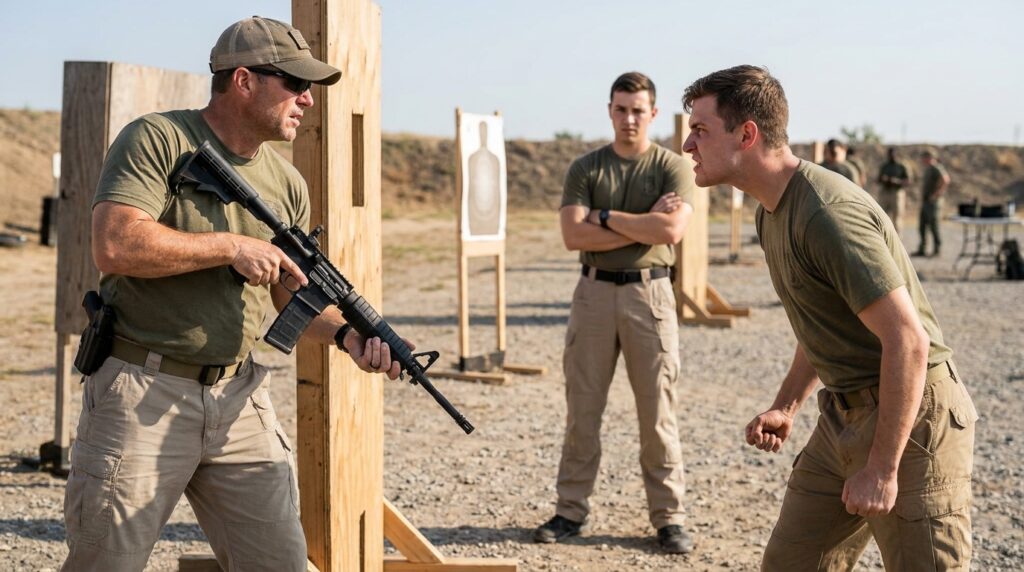
“Eyes downrange. Reset the cylinder,” Samuel Dalton commanded. His voice was a flat, low rasp, conditioned by twenty-five years of breathing in pulverized caliche and burning gunpowder.

Three paces ahead of him on Lane Four, Miller’s shoulders were shaking. The back of the young man’s khaki shirt was soaked through with a dark, salt-rimmed V of sweat. His fingers, white-knuckled and trembling, fumbled with the charging handle of the M4 carbine. The brass casing jammed in the extraction port—a simple Type 2 malfunction that a second-week recruit should have cleared in three seconds.

Miller didn’t clear it. He froze.

“Clear the throat, Miller,” Samuel said, his fingers resting lightly on the brass stopwatch against his chest. The metal was hot, slick with his own sweat. “The clock is running out on your legacy. Your father didn’t buy this slot for you to stare at a stovepipe.”

That was the fracture point.

Miller didn’t drop the magazine. He didn’t drop the bolt. Instead, he spun on his heel, the muzzle of the loaded carbine sweeping a lethal ninety-degree arc across the sun-bleached wood target frames, straight toward Samuel’s chest.

To Samuel’s left, the second trainee—Garrett—went rigid. The boy’s eyes widened, his hands locked onto the frame of his own holster, paralyzed by the sudden breach of the sacred line.

“Don’t talk about him,” Miller spat. His face was a mask of desaturated red, his teeth bared, saliva bubbling at the corner of his cracked lips. He took an aggressive step forward, the rifle rising. “Don’t you ever talk about him.”

Samuel didn’t blink. His world narrowed to the geometry of the lane and the grease on Miller’s receiver. He didn’t yell; shouting was a luxury for men who still believed words could stop a firing pin.

As Miller lunged, trying to vent three weeks of psychological starvation into a physical strike, Samuel stepped inside the weapon’s arc. His left hand slammed down on the top of the handguard, forcing the muzzle toward the parched earth. The heat of the barrel bit into his palm, but he ignored the sting. With his right hand, he drove two fingers into the soft tissue beneath Miller’s jaw, utilizing raw leverage to tilt the young man’s center of gravity backward.

It was over in two seconds. A silent, ugly crunch of bone against utility nylon.

Samuel wrenched the rifle from Miller’s grip, his thumb instantly hitting the magazine release. The steel box clattered into the dirt. He racked the bolt, ejecting the crushed brass casing into the sand, and brought the weapon up into a rock-solid, downrange aiming stance with his right hand alone, his left hand pinning Miller by the collar against the wooden post of the shooting box.

Miller gasped for air, his heels digging into the dry caliche, his eyes bloodshot and terrified.

“Step back on the line,” Samuel whispered. The silence of the desert rushed back into the space between them, heavy and suffocating. “Look downrange.”

Miller didn’t move. He looked down at the empty dirt where his ammunition lay, then up at Samuel’s weathered face.

Samuel lowered the rifle slightly, his eyes shifting to Garrett, who was still frozen three feet away. A dark smudge of old oil sat on Garrett’s jawline, and his knuckles were white. He had known Miller was unraveling. He had known it for weeks.

“Pick up the magazine, Garrett,” Samuel ordered softly.

Garrett bent down, his hands trembling as he retrieved the steel box from the sand. As he handed it back, Samuel’s eyes caught a tiny, silver engraving on the baseplate of Miller’s magazine—an asset tag belonging to the corporate security firm currently bidding on the facility’s land. It shouldn’t have been there.


CHAPTER 2: THE WEIGHT OF THE COLD IRON

“That magazine doesn’t belong to the yard, Garrett.”

Samuel didn’t look up from the workbench. His thumb worked a greasy rag into the receiver tracks of the fouled carbine, the metal raspy and cold beneath his calluses. The armory smelled of mineral spirits, stale coffee, and the orange rust that crept off the corrugated tin roof whenever the desert temperature dropped ten degrees at dusk.

Garrett stood under the flickering fluorescent bulb, his shadow stretched long and thin across the concrete floor. He didn’t drop his gaze, but his throat moved as he swallowed a dry knot of sand. “He brought it with him from the coast, sir. Private stock.”

“Private stock doesn’t carry a laser-etched inventory code from Vanguard Logistics,” Samuel said. He dropped the bolt carrier group onto the steel table with a sharp, heavy clink. The sound vibrated through the small room, cutting through the low hum of the generator outside. “Vanguard is currently sitting in the county commissioner’s office with a checkbook, waiting for my lease to expire. Now tell me why my legacy candidate is carrying their hardware.”

The silence stretched, thick with the smell of carbon and unsaid truths. Samuel watched the boy’s eyes. Garrett’s jaw was locked so tight a muscle twitched beneath the dust on his cheek. He was a good kid—too quiet for the line, maybe, but he saw everything. He had seen Miller breaking down piece by piece during the forty-mile navigation drill, and he had kept his mouth shut.

“He’s my friend, Chief,” Garrett whispered. The words were thin, almost swallowed by the rattle of the tin wall as a gust of high-desert wind hit the building. “His old man… you don’t know what his old man does to him if he fails a cycle. If he gets sent back without the certification, he’s done. The whole family is done.”

“The line doesn’t care about his father,” Samuel said, his voice dropping an octave into that steady, dangerous calm. He stood up, his knees popping with a sound like dry kindling. He reached into his pocket and pulled out the brass stopwatch, placing it on the table between them. The casing was scratched, the chrome wearing away at the edges to reveal the dull, yellowish zinc beneath. “The line cares about muzzle discipline. If he sweeps my range again, I won’t use a throat-jab. I’ll let the lead do the talking. Do you understand me?”

Garrett looked at the stopwatch, then at the half-disassembled rifle. “You didn’t report it to the front office.”

“The front office is looking for an insurance violation so they can break my contract before the weekend,” Samuel said, his fingers tightening around the greasy rag. “If I log a red-line safety breach, the corporate lawyers will have the gates locked by sunrise. We finish the cycle. Miller stays on the line, but you anchor him. You hold his belt during the night-fire. If he twitches, you pin him. If you don’t, I’m tossing both of you over the wire.”

He didn’t wait for Garrett to answer. He turned his back, picking up the solvent bottle to signal the end of the transaction. Dialogue in the armory was always transactional; you paid in information, or you paid in blood.

Garrett hesitated, his boots shifting on the grit-strewn concrete, before he turned and pushed through the heavy plywood door. The sudden draft from the desert floor blew a swirl of fine caliche dust across the workbench, settling into the clean grease of the rifle parts.

Samuel waited until the footsteps faded into the gravel outside before he walked over to the corner locker. The padlock was old, its iron shackle scarred by years of salt-air before he brought it out to the hills. He twisted the dial—three turns right, two left—and pulled the door open.

Inside, behind the spare cleaning rods and the cases of green-tip five-point-five-six ammunition, sat Miller’s personal gear bag. It was a high-end nylon pack, far too expensive for a contractor trainee, the zippers clean and uncorrupted by sand.

Samuel unzipped the side pocket. He wasn’t looking for contraband weapons; he was looking for the source of the tremor in the kid’s hands. His fingers brushed past a spare tourniquet, a pair of ballistic lenses, and settled on a small, hard plastic case disguised as an individual first-aid kit.

He popped the latch.

Inside lay three amber vials of Propropanol—heavy-duty beta-blockers used to suppress physical tremors and high-stress panic—along with a folded sheet of official letterhead. Samuel unfolded the paper with his grease-stained thumbs, his eyes scanning the dense bureaucratic text.

It wasn’t a medical release. It was a formal psychiatric waiver, stamped three days ago by the facility’s own administrative medical officer.

The text at the bottom was explicit: Candidate exhibits acute stress-induced psychological volatility. Monitor closely for contractual non-compliance.

Samuel’s chest tightened as the internal calculation shifted. The administration hadn’t been kept in the dark by Garrett’s silence. They already knew. They had known before Miller even stepped onto the bus at the airfield. They had approved an unstable legacy candidate, cleared him for live-fire drills, and dropped him directly into Samuel’s lane like a timed charge, waiting for the inevitable blast to destroy the facility’s safety record.

A floorboard creaked in the dark corridor outside the armory door.

Samuel didn’t drop the paper. He reached out with his right hand, his fingers instantly wrapping around the cold, checkered steel grip of the unholstered Colt forty-five resting on the shelf beneath the ledger. He didn’t cock the hammer; the sound would give away his position. He simply stood in the shadow of the locker, his eyes locked on the narrow strip of yellow light beneath the door, listening to the slow, heavy breathing of someone standing just on the other side of the wood.

CHAPTER 3: THE BLACKMARKET DOSSIER

The weight of the Colt forty-five was a familiar, anchoring ache in Samuel’s right wrist. His palm melted against the cross-hatched checkered steel, the metal cold and coated in a thin sheen of protective mineral oil that bit into the small cuts on his fingers. He did not raise the muzzle. He kept his forearm pinned against his thigh, body angled to minimize his profile in the locker’s desaturated shadow.

Beneath the gap in the plywood door, the strip of yellow light fractured. A silhouette blocked it out.

The brass stopwatch against Samuel’s chest felt like an anvil, every mechanical tick within its worn zinc casing echoing like a hammer on an anvil inside his own ears. The hinges of the armory door didn’t groan—he maintained them with dry graphite too well for that—but the latch clicked with the distinct, metallic snap of a deliberate entry.

The door swung inward three inches.

“Chief Dalton?”

The voice was thin, reeking of stale cigarette smoke and cheap administrative mints. It belonged to Vance, the facility’s night auditor—a corporate paper-pusher whose hands had never held anything heavier than a clipboard.

Samuel didn’t lower the weapon, but he stepped out of the shadow, his boots making zero sound on the grit-strewn concrete floor. He kept the Colt tucked tight against his hip, hidden behind the flap of his canvas instructor’s vest. “The range is closed for maintenance until twenty-three hundred, Vance. You’re off your reservation.”

Vance stopped. His eyes shifted from the half-disassembled carbine on the workbench to the open locker behind Samuel, where the nylon medical pack sat with its red cross flipped open. His throat bobbed. He didn’t look at Samuel’s eyes; he looked at Samuel’s right shoulder, calculating the posture of a man ready to draw.

“The front office needs the day-three ammunition logs, Chief,” Vance said, his hand twitching toward the pocket of his synthetic uniform shirt. “And the incident reports. We heard there was a… discrepancy on Lane Four during the live-fire sequence.”

“A Type 2 malfunction,” Samuel said. His voice was flat, hard as a rusted railway spike. “Trainee cleared it under instruction. Standard protocol.”

“That’s not what the administrative monitor logged from the tower,” Vance replied, taking a slow step toward the workbench. He reached out, his soft, uncalloused fingertips brushing the rusted edge of the iron table frame, leaving a clean streak in the orange dust. “The tower saw physical contact. They saw an operator lose muzzle control. If you’re falsifying the safety log to shield a candidate, Samuel, that’s an immediate breach of your facility’s operational insurance.”

Samuel took half a step forward, using his bulk to block Vance’s line of sight to the open locker. “The logs are filed at midnight. Not a minute before.”

Vance smiled, a tight, bloodless expression that didn’t reach his eyes. “Make sure they’re accurate. The regional director arrives with the morning transport. They aren’t just reviewing the training logs anymore. They’re bringing a restructuring addendum from Vanguard Logistics. If this facility shows even a fraction of a percentage of liability before the ink is dry, the contract liquidates automatically.”

Vance backed toward the door, his eyes dropping briefly to the dark space behind Samuel’s vest where the iron frame of the Colt remained nestled against his ribs. “Have a good night exercise, Chief. Keep the lines clean.”

When the door clicked shut, Samuel didn’t move for sixty seconds. He stood in the stale, iron-tinged air of the room, his breath slow and metered. The decoy was clear now. The administration wasn’t trying to fix Miller’s psychological stability; they were using his breakdown as a legal lever to crack the facility’s safety insurance open. If Samuel reported Miller, the facility was disqualified for admitting an unstable operator. If he hid it, he was liable for fraud.

He turned back to the locker, his hand shaking slightly as he pulled the folded psychiatric waiver out of his pocket. He turned it over. On the reverse side, hidden beneath the official corporate seal, was a typed routing code.

Samuel’s eyes narrowed as he traced the alphanumeric string. It wasn’t an internal facility code. It was an encrypted routing number used exclusively for high-level asset transfers by Vanguard’s executive board. At the very bottom of the page, beneath the transfer conditions, was a single legal entity name listed as the primary financier for the Vanguard acquisition: The Miller Group Corporation.

The realization hit him with the dull, blunt force of a low-velocity round to the chest. The corporate competitor trying to strangle his facility wasn’t just an anonymous board of directors. It was the candidate’s own bloodline. The kid wasn’t just a legacy candidate struggling under his father’s shadow; he was the tool his father was using to break the facility from the inside out. And Miller didn’t even know it.

Outside, the first thunderous rattle of the night-exercise siren tore through the desert quiet. The wind had picked up, howling through the corrugated tin panels of the roof, carrying with it the cold, sharp scent of an approaching mountain squall.

Samuel slipped the Colt back into his holster, the leather snapping tight over the hammer with a dry, definitive pop. He shoved the paperwork deep into his belt line, grabbed the half-assembled M4 from the workbench, and jammed the bolt carrier into place with a brutal, scraping shove of his palm.

He had sixty minutes before the live-tissue simulation began in the dark of the valley. Two trainees were waiting for him by the transport truck—one unraveling from the inside out, the other drowning in complicit silence—and both of them were walking directly into a trap designed by the very people who paid their salaries.

Samuel turned off the fluorescent light, plunging the armory into the dark, desaturated gray of the desert night. He stepped out into the wind, his boots grinding the loose gravel into fine white powder.

CHAPTER 4: THE LIVETISSUE CRISIS

The wind howling through the canyon carried a heavy curtain of coarse sand that stung like birdshot against Samuel’s weathered cheeks. In the desaturated darkness of the canyon floor, the simulated kill-zone was a maze of rusted shipping containers, their iron surfaces pitted by decades of desert neglect. The air was a thick, suffocating slurry of dry caliche and burning diesel fumes from the transport truck’s idling engine.

“Red baseline is active!” Samuel shouted over the roar of the gale, his thumb striking the side of his old brass stopwatch. The internal gears ground together with a dry, sand-choked rattle, but the needle jumped forward. “Three targets downrange, hostage profile unverified. Move!”

Miller moved first, his silhouette stiff, his boots skittering across the loose gravel. Behind him, Garrett trailed by exactly two paces, his hand hovering near the small of Miller’s back, a tense anchor in the shifting shadows. The beams of their weapon-mounted lights cut through the swirling dust, illuminating the oxidized iron walls of the kill-box.

Then the geometry shattered.

A sudden, metallic bang echoed from the interior of the primary container—not the sharp crack of a blank cartridge, but the dull, heavy thud of shifting structural iron. A structural support cable, corroded by years of salt-air exposure and neglected by the front office’s risk-management teams, snapped with a sound like a pistol shot. The rear wall of the rusted container sheared off its mountings, collapsing inward with massive weight.

“Hold the line!” Samuel roared, his boots digging into the shifting sand as he lunged forward.

It wasn’t a simulation anymore. The falling iron plate caught Miller across his ballistic vest, slamming him hard against the gravel floor and pinning his legs beneath two hundred pounds of industrial scrap. The carbine tore from his grip, its light spinning through the dust before dying completely.

“Garrett, anchor left!” Samuel commanded, dropping to his knees beside the pinned trainee. The iron frame of the container was cold, rough with decades of scaling rust that tore through the leather of his instructor’s gloves, biting into his palms. He jammed his shoulder beneath the edge of the plate, utilizing raw mechanical advantage to keep the weight from crushing the boy’s femoral artery. “Lift on three! One, two—”

“Chief, the radio’s dead!” Garrett yelled, his fingers frantically working the dials of his chest-mounted tactical transponder. The indicator light remained a stubborn, cold gray. He reached down, pulling at the manual emergency beacon attached to the wall of the training lane. The wire had been cleanly severed, its copper core exposed and oxidized. “The whole grid is down. There’s no medical air transport coming.”

Samuel didn’t look down. His teeth ground against the grit in his mouth as his muscles locked under the strain of the iron plate. The disabled transponder wasn’t an equipment failure; it was the final signature of the corporate takeover. The administration hadn’t just set up an insurance breach—they had cut the safety lines entirely, ensuring that whatever happened in the dark stayed in the dark until the property transfer could be executed at dawn.

Beneath the plate, Miller gasped, his face gray under the film of desert dust. His fingers caught Samuel’s canvas vest, pulling him down until their faces were inches apart. “My father… he told me I wouldn’t make the weekend,” the boy whispered, his voice cracked and hollow. “He said the yard… would be cleared out anyway.”

“Shut your mouth, Miller,” Samuel growled, his spine popping under the weight of the steel. He looked across the iron plate at Garrett, whose hands were still locked onto the frame, his knuckles white and bleeding where the metal had sheared. “Garrett, look at me. No one is coming. If we don’t clear this box ourselves, the morning transport finds three corpses and a liquidated lease. Take his shoulders.”

Garrett met Samuel’s gaze through the swirling sand. The fear in the boy’s eyes hardened into something flat, transactional, and permanent. He dropped his broken transponder into the dirt, reached down, and locked his arms beneath Miller’s armpits.

“On three,” Garrett said. His voice had lost its tremor.

Samuel threw his entire weight against the rusted iron frame, his legs driving into the caliche until his boots slipped. With a brutal, metallic scream, the plate lifted four inches. Garrett hauled Miller backward, the boy’s boots scraping over the sharp gravel until his legs cleared the shadow of the steel. Samuel dropped the weight, the plate slamming into the ground with a definitive thud that shook the canyon floor.

Samuel stood up slowly, his breath coming in ragged, shallow wheezes. He reached down and picked up the broken emergency beacon, his thumb running over the clean, diagonal cut in the copper wire. He looked toward the ridge line, where the dark silhouette of the administrative tower stood against the desaturated gray sky.

They had survived the lane, but the contract was gone, replaced by a cold, industrial reality that didn’t care about discipline or the legacy of the line. Samuel reached into his vest, his fingers wrapping around the warm casing of his brass stopwatch. He didn’t look at the time. He squeezed his fist until the glass face cracked, the tiny shards biting into his palm as he turned toward the perimeter fence.

CHAPTER 5: THE RETRIBUTION LEDGER

The rusted iron hinge of the administrative building’s rear window gave way with a low, agonizing scrape that Samuel masked by timing it to the rhythmic thrum of the perimeter generator. Caliche dust, fine as flour and cold from the pre-dawn drop in temperature, spilled across his knuckles as he pried the frame upward.

“Garrett, take the sill. Watch the glass,” Samuel whispered. His voice was barely a vibration against the wind.

Garrett stepped forward, his boots grinding a single stray pebble into the concrete foundation. His hands, still stained with dried blood and dark oil from the night exercise, caught the rotting wood of the casing. He hoisted himself through the narrow gap with the clinical efficiency of an operator who had spent three weeks learning how to move without throwing a shadow. Miller followed, his breath hitching as his bruised ribs caught the edge, but he didn’t cry out. The kid was pale, his eyes wide and hollow in the desaturated gray light, looking like a ghost trapped in his own family’s trap.

Samuel dropped inside behind them, his boots hitting the cracked linoleum floor of the utility room with a dull thud. The interior smelled of old bleached mops, wet cardboard, and the underlying ozone tang of the server racks hummed behind the drywall.

They moved down the narrow corridor in an unbroken wedge. Samuel held the point, the Colt forty-five unholstered but held low against his thigh, his thumb resting on the cold steel hammer. The facility was dead-quiet, save for the mechanical click of the HVAC vents resetting for the morning shift.

At the end of the hall, the door to the night auditor’s office stood slightly ajar. A single sliver of pale yellow light cut across the dust-choked carpet.

Samuel didn’t knock. He drove his boot into the strike plate, forcing the door open so fast it slammed against the rubber stop with a sharp crack.

Vance jumped from the vinyl rolling chair, his fingers fumbling with a heavy black thumb drive plugged into the side of the main server tower. A half-eaten sleeve of mints scattered across the cracked laminate desk, rolling into the orange rust scaling off the ancient metal filing cabinets.

“Chief,” Vance stammered, his hand instantly darting toward the desk drawer. “The range cycle isn’t—”

Samuel’s left hand caught Vance by the throat before the man’s fingers could clear the laminate edge. He slammed the auditor back into the chair, the casters screaming against the grit on the floor. The cold muzzle of the Colt didn’t touch Vance’s skin; it hovered exactly two inches from his left eye, steady as a stone marker.

“Don’t move the hand, Vance,” Samuel said. The silence that followed was weaponized, thick with the smell of Vance’s sudden, sour sweat. “The thumb drive. Pull it out with two fingers and set it on the ledger.”

Vance’s eyes darted past Samuel’s shoulder to Miller, who stood by the door frame, his jaw locked, his arms crossed over his cracked ribs to keep from shaking. “Miller,” Vance choked out, his face turning an ugly, mottled purple under Samuel’s grip. “You don’t know what you’re doing here. Your father’s aircraft cleared the terminal at Albuquerque an hour ago. He’s already got the liquidation orders signed.”

“He’s right, Chief,” Garrett said from the corner of the room. He had already cleared the desk drawers, his hands pulling out a thick, leather-bound operational ledger with a rusted zinc binder. He flipped it open, revealing pages of hand-stamped receipts and legal descriptions. “The property lines are already marked for asset transfer. Look at the date on the addendum. They signed the initial intent three months before the training cycle even started.”

Samuel didn’t let go of Vance’s throat. He leaned in closer, the scent of mineral oil from the Colt overriding the auditor’s cheap cologne. “The routing codes on the psychiatric waiver, Vance. Where are the local backups?”

“There are no backups,” Vance wheezed, his uncalloused fingers clawing weakly at Samuel’s wrist. “Vanguard’s server wiped the local drive ten minutes ago. The digital transition is automated. As soon as the sun clears the ridge, the facility’s safety certificate is revoked based on the tower logs from yesterday’s breach. The land reverts to the primary debtor. It’s a closed loop, Samuel. You’re holding a dead hand.”

“Not yet,” Miller said. His voice was unexpectedly loud in the small room, raw and scraping like sandpaper. He stepped forward, his eyes fixed on the black thumb drive still resting in the server tower. He reached out and wrenched it from the slot, his knuckles white. “My father doesn’t own the title yet. The contract specifies completion of the live-tissue evaluation. If the records show we passed the line without a logged failure, the insurance clause remains locked for thirty days. He can’t liquidate a compliant facility.”

“You didn’t pass, kid,” Vance sneered, though his voice cracked as Samuel tightened his grip by a fraction of an inch. “The cable snap in the canyon… the tower logged it as an operator failure. They’re writing the report right now in the front office.”

Samuel felt the cold weight of the setback settle into his chest. It was the absolute failure of the old methods—he had kept the line running, hidden the fractures, and trusted that raw discipline would see them through, but the corporate machine didn’t play by range rules. They didn’t wait for a safety violation; they manufactured one out of iron and rust, then cut the wires to ensure no one could contest the data.

Outside, the low, distant rumble of a diesel engine broke through the pre-dawn dark. Headlights cut through the frosted glass of the office window, throwing long, skeletal shadows of the metal filing cabinets across the ceiling.

“The regional director,” Garrett said, his eye pressed to the gap in the window blinds. “They’re at the perimeter gate. Two security escorts from Vanguard. They aren’t waiting for sunrise.”

Samuel released Vance, letting the auditor slump forward onto the desk, coughing and clutching his throat. He turned to Garrett and Miller, his thumb rubbing the cracked casing of the stopwatch in his vest pocket. The glass fragments bit into his skin, a sharp reminder of the cost of every second they had left.

“Garrett, take the ledger,” Samuel ordered, his voice dropping into the final, pragmatic rhythm of a commander whose line had been breached. “Miller, you keep that drive. We aren’t clearing out. We’re moving to the road. If they want the liquidation papers filed, they’re going to have to sign them on my caliche.”

Miller looked down at the thumb drive in his hand, then up at Samuel. For the first time, the tremor in the boy’s hands had stopped. He nodded once, a cold, hard movement that belonged to a man who had finally figured out which side of the line he was standing on.

Samuel checked the cylinder of the Colt, clicked it shut, and led them back out into the freezing gray fog of the desert morning.

CHAPTER 6: THE BOUNDARY LINE

The washboard gravel of the access road vibrated beneath Samuel’s boots before the headlights actually rounded the ridge. He lay flat against the freezing caliche behind an overturned corrugated stock tank, the iron rough and scaling with heavy zinc rust that tore at his woolen sleeves. Beside him, Garrett adjusted his grip on the stolen administrative ledger, his knuckles raw and crusted with gray mud. Miller was ten yards further down the line, tucked into a shallow wash where the wind piled the tumbleweeds high.

The twin beams of the regional director’s Ford Excursion sliced through the desaturated gray fog, illuminating the swirling dust and the skeletal branches of dead mesquite.

“They’re moving too fast for a standard checkpoint stop,” Garrett muttered, his teeth clicking together from the bitter cold. He didn’t drop his gaze from the oncoming grill. “Vanguard’s security detail doesn’t play by state transport rules, Chief. If we just stand in the middle of the wash, they’ll roll right over us.”

“They’ll stop,” Samuel said. His voice was a dry, hollow rasp, almost lost to the wind. He reached down and unhitched the heavy steel towing chain he had dragged from the motor pool, its links rusted into a rigid, orange snake. He had anchored one end to the axle of a disabled tractor on the east side of the track. The loose end was wrapped three times around his own forearm. “Miller, when the front tires clear the dip, you drop the brush into the lane. Not a second before.”

The massive SUV roared down the incline, its heavy diesel engine clattering like a bucket of bolts. The headlights hit the stock tank, casting Samuel’s elongated shadow across the rusted metal behind him.

Three seconds. Two.

Samuel lunged backward, dumping his entire weight into the caliche, his boots digging into the frozen earth as he hauled the chain taut across the gravel.

The Excursion’s front bumper caught the heavy iron links with a deafening, metallic shriek. The steel didn’t snap, but the tractor axle groaned, the tension pulling Samuel forward three inches before the truck’s front suspension collapsed inward. The tires blew with twin explosions of pressurized air and shredded rubber, throwing a cloud of white caliche dust and sharp gravel across the ditch. The vehicle skidded sideways, its massive chassis tilting twenty degrees before coming to an abrupt, violent halt against the washboard ridge.

Silence rushed back into the canyon, broken only by the hiss of a ruptured radiator and the steady, rhythmic ticking of the truck’s cooling block.

Samuel stood up, his forearm numb where the iron links had bitten through his sleeve. He kept his right hand anchored on the checkered frame of the Colt forty-five behind his vest as he strode toward the smoking grill. Garrett moved out from behind the tank, his weapon raised in a steady, low-ready stance, covering the tinted side glass.

The heavy driver’s door groaned on its hinges, forcing its way open against the crumpled fender. A corporate security guard in clean, dark blue tactical nylon stepped out, his hand instantly darting toward his holstered sidearm.

“Keep it in the leather,” Samuel said, his voice flat, empty of heat. He didn’t raise the Colt, but the angle of his body left no doubt about the trajectory. “This road belongs to the leaseholder until twelve hundred hours. You’re trespassing on a live range.”

A second door opened from the rear passenger compartment. The regional director—a sharp-featured woman named Vance’s supervisor, Marcus—didn’t look at Samuel. She looked past him, her eyes locking onto Miller as the boy climbed out of the wash, the black server drive gripped tightly in his fist.

“You’re making a catastrophic professional mistake, Miller,” Marcus said, her voice pristine, unaffected by the freezing dust. She reached into her wool coat and pulled out a sleek, laminated portfolio. “Your father’s legal counsel has already verified the asset transfer. The facility’s certification was revoked thirty minutes ago when the local automated server logged the structural collapse in Lane Four as a terminal safety failure.”

“The server didn’t log an operator error,” Miller said, his voice steady despite the shallow, painful breaths he took through his cracked ribs. He held up the thumb drive, the polished plastic catching the first pale glint of the morning sun. “The local backup data shows the maintenance logs for that cable were falsified by the front office for six consecutive months. The collapse wasn’t a trainee failure. It was institutional sabotage.”

Marcus didn’t blink. Her expression remained a cold, flat calculation—the look of an executive realizing the risk profile had just shifted five percentage points. “That drive is corporate property. If you leave this property with it, the state authorities will have a warrant issued before you reach the interstate.”

“The warrant won’t matter if the insurance board gets the unedited telemetry data first,” Garrett cut in, holding up the leather-bound operational ledger. The rusted zinc binder caught the light, casting a dull orange reflection across Marcus’s immaculate coat. “The ledger has every original entry before Vance ran the digital wipe. It shows the facility was one hundred percent compliant until your team cut the emergency transponder wires.”

Samuel watched Marcus’s shoulders drop by a fraction of an inch. She was a professional; she knew when a defensive line had been turned. She didn’t monologue, and she didn’t threaten. She simply turned back toward the idling wreck of the SUV, her fingers working her satellite phone with rapid, silent precision.

“They’re bypassing the local court,” Samuel muttered to Garrett, his eyes shifting to the unlisted third passenger who had just stepped out of the opposite side of the vehicle—a tall, grey-haired man in a tailored field jacket who looked exactly like the portrait hanging in the facility’s legacy foyer. “The owner just arrived to sign the liquidation order himself.”

The older man didn’t look at Samuel or Garrett. He walked straight toward Miller, his boots making a heavy, deliberate crunch in the gravel, his face an unreadable mask of family authority and corporate iron.

CHAPTER 7: THE FINAL LEVERAGE

“You haven’t changed the oil in your primary generator since the winter freeze, Samuel.”

Arthur Miller Senior didn’t raise his voice to compete with the desert wind. He stopped exactly five paces from the crumpled fender of the SUV, his polished leather hunting boots resting on the rusted lower strand of the perimeter wire fence. The cold zinc coating left a powdery white smudge on his custom-tailored cuff. His face was an older, harder carving of the boy standing behind Samuel—devoid of the sweat, the caliche grit, or the terror.

“The generator runs hot, Arthur. But it runs,” Samuel said. He stood between the two men, his right arm loose beside the cold steel grip of his Colt. The wind was whipping fine white caliche dust between them, a dry curtain that desaturated the space into shades of ash and iron. “Your people cut my safety transponder wire. That’s a felony on a federal training lease.”

“A maintenance discrepancy,” Arthur replied smoothly, his eyes passing over Samuel as if he were an obsolete piece of machinery left to rust in the wash. He held out an open palm toward his son. “Give me the digital drive, boy. The transport is waiting at the crossing. The board has already voted.”

Miller didn’t step forward. His hand tightened around the black plastic casing of the server drive until his knuckles turned the color of the caliche earth. “You put those beta-blockers in my medical kit, didn’t you? You didn’t want me to pass the line. You wanted the liability log.”

Arthur’s expression didn’t shift. The equal intellect of the man was a heavy, pragmatic force; he didn’t lie because the truth was a better weapon. “You were never an operator, son. Your grandfather left this facility to a family that was supposed to build an industrial empire, not run tactical drills for private security contractors in the dirt. Vanguard Logistics is moving forty percent of the western supply line through this valley by the end of the year. Your failure was a necessary asset reallocation.”

“The line was clear,” Garrett said from behind Samuel’s shoulder, his fingers tapping the rusted iron spine of the operational ledger. “We pulled him out of the container box. The telemetry on this drive proves the structure failed due to deferred facility maintenance. The liability belongs to your front office administrators, not the chief.”

“It’s a beautiful record,” Arthur said, a thin, bloodless smile touching the corner of his mouth. He pulled a heavy silver fountain pen from his breast pocket, its gold signet crest catching the harsh, flat glare of the morning sun. “But a dead one. Marcus, give him the addendum.”

The regional director stepped forward, holding out a single sheet of watermarked bond paper. The text was short, transactional, and definitive.

“Vanguard doesn’t need a safety violation to dissolve the lease, Samuel,” Marcus said. Her voice was flat, a perfect match for the wind-stripped landscape. “The Miller Group holds fifty-one percent of the facility’s underlying debt. Arthur is calling the note. You have exactly sixty minutes to clear your personal effects from the armory before the security detail locks the main gate.”

Samuel looked at the paper. He didn’t take it. His left hand slowly reached inside his canvas vest and pulled out the brass stopwatch. The glass face was completely webbed with fine, silver fractures from the canyon collapse, the tiny gears inside choked with fine desert dust. The needle was frozen at twenty-three minutes past the hour. His career wasn’t a countdown anymore; it was stone-dead.

“The boys’ certifications,” Samuel said, his voice dropping into a low, final resonance. “They passed the live-tissue evaluation. You sign their operational logs, or the backup telemetry on this drive goes directly to the federal insurance oversight board before the property title can clear the county clerk.”

Arthur watched the stopwatch in Samuel’s hand. He recognized the play. It was the pragmatism of the dusty gray—no clean victories, no heroic rescues, only the heavy cost of a dirty compromise. If the federal board locked the title for an investigation, Vanguard’s supply contracts would miss the winter shipping window.

“They get their signatures,” Arthur said, his voice clipped and dry as a dead branch. “They get their contractor placement with Vanguard’s coastal division. But you leave the keys on the workbench, Samuel. You don’t come back across the wire.”

“Deal,” Samuel said.

He didn’t look at Miller or Garrett. He reached out with his left hand and took the gold-crested pen from Arthur’s fingers. He walked to the hood of the wrecked Excursion, laid the leather-bound ledger across the hot, oil-streaked metal, and signed his name on the final line of the operational release.

Miller stepped forward, his boots heavy in the loose sand. He placed the black server drive on top of the signature page. He didn’t look at his father. He looked at the rusted wire fence, then at Samuel’s weathered face.

“Chief,” Miller said, his voice tight.

“Go to the transport, kid,” Samuel said, handing the pen back to Marcus without looking up. “You’re an operator now. Keep your eyes downrange and your muzzle low. The line doesn’t care who your father is.”

Garrett took the ledger from the hood, his fingers leaving a dark smudge of grease on the clean white bond paper. He gave Samuel a single, rigid nod—the guarded vulnerability of a man who knew the price of the secret they were leaving behind in the dirt.

Samuel turned his back on the SUV, the corporate executives, and the legacy line. He walked alone down the center of the washboard access road, his boots grinding the white caliche powder into the wind. The sun was fully over the ridge now, casting a sharp, flat light that illuminated every rusted edge, every broken wire, and the deep, permanent scars left by twenty-five years of labor in the high desert.

He reached the armory door, pulled the keys from his belt, and laid them gently on the cold iron anvil beside the workbench.

Similar Posts

Leave a Reply

Your email address will not be published. Required fields are marked *






