
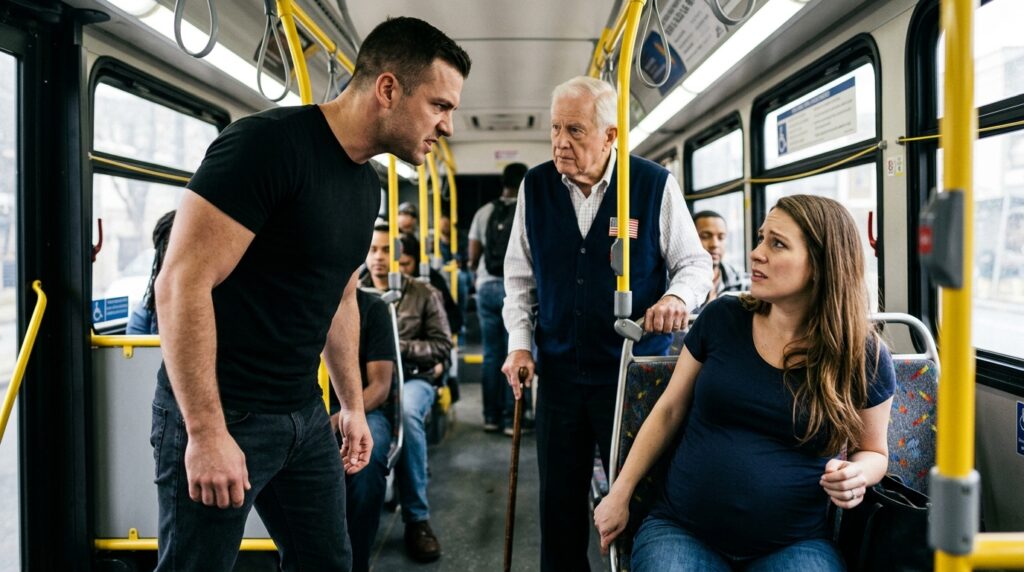
The Unforgiving Weight of Stillness on a Cross-City Transit Lane
CHAPTER 1: THE CONFRONTATION LANE
The vertical stainless steel handrail vibrated against Marcus’s age-spotted palm with the steady, mechanical rumble of a dying diesel engine. Three inches away, a man’s flexed forearm blocked the light. The afternoon sun through the city bus window was harsh, cutting sharp gray shadows across the yellow-painted floor markers of the priority seating zone.
“You need to move now, I’m not asking again,” the man said.
His voice was clipped, a hard rasp that carried over the low drone of the transit lane. He stood over the seated woman, his posture an aggressive, forward lean that narrowed her physical world down to the synthetic vinyl backing of her chair. He wore a tight black crew-neck shirt, his forearms thick and laced with veins that pulsed with every jerky shift of the bus. A heavy silver chain swung slightly against his chest, catching the desaturated light.
The woman didn’t answer with words. Her hand, small and trembling, tightened against the cold edge of her canvas shoulder bag. She was late into her third trimester, her breathing shallow beneath a dark casual top. She looked up, her eyes wide with a frantic, quiet panic, searching the adjacent rows for a single point of intervention.
Nobody looked back.
Across the aisle, a young man in business casual immediately lowered his chin, his thumb flicking rapidly across the glowing screen of his phone. Two rows down, a woman adjusted her headphones, staring intently at the advertising placards above the windows. The cabin was a gallery of calculated blindness. The unwritten code of urban non-engagement had settled over the commuters like lead, thick and paralyzing.
Marcus watched the space between them tighten. He didn’t adjust his grip on the horizontal rail. His spine remained straight, an old habit that seventy-nine years had failed to bend out of his frame. He wore a simple, faded white shirt under a dark canvas vest, his clean-shaven jawline set hard against the stale, air-conditioned draft. To the rest of the bus, he was an invisible element—a fragment of graying hair and old clothes waiting out his stop.
The bully took another step inward, his hip crowding the aisle edge, his shadow completely submerging the woman’s lap. “Get up,” he muttered, his hand reaching out toward the headrest of her seat, his knuckles white. “I don’t care about the sign. Move your things.”
The woman shifted her weight to rise, her posture awkward, her boots slipping slightly on the slick transit flooring. Her face had gone pale, the exhaustion in her features twisting into an immediate, visible distress.
Marcus let go of the rail. His movement was fluid, lacking the jerky hesitation common to men of his decade. He didn’t speak. He stepped into the interaction lane, his body inserting itself directly between the black T-shirt and the rising woman. He planted his boots exactly shoulder-width apart, his center of gravity dropping instantly, anchoring his skeletal frame against the lurching momentum of the vehicle.
The aggressive passenger’s eyes snapped down, his close-cropped head tilting as he registered the intrusion. A cold, dismissive sneer pulled at his mouth. “Out of the way, old man,” he spat, his right shoulder dropping as he prepared to crowd past the barrier. He reached out a broad, calloused hand, fingers curling into a heavy hook aimed directly at Marcus’s chest.
Marcus watched the hand approach in real-time detail. He didn’t flinch. As the fingers made contact with the fabric of his vest, right above the small, polished brass Marine Corps pin tucked into his pocket, a sudden, familiar coldness settled behind Marcus’s eyes.
The silver watch on Marcus’s wrist ticked once against the heavy nylon strap, its small second hand marking the exact micro-second his left hand shot upward to meet the threat.

CHAPTER 2: STRUCTURAL GEOMETRY
Marcus didn’t push. He didn’t pull. The momentum of the aggressive passenger’s forward rush was a heavy, unrefined mass, and Marcus simply offered it an alternate trajectory.
His left thumb found the soft, anatomical junction just below the man’s radial styloid process—the outer edge of the wrist where the bone flared into a natural ridge. It was a precise, microscopic interception. With his right palm anchoring the man’s elbow to freeze the joint, Marcus executed a tight, downward pivot of his hips. The physics of the movement were ancient, stripped of showmanship, and completely devastating to a top-heavy opponent.
The bully’s broad chest jerked forward, but his feet stayed behind. The sudden, unnatural restriction of his skeletal alignment sent a sharp crack through the cabin’s ambient noise. It wasn’t a bone breaking; it was the violent snap of a leather jacket tightening as two hundred pounds of muscle met an immovable, low-leverage center of gravity. The man’s breath left him in a ragged, involuntary grunt. His fingers, which had been clawing for Marcus’s vest pocket a millisecond prior, flared open, paralyzed by the clean pressure on the median nerve.
Marcus held the lock with absolute, frozen economy. He could feel the rigid trembling of the younger man’s forearm, the heat radiating from the flexed tendons, and the sudden, frantic pulse drumming against Marcus’s thumb.
The bus cabin plunged into a dead, iron silence.
The low hum of the diesel engine beneath the floorboards seemed to drop an octave. In the perimeter of Marcus’s vision, the young man in business casual froze, his thumb hovering an eighth of an inch above his smartphone screen. The woman with the headphones pulled one ear cup down, her mouth opening slightly as she registered the total stillness of the aisle. The aggressive passenger was completely immobilized, pinned by nothing more than an old man’s two-finger grip and a flawless understanding of structural leverage.
Marcus leaned forward an inch, his voice a low, gravelly vibration that barely traveled past the man’s close-cropped temple. “Back away from her right now and show some respect.”
The bully’s eyes were wide, white showing around the dark irises as he stared down at the age-spotted hand controlling his entire body. The arrogance had drained from his face, replaced by the primitive, sharp panic of a predator that had unexpectedly stepped into a heavy steel trap. He tried to twitch his shoulder back, to find a pocket of air to swing his left fist, but Marcus subtly increased the downward angle of the wrist by three degrees. The bully’s knees buckled, his thigh scraping hard against the horizontal stainless steel handrail with a hollow metallic screech.
“Fine,” the man rasped, the words coming out in a tight, strangled wheeze. His face was flushing a deep, mottled red under the gaze of the entire bus. “Fine. I’m backing off.”
Marcus didn’t release him immediately. He waited until the bus hit a seam in the asphalt, using the natural sway of the vehicle to step back and dissolve the lock without giving the man a structural point to launch a counter-attack. He broke contact with a smooth, sweeping motion that restored a clear four feet of distance between them.
The aggressive passenger stumbled back, his boots dragging loudly against the gray transit floor. He clutched his left wrist to his chest, his breath coming in short, ragged bursts. He looked around the cabin, his gaze frantic, looking for a distraction, an ally, or an exit. But the witness layer had locked him out. The passive crowd had transformed into a wall of silent judgment; two passengers in the middle row intentionally shifted their knees outward, narrowing the aisle, physically blocking his path back into the deeper section of the bus.
Marcus stood perfectly centered in the aisle, his hands returning to his sides, his shoulders square. His chest didn’t heave; his breathing remained timed to the steady, mechanical click of the second hand on his nylon-strapped watch.
As the bully retreated toward the rear exit door, his steps uneven, Marcus’s eyes tracked his movement. The desaturated sunlight caught the man’s exposed arm as he grabbed the rear exit handle. Just below the cuff of his black shirt, Marcus noticed a thin, pale mark—a microscopic, surgical scar shaped like a reverse chevron, right above a faded discolored line where a heavy tactical watch strap had sat for years.
It wasn’t a civilian mark. It was the precise exit scar of a low-velocity fragment, the exact type Marcus had seen on dozens of logistics officers stationed near the perimeter fences of the old Southern Command sectors twenty years ago.
The realization hit Marcus with the cold, heavy weight of iron. A civilian bully didn’t carry that specific operational scarring, and a civilian bully didn’t yield to a defensive wrist lock with that exact form of tactical compliance. The man hadn’t just panicked; he had recognized the mechanical lineage of the technique.
The bus began to slow, the distinct chime of the stop-request pull-cord ringing through the ceiling speakers. The rear doors hissed open as the bus ground to a halt against a curb of cracked concrete. The aggressive passenger didn’t look back. He plunged out of the vehicle and into the grey afternoon shadow of the terminal platform, his black shirt disappearing rapidly into the pedestrian crowd.
Marcus didn’t follow him with his body, but his mind was already calculating the variables. He looked down at the yellow-painted floor markers where the struggle had just occurred. Near the edge of the priority seating row, half-hidden beneath the metal base of the seat frame, a small, matte-black object reflected the dull interior lights of the transit cabin.
It was a heavy, ruggedized cellular device, completely devoid of consumer logos, its screen dark but humming with a faint, internal vibration.
Marcus stepped forward, his boot covering the object as the bus doors began to hiss shut once more.
CHAPTER 3: THE INTERCEPTION MATRIX
The heavy rubber edge of Marcus’s right boot came down over the matte-black device with a dull, hollow thud. He didn’t bend down immediately. The bus engine gave a violent, shuddering cough as the vehicle accelerated away from the concrete terminal curb, its suspension groaning under the shifting weight of the remaining passengers.
Marcus kept his weight pressed firmly onto the heel of his shoe, pinning the phone against the metal base of the seat frame. His eyes swept the cabin one more time, a rhythmic, three-second sweep that took in every face, every shoulder line, every hand placement. The young executive was looking out the window; the woman with the headphones was already pulling her ear cups back into place. The collective gaze of the cabin had softened, dropping from the high-voltage alertness of a live threat back into the comfortable, listless haze of ordinary transit. They had witnessed a victory, but their understanding of it was shallow, limited to the crude arithmetic of an old man defending a pregnant woman.
He reached down with his canvas bag, pretending to adjust the frayed strap near his ankle. His fingers closed around the ruggedized phone, sliding it smoothly into the deep interior pocket of his canvas vest. The weight of the device was wrong for a commercial cell; it was dense, encased in hard-anodized aluminum with a slightly textured rubberized perimeter designed to prevent slippage in wet conditions. It was exactly two hundred grams, the standard weight of a military-grade tactical receiver.
Marcus turned to the woman beside the window. She had settled back into her seat, her breathing slower now, though her hands still remained curled tightly over her shoulder bag.
“You should get off at the next avenue,” Marcus said, his voice flat, stripped of comforting inflection. “The platform there has better lighting. More security.”
The woman looked up at him, her lips parting as she tried to find the words to frame her gratitude. “Thank you, sir. I didn’t think… I didn’t think anyone was going to stop him. He was so large.”
“He was off-balance,” Marcus replied simply, his jaw tightening as the bus took a sharp left turn. “Take care of yourself.”
He didn’t wait for her response. He moved two steps down the aisle, occupying a new standing position near the central exit doors. His right hand slipped into the vest pocket, his thumb brushing the smooth surface of the device’s screen. There were no external buttons, no brand markings, no regulatory labels etched into the casing. It was a blank slate, the kind of sterile tech issued to regional units operating outside standard jurisdictional frameworks.
The screen hummed against his palm, a continuous, rapid double-pulse that signaled an incoming, high-priority transmission.
Marcus tilted his torso slightly toward the dark corner of the bus door, creating a shadow with his shoulder to mask the illumination of the display. He pressed his thumb against the center of the glass. The screen didn’t open into a standard consumer interface. It immediately executed a vertical scroll of lime-green text, a basic command-line boot sequence that bypassed any commercial carrier network.
A single notification box expanded at the center of the desaturated display. It wasn’t an alphanumeric text message. It was an automated system routing log, displaying a string of encrypted telemetry parameters that Marcus hadn’t seen since the deployment logs of the old Southern Command sector in the winter of ninety-six.
At the bottom of the routing header, where the destination network protocols were listed, three words sat in cold, pixelated clarity: DEST_UNIT: TASK_FORCE_SEVEN.
The blood in Marcus’s veins turned to liquid nitrogen.
Task Force Seven didn’t exist. It hadn’t existed for twenty-four years, not since the day the defense ministry signed the decommissioning orders and wiped every personnel file from the secure databases at Fort Meade. The men who served in that group were either buried under nameless granite markers in Arlington or, like Marcus, living out a calculated, quiet retirement behind cash-only utility bills and untraceable civilian pensions.
The phone pulsed again, the green text flashing twice before dissolving into a live communication window. A single line of text began to type itself across the screen in real time, the letters appearing with the steady, mechanical rhythm of a terminal operator working from a remote, secure location.
PULSE RATE CONFIRMED. MECHANICAL REFLEX RANGE WITHIN FIVE PERCENT OF EXPECTED EFFICIENCY. TARGET MARKS RETAINED.
Marcus stared at the glowing characters, his breathing perfectly regular despite the sudden, hard pressure hammering inside his chest. He didn’t type a reply. He watched the text line linger for exactly five seconds before the phone’s internal system executed a forced wipe. The screen flickered, the lime-green text collapsing into a single, horizontal line of light before the device went entirely dark, its internal battery matrix discharging a faint, chemical smell through the seams of the aluminum casing.
The bus pulled up to the curb of the next avenue stop with a heavy hiss of air brakes. The pneumatic doors slid open, revealing an empty, rain-slicked concrete platform illuminated by the orange glow of a sodium transit light.
Marcus stepped out of the vehicle, his boots hitting the wet pavement with a crisp, measured snap. He didn’t look back at the bus as its taillights dissolved into the gray urban drizzle. He looked down at the dead black phone in his hand, then out toward the empty industrial lane stretching between the shipping warehouses.
The confrontation on the bus hadn’t been an accident of modern urban decay. The muscular man in the black shirt hadn’t been looking for a seat. He had been looking for a reaction. They had been tracking his daily transit route, measuring his physical deceleration, checking to see if the ancient muscle memory of Task Force Seven’s most lethal asset had survived the long, silent freeze of civilian life.
Marcus slipped the dead phone back into his vest, his eyes narrowing as he caught the faint, distant click of a camera shutter from the shadow of the overpass fifty yards away.
The trap had already closed.
CHAPTER 4: THE SHATTERED BOUNDARY
The distant click of the shutter was still vibrating through the wet air when Marcus changed his stride. He didn’t run. Running was an admission of compromise, a loud declaration of a broken perimeter that immediate operational intelligence would exploit instantly.
Instead, he drifted three inches to the left, aligning his posture behind the rusted iron column of a defunct utility grid. The rain was sharpening, coming down in cold, needle-like points that ricocheted off the wet pavement and stained the canvas of his bag a dark, heavy charcoal. His silver watch clicked. One second. His mind laid a transparent tactical overlay across the industrial lane. Three primary sightlines from the overpass. Two blind alleyways between the shipping warehouses. One clear exit corridor toward the civilian commercial sector.
He chose the alleyway to his immediate right—a narrow, brick-walled chasm choked with industrial waste containers and the sharp, sour stench of decomposing freight.
Marcus stepped into the shadow of the brick lane, his fingers sliding into his vest to grip the dead aluminum frame of the burner phone. His pulse remained flat, locked under the heavy seal of decades of field conditioning, but his lower back muscles were tight. The ache in his L4 vertebra, a permanent souvenir from an extraction op in Bogotá thirty years ago, throbbed with a dull, rhythmic reminder of his mortality. He was seventy-nine. His mechanical leverage was flawless, but his skeletal endurance was a diminishing asset. If they pushed him into an extended kinetic encounter, the physics of exhaustion would eventually compromise his defense.
A high-frequency whine clipped the air behind him.
It wasn’t a sound a civilian would notice. It was a faint, metallic ping—the distinct acoustic signature of an overtensioned steel cable parting under load. Marcus didn’t look back to verify the source. His right boot jammed into the wet gravel, his entire frame pivoting ninety degrees as he threw his weight flush against the damp brick wall of the warehouse.
A heavy, industrial freight pallet, loaded with three tons of discarded iron castings, tore through the rusted chain-link gate at the top of the alleyway incline. It didn’t slide; it flew down the wet slope, a roaring avalanche of wood and iron that splintered against the brick walls, throwing razor-sharp fragments of pine and rusted metal through the narrow space.
Marcus took the impact through his shoulder blade. A jagged piece of the wooden frame, three inches wide and traveling with the velocity of an artillery fragment, sliced through the shoulder of his canvas vest. The wood didn’t penetrate the muscle, but the sheer kinetic force slammed him sideways into a metal dumpster, the iron edge cutting into his ribs with a sickening, metallic crunch.
The breath left Marcus’s lungs in a cold hiss. He didn’t scream. He didn’t pause. He forced his legs to lock, using the rebounding momentum of the impact to drive himself forward, stumbling through the remaining debris as the pallet pulverized itself into a dead mass of splinters and iron behind him.
The trap wasn’t a passive observation anymore. It had evolved into an active termination protocol.
He dragged himself out of the mouth of the alleyway, his left hand pressed hard against his ribs to stabilize the bone. The desaturated orange light of the sodium streetlamps caught the wet pavement ahead, but the lane was no longer empty. At the intersection of the avenue, idling quietly against the curb, sat a gray municipal utility van. Its side doors were already unlatched, a two-inch gap of interior blackness showing through the seam.
A single figure stood beside the driver’s side door, silhouetted against the wet glare of the headlights. The individual wore a standard municipal worker’s reflective vest, but the posture was wrong. The shoulders were rolled back, the chin tucked slightly, the right hand vanished completely into the deep interior fold of the nylon vest where a high-capacity sidearm would be indexed for a cross-body draw.
Marcus stopped ten yards from the vehicle. His breathing was shallow, every intake of air bringing a sharp, burning reminder of the cracked cartilage in his chest. His canvas bag was gone, left behind in the wreckage of the timber pallet. He was stripped down to his clothes, his watch, and the dead piece of military tech in his pocket.
The man in the reflective vest didn’t draw a weapon. He didn’t take an aggressive step. He simply reached up with his left hand and pulled a small, tactical earpiece out of his canal, letting it dangle against his collar.
“The unit was dissolved, Marcus,” the man said. His voice was flat, an uninflected midwestern accent that carried perfectly through the steady patter of the rain. “The records were burned. You’re an unaccounted-for variable in a ledger that has been balanced for twenty-four years. You shouldn’t have stayed on the bus line.”
Marcus didn’t answer with words. He watched the man’s right shoulder. A five-degree drop in the shoulder line meant the draw sequence had been initiated.
He didn’t wait for the weapon to clear the fabric. Marcus took one explosive step forward, his boot sliding across the wet asphalt as he forced his damaged ribs to endure the twisting torque of a direct, offensive charge. The decoy secret—the idea that this was a routine retrieval operation by his old command—shattered completely in his mind. This wasn’t an extraction. This was an eradication.
Before his fingers could reach the man’s collar, a heavy, concussive force struck Marcus from the side. A second utility vehicle, running without headlights, slammed its front bumper directly into his hip, throwing his upper body across the wet hood before he spiraled down into the black, pooling water of the gutter.
His silver watch hit the granite curb, the crystal glass shattering with a tiny, sharp tinkle as the second hand stopped dead at the twelve-o’clock marker. Through the gray, fading periphery of his vision, Marcus saw the side doors of the first van slide open completely, revealing three more identical figures moving toward him with the synchronized, unhurried cadence of a firing squad.
CHAPTER 5: THE EXTRACTED EXTENSION
The frozen puddle water tasted of sulfur and diesel exhaust. Marcus lay on his left side, his cheek pressed flat against the slick granite of the curb while the rain beat a frantic, hollow rhythm against his temple.
His right hip was a single, radiating column of white-hot agony. The vehicle’s front bumper had taken him right on the joint, a precise, calculated low-speed impact designed to break a man’s mobility without shattering the femur. Every breath pulled a jagged spasm through his cracked ribs, filling his throat with the hot, metallic copper taste of tissue fluid. He didn’t move his limbs. He let them stay splayed across the wet asphalt, a posture of total defeat, while his remaining eye tracked the advance of the boots approaching his position through the oily water.
Four pairs of heavy, black, identical tactical soles. They didn’t hurry. Their stride was a synchronized, military cadence—the methodical march of cleaners verifying a carcass.
“Subject is grounded,” the lead man said. The voice was different from the driver’s—higher, sharper, lacking the midwestern drawl. “Initiating physical recovery for verification.”
A hand closed around Marcus’s collar, the grip efficient and thick with nomex webbing. He was hauled out of the gutter with a single, brutal upward heave, his back slamming hard against the side panels of the gray utility van. The interior of the vehicle was entirely lined with sound-dampening acoustic foam, the black panels smelling heavily of ozone, synthetic lubricants, and industrial adhesive.
The man who had hauled him up reached straight into Marcus’s vest pocket, his gloved fingers wrapping around the dead aluminum shell of the military burner phone. He didn’t look at Marcus’s face. He turned toward the interior of the van, passing the device into the dim blue light of a built-in diagnostics station.
“We have the target receiver,” the technician seated inside the van muttered. Her fingers moved across a compact mechanical keyboard with a dry, rapid clicking. “Re-routing internal log loops now. Checking the baseline data packet.”
Marcus leaned his head against the cold steel doorframe, his vision swimming with gray, pixelated static. His right sleeve was torn open, exposing the ancient, dark blue ink of his old unit tattoo against his pale skin. He looked down at the floorboards of the van. Beneath the diagnostics console, a small plastic bin held a dozen identical matte-black burner phones, their screens all displaying the same lime-green boot text he had seen on his own device.
The realization didn’t come with an explosion; it came with a quiet, sickening alignment of facts.
The phone hadn’t been dropped by a panicked bully during a random transit altercation. The bully hadn’t run because he was outmatched. The entire bus route—the aggressive passenger, the pregnant woman, the passive onlookers staring into their screens—had been an engineered stage. A highly structured, high-pressure environmental simulator deployed in a public sector to force Marcus to execute a specific, signature defensive response that could only be linked to one living man.
“Data packet is clear,” the female technician said, her face illuminated by the desaturated blue glare of her monitor. She didn’t look up. “He used the Third Protocol wrist-lock redirection at index mark forty-two. Reaction time was five-point-eight seconds. It’s him. The identity is confirmed.”
The lead operative stepped into the van, his shadow completely cutting off the street light from the alleyway. He pulled a black, compressed-gas cylinder syringe from his utility belt, the needle tip gleaming under the low-voltage interior light of the vehicle.
“You survived twenty-four years because we let the file stay cold, Marcus,” the operative said softly, his thumb resting against the cylinder’s activation valve. “But the procurement office needed to know if the asset’s mechanical reflexes were still operational before they opened the new theater. You’re not being eliminated because you’re old. You’re being brought back into rotation.”
Marcus looked past the needle, his remaining clear sight focusing on the technician’s screen. Beneath his data logs, an administrative command line was running an automated personnel transfer protocol. The text didn’t read TERMINATION ORDER.
It read: RE-ACTIVATION SEQUENCE INITIATED. TARGET ASSET M7-V7 RE-ASSIGNED TO DOMESTIC CONTAINMENT SERVICES.
The old veteran didn’t answer. He didn’t claw for the operative’s throat. He let his head drop back against the hard metal, his left fingers quietly sliding down to the split seam of his vest pocket where a tiny, embedded silver tracking filament—the secondary backup anchor he had carried since his deployment in Berlin—remained completely untouched by the search.
The operative brought the syringe down toward the soft tissue of Marcus’s neck. As the needle broke the skin, a low, mechanical tone began to loop from the diagnostic station’s central console, signaling a new, unlisted transmission breaking into the van’s private network from a completely different sector of the city.
CHAPTER 6: THE BLACK PLATFORM OVERLAY
The needle point entered the skin of his neck with a clean, freezing hiss.
Time lost its linear momentum. The chemical compound inside the cylinder didn’t burn; it spread like a microscopic web of frost through Marcus’s jugular vein, each cold molecule decelerating his nervous system until the dull hum of the rain outside transformed into a series of isolated, heavy impacts against the van’s aluminum roof panels. One drop. Another drop. Each one a distinct, hollow thud.
Marcus didn’t fight the paralysis. He let his eyelids drop by half, his remaining vision narrowing down to a single, desaturated blue horizontal band across the technician’s diagnostic monitor.
The low-frequency tone coming through the main network speaker wasn’t an alarm. It was an over-ride protocol. The lime-green characters on the screen stopped their vertical tracking. They didn’t wipe; they inverted, turning a bright, bleeding crimson that threw a web of sharp red lines across the technician’s flexed knuckles.
“We have a data rupture,” the woman said. Her words came out in a stretched, low-velocity drawl, filtered through the temporal expansion in Marcus’s mind. “The transmission… it isn’t coming from Fort Meade. The handshake is originating from a mobile transceiver inside the perimeter. It’s right behind us.”
The lead operative didn’t depress the cylinder plunger. His thumb froze against the activation valve, his entire upper body locking into a rigid, defensive curve as the side windows of the utility van shattered inward simultaneously.
It wasn’t a tactical breach from an opposing force. It was an acoustic concussion—a high-frequency, non-lethal shockwave pulse designed to disrupt skeletal muscle control. The black sound-dampening panels lining the interior of the van tore away from their adhesive brackets with a dry, ripping screech, exposing the bare, unpainted structural ribs of the vehicle beneath.
The operative in front of Marcus collapsed instantly, his limbs turning to loose, unanchored weights as his body struck the aluminum floor grid with a heavy, metallic clang. The syringe skittered across the metal, its transparent fluid pooling into the grooved drainage tracks near Marcus’s boots.
Marcus remained seated against the doorframe, his spine straight, his body anchoring itself through the sheer, static mass of his skeletal alignment. The paralysis from the needle prick was a shallow layer, easily bypassed by the ancient, hard-coded adrenaline pathways his mind unlocked with a single, deliberate breath. He looked through the shattered pane of the rear door.
The rain-slicked platform of the transit terminal was no longer empty.
A single figure stood beneath the orange sodium light, thirty yards away, completely indifferent to the gray drizzle. She didn’t wear a reflective vest or a tactical uniform. She wore a dark, casual top and jeans, her long brown hair matted against her forehead by the rain—the exact physical profile of the pregnant passenger from the bus seating area.
Except her posture was completely rewritten. The vulnerable, exhausted curve of her shoulders was gone, replaced by the balanced, terrifying symmetry of a command-level controller. Her right hand didn’t hold a canvas shoulder bag; it was wrapped around a heavy, industrial-grade acoustic directional projector, its emitter cone still smoking with a faint, white vapor of compressed gas.
The woman walked toward the van with a slow, unhurried cadence, her boots striking the wet asphalt with a rhythmic precision that Marcus’s broken watch could no longer measure. She didn’t look at the fallen operatives groaning on the floorboards. Her eyes locked directly onto Marcus’s face through the broken glass, her features cast in the hard, unyielding geometry of an instructor verifying a field result.
“The test is completed, Marcus,” she said, her voice carrying through the shattered door without the aid of an electronic amplifier. It was clear, stripped of the frantic panic she had performed inside the cabin less than an hour ago. “The procurement office didn’t open a new theater. There is no Task Force Seven reactivation. There is only the preservation of the baseline.”
She stopped three feet from the bumper, the orange light from the streetlamp catching the dark, metallic surface of the projector in her grip.
“You were never a deep-cover asset left in retirement,” she whispered, her eyes tracking the dark blue ink of the unit tattoo on his exposed arm. “You were the control sample. We needed to confirm if twenty-four years of civilian isolation could naturally erode the mechanical reflex of the Third Protocol. It didn’t. The muscle memory is an absolute structure.”
Marcus didn’t reach for a weapon. He didn’t rise from the metal bench. He let his left fingers stay pressed against the split seam of his canvas vest, his thumb holding the silver tracking filament—the anchor that had just sent his live telemetry data directly back to a secondary, silent receiver buried deep within the city’s municipal infrastructure.
The woman noticed the placement of his hand. A cold, microscopic shift occurred behind her eyes—not fear, but the immediate, tactical recognition of a counter-move she hadn’t calculated into the environmental simulator.
The crimson text on the diagnostic monitor flickered once more, the automated transfer logs dissolving into a single, permanent system loop that read: DATA STORAGE EXPORTED. THIRD-PARTY RECIPIENT NETWORK SECURED.
The ultimate reality of his existence settled over Marcus with the frozen, irreversible weight of a iron vault door dropping into place. He hadn’t survived the purge because he was forgotten. He had been preserved as an engineered standard, a physical library of lethal discipline kept under constant, unseen surveillance by the very architecture that had created him. And now, by executing the defense on the bus, he had validated their science—but through the tracking filament in his vest, he had just given the world the exact coordinates of the machine’s creators.
The sirens began to wail from the western commercial sector, a distant, high-pitched chorus cutting through the steady roar of the rain as the gray utility van’s interior lights went completely dark.
CHAPTER 7: THE CLOSING FREQUENCY
The dark was instantaneous, but to Marcus, it was a spatial asset.
When the van’s diagnostic platform shorted out, the crimson glow on the sound-dampening insulation vanished, leaving only the dull, grey rectangular frame of the shattered rear door as a point of reference. Marcus didn’t wait for his vision to adjust to the sudden blackness. He knew the geometry of the interior by heart—three steps to the rear step-plate, a low overhead clearance of fifty-four inches, and a left-side mounting bracket for an auxiliary pneumatic jack.
His left elbow swung back in a tight, three-inch arc, the blunt bone of his olecranon striking the lead operative’s temple as the man attempted to push himself up from the aluminum grid. The impact was a dead, heavy thud. The operative went limp a second time, his forehead striking the floorboards with a hollow clatter.
Marcus used the momentum of the strike to launch his upper body through the rear doorframe, his boots clearing the vehicle’s bumper before his damaged right hip could lock under the influence of the chemical frost. He hit the wet asphalt shoulder-first, rolling over his left scapula to protect his cracked ribs. The impact was a violent shock of cold and grit, the sharp stones of the transit yard tearing through the split seam of his dark vest.
“Target is mobile,” a voice barked through the dark behind him. It was the technician, her voice re-indexed into a high-pitched operational command. “Deploy the secondary perimeter markers. He’s heading into the west terminal sector.”
Marcus didn’t look back to track her position. He was already thirty yards down the industrial lane, his boots cutting through the pooling gutter water with a low, rhythmic slapping sound. The sleet was turning heavy, thickening into gray sheets that blurred the outlines of the massive corrugated iron shipping containers stacked three-high along the rail spur.
The pain in his hip was no longer a dull ache; it was an active structural restriction, a sharp spike of iron that fired into his lower back with every second stride. He counted his breaths against the click of his pulse. One. Two. Three. He needed a closed environment—a space where their directional acoustic projectors couldn’t achieve a clean line of sight without bouncing the concussive waves back into their own deployment teams.
He targeted the door of a defunct freight-sorting shed forty yards ahead. The wood was old, its green paint long ago reduced to dry, peeling scales, but the lock was a standard, mechanical American transit deadbolt.
Marcus reached into the small coin pocket of his vest, his thumb and index finger catching the cold, notched edge of his old municipal bypass key—a piece of brass stamped with an expired transit code from ninety-six. He didn’t slow his pace as he reached the threshold. He jammed the key into the cylinder, using the weight of his entire upper body to force the frozen brass mechanism to shear through the internal pins.
The lock gave way with a sharp, metallic crack, the door swinging inward just far enough for his narrow frame to slip into the unlit interior before the hissing roar of a secondary acoustic pulse tore the green wood panels completely off their upper hinges behind him.
The interior of the sorting shed was a cavern of desaturated shadows and old oil fumes. Rows of abandoned iron sorting tables stretched into the center depth, their surfaces covered in a thick layer of industrial dust that muffled the sound of his boots.
Marcus slammed the broken door shut behind him, jamming the sheared remains of the deadbolt back into the casing to hold the frame. He stood perfectly still in the black aisle, his chest heaving as he forced his lungs to take in the cold, dry air without making a sound.
In the silence of the warehouse, his silver tracking filament began to warm against the lining of his vest—a faint, rhythmic electrical pulse that signaled an active data sync with the secondary civilian receiver he had hidden three miles away in the basement of an old VFW hall.
Outside, the synchronized cadence of the recovery team’s boots stopped exactly ten feet from the shattered entrance.
Marcus pulled his old watch strap tight against his wrist, his eyes tracking the narrow cracks of orange light filtering through the wall boards. The pregnant controller’s voice cut through the partition, low and perfectly measured, lacking any trace of human urgency.
“He isn’t trying to escape the sector,” she said to her team. “He’s downloading the baseline architecture. If that file reaches the public transit infrastructure, the entire control group is compromised. Take the hinges off.”
CHAPTER 8: THE TRACE ROUTING
The door frame splintered before Marcus finished his next intake of air. A heavy, hydraulic ram hit the rotted green wood, throwing jagged white shards across the dusty floorboards like frozen daggers.
Marcus didn’t watch the breach. He was already sliding behind the solid iron pedestal of a ninety-ton mechanical sorting press, his boots dragging through old, congealed grease that left dark streaks on the concrete. The silver tracking filament beneath the canvas lining of his vest was pulsing with a dry, prickling heat now, vibrating at a frequency that matched the hard throb behind his temples. The signal was locked onto the terminal sub-station buried beneath the floorboards—the ancient municipal artery where the city’s fiber-optic trunk line met the forgotten copper networks of the old transit board.
He reached the maintenance hatch behind the press, his right hand catching the freezing iron ring. He heaved upward, his damaged ribs screaming as the bone grated against cartilage. The iron plate gave way with a heavy, scraping groan, opening into a four-foot vertical shaft lined with rusted metal rungs.
“Breach point secure,” a man’s voice echoed through the high rafters of the shed, flattened by the acoustics of the industrial space. “The target went sub-floor. Deploy the gas markers.”
Marcus dropped into the dark of the shaft before the first canister hit the floorboards above. He slid down the rusted rungs, the skin of his palms tearing against the oxidized scales of iron, until his boots hit the soft, wet silt of the drainage corridor below. The air down here was thick with the smell of old brick, standing water, and the distinct, chemical ozone smell of live high-voltage cables.
He moved forward in a low crouch, his left hand tracing the damp, curved brickwork of the tunnel until the masonry gave way to a modern, underground utility vault.
At the center of the vault sat the terminal—a vintage, heavy cast-iron rotary switching junction that had been crudely but systematically retrofitted with modern fiber-optic nodes. Thick, black data bundles ran into the old iron casing like parasitic vines, their clear jacket tubes pulsing with a faint, continuous violet light. This was the intercept point. The machine that had watched him buy his transit tokens every Tuesday for two decades wasn’t managed from a clean military center in Virginia; it was hard-wired directly into the city’s concrete basement.
Marcus reached into his vest, pulling out the frayed edge of the tracking filament. He didn’t use a keyboard; there was none. He jammed the raw, exposed silver wire directly into the exposed copper copper-bus terminal at the base of the node.
The violet light inside the glass tubes went blindingly white.
The small, circular diagnostic display on the iron casing flared into life, a single line of amber alphanumeric code running in a frantic, horizontal loop across the glass. Marcus leaned closer, his breath leaving him in a shallow mist that fogged the small viewport. He didn’t need a decryption interface; his mind recognized the syntax from the old training cells in Panama. The data routing logs weren’t sending his tracking markers to a government agency. They were loop-routing back into the municipal transit system itself.
The phone lines, the security cameras at the currency booths, the automatic pressure plates under the bus stairs—they weren’t reporting outward. The entire city was a closed loop, an isolated laboratory ecosystem where every civilian variable was calculated solely to measure the decay rate of his specific physical baseline.
A shadow broke the white light from the drainage shaft behind him.
Marcus didn’t turn around. He could hear the distinct, unhurried click of a safety selector being shifted from safe to single-shot—the quiet, mechanical snap of a standard-issue tactical sidearm.
“You’re tracking a dead wire, Marcus,” the pregnant controller said from the mouth of the brick tunnel. She stood in the damp air, her dark top soaked through with grey city water, her hand holding the weapon with the relaxed, unshakeable symmetry of a sniper on a fixed range. “You think you’re exporting the files to the VFW hall, but that receiver was decommissioned three minutes ago. We own the infrastructure. We built the room you’ve been sleeping in for twenty-four years.”
Marcus let his hand drop away from the silver filament. He turned slowly, his boots sinking an inch into the wet silt of the vault floor, his eyes looking straight past the iron barrel of her weapon to catch the faint, blinking red error indicator on the wall panel behind her.
The decoy secret—the idea that he was a rogue element being hunted for his data—was gone. The files weren’t a weapon he could use to buy his freedom. They were the very walls of his cage. But as his watch clicked against the dead nylon strap, Marcus noticed something she hadn’t calculated: the violet lights in the fiber tubes weren’t just white; they were beginning to smoke, the raw voltage from the tracking filament overloading the ancient copper junctions at the core of the machine.
“The room,” Marcus said, his gravelly voice cutting through the hum of the vault with a flat, deadly certainty, “has a faulty circuit.”
Before she could adjust her grip, the retrofitted iron terminal exploded in a violent shower of white-hot copper sparks and shattering glass fragments, plunging the vault into absolute darkness as the high-voltage lines shorted out across the wet concrete.
CHAPTER 9: THE BALANCED FORCE
The flash of the terminal explosion left a jagged, green phosphorus streak across Marcus’s retinas, but his body was already dropping beneath the level of the primary discharge.
In the sudden, heavy blackness that followed, the vault became a closed grid of acoustic echoes and temperature gradients. He knew the pregnant controller was exactly ten feet away, her boots anchored in the wet silt, her center of gravity shifted slightly to her left to compensate for the weight of her acoustic projector. Marcus didn’t rely on sight. He calculated her position by the faint, rhythmic rustle of her wet nylon top against her chest rig and the tiny, automated hum of her night-vision optics adjusting to the dark.
A civilian would have broken distance. Marcus accelerated inward.
He moved through the dark with the silent, linear efficiency of a heavy pendulum, his boots lifting barely an eighth of an inch above the flooded concrete to eliminate the sound of splashing water. His right shoulder, bruised and stiff from the vehicle impact, locked into a rigid mechanical brace as he closed the gap. He didn’t swing a fist; he offered her skeletal frame a direct, unyielding collision.
The muzzle flash of her weapon cut a horizontal white razor blade through the dark. The round tore through the empty space where Marcus’s head had been a fraction of a second prior, the concussive crack of the supersonic wave shattering the remaining glass tubes on the walls behind him.
Before her cylinder could cycle the next chamber, Marcus’s left hand found her wrist.
It wasn’t a standard grab. His fingers indexed the soft tissue between her ulna and radius, his thumb driving into the deep tendon track with a sudden, localized pressure that forced her fingers to unlock from the grip. The weapon didn’t fall to the floor; Marcus’s right hand caught the barrel before it hit the silt, his hips executing a sharp, clockwise pivot that stripped the directional projector from her chest rig with a dry, metallic pop of plastic buckles.
The woman didn’t scream. She didn’t lose her balance. She reacted with the exact mechanical compliance he had observed in the muscular passenger on the bus line—a smooth, immediate transition into a low-leverage defensive posture that proved she shared the same genetic and structural lineage.
Her left heel shot upward, targeted directly at Marcus’s cracked ribs.
Marcus took the force of the strike on the meat of his left forearm, the impact driving a dull, sickening ache through his radius bone. He shifted his weight instantly, using her upward momentum to lift her center of gravity off the wet concrete. With a single, continuous rotation of his shoulders, he drove the heavy aluminum frame of the captured acoustic projector straight down into her bracing knee.
The bone didn’t break, but the mechanical leverage was absolute. The controller’s leg gave way, her shoulder striking the rusted iron column of the backup junction box with a hard, hollow thud.
Marcus held her pinned against the metal, the cold muzzle of her own directional device pressed precisely under her chin line. His breathing remained low, flat, and perfectly regular, his pulse locked down by the ancient, hard-coded command authority that had survived twenty-four years of civilian rust.
The vault settled back into an iron silence, broken only by the steady, dripping hiss of ionized water leaking from the ruined terminal overhead.
“The infrastructure doesn’t belong to a agency, Marcus,” she said, her voice coming through the dark in a low, breathless rasp. She didn’t struggle against the iron frame pinning her throat. Her features were completely invisible in the black, but her tone retained that same chilling, academic detachment. “You think you’ve neutralized the test lane, but the baseline parameters are already archived. Every movement you made on that transit line is currently being decoded by the automated service hubs across forty-eight sectors. You’re a library. You can’t burn the books by shorting out one room.”
Marcus didn’t release the pressure on her throat. He tilted his head slightly, his left hand reaching down to the split lining of his dark canvas vest where the silver tracking filament was still humming with a faint, residual heat.
The red error indicator on the wall panel behind her wasn’t dead. It was flashing a secondary sequence—an automated, low-bandwidth backup frequency that was bypassing the ruined switching station and routing the terminal’s core telemetry files directly into the city’s main civilian transit grid.
“The books,” Marcus whispered, his gravelly voice dropping an octave into the freezing dark, “have already been leaked to the commuters.”
Through the drainage tunnel behind them, the sound of heavy, synchronized boots returned—the rapid, tactical advance of the secondary extraction team closing the perimeter to terminate the counter-move before the data transfer could break the boundaries of the industrial yard.
CHAPTER 10: THE HORIZON ARCHIVE
The high-voltage hiss of the dying terminal faded into an absolute, localized stillness. Time dilated, turning the tactical advance through the drainage shaft into a sequence of isolated mechanical intervals.
Marcus didn’t alter the pressure of his grip. The aluminum frame of the captured projector remained locked against the controller’s throat, a cold, geometric bar that measured her shallow, regular breathing. He could feel the fine vibration of her neck muscles—the steady, unhurried rhythm of an entity that viewed its own imminent termination as nothing more than an entry in a logistics spreadsheet. She wasn’t afraid. Her equal intellect didn’t allow for panic; it was already computing the downstream consequences of his transmission.
“The secondary squad is at five meters,” she said. Her voice was a low, uninflected rasp that barely ruffled the cold air between them. “They aren’t coming to negotiate, Marcus. They have no parameter for retrieval if the control sample breaks containment. They will clear the room with thermite.”
“They’ll clear a dead loop,” Marcus replied.
His left thumb remained pressed against the silver tracking filament, his skin registering the sharp, prickling warmth of the high-speed data export. On the wall behind her, the backup red indicator stopped blinking. It went solid, a single, fixed point of crimson that illuminated the vapor rising from the wet concrete floor. The upload was finished. The twenty-four years of tracking logs, the reaction-time telemetry from the bus line, the mechanical profiles of every asset assigned to Task Force Seven—they were no longer trapped inside his body or this cellar. They were moving through the city’s automated routing switches, embedding themselves into the public transit mainframe where thousands of civilian nodes downloaded the data with every token swipe.
The first pair of tactical boots broke the surface of the silt at the vault entrance, throwing a dull splash of gray water into the dark.
Marcus didn’t pivot to face them. He didn’t drop his center of gravity for a counter-offensive charge. The tactical exhaustion of his seventy-nine-year-old frame had reached its absolute physical boundary. His right hip was cold, a dead weight that anchored him to the rusted iron column, and his cracked ribs no longer pulled enough air to sustain a kinetic exit. He had used his discipline to rewrite the geometry of the trap, but the cage itself was still made of concrete.
The white beam of a tactical weapon light cut through the tunnel mouth, catching the raw silver edge of the tracking wire in Marcus’s hand.
The controller looked past the muzzle of her weapon, her invisible features catching a fragment of the reflected illumination. A microscopic, cold curve pulled at the corner of her mouth—the final, intellectual acknowledgment of a chess match that had ended in an absolute structural draw.
“You didn’t break the room, Marcus,” she whispered as the lead operative’s weapon indexed her own shoulder line. “You just changed the surveillance protocol for the next generation. They will track the data you just sent to see who reads it.”
Marcus let his fingers release the silver filament. He didn’t drop his chin. His shoulders remained square, his posture retaining the upright, military discipline that seventy-nine years of unacknowledged service had failed to erode. The sound of the tracking team’s weapons cycling was a sharp, metallic snap that occurred at the exact instant the entire city’s public transit chime began to echo down the drainage shaft from the street level above—the synchronized, automated announcement of ten thousand commuter doors sliding open across the grid at the exact same micro-second.
The ultimate reality was fully revealed. He was the baseline, and the baseline had just become public domain.







