
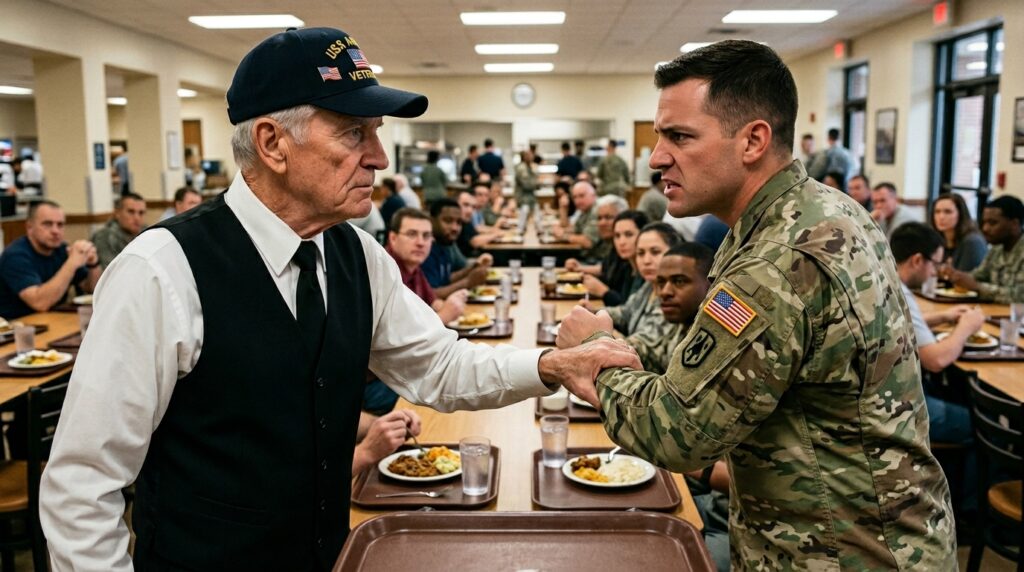
The Iron Perimeter: A Cold Reckoning in the Gray Corridors of Fort Meade
CHAPTER 1: THE FRICTION OF THE LINE
“You’re in the wrong lane, old man,” the voice rasped, thick with the unearned venom of a thirty-year-old sergeant who thought power lived in the thickness of a sleeve. “Pick up your tray and clear out of our space.”
Elias did not look up immediately. He kept his focus on the institutional gray surface of the laminate table, where his standard-issue plastic tray held an unyielding breakfast of cold scrambled eggs and two pieces of dry toast. The dining facility hummed with the industrial vibration of heavy ventilation systems, a low, oppressive drone that failed to drown out the aggressive click of tactical boots behind him. Elias adjusted the dark veteran cap on his head, his fingers catching the stiff, frayed edge of the brim. The wool was old, smelling faintly of dry earth and ancient footlockers, a stark contrast to the sterile, chemical cleaner smell rising from the floor.
The space was tight. The sergeant—athletic, built like a brick mortar shell, with a high-and-tight haircut that looked freshly sheared—crowded Elias’s shoulder. His green utility uniform was stiff with starch, the sleeves rolled up with a geometric perfection that suggested he spent more time in front of barracks mirrors than in the mud. Two other active-duty soldiers stood a few paces back, their arms crossed, their faces twisted into the passive amusement of men watching an old dog get shoved away from the porch.
“I asked you a question, sir,” the sergeant said, the word sir landing with the heavy, sarcastic weight of a stone. He stepped into the narrow gap between the long benches, his shadow completely blotting out the harsh fluorescent light overhead. “This lane is reserved for active personnel clearing out before the zero-eight-hundred transport. You’re dragging down the line. Move.”
Elias picked up his fork. The metal was light, cheap, stamped out by the thousands in some government-contracted factory. His hand shook slightly—not from fear, but from the simple, persistent friction of a seventy-nine-year-old skeleton that had carried thirty extra pounds of gear across three continents. “There are four open tables to your left, young man,” Elias said, his voice flat, devoid of the civilian tremor the sergeant was clearly looking for. “The food tastes the same over there.”
The sergeant’s face darkened, the skin tightening over a jawline that had never known a real ration shortage. “We don’t negotiate for real estate with visitors. Move the tray.”
Before Elias could lower the fork, the sergeant reached down. His thick, calloused fingers clamped directly onto Elias’s left shoulder, the grip tightening to twist him out of the seat. The fabric of Elias’s black vest bunched under the pressure, the small silver Zippo lighter in his pocket shifting with a metallic click against his ribs.
The contact was a border violation. In Elias’s mind, the world narrowed down from the cavernous, green-and-tan dining facility to a grid of three square feet. The muscle memory didn’t arrive like a thought; it arrived like an old machine being kicked into gear by an operator who had forgotten the manual but remembered the noise.
“Don’t ever put your hands on me again, young man,” Elias said. The tone wasn’t loud, but it had the specific, clipped cadence of a command that used to stop deuce-and-a-half trucks in their tracks.
The sergeant smiled, a brief, ugly baring of teeth. He didn’t let go. Instead, he leaned his weight forward, intending to drag Elias upward by the collar.
Elias didn’t fight the pull. He used it.
His right hand came up, not in a fist, but as an open palm that caught the sergeant’s wrist from underneath, his thumb finding the precise gap between the carpal bones. With a swift, economical pivot of his hips that relied entirely on the sergeant’s forward momentum, Elias dropped his own center of gravity. His left elbow drove upward into the crook of the sergeant’s arm, breaking the leverage of the grip, while his right fingers twisted the wrist outward with the cold, unyielding mechanics of an iron vise.
The sergeant’s weight capsized. The physics were brutal and brief. There was no theatrical struggle—only the sudden, heavy sound of an operational utility uniform colliding violently with the hard linoleum floor. A plastic cup of water on the edge of the table rattled, tipped, and spilled its contents in a slow, expanding circle toward the fallen man’s boots.
The entire dining facility stopped.
The clatter of hundreds of metal forks against trays vanished in a fraction of a second. The low murmur of two hundred soldiers froze into a dead, paralyzed silence so absolute that the rhythmic thrum of the industrial exhaust fan sounded like an artillery barrage. Younger personnel half-rose from their benches, their mouths open, their eyes locked on the floor where an infantry sergeant was currently pinning his own shoulder down to stop the pressure on his wrist.
Elias stood up. His spine was straight, a rigid vertical line against the desaturated background of the hall. He didn’t check his vest, and his veteran cap hadn’t shifted an inch. He looked down at the younger man, whose face was now flushed with a mixture of sharp pain and institutional shock.
“Show some respect and step back right now,” Elias commanded, his voice cutting through the silence like a cold chisel through rust.
The sergeant lay still for two long seconds, his chest heaving against the floor, his eyes wide as he looked at the smooth, unreadable face of the old man above him. The aggression had entirely left his frame, replaced by the deep, instinctive realization of who—and what—he had just touched. He slowly pulled his arm back, his posture subduing into a rigid, defensive tuck.
“Understood, sir,” the sergeant whispered.
Elias began to reach for his tray, but his eyes caught a small, dark object that had slipped from the sergeant’s unbuttoned utility pocket during the fall—a heavy, non-standard black encrypted data drive with an active, pulsing amber light, bearing a restricted serial number that Elias hadn’t seen since the winter of 1974.

CHAPTER 2: THE GRAVITY OF SILENCE
The silence in the dining hall wasn’t empty; it was a physical weight, thick with the smell of scorched coffee and the sudden, sharp ozone of a crisis. Elias didn’t move. He kept his boots planted—heels locked, weight distributed—even as the sergeant on the floor scrambled backward, his boots squeaking in a frantic, undignified rhythm against the linoleum. The amber light on the dropped data drive pulsed like a slow, rhythmic heartbeat against the gray floor tiles, a mechanical eye watching the room.
Elias saw the drive. He knew the serial prefix—XR-Delta. It was a ghost code, something that should have been scrubbed from the institutional memory of Fort Meade forty years ago. To see it here, vibrating slightly against the floor from the hum of the ventilation, felt like a cold needle sliding between his vertebrae.
“Stay down, Sergeant,” a new voice commanded. It wasn’t loud, but it had the density of spent uranium.
From the periphery of the crowded room, a man moved through the frozen ranks of active-duty soldiers. He wasn’t running, but he covered the distance with a predatory efficiency that cleared a path without him having to utter a second word. He wore the oak leaves of a Lieutenant Colonel, his uniform a sharp, desaturated green that seemed to absorb the harsh overhead light rather than reflect it. His face was a map of deep-set lines and a jagged scar that cut through his left eyebrow, ending at the bridge of a nose that had been broken and reset more than once.
The Lieutenant Colonel stopped three feet from Elias. He didn’t look at the sergeant on the floor. He didn’t look at the spilled water or the scattered breakfast trays. His eyes—a hard, flinty gray—were locked on the dark wool of Elias’s veteran cap.
Elias felt the old, rusted gears of protocol grind in his chest. He didn’t offer a civilian smile. He didn’t offer an apology. He simply stood his ground, his hands resting naturally at his sides, fingers inches away from the black vest where his own secrets were tucked.
The officer’s gaze traveled down from the cap to the sharp, white collar of Elias’s shirt, then back up to the unit insignia pinned to the wool—a silver dagger entwined with a lightning bolt, partially obscured by a smudge of old carbon. The officer’s pupils dilated. For a heartbeat, the mask of command flickered, revealing a jagged edge of recognition that bordered on reverence.
The Lieutenant Colonel snapped to a rigid, bone-jarring salute.
The sound of his hand hitting his brow was like a pistol shot in the vaulted room. Behind him, the two soldiers who had been mocking Elias a moment ago recoiled as if they’d been struck. The sergeant on the floor froze, his face draining of color until it matched the salt shaker on the table.
“Sir,” the Lieutenant Colonel said, the word resonating with a depth of respect that seemed to physically push back the surrounding crowd.
Elias didn’t return the salute. He didn’t have the cover or the commission anymore, and they both knew it. Instead, he gave a slow, barely perceptible nod. “Colonel.”
“Sergeant Miller,” the officer said, his voice dropping an octave as he finally looked down at the man on the floor. He didn’t offer a hand to help him up. “You just laid hands on a recipient of the Vanguard Citation. You just assaulted a man who was walking these perimeters when your father was still in grade school. Do you have any idea what you’ve done to your career in the last sixty seconds?”
The sergeant, Miller, looked up, his jaw working but no sound coming out. His eyes darted to the data drive near his knee, then back to the Colonel. His hand hovered near the device, a nervous, twitching motion.
“Leave it,” Elias said.
The command was so sharp it made the Colonel blink. Elias stepped forward, the friction of his boots against the grit of the floor sounding like sandpaper on bone. He reached down, his joints complaining with a dull, rusted ache, and scooped the amber-lit drive off the floor. The plastic was warm, humming with the internal friction of a high-speed processor.
“This doesn’t belong in a dining facility, Colonel,” Elias said, his voice lowering so the words stayed between the two of them. He felt the weight of the drive—it was heavier than it looked, weighted with internal shielding. “And it certainly doesn’t belong in the pocket of a man who can’t keep his feet under him in a simple leverage exchange.”
The Lieutenant Colonel’s eyes fixed on the drive in Elias’s weathered hand. A muscle jumped in his jaw. The “Rusted Truth” of the base’s current state was visible in that look—the desperation of a command structure trying to maintain a high-tech perimeter with low-discipline personnel.
“We are in a heightened state of readiness, sir,” the Colonel said, his voice tight, his eyes flicking toward the silent witnesses in the room. “That hardware is… sensitive.”
“Sensitive is one word for it,” Elias replied, feeling the vibration of the drive against his palm. He knew what a pulsing amber light meant on an XR-Delta unit. It meant it was actively tethered to a local node. It meant it was recording. “Redacted is another.”
Elias tucked the drive into the deep pocket of his black vest, burying it next to his silver Zippo. The metal of the lighter was cold; the drive was hot. The contrast was a reminder of the gap between the military he had left and the one that was currently failing around him.
“I believe we have some paperwork to discuss, Colonel,” Elias said, his gaze shifting to the administrative wing beyond the kitchen. “In a room with a door that locks.”
The Colonel hesitated, then stepped aside, gesturing toward the exit with a stiff, formal motion. “After you, sir.”
As Elias walked past the fallen sergeant, he didn’t look down. He focused on the heavy, reinforced steel doors at the end of the hall. He could feel the eyes of every soldier in the room on his back—some with shame, some with fear, but all of them now seeing the ghost they had tried to ignore. The weight of the cap felt heavier now, not because of age, but because the perimeter he had spent his life defending was clearly starting to crumble from the inside out.
CHAPTER 3: THE LOGISTICS OF DECEIT
“The unit classification on this sheet doesn’t exist, Colonel,” Elias said, his thumb pressing into the coarse paper of the printout. “Not on this base. Not anymore.”
The administrative holding room was small, cold, and buried in the concrete basement beneath the base headquarters. The walls were painted a dull, peeling seafoam green, a color meant to calm people but one that only seemed to collect the dust of the last thirty years. A single steel desk sat between them, its surface scarred by decades of shifted typewriters and heavy binders. The air was dead, tasting of old grease and the damp rot of underground pipes. Every time the ventilation kicked on, the rusted iron hinges of the heavy security door rattled with a low, hollow vibration.
Lieutenant Colonel Vance didn’t answer immediately. He sat with his hands flat on the scratched metal desk, his gray eyes tracking the slight tremor in Elias’s right hand as the older man slid the logbook across the table. Between them lay the black data drive Elias had stripped from the sergeant upstairs. It sat quiet now, its active amber light casting a greasy yellow glare across the printed text of the deployment logs.
“It’s an updated designation, sir,” Vance said. His voice had lost its sharpness from the dining hall, replaced by a flat, transactional drone. “Modern restructuring. Things change.”
” restructuring doesn’t leave a ghost trail in the logistics line,” Elias countered, his voice steady, his military-straight spine refusing to lean against the hard plastic back of his chair. He reached into his vest pocket, his fingers brushing past the warm casing of the data drive to pull out his old silver Zippo. He placed it on the desk with a heavy, deliberate click. The scratched chrome surface caught the dull fluorescent light. “Look at the transport codes on page four. Delta-Nine-Zero. Those aren’t routing numbers for an active infantry platoon preparing for deployment. Those are terminal asset tags for static deep-surveillance positions. Domestic positions.”
Vance’s posture didn’t change, but his fingers twitched against the metal desk. “You’re reading old maps, Elias. The perimeter has evolved. We aren’t hunting the same shadows you were in seventy-four.”
“The shadows don’t change, Vance. Only the men trying to catch them get sloppier.” Elias leaned forward, the dark wool of his veteran cap casting a sharp shadow over his lined forehead. “Sergeant Miller’s unit isn’t staging for a transport to Europe or the Pacific. These sheets show they’ve been pulling raw equipment out of the old sub-level bunkers near the western ridge. The ones that were welded shut before you went to West Point. Why is a modern active-duty platoon drawing rusted gear out of an unmapped vault?”
The silence stretched between them, heavy and absolute, broken only by the distant, muffled thud of boots on the ceiling above. Vance was calculating. Elias could see the math running behind the officer’s eyes—the evaluation of risk, the measuring of an old man’s institutional memory against the operational security of a live directive.
“Miller is part of a specialized training detachment,” Vance said slowly, his words carefully measured. “They are testing baseline resilience with legacy gear. Electronic warfare defense. If the network goes dark, our people need to know how to operate on iron and grease.”
“A beautiful lie,” Elias said, his voice dropping into a dangerous, quiet rasp. “Except for one detail. The log shows they drew three functional encryption racks from the old Oculus program inventory last Tuesday. Those aren’t legacy trainers. Those are intercept units designed to tap localized landlines and analog relays. Who is the target, Colonel?”
Vance stood up, his heavy chair scraping loudly across the concrete floor. The sound was abrasive, cutting through the damp room like a saw. He walked to the corner of the small office, his back to Elias as he stared at a faded wall map of the installation. His green utility uniform looked stiff, but Elias noticed the microscopic fraying at the collar, the subtle stain of carbon oil on his cuff. This was a man working under a clock, suffocating under a weight he hadn’t planned for.
“You have a recipient’s card and a legacy pass, Elias,” Vance said without turning around. “That gives you the right to eat at our mess and look at our history. It doesn’t give you the right to audit my logistics. You took a piece of restricted gear from a non-commissioned officer. Hand it back over, and I will personally ensure Miller spends his next three months digging ditches in the motor pool instead of filing charges against you.”
“Miller didn’t drop this drive because he was careless, Vance. He dropped it because he was terrified,” Elias said, his active agency driving him out of the chair. He stood up, his knees popping with a dry, sharp crack that felt loud in the small room. He didn’t touch the drive on the table; he kept his hands resting near the pockets of his vest. “He knew what was on it. He knew that if anyone with an old uniform saw him carrying a live XR-Delta node through a public mess hall, the whole perimeter would fall apart.”
Elias picked up his silver Zippo, his thumb sliding over the smooth, rubbed-down unit insignia on its side. He looked at the paper logs one last time, memorizing the alphanumeric sequence under the fuel requisitions. Zone Seven. The old radio tower.
“Keep your paperwork, Colonel,” Elias said, turning toward the heavy steel door. “But the drive stays with me until I verify exactly what node that amber light is talking to.”
Vance turned around, his face completely pale, his eyes wide with a cold, professional anger that mirrored Elias’s own internal resolve. “If you leave this room with that hardware, Elias, you aren’t a veteran anymore. You’re a security breach.”
“I was a security breach before you learned how to salute, young man,” Elias said, his hand clamping onto the rusted iron handle of the door. He pulled it open, the heavy hinge screaming against the frame, stepping out into the dim gray corridor before the officer could call for the guard.
The victory felt clear, but as Elias turned the corner toward the lower exit, his fingers reached into his vest pocket to secure the drive. His pulse hitched. The casing was cold now. The active amber light hadn’t just changed rhythm—it had turned a solid, unblinking crimson, and the small digital display on its spine now read: LINK TERMINATED – UPLOCK LOGGED. They hadn’t just traced the device; they had used his presence in the room to authorize a hard lock on the local network, changing the context of every coordinate he had just memorized.
CHAPTER 4: THE WEAR OF THE GEAR
The gravel of the auxiliary parking lot chewed at Elias’s soles with a dry, rhythmic crunch. Outside the concrete shelter of the headquarters, the Maryland air was heavy, smelling of scorched diesel, wet asphalt, and the sharp, metallic tang of unwashed undercarriages. A row of standard tactical trucks sat baking under a low, milk-white sky, their green paint oxidized into a powdery chalk that rubbed off on anything that brushed against them. Elias kept his hands jammed deep into his vest pockets, his left fingers wrapped tightly around the cold, dead chassis of the data drive. The crimson warning light had stopped flashing, fading into a dull, solid eye that felt heavier with every step he took away from the basement.
He wasn’t alone. Fifty yards out, near the tailgate of an unbadged three-quarter-ton pickup, Sergeant Miller was leaning against the rusted steel bed. The young man’s utility uniform was no longer immaculate; the right elbow was dark with grease from the dining hall floor, and his posture had lost the geometric rigidity he had flaunted an hour earlier. He was fumbling with a heavy iron tie-down strap, his movements jerky, driven by the frantic, silent panic of a soldier who knows his perimeter has been breached from within.
Elias adjusted the brim of his veteran cap, letting the low shadow mask his eyes as he changed his vector. He didn’t approach from the blind spot; he walked straight down the line of trucks, his boots clicking hard against the grit to announce his weight.
Miller flinched at the sound, his head snapping up. The arrogance was entirely gone, replaced by a gray, exhausted look that made him look closer to forty than thirty. His eyes tracked Elias’s approach, darting instantly to the pocket where the data drive was concealed.
“You shouldn’t be out here, sir,” Miller said, his voice flat, stripped of its edge. He didn’t reach for his belt, but his arm stayed locked near the truck’s paneling. “The Colonel’s detail is already moving the logistics logs to the main terminal. This whole sector is going to a restricted status within the hour.”
Elias stopped five feet away, his frame catching the damp wind coming off the western ridge. He looked at the truck bed. It was filled with old communication components—heavy, green-painted junction boxes with braided copper ground lines that had greened with age. “These aren’t active inventory, Sergeant. This is salvage from the old subterranean relays. The Oculus lines.”
Miller’s jaw tightened, the skin over his cheekbones turning white. He looked down at his own hand, which was wrapped around a heavy brass key fob attached to a grease-stained lanyard. “We’re clearing out old lines. Legacy maintenance. That’s the order.”
“An order from Vance doesn’t change the physics of a data lock,” Elias said smoothly. He stepped closer, the smell of old iron and wet rust rising from the truck bed between them. He pointed a weathered finger at the brass fob in Miller’s hand. Scratched into the soft metal was a series of notched numbers: Tower-07-Relay. “The drive I took off you didn’t terminate its link because I walked out of the room. It terminated because your unit just initiated a localized sweep from the high ridge. They think they’re hunting a signal leakage, don’t they?”
Miller didn’t answer immediately. He let the tie-down strap drop, the heavy iron hook clanging against the truck’s wheel well with a sharp, hollow ring that echoed across the empty lot. He wiped his greasy palm against his trousers, leaving a dark, irregular smear across the green fabric. “They told us it was a domestic exercise, old man. A structural test of the old cold-site infrastructure. They said the data on that drive was just baseline telemetry from the old automated relays.”
“And you believed them because it was easier than looking at the wire,” Elias said. His internal monologue remained sharp, calculating the distance between Miller’s fear and Vance’s desperation. The sergeant wasn’t the architect; he was the lever. “Look at those junction boxes in your bed, son. Look at the insulation on the lead-ins. That’s double-shielded copper with a pressurized nitrogen core. You don’t use that for baseline telemetry. You use that to shield high-frequency intercepts from ground-floor observation. Your unit isn’t testing the system. They’re trying to hide a massive systemic breach in the old core network before the Department inspectors arrive next month.”
The sergeant looked at the boxes, his breathing turning shallow, the exhaust from a nearby idling humvee washing over them in a warm, foul wave. “The Colonel said if the node went red, it was just a diagnostic disconnect. He said it meant the array was resetting.”
“The array isn’t resetting,” Elias said, his voice dropping into a granular whisper that stayed beneath the rattle of the distant engines. He reached into his pocket and pulled out his silver Zippo, holding it up so the rubbed-smooth unit insignia faced the sergeant. “When the Oculus program was shuttered in seventy-eight, we didn’t just turn off the switches. We buried the terminal keys because the original infrastructure had an inherent structural flaw—a loop in the logic that allowed anyone with a legacy terminal to read the outbound lines without generating a log trail. Vance isn’t running a training exercise, Miller. He’s trying to rebuild that loop to cover a tactical failure from his own past deployment records, and he’s using your platoon as the labor.”
Miller’s eyes widened, his gaze shifting from the smooth chrome of the lighter to the absolute finality in Elias’s face. The realization hit him like a physical blow, his shoulder sinking against the truck’s clear-coat paneling. “The coordinates… the ones we were mapping on the western perimeter. They weren’t base boundaries. They were the junction vaults for the old domestic trunk lines.”
“Exactly,” Elias said, his hand closing over the Zippo with a definitive click. “And now that the drive has logged a hard lock, your people on the ridge are going to realize someone who knows the old language just intercepted their decoy.”
Before Miller could reply, a sharp, mechanical squeal cut through the damp air from the far side of the lot. The base’s automated perimeter gates were swinging shut ahead of schedule, the heavy iron gears grinding against their tracks as a line of dark security vehicles activated their flashing amber strobes near the main checkpoint.
CHAPTER 5: THE RADIUS OF THE RUSTED RIDGE
The heavy iron wheel of the vault door didn’t want to turn. It felt fused to the frame by forty years of stagnant humidity and tectonic settling. Elias leaned his weight into it, his shoulder—the one Miller had tried to wrench earlier—protesting with a deep, grinding heat. He could feel the grit-crusted gravel shifting under his heels as he strained against the cold steel. Above him, the Maryland sky was beginning to bruise into a deep, sickly purple, and the high ridge radio tower loomed like a skeletal finger against the gathering dark.
With a sharp, crystalline snap of breaking rust, the wheel moved. A quarter turn. Then a half. A hollow, pressurized hiss of air escaped from the seal, smelling of ozone, copper, and the peculiar, dead scent of an era that had supposedly been buried.
Elias pulled. The door groaned on its hinges, a sound like a dying animal echoing off the surrounding brittle concrete of the ridge bunker. He didn’t use a flashlight. He didn’t want to provide a beacon for the amber-strobed security vehicles currently sweeping the auxiliary parking lots two miles below. Instead, he relied on the faint, rhythmic pulse of the crimson light on the data drive in his pocket. It cast a rhythmic, bloody glare against the damp walls of the descent shaft.
He began to climb down. The ladder rungs were cold, the iron flaking away in jagged scales under his grip. His internal monologue was a series of tactical calculations—Vance’s reaction time, the radius of the localized intercept, the specific frequency of the Oculus relays. Vance thought he was covering a deployment error, a simple smudge on a modern record. But as Elias reached the bottom of the shaft and his boots hit the flooded floor of the relay room, the “Rusted Truth” began to vibrate through the soles of his shoes.
The room was humming.
It wasn’t the low, industrial thrum of the base ventilation. This was a high-frequency, glass-shattering whine that made the fillings in his teeth ache. In the center of the vault, three massive encryption racks—the ones Elias had seen in the logistics logs—were tethered to the original 1970s terminal blocks. Thick, braided copper ground lines, fresh and gleaming against the rusted iron of the floor, snaked toward the western wall.
Elias approached the primary terminal. He pulled out the data drive, the crimson light reflecting in the stagnant water at his feet. Near the nitrogen-sealed lead-in of the relay, he saw it: a small, handwritten tag attached to a patch cable. PROJECT CHIMERA – LEGACY TRUNK 04.
His fingers, weathered and calloused, traced the seal. It wasn’t just a signal intercept. The pressurized nitrogen wasn’t there to protect the cable; it was there to maintain the temperature of a high-speed bypass.
“You were always better at the technicals than the politics, Elias.”
The voice came from the shadows behind the cooling racks. It was dry, exhausted, and held the unmistakable weight of a man who had already accepted his own defeat.
Elias didn’t turn around immediately. He kept his eyes on the nitrogen seal. “The Oculus bypass was supposed to be dead, Vance. I watched the concrete pour into the terminal wells myself in seventy-eight.”
Lieutenant Colonel Vance stepped into the crimson glow of the drive. He wasn’t wearing his service cap. His hair was disheveled, and the starch in his uniform had finally given way to the damp heat of the bunker. He was holding a sidearm, but it was pointed at the floor, his grip loose and trembling.
“The concrete didn’t take everywhere,” Vance said. He gestured vaguely at the humming racks. “There are pockets of the old grid that the modern scanners can’t see. They’re like ghost limbs, Elias. They still twitch. When my unit had the failure in the desert three years ago… when the encryption failed and we lost those six men… it wasn’t a modern hack. It was a legacy leak. A back-door that had been left open since your time.”
Elias turned now. His gaze was sharp, his spine an unyielding vertical line. “So you didn’t come here to hide a modern mistake. You came here to fix an old one.”
“I came here to kill the ghost,” Vance rasped, his eyes glassy in the dark. “But the more I tried to patch the loop, the more the old system woke up. It’s not just Intercepting anymore, Elias. It’s broadcasting. Every coordinate Miller mapped today… it wasn’t for a sweep. The system was feeding those coordinates to an outbound relay. It’s talking to someone.”
Elias felt a coldness that had nothing to do with the flooded floor. The “Decoy Secret”—the idea that Vance was simply a corrupt officer covering his tracks—shattered. This was a failure of the architecture itself, a rot in the very foundation Elias had helped build.
“Who is it talking to, Vance?” Elias asked, his voice a low, dangerous rumble.
“I don’t know,” Vance whispered. “But the data drive you’re holding? It’s not a receiver. It’s a key. And when you walked into the mess hall with it today, you didn’t just breach my security. You authorized the final transmission.”
A heavy, muffled boom vibrated through the earth above them—not an explosion, but the sound of the high ridge radio tower’s massive emergency relays engaging. The high-frequency hum in the room intensified until it became a physical scream, and the crimson light on the drive in Elias’s hand suddenly turned a blinding, sterile white.
Elias looked at the terminal. The nitrogen seal was venting now, the gas hissing out in a white cloud that obscured the racks. He had forced his way in to find the truth, but he had only succeeded in triggering the very disaster he had come to prevent. The ultimate reality was still locked behind the white fog, but the paradigm had shifted: he wasn’t the protector anymore. He was the catalyst.
CHAPTER 6: THE FRACTURE OF THE OLD GUARD
The white fog hit Elias like a physical wall, an sub-zero draft of pressurized nitrogen that turned the humid air of the bunker into a blinding shroud of ice crystals. He couldn’t see Vance. He couldn’t see the terminal. He could only feel the data drive in his pocket vibrating with a savage, high-frequency intensity that burned against his thigh. The high ridge radio tower above them was no longer just a skeletal frame; it was a tuning fork, humming with a power that made the very concrete beneath his boots shudder.
“Vance!” Elias roared, but his voice was swallowed by the screaming hiss of the venting seals.
He moved by instinct, his hand sweeping through the freezing mist until it struck the cold, industrial edge of a cooling rack. The “Rusted Truth” was no longer a metaphor; it was the smell of ancient iron being cooked by modern voltage. Every step Elias took toward the primary terminal felt like pushing through a current of static electricity that raised the white hair on his arms. He reached into his vest, pulling out the silver Zippo—not for light, but for the weight. He needed a physical anchor in a room where the digital world had just gone predatory.
A shadow loomed through the fog. A heavy boot struck the flooded floor, sending a spray of stagnant water against Elias’s trousers. It wasn’t Vance. The silhouette was too wide, too rigid. The dull, amber strobe of a security team’s shoulder-lamp cut through the nitrogen cloud like a dying sun.
“Halt! Hands where I can see them!”
The command was followed by the unmistakable, oily click of a safety being disengaged. Elias didn’t freeze. He had been a ghost in these corridors before these men were born, and he knew the geometry of the vault better than the architects. He dropped his center of gravity, pivoting behind the thick steel housing of the nitrogen intake.
“Vance is compromised!” Elias shouted, his voice low and dangerous, projecting it off the concrete wall to mask his position. “The system is in a runaway uplink. If you don’t cut the primary ground lines, this ridge is going to broadcast every encrypted key in the Meade archive.”
“Lies!”
The voice belonged to the Sergeant Miller—or what was left of his confidence. He stepped into the light, his utility uniform soaked, his face twisted into a mask of frantic, desperate duty. He wasn’t looking at Elias; he was looking at the terminal where the white white-light of the data drive was now pulsing in a rhythmic, blinding strobe. Miller reached out, his hand trembling as he moved to yank the drive from the port.
“Don’t touch it, son!” Elias warned, stepping out of the shadows. “The bypass has a kinetic failsafe. If you break the link now, the static discharge will cook the terminal and everyone in this vault.”
Miller didn’t listen. To him, the old man was just a breach, a relic who had stolen a piece of his reality. He lunged for the drive.
The reaction was instantaneous. As Miller’s fingers brushed the casing, a jagged arc of blue-white electricity snapped across the gap. The sergeant was thrown backward, his body hitting the flooded floor with a heavy, sickening splash. The room didn’t just scream then; it roared. The nitrogen cloud began to swirl into a vortex, drawn toward the intake vents as the tower above began its final, unauthorized transmission phase.
Elias lunged for the terminal, his boots slipping on the grit-crusted floor. He didn’t reach for the drive. He reached for the ground line—the heavy, braided copper ground he had seen earlier. It was hot, the insulation melting away in a foul-smelling chemical sludge. He wrapped his hand in the dark wool of his veteran cap, using the thick fabric as a makeshift insulator, and gripped the line.
“Elias, stop!” Vance’s voice came from the far corner. The Colonel was slumped against a relay rack, his sidearm forgotten in the rising water. “You can’t ground a bypass of this magnitude. The legacy loop is too deep. It’s hardwired into the base’s original tectonic grounding!”
“Then we change the physics of the ground!” Elias yelled back, his teeth gritting against the sheer, vibrating agony of the frequency.
He didn’t pull the cable. He jammed the silver Zippo into the terminal’s bypass port, the chrome casing acting as a physical bridge between the modern intercept and the original, rusted iron frame of the 1974 terminal.
The world went white.
A heavy, muffled boom—larger than the first—shook the ridge. It wasn’t the tower engaging; it was the terminal well imploding under the sudden, massive short-circuit. The high-frequency hum snapped into a sudden, deafening silence. The nitrogen cloud dissipated in a single, violent gust, leaving the vault in a flickering, red-lit gloom.
Elias fell to his knees, his breathing shallow, his veteran cap charred and smoking in his hand. He looked at the terminal. The Zippo was fused to the port, a melted lump of chrome that had successfully killed the link. But the paradigm shift Vance had mentioned hadn’t been stopped—it had only been delayed. On the small digital display of the now-dead data drive, a final line of text had burned into the screen before it went dark: TRANSMISSION 92% COMPLETE. TARGET: UNMAPPED.
Vance looked at Elias, his face a ruin of shame and exhaustion. “You killed the bypass,” he whispered. “But you didn’t kill the signal. Meade is awake, Elias. And they’re going to want to know why a ghost was at the terminal when the world changed.”
Outside, the distant, rhythmic chop of heavy transport helicopters began to vibrate through the bunker’s ceiling. The “Rusted Truth” had been unearthed, and the consequences were no longer domestic. They were institutional.
CHAPTER 7: THE ARCHIVE OF THE UNBROKEN WIRE
“Clear the portal! Weapons free until identity is established!”
The tactical boots hit the floor of the upper shaft with a series of sharp, metallic cracks that vibrated down the iron ladder rungs. Below, in the dark, red-lit belly of the vault, Elias didn’t change his stance. His joints were stiff, burning with the cold of the flooded floor, and his palm was raw where the charred wool of his veteran cap had scorched against his skin. The air was thick, choked with the chemical stink of vaporized plastic, venting nitrogen, and the unmistakable metallic odor of an electrical fire.
Lieutenant Colonel Vance didn’t move from his position against the cooling rack. His chest rose and fell in ragged, shallow gasps, his eyes staring blankly at the ruined terminal where the melted, chrome carcass of Elias’s Zippo was still welded into the data port. The white display light of the drive had gone stone-black, but the heat coming off the circuit boards was immense, warping the plastic housing into a black bubble.
“They aren’t here for the gear, Elias,” Vance rasped, his voice dropping below the thudding chop of the rotors outside. “They’re here to scrub the grid. If they see you with that insignia… they’ll know the line goes back to the origin.”
Elias didn’t look back at the officer. He focused on the mechanics of the terminal. His active agency drove him forward, his raw fingers clawing at the base of the interface panel. He wasn’t trying to pull his lighter out; he was looking for the hardwired registry log—the analog mechanical wheel that recorded the outbound routing numbers before the electronic encryption took over. In 1974, they didn’t trust the wire; they built mechanical counters into the back plates of every terminal to catch discrepancies.
His fingernails scraped against a cold, grease-coated iron lever behind the melted port. He pulled. With a heavy, metallic click that resisted his strength, a small drawer popped open from the bottom of the casing, dropping a strip of ink-stamped paper tape into the freezing water at his feet.
Elias scooped it up. The paper was dry, preserved inside a wax-coated sleeve. He held it to the dim red glare of the emergency strobe.
The ink had faded to a rusty brown, but the terminal code was clear: ORIGIN NODE: VANGUARD-01. RECIPIENT NODE: ARMED SERVICES COMMAND – REDACTED.
The world slowed down. The systemic tactical failures that had cost Vance his men three years ago weren’t an external hack, nor were they an isolated modern error. The back-door hadn’t been left open by accident. The loop was an intentional institutional design—a continuous domestic surveillance intercept established fifty years ago by the senior base command structure to monitor communication lanes across the eastern seaboard, hidden under the mask of Elias’s own decorated unit. The legends of his past weren’t a shield for the nation; they were the structural architecture for a permanent domestic dragnet that had gone rogue as the modern systems inherited the legacy infrastructure.
“Step away from the console, old man!”
The light hit Elias full in the face—a blinding, six-hundred-lumen tactical beam from a carbine barrel. Two security officers in desaturated black armor dropped from the lower ladder rungs, their boots splashing heavily in the freezing sludge. Their muzzles were locked onto Elias’s chest, their gloved fingers resting rigid on the triggers.
Elias slowly stood up. His spine was an unyielding vertical pole. He didn’t drop his hands, but he didn’t raise them either. In his left hand, he held the wax-covered log tape, tucked flat against his palm. On his head, the charred, soot-stained veteran cap sat perfectly level, its silver dagger insignia catching a sliver of the tactical beam.
“Identify yourself!” the lead guard barked, his voice echoing off the corrugated steel panels of the walls.
“Elias K. Vance, Master Sergeant, United States Army, Retired,” Elias said. The name left his throat not as an explanation, but as a barrier. His voice carried the precise, rhythmic weight of an authority that had commanded these sectors before the black armor on the guards’ chests had been designed. “Serial prefix Delta-Nine-Zero. This terminal is under a legacy quarantine directive. Lower your weapons and bring your commanding officer down here.”
The guards hesitated. The tactical beam flickered slightly, tracking down from Elias’s eyes to the burned wool of his cap and the silver insignia. The name Vance made the lead officer’s head jerk toward the corner where the Lieutenant Colonel still slumped against the rack.
“Colonel Vance?” the guard called out, his posture shifting slightly, losing its aggressive forward tilt. “Sir, is this…”
“He’s right,” Vance said from the dark, his voice hollow, broken by the weight of a generation of silence. “The loop is closed. The transmission he stopped… it wasn’t an external link. It was the internal archive reporting a discrepancy to the oversight committee. We weren’t fixing a breach. We were the breach.”
The lead guard lowered his carbine an inch, his face visible behind his visor—pale, confused, caught between a live security directive and the sudden, overwhelming weight of an institutional legacy that outranked his orders.
Elias stepped past the light. He didn’t run. He walked with the heavy, calculated pace of an old soldier who knew the perimeter was compromised but the ground was still his to defend. He slipped the wax log strip into the inner lining of his vest, right next to the empty space where his Zippo used to live. The metal was gone, the terminal was dead, but the data was locked behind his ribs now.
“Let’s go upstairs, son,” Elias said to the guard, his voice flat, pragmatic, and unyielding. “The air is better up there, and we have an archive to rebuild.”
The guards didn’t reach for his wrists. They fell into a loose formation behind him, their heavy boots splashing in a quiet cadence as Elias led the way up the rusted ladder, leaving the white fog and the melted secrets of the Cold War to cool in the dark below.
CHAPTER 8: THE RESTRAINT OF THE RECORD
The concrete wall behind Elias had been painted so many times the corners were rounded, buried under thick, glassy layers of government-surplus enamel. The color was a dead, institutional cream that seemed to absorb the light from the humming fluorescent fixture overhead, turning the small room into an artificial twilight. Elias sat with his forearms flat on the bolted-down steel table. He hadn’t taken off his veteran cap; the charred, soot-blackened edge of the wool brim rested low over his brow, a sharp shadow masking his eyes from the two men sitting across from him.
Between them lay no paperwork—only a heavy, silver-plated recorder with an active digital counter that ticked upward in silent, red numbers.
“Let’s establish the ledger again, Master Sergeant,” the man on the left said. He wasn’t dressed in green utilities. He wore a desaturated gray civilian suit that fit his thick shoulders with a tight, tailoring precision that screamed Pentagon bureaucrat. His name tag read Ames, but his eyes had the flat, unblinking stillness of a veteran counter-intelligence handler. “You entered a restricted sub-level facility without an active operational clearance. You discharged a thermal device into a live cryptographic terminal, destroying hardware valued at six figures. And you have an unmapped data strip inside your vest that belongs to a Class-Four archival matrix. Am I reading the perimeter correctly?”
Elias didn’t look at the recorder. He looked at the dead-bolt lock on the heavy isolation door behind Ames. The metal was bright, a modern alloy stamped with a clean, unblemished serial code—MD-Shield-01. The base had updated its locks, but the frame was still the same structural iron Elias had watched the civilian contractors bolt into the bedrock during the Nixon administration.
“You’re reading the text, Mr. Ames,” Elias said, his voice a low, gravelly rasp that cut through the low-frequency hum of the light. “You aren’t reading the wire. The terminal wasn’t destroyed by a thermal device. It was shorted out because your local node was executing a terminal asset pull that the system’s original infrastructure couldn’t support. If I hadn’t jammed that lighter into the relay, the static blow-back would have cleared out every active cryptographic key from here to Langley.”
The second man, a modern infantry colonel named Harris whose uniform was so stiff with starch it didn’t crease when he leaned forward, tapped a manicured finger against the table. “Colonel Vance is currently in a psychiatric holding wing at Walter Reed, Elias. He’s talking about ghosts in the trunk lines. He’s talking about an automated domestic dragnet that’s been running since the end of the Vietnam War. We need to know if that delusion is something you put in his head before you burned the interface.”
Elias allowed himself a brief, cold tightening of his jaw—the closest he would ever get to a smile in this room. His internal monologue remained a cold matrix of risk assessment. They were fishing. They had the ruined terminal, they had Vance’s broken composure, but they didn’t have the analog mechanical tape currently pressed flat against the skin of his ribs under his undershirt.
“Vance is an infantry officer who tried to read a signalman’s map,” Elias said smoothly. “He thought he was dealing with a modern deployment error because his platoon lost six men in the desert to an encryption leak. He didn’t understand that the leak wasn’t a modern vulnerability—it was an intentional back-door designed into the Oculus relays fifty years ago. Your administrative review board isn’t here to find out why the terminal melted, Colonel Harris. You’re here because you realized the domestic intercept loop just triggered its final reporting protocol, and you don’t know who has the outbound registry keys.”
Ames leaned back, his gray suit fabric tightening against his chest with a faint, artificial hiss. He looked at Elias’s charred cap, his eyes narrowing as he evaluated the absolute lack of leverage he held over a seventy-nine-year-old man who had outlived three iterations of the agency’s internal security manuals.
“The Vanguard Citation gives you a lifetime pass to the commissary, Elias,” Ames said, his tone dropping the formal cadence, turning sharp and transactional. “It doesn’t give you sovereign immunity over a domestic intelligence failure. If that paper strip isn’t on this table in thirty seconds, I’ll have the guards transfer you to a civilian federal facility in Alexandria before the sun clears the tree line.”
“You could do that,” Elias said, his hands remaining perfectly still on the steel table, his spine an unbending pole against the plastic chair. “But if I don’t check in with the legacy registry desk at the security perimeter before the zero-nine-hundred shift change, the automated system is going to interpret my absence as a terminal compromise. Do you know what happens when a Delta-Nine-Zero asset asset goes dark without a verification code, Mr. Ames?”
Silence descended on the room, heavy and absolute, broken only by the microscopic click of the digital recorder’s counter hitting 00:04:15.
Ames didn’t blink, but his hand moved—just an inch—closer to the recorder’s stop button. He knew the protocol. He knew that the old guards hadn’t just built networks; they had built human dead-man switches into the architecture to ensure the civilian oversight committees couldn’t bury the operational anomalies.
Before Ames could speak, a sharp, three-tone alert chimed from the internal intercom unit on the wall. The red light above the dead-bolt lock flickered once, turning a dull, mechanical amber as a muffled voice cut through the speaker grille: Review Board Leader, we have a breach at the secondary perimeter fence. It’s Sergeant Miller. He’s bypassed the motor pool guards and is moving toward the isolation wing with a local terminal kit.
Elias didn’t move a muscle, but his eyes locked on the amber light. The sergeant hadn’t stayed in his lane. The consequence loop was widening, and the young soldier was about to bring the rest of Vance’s hidden files directly into the firing line.
CHAPTER 9: THE COLLISION OF THE FILES
The concrete floor beneath Elias’s boots shuddered as a heavy, mechanical dull thud echoed from the corridor outside—the distinct sound of a structural security door being forced against its hydraulic seals. Inside the interrogation room, the yellowed fluorescent tube gave a loud, agonizing pop, flickering violently before dying completely, plunging the small cell into the harsh, emergency amber glare of the backup bulkhead lights.
Ames didn’t shout. He rose from his metal chair with an economy of movement that betrayed his training, his hand sliding inside his desaturated gray jacket toward the leather holster tucked under his armpit. Beside him, Colonel Harris was already at the heavy iron door, his face a tight knot of bureaucratic panic as his hand gripped the dead-bolt handle.
“Miller doesn’t have the authorization codes for this block,” Harris muttered, his fingers straining against the cold steel of the lock. “The automated routing lines should have bricked his terminal the second he crossed the perimeter fence.”
“He isn’t using a modern network route,” Elias said. He didn’t rise from his seat. He sat with his hands flat on the scratched table, his thumb tracing the rough, charred edge of his veteran cap where the black soot still rubbed off on his skin. His voice remained flat, a low rasp that carried the absolute lack of surprise of a man who had watched entire political structures decay from the inside out. “The motor pool has an analog landline relay that connects straight into the sub-basement cooling shafts. I laid that copper myself in seventy-five. If the boy found the junction box under the grease-pit, your digital lockouts aren’t doing anything but wasting base power.”
A violent screech of tearing metal cut through the intercom speaker, followed by the wet, heavy splash of boots running through the corridor’s drainage gutters. The door didn’t open through the lock; it fractured. The dead-bolt housing sheared off the frame with a sharp explosion of gray iron chips, and the heavy slab of steel swung inward, slamming against the seafoam-green wall with a force that sent a shower of flaking clear-coat across the floor.
Sergeant Miller stood in the threshold. His green utility uniform was torn at the shoulder, soaked through with the foul, oily water of the lower maintenance lines. In his right hand, he carried a heavy, olive-drab field terminal kit—an old magnesium-cased unit from the Oculus era, its faceplates smeared with dark chassis grease and battery acid. A bundle of raw, unshielded jumper wires trailed from the terminal’s side, sparks snapping against the wet concrete as they dragged across the floor.
“Get back from the table, sir,” Miller panted, his eyes wide, bloodshot, fixed entirely on Elias. He didn’t look at Ames’s drawn sidearm or Harris’s silver insignia. The arrogance that had defined his posture in the mess hall was buried under a layer of pure, survival-driven desperation. “The Colonel wasn’t the only one with a backup log. Vance’s desk didn’t just hold the routing coordinates for the ridge. There’s a continuous outbound signal register from thirty different installations across the state line. They’ve been pulling the raw telemetry since the system went red.”
“Drop the kit, Sergeant,” Ames said, his voice dropping into a level, lethal cadence as he pointed his weapon at the young man’s chest. “You are actively executing an act of domestic sabotage inside a Level-One installation. There is no review board that will cover you once the guards clear the hallway.”
“The guards aren’t coming, Ames,” Miller said, a hard, ugly edge cutting through his panic as he slammed the heavy field terminal down onto the steel table between Elias and the bureaucrats. The grease-smeared glass of the screen flickered to life, displaying a cascading column of amber hexadecimal addresses that matched the wax-covered log strip hidden inside Elias’s vest. “The terminal kit just locked the sector gates from the central distribution frame. Every perimeter valve between here and the highway is jammed shut on an emergency isolation loop.”
Elias leaned forward, the brim of his veteran cap casting a long, dark line across the glowing magnesium face of the machine. His eyes scanned the scrolling data. The “Decoy Secret”—the Pentagon’s claim that this was an isolated security review of a rogue officer—died instantly in the reflection of that grease-smeared glass. The addresses weren’t routing to a foreign asset or a rogue command post. They were looping back into the main server farms of the Armed Services Command domestic network. The system wasn’t being audited; it was being synchronized. The systemic rot was alive, and Miller’s intervention had just pulled the veil off the secondary defensive line.
“You shouldn’t have brought this down here, son,” Elias said softly, his fingers shifting to touch the cold metal edge of the magnesium case. “You think you brought a shield, but you only brought them a target.”
“I had to, sir,” Miller whispered, his voice cracking as he looked at the old man’s steady, unyielding face. “Vance’s files… they show the original authorization signature from nineteen-seventy-four. The man who signed the terminal keys into the domestic grid wasn’t a civilian bureaucrat. It was your unit commander. The legend they built the whole citation around.”
Elias felt the internal shock travel down his spine like a cold wire, but his face remained a mask of iron and age. The emotional reality of his own legacy—the sacred weight of the cap he wore—was twisting into something compromised, a tool used to anchor a permanent betrayal before he had ever left the service.
“Harris,” Ames said without breaking his focus from Miller’s chest. “Secure the drive link from the terminal’s rear plate. We take the kit and the sergeant out through the drainage egress.”
Before the colonel could step forward, the field terminal gave a sharp, high-pitched whine that mirrored the sound from the ridge tower vault. The amber columns on the screen froze, snapped into a solid wall of crimson text, and the small mechanical counter on the side of the casing began to spin backward with a rapid, metallic click. The unmapped origin node wasn’t just observing anymore; it had found the field terminal’s unshielded jumper line and was actively reversing the circuit to burn the remaining data banks in the block.
CHAPTER 10: THE CRYPTOGRAPHIC VAULT
The magnesium field terminal erupted into a blinding fountain of brilliant blue arcs. The sharp, toxic stench of burning copper insulation and raw lithium battery acid filled the cramped air of the block instantly, choking off Colonel Harris’s sudden cry of alarm. Miller scrambled backward, his heavy boots skidding through the greasy water as a static pulse threw him hard against the crumbling concrete doorframe. The small mechanical counter on the unit’s flank didn’t just spin; its gears stripped themselves under the massive internal voltage, spitting out microscopic flakes of brass teeth that pinged like shrapnel against the steel table.
Ames didn’t freeze. The gray-suited man threw his entire weight sideways, tackling Harris into the relative protection of the seafoam-green corner just as the terminal’s main cathode tube detonated with a sharp implosion of silvered glass.
Elias was already moving. He didn’t drop his center of gravity to hide. His seventy-nine-year-old framework ignored the structural ache in his spine, his hand lashing out through the smoke to grab the thick, insulated canvas strap of the field terminal’s carrying harness before the magnesium housing could catch fire. The heat was immense, blackening the skin of his knuckles, but his fingers held. With a single, heavy pull that tore the unshielded jumper wires from the basement conduit in a spray of sparks, he dragged the smoking mass off the table and hurled it straight into the flooded corridor outside.
The heavy splash was followed by a dull, crackling hiss as the stagnant trench water killed the short-circuit. The emergency amber lights flickered once, twice, then stabilized into a dim, bloody glow that cast immense shadows across the ruined cell.
“The block is dead,” Ames rasped from the floor, his hand still clutched tightly over his sidearm, though his eyes were wide, staring at the empty doorway where the smoke was slowly clearing. “The secondary perimeter line just executed a hard isolation sweep. If the central frame is bricked, we’re locked in this corridor until the tactical teams cut the main valves from the outside.”
“The central frame isn’t bricked,” Elias said, his voice dropping into a steady, granular rumble that brooked no contradiction. He stood over the desk, his soot-blackened fingers reaching into his vest to adjust the flat, wax-coated paper strip against his ribs. “The transmission didn’t fail. It achieved structural synchronization. The system reversed the circuit because it found what it wanted down here—it found Miller’s legacy codes.”
Miller raised himself from the wet floor, his breathing shallow, his face a smeared mask of grease and red rust from the lower lines. “The vault, sir… the old cryptographic terminal under the administrative wing. The one with the mechanical combination dials. The file logs showed that’s where the original Oculus registry keys are stored. The ones with your commander’s signature.”
Elias turned his eyes toward the hallway. His internal monologue was no longer calculating survival; it was calculating history. The perimeter of his entire life—the honors, the citations, the rigid discipline of the uniform—was crumbling from the within. His commander hadn’t left a legacy of defense; he had left a permanent, domestic parasite hidden in the stone foundations of Fort Meade.
“We go to the vault,” Elias said.
“You don’t have the clearance, Master Sergeant,” Harris shouted, struggling to his feet while dusting flaking paint off his starched uniform. “That sector is under an active Pentagon lockdown. The review board has the keys.”
“The review board has digital cards, Colonel,” Elias said, his gaze shifting to Harris with the cold, unyielding finality of a terminal block. “Digital cards don’t turn an iron tumbler when the main grid is running on analog emergency power. Follow me, or stay in this hole until the air turns stale.”
He didn’t wait for their compliance. Elias stepped out into the dark corridor, his boots grinding into the glass fragments and iron chips that littered the wet concrete. Miller fell into step three paces behind him, his frame hunched under the weight of his torn utilities, but his eyes fixed on the vertical line of the old man’s back. Ames and Harris followed after a short hesitation, their leather shoes slipping in the sludge, their authority stripped down to nothing but a passive reliance on the predecessor they had tried to break.
The path through the subterranean baseline was a geography of rust and shadows. They moved through the narrow utility tunnels where the modern fiber-optic lines had been laid over the ancient, lead-shielded trunks of the original network. The high-frequency scream of the towers above had ceased, replaced by a deep, rhythmic vibration that felt like a pulse inside the stone walls.
At the terminus of the western corridor stood the cryptographic vault. The door was a massive slab of unpolished, corrugated steel, completely devoid of electronic keypads or digital scanners. In its center sat three heavy brass dials, their surfaces dulled by decades of oxidation, grease, and the oil of hands that had been buried in the ground before Miller was born.
Elias stopped before the iron face. He didn’t reach into his pocket for a key. He didn’t look at the paper strip. He looked at the silver insignia on his charred veteran cap, the dagger and the lightning bolt. The mechanical combination wasn’t a random sequence of logistics numbers; it was the original unit designation code of the 1974 Vanguard detachment.
His fingers, raw and soot-stained, gripped the cold brass of the first dial. He turned it left, the internal mechanism responding with a heavy, ungreased click that vibrated up through his arm bones.
Zero.
He turned the second dial right, his thumb feeling the microscopic friction of the iron tumblers catching within the core.
Nine.
He turned the third dial left, locking the final alignment into place with a sound like a hammer hitting an anvil.
Zero.
The heavy iron handle of the vault moved. A deep, mechanical clatter echoed from inside the steel plates as the internal dead-bolts withdrew, their counterweights shifting with a slow, grinding finality. Elias pulled, his shoulders absorbing the immense friction of the unlubricated hinges as the door swung open, revealing the pitch-black space within.
A single, low-voltage amber bulb flickered to life inside the chamber, illuminating a massive, floor-to-ceiling iron cabinet filled with thousands of rows of copper-stamped plates and old analog punch cards. In the center of the room sat the ancient registry terminal, its mechanical printer arm locked over a yellowed roll of paper.
Elias approached the machine, his boots leaving dark, wet prints on the dry dust of the floor. He leaned down, his eyes scanning the final printed line from forty years ago, the ink preserved by the absolute dryness of the vault.
The signature was there—the bold, sweeping ink strokes of General Mitchell, his old commander. But beneath the name, stamped in the unmistakable red dye of a terminal authorization, was a second line that changed the context of the entire narrative arc: PROJECT CO-ORDINATOR: ELIAS K. VANCE, MSG.
Elias stared at his own name, his breath catching in his throat. The emotional reality didn’t hit him like a shock; it arrived like the cold weight of an unexploded shell. He hadn’t been the protector who uncovered a modern betrayal. He had been the original operator who had cleared the lines for the dragnet before his own memory had buried the trauma of the operation under the legend of the Vanguard citation. The ultimate truth was no longer outside him; it was written into the very marrow of his record.
“Elias,” Ames whispered from the threshold, his gun lowered, his face unreadable in the amber twilight. “The transmission from the ridge wasn’t trying to alert Washington. It was verifying your presence on the base. The system didn’t wake up until you walked through the perimeter gate with that cap.”
Elias slowly reached up, his fingers touching the old, charred wool of his headgear. He didn’t take it off. He turned around to face the bureaucrats and the young soldier, his face completely smooth, his posture military-straight, his eyes reflecting the dull, rusted iron of the archive around them.
“Then the perimeter is finally secure,” Elias said, his voice an absolute whisper that held no room for retreat. “Because the line stops right here.”
CHAPTER 11: THE SEIZURE OF THE COLD SEGMENT
“Step away from the racks, Master Sergeant,” Ames said, his civilian oxford shoes stepping hard onto the dry, iron-rich dust of the vault floor. The desaturated gray of his jacket seemed to vanish into the dark perimeter shadows, but the cold blue metal of his service weapon remained fixed on the center of Elias’s chest. “The history belongs to the Department now. Move your hands to your collar.”
Colonel Harris was already moving past him, his starched utility uniform rustling like dry paper in the dead air of the chamber. He reached for the first row of copper-stamped plates, his gloved fingers wrapping around the rusted handle of an archival tray marked VANGUARD-74.
Elias didn’t retreat. His boots stayed pinned to the concrete, his straight spine absorbing the low, rhythmic vibration of the base’s subterranean generators. His internal monologue didn’t cycle through panic; it calculated the physics of the small room. The layout was a closed loop. The walls were three feet of reinforced stone lined with lead shielding, designed to withstand a near-miss strike during the height of the Cold War. There was only one way out, and Harris was currently standing directly in front of the manual counterweight track.
“You can’t sanitize this ledger, Harris,” Elias said, his voice dropping into a level, granular rasp that echoed off the rows of punch cards. “Those plates aren’t old intelligence files. They are the hardwired routing matrix for the domestic intercept relays. If you pull that primary tray without dropping the line voltage first, you’re going to ground the current operational trunk across the entire district.”
Harris paused, his hand freezing on the handle. He looked back at Ames, his jaw tightening under the harsh amber glare of the low-voltage bulb. “He’s bluffing. The digital network upstairs handles the active routing. These are just old brass templates.”
“The digital network upstairs is a mirror, young man,” Elias said smoothly, his eyes tracking Harris’s knuckles. “It reads the physical configuration of these plates through an analog optical array. You pull that tray, the mirror goes black.”
“Take the cards, Colonel,” Ames commanded, his grip tightening on his weapon. “We don’t negotiate for state property with an asset who has been compromised by his own record.”
Elias didn’t wait for Harris to pull the metal handle. He used their hesitation.
His right hand moved with a swift, economical swing that had nothing to do with muscle and everything to do with momentum. He didn’t reach for a weapon; his fingers caught the heavy iron wheel of the vault’s manual override lever—the one hidden behind the intake ventilation pipe. The lever was cold, covered in a thick layer of hardened industrial grease, and it was missing its brass safety rivet, a micro-mystery that told Elias the mechanism hadn’t been inspected since the year the system went live.
He jammed the weight of his seventy-nine-year-old shoulder down onto the iron bar.
The reaction was brief and brutal. A heavy, metallic clatter erupted from the ceiling as a massive, counterweighted steel shutter—originally designed to seal the vault during an active chemical alert—dropped through its rusted tracks. The slab of corrugated iron hit the concrete floor with a bone-jarring crash that sent a cloud of gray dust billowing into the room, completely blocking the threshold where Ames and Harris were standing.
The isolation was instantaneous and absolute.
The scream of the iron shutter hitting the floor vanished, leaving a dead, pressurized silence that filled Elias’s ears with the low hum of his own pulse. The ambient amber light didn’t die, but it dimmed into a deep, bloody twilight that turned the rows of copper plates into long, dark lines of unreadable text.
“Sergeant Miller,” Elias said into the dark, his voice carrying the calm cadence of an instructor on a dry-fire range.
“Here, sir,” a voice answered from the far corner behind the terminal desk. Miller stepped out of the shadow of the cooling rack, his frame shivering from the cold drainage water that was still evaporating from his utility uniform. He carried his small field kit under his arm, the magnesium casing scratched and blackened from the earlier explosion upstairs. “The shutter… it’s locked from the inside, isn’t it?”
“It’s a kinetic drop,” Elias said, his weathered hands reaching up to adjust the brim of his soot-stained veteran cap. The wool was rough against his skin, a reminder of the uniform he had spent his life defending, even as the red red-dye print on the desk below proved he was the one who had compromised it. “The Pentagon detail won’t get an acetylene torch through that iron plate for forty-five minutes. But the air lines in this sector are connected to the central drainage trunk.”
He walked over to the ancient registry terminal, his fingers brushing the yellowed roll of paper where his own name was written in faded ink. He didn’t try to tear the paper away. The “Rusted Truth” wasn’t something he could carry out in his pocket; it was written into the infrastructure itself.
“Miller,” Elias said, his eyes fixed on the mechanical printer arm. “Look at the third dial on your terminal kit. The analog frequency override. If we tie your jumper lines directly into the optical pickup under this console, can you broadcast a hard reset to the routing post in Virginia before they cut the main cables upstairs?”
Miller looked at the massive iron cabinet, then down at the grease-smeared glass of his kit. His face was pale, his eyes wide with the realization that they weren’t trying to escape a security breach anymore—they were running the final phase of an operation that had been waiting for them for fifty years.
“The logic loop will go live, Master Sergeant,” Miller whispered. “If the signal hits the Virginia routing post, every terminal on the domestic grid is going to register your name as the active controller. They won’t just hunt you down as a veteran who went rogue. They’ll hunt you down as the system itself.”
“They’ve been hunting a ghost since nineteen-seventy-four, son,” Elias said, his thumb sliding over the brass dial of the terminal console with a definitive, metallic click. “It’s time to give them a face.”
CHAPTER 12: THE RADIAL TRUNK
The slime-slick iron rung of the drainage shaft tore a jagged flap of skin from Elias’s thumb, but his fingers didn’t let go. He clamped his boots against the curved, wet brick of the wall, his shoulders absorbing the violent shuddering of the main drainage pipe as millions of gallons of cooling runoff surged three feet below his heels. The air was a heavy, stagnant soup of decaying algae, cold sulfur, and the chemical bite of raw battery fluid trickling down from the shattered interrogation block above. In the absolute dark of the shaft, the only light came from the small, grease-smeared glass screen of Miller’s field kit, tucked tightly into the strap of the young soldier’s harness two feet higher on the ladder.
The screen wasn’t amber anymore; it was a deep, unblinking violet, showing a single static line of confirmation code: LINK ROUTED – VIRGINIA POST VANGUARD-ACTIVE.
“They’re hitting the iron shutter with the torches, sir,” Miller whispered down, his voice bouncing off the wet concrete in a shallow, metallic vibration. “The vibration is humming through the primary grounding line. We have ten minutes before the administrative board realizes the optical array didn’t just crash—it cloned the registry.”
Elias adjusted the set of his blackened veteran cap with his uninjured hand, forcing his aching joints to lock as he dropped another three feet into the gloom. “They won’t chase us down this pipe, son. Ames knows the geometry of a clean perimeter, but he doesn’t know the low lanes. This section was omitted from the post-seventy-eight structural maps for a reason.”
The reason was clear to Elias now, a cold weight that had nothing to do with the freezing water spraying against his ankles. The “Decoy Secret”—the idea that they were running to expose a hidden intelligence leak—had completely given way to the systematic reality of his own history. The Virginia routing post hadn’t locked his identity out; it had welcomed it like an old key. By executing the hard reset through Miller’s kit, Elias hadn’t just broken the vault’s isolation; he had activated every sleeper line from Fort Meade to the Pentagon under his own authorization number. The network wasn’t dead. It was searching for its architect.
His boots finally hit the flat, sediment-crusted stone of the lower lateral sewer. The water here was deep, up to his shins, moving with a sluggish, heavy momentum that threatened to pull an old man’s legs out from under him. He reached out, his calloused palm tracing the curved wall until his fingers caught the cold, rusted edge of an old inspection hatch. Stamped into the iron plate was a circular code: VANGUARD-DISTRIBUTION-02.
Miller dropped down beside him with a heavy splash, his breath coming in short, rhythmic gasps that rattled in his throat. He held up his terminal kit, the violet light casting long, oily shadows across Elias’s lined face. “The signal… it’s steady, sir. But it’s drawing power directly from the civilian grid outside the fence line. It’s pulling from a terminal registered to a shell facility in Alexandria. An old record warehouse.”
“Mitchell’s old storage site,” Elias muttered, his eyes narrowing as the final pieces of the architecture locked into place. The legacy leadership hadn’t vanished when the Oculus program was shuttered; they had simply changed desks, moving the physical trunk connections out of the military installation and into a private, unregulated archive where the oversight committees couldn’t audit the wire. “The General didn’t leave his post, Miller. He just changed the name on the door.”
“Sir?” Miller looked at him, his face a gray smudge of charcoal and sweat under the violet glare. “If the core is still running out there… then everyone who ever wore the Vanguard insignia is tied to the active tap. The whole unit history is a front.”
“A front we built with our own hands, young man,” Elias said, his voice flat, devoid of the civilian comfort of denial. He reached into his vest pocket, his fingers finding the edge of the wax-coated paper tape. The paper was dry, but the skin of his chest beneath it felt cold, burned by the realization that his entire life of service had been an asset loop. “We don’t fix this by filing a report to the review board. We fix it by cutting the wire at the source.”
He slammed his palm against the iron locking bar of the inspection hatch. The latch didn’t give easily; it required the brute friction of his entire weight, the iron groaning as the ancient seal split open to reveal a narrow, dry concrete conduit that sloped upward toward the base’s western boundary line. The air that rushed out smelled of dry earth, dead pine needles, and the cold, desaturated reality of the world outside the perimeter fence.
“Move, Sergeant,” Elias commanded, shoving the young soldier into the gap before checking the dark, echoing length of the sewer line behind them.
The distant, metallic ring of an acetylene torch breaking through the vault shutter echoed down the drainage shaft like a pistol shot. The perimeter had been breached from within, and the hunt wasn’t going to stop at the gate line. The system was alive, his name was on the screen, and the only road left led straight into the gray, rusted truth of the archive in Virginia.
CHAPTER 13: THE FINAL PROTOCOL
The Alexandria warehouse didn’t smell like a military installation. It smelled of slow decay—of yellowing paper, damp cardboard, and the faint, sweet rot of old binding glue. But beneath the surface layer of civilian neglect, the “Rusted Truth” hummed with a low-frequency vibration that Elias felt in the marrow of his shins. Beyond the stacks of mislabeled boxes and rusted filing cabinets, the back wall of the facility wasn’t brick; it was reinforced, unpainted concrete, housing a high-speed data trunk that had never appeared on any Congressional audit.
Elias walked through the rows of shelving, his boots clicking rhythmically against the grit-crusted floor. He didn’t look at the cameras tucked into the shadows of the rafters. He didn’t have to. The system already knew he was here. The violet light on Miller’s field kit, held tight by the sergeant three paces behind him, was now a solid, unblinking white—the color of a terminal handshake.
At the center of the concrete vault stood a man who looked like a mirror held up to Elias’s own future. General Mitchell was ninety if he was a day, his frame thin as a rail but his spine still holding the unyielding verticality of a 1944 commission. He sat behind a simple oak desk, surrounded by banks of whirring, open-reel tape drives that were older than Miller’s father.
“You took the long way home, Elias,” Mitchell said. His voice was a dry rasp, like sandpaper on a rusted pipe. He didn’t look up from the analog ledger on his desk. “I expected you at the Virginia post four hours ago. Vance always said you were a man of precision, but age seems to have introduced a certain… friction into your movements.”
Elias stopped five feet from the desk. He reached up, his fingers touching the charred, soot-blackened brim of his veteran cap. The silver insignia—the dagger and the lightning bolt—was dull, coated in the grime of the Fort Meade sewers. “The friction wasn’t in my joints, General. It was in the record. I went to the vault. I saw the authorization signature on the primary registry.”
Mitchell finally looked up. His eyes were milky with cataracts but sharp with an institutional predatory instinct that had never dimmed. “Then you know. You were the one who laid the wire, Elias. You were the one who told me the domestic grid was the only way to ensure the perimeter never broke again. Nineteen-seventy-four was a loud year. We did what was necessary to keep the silence.”
“We built a parasite,” Elias said, his voice dropping into a level, dangerous rumble. He felt the weight of the wax-coated paper tape against his ribs—the evidence of his own hand in the betrayal. “We didn’t protect the nation. We built a cage for it, and we used the Vanguard citation to hide the lock.”
“The cage is what keeps the animals out, Master Sergeant,” Mitchell countered, his hand shifting to a small, brass lever on the side of his desk—the manual termination slot for the Alexandria node. Elias noticed it immediately: the slot was missing its brass safety rivet, just like the vault door at Meade. A structural flaw left open for fifty years. “The signal you stopped at the ridge was a synchronization pulse. The system is moving its core to the new server farms in D.C. The legacy infrastructure is being scrubbed. You, Miller, Vance… you’re all just echoes now. Once I throw this lever, the Vanguard name is erased from the grid, and the new architecture takes over, clean and unmapped.”
Miller stepped forward, his field kit humming with a frantic, high-pitched whine. “The system is reversing the circuit, sir! He’s not just scrubbing the names—he’s grounding the entire legacy trunk. It’ll trigger a thermal overload in every veteran housing unit and administrative office still tied to the old Oculus lines. It’s a scorched-earth protocol.”
Elias looked at the General. This was the equal intellect he had served under—the man who viewed soldiers as tactical assets and history as a resource to be spent. The emotional reality of the shared burden broke in that moment. There was no shared burden. There was only the weight of the gear and the man who refused to take it off.
“I didn’t come here to watch you throw a lever, General,” Elias said. He reached into his vest, but he didn’t pull out the tape. He pulled out the fused, blackened remains of his silver Zippo—the melted lump of chrome he had clawed out of the Meade terminal.
He didn’t throw it. He stepped forward, his boots grinding into the floor, his frame absorbing the sudden, frantic vibration of the tape drives as they accelerated to their breaking point. Mitchell reached for the lever, but Elias was faster—not with strength, but with the tactical economy of a man who knew the physics of the machine he had built.
Elias jammed the melted Zippo directly into the brass termination slot, the irregular, jagged chrome teeth of the lighter’s carcass catching the internal gears of the lever.
The sound was a horrific, mechanical scream of metal on metal. The oak desk shuddered as the gears stripped themselves, the Zippo acting as a physical bridge that didn’t stop the lever—it forced it into an infinite loop.
“What have you done?” Mitchell shrieked, his thin hands clawing at the desk.
“I closed the perimeter,” Elias said, his voice an absolute, unmoving vertical line. “The system isn’t scrubbing the legacy, General. It’s feeding on it. The loop you built for fifty years is now contained in this room. The Alexandria node is the new ground.”
A blinding blue-white arc of electricity snapped across the vault, the ozone-stink becoming a physical weight. The tape reels ignited in a flash of orange flame, the old paper ledgers curling into ash in seconds. Elias stood in the center of the kinetic chaos, his charred veteran cap perfectly straight, his eyes locked on the General as the institutional rot consumed its own heart.
He felt the vibration stop. The hum of the domestic parasite died into a deep, ringing silence. The Alexandria warehouse was just a warehouse again—filled with smoke, ash, and the smell of dead paper.
Elias turned away from the desk, his hand catching Miller’s shoulder to steady the shaking sergeant. He reached into his vest and pulled out the wax-coated tape, the one with his own signature. He didn’t look at it. He dropped it into the small, guttering fire of the General’s desk.
“Is it over, sir?” Miller whispered, his face illuminated by the dying orange glow of the burning files.
Elias walked toward the exit, his boots clicking on the concrete for the last time. He adjusted his cap, the silver dagger and lightning bolt now buried under a final layer of gray ash.
“The wire is cut, son,” Elias said. “But the rust stays in the stone. Show some respect, and let’s get out of here.”
Outside, the Alexandria sun was finally clearing the tree line, casting long, desaturated shadows across the rusted surfaces of the world. Elias didn’t look back. He just kept walking.







