
The Tang of Iron: One Dying Lifer Against the Prison

CHAPTER 1: THE TANG OF IRON

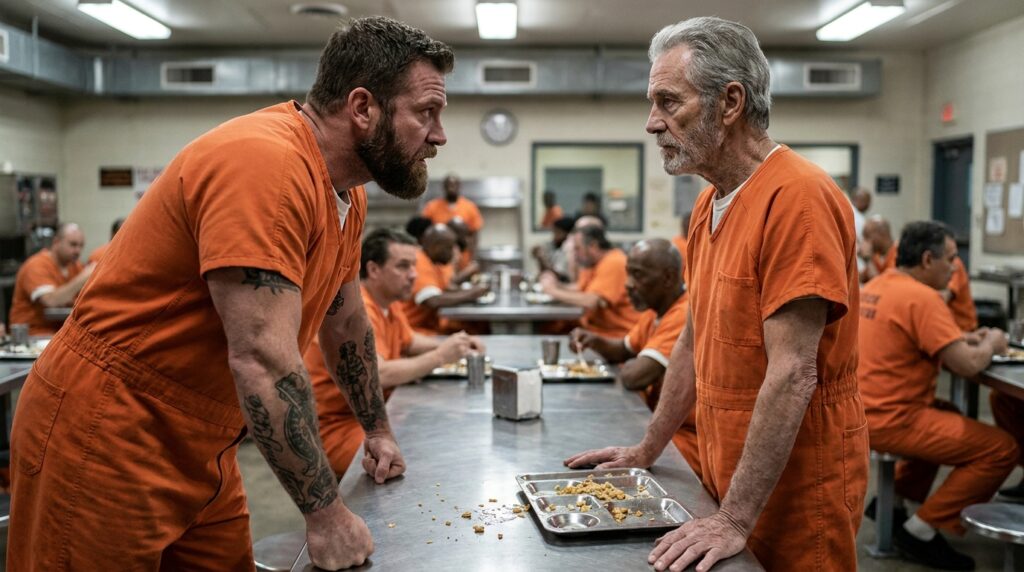
“You’re finished old man, nobody here is backing you.”

The words cut through the heavy, grease-laden air of the cafeteria, but they didn’t register as language. To the man with the graying beard, they were just a directional shift in the room’s pressure. The younger man’s chest was too close, a wall of orange cotton smelling of cheap soap and sour sweat. Then came the sharp, metallic clatter—the plastic food tray slithering off the bolted steel table, spilling boiled cabbage and gray gravy across the concrete floor.

The older man didn’t look down at the food. His boots remained fixed in the grease. In his seventy-eight years, fifty of them spent watching the predictable geometry of small rooms, he had learned that the moment a predatory man speaks, he has already committed his weight to a trajectory. The aggressor’s tattooed arms were flexed, his fingers widening to grip the older man’s collar, his posture leaning forward to use his late-thirties bulk as an anchor.

The older man didn’t swing. He didn’t have the marrow for a prolonged exchange. Instead, as the aggressor closed the final inches of the confrontation lane, the older man simply dropped his center of gravity by three inches, stepping inside the younger man’s reach with the dead, heavy momentum of a falling timber. He drove the heel of his palm upward, not into the jaw, but directly against the sub-clavian nerve cluster beneath the collarbone, while simultaneously hooking his left boot behind the aggressor’s right heel.

Physics took the space where malice had been. The younger man’s mass carried him forward, but his base was gone. His head struck the edge of the iron table leg with a dull, hollow thud that silenced the immediate rows of tables. He hit the concrete hard, his breath leaving him in a wet, ragged gasp, his fingers twitching against the gray gravy pooling near his cheek.

The older man stayed upright, though his own knee joint clicked with a dry, warning friction. His breath came short, tasting of the copper washer tucked firmly beneath his tongue. The entire room had gone static—two hundred men holding plastic spoons, their eyes locked on the gray beard and the shattered tray.

He looked down at the enforcer on the floor. The younger man’s eyes were wide, white-rimmed with shock, the skin around his temple already darkening where the iron had met bone.

“I have nothing left to lose,” the older man said, his voice a low, gravelly rasp that barely carried past the table edge. “Don’t test me. Stay down and leave it there.”

The aggressor didn’t move. He remained grounded, the violent momentum completely drained from his frame, his jaw working silently as he stared up at the man he had been ordered to break.

The older man began to step back, his boots slipping slightly in the grease, ready to retreat before the alarms started their rhythmic wail. But as he turned his face toward the exit tier, his eyes locked onto the guard post by the heavy iron gate. Officer Miller was standing there, his hand resting on his baton, his mouth twisted into a cold, transactional smile. He wasn’t reaching for his radio. Instead, he slowly slipped a small, black notebook—the exact medical logbook from the pharmacy cage that controlled the older man’s daily heart medication—directly into his back pocket.


CHAPTER 2: THE ISOLATION CAGE

The heavy iron gate didn’t swing; it shrieked along a rusted floor groove, a sound that vibrated straight through the soles of the older man’s split leather boots. Officer Miller’s hand remained flat against the textured grip of his heavy wooden baton, the small black medical notebook protruding from his hip pocket like a dark wedge. He didn’t issue an order. He simply canted his head toward the dark corridor that smelled of industrial bleach and seventy years of trapped damp.

“Walk, old man,” Miller said, his tone flat, entirely stripped of the performative hostility he used when the shifts changed.

The older man moved. Every step was an internal inventory of damage. The brief kinetic burst in the cafeteria had cost him more than the enforcer on the floor; his right knee joint grinded with a dry, iron-on-iron friction, and a dull, deep ache beneath his left ribs signaled a hairline fracture where the younger man’s elbow had grazed him during the descent. He held his breath to stabilize his diaphragm, keeping his lips pressed tightly over the thin copper washer tucked into the recess of his lower gum. The metallic tang of the coin mixed with the sour taste of adrenaline.

The isolation wing was a separate architecture of despair, situated in the basement beneath the laundry tier where the walls were perpetually slick with condensed sweat. They reached Cell 4—a narrow slit of concrete with a solid iron door and a viewless, rusted ventilation grate near the ceiling.

“Strip it down,” Miller commanded, leaning against the door frame. His keys clattered against his belt, a sharp, transactional ring that filled the six-by-nine space.

The older man unbuttoned his orange cotton uniform shirt with steady, thick-jointed fingers, dropping the fabric onto the concrete. He didn’t look at Miller’s eyes; he focused on the guard’s midsection, watching the small black notebook. That book contained the pharmacy cage logs—the double-entry verification that proved his clinical need for the beta-blockers that kept his irregular heartbeat from triggering an ischemic stroke. Without those entries, his pending medical parole application would be automatically discarded as non-essential.

Miller stepped into the cell, his heavy boot pinning the discarded orange shirt to the floor. He leaned in, his breath smelling of stale coffee and wintergreen tobacco. “You’ve got an active imagination for an old timer. Thinking you can drop a tier boss’s favorite runner and just walk back to your bunk.”

“He crossed the lane,” the older man said, his gravelly voice tight, compressed by the pain in his ribs. “The table anchor is common ground. You saw the tray.”

“I saw an old man getting erratic,” Miller whispered, his face inches away. He reached back and tapped the black notebook in his pocket. “The documentation says you’ve been refusing your daily vitals. Says you’re non-compliant. A man who won’t take his heart pills isn’t a candidate for early release. He’s a liability. The state doesn’t parole liabilities; it buries them in the outer yard.”

The older man stayed rigid, his bare chest rising and falling in shallow, metered increments to avoid aggravating the rib. The trap was clumsy but absolute. The administrative syndicate didn’t need to stab him in the shower tier; they just needed to let his own cardiovascular system do the work by withholding the daily white tablets under the guise of behavioral non-compliance. It was a clean, paperwork-driven execution.

“Who told you to pull the log?” the older man asked, keeping his subtext bare, transactional.

Miller smiled, a thin line that didn’t reach his eyes, and stepped back into the corridor. “The administration likes a clean ledger, Silas. Some names aren’t supposed to leave the roster. You’ve been here thirty years. You’re part of the masonry now. Why would we let a piece of the foundation just walk out the front gate?”

The heavy iron door slammed shut, the deadbolt engaging with a dry, mechanical thud that echoed down the isolation tier. The light inside the cell died instantly, leaving only a dim, desaturated gray rectangle where the door’s food slot sat closed.

Silas stood in the dark, the cold of the concrete floor rising through his socks. He reached into his mouth, pulled the small copper washer from behind his teeth, and pressed it firmly against his split lower lip. The pain was grounding. They thought they were rewriting his medical files to kill his parole, but they didn’t know he had already survived three administrations by knowing exactly which ledgers were kept in the dark. He felt along the rusted seam where the iron frame of the bunk met the stone wall, his fingertips tracing a small, sharp indentation in the mortar. The decoy secret—the guard’s forged medical logs—was meant to keep him look downward, focusing on his own survival, while the real ledger remained hidden where the infrastructure was rotting from the inside out.

He sat down on the bare steel springs of the bunk, his ears tuning to the rhythmic, low-frequency hum of the industrial laundry dryers two floors above. The vibration traveled through the stone, a steady, mechanical pulse that told him the shift rotation was beginning. He had exactly twenty-four hours before his heart muscle began to misfire without the medication, and the only man who could get him past the tier gates was currently waiting in the steam of the washroom.

CHAPTER 3: THE LAUNDRY SORTING FACILITY

The administrative transfer order came down at dawn, signed by a shift lieutenant Silas had never seen. It wasn’t an exoneration; it was a reassignment to the basement laundry lines, where the ambient temperature stayed at ninety-eight degrees and the humidity came from giant, vibrating copper boilers that ran on high-pressure steam. For Silas, the heat was a heavy weight against his fractured rib, each breath a sharp reminder of the cafeteria floor, but the change of venue was exactly what he had calculated for when he sat in the dark of Cell 4.

The laundry sorting facility was a labyrinth of gray institutional linen, wet canvas carts, and the choking stench of industrial lye. Because of the constant steam, the guards preferred to stay behind the reinforced glass of the upper observation deck, leaving the floor to the trusted lifers who managed the sorting tables.

Silas hauled a wet canvas cart toward the furthest row of industrial dryers, his boots sliding through the slick water that pooled along the cracked floor drainage tiles. His heart gave a rhythmic, double-beat skip—a warning sign that his lack of beta-blockers was starting to strain his arterial walls. He needed the logs, and he needed them before the afternoon tier count.

A lean man with a missing thumb and skin yellowed by three decades of basement grease stood by the linen press. This was Henderson, a lifer who had spent twenty years handling the intake manifests for the prison medical wing’s laundry bags. As Silas approached, Henderson didn’t look up from his press, his movements remaining perfectly rhythmic as he fed gray sheets into the hot iron rollers.

“Miller brought down three bags of medical rags last night,” Henderson said, his voice barely audible beneath the high-volume drone of the exhaust fans. “He didn’t leave them with the intake crew. He took them straight to the industrial incinerator chute behind the boiler room.”

Silas leaned his weight against the frame of his laundry cart, allowing his diaphragm to rest against the cold iron rim. “Did he clear the pockets?”

“He thought he did,” Henderson muttered, his foot tapping the steam valve pedal with a sharp hiss. “He dropped a bundle of burned carbon paper into the waste bin before he locked the chute. It was mostly ash by the time the shift turned over, but some pieces caught on the lip of the grease trap.”

Henderson didn’t look back as his hand slid into the inner lining of a freshly ironed pillowcase on the folding table. With a swift, practiced gesture born of institutional survival, he transferred a small, folded scrap of paper into Silas’s palm. The paper was rough, stiff with dried bleach, and smelled faintly of chemical residue.

Silas tucked the scrap beneath his orange waistband, his fingers immediately feeling the faint, raised indentation of carbon ink through the fabric. He turned his cart back toward the shadow of the storage bins, out of the direct line of sight of the upper glass booth. His pulse was thudding in his ears, a thin, rapid vibration that made his vision blur slightly around the edges.

Standing in the narrow gap between two stacks of institutional mattresses, Silas unfolded the scrap. It was a single, bleach-stained sheet torn from the pharmacy cage’s primary intake register. The handwriting belonged to Officer Miller, but the signatures alongside each entry were forged with a heavy, uneven pressure that didn’t match the medical officer’s clinical script.

The page documented three months of systematic medical non-compliance attributed to Silas’s name. According to the ink, Silas had allegedly refused twelve consecutive doses of heart medication, each refusal marked with a code that classified him as actively suicidal and a hazard to the tier staff. But the true detail—the physical secret that broke the surface of the lie—lay at the bottom of the column. Every forged refusal had been stamped with an authorization code that didn’t originate from the medical clinic. The stamp belonged to the Special Investigations Unit, the internal division controlled directly by the Warden’s administrative circle.

The decoy secret was clear. Miller wasn’t acting out of a personal grievance or simple tier cruelty; he was the functional instrument of an administrative execution designed to terminate Silas’s medical parole before his file reached the state review board next month. They were building a paper trail that would justify finding him dead in his bunk from natural causes, a clean bureaucratic deletion.

Silas refolded the carbon sheet, his thumb pressing against the rough edges of the paper until the crease cut into his skin. The revelation confirmed the trap, but it raised a deeper, colder question that Miller’s black notebook couldn’t answer. Silas was an old lifer, a quiet trustee who kept his mouth shut and his head down. A forged medical log was a high-risk administrative forgery, the kind of paper that could ruin a guard’s pension if an outside inspector ever verified the signatures. The administration wouldn’t risk that level of exposure just to keep a seventy-eight-year-old thief from dying at home.

He felt the copper washer inside his mouth, its metallic taste stronger now against his parched throat. They weren’t trying to punish him for the cafeteria fight. They were trying to silence him because they believed his impending release would take something out of these walls that was never supposed to see the sun.

The heavy iron door at the back of the laundry tier groaned open, the sound cutting cleanly through the steam. Two tier guards Silas hadn’t seen on the laundry rotation stepped through the mist, their hands unhooking the leather retaining straps on their heavy wooden batons. They didn’t look at Henderson or the other lifers. They walked directly down the center lane toward Silas’s cart, their eyes fixed on his gray beard.

“Silas,” the lead guard called out, his voice sharp against the hiss of the copper boilers. “Warden wants you in the recreation yard. Now. Leave the cart where it sits.”

CHAPTER 4: THE RECREATION YARD

The transition from the laundry basement to the yard was a blunt shock of cold air and blinding, desaturated light. Silas kept his left arm pressed slightly against his ribs, trying to damp the internal friction of the bone with the weight of his forearm. The two guards didn’t speak as they escorted him past the weight piles, where the rusted iron plates sat in puddles of brackish water. The general population had been cleared from the north corner of the enclosure, leaving an artificial vacuum against the chain-link fence.

Sitting on a bolted steel bench beneath the shadow of watchtower three was Vance. He didn’t look like an inmate who had spent twenty years in the iron. His orange uniform was pressed, his boots were free of yard mud, and his fingernails were clean. Vance was the undisputed engine of the block’s black market, a man who survived three separate gang wars by making himself indispensable to the administrative staff upstairs.

The guards stopped ten paces back, crossing their arms. They weren’t watching Vance; they were watching the perimeter, acting as a human screen.

“Sit, Silas,” Vance said, his voice quiet, holding the calm precision of a man who dealt exclusively in balances. He didn’t offer a cigarette. He didn’t acknowledge the dark bruise forming along Silas’s jaw.

Silas remained standing. The cold wind from the fence line cut through his damp uniform shirt, causing the muscles across his back to seize. “The laundry line wasn’t finished.”

“The laundry is irrelevant,” Vance replied, his eyes narrowing as he looked at the old man’s posture. “You survived the cafeteria because the kid was sloppy. He thought he was proving a point. I don’t care about points, Silas. I care about consistency. You’re holding something that belongs to a very delicate ecosystem.”

Silas felt the cold metal washer beneath his tongue. He didn’t blink. “I’m an old lifer with an irregular heartbeat, Vance. I don’t hold anything but my breath.”

Vance smiled, a slow, humorless movement of his lips that looked like a scar opening. He reached into his pocket and pulled out a small, yellowed index card—the master release manifest from the records department. “Your medical parole application passed the first administrative desk last night. It was supposed to die in the pharmacy log under non-compliance. Miller was supposed to handle that cleanly. But you’ve been digging around the linen bins, and Miller tells me you have a piece of carbon paper that doesn’t belong to you.”

Vance leaned forward, his elbows resting on his knees, his eyes dropping to the waistband where Silas had tucked the stolen register sheet. “You think that carbon paper is your leverage. You think proving the administration is forging your medical refusal will force the state board to let you out early. That’s your decoy, Silas. You’re playing a small game about a heart pill.”

Silas kept his face clear of expression, but his heart gave a violent, irregular thump against his fractured rib cage. The internal pressure was growing.

“The Warden doesn’t care about a medical lawsuit,” Vance continued, his voice dropping an octave, competing with the distant hum of the perimeter wire. “He cares about the thirty-year ledger. The one from the old basement archive. The ledger that details every offshore transaction handled through the inmate welfare fund since 1996. The ledger you re-indexed when you were the library trustee.”

The revelation hit Silas like a physical blow, colder than the wind off the fence. The carbon paper in his pocket wasn’t his shield; it was the bait that had drawn him out into the open yard. They didn’t want him dead in his cell because of a parole dispute. They wanted the financial records that could dismantle the entire administrative structure of the state correctional system.

“The kid in the cafeteria was a test,” Vance whispered. “If you were weak, we’d just let the medical log handle you. But you’re still functional. You’re still sharp enough to break a runner’s leg. Which means you’re still dangerous enough to take that ledger to the federal prosecutor the minute you cross the state line.”

Silas looked up at watchtower three. The guard in the glass booth wasn’t looking at the yard; his rifle was unslung, his back turned to the fence. The isolation was absolute.

“You have until the evening lockup to drop that ledger in the laundry chute,” Vance said, rising from the steel bench. He stepped close, his breath a cold mist between them. “If it’s not there when the tier count clears, the guards won’t bother with the pharmacy records. The doors on tier four will simply fail to lock during the night shift. Every unaligned runner on the block will have five minutes of free movement, and your cell door will be unlatched from the master control.”

Vance turned and walked toward the main corridor gate, the two escort guards immediately falling into step behind him. Silas was left alone against the chain-link fence, his hand shaking slightly as he reached into his pocket to touch the folded carbon paper. The small piece of leverage was gone, dissolved by the weight of a thirty-year secret he had hoped the world had forgotten.

He turned toward the housing block, his boots crunching against the desaturated gravel of the yard. The sky above the concrete walls was darkening, a heavy slate gray that promised rain before lockup. He had four hours before the tier gates closed, and the ledger was hidden where no one—not even Vance—could reach it without tearing the foundation of his own cell apart.

CHAPTER 5: THE SHATTERED BED

The steel door to Cell 12 didn’t close with its usual mechanical click; it dropped into the housing frame with a heavy, unyielding vibration that rattled Silas’s teeth. The single unshaded bulb hanging from the center of the tier ceiling flickered twice, casting a desaturated, yellow glare across the narrow room.

Silas stopped on the threshold. The small space had been systematically disassembled. His state-issued mattress had been dragged from the iron spring frame and split down the center seam, its compressed gray linen fibers spilling across the concrete floor like dirty snow. His replacement uniform shirts had been ripped from their plastic hooks, their sleeves tangled around the base of the stainless steel sink.

They hadn’t just searched the cell. They had gutted it.

He stood perfectly still, his left forearm clamped hard against his ribs to suppress the sharp, grinding heat of the hairline fracture. The internal skipping in his chest had grown more pronounced, a rapid, uneven flutter that tasted like pennies at the back of his throat. He had less than an hour before the final evening siren, and the yard guards were already executing the pre-lockout tier sweep.

He didn’t move toward the shredded mattress. He knew Vance’s crews wouldn’t find what they were looking for inside the cotton batting; that was a novice hiding place, the kind used by short-timers smuggling tobacco or sublingual strips. Silas closed his eyes, listening to the rhythmic, distant clanking of the tier gates closing on the lower levels.

He walked slowly to the rear wall, his split leather boots crunching against a piece of shattered institutional soap. Kneeling beside the rusted iron anchor where the bunk frame was bolted directly into the stone foundation, he ran his cracked fingers across the vertical mortar seam. The mortar was cold, rough, and damp from the rain dripping down the outer ventilation shaft.

His fingers found the specific indentation he had traced in the dark of the isolation cage. He pressed his thumbnail into the crease. The dried gray material didn’t crumble; it shifted backward as a solid block. Silas reached into his mouth, pulled the worn copper washer from beneath his tongue, and used its thin, notched edge to pry the hidden stone out of the recess.

The cavity behind the stone was completely empty.

A cold stillness settled into the marrow of his bones, heavier than the damp basement air. The ledger—the thirty-year record of the warden’s offshore accounts that he had extracted from the library archive before the re-indexing—was gone.

“Looking for this, old man?”

The voice came from the open food slot of the cell door. Silas didn’t turn around immediately. He carefully replaced the loose stone, stood up by leveraging his weight against the iron sink, and turned his face toward the small, rectangular opening in the steel.

Officer Miller was looking through the mesh. In his left hand, he held a thick, canvas-bound ledger with brass corners, its spine cracked and stained with the black ink of a dozens of audit stamps. In his right hand, he held a plastic syringe filled with a clear, colorless solution—the high-dosage synthetic beta-blocker that Silas’s heart required to prevent a fatal stroke.

“Vance thinks he runs the tier,” Miller said, his voice dropping into a flat, transactional whisper that barely cleared the iron slot. “Vance thinks everything in these walls belongs to his ecosystem. But Vance doesn’t look at the master payroll. He doesn’t see who authorizes the transfers.”

Silas leaned against the sink, his fingers gripping the cold, pitted metal to keep his knees from buckling under the irregular pounding in his chest. “You didn’t take it to Vance.”

“Vance wants to swap this book for a favor from the Warden,” Miller said, tapping the canvas cover against the iron door. “A reduction in his minimum date. A move to a low-security camp out west. Small-time thinking. This ledger isn’t a bargaining chip for a better room, Silas. This book is an insurance policy against the entire department.”

The old man understood the geometry of the trap now. The predatory hierarchy didn’t end with the cellblock syndicates or the warden’s inner office. It went down into the shift rotations, into the hands of the low-wage enforcers who kept the keys and watched the gates. Miller wasn’t working for Vance, and he wasn’t protecting the warden; he was securing his own retirement by collecting the chains that held them both.

“The block doors are unlatching in ten minutes,” Miller whispered, sliding the plastic syringe halfway through the food slot until it rested on the iron lip. “The control panel is going dark for the tier sweep. You give me the authorization codes for the encrypted columns on page forty-two, and I leave the needle on the shelf. You keep your mouth shut, and your heart stays inside your ribs until the morning shift.”

Silas looked at the clear fluid in the cylinder, then up at Miller’s eyes—cold, calculation-driven, entirely devoid of empathy. If he gave up the codes, the ledger became a live weapon in the hands of a dirty tier guard, and his life would be worth exactly nothing the moment the ink dried. If he refused, his door would slide open in ten minutes, and Vance’s runners would clear the debt with five inches of sharpened fence wire.

He reached down, his fingers closing around the cold plastic of the syringe. He didn’t look at the needle. He looked at the copper washer he still held tight in his left palm, the metal worn smooth by thirty years of keeping his teeth together.

“The code isn’t on page forty-two,” Silas said, his gravelly voice dropping into a hard, unyielding rasp. “It’s in the masonry. And you’re going to have to leave the door open if you want to find it.”

Miller’s eyes hardened, his hand pulling the canvas ledger back against his chest as the first long, rhythmic blast of the lockout siren began to wail across the tier.

CHAPTER 6: THE OPEN EDGE

The master control panel on the lower tier clicked—a single, heavy hydraulic sigh that traveled up the steel riser pipes—and Silas’s cell door slid back six inches into its recessed housing. It didn’t slam. It stopped with a loose, metallic rattle that indicated the deadbolts had been remotely bypassed from the guard desk.

Miller was already gone from the mesh, his boot-heels echoing with a rapid, deliberate rhythm down the concrete stairs toward the lower office. He had left the syringe. It lay on the iron lip of the food slot, its clear plastic barrel reflecting the desaturated yellow light of the corridor.

Silas didn’t reach for the needle. His pulse was a ragged, chaotic vibration now, a series of short, shallow thumps that sent a cold numbness creeping down the inside of his left bicep. The ten-minute window of unlatched movement had begun. The corridor outside was dead silent, but it was the silence of a pressurized pipe before the seam fails.

He didn’t have weapons. The state-issued toothbrush in his sink had been snapped by the search crew, its plastic handle too short to serve as an effective puncture tool against heavy cotton coats. Instead, Silas reached down and gripped the loose block of mortar he had pried from the rear wall anchor. It weighed four pounds, its edges sharp with dried lime and iron dust.

Footsteps rounded the corner of Tier Four. They weren’t the heavy, synchronized thuds of leather guard boots; they were the soft, shuffling slides of rubber-soled shower shoes. Three men.

Silas positioned himself behind the half-open steel door, using the narrow angle of the frame to constrict the entry lane. In a maximum-security cellblock, three hundred pounds of muscle meant nothing if it had to enter a twenty-eight-inch opening one shoulder at a time. He held his breath, pressing his back against the cold, sweating stone of the conduit chase, his left hand holding the thin copper washer against his lower teeth to anchor his jaw.

The first shadow crossed the gap. It was the younger enforcer from the cafeteria, his temple crudely taped with white medical gauze that was already dark with seeping blood. He didn’t look into the cell; he pushed the door with his shoulder, his right hand driving an eight-inch piece of sharpened concrete reinforcing bar toward the center of the bunk.

Silas didn’t defend the bed. As the enforcer’s momentum carried him into the empty cell, Silas brought the four-pound mortar block down in a short, vertical arc against the hinge of the man’s elbow.

The sound was a wet, heavy crack. The rebar spike dropped onto the concrete floor, its rusted tip spinning into the spilled gravy from the previous shift. The enforcer didn’t scream—screaming brought the response team before the five-minute block window cleared—he simply folded at the waist, his face striking the stainless steel rim of the sink with a dull, hollow impact that left him limp across the porcelain.

The remaining two men blocked the threshold, their shoulders wedged in the frame as they tried to clear their partner’s weight from the lane.

“He’s behind the leaf,” one whispered, his fingers clawing at the rusted iron edge of the door to force it wide.

Silas didn’t try to hold the barrier. He reached through the open food slot from the inside, his fingers closing around the barrel of the plastic syringe Miller had left behind. He didn’t inject his own arm. With a single, explosive thrust born of fifty years of tier survival, he drove the steel needle directly through the mesh into the exposed throat of the second enforcer crowding the gap.

He hit the plunger with his palm. The synthetic beta-blocker—a massive, concentrated dose designed to slow an ischemic heart down to a resting state—was forced instantly into the man’s carotid artery.

The effect wasn’t cinematic; it was a sudden, catastrophic drop in systemic blood pressure. The second man’s eyes rolled backward, his knees buckling outward as his nervous system failed to process the chemical shock. He collapsed into the corridor lane, his bulk pinning the third man’s legs against the opposite tier rail.

Silas stood in the narrow throat of the door, his breath coming in short, burning gasps that tasted of iron dust and old lye. He had cleared the entry, but the rapid exertion had pushed his own unmedicated heart into a fluttering stall. His vision was narrowing into a desaturated gray circle, the yellow corridor lights dissolving into a single, vibrating line.

Down the tier, the red emergency beacon above the pharmacy cage began to rotate, its silent, bloody glare cutting through the humid steam rising from the laundry shafts below. The administrative lockdown hadn’t been triggered by the fight; the alarm was pulsing because someone had just broken the glass on the central medical intake vault.

Silas dropped the empty plastic syringe body onto the concrete, his fingers reaching down to retrieve the rusted rebar spike from the floor grease. He didn’t look back at the cell. He stepped over the two fallen enforcers into the wider lane of the tier, his eyes locked on the rotating red light at the end of the block. Henderson was down there, and the air smelled of burnt copper wire.

CHAPTER 7: THE PHARMACY ALLIANCE

The air at the end of Tier Four didn’t smell of old cabbage or cold grease anymore; it tasted of scorched PVC insulation and the sharp, chemical dry-ice discharge of an expired fire extinguisher. Silas dragged his left foot across the threshold of the pharmacy vestibule, his fingers clamped so tightly around the rusted rebar spike that the coarse iron ridges began to split his calloused palm. The red beacon above the security enclosure continued its slow, mechanical rotation, painting the wire-reinforced glass partitions in alternating slashes of dark crimson and heavy shadow.

The heavy steel mesh gate to the medical intake vault had been wrenched outward by a hydraulic vehicle jack, its anchor bolts sheared clean from the reinforced concrete casing. Inside the narrow room, among overturned metal trays of saline bags and scattered white paper cups, Henderson was slumped against the backup power generator. His remaining thumb was hooked into the heavy chain of a floor-mounted lockbox, and his face was slick with gray sweat that highlighted the deep lines of thirty years of subterranean labor.

“You’re late, Silas,” Henderson rasped, his breath coming in a wet whistle that suggested his own lungs were filling from the thick, hovering layer of plastic smoke. “Miller didn’t take the outer elevator. He went back through the service crawlways behind the water lines.”

Silas dropped to his good knee beside the generator, his joints letting out a dry click that seemed abnormally loud against the low, hum of the emergency sirens. He didn’t pick up the medicine bottles scattered by his boot. His vision was still tunneled by the irregular, racing stammer in his chest—a frantic, dry-pump rhythm that left his throat parched. “Where is the ledger?”

“He didn’t have it when he came through the cage,” Henderson whispered, his hand trembling as he gestured toward the shattered glass partition of the primary pharmacy office. “He had a courier bag, but it was light. He was looking for the master override key—the heavy brass one with the blank head that unlocks the warden’s private elevator in the administration wing. He’s running, Silas. He knows the Warden sent Vance’s crew to clear your block, and he knows he’s the next variable they’re going to delete to keep the offshore accounts from leaking.”

The trap had widened. It had broken out of the simple transactional violence of the cells and entered the survival logic of the administrative staff. Miller wasn’t an enforcer looking for a long-term pension anymore; he was a rabbit who had stolen the hawk’s nesting records and was trying to reach the highway before the perimeter gates locked for the state audit.

“Did he get the override?” Silas asked, his fingers tightening around the rebar spike as he calculated the distance to the central administrative stairwell.

“He didn’t find the original,” Henderson said, pulling a heavy, unnotched brass key from beneath his oil-stained canvas work apron. The key was clean, but its blank head was stamped with a single, deep horizontal scratch—the mark of a duplicate made in the machine shop forty-eight hours ago. “I switched the cabinet tags before the morning shift rotation. He took the dummy from the medical locker. If he tries to jam that into the administration gate elevator, the cylinder will freeze, and the electronic relays will lock him inside the shaft cage until the main guard desk resets the grid.”

Silas took the brass key from Henderson’s hand. The cold metal was heavy, its surfaces unpolished and sharp along the shoulder grooves. This was the real tool—the single mechanical leverage point that could get him out of the housing tier and into the upper executive offices where the true ledger was being processed for destruction. But the victory felt dirty, paid for with the immediate collapse of his own safety margin.

“The Warden’s personal enforcers are already coming down the north stairs,” Henderson said, his head dropping back against the vibrating casing of the generator. “They aren’t block guards, Silas. They’re the riot crew from the executive detail. They have the black vests and the heavy wooden clubs. They aren’t here to check your ID tokens. They’re here to clean the block before the state inspectors arrive at five o’clock.”

A sudden, sharp series of metallic thuds echoed from the access tunnel behind the pharmacy enclosure. The security gates at the end of the corridor were being struck with heavy iron pry-bars, the sound ringing through the structural pipes like a series of rapid hammer blows. The unlatched movement window was closing; the administration was forcing the grid back into operation ahead of schedule to trap the survivors inside the burning tiers.

Silas pulled Henderson upward by his canvas apron, but the older lifer’s legs remained loose, his boots sliding uselessly through the oil and spilled medicine on the floor.

“Leave it, Silas,” Henderson muttered, his hand weakly pushing at the old man’s forearm. “My knees are done. I’ve been down in this damp since seventy-two. There’s no parole waiting for a five-to-life man with fluid in his chest. You get across the service bridge. You use the scratch-key on the administrative lift. If you find that book, you don’t take it to a lawyer. You drop it into the public furnace line by the power house. You let the whole block see the soot.”

The iron gate at the entry vestibule gave way with a final, tearing screech of metal. Three figures in dark, unlabeled ballistic vests and visored helmets stepped through the black smoke, their long wooden batons raised as they began their rhythmic, silent advance through the wreckage of the medical cage. They didn’t offer verbal commands; their boots moved with the synchronized, heavy precision of a machine designed to grind down everything in its lane. Silas stood up, his spine straight against the wall, the real brass key hidden inside his closed fist while the red light continued its bloody, mechanical sweep across the visors of the oncoming crew.

CHAPTER 8: THE EXHAUST CORRIDOR

The visored helmet of the lead tactical guard didn’t sway; it came forward in a straight, mechanical line through the plastic smoke, the heavy wooden baton raised to strike the width of the lane. Silas didn’t attempt to swing the rusted rebar spike against the armor plating. He dropped his weight downward, dragging his shoulder along the slick casing of the backup generator, and drove the blunt iron rod directly into the narrow gap behind the guard’s left knee guard.

The impact was a dull, vibrations-heavy thud that traveled straight into Silas’s cracked ribs. The guard stumbled, his boot sliding through the pool of spilled oil, but the second officer was already swinging. The wooden baton caught Silas across the shoulder blade, a numbing shock that broke his grip on the rebar and sent him crashing sideways against the ventilation ducting.

“Get the lifer,” a voice barked behind the visors, distorted by the internal filters of the respirators.

Silas didn’t look back to see if Henderson was still breathing. His left arm was completely dead, a cold weight hanging from his shoulder, but his right hand remained closed around the duplicated brass key hidden inside his palm. He slid his body through the open maintenance port behind the ductwork—a fourteen-inch vertical slit intended for the high-pressure steam pipes. The metal edges were jagged with rust, tearing through his orange uniform shirt and cutting deep into the skin of his stomach, but the constriction of the gap worked in his favor. The wide, bulky ballistic vests of the executive detail couldn’t follow.

The utility shaft was a vertical column of absolute dark, roaring with the high-velocity vibration of the main drainage pumps. Silas climbed by feel, his boots finding the slippery, narrow rungs of the iron service ladder that led toward the administrative floor. Every vertical extension of his frame felt like a burning needle driven through his chest; his heart was hitting a frantic, hollow three-beat gallop that made a thick, greasy gray mist settle behind his retinas.

He reached the upper access hatch after three minutes that felt like hours measured in iron rust and sweat. He shoved the unbolted iron plate upward with his forehead, tumbling out onto the linoleum tile of the administrative basement corridor.

The air here was different—cool, dry, and smelling faintly of floor wax and copy toner. At the end of the hall, the indicator light above the warden’s private elevator shaft was pulsing a steady, mechanical amber.

Officer Miller was there. He was frantically hammering his fist against the steel control casing, his uniform cap gone, his collar soaked with perspiration. The thick, canvas-bound ledger was jammed beneath his armpit, its brass corners catching the fluorescent light. Inside the keyway of the elevator control panel, the dummy brass key Henderson had planted was sheared off flat against the cylinder, its unnotched shoulder having frozen the mechanical tumbler solid.

“Open up, you piece of garbage,” Miller muttered, his fingers clawing at the brass fragment protruding from the lock.

Silas dragged himself forward, his boots making a faint, wet sucking sound on the polished floor. The numbness in his left arm had reached his throat, tasting like burnt tin. “The pins are dead, Miller. It won’t turn.”

Miller spun around, his hand moving instantly toward the leather holster at his hip. But the movement was clumsy, driven by the panic of a man who heard the riot sirens rising from the lower tiers. Silas didn’t wait for the draw. He threw his entire seventy-eight-year-old bulk forward, driving his right hand—still holding the genuine, scratched brass key—straight into the guard’s throat.

The horizontal scratch on the key’s blank head caught the light as it struck the soft tissue beneath Miller’s chin. The guard choked, his back hitting the steel elevator doors with a hollow reverberation, the canvas ledger slipping from his armpit to slide across the floor toward the baseboard.

Silas didn’t follow the man down. He collapsed over the ledger, his knees striking the floor with a heavy, final impact that cracked the linoleum. He pulled the thick volume toward his chest, his fingers tracing the worn canvas fibers.

The double-layer mystery was gone now. This wasn’t about his heart pills, and it wasn’t about a single guard’s career. The open ledger lay flat in the cool administrative light, its pages covered in the tight, uniform ledger rows of thirty years of institutional fraud—the specific signatures of three separate state senators alongside the Warden’s private offshore banking routings. Silas had spent three decades in the dark of this prison, thinking he was just a number waiting out the clock, but he had been the sole keeper of the ink that could dismantle the state’s entire penal engine.

The elevator cables inside the shaft groaned, a low, mechanical whistle that indicated the override from the main guard desk had finally cleared the frozen cylinder from above. The heavy steel doors began to slide back, revealing the wide, dark interior of the executive car.

Silas lay flat against the floor, his cheek pressed against the cool, waxed tile, his right hand still locked around the real brass key. The rapid, chaotic fluttering in his chest was beginning to slow down into a wide, cold silence. He had kept his mouth shut for thirty years, and now the ledger was out of the wall, but his own release papers were still sitting on a desk that was about to burn.

The iron security gates at the end of the administrative corridor gave way with a loud, mechanical snap, and the sound of heavy, polished boots began to advance down the tile toward the open lift.

CHAPTER 9: THE EXTRACTION SHAFT

The first boot-heel of the executive detail struck the linoleum thirty yards down the hall, a sharp, military pop that echoed off the painted concrete walls. Silas didn’t try to lift his frame using his deadened left arm. He rolled his body sideways, dragging the five-pound canvas ledger across the polished floor tiles until his shoulder hit the narrow gap between the open elevator car and the raw steel edge of the shaft threshold.

The gap was barely nine inches wide—a dark drop filled with the smell of old grease and cold machinery.

Silas let himself slide through the opening, his legs dangling into the void of the elevator pit as Miller’s unconscious form lay twitching against the control panel above. His fingers, greasy with floor wax and his own blood, clawed at the heavy structural beam beneath the floor line. The hairline fracture in his rib cage screamed with a hot, dry friction as his full weight settled onto the rusted iron brackets that held the counterweight rails.

He dropped four feet into the absolute dark of the pit, his boots hitting the concrete base with a wet slap as they sunk into two inches of stagnant water and sludge. Above him, the heavy steel elevator doors slid closed with a dull, hydraulic hiss, cutting off the fluorescent light of the administrative corridor and replacing it with the low, vibrating static of the exhaust turbines.

“Clear the floor,” a voice barked through the steel paneling above his head. “Miller’s down. Find the old man before he reaches the service stairs.”

Silas didn’t move through the sludge. He sat back against the oily concrete foundation wall, pulling the thick canvas ledger into the lap of his wet orange trousers. His heart was no longer hitting the frantic, rapid stammer; it had dropped into a heavy, sluggish pound that left his fingertips cold and his throat tasting of lead. He had less than twenty minutes before the administrative shift turned over for the morning audit, and his only path out of the basement line was the low-clearance return line that fed the main boiler furnaces.

He reached into the dark, his hand tracing the base of the elevator car’s iron buffer spring until his fingers found the edge of a loose sheet-metal louver. This was the intake vent for the primary air circulation system—a narrow, square conduit that bypassed the guarded corridor gates by cutting directly through the subterranean foundation walls.

The louver was secured by two rusted flat-head screws. Silas didn’t have a driver, but he had the duplicated brass key Henderson had given him in the pharmacy cage. He jammed the notched edge of the blank key into the screw head, using the weight of his palm to force the metal to turn against thirty years of lime buildup.

The iron gave way with a sharp, dry snap that echoed inside the hollow shaft. Silas pried the metal plate back, creating an entry hole just wide enough for his lean, elderly shoulders. He shoved the thick ledger into the darkness of the pipe first, the sound of the canvas scraping against the zinc lining like a shovel sliding through dry dirt.

As he dragged his legs into the conduit, his left foot caught on a jagged piece of the buffer frame. The metal tore through his boot leather, cutting into his heel, but the pain was distant, secondary to the cold air rushing through the tube from the boiler room below. He crawled by feel, his elbows scraping the narrow zinc sides of the pipe, his forehead pressing against the cold spine of the ledger as he pushed it forward inch by inch.

The pipe wasn’t level; it pitched downward at a fifteen-degree angle, forcing his weight to slide through a film of soot and accumulated coal dust. The air grew rapidly warmer, the smell of institutional lye and grease fading behind the heavy, sulfurous stench of low-grade fuel oil and burning anthracite. He was moving beneath the main security fence now, outside the grid of the housing tiers, but he was moving deeper into the mechanical lungs of the facility where the temperature stayed at one hundred and ten degrees.

He reached the end of the line after ten yards of horizontal friction. The conduit terminated in a heavy iron intake grate situated twelve feet above the concrete floor of the main boiler vault. Through the metal slats, Silas could see the massive, vibrating cylinders of the three primary steam furnaces, their combustion ports glowing with a low, white-hot roar that filled the room with an unceasing mechanical thunder.

Standing between the two largest boilers was the Warden. He wasn’t wearing his executive suit; his shirtsleeves were rolled up to his elbows, his hands covered in gray graphite grease as he manually fed loose bundles of white administrative paper into the auxiliary incinerator chute. His private security detail—two men in civilian leather coats with unslung automatic carbines—stood by the service elevator door, their eyes locked on the master pressure gauges.

They weren’t burning old laundry manifests. They were destroying the master hard drives from the financial office before the federal audit vans crossed the outer perimeter. The administrative circle was clearing the house from the inside out, and the ledger Silas held against his ribs was the last physical fragment of the truth left on the property.

Silas pressed his face against the iron slats of the grate, his breath coming in shallow, dry wheezes that left black coal rings around his graying mustache. He had the book, but the room below was a closed trap, and the key in his hand couldn’t open an iron door that was bolted from the clean side.

CHAPTER 10: THE VALVES OF THE ARCHITECT

The sheet-zinc lining beneath Silas’s palms vibrated with a rhythmic, high-frequency shudder that threatened to loosen the bone-deep ache in his fractured ribs. The intense, sulfurous heat radiating from the iron intake grate twelve feet above the floor felt like a physical barrier, drying the sweat on his forehead into a white crust of salt and coal soot. He held the canvas ledger squeezed tight between his chest and the metal pipe floor, his lungs working in shallow, rapid hitches to absorb what little oxygen remained above the white-hot combustion zones.

Below the grate, the physical workspace of the boiler vault operated with a deafening, industrial roar. The Warden stood precisely between the two largest steam cylinders, his jaw set in a hard, pale line that looked completely bloodless under the yellow glare of the overhead safety lamps. He didn’t look up at the ventilation network; his eyes were tracked entirely on the digital readout of the master pressure valves while his grease-stained hands methodically stuffed bundles of shredder remnants into the auxiliary furnace port.

“The perimeter sensors on the north gate just dropped offline,” the lead security guard said, his voice flat but strained as he adjusted the heavy leather strap of his carbine. “The audit convoy is passing the secondary outer checkpoint. We have less than ten minutes before the federal marshal clears the main administration desk.”

The Warden didn’t stop his hands. He rammed a fresh block of documentation into the white-hot opening, the sudden surge of fuel causing a long, bright tongue of yellow flame to lick the rusted iron hinges of the hatch. “Let them clear the desk. The data loops on the primary server were overwritten at midnight. If they don’t have the hard-copy registration blocks from ninety-six, they’re looking at a standard budget deficit, nothing more.”

Silas watched the paper char instantly inside the chamber, the fine gray soot swirling upward to settle against the iron slats of his perch. The trap below was absolute, but the old man’s intellect was already calculating the mechanical limits of the room. The main boilers ran on an interconnected high-pressure steam line that was managed by a single, manually operated counterweight valve located directly beneath the intake grate’s structural support bracket. If that valve was forced past its safety stop, the thermal pressure would back up into the auxiliary incinerator line, freezing the intake hatches and flooding the lower floor with three hundred degrees of raw, unspent oil steam.

He reached through the metal slats of the grate with his good right hand, his fingers feeling along the rough, pitted surface of the valve’s iron locking pin. The pin was thick, covered in a deep glaze of baked industrial grease that had hardened into a substance as solid as the masonry itself. He didn’t have the leverage to pull it with raw muscle; his left arm was still a useless, dead weight pinning the ledger to his ribs.

He pulled the duplicated brass key from his waistband, jamming its flat, notched shoulder into the narrow gap behind the pin’s retaining ring. He used his lower jaw to brace his arm, pressing his teeth against the cold copper washer inside his cheek until the metallic tang filled his mouth. With a single, desperate heave that sent a white flash of pain straight down his spine, he threw the entire weight of his shoulder against the brass key.

The iron retaining ring sheared off with a sharp, high-frequency ping that was completely swallowed by the roar of the furnace turbines. The counterweight arm dropped instantly, its heavy iron wheel spinning backward until it hit the safety stop with a dull, mechanical thud.

The effect on the room below was immediate. The white-hot roar of the combustion ports choked down into a low, wet rumble as the high-pressure steam lines began to back up into the exhaust manifold. The auxiliary intake port where the Warden was standing let out a violent, high-volume hiss, the hatch door slamming shut automatically under the sudden buildup of internal pneumatic pressure.

“The pressure’s dropping in cell block four,” the second security guard shouted, his hand dropping to his side as the overhead safety lamps flared and died, leaving the vault illuminated only by the dull, orange glow of the blocked furnaces. “The line’s backing up into the main manifold! Get the Warden out to the service lift!”

The Warden stepped back from the hissing hatch, his face blackened by a sudden blowback of soot, his eyes tracking the structural pipes up toward the ventilation ceiling. He didn’t see Silas behind the dark iron slats of the intake grate, but he saw the outline of the canvas ledger sticking out from the open zinc seam where the metal had pulled away from the stone.

“Silas,” the Warden said, his voice dropping into a clear, un-amplified tone that carried through the sudden steam hiss with the cold precision of a judicial sentence. “You’re still inside the pipe. You’ve been inside the pipe for thirty years, old man. You think changing the valves changes who owns the foundation?”

The two security guards raised their carbines toward the ceiling, their fingers tightening on the triggers as the first white plumes of raw steam began to leak from the overhead pressure seals, filling the upper three feet of the vault with a blinding, lethal mist that completely obscured the iron rungs of the exit ladder. Silas dragged the ledger back into the dark of the shaft, his boots sliding through the soot as the iron slats beneath him began to blister his skin through the leather.

CHAPTER 11: THE SOOT ON THE WIND

The white steam didn’t rise; it expanded with a high-pressure roar that flattened the remaining smoke against the zinc ceiling plates. Silas crawled backward through the burning tube, his right hand hooking into the raw linen binding of the five-pound ledger while his split leather boots kicked blindly into the dark toward the elevator pit. Below the grate, the carbine fire was a series of muffled, concussive thuds, the bullets puncturing the steel floor framing but failing to penetrate the horizontal thickness of the foundation stone.

He tumbled out of the air intake conduit back into the standing water of the shaft base, his body hitting the sludge with a heavy, deadened splash that cooled the blistering heat in his shirt. Above him, the administrative lift car was completely stationary, its safety counterweights locked in place by the pneumatic shutdown. The air down here was thick with the smell of vaporized machine oil and old limestone dust.

Silas sat in the mud, his back braced against the concrete pillar that anchored the main lift track. The uneven, three-beat gallop in his chest had finally gone quiet, replaced by a wide, heavy coldness that made his fingers clumsy as he opened the canvas-covered ledger across his wet knees. The fluorescent light leaking down from the cracked service door was barely enough to illuminate the columns, but Silas didn’t need to read the numbers. He knew the names by heart.

He reached into the inner sleeve of the binding, his fingers sliding behind the glued linen reinforcement until they touched a hard, metallic circle. It wasn’t another copper washer. It was a silver federal transit token from 1996—the unique identification marker issued to the independent treasury inspectors who had vanished from the state roster during the first prison construction audit thirty years ago.

The ultimate reality sat flat in his palm. The Warden hadn’t built this infrastructure to launder simple administrative bribes or kickbacks from the welfare fund. The prison itself was the asset; a closed financial circuit where every cell block was a shell company designed to absorb federal infrastructure bonds for an offshore trust that had been operational since the day the first iron gate was bolted into the stone. Silas hadn’t been chosen to re-index the archive because he was a trusted lifer; he had been left there because they believed an old man with a failing heart would simply die before the maturity date on the bonds cleared the regional bank.

The service elevator door at the end of the lower corridor blew outward with a sharp, pneumatic pop, and the white mist from the boiler room began to spill across the linoleum tiles like river silt.

“Silas!” the Warden’s voice came through the vapor, closer now, accompanied by the wet, rhythmic dragging of a leather boot-heel through the water. He was moving without his security detail, his hand scraping along the rusted wall conduits to maintain his balance in the blindness of the steam. “The trucks are at the outer wire, Silas. The marshals aren’t here to read the ledger. They’re here to secure the physical property for the state receiver. A piece of paper doesn’t change the custody order.”

Silas stood up, his right hand lifting the canvas volume by its broken spine, his left arm still hanging uselessly against his cracked ribs. He pushed the heavy service door wide, stepping out of the dark of the elevator pit directly into the path of the advancing silhouette.

The Warden stopped five paces back, his white shirt completely blackened by the boiler blowback, his fingers twitching near the pocket where his private keys were kept. He looked at the thick canvas book in Silas’s hand, then down at the small silver transit token sitting on the top page.

“It’s thirty years too late for a trial, Silas,” the Warden whispered, his breath coming in shallow, ragged wheezes that matched the old man’s cadence. “The men who signed those transfers are either dead or running the committee upstairs. You take that book across the gate, and all you’re doing is giving them a reason to rename the facility.”

“I’m not taking it to the gate,” Silas said, his gravelly voice dropping into the lowest register of the room’s industrial rumble.

He didn’t swing at the Warden. He didn’t move toward the main administration lift. Silas stepped sideways to the wide, vertical iron shaft of the primary powerhouse flue—the massive, unlined exhaust trunk that fed the soot from the lower furnaces straight up through the center of the housing tiers toward the roof line. The iron access hatch was hot to the touch, its edges weeping with thick, black creosote that had accumulated over half a century of continuous burning.

With his right hand, Silas unlatched the heavy lever, the internal draft of the chimney drawing the white steam from the corridor into the dark throat of the brickwork with a fierce, whistling intake of air. He held the canvas ledger over the open void for a single, static second, letting the hot air from the backed-up boilers catch the edges of the linen pages.

“Silas, don’t,” the Warden said, taking a step forward, his hand extending toward the book with a sudden, frantic desperation that stripped the last remnants of executive authority from his face. “That’s the only record left.”

“I know,” Silas said.

He released his grip. The five-pound book didn’t fall down into the flames; the immense, pneumatic upward draft of the exhaust line caught the heavy canvas volume, tearing the pages from the spine in a fraction of a second. The thirty-year accounting ledger vanished upward through the dark center of the prison architecture, its columns of ink and forged signatures dissolving into a column of white-hot ash and gray sparks that flew out into the cold rain above the cell blocks.

The Warden dropped to his knees before the open hatch, his hands reaching blindly into the hot soot to catch the charred fragments of the linen binding, but the draft had already cleared the chamber.

Silas stepped back into the shadow of the elevator frame, his hand moving to his mouth to retrieve the thin copper washer from beneath his tongue. He dropped the small piece of metal into the stagnant water of the floor drain, watching it sink beneath the gray oil slick before the first heavy thuds of the federal marshal’s entry axes began to splinter the upper administrative doors. The air from the chimney was clean now, smelling only of wood-ash and the wet earth outside the walls, and the old man simply sat down against the iron rail to wait for the change of shift.

Similar Posts

Leave a Reply

Your email address will not be published. Required fields are marked *






