CHAPTER 1: THE ACCRUED WEIGHT
The heavy wheels of the commercial cart rattled against the unsealed concrete of the third aisle, a low vibration that traveled up the steel frame and settled behind Arthur’s knuckles. The air smelled distinctly of cold refrigeration coolant and floor wax—the industrial perfume of a suburban market at mid-day. Around him, the noise of Saturday morning shopping was flat, muffled by the sheer volume of high-stacked pallets and the distant hum of the main compressors. Arthur didn’t look up at the glare of the high overhead lights. His gaze was anchored three inches above his own reflection on the chrome handle, his left thumb hooked through a tarnished brass key ring that had grown cold against his skin.
He picked a bunch of rosemary from the wooden crate, his fingers catching the rough, oily texture of the stems. Every movement had the dry, metric precision of a man who spent his mornings measuring flour by the gram and wood shavings by the millimeter. The leaves went into a plain canvas sack that sat beside three blocks of local cheddar. The weight was right. He knew the margin of his clock down to the single digit; the community kitchen doors would unlock at exactly four, and the iron ranges required two full hours of pre-heating before the iron would hold the steady, uniform heat Martha had always demanded for the charity roast.
“They’re holding the box at the cage, Artie,” the boy behind the specialty counter muttered, his voice dry from the draft of the nearby intake vent. He didn’t look up from his ledger. He simply reached out a hand, his skin gray under the fluorescent tube, and waited for the slip.
Arthur handed over the paper. The blue ink was faded, stamped forty-eight hours prior by the parish administrator. He watched the boy slide the key into the heavy iron lock of the mesh cage at the rear wall. When the gate swung back, it gave a dry, ungreased shriek that made a woman two lanes over stop her cart. Inside the cage sat the hammered copper set—a three-ply heavy metal container with raw brass rivets, the cardboard box thick and bound with fiber tape that smelled of old starch and dust. It was an old-stock model, heavier than the modern aluminum-core sets that flooded the front displays, built for heavy labor over open flame.
The terminal key clicks were short, sharp impacts. Arthur pulled his wallet from the internal pocket of his canvas jacket—the fabric stiff with the grease of three seasons of school workshops—and laid five twenty-dollar bills flat on the zinc counter. The paper money was dry, ironed flat by hand the night before.
“Serial number ends in nine-zero,” the clerk said, stamping the paper receipt twice with a heavy ink pad that left a purple smudge across the invoice margin. “It’s out of the system now. It’s off our ledger.”
Arthur lifted the box. The weight settled immediately into the lower discs of his spine—a solid, unyielding presence that felt real in a way the brightly colored boxes on the grocery shelves never did. He laid it flat in the bottom of his metal basket, covering the rough cardboard with the edge of his canvas sack. The metal lines of the basket groaned slightly under the load, then went silent as he turned the corner toward the main corridor.
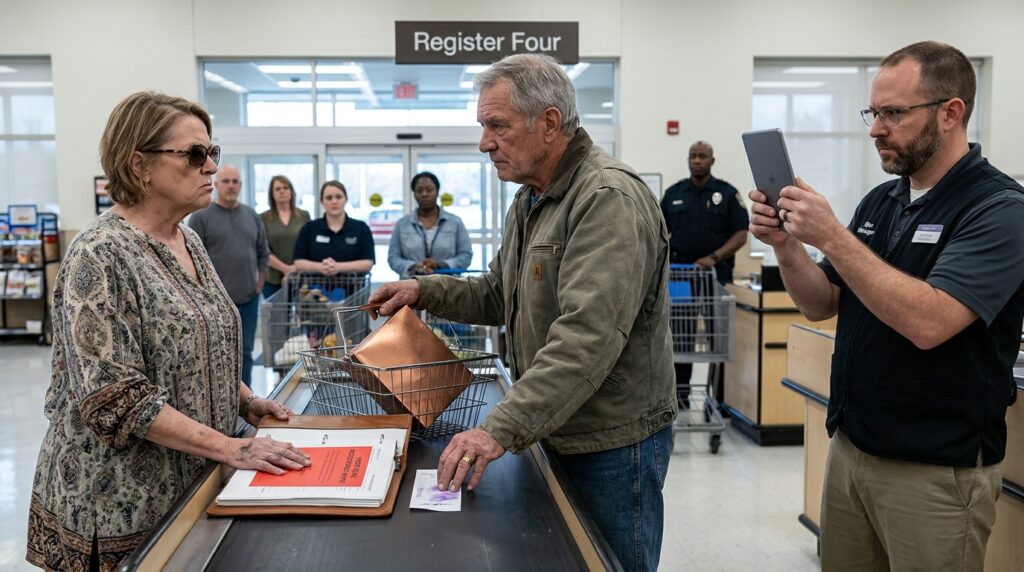
At the entrance of Lane Four, the line had ground to a complete halt. A massive cart, piled high with imported mineral water and white-boxed catering trays, sat diagonally across the narrow lane, its front wheels jammed hard against the rubber conveyor frame. Beatrice Crawford stood beside the obstruction, her frame rigid inside a loud, oversized tunic that seemed to absorb the gray light from the glass doors. Her designer sunglasses were pushed into her hair, leaving two dark marks on the bridge of her nose, and her right hand clutched a leather-bound logbook like a defensive weapon.
“That cart stays behind the line, Pendleton,” she said, her voice dropping onto the conveyor with the dull, metallic thud of a closing gate. She didn’t look at his face; her eyes were locked onto the brown cardboard corner visible beneath his canvas sack. “The registry for the valley foundation was cleared by the board this morning. That unit belongs on the club vehicle.”
Arthur stopped his cart six inches from her rear tire. He didn’t drop his hands from the handle. He felt the cold brass ring bite into his thumb as he tightened his grip, the sharp edge of the metal grounding the heat that had started to rise in his throat. The line behind him grew quiet, the sudden silence expanding outward until the checkout clerk at the register froze, a bottle of olive oil held inches above the red laser window.
“The unit is logged,” Arthur said. His voice was flat, carrying the dry rasp of dry erase dust and old pine. “It’s paid.”
Beatrice stepped forward, her sandals clicking hard against the concrete, her shadow falling directly across the rosemary leaves in his basket. She reached out, her fingers hooked like iron talons as they caught the edge of his canvas sack. “We’ll let the manager check the floor logs before you move another inch.”
Behind her, through the large glass front of the market, a silver sedan pulled into the loading zone, its hazard lights pulsing against the gray asphalt like a low, rhythmic warning.