CHAPTER 4: THE AUDIT LOCKDOWN
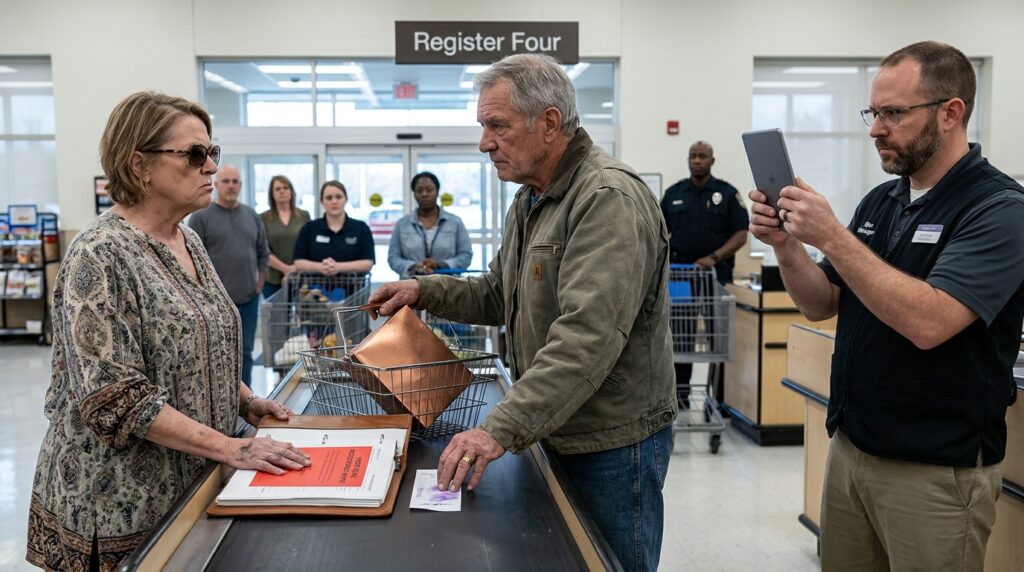
The heavy black boots of floor manager Marcus Vance stopped precisely at the juncture where the rubber conveyor belt met the stainless steel dividing rail. He did not look at the crowd backing into the seasonal endcaps, nor did he look at the cell phone lenses catching the harsh fluorescent glare from the pharmacy line. His eyes were entirely clinical, fixed on the corner of the brown cardboard box wedged beneath Arthur’s canvas sack. The air between them hummed with the electric dry heat of twenty digital registers operating at maximum capacity, carrying the smell of crushed paper bags, warm circuit boards, and the dry grease of old shopping cart axles.
“Miller, clear the corridor behind Lane Five,” Marcus said, his voice dropping into the tense pocket of air like a wrench hitting a workshop floor. He did not raise his tone, but the transactional rhythm of his command made the guard shift his weight away from Arthur’s cart. “We’re blocking the egress lane. Mr. Pendleton, keep your hands on the chrome bar. Mrs. Crawford, take your planner off the conveyor.”
Beatrice did not retreat. Instead, she adjusted the heavy strap of her binder, her knuckles whitening as she jammed the leather cover down onto the metal divider. The motion was defensive, quick, but it wasn’t fast enough to conceal the bright red receivership notice tucked into the clear plastic sleeve of her portfolio. “The ledger is clear, Marcus,” she said, her teeth clicking slightly behind her sunglasses. “The corporate authorization draft was logged by the foundation treasurer. This unit was flagged for pre-clearance withdrawal under the old valley development easement. If this man has a printout from the rear bay, it’s an invalid duplication.”
Arthur felt the cold brass of Martha’s key ring press deep into the muscle of his left thumb. The time on the big digital terminal clock above the exit doors read 11:42. The iron ranges at the community center required two full hours of pre-heating before the heavy metal plates could hold the precise, uniform thermal load needed for the charity roast. Every minute spent idling at this register was a minute stolen from the promise he had made in the dry dust of the winter cemetery.
“The invoice is cash-cleared,” Arthur said, his voice carrying the rough, unyielding grain of a rasp cutting through pine. He reached down with his right hand, smoothing the smudged purple invoice against the dividing rail. “The terminal registered the transaction at 10:14. The tracking code ends in nine-zero. The parish paid the warehouse directly.”
Marcus Vance pulled a gray digital tablet from the holster at his hip. The screen flickered with a low, green-tinted inventory log that reflected across his glasses in thin, horizontal lines. His thumb made three sharp, tapping sounds against the glass—the friction of dry skin on an unpolished screen. “The inventory log shows the nine-zero series was moved to the secondary asset cage forty-eight hours ago,” Marcus murmured, his eyes scanning the data columns. “It wasn’t flagged for the floor. It was designated as a county liquidation asset.”
“Exactly,” Beatrice said, her posture straightening as she took a half-step forward, her loud tunic rustling like dry corn husks. “It’s a corporate allocation under the charter. The store has no authority to clear it for public purchase.”
“Hold on, Mrs. Crawford,” Marcus interrupted, his thumb pausing on a specific line of the data matrix. He leaned closer to the tablet, the light from the screen illuminating the tight, critical set of his mouth. “The liquidation manifest wasn’t initiated by the county. It was generated by the regional bank trust as part of the asset collection sweep. The district easement was dissolved three months ago when the township defaulted on the road bond.”
He turned the tablet screen six inches to the left, letting the data line align with the purple smudge on Arthur’s paper receipt. The secondary tracking sequence—the seven digits Arthur had noticed under the flickering tube in the rear corridor—matched perfectly with the automatic lien-hold flag on the manager’s screen. The decoy logic Beatrice had used to claim the cookware under the old community charter was entirely gone; the physical reality of the record proved the item had already been seized by the state to cover the foundation’s unpaid liabilities.
Beatrice’s jaw tightened until the skin over her cheekbones looked like paper pulled tight over limestone. Her hand moved instinctively to cover the edge of her binder, but the movement was too late. The family standing directly behind Arthur’s cart had already shifted their basket, the father pointing his phone camera directly at the open portfolio sleeve where the red receivership stamp remained visible under the high-intensity register lights.
“The bank freeze took effect at midnight, Mrs. Crawford,” Marcus said, his tone dropping the standard customer-service veneer entirely, replacing it with the flat finality of a court officer reading an eviction notice. “This unit isn’t on your registry because it can’t be registered. The foundation doesn’t own the inventory in the valley warehouse anymore. The state cleared it for public cash auction to liquidate the district’s outstanding labor debts. That’s why the parish slip is legal.”
A heavy, static-filled murmur broke through the checkout line. The clerk at Lane Four finally lowered his arms, his fingers moving away from the void key as he looked at Beatrice with a cold, clear recognition. The crowd was no longer an uneasy audience; they were witnesses to a structural collapse, their whispers turning into a sharp, dry scratch of judgment that filled the narrow corridor between the shelves.
Beatrice didn’t drop her binder. She double-downed, her voice rising slightly as she slammed her hand against the conveyor. “The board will have a stay of execution on that freeze by Monday morning, Marcus. I am taking this box to the club vehicle now, and we will settle the variance with the parish attorneys after the weekend.”
She reached out, her fingers hooking onto the cardboard edge of the saucier box beneath Arthur’s canvas bag, her grip desperate, heavy, and frantic. Arthur did not move his boots, but his left hand tightened on the chrome bar until the wire frame of the basket groaned under the strain of the resistance beat.