CHAPTER 3: THE CORRIDOR FRICTION
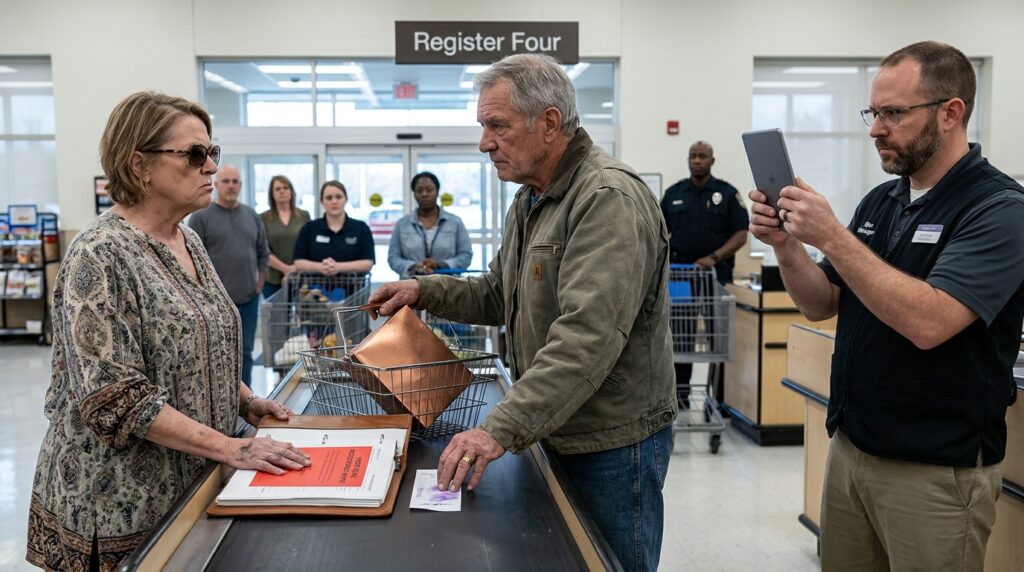
The transition from the cold rear corridor to the high-glare ceiling matrix of checkout Lane Four brought a sharp spike of dry air that tasted of static electricity and cheap receipt paper. Arthur pushed the cart forward, the squeal of the left caster cutting clean through the dense murmurs of the Saturday queue. The massive cart belonging to Beatrice Crawford remained wedged across the rubber lane barrier like a rusted vehicle chassis left in a creek bed. She hadn’t shifted her boots by a fraction of an inch. Her leather-bound planner was still pinned beneath her forearm, its brass corners glinting under the store lights, while her other hand remained clamped onto the wire lip of Arthur’s basket.
“You’re not clearing this register, Arthur,” Beatrice said. Her voice lacked the high, shrill pitch of a typical floor dispute; it carried the cold, transactional weight of a bank clerk denying a late withdrawal. Her sunglasses had dropped back down across her nose, hiding her eyes, but the tight, graying cords of her neck showed the true strain of her posture. “The warehouse clearance for the valley foundation was logged into the regional database before the weekend count. This unit belongs on the country club vehicle, and I have the asset ledger right here.”
Arthur kept his hand locked onto the chrome bar, letting his thumb press harder against the brass key ring until the metallic chill of it ground into the bone. He didn’t check the line behind him, though he could hear the distinct sound of two heavy grocery baskets dropping onto the floor and the rustle of cell phone cases being cleared from pockets. The clerk at the register lane stood completely immobile, his fingers hovering over the manual void key as if any sudden movement would trigger a terminal shutdown.
“The register accepted the payment,” Arthur said, keeping his voice beneath the rhythm of the overhead cooling fans. “The manifest inside this box is already signed off by the parish administrator. The district warehouse account has been closed for four seasons.”
“The district account was transferred, not closed,” Beatrice countered, her fingers tightening on the wire grid until the skin over her knuckles turned the color of dry tallow. She leaned in closer, the scent of expensive lavender soap cutting through the heavy smell of floor wax. “The valley foundation retained the easement rights under the old charter. If you think the parish can just liquidate structural assets to fund a free kitchen at the community center, you haven’t read the small print on your own tax vouchers.”
She yanked backward on the wire basket, the sharp metallic jolt traveling up Arthur’s arms and rattling the heavy blocks of cheddar against the cardboard box below. The sudden movement pulled the corner of his canvas sack away, fully exposing the thick, double-banded fiber tape and the stamped serial number ending in nine-zero.
Arthur didn’t pull back. He allowed the momentum of her pull to carry his cart forward two inches, the heavy steel frame striking the rubber bumper of her own vehicle with a solid, unyielding crunch that echoed off the front glass doors. From the corner of his eye, he saw the store security guard—a thin man named Miller with an old leather holster that smelled of dry rot—begin a slow, heavy-footed march from the service desk.
“Take your hand off the basket, Beatrice,” Arthur said quietly.
“Not until the evening manager pulls the duplicate tracking invoice,” she said, her voice dropping into a razor-thin whisper as she tapped the cover of her planner. “This isn’t an item, Pendleton. It’s a documented asset allocation. And if I have to call the sheriff’s department to lock down this register lane for an audit, I’ll ensure your kitchen doors stay chained shut through the winter.”
Arthur reached down, his fingers sliding between the cheese blocks until they touched the raw cardboard. The physical reality of the box—the rough starch of the binding tape and the dense, industrial cold of the three-ply copper beneath—felt entirely solid against the shifting, paper-thin logic of her arguments. He pulled the purple-smudged printout from his jacket pocket, unfolding the dry sheet with a slow, deliberate scrape of paper that sounded like a boot tracking across dry earth.
“The receipt has a secondary tracking sequence,” Arthur said, holding the paper flat against the dividing bar so the register clerk could see the ink impression. “The clerk in the rear bay stamped it twice. It’s not an allocation anymore. It’s a cash-cleared purchase under the third code.”
Beatrice didn’t look at the paper. Instead, her hand moved toward the inner pocket of her leather binder, her fingers searching for a document she seemed to expect would override the purple ink. But as her hand caught on the zipper, her thumb slipped, her leather binder dropping slightly to reveal a modern pink slip tucked behind her corporate sheets—an official bank overdraft notification from the county trust, stamped forty-eight hours prior with a bright red notice of immediate receivership.
Arthur’s gray eyes locked onto the red ink before she could shove the folder shut. The decoy secret of the dissolved development easement was clear—she was using the old district charter to justify the seizure—but the physical reality of the red receivership stamp revealed a far rougher truth. The valley foundation wasn’t collecting registry items for an auction. They were scrambling to secure un-audited physical property before the morning bank freeze locked their holdings completely.
The security guard stopped at the mouth of the lane, his boots squeaking on the polished concrete as he looked between the flat invoice in Arthur’s hand and the rigid, defensive line of Beatrice’s shoulders. “We’ve got a backup forming all the way to the pharmacy counter,” Miller said, his hand resting awkwardly on his belt. “Let’s move this talk into the vestibule.”
“We stay right here, Miller,” Beatrice commanded, her jaw locking as she stepped directly between Arthur’s cart and the register gate. “This cart doesn’t move an inch until the manager checks the duplicate ledger.”