
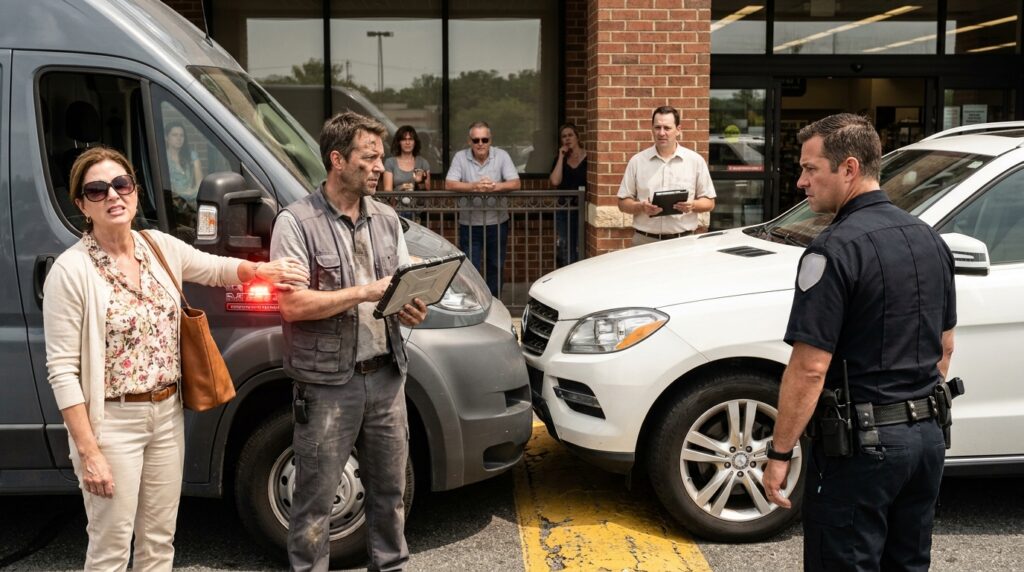
The Weight of Yellow Paint and the Architecture of an Earned Delivery Lane

CHAPTER 1: THE FRICTION OF THE CURB

“You will put that vehicle in reverse and clear this lane right now, or I will have the property manager strip your corporate access before the sun sets.”

Marcus Wright kept his fingers balanced on the worn rubber of the steering wheel. Through the side mirror, the desaturated glare of the afternoon sun hit the clean white hood of the luxury SUV idling just behind his bumper. The heat rising from the Oakridge Plaza parking grid made the air look thick, smelling of hot tire tread and expensive lawn fertilizer. Eleanor Crane stood on the concrete curb, her large dark sunglasses reflecting the gray side panels of his transport van. She didn’t drop her gaze. Her heavy leather tote bag swung slightly as she pointed a manicured finger down toward the faded yellow line beneath his front tires.

“Ma’am,” Marcus said, his voice level, flat, carrying the mechanical drone of a man who had spent eight hours idling through highway construction. “I have twelve crates of temperature-controlled pharmaceutical stock behind this partition. They are logged for the pharmacy counter inside. I am staying on this yellow paint until the manifest is cleared.”

“This is a private shopping pavilion, not a distribution warehouse,” Eleanor said. She took a step closer, the gold links of her watch clicking against the strap of her bag. “Look around you. People come here to spend money, not to stare at a delivery truck blocking the entrance walkway. Your schedule doesn’t dictate the rules of this neighborhood.”

Marcus didn’t turn his head to look at the outdoor cafe patrons three yards away, though he could hear the distinct hush that had settled over the metal tables. He simply pulled his rugged digital tablet from its plastic dashboard cradle. The silver casing was cold against his palm, the glass screen marred by faint oily smudges from three separate warehouse stops since dawn. He tapped the anti-glare display, bringing up the secure manifest screen where a bright green checkmark continued to pulse beside the store’s internal registry code. He didn’t offer the screen to her. He kept it low, inside the shadow of the cab, calculating the minutes remaining before the internal cooling units in the cargo hold began to draw down his main battery voltage. Every second spent talking to someone with an expensive athletic set and a grievance was a second the baseline temperature inside the crates ticked closer to the margin.

Through the windshield, he watched Eleanor’s mouth tighten. She didn’t wait for a reply. She unclipped her phone, her thumb stabbing at the screen as she began describing his vehicle license number to the plaza’s private security desk, her posture leaning hard into the driver’s side mirror until the plastic frame creaked under the weight of her shadow.

Marcus checked the digital clock on the display panel. 13:42. The store manager’s signature window opened in exactly three minutes, and the white SUV behind him hadn’t shifted from park.


CHAPTER 2: THE INTERROGATION AT THE CURB

“Your yellow paint doesn’t mean a damn thing if the plaza code says otherwise, driver.”

Eleanor Crane did not step back from the driver’s side door. The oversized black lenses of her sunglasses remained fixed on Marcus, two dark voids reflecting the dull gray metal of the transport van’s frame. The heat rising from the asphalt was a living thing now, thick with the oily stench of the idling diesel and the sharp, chemical tang of sun-baked premium wax from her white SUV.

Marcus didn’t shift his posture. He kept his left arm resting flat against the hard plastic of the window sill, his fingers balanced over the silver bezel of his logistics tablet. The metal casing had absorbed the cab’s thin, strained air conditioning, but the heat outside was already eating through the seal. He looked at the French-tipped index finger she kept leveled at his mirrors.

“The municipal code for this township classifies this specific curb lane as an unrestricted commercial logistics easement, ma’am,” Marcus said, his voice dropping into the low, rhythmic drawl of a diesel mechanic reading an inspection log. “It’s tied directly to the commercial structural grid of the main pharmacy store. If I pull this rig out into the active traffic lane, the digital manifest logs a safety abort. The crates lock down automatically to protect the internal temperature.”

“Don’t read a script to me,” Eleanor snapped, her tote bag cutting a sharp arc through the heavy air as she shifted her weight. Her gold watch caught the glare of the noon sun, casting a jagged sliver of light across the peeling yellow paint of the curb. “I know exactly who owns this development company. I know the board members who signed off on the aesthetic restrictions for the outer perimeter. You are an independent contractor in an unmarked, unwashed utility van, and you are creating a visual obstruction for the high-end retail storefronts. This isn’t a shipping yard.”

Marcus looked past her shoulder. At the outdoor juice bar three yards away, a man in a tailored linen shirt lowered his glass, his eyes tracking the hard angle of Eleanor’s shoulders. Further down the walkway, a store clerk from the boutique leaned against the clean glass storefront, a brass ring of keys jingling softly against the frame. The silence between the plaza patrons was expanding, filling with the steady, dry rattle of Marcus’s cooling compressor.

He didn’t need to check the tablet to know the numbers were shifting. The internal sensors in the hold were reading 38 degrees Fahrenheit. If the compressor had to fight the ambient ninety-degree heat for another four minutes without the storefront’s auxiliary power line plugged in, the digital log would flag the shipment as compromised.

“I don’t clear the space until the manager provides the verification scan,” Marcus said, his eyes tracking a strange detail on the pharmacy’s secondary iron security gate—a heavy, notched brass padlock that looked decades older than the rest of the plaza’s polished chrome fixtures. It was scratched deep near the keyway, the iron shackle stained with green oxidation. It didn’t look like standard corporate issue. It looked like a lock placed by someone who wanted to keep a specific door closed, regardless of who held the master keys to the property.

Eleanor followed his gaze, her jaw setting into a hard, defensive line. She stepped directly into the narrow space between the van’s door and the concrete step, using her physical presence to narrow his field of vision. “The manager doesn’t run the exterior space, Mr. Wright. I’ve already contacted security supervisor Davies. He’s rounding the north corridor right now. When he gets here, he isn’t going to look at your tablet. He’s going to look at a commercial vehicle refusing to comply with a lawful request from a property shareholder.”

Marcus let his thumb slide across the tablet’s cracked anti-glare screen, pulling up the secondary metadata screen. Hidden beneath the standard shipping routing was a secondary, restricted notification layer from the county planning office—a three-month-old administrative entry indicating that the entire Oakridge Plaza curb system was under active zoning evaluation for municipal water main access. Eleanor was standing right on top of the main easement line.

“Then we’ll wait for Davies,” Marcus said, his voice entirely devoid of friction. He reached up, his calloused fingers turning the ignition key just enough to cut the heavy vibration of the diesel engine, leaving only the thin, battery-driven whine of the refrigeration unit cutting through the midday quiet. “But until his cart pulls up, this van stays exactly where the yellow paint tells it to.”

Eleanor didn’t move. She stood against the side panel, her smartphone clutched tightly in her palm, her breathing fast and shallow against the desaturated glare of the upscale brick facades. Marcus settled back into the worn vinyl seat, his unblinking gaze locked on the notched brass padlock in the distance, waiting for the weight of the plaza’s internal rules to finally hit the pavement.

CHAPTER 3: THE STRATAGEM OF THE BARRICADE

The metallic scrape of a heavy chassis engaging its transmission cut through the dry hum of the plaza’s air conditioning grid. Eleanor Crane didn’t walk back to her vehicle; she moved with a calculated, rhythmic stride that signaled a long-established habit of commanding open ground. The white luxury SUV didn’t just back out. The massive tires crunched over a stray strip of plastic landscape edging, spraying a fine spray of red mulch across the pristine stamped concrete of the shopping corridor walkway.

Marcus stayed in his seat, his palms flat against the smooth silver casing of the rugged tablet. Through the salt-crusted sweep of the windshield, he watched the white hood swing across his line of sight. The vehicle didn’t clear the lane. With a heavy, deliberate turn of the wheel, Eleanor guided the three-ton machine directly perpendicular to his front grill, the polished chrome of her passenger door stopping less than two inches from the van’s stamped steel bumper. She put the vehicle in park, the heavy hydraulic sigh of the automatic suspension lowering the frame until it formed a solid, unbroken wall of steel between Marcus and the exit lane.

The physical trap was set, completely sealing the gray utility transport against the twelve-inch concrete lip of the storefront curb.

Marcus tapped the tablet screen, the cold glass recording the tiny oil patterns from his thumbs as he pulled up the active internal climate logs of the hold. The display flickered once, showing a steady climb: 39.1 degrees. The small red notification light at the top of the bezel began its slow, systematic pulsing. In twenty minutes, the digital ledger would send an automated failure report to the central terminal in the city, freezing his independent logistics license before he could unlatch the rear partition doors.

He reached down, his fingers gripping the heavy handle of the driver’s side door. The latch popped with a dry, metallic thud that sounded unnaturally loud in the narrow corridor between the vehicles. As his work boots hit the concrete, the grit of the unwashed pavement ground beneath his heels. The heat out here was immediate, a physical weight that pressed against his chest, smelling of hot asphalt oil and the bitter, chemical undertone of the luxury SUV’s low-idle exhaust system.

“Ma’am,” Marcus said, walking toward the driver’s side window of the SUV. He didn’t raise his voice; he kept it anchored in that flat, unyielding register he used when logging cargo damages at major freight yards. “You’ve blocked an active commercial transport route. If the local fire marshal rounds the north curve of this pavilion, the fine for obstructing a designated storefront access lane begins at five hundred dollars for the registered owner. You’re sitting right over the main secondary shut-off valve for the pharmacy line.”

The dark tinted glass of the SUV slid down halfway, a cold pocket of climate-controlled air spilling out into the sweltering heat of the lot. Eleanor didn’t remove her sunglasses. She kept her fingers draped lazily over the leather-wrapped steering wheel, her heavy gold rings catching the harsh glare of the midday sun. Marcus’s eyes caught a minor detail near the bottom corner of her windshield—two separate, distinct registration decals from the township building department, both marked with a crossed-out zoning code and a hand-written clearance number that matched the prefix on his restricted manifest notes. It wasn’t just a shopping trip. The vehicle was marked with the internal administrative stamps of a property development firm that had been quietly petitioning the county to reclassify the entire storefront lane for high-density retail parking.

“The fire marshal doesn’t take instructions from independent logistics labor, Mr. Wright,” Eleanor said, her voice dropping behind the low rattle of her vehicle’s eight-cylinder engine. She gestured toward the glass double doors of the pharmacy, where a small white notice was taped just behind the display window. “This development sector has a strict aesthetic covenant. If you check your digital logs carefully, you’ll find that the loading allowance for third-party logistics services was suspended under the temporary infrastructure review three weeks ago. You shouldn’t even have the master access code for the rear security gates.”

“The master access code is issued by the state medical distribution network, not the local merchant board,” Marcus said, leaning slightly closer until his reflection in her dark lenses showed the tight, gray utility vest pulled taut across his shoulders. He held the tablet screen flat against her window sill, forcing her to look down at the pulsing green checkmark. “The temporary review you’re talking about applies to general dry-goods freight. This manifest is classified under medical priority tier-two. If you check that secondary sticker on your own glass, you’ll see the municipal reference code matches the exclusion clause on this screen.”

The lines around Eleanor’s mouth hardened, a quick, structural shift in her composure that lasted only a fraction of a second before she rolled the tinted glass back to the seal, completely cutting off the connection.

Marcus stood on the hot asphalt, the steady whine of his van’s straining refrigeration compressor vibrating through the soles of his boots. He looked down the long, empty corridor of the plaza walkway. From the far end of the north plaza, the distinct, low electric hum of a security cart signaled that the balance of the lane was about to change. Officer Davies was already coming around the brick perimeter, his yellow light bars flashing silently against the clean glass fronts of the upscale boutiques.

CHAPTER 4: THE INQUIRY UNDER PUBLIC SCRUTINY

“Step out of the loading path, please, ma’am. Let’s see the manifest logging for this bay.”

Officer Davies didn’t kill the low, electric purr of his security cart. He stepped over the low fiberglass rim before the machine had completely rolled to a stop against the curb, his boots crunching down hard on the dry gravel scattered along the edge of the asphalt. His uniform shirt looked stiff, darkened by broad swathes of sweat across the shoulders, and his eyes stayed low, narrowed against the blinding white glare bouncing off Eleanor Crane’s luxury SUV.

Marcus stood by the driver’s side panel of his van, his arm resting flat against the hot metal flank of the chassis. He didn’t drop his hands. He kept the rugged silver tablet angled away from the ambient glare, watching Davies trace the exact line where the front bumper of the SUV remained pinned against the van’s stamped steel grille.

“Officer,” Eleanor’s voice cut through the heavy, vibrating air before Davies could reach the curb. The door of her SUV didn’t swing wide; she cracked it just enough to step out into the heat, her leather tote bag clutched against her ribs like a piece of structural armor. She didn’t take off her dark glasses. “This driver has been sitting over our primary storefront access lane for twenty minutes. He is using an unauthorized transport code to bypass the retail restrictions. I’ve already verified with the township development board that the aesthetic zoning guidelines for the outer loop do not permit commercial utility operations during peak merchant hours.”

Davies stopped between the two vehicles, his hand coming down onto the utility belt resting on his hip. He looked at the yellow paint flaking off the curb, then up at the glass display window of the pharmacy where three separate patrons had gathered, their faces pressed close to the tint. Further down the covered walkway, two diners from the terrace juice bar stood up, their reflections moving across the polished boutique windows as they leaned over the wrought-iron barrier to get a better view of the gridlock. The public square was closing in, tightening around the two idling machines.

“Let’s see the distribution log, driver,” Davies said, turning his bulk toward Marcus. His voice carried the mechanical weight of a man who spent his life enforcing the compromises of a commercial lease. “Mrs. Crane is correct about the infrastructure review. The merchant board issued an administrative hold on third-party vehicle parking along this strip three weeks ago. If you don’t have a stamped retail waiver from property management, I need you to back this rig out into the overflow lot immediately.”

“The logistics license under this manifest doesn’t run through the merchant board, Officer,” Marcus said. He stepped forward, his boots tracing the gritty edge of the yellow paint. He held the silver tablet toward the security supervisor, the screen flickering as the battery voltage warning began a fast, rhythmic flash across the status bar. “Look at the secondary routing code under the tracking registry. It’s a state-mandated medical stock line. The hold you’re talking about is a local commercial freeze designed for general dry-goods delivery. This shipment bypasses the township development review under the municipal health code override.”

“That override is undergoing active litigation by the plaza developers, Davies,” Eleanor struck in, stepping closer until the gold links of her watch clicked sharply against the metal casing of the transport’s side mirror. She pointed a finger at the cracked glass of the tablet. “The paperwork he’s showing you is an outdated digital entry. The gate padlock code was changed this morning specifically to prevent independent contractors from exploiting the access lanes before the court issues the final zoning injunction.”

Marcus caught the shift in Davies’s eyes—a brief, professional calculation. The security officer took the tablet, his thick thumb scrolling through the metadata screen where the green checkmark continued its slow, mechanical pulse. Near the bottom of the ledger, a faded serial number emerged, perfectly matching the alphanumeric prefix stamped into the oxidized iron shackle of the notched brass padlock on the pharmacy’s secondary security gate. It wasn’t an outdated entry. The digital manifest was actively generating the live security key required to clear the storefront’s internal tracking locks.

“Hold on,” Davies muttered, his voice dropping as he looked from the screen back to the building department decals on Eleanor’s windshield. The local restriction she was claiming wasn’t an official plaza rule; it was a private development petition that had been pushed by a small faction of neighborhood shareholders to clear the curb for their personal convenience.

Before Eleanor could double down on her claim, the double glass doors of the medical storefront hissed open. The pharmacy manager stepped out onto the hot stamped concrete, an unsealed electronic ledger clutched in his hand, his eyes tracking the critical red warning light still pulsing on the side of Marcus’s transport van. The space between the vehicles went completely still, the silence thickening as the manager reached the edge of the yellow line.

CHAPTER 5: THE TURNING OF THE SHEET

“The inventory tracking logs are already flashing red inside my dispensary, Davies. If that refrigeration compressor cuts out, the state board holds this entire plaza liable for the loss.”

The storefront manager didn’t step completely off the elevated threshold. He stood with his thumb jammed into the side of an industrial ledger, the hard plastic cover warped by years of humidity and counter sweat. His gaze traveled over the front bumper of the white SUV, then locked onto the small digital layout on Marcus’s screen.

Marcus kept his shoulders dropped, his feet set flat on the flaking yellow paint of the easement lane. The air out here was expanding with a sudden, localized pressure as the store manager tapped his tracking ledger directly against the silver bezel of the logistics tablet. The electronic handshake between the two systems cleared with a clean, low-pitched chirp that cut through the low-frequency rattle of the idling transport engine.

“Mr. Wright is cleared under the state distribution network,” the manager said, turning his chin slightly toward Eleanor Crane. He didn’t look at her sunglasses. He looked at the heavy leather strap of her tote bag where her knuckles had gone completely bloodless. “The merchant board doesn’t have the administrative authority to execute a lockdown on priority-two medical stock. If these crates are compromised because you want a clear sightline for the boutique entrance, I’m filing the compliance failure report with the regional medical board before the top of the hour.”

Eleanor took a slow, deliberate step back toward the open cabin of her SUV. The dark lenses of her glasses caught the reflection of the three diners who had now reached the edge of the terrace railing, their conversation dropped into an absolute freeze. Further down the brick avenue, a second store clerk stepped onto the pavement, his arms crossed over his apron, his gaze anchored to the heavy tires blocking the designated commercial lane. The social terrain of Oakridge Plaza was shifting, the small, quiet network of regular patrons quietly withdrawing their support as the municipal weight of the logistics log hit the concrete.

“This is an intentional misconstruction of the association bylaws,” Eleanor said, her voice dropping into a tight, transactional register that barely carried over the steady hum of the cooling grid. She pointed a French-tipped finger at the municipal stamps on her own windshield. “The development board signed a preliminary injunction to prevent out-of-county logistics services from staging equipment along this curb. Officer Davies, you have the operational mandate to clear this vehicle for an unauthorized access violation.”

Davies looked down at the rugged display panel in his hand, then back at the notched brass padlock securing the secondary pharmaceutical gate. The serial number matching Marcus’s manifest was unmistakable. The restriction Eleanor had been enforcing wasn’t an official, board-approved code; it was a private zoning petition pinned to her own real estate firm’s letterhead, designed to convert the distribution easement into high-value customer parking before the town council could finalize the permanent utility line review.

“No, Mrs. Crane,” Davies said, his voice dropping the defensive neutrality it had carried since he first rolled around the north curve. He handed the silver tablet back to Marcus, his palm moving down to his utility belt with a slow, structural finality. “The municipal health code override is active on this curb twenty-four hours a day. By positioning this SUV directly within the vehicle exit path during a priority-two delivery window, you are currently obstructing an active commercial fire corridor. I need you to clear this machine from the yellow paint immediately.”

Eleanor stood frozen for a single, extended second. Her reflection in the van’s side panels looked small, isolated against the massive desaturated brick grid of the plaza storefronts. The cafe patrons remained entirely silent, their phones staying low, their eyes tracking the hard shift in the security supervisor’s physical alignment. The authority she had spent twelve years accumulating through property shareholder meetings and aesthetic complaints had dissolved into the flat, unyielding text of a regional logistics registry.

She didn’t offer a counter-argument. Without another word, she stepped up onto the running board of her vehicle, the door shutting with a heavy, pressurized thud that sealed her inside the air-conditioned cabin. The large white SUV shifted into reverse, its massive tires grinding through the grit and red mulch with a sharp, dry crunch as she backed out of the restricted corridor and accelerated down the main exit lane toward the perimeter gate.

Marcus didn’t watch the white paint disappear past the hedges. He moved to the rear of the transport van, his calloused fingers sliding the heavy iron key into the notched brass padlock on the security gate. The latch popped open with a solid, metallic ring that marked the clean return of the lane’s intended purpose. As the heavy insulated doors of the cargo hold swung wide, a thick, clean cloud of cold air spilled out across the hot asphalt, cooling the flaking yellow paint beneath his boots. He reached for the first blue supply crate, his arms tracking the weight of the earned cargo, entirely focused on the steady, unromantic progress of the route.

Similar Posts

Leave a Reply

Your email address will not be published. Required fields are marked *






