
CHAPTER 5: THE TURNING OF THE SHEET
“The inventory tracking logs are already flashing red inside my dispensary, Davies. If that refrigeration compressor cuts out, the state board holds this entire plaza liable for the loss.”
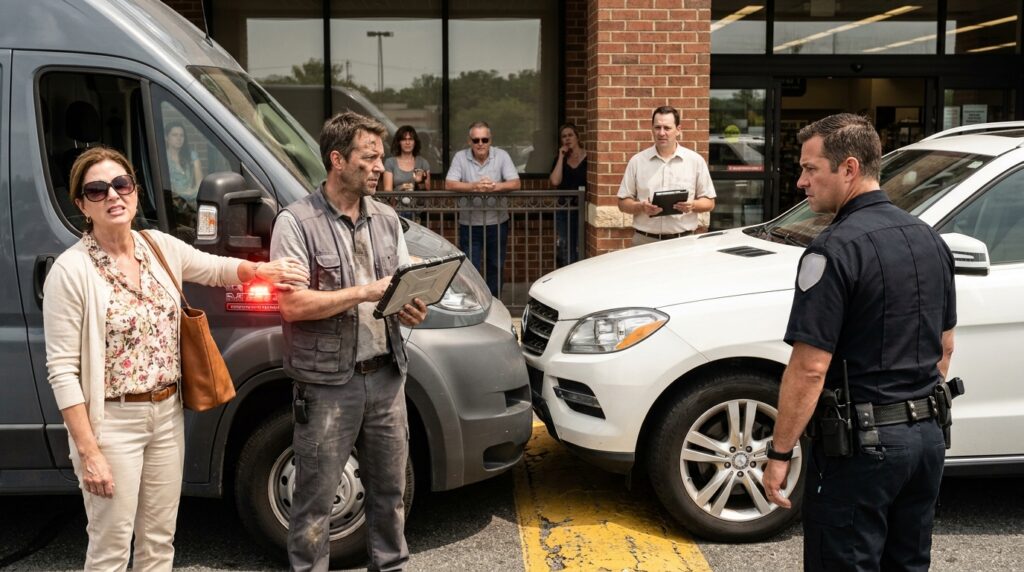
The storefront manager didn’t step completely off the elevated threshold. He stood with his thumb jammed into the side of an industrial ledger, the hard plastic cover warped by years of humidity and counter sweat. His gaze traveled over the front bumper of the white SUV, then locked onto the small digital layout on Marcus’s screen.
Marcus kept his shoulders dropped, his feet set flat on the flaking yellow paint of the easement lane. The air out here was expanding with a sudden, localized pressure as the store manager tapped his tracking ledger directly against the silver bezel of the logistics tablet. The electronic handshake between the two systems cleared with a clean, low-pitched chirp that cut through the low-frequency rattle of the idling transport engine.
“Mr. Wright is cleared under the state distribution network,” the manager said, turning his chin slightly toward Eleanor Crane. He didn’t look at her sunglasses. He looked at the heavy leather strap of her tote bag where her knuckles had gone completely bloodless. “The merchant board doesn’t have the administrative authority to execute a lockdown on priority-two medical stock. If these crates are compromised because you want a clear sightline for the boutique entrance, I’m filing the compliance failure report with the regional medical board before the top of the hour.”
Eleanor took a slow, deliberate step back toward the open cabin of her SUV. The dark lenses of her glasses caught the reflection of the three diners who had now reached the edge of the terrace railing, their conversation dropped into an absolute freeze. Further down the brick avenue, a second store clerk stepped onto the pavement, his arms crossed over his apron, his gaze anchored to the heavy tires blocking the designated commercial lane. The social terrain of Oakridge Plaza was shifting, the small, quiet network of regular patrons quietly withdrawing their support as the municipal weight of the logistics log hit the concrete.
“This is an intentional misconstruction of the association bylaws,” Eleanor said, her voice dropping into a tight, transactional register that barely carried over the steady hum of the cooling grid. She pointed a French-tipped finger at the municipal stamps on her own windshield. “The development board signed a preliminary injunction to prevent out-of-county logistics services from staging equipment along this curb. Officer Davies, you have the operational mandate to clear this vehicle for an unauthorized access violation.”
Davies looked down at the rugged display panel in his hand, then back at the notched brass padlock securing the secondary pharmaceutical gate. The serial number matching Marcus’s manifest was unmistakable. The restriction Eleanor had been enforcing wasn’t an official, board-approved code; it was a private zoning petition pinned to her own real estate firm’s letterhead, designed to convert the distribution easement into high-value customer parking before the town council could finalize the permanent utility line review.
“No, Mrs. Crane,” Davies said, his voice dropping the defensive neutrality it had carried since he first rolled around the north curve. He handed the silver tablet back to Marcus, his palm moving down to his utility belt with a slow, structural finality. “The municipal health code override is active on this curb twenty-four hours a day. By positioning this SUV directly within the vehicle exit path during a priority-two delivery window, you are currently obstructing an active commercial fire corridor. I need you to clear this machine from the yellow paint immediately.”
Eleanor stood frozen for a single, extended second. Her reflection in the van’s side panels looked small, isolated against the massive desaturated brick grid of the plaza storefronts. The cafe patrons remained entirely silent, their phones staying low, their eyes tracking the hard shift in the security supervisor’s physical alignment. The authority she had spent twelve years accumulating through property shareholder meetings and aesthetic complaints had dissolved into the flat, unyielding text of a regional logistics registry.
She didn’t offer a counter-argument. Without another word, she stepped up onto the running board of her vehicle, the door shutting with a heavy, pressurized thud that sealed her inside the air-conditioned cabin. The large white SUV shifted into reverse, its massive tires grinding through the grit and red mulch with a sharp, dry crunch as she backed out of the restricted corridor and accelerated down the main exit lane toward the perimeter gate.
Marcus didn’t watch the white paint disappear past the hedges. He moved to the rear of the transport van, his calloused fingers sliding the heavy iron key into the notched brass padlock on the security gate. The latch popped open with a solid, metallic ring that marked the clean return of the lane’s intended purpose. As the heavy insulated doors of the cargo hold swung wide, a thick, clean cloud of cold air spilled out across the hot asphalt, cooling the flaking yellow paint beneath his boots. He reached for the first blue supply crate, his arms tracking the weight of the earned cargo, entirely focused on the steady, unromantic progress of the route.








