CHAPTER 4: THE INQUIRY UNDER PUBLIC SCRUTINY
“Step out of the loading path, please, ma’am. Let’s see the manifest logging for this bay.”
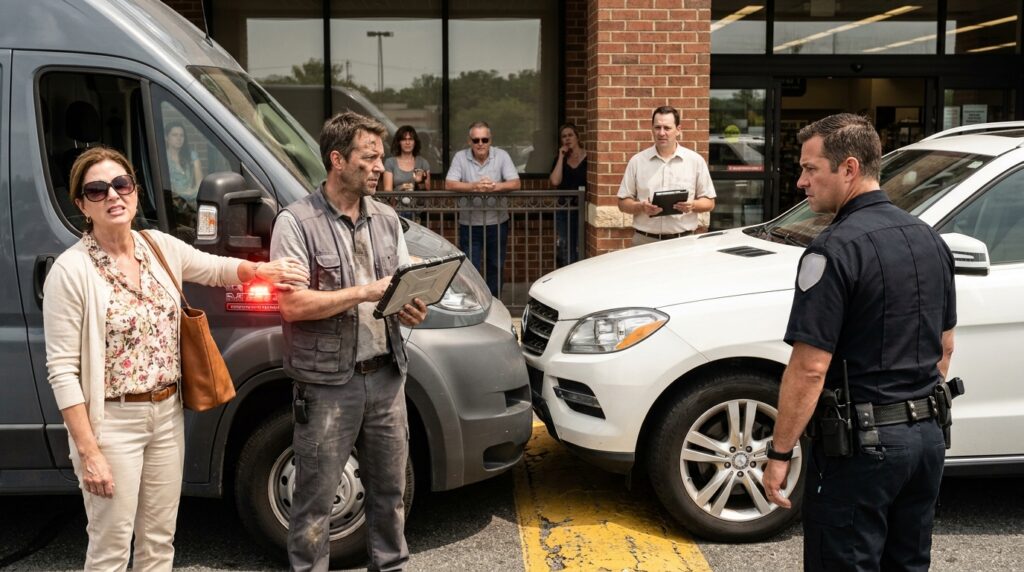
Officer Davies didn’t kill the low, electric purr of his security cart. He stepped over the low fiberglass rim before the machine had completely rolled to a stop against the curb, his boots crunching down hard on the dry gravel scattered along the edge of the asphalt. His uniform shirt looked stiff, darkened by broad swathes of sweat across the shoulders, and his eyes stayed low, narrowed against the blinding white glare bouncing off Eleanor Crane’s luxury SUV.
Marcus stood by the driver’s side panel of his van, his arm resting flat against the hot metal flank of the chassis. He didn’t drop his hands. He kept the rugged silver tablet angled away from the ambient glare, watching Davies trace the exact line where the front bumper of the SUV remained pinned against the van’s stamped steel grille.
“Officer,” Eleanor’s voice cut through the heavy, vibrating air before Davies could reach the curb. The door of her SUV didn’t swing wide; she cracked it just enough to step out into the heat, her leather tote bag clutched against her ribs like a piece of structural armor. She didn’t take off her dark glasses. “This driver has been sitting over our primary storefront access lane for twenty minutes. He is using an unauthorized transport code to bypass the retail restrictions. I’ve already verified with the township development board that the aesthetic zoning guidelines for the outer loop do not permit commercial utility operations during peak merchant hours.”
Davies stopped between the two vehicles, his hand coming down onto the utility belt resting on his hip. He looked at the yellow paint flaking off the curb, then up at the glass display window of the pharmacy where three separate patrons had gathered, their faces pressed close to the tint. Further down the covered walkway, two diners from the terrace juice bar stood up, their reflections moving across the polished boutique windows as they leaned over the wrought-iron barrier to get a better view of the gridlock. The public square was closing in, tightening around the two idling machines.
“Let’s see the distribution log, driver,” Davies said, turning his bulk toward Marcus. His voice carried the mechanical weight of a man who spent his life enforcing the compromises of a commercial lease. “Mrs. Crane is correct about the infrastructure review. The merchant board issued an administrative hold on third-party vehicle parking along this strip three weeks ago. If you don’t have a stamped retail waiver from property management, I need you to back this rig out into the overflow lot immediately.”
“The logistics license under this manifest doesn’t run through the merchant board, Officer,” Marcus said. He stepped forward, his boots tracing the gritty edge of the yellow paint. He held the silver tablet toward the security supervisor, the screen flickering as the battery voltage warning began a fast, rhythmic flash across the status bar. “Look at the secondary routing code under the tracking registry. It’s a state-mandated medical stock line. The hold you’re talking about is a local commercial freeze designed for general dry-goods delivery. This shipment bypasses the township development review under the municipal health code override.”
“That override is undergoing active litigation by the plaza developers, Davies,” Eleanor struck in, stepping closer until the gold links of her watch clicked sharply against the metal casing of the transport’s side mirror. She pointed a finger at the cracked glass of the tablet. “The paperwork he’s showing you is an outdated digital entry. The gate padlock code was changed this morning specifically to prevent independent contractors from exploiting the access lanes before the court issues the final zoning injunction.”
Marcus caught the shift in Davies’s eyes—a brief, professional calculation. The security officer took the tablet, his thick thumb scrolling through the metadata screen where the green checkmark continued its slow, mechanical pulse. Near the bottom of the ledger, a faded serial number emerged, perfectly matching the alphanumeric prefix stamped into the oxidized iron shackle of the notched brass padlock on the pharmacy’s secondary security gate. It wasn’t an outdated entry. The digital manifest was actively generating the live security key required to clear the storefront’s internal tracking locks.
“Hold on,” Davies muttered, his voice dropping as he looked from the screen back to the building department decals on Eleanor’s windshield. The local restriction she was claiming wasn’t an official plaza rule; it was a private development petition that had been pushed by a small faction of neighborhood shareholders to clear the curb for their personal convenience.
Before Eleanor could double down on her claim, the double glass doors of the medical storefront hissed open. The pharmacy manager stepped out onto the hot stamped concrete, an unsealed electronic ledger clutched in his hand, his eyes tracking the critical red warning light still pulsing on the side of Marcus’s transport van. The space between the vehicles went completely still, the silence thickening as the manager reached the edge of the yellow line.