
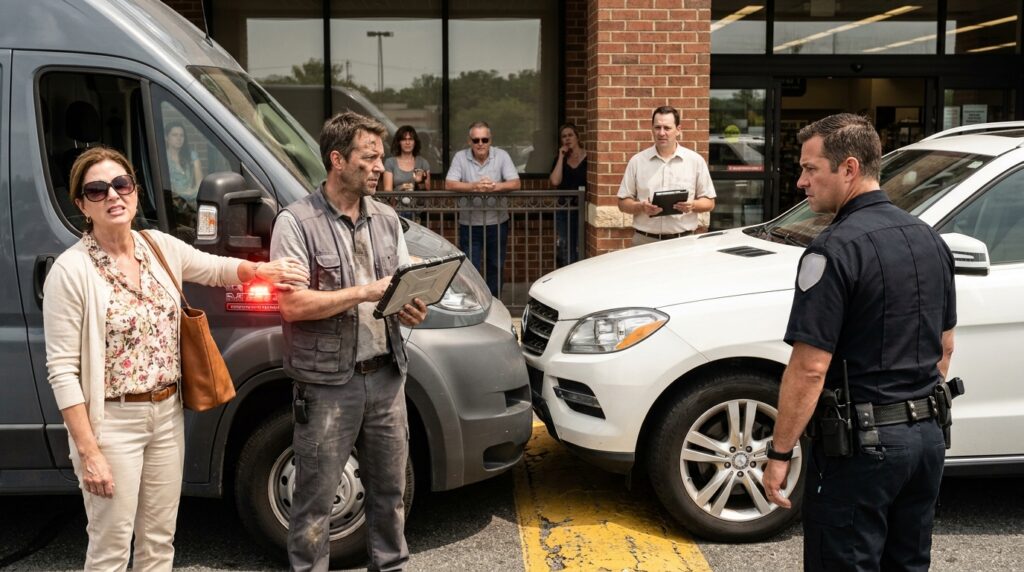
CHAPTER 2: THE INTERROGATION AT THE CURB
“Your yellow paint doesn’t mean a damn thing if the plaza code says otherwise, driver.”
Eleanor Crane did not step back from the driver’s side door. The oversized black lenses of her sunglasses remained fixed on Marcus, two dark voids reflecting the dull gray metal of the transport van’s frame. The heat rising from the asphalt was a living thing now, thick with the oily stench of the idling diesel and the sharp, chemical tang of sun-baked premium wax from her white SUV.
Marcus didn’t shift his posture. He kept his left arm resting flat against the hard plastic of the window sill, his fingers balanced over the silver bezel of his logistics tablet. The metal casing had absorbed the cab’s thin, strained air conditioning, but the heat outside was already eating through the seal. He looked at the French-tipped index finger she kept leveled at his mirrors.
“The municipal code for this township classifies this specific curb lane as an unrestricted commercial logistics easement, ma’am,” Marcus said, his voice dropping into the low, rhythmic drawl of a diesel mechanic reading an inspection log. “It’s tied directly to the commercial structural grid of the main pharmacy store. If I pull this rig out into the active traffic lane, the digital manifest logs a safety abort. The crates lock down automatically to protect the internal temperature.”
“Don’t read a script to me,” Eleanor snapped, her tote bag cutting a sharp arc through the heavy air as she shifted her weight. Her gold watch caught the glare of the noon sun, casting a jagged sliver of light across the peeling yellow paint of the curb. “I know exactly who owns this development company. I know the board members who signed off on the aesthetic restrictions for the outer perimeter. You are an independent contractor in an unmarked, unwashed utility van, and you are creating a visual obstruction for the high-end retail storefronts. This isn’t a shipping yard.”
Marcus looked past her shoulder. At the outdoor juice bar three yards away, a man in a tailored linen shirt lowered his glass, his eyes tracking the hard angle of Eleanor’s shoulders. Further down the walkway, a store clerk from the boutique leaned against the clean glass storefront, a brass ring of keys jingling softly against the frame. The silence between the plaza patrons was expanding, filling with the steady, dry rattle of Marcus’s cooling compressor.
He didn’t need to check the tablet to know the numbers were shifting. The internal sensors in the hold were reading 38 degrees Fahrenheit. If the compressor had to fight the ambient ninety-degree heat for another four minutes without the storefront’s auxiliary power line plugged in, the digital log would flag the shipment as compromised.
“I don’t clear the space until the manager provides the verification scan,” Marcus said, his eyes tracking a strange detail on the pharmacy’s secondary iron security gate—a heavy, notched brass padlock that looked decades older than the rest of the plaza’s polished chrome fixtures. It was scratched deep near the keyway, the iron shackle stained with green oxidation. It didn’t look like standard corporate issue. It looked like a lock placed by someone who wanted to keep a specific door closed, regardless of who held the master keys to the property.
Eleanor followed his gaze, her jaw setting into a hard, defensive line. She stepped directly into the narrow space between the van’s door and the concrete step, using her physical presence to narrow his field of vision. “The manager doesn’t run the exterior space, Mr. Wright. I’ve already contacted security supervisor Davies. He’s rounding the north corridor right now. When he gets here, he isn’t going to look at your tablet. He’s going to look at a commercial vehicle refusing to comply with a lawful request from a property shareholder.”
Marcus let his thumb slide across the tablet’s cracked anti-glare screen, pulling up the secondary metadata screen. Hidden beneath the standard shipping routing was a secondary, restricted notification layer from the county planning office—a three-month-old administrative entry indicating that the entire Oakridge Plaza curb system was under active zoning evaluation for municipal water main access. Eleanor was standing right on top of the main easement line.
“Then we’ll wait for Davies,” Marcus said, his voice entirely devoid of friction. He reached up, his calloused fingers turning the ignition key just enough to cut the heavy vibration of the diesel engine, leaving only the thin, battery-driven whine of the refrigeration unit cutting through the midday quiet. “But until his cart pulls up, this van stays exactly where the yellow paint tells it to.”
Eleanor didn’t move. She stood against the side panel, her smartphone clutched tightly in her palm, her breathing fast and shallow against the desaturated glare of the upscale brick facades. Marcus settled back into the worn vinyl seat, his unblinking gaze locked on the notched brass padlock in the distance, waiting for the weight of the plaza’s internal rules to finally hit the pavement.








