
The Cold Geometry of a Suburban Line Drawn in Blood and Shredded Petals

CHAPTER 1: THE WEIGHT OF CUT STEMS

“This garden isn’t yours, the rules say it’s shared property.”

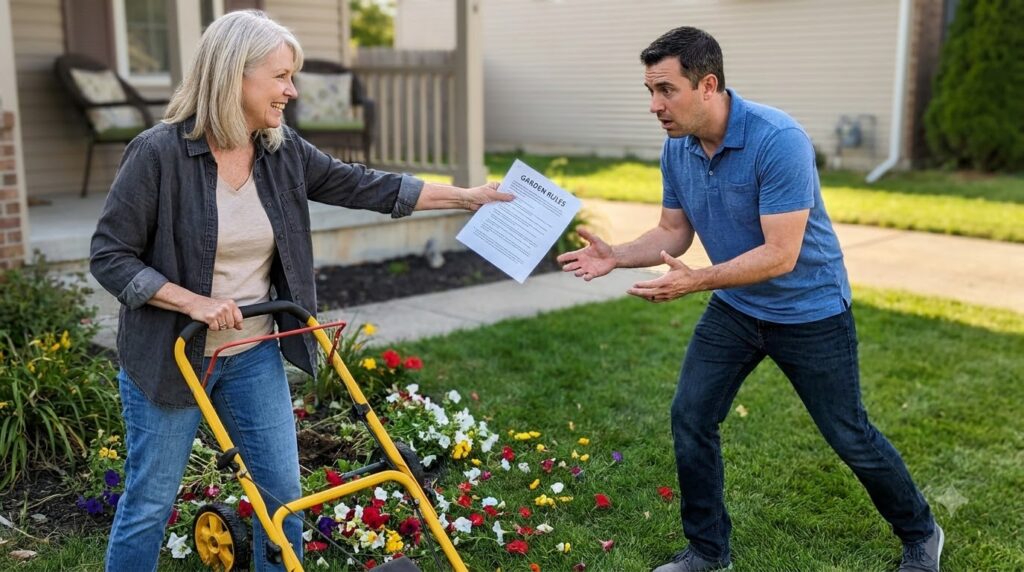
The voice carries the dry, clipped snap of a plastic binder shutting. Evelyn Thorne doesn’t cut the throttle of the yellow push mower. She lets the engine idle, a low, wet mechanical vibration that shakes the dead grass clogging its deck. Beneath the steel blades, shredded stalks of purple salvia and red peony petals lie crushed into the dark, damp soil, bleeding sap onto the edge of Daniel’s driveway.

Daniel Vance doesn’t take another step forward. His sneakers rest on the cool asphalt, two inches short of the turf line. His pulse hammers behind his jaw, but his arms remain loose at his sides—a deliberate, practiced stillness. He looks down at the severed stems, then up at Evelyn’s face.

She stands erect in her charcoal overshirt, silver-blonde hair unruffled by the morning air, tan handbag tucked tightly against her ribs like a sidearm. In her right hand, raised precisely at chest height, is a white sheet of heavy bond paper. The header reads GARDEN RULES in bold, block lettering. The text beneath it is a blur of tight, double-spaced paragraphs.

“Let me see where it says that,” Daniel says. His voice is flat, devoid of the tremor she is plainly waiting for.

He reaches an open palm toward the page.

Evelyn’s smile doesn’t widen; it sharpens. With a flick of her wrist, she tilts the paper back three inches, keeping the body of the text angled away from the light. “It’s all outlined in the neighborhood covenants, Daniel. Section Four. Common greenways are subject to uniform maintenance. You’ve let this bed spill past the curb line.”

“That bed sits six inches inside my property pin,” Daniel says. He keeps his eye on the paper, noting the crispness of the corners. Freshly printed. No institutional fold marks. No HOA seal at the bottom margin. “Show me the section.”

“You can request a copy from the committee,” she says, her tone dripping with mock maternal patience. She turns the sheet face down and slides it into her handbag, the zipper closing with a sharp, metallic click. “In the meantime, the board asked me to clear the sightlines for the turn-around.”

Across the street, on the elevated porch of number 114, Marcus stops mid-sip from his mug. Beside him, Sarah leans over the railing, her eyes tracking the bright yellow deck of the mower sitting square over Daniel’s ruined border. Neither of them speaks. The neighborhood is listening to the idle of the engine.

Daniel shifts his gaze from the handbag to the dirt. He spent three weeks last spring digging out the clay by hand, mixing in compost to honor the hybrid perennials his mother had cultivated before her health failed. The soil is still dark from yesterday’s rain, scored now by two deep, black tire ruts.

“You crossed the seam, Evelyn,” Daniel says softly.

“It’s shared land,” she repeats, taking two steps back and resting her hand on the mower’s rubber grip. She pulls the throttle lever, and the blades roar back to life, spraying a cloud of finely minced green leaves across his sneakers. “Read the rules before you plant next time.”

She executes a tight three-point turn, wheeling the machine over the curb and back onto her paved driveway, leaving the engine running as she walks toward her front porch without looking back.

Daniel stays on the asphalt. He doesn’t yell. He doesn’t follow her onto her grass. Instead, he reaches into his blue polo pocket, pulls out his phone, and unlocks the camera. He crouches near the edge of the lawn, bringing the lens down to turf level to record the exact trajectory of the tire tread cutting through the mulch.

As the shutter clicks, his eye catches something embedded beneath the shredded roots at the very base of the bed—a small, square piece of rusted metal, buried deep, stamped with a single faded serial number that shouldn’t be there.


CHAPTER 2: THE ANCHOR IN THE CLAY

The shutter click of the smartphone camera sounds like a dry twig snapping in the quiet morning air.

Daniel doesn’t rise from his crouch. The cold of the asphalt bleeds through the soles of his sneakers, settling into his calves as he holds the phone steady over the tire tracks. The yellow push mower had carved two distinct, parallel trenches through the damp black mulch, shearing off the stems of his mother’s hybrid peonies three inches above the crown.

He shifts his weight to his left knee, balancing on the balls of his feet. His thumb brushes the screen, locking the exposure before taking a wide shot that frames Evelyn’s manicured driveway in the background, where the mower still idles like a muted thrum in the distance.

Then his eyes drop back to the soil.

Where the front right wheel of the mower had skidded against the edge of the bed, the topsoil had peeled back in a long, dark ribbon. Beneath the shredded mulch and tangled pink roots sits a small, flat square of rusted iron.

It isn’t a stray garden stake. It isn’t a discarded piece of construction scrap.

Daniel reaches down, his index finger pressing against the cool, oxidized surface. The metal is heavy, set firmly into the hard-packed clay beneath the organic layer. He sweeps his thumb across the top, clearing away a layer of wet grit. Stamped into the center of the iron plate, pitted by decades of moisture but still unequivocally legible, is a series of raised block characters:

PROPERTY PIN – SE TRACT 4 – 1982

A cold, methodical clarity washes over his chest, replacing the raw heat of the confrontation with the sharp precision of an equation waiting to be solved.

He knows this pin. When his mother bought the house in 1989, the developer’s markers were already considered historical artifacts of the original subdivision survey. This square marker isn’t just a boundary marker; it is the physical legal anchor of his deed. And it sits four inches inside the flower bed, fully surrounded by the dark compost he had laid down with his own hands last March.

Evelyn hadn’t just crossed onto his grass. She had driven her blades over the exact physical monument that defined his land.

“Daniel?”

The voice comes from across the asphalt, soft and tentative.

Daniel rises in one fluid motion, slipping the phone into his back pocket. He turns slowly.

Sarah stands at the edge of her driveway, wearing an oversized gray cardigan pulled tight around her shoulders. Her husband, Marcus, remains two steps behind her on their front porch, his coffee mug held in both hands, his expression strained with the awkward discomfort of a spectator who had witnessed a mugging but wished he hadn’t.

“Is… is everything alright?” Sarah asks, her eyes darting toward the severed blooms scattered across the grass. “We heard the mower. We thought she was just trimming the curb.”

Daniel looks at her. He doesn’t raise his voice. He doesn’t perform anger for an audience. In the suburban chess match, emotional outbursts are currency given away for free to the aggressor.

“She crossed the pin, Sarah,” Daniel says smoothly. His voice carries easily across the quiet street.

Sarah shifts her weight, her eyes flicking nervously toward Evelyn’s front porch, where the front door sits heavy and closed behind the dark screen. “Well… you know how Evelyn gets about the appearance of the street. She told the HOA committee last month that the corner lots needed to maintain a uniform border for the sidewalk sightlines. She said there was some old agreement about the easement.”

“An agreement?” Daniel asks. He steps off the bed, his sneakers making no sound on the pavement. “Did she show you an agreement?”

“She mentioned a document,” Marcus calls down from the porch, taking a slow step toward the driveway. “Said something about a shared pedestrian access plan from when the neighborhood was first mapped out. She had a copy at the block meeting.”

Daniel nods once. The detail fits seamlessly into the shape of the trap. Evelyn wasn’t acting on a sudden impulse of malicious spite; she was executing a staged campaign, laying a trail of verbal breadcrumbs among the neighbors to establish a narrative of “common land” before bringing the blades down on the soil.

“She showed a title page,” Daniel says, reading the subtext in Marcus’s hesitant posture. “Not the signatures.”

Marcus rubs the back of his neck, looking down at his slippers. “Well, no. But she sounded pretty sure about it, Dan. We just didn’t want to get caught in the middle of a board dispute.”

“There is no dispute,” Daniel says.

He walks past them toward his front porch steps, his posture straight, his movements deliberate. He doesn’t look back at Evelyn’s house. He doesn’t check the window blinds to see if she is watching him from behind her glass. He knows she is. He can feel the pressure of her gaze like a physical weight on the back of his neck.

He opens his front door, steps into the cool, dark shade of the entry hall, and shuts the lock behind him with a firm, decisive click.

The interior of the house smells faintly of lemon polish and the lingering scent of his mother’s dried lavender bundles in the study. Daniel walks straight to the back room—the small, sunlit office where his mother had kept the family records organized in gray steel filing cabinets since 1994.

He kneels before the bottom drawer, the metal cold against his knees as he slides the latch.

The files are categorized by year and property code. He bypasses the utility bills, the tax assessments, and the roofing estimates, sliding his fingers back to the heavy manila folder labeled DEED & TITLE INVENTORY – ORIGINAL PURCHASE.

He pulls the folder onto the desk and spreads the yellowed pages under the desk lamp.

The property description is standard residential acreage, defined by metes and bounds from the 1982 survey. But as he flips past the county clerk’s stamp, his eyes stop on a small, blue-inked addendum attached to the back of the title policy—a rider document titled PROVISIONAL ACCESS DRAFT – DEVELOPER OPTION.

Daniel leans forward, his elbows resting on the polished oak desk, his fingers tracing the faint carbon-copy print.

The document describes a proposed six-foot pedestrian walkway running along the eastern boundary of Lot 14—his lot. It bears the bold heading that Evelyn had thrust in his face an hour ago.

But as Daniel’s thumb slides down to the signature line at the bottom of the page, his breath hitches.

The line reserved for the County Recorder is completely blank. In its place is a red rubber stamp, faded by forty years of darkness inside the file cabinet, reading: REJECTED – SUBDIVISION PLAT AMENDED WITHOUT APPLICATION.

Daniel pulls his phone from his pocket, opens the doorbell camera application, and hits the live playback feed.

On the small screen, the wide-angle lens captures his front lawn in crystal-clear high definition. Evelyn isn’t on her porch anymore.

The screen shows her stepping out of her side garage door, carrying a bundle of white plastic border stakes and a small wooden mallet in her hand, heading straight back toward the ruined flower bed under the cover of the quiet morning.

CHAPTER 3: THE DEED IN THE SHADOWS

On the phone screen, the wide-angle camera lens distorts the perspective, bending the straight asphalt line of the street into a gentle arc. But there is no distortion in Evelyn’s stride.

She walks with the methodical, unhurried cadence of someone who believes the surrounding world is merely waiting for her instructions. The white plastic stakes in her left hand catch the bright morning sun, gleaming like sharp, synthetic teeth. In her right, the heavy wooden mallet hangs loose at her hip.

Daniel doesn’t rush to the door. He doesn’t fling the screen wide to yell across the grass.

He stands in the cool quiet of his mother’s office, his thumb resting against the glass of the smartphone screen, watching her step off her driveway and plant her heels into the black mulch of his ruined flower bed.

Through the camera’s speaker, a muted thump carries across the digital feed—the heavy, solid impact of wood striking plastic as she drives the first stake into the soil. She places it six inches past the severed stems of the hybrid peonies, well inside the territory she claimed under her fictitious “GARDEN RULES.”

She is establishing physical possession. It is the classic maneuver of the suburban land-grabber: create a visual boundary, let it stand unchallenged for twenty-four hours, and then cite its unresisted presence as tacit neighborhood consent.

Daniel turns back to the desk. He leaves the phone prop-lit against a stack of ledgers, the live video continuing to stream in silent, pixelated color.

His fingers slide beneath the blue-inked rider document—the PROVISIONAL ACCESS DRAFT – DEVELOPER OPTION dated October 14, 1982. Beneath it lies a second sheet, thin and translucent, yellowed around the margins where the glue had dried and failed thirty years ago. It is a carbon-copy surveyor map drawn on architectural vellum.

He brings his face down close to the paper, the desk lamp casting sharp shadows across the gridlines.

The map shows Lot 14—his parcel—highlighted in faint red pencil. Along the eastern edge, a hatched corridor precisely six feet wide cuts from the street curb back toward the rear alleyway. Inside that hatched zone sits the flower bed, the driveway apron, and the electrical junction box for the entire block.

Scrawled in the margin, in the hurried, looping handwriting of the long-deceased original developer, is a pencil notation:

Hold for community pedestrian connector. Pending HOA board vote #4.

Daniel opens the desk drawer, pulls out a magnifying loupe, and sets the glass directly over the signature block at the base of the vellum.

The signature of the developer, Arthur Vance—no relation, simply the man who mapped the subdivision before going bankrupt in the mid-eighties—is crisp. But right beside it, where the municipal registry seal should be embossed into the heavy fibers of the paper, there is only a faint, rectangular outline of dried adhesive, as if a temporary label had been affixed and later violently torn away.

A second thump echoes from the phone screen on his desk.

Daniel looks up. On the monitor, Evelyn is kneeling in the mulch now, her charcoal overshirt dusted with damp soil, driving a second stake into the ground. She is stringing a bright yellow nylon cord between the two white pegs, creating a taut, visible barrier three feet inside his deeded line.

She isn’t just cutting flowers anymore. She is laying down the physical framework for an easement that was never legally created.

Daniel picks up the manila folder, slides the carbon-copy map and the rejected rider into a clear plastic sleeve, and tucks the sleeve inside the inner pocket of his polo shirt.

He knows how Evelyn’s mind works. She had lived in this subdivision since the first foundations were poured in 1983. She had been on the original steering committee when the developer went under, leaving the neighborhood in legal limbo for two years before the county stepped in to establish the modern HOA structure. She remembered the original sales brochures—the ones that promised community parks, shared walking trails, and open green corridors.

When his mother had bought the house in 1989, the developer’s assets were being liquidated by a bankruptcy trustee in the county seat thirty miles away. Evelyn had been at those hearings. She had been the one who took home the leftover filing boxes from the sales office, storing them in her garage for four decades like personal trophies of local history.

She had found the unratified draft. She knew the original plan had envisioned a pedestrian path across Lot 14.

And she was relying on the fact that forty years of forgotten paperwork, combined with the intimidating authority of her printed “rules” sheet, would keep Daniel from looking too closely at the gaps in the record.

Another heavy, dull thud vibrates through the small speaker as Evelyn strikes the third stake.

Daniel checks the time on his phone: 8:42 AM. The County Register of Deeds office opens at 9:00 AM in the city center.

He reaches for his car keys on the brass hook beside the office door, his jaw set in a hard, unyielding line. He doesn’t need to argue with her on the lawn. He doesn’t need to pull up her plastic stakes or snap her yellow string. To fight her on the turf right now would be to accept her choice of battlefield.

He will let her build her fence. He will let her string her line in front of Marcus and Sarah and every neighbor on the block. He will let her lock herself into a physical posture of absolute, unassailable certainty.

Because the higher she builds her claim on a rejected piece of paper, the harder the fall will be when the official seal hits the table.

Daniel opens his front door, stepping out onto the porch into the crisp morning air.

Across the lawn, Evelyn halts mid-swing, the wooden mallet held frozen over her head. She looks up, her silver-blonde hair glinting in the sharp sunlight, her expression instantly hardening into a mask of defiant readiness. She waits for him to shout. She waits for him to cross the grass and demand she stop.

Daniel looks directly at her. His gaze drops to the three plastic stakes sticking out of his dirt, then travels up to the yellow string, and finally settles on the paper sticking out of her handbag.

He doesn’t say a word. He doesn’t gesture.

He simply turns, walks down his driveway steps, unlocks the door of his sedan, and slides into the driver’s seat.

As he turns the key and the engine settles into a smooth, quiet idle, he watches her in his rearview mirror. Evelyn stands alone in the middle of his ruined garden, the mallet still raised, her confident smile slowly faltering as the silence of his departure settles over the street like heavy iron.

CHAPTER 4: THE PAPER ARCHIVE

The hum of the sedan’s tires on the highway fades into the heavy, echoing silence of the County Records Building basement.

Daniel walks down the long corridor, the rubber soles of his sneakers squeaking against white terrazzo tile. The air down here is cool, smelled faintly of dry paper, industrial floor wax, and decades of dust undisturbed by sunlight. Row after row of floor-to-ceiling steel shelving units fill the vaulted room, housing the physical paper memory of every boundary line, mortgage lien, and land dispute logged in the county since 1912.

He stops at the high oak counter of the Public Search Desk. Behind the scuffed wood, a clerk in a faded cardigan glances up from a computer monitor, her eyes tracking the clear plastic sleeve tucked under Daniel’s arm.

“Lot fourteen, Oakridge Estates, Section Two,” Daniel says, his voice quiet, even, and clipped. He lays the plastic sleeve flat on the counter. “I need to verify the plat history and any attached public access riders between 1982 and 1986.”

The clerk doesn’t ask why. People don’t come down to the basement vaults at nine in the morning unless land is being claimed or stolen. She reaches for the plastic sleeve, her pale fingers sliding the yellowed carbon-copy vellum onto the blotter.

“Oakridge,” she mutters, her thumb tracing the faint red-penciled border of Lot 14. “That was the Arthur Vance development. Bankrupt before the second phase paved out.”

She turns to a terminal, her keys clicking in a fast, rhythmic clatter. “Subdivision Plat Book 44, Page 112. Give me five minutes.”

She disappears into the shadows between the high metal stacks.

Daniel remains at the counter, his hands resting flat against the polished oak surface. His posture is rigid, motionless. In his mind, the clock is ticking against Evelyn’s yellow string back on his front lawn. By now, the morning sun would be hitting the front porch across the street. Marcus and Sarah would be coming out to retrieve their morning paper, seeing the white plastic stakes standing proudly inside his ruined bed. Evelyn would be leaning against her garage door, arms crossed, letting the sight of her illegal fence normalize in the eyes of the neighborhood.

Every minute he spends in this basement is a minute her claim sits unchallenged on the ground. But he knows better than to march out with emotion as his only weapon. A suburban bully thrives on arguments; she starves on documentation.

The clerk returns, carrying a heavy, leather-bound volume nearly three inches thick. The spine is cracked, the gold-leaf lettering faded to a dull gray: MAP BOOK 44 – SUBDIVISION RECORDS 1982-1984.

She thumps the book down on the counter, sending a small puff of dust into the fluorescent light. “Page 112,” she says, sliding the open ledger toward him.

Daniel steps forward, his eyes locking onto the heavy rag paper.

There it is. The master plat map for Oakridge Estates, stamped by the county planning board in November 1982. And drawn along the eastern boundary of Lot 14—exactly where his mother’s flower bed sits—is the hashed corridor.

Beside it, printed in clean, crisp black ink, are the exact words from Evelyn’s paper: Designated Public Pedestrian Access Corridor – Six Foot Width.

A cold knot tightens in Daniel’s stomach.

For a fraction of a second, the ground beneath his feet feels unstable. The document in the public ledger matches the paper Evelyn had thrust in his face. It is right there in the official county map book. The original developer did map a six-foot public access easement right across his front yard. If this page stands, Evelyn’s yellow string isn’t an act of trespass—it’s the enforcement of a recorded public right.

The clerk watches his face, her expression unreadable. “Looks like it was platted in eighty-two,” she says softly, tapping her pencil against the ledger. “If it’s on the master plat, it runs with the land.”

Daniel doesn’t blink. He refuses to accept the surface layer of the trap. He knows how administrative records work; a map is only an intent until a court or a board seals it into law.

“Turn the page,” Daniel says. His voice drops an octave, sharp as a razor. “Show me the liquidation docket from the eighty-five bankruptcy.”

The clerk pauses, her eyebrows lifting slightly at the edge of his tone. She looks at him for a long moment, assessing the cold, quiet fire in his eyes, then flips the heavy parchment page over.

Attached to the back of Page 112 is a second document—a legal notice printed on dense blue bond paper, stamped with a heavy, red ink seal that has bled through the fiber over forty years: ORDER OF DISSOLUTION AND RE-PLAT CLEARANCE – CASE #85-B-1402.

Daniel leans in until his forehead is inches from the lamp.

The blue document lists every unfulfilled easement, unbuilt sidewalk, and proposed public corridor from the failed Arthur Vance development. Paragraph Three explicitly cites the six-foot pedestrian corridor on Lot 14.

IT IS HEREBY ORDERED, the text reads in bold typescript, that all unexecuted developer options, proposed public access corridors, and unratified pedestrian easements within Oakridge Estates Section Two are VACATED and DISSOLVED. Title to Lot 14 is quieted to the fee-simple owner, free and clear of all unrecorded developer encumbrances.

Daniel’s breath leaves his chest in a long, silent exhale.

Evelyn had gone to the garage boxes. She had pulled out the original 1982 sales brochure and the unexecuted 1982 master plat map from Page 112. She had printed a summary, called it “GARDEN RULES,” and presented it to the neighbors as an active covenant. She had deliberately suppressed the 1985 court order that killed the easement before the ink was even dry.

She hadn’t just made a mistake. She had weaponized a legally dead ghost document to steal his land.

“I need certified copies of both pages,” Daniel says smoothly, reaching for his wallet. “Page 112, and the Order of Dissolution. Sealed by the Registrar.”

The clerk looks at the red bankruptcy stamp, then up at Daniel. A thin, knowing smile touches the corner of her mouth. “That’ll be fifteen dollars,” she says, sliding the book toward the heavy copper seal press on her back desk. “And I’ll stamp them official.”

Ten minutes later, Daniel walks out of the heavy glass doors of the County Building into the glare of the mid-morning sun. In his hand is a stiff manila envelope containing two certified, raised-seal documents that legally prove Evelyn Thorne is a fraud.

He slides into his sedan and starts the engine.

As he turns the wheel toward home, his phone buzzes on the passenger seat. It’s a text notification from his doorbell camera app: Motion detected at Front Porch.

Daniel taps the screen while idling at the red light.

The live camera feed pops up. On his porch, standing right at his front door with a clipboard in her hand and two uniformed police officers standing behind her on the walkway, is Evelyn Thorne. She is pointing at his front yard, where her white plastic stakes and yellow nylon string now completely encircle his ruined flower bed.

She isn’t waiting for him to return. She has called the authorities to report him for interfering with an active neighborhood easement.

CHAPTER 5: THE ESCALATION AT THE EDGE

The tires of Daniel’s sedan crunch against the gravel apron as he turns onto his street.

The calm morning quiet has disintegrated. Parked bumper-to-bumper along the curb in front of his house are two municipal police cruisers, their low-profile light bars casting faint, rhythmic flashes of red and blue across the white siding of his home. Across the road, Marcus and Sarah have stepped off their porch entirely, standing near their mailbox beside two other neighbors from down the block, all four watching the scene with tight, uneasy expressions.

In the center of Daniel’s ruined flower bed, the white plastic stakes gleam under the midday sun, the yellow nylon string stretched taut between them like an enclosure fence.

Beside the line stands Evelyn. She wears her charcoal overshirt buttoned to the collar, a silver pen poised over a thick black clip-board. Standing beside her on the lawn is a young deputy, his hand resting casually near his duty belt as he takes notes. A second officer stands near the cruiser door, speaking into his shoulder microphone.

Daniel cuts the engine. He grips the sealed manila envelope resting on his passenger seat, feeling the raised impression of the county registrar’s stamp through the thick paper. He doesn’t hurry. He steps out of the car, shuts the door with a firm, solid thud, and walks directly toward his front walkway.

“Mr. Vance?” the deputy on the lawn calls out, stepping forward to intercept him before he reaches his porch steps. “I’m Deputy Miller. We received a call regarding a property dispute and an intentional obstruction of a neighborhood access corridor.”

Daniel stops three feet from the officer, his posture upright, his hands loose at his sides with the envelope held flat against his hip. “It’s not a dispute, Deputy,” he says smoothly. “It’s a trespass.”

Evelyn takes a deliberate step forward, her tan flats planting squarely inside the boundary of the yellow string. She holds up her clipboard, revealing a laminated copy of her self-typed “GARDEN RULES” page fastened over a copy of the 1982 developer’s plat.

“He’s attempting to deny the neighborhood access to the common greenway, Officer,” Evelyn says, her voice carrying across the yard with crisp, practiced authority. “I informed him this morning that Section Four of the master covenants requires uniform maintenance of the pedestrian path. Instead of complying, he fled the scene and refused to cooperate with board oversight.”

Deputy Miller shifts his weight, turning to Daniel with a neutral, weary expression. “Mr. Vance, Mrs. Thorne here provided us with a copy of the subdivision plan showing a six-foot pedestrian easement running along this property line. If you’ve been altering or blocking a recorded access path—”

“Did she show you the court order?” Daniel interrupts quietly.

The deputy pauses, his pen hovering above his notepad. “The what?”

“The court order,” Daniel repeats. He doesn’t look at Evelyn. He keeps his eyes locked on the officer. “She gave you a copy of the 1982 proposed developer plat. That map was drawn forty-four years ago by a bankruptcy debtor.”

Evelyn’s smirk falters for a fraction of a second, her thumb tightening over the edge of her clipboard. “That plat is part of the public record, Daniel. It was filed with the county planning board.”

“It was filed,” Daniel agrees softly. “And then it was struck down.”

He raises his left hand and slides the certified, raised-seal documents out of the manila envelope. The heavy parchment pages crackle in the breeze. He extends them toward Deputy Miller, ignoring Evelyn entirely.

“That is a certified copy from the County Register of Deeds, issued an hour ago,” Daniel says. “Page one is the 1982 proposal she is holding in her hand. Page two is the 1985 Order of Dissolution from the County Bankruptcy Court, Case 85-B-1402. The court legally vacated and dissolved every unexecuted pedestrian easement in this subdivision forty-one years ago. The land sits entirely inside my deeded parcel.”

Deputy Miller takes the parchment, his eyes scanning the red ink seal at the bottom of the second page. His mouth sets into a thin line as he reads the bold text of Paragraph Three.

Silence settles over the yard. The only sound is the low, idling thrum of the patrol car behind them. Across the street, Marcus leans forward, trying to read the body language of the officer.

Evelyn steps closer, her voice losing its calm, maternal rhythm, sharpening into a tight, defensive pitch. “Deputy, that is a preliminary filing! The HOA board has operated under the assumption of common access since 1989. You can’t simply ignore thirty years of established neighborhood use based on an obsolete bankruptcy filing—”

“Mrs. Thorne,” Deputy Miller cuts in, his voice flat and unyielding. He looks up from the paper, his eyes cold as he looks at her clipboard. “Is this document certified?”

Evelyn freezes, her jaw tightening. “It is a copy of the original subdivision master plan—”

“Is it certified by the county?” the officer repeats, stepping between her and the yellow string.

“No,” she snaps. “Because the board maintains the historical records—”

“Then as far as the Sheriff’s Office is concerned, this is private property,” Deputy Miller says firmly. He turns back to Daniel, handing the certified pages back to him. “Mr. Vance, your title appears clear. We cannot enforce an uncertified document or a civil covenant dispute.”

Daniel takes the papers, slipping them back into his envelope. “Thank you, Deputy. I’d like to file an official report for property damage to my flower bed and unauthorized placement of barriers on my land.”

Deputy Miller nods once, reaching for his incident log. “Understood. We’ll take your statement.”

A flash of pure, cold panic crosses Evelyn’s face, instantly replaced by a wave of furious anger. She looks at the deputy, then at the neighbors watching from the curb, and finally at Daniel.

“This isn’t over, Daniel,” she says, her voice dropping to a harsh, venomous whisper. “You think a piece of paper from 1985 gives you the right to ruin the appearance of this street? The board will meet tonight. We will vote an emergency assessment on this lot, and we will fine you every single day those stakes aren’t recognized.”

She turns on her heel, pulling her plastic stakes out of the ground with sharp, violent jerks, kicking the yellow string into the dirt as she marches toward her driveway.

Daniel watches her go, his posture motionless, his expression unreadable.

He has won the skirmish with the police. He has proven her document is a fraud in front of the deputy. But as he looks down at the certified pages in his hands, he notices something he missed in the dark vault of the county building—a tiny, handwritten docket entry in the margin of the 1985 bankruptcy order, written in faded blue ink beneath the judge’s signature:

Subject to municipal utility easement verification upon petition of adjacent parcel #15.

Parcel 15 is Evelyn’s lot.

Daniel’s fingers tighten against the envelope. Evelyn hadn’t just relied on the fake “GARDEN RULES” paper to bully him. She had filed an independent petition with the city utility board thirty days ago—and if that petition is granted at tonight’s emergency meeting, she won’t need an HOA rule to take his land. She will have the city code enforcement division do it for her.

CHAPTER 6: THE NEON GEOMETRY

The static hum from Deputy Miller’s shoulder radio crackles once and dies into silence as the patrol cars pull away from the curb. Their departure leaves an abrupt, heavy vacuum over the front lawn.

Evelyn stands thirty feet away at the end of her concrete driveway, her arms folded tightly across her charcoal overshirt, the wooden mallet dangling from her fingers like a dead weight. She does not go inside. She watches Daniel’s every breath, her gaze pinned to the manila envelope tucked beneath his arm.

Daniel turns his back on her. He steps over the flattened grass where the yellow string had lain, his sneakers crushing a stray fragment of white plastic stake into the damp dirt. He reaches into his blue polo shirt, pulls out his phone, and dials the direct extension for the Municipal Land Survey Division.

“Inspector Reed,” a dry, rasping voice answers on the third ring.

“This is Daniel Vance, Lot Fourteen, Oakridge Estates,” Daniel says, his tone calm, steady, and sharp as a honed blade. “I have the certified 1985 bankruptcy dissolution order from the Register of Deeds in my hand. I need an immediate on-site boundary verification and official pin placement before the county enforcement office closes today.”

There is a brief pause on the line, the rustle of heavy blue-line paper being unrolled across a steel desk. “Lot Fourteen,” Reed mutters. “I had a utility easement inquiry flagged on adjacent Parcel Fifteen two weeks ago. Someone claimed a pedestrian right-of-way.”

“The right-of-way was vacated in eighty-five, Case 85-B-1402,” Daniel replies without missing a beat. “The claim is fraudulent. I have a party actively trespassing and altering the topography inside my deeded parcel. I need the laser markers on the dirt.”

“I’m three blocks away at the new cul-de-sac,” Reed says simply. “Keep your driveway clear.”

Ten minutes later, a silver utility truck bearing the official seal of the Municipal Code Enforcement Bureau pulls up to the curb. The side doors slide open, and Inspector Reed steps out—a tall, weathered man in a dust-stained khaki uniform, a heavy brass-bound clipboard in one hand and a heavy optical laser rangefinder mounted on a collapsible aluminum tripod in the other.

Across the street, Marcus and Sarah step closer to the edge of their lawn. Two more neighbors—an older couple from the corner house—walk down their driveway to stand on the sidewalk, their eyes fixed on the silver truck.

Evelyn takes three fast, aggressive steps off her driveway onto the grass. “Inspector,” she calls out, her voice hard and authoritative, “I am Evelyn Thorne, vice chair of the neighborhood covenant committee. This property is currently under administrative review for boundary non-compliance.”

Inspector Reed doesn’t look up from his tripod. He unlatches the leg clamps with three sharp metallic snaps, extending the aluminum shafts until the optical lens rests precisely at chest height.

“I don’t report to neighborhood committees, ma’am,” Reed says flatly. His voice is a gravelly drone, completely immune to her tone. “I report to the county land registry.”

He reaches into his door pocket, pulls out a heavy brass-tipped plumb bob and a spool of neon-orange surveyor string, and walks straight toward the edge of Daniel’s driveway.

Evelyn follows him, her tan flats clicking loudly against the asphalt. “The original developer’s plat established a six-foot public corridor along this entire property seam! I have the documentation—”

“The 1982 draft was voided forty-one years ago, Mrs. Thorne,” Reed interrupts, setting the tripod directly over the small square iron pin Daniel had uncovered beneath the crushed mulch. He adjusts the optical scope, leveling the spirit bubble in the brass housing with two quick turns of his thumb. “And unless you have a signed, sealed amendment from the Circuit Court bearing a date after October 1985, your documentation is paper scrap.”

Evelyn’s jaw tightens so hard the muscles along her neck stand out like cords. She opens her mouth to speak, but Reed flicks a toggle switch on the side of the rangefinder.

A thin, razor-sharp beam of neon-red laser light shoots out from the optical lens, slicing through the afternoon air. It cuts straight across the ruined flower bed, painting a vivid red line along the stems, the black compost, and the turf.

The laser beam strikes the grass three full feet past where Evelyn’s yellow string had been pegged—deep inside the territory she had spent the morning claiming as public land.

Reed pulls a bundle of wooden surveyor stakes from his utility belt. Each stake is tipped with a six-inch flutter of bright, fluorescent orange vinyl ribbon. He steps along the laser path, bringing his steel mallet down with three precise, heavy strikes.

CRACK. CRACK. CRACK.

The first stake sinks eight inches into the soil, right through the exact spot where Evelyn’s push mower had driven its steel blades.

Reed moves four paces down the red line and strikes again.

CRACK. CRACK. CRACK.

The second stake goes down, its neon ribbon fluttering wildly in the breeze.

“That’s the deeded boundary line of Lot Fourteen,” Reed announces loudly, turning toward the gathered neighbors on the sidewalk. He points his clipboard directly at the orange flags standing in a straight, uncompromising row. “Everything three feet to the west of these flags sits entirely within Mr. Vance’s private property. Any unauthorized removal of these monuments constitutes a Class 2 misdemeanor under state land survey codes.”

He turns to Evelyn, his expression cold, clinical, and completely indifferent. “If you cross these flags with a lawnmower, a shovel, or a plastic stake, Mrs. Thorne, you are committing criminal trespass and destruction of verified private property.”

Marcus lets out a low, audible breath from the sidewalk. Beside him, Sarah pulls out her phone, taking a clear, high-resolution photograph of the neon flags standing three feet inside Evelyn’s assumed territory.

Evelyn stands frozen beside her driveway. The color has drained entirely from her face, leaving her skin pale and drawn beneath her silver-blonde hair. The clipboard in her hand looks small, flimsy, and absurd against the bright neon flags driving deep into the earth.

Daniel steps up beside Inspector Reed. He doesn’t smile. He doesn’t gloat. He simply looks at Evelyn across the neon line, his blue polo shirt crisp, his hands folded loosely behind his back.

“The border is marked, Evelyn,” Daniel says softly, his voice cutting through the quiet street with absolute, lethal clarity. “Now let’s talk about the damage to my mother’s flowers.”

CHAPTER 7: THE ARCHITECTURE OF REASON

The wind picks up across the front lawn, catching the edges of the fluorescent orange ribbons tied to the survey stakes. They flutter with a sharp, dry snapping sound, bright against the dark, churned soil of the bed.

Evelyn Thorne does not move. Her knuckles are white where her fingers grip the top edge of her clipboard. For thirty years, she has ruled this corner of Oakridge Estates through the steady, unyielding pressure of minor enforcement: a typed notice in a mailbox, a phone call to a city inspector, a casual remark at a block party about property values and curb appeal. She has built an empire out of compliance born of inconvenience.

Now, three wooden stakes painted in neon orange stand directly between her feet and the grass she had claimed as public property.

Daniel steps forward, his movement unhurried. He carries the certified manila envelope in his right hand, the raised seal of the County Register of Deeds glinting under the harsh afternoon light. He stops two feet short of the orange line—on his side of the boundary.

“You had the 1982 sales draft in your house for forty years, Evelyn,” Daniel says. His voice is devoid of anger, stripped clean of any emotional variance. It is the voice of an accountant reading a final ledger balance. “You knew the developer went under in eighty-five. You knew the county quieted the title when my mother bought the parcel. But you kept the unratified page because you thought no one would ever walk down to the basement vault in the city center to check the clerk’s signature.”

Across the street, Marcus steps off the curb, walking into the middle of the road with his hands in his pockets. Sarah follows him, stopping at the edge of Daniel’s driveway. Behind them, two more residents from the corner house stand silently on the sidewalk, their eyes shifting between the certified court order in Daniel’s hand and the bright orange flags marking the true property pin.

Evelyn draws herself up, her charcoal overshirt stiff, her chin tilting upward in a final, rigid instinct of control. “The neighborhood covenants were designed to preserve the aesthetic harmony of this block, Daniel. Your mother understood that. A sprawling, unregulated flower bed that bleeds onto the turn-around—”

“My mother bought this land,” Daniel interrupts softly. “She paid the taxes on every square inch of it. She planted those peonies thirty years ago, and when she got sick, she sat on that porch and watched them bloom. You didn’t drive that mower through this dirt to enforce a rule, Evelyn. You did it because you couldn’t stand the fact that there was six feet of land on this street you didn’t control.”

Inspector Reed steps up beside Daniel, sliding his brass-bound clipboard out from under his arm. He pulls a yellow carbon-copy pad from his utility vest, his heavy pen scratching across the surface with a loud, abrasive scrape.

“Mrs. Thorne,” Reed says, his voice flat and clinical. “Under Municipal Code Section 412-B, driving motorized equipment across a verified property pin and intentionally destroying private landscaping constitutes unlawful property damage. I am issuing an administrative citation for boundary violation and unauthorized site alteration.”

He tears the yellow slip from the pad with a crisp, sharp rip. He doesn’t hand it to her. He steps across the neon laser line, lays the paper flat against the clipboard she still holds against her chest, and presses his thumb against it until she is forced to take it.

“The fine is five hundred dollars,” Reed adds, turning back to his truck to collapse his aluminum tripod. “And if those orange stakes are moved, altered, or obscured before the county audit next month, the Sheriff’s Department will issue a criminal summons for interference with an official land survey.”

Evelyn looks down at the yellow citation slip resting against her self-typed “GARDEN RULES” page. The contrast is stark: her unrated, unsealed printout beneath an official, ink-stamped municipal citation carrying the seal of the city magistrate.

The illusion of authority vanishes. It does not collapse with a scream or a drama; it simply dissolves into the silence of five neighbors watching from the curb.

Marcus looks at Evelyn, then shakes his head once, turning to walk back toward his house. Sarah gives Daniel a brief, solemn nod before following her husband. One by one, the neighbors turn away, returning to their porches, leaving the street empty under the pale afternoon sun.

Evelyn stands alone on her driveway. She folds the yellow citation slip in half, slides it into her tan handbag alongside her useless paper draft, and turns on her heel. Her front door opens and shuts with a quiet, final latch click that echoes down the pavement.

Daniel remains on the lawn.

The afternoon shadow of his house lengthens across the grass, falling softly over the severed stems and crushed petals of the peony bed. Beside him, the neon orange ribbons flutter in the cool breeze, marking a line that is three feet wider, three feet deeper, and permanently unassailable.

He kneels in the black compost, his fingers brushing against the cool, oxidized surface of the 1982 iron survey pin buried deep in the clay. He clears away the loose dirt, packs the fresh soil firmly around its edges, and stands up.

There is work to do before dusk. He will clear the shredded leaves, turn the soil, and prepare the roots for next spring. But as he looks down at the sharp, straight line of orange flags running along his driveway, Daniel knows that the border is set, the record is sealed, and no one will ever drive a blade across his mother’s soil again.

Similar Posts

Leave a Reply

Your email address will not be published. Required fields are marked *






