CHAPTER 7: THE ARCHITECTURE OF REASON
The wind picks up across the front lawn, catching the edges of the fluorescent orange ribbons tied to the survey stakes. They flutter with a sharp, dry snapping sound, bright against the dark, churned soil of the bed.
Evelyn Thorne does not move. Her knuckles are white where her fingers grip the top edge of her clipboard. For thirty years, she has ruled this corner of Oakridge Estates through the steady, unyielding pressure of minor enforcement: a typed notice in a mailbox, a phone call to a city inspector, a casual remark at a block party about property values and curb appeal. She has built an empire out of compliance born of inconvenience.
Now, three wooden stakes painted in neon orange stand directly between her feet and the grass she had claimed as public property.
Daniel steps forward, his movement unhurried. He carries the certified manila envelope in his right hand, the raised seal of the County Register of Deeds glinting under the harsh afternoon light. He stops two feet short of the orange line—on his side of the boundary.
“You had the 1982 sales draft in your house for forty years, Evelyn,” Daniel says. His voice is devoid of anger, stripped clean of any emotional variance. It is the voice of an accountant reading a final ledger balance. “You knew the developer went under in eighty-five. You knew the county quieted the title when my mother bought the parcel. But you kept the unratified page because you thought no one would ever walk down to the basement vault in the city center to check the clerk’s signature.”
Across the street, Marcus steps off the curb, walking into the middle of the road with his hands in his pockets. Sarah follows him, stopping at the edge of Daniel’s driveway. Behind them, two more residents from the corner house stand silently on the sidewalk, their eyes shifting between the certified court order in Daniel’s hand and the bright orange flags marking the true property pin.
Evelyn draws herself up, her charcoal overshirt stiff, her chin tilting upward in a final, rigid instinct of control. “The neighborhood covenants were designed to preserve the aesthetic harmony of this block, Daniel. Your mother understood that. A sprawling, unregulated flower bed that bleeds onto the turn-around—”
“My mother bought this land,” Daniel interrupts softly. “She paid the taxes on every square inch of it. She planted those peonies thirty years ago, and when she got sick, she sat on that porch and watched them bloom. You didn’t drive that mower through this dirt to enforce a rule, Evelyn. You did it because you couldn’t stand the fact that there was six feet of land on this street you didn’t control.”
Inspector Reed steps up beside Daniel, sliding his brass-bound clipboard out from under his arm. He pulls a yellow carbon-copy pad from his utility vest, his heavy pen scratching across the surface with a loud, abrasive scrape.
“Mrs. Thorne,” Reed says, his voice flat and clinical. “Under Municipal Code Section 412-B, driving motorized equipment across a verified property pin and intentionally destroying private landscaping constitutes unlawful property damage. I am issuing an administrative citation for boundary violation and unauthorized site alteration.”
He tears the yellow slip from the pad with a crisp, sharp rip. He doesn’t hand it to her. He steps across the neon laser line, lays the paper flat against the clipboard she still holds against her chest, and presses his thumb against it until she is forced to take it.
“The fine is five hundred dollars,” Reed adds, turning back to his truck to collapse his aluminum tripod. “And if those orange stakes are moved, altered, or obscured before the county audit next month, the Sheriff’s Department will issue a criminal summons for interference with an official land survey.”
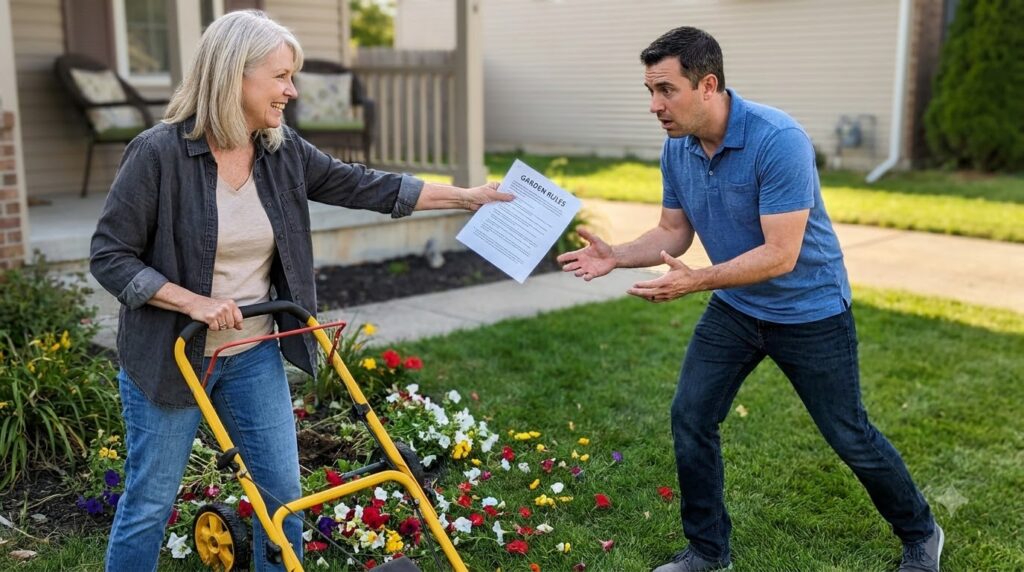
Evelyn looks down at the yellow citation slip resting against her self-typed “GARDEN RULES” page. The contrast is stark: her unrated, unsealed printout beneath an official, ink-stamped municipal citation carrying the seal of the city magistrate.
The illusion of authority vanishes. It does not collapse with a scream or a drama; it simply dissolves into the silence of five neighbors watching from the curb.
Marcus looks at Evelyn, then shakes his head once, turning to walk back toward his house. Sarah gives Daniel a brief, solemn nod before following her husband. One by one, the neighbors turn away, returning to their porches, leaving the street empty under the pale afternoon sun.
Evelyn stands alone on her driveway. She folds the yellow citation slip in half, slides it into her tan handbag alongside her useless paper draft, and turns on her heel. Her front door opens and shuts with a quiet, final latch click that echoes down the pavement.
Daniel remains on the lawn.
The afternoon shadow of his house lengthens across the grass, falling softly over the severed stems and crushed petals of the peony bed. Beside him, the neon orange ribbons flutter in the cool breeze, marking a line that is three feet wider, three feet deeper, and permanently unassailable.
He kneels in the black compost, his fingers brushing against the cool, oxidized surface of the 1982 iron survey pin buried deep in the clay. He clears away the loose dirt, packs the fresh soil firmly around its edges, and stands up.
There is work to do before dusk. He will clear the shredded leaves, turn the soil, and prepare the roots for next spring. But as he looks down at the sharp, straight line of orange flags running along his driveway, Daniel knows that the border is set, the record is sealed, and no one will ever drive a blade across his mother’s soil again.