CHAPTER 4: THE PAPER ARCHIVE
The hum of the sedan’s tires on the highway fades into the heavy, echoing silence of the County Records Building basement.
Daniel walks down the long corridor, the rubber soles of his sneakers squeaking against white terrazzo tile. The air down here is cool, smelled faintly of dry paper, industrial floor wax, and decades of dust undisturbed by sunlight. Row after row of floor-to-ceiling steel shelving units fill the vaulted room, housing the physical paper memory of every boundary line, mortgage lien, and land dispute logged in the county since 1912.
He stops at the high oak counter of the Public Search Desk. Behind the scuffed wood, a clerk in a faded cardigan glances up from a computer monitor, her eyes tracking the clear plastic sleeve tucked under Daniel’s arm.
“Lot fourteen, Oakridge Estates, Section Two,” Daniel says, his voice quiet, even, and clipped. He lays the plastic sleeve flat on the counter. “I need to verify the plat history and any attached public access riders between 1982 and 1986.”
The clerk doesn’t ask why. People don’t come down to the basement vaults at nine in the morning unless land is being claimed or stolen. She reaches for the plastic sleeve, her pale fingers sliding the yellowed carbon-copy vellum onto the blotter.
“Oakridge,” she mutters, her thumb tracing the faint red-penciled border of Lot 14. “That was the Arthur Vance development. Bankrupt before the second phase paved out.”
She turns to a terminal, her keys clicking in a fast, rhythmic clatter. “Subdivision Plat Book 44, Page 112. Give me five minutes.”
She disappears into the shadows between the high metal stacks.
Daniel remains at the counter, his hands resting flat against the polished oak surface. His posture is rigid, motionless. In his mind, the clock is ticking against Evelyn’s yellow string back on his front lawn. By now, the morning sun would be hitting the front porch across the street. Marcus and Sarah would be coming out to retrieve their morning paper, seeing the white plastic stakes standing proudly inside his ruined bed. Evelyn would be leaning against her garage door, arms crossed, letting the sight of her illegal fence normalize in the eyes of the neighborhood.
Every minute he spends in this basement is a minute her claim sits unchallenged on the ground. But he knows better than to march out with emotion as his only weapon. A suburban bully thrives on arguments; she starves on documentation.
The clerk returns, carrying a heavy, leather-bound volume nearly three inches thick. The spine is cracked, the gold-leaf lettering faded to a dull gray: MAP BOOK 44 – SUBDIVISION RECORDS 1982-1984.
She thumps the book down on the counter, sending a small puff of dust into the fluorescent light. “Page 112,” she says, sliding the open ledger toward him.
Daniel steps forward, his eyes locking onto the heavy rag paper.
There it is. The master plat map for Oakridge Estates, stamped by the county planning board in November 1982. And drawn along the eastern boundary of Lot 14—exactly where his mother’s flower bed sits—is the hashed corridor.
Beside it, printed in clean, crisp black ink, are the exact words from Evelyn’s paper: Designated Public Pedestrian Access Corridor – Six Foot Width.
A cold knot tightens in Daniel’s stomach.
For a fraction of a second, the ground beneath his feet feels unstable. The document in the public ledger matches the paper Evelyn had thrust in his face. It is right there in the official county map book. The original developer did map a six-foot public access easement right across his front yard. If this page stands, Evelyn’s yellow string isn’t an act of trespass—it’s the enforcement of a recorded public right.
The clerk watches his face, her expression unreadable. “Looks like it was platted in eighty-two,” she says softly, tapping her pencil against the ledger. “If it’s on the master plat, it runs with the land.”
Daniel doesn’t blink. He refuses to accept the surface layer of the trap. He knows how administrative records work; a map is only an intent until a court or a board seals it into law.
“Turn the page,” Daniel says. His voice drops an octave, sharp as a razor. “Show me the liquidation docket from the eighty-five bankruptcy.”
The clerk pauses, her eyebrows lifting slightly at the edge of his tone. She looks at him for a long moment, assessing the cold, quiet fire in his eyes, then flips the heavy parchment page over.
Attached to the back of Page 112 is a second document—a legal notice printed on dense blue bond paper, stamped with a heavy, red ink seal that has bled through the fiber over forty years: ORDER OF DISSOLUTION AND RE-PLAT CLEARANCE – CASE #85-B-1402.
Daniel leans in until his forehead is inches from the lamp.
The blue document lists every unfulfilled easement, unbuilt sidewalk, and proposed public corridor from the failed Arthur Vance development. Paragraph Three explicitly cites the six-foot pedestrian corridor on Lot 14.
IT IS HEREBY ORDERED, the text reads in bold typescript, that all unexecuted developer options, proposed public access corridors, and unratified pedestrian easements within Oakridge Estates Section Two are VACATED and DISSOLVED. Title to Lot 14 is quieted to the fee-simple owner, free and clear of all unrecorded developer encumbrances.
Daniel’s breath leaves his chest in a long, silent exhale.
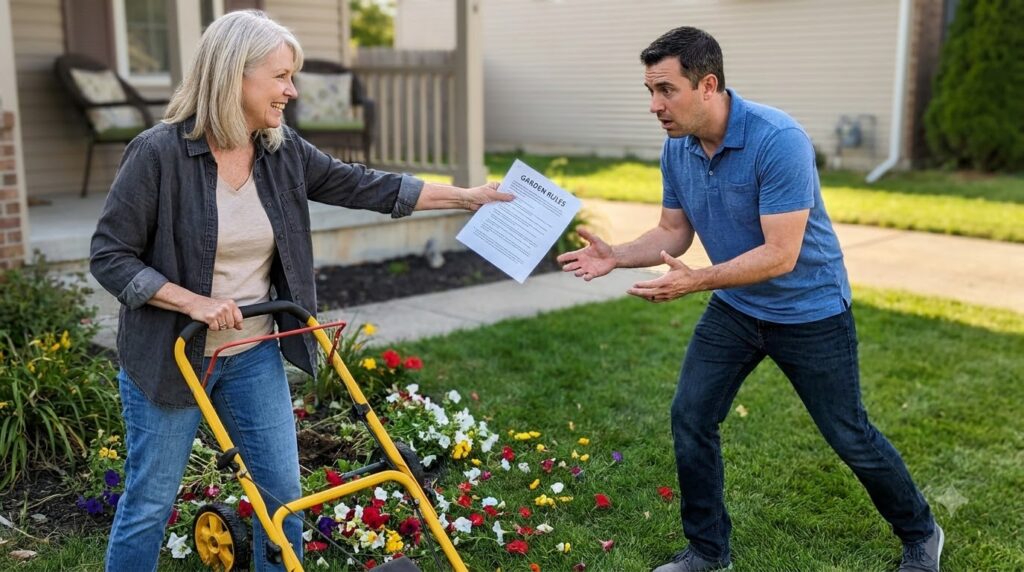
Evelyn had gone to the garage boxes. She had pulled out the original 1982 sales brochure and the unexecuted 1982 master plat map from Page 112. She had printed a summary, called it “GARDEN RULES,” and presented it to the neighbors as an active covenant. She had deliberately suppressed the 1985 court order that killed the easement before the ink was even dry.
She hadn’t just made a mistake. She had weaponized a legally dead ghost document to steal his land.
“I need certified copies of both pages,” Daniel says smoothly, reaching for his wallet. “Page 112, and the Order of Dissolution. Sealed by the Registrar.”
The clerk looks at the red bankruptcy stamp, then up at Daniel. A thin, knowing smile touches the corner of her mouth. “That’ll be fifteen dollars,” she says, sliding the book toward the heavy copper seal press on her back desk. “And I’ll stamp them official.”
Ten minutes later, Daniel walks out of the heavy glass doors of the County Building into the glare of the mid-morning sun. In his hand is a stiff manila envelope containing two certified, raised-seal documents that legally prove Evelyn Thorne is a fraud.
He slides into his sedan and starts the engine.
As he turns the wheel toward home, his phone buzzes on the passenger seat. It’s a text notification from his doorbell camera app: Motion detected at Front Porch.
Daniel taps the screen while idling at the red light.
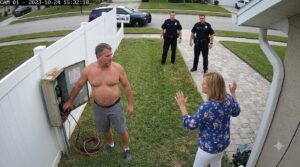
The live camera feed pops up. On his porch, standing right at his front door with a clipboard in her hand and two uniformed police officers standing behind her on the walkway, is Evelyn Thorne. She is pointing at his front yard, where her white plastic stakes and yellow nylon string now completely encircle his ruined flower bed.
She isn’t waiting for him to return. She has called the authorities to report him for interfering with an active neighborhood easement.