
CHAPTER 2: THE ANCHOR IN THE CLAY
The shutter click of the smartphone camera sounds like a dry twig snapping in the quiet morning air.
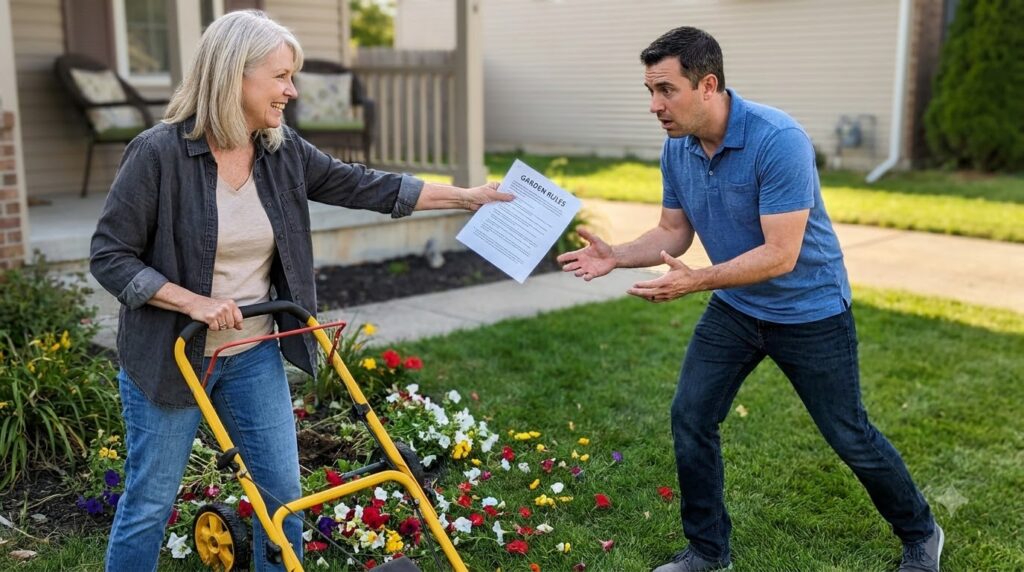
Daniel doesn’t rise from his crouch. The cold of the asphalt bleeds through the soles of his sneakers, settling into his calves as he holds the phone steady over the tire tracks. The yellow push mower had carved two distinct, parallel trenches through the damp black mulch, shearing off the stems of his mother’s hybrid peonies three inches above the crown.
He shifts his weight to his left knee, balancing on the balls of his feet. His thumb brushes the screen, locking the exposure before taking a wide shot that frames Evelyn’s manicured driveway in the background, where the mower still idles like a muted thrum in the distance.
Then his eyes drop back to the soil.
Where the front right wheel of the mower had skidded against the edge of the bed, the topsoil had peeled back in a long, dark ribbon. Beneath the shredded mulch and tangled pink roots sits a small, flat square of rusted iron.
It isn’t a stray garden stake. It isn’t a discarded piece of construction scrap.
Daniel reaches down, his index finger pressing against the cool, oxidized surface. The metal is heavy, set firmly into the hard-packed clay beneath the organic layer. He sweeps his thumb across the top, clearing away a layer of wet grit. Stamped into the center of the iron plate, pitted by decades of moisture but still unequivocally legible, is a series of raised block characters:
PROPERTY PIN – SE TRACT 4 – 1982
A cold, methodical clarity washes over his chest, replacing the raw heat of the confrontation with the sharp precision of an equation waiting to be solved.
He knows this pin. When his mother bought the house in 1989, the developer’s markers were already considered historical artifacts of the original subdivision survey. This square marker isn’t just a boundary marker; it is the physical legal anchor of his deed. And it sits four inches inside the flower bed, fully surrounded by the dark compost he had laid down with his own hands last March.
Evelyn hadn’t just crossed onto his grass. She had driven her blades over the exact physical monument that defined his land.
“Daniel?”
The voice comes from across the asphalt, soft and tentative.
Daniel rises in one fluid motion, slipping the phone into his back pocket. He turns slowly.
Sarah stands at the edge of her driveway, wearing an oversized gray cardigan pulled tight around her shoulders. Her husband, Marcus, remains two steps behind her on their front porch, his coffee mug held in both hands, his expression strained with the awkward discomfort of a spectator who had witnessed a mugging but wished he hadn’t.
“Is… is everything alright?” Sarah asks, her eyes darting toward the severed blooms scattered across the grass. “We heard the mower. We thought she was just trimming the curb.”
Daniel looks at her. He doesn’t raise his voice. He doesn’t perform anger for an audience. In the suburban chess match, emotional outbursts are currency given away for free to the aggressor.
“She crossed the pin, Sarah,” Daniel says smoothly. His voice carries easily across the quiet street.
Sarah shifts her weight, her eyes flicking nervously toward Evelyn’s front porch, where the front door sits heavy and closed behind the dark screen. “Well… you know how Evelyn gets about the appearance of the street. She told the HOA committee last month that the corner lots needed to maintain a uniform border for the sidewalk sightlines. She said there was some old agreement about the easement.”
“An agreement?” Daniel asks. He steps off the bed, his sneakers making no sound on the pavement. “Did she show you an agreement?”
“She mentioned a document,” Marcus calls down from the porch, taking a slow step toward the driveway. “Said something about a shared pedestrian access plan from when the neighborhood was first mapped out. She had a copy at the block meeting.”
Daniel nods once. The detail fits seamlessly into the shape of the trap. Evelyn wasn’t acting on a sudden impulse of malicious spite; she was executing a staged campaign, laying a trail of verbal breadcrumbs among the neighbors to establish a narrative of “common land” before bringing the blades down on the soil.
“She showed a title page,” Daniel says, reading the subtext in Marcus’s hesitant posture. “Not the signatures.”
Marcus rubs the back of his neck, looking down at his slippers. “Well, no. But she sounded pretty sure about it, Dan. We just didn’t want to get caught in the middle of a board dispute.”
“There is no dispute,” Daniel says.
He walks past them toward his front porch steps, his posture straight, his movements deliberate. He doesn’t look back at Evelyn’s house. He doesn’t check the window blinds to see if she is watching him from behind her glass. He knows she is. He can feel the pressure of her gaze like a physical weight on the back of his neck.
He opens his front door, steps into the cool, dark shade of the entry hall, and shuts the lock behind him with a firm, decisive click.
The interior of the house smells faintly of lemon polish and the lingering scent of his mother’s dried lavender bundles in the study. Daniel walks straight to the back room—the small, sunlit office where his mother had kept the family records organized in gray steel filing cabinets since 1994.
He kneels before the bottom drawer, the metal cold against his knees as he slides the latch.
The files are categorized by year and property code. He bypasses the utility bills, the tax assessments, and the roofing estimates, sliding his fingers back to the heavy manila folder labeled DEED & TITLE INVENTORY – ORIGINAL PURCHASE.
He pulls the folder onto the desk and spreads the yellowed pages under the desk lamp.
The property description is standard residential acreage, defined by metes and bounds from the 1982 survey. But as he flips past the county clerk’s stamp, his eyes stop on a small, blue-inked addendum attached to the back of the title policy—a rider document titled PROVISIONAL ACCESS DRAFT – DEVELOPER OPTION.
Daniel leans forward, his elbows resting on the polished oak desk, his fingers tracing the faint carbon-copy print.
The document describes a proposed six-foot pedestrian walkway running along the eastern boundary of Lot 14—his lot. It bears the bold heading that Evelyn had thrust in his face an hour ago.
But as Daniel’s thumb slides down to the signature line at the bottom of the page, his breath hitches.
The line reserved for the County Recorder is completely blank. In its place is a red rubber stamp, faded by forty years of darkness inside the file cabinet, reading: REJECTED – SUBDIVISION PLAT AMENDED WITHOUT APPLICATION.
Daniel pulls his phone from his pocket, opens the doorbell camera application, and hits the live playback feed.
On the small screen, the wide-angle lens captures his front lawn in crystal-clear high definition. Evelyn isn’t on her porch anymore.
The screen shows her stepping out of her side garage door, carrying a bundle of white plastic border stakes and a small wooden mallet in her hand, heading straight back toward the ruined flower bed under the cover of the quiet morning.








