CHAPTER 5: THE ESCALATION AT THE EDGE
The tires of Daniel’s sedan crunch against the gravel apron as he turns onto his street.
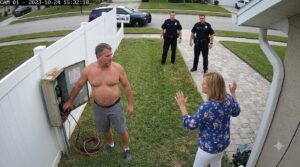
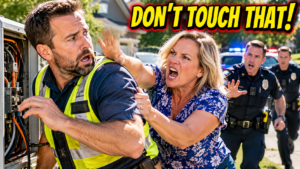
The calm morning quiet has disintegrated. Parked bumper-to-bumper along the curb in front of his house are two municipal police cruisers, their low-profile light bars casting faint, rhythmic flashes of red and blue across the white siding of his home. Across the road, Marcus and Sarah have stepped off their porch entirely, standing near their mailbox beside two other neighbors from down the block, all four watching the scene with tight, uneasy expressions.
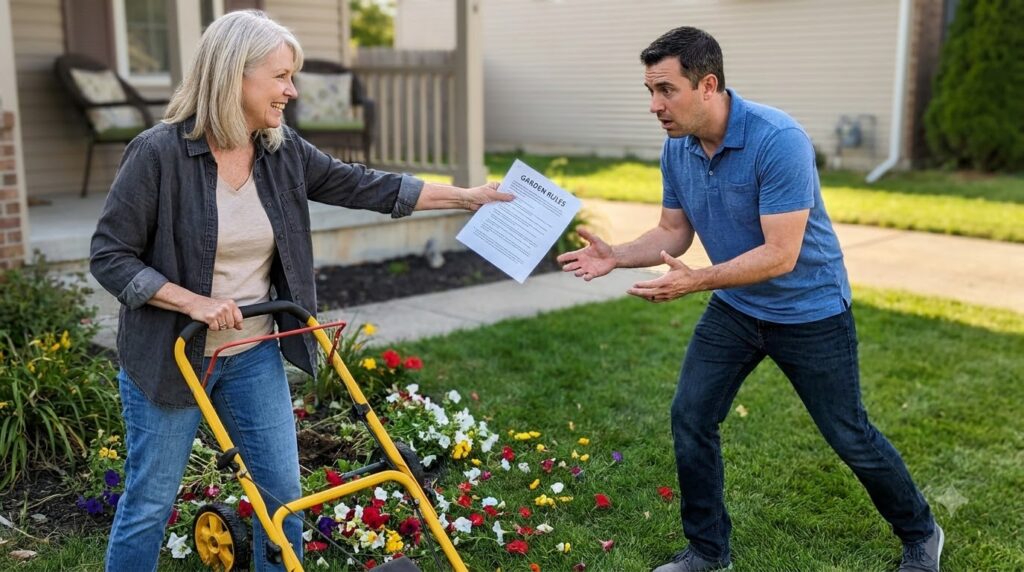
In the center of Daniel’s ruined flower bed, the white plastic stakes gleam under the midday sun, the yellow nylon string stretched taut between them like an enclosure fence.
Beside the line stands Evelyn. She wears her charcoal overshirt buttoned to the collar, a silver pen poised over a thick black clip-board. Standing beside her on the lawn is a young deputy, his hand resting casually near his duty belt as he takes notes. A second officer stands near the cruiser door, speaking into his shoulder microphone.
Daniel cuts the engine. He grips the sealed manila envelope resting on his passenger seat, feeling the raised impression of the county registrar’s stamp through the thick paper. He doesn’t hurry. He steps out of the car, shuts the door with a firm, solid thud, and walks directly toward his front walkway.
“Mr. Vance?” the deputy on the lawn calls out, stepping forward to intercept him before he reaches his porch steps. “I’m Deputy Miller. We received a call regarding a property dispute and an intentional obstruction of a neighborhood access corridor.”
Daniel stops three feet from the officer, his posture upright, his hands loose at his sides with the envelope held flat against his hip. “It’s not a dispute, Deputy,” he says smoothly. “It’s a trespass.”
Evelyn takes a deliberate step forward, her tan flats planting squarely inside the boundary of the yellow string. She holds up her clipboard, revealing a laminated copy of her self-typed “GARDEN RULES” page fastened over a copy of the 1982 developer’s plat.
“He’s attempting to deny the neighborhood access to the common greenway, Officer,” Evelyn says, her voice carrying across the yard with crisp, practiced authority. “I informed him this morning that Section Four of the master covenants requires uniform maintenance of the pedestrian path. Instead of complying, he fled the scene and refused to cooperate with board oversight.”
Deputy Miller shifts his weight, turning to Daniel with a neutral, weary expression. “Mr. Vance, Mrs. Thorne here provided us with a copy of the subdivision plan showing a six-foot pedestrian easement running along this property line. If you’ve been altering or blocking a recorded access path—”
“Did she show you the court order?” Daniel interrupts quietly.
The deputy pauses, his pen hovering above his notepad. “The what?”
“The court order,” Daniel repeats. He doesn’t look at Evelyn. He keeps his eyes locked on the officer. “She gave you a copy of the 1982 proposed developer plat. That map was drawn forty-four years ago by a bankruptcy debtor.”
Evelyn’s smirk falters for a fraction of a second, her thumb tightening over the edge of her clipboard. “That plat is part of the public record, Daniel. It was filed with the county planning board.”
“It was filed,” Daniel agrees softly. “And then it was struck down.”
He raises his left hand and slides the certified, raised-seal documents out of the manila envelope. The heavy parchment pages crackle in the breeze. He extends them toward Deputy Miller, ignoring Evelyn entirely.
“That is a certified copy from the County Register of Deeds, issued an hour ago,” Daniel says. “Page one is the 1982 proposal she is holding in her hand. Page two is the 1985 Order of Dissolution from the County Bankruptcy Court, Case 85-B-1402. The court legally vacated and dissolved every unexecuted pedestrian easement in this subdivision forty-one years ago. The land sits entirely inside my deeded parcel.”
Deputy Miller takes the parchment, his eyes scanning the red ink seal at the bottom of the second page. His mouth sets into a thin line as he reads the bold text of Paragraph Three.
Silence settles over the yard. The only sound is the low, idling thrum of the patrol car behind them. Across the street, Marcus leans forward, trying to read the body language of the officer.
Evelyn steps closer, her voice losing its calm, maternal rhythm, sharpening into a tight, defensive pitch. “Deputy, that is a preliminary filing! The HOA board has operated under the assumption of common access since 1989. You can’t simply ignore thirty years of established neighborhood use based on an obsolete bankruptcy filing—”
“Mrs. Thorne,” Deputy Miller cuts in, his voice flat and unyielding. He looks up from the paper, his eyes cold as he looks at her clipboard. “Is this document certified?”
Evelyn freezes, her jaw tightening. “It is a copy of the original subdivision master plan—”
“Is it certified by the county?” the officer repeats, stepping between her and the yellow string.
“No,” she snaps. “Because the board maintains the historical records—”
“Then as far as the Sheriff’s Office is concerned, this is private property,” Deputy Miller says firmly. He turns back to Daniel, handing the certified pages back to him. “Mr. Vance, your title appears clear. We cannot enforce an uncertified document or a civil covenant dispute.”
Daniel takes the papers, slipping them back into his envelope. “Thank you, Deputy. I’d like to file an official report for property damage to my flower bed and unauthorized placement of barriers on my land.”
Deputy Miller nods once, reaching for his incident log. “Understood. We’ll take your statement.”
A flash of pure, cold panic crosses Evelyn’s face, instantly replaced by a wave of furious anger. She looks at the deputy, then at the neighbors watching from the curb, and finally at Daniel.
“This isn’t over, Daniel,” she says, her voice dropping to a harsh, venomous whisper. “You think a piece of paper from 1985 gives you the right to ruin the appearance of this street? The board will meet tonight. We will vote an emergency assessment on this lot, and we will fine you every single day those stakes aren’t recognized.”
She turns on her heel, pulling her plastic stakes out of the ground with sharp, violent jerks, kicking the yellow string into the dirt as she marches toward her driveway.
Daniel watches her go, his posture motionless, his expression unreadable.
He has won the skirmish with the police. He has proven her document is a fraud in front of the deputy. But as he looks down at the certified pages in his hands, he notices something he missed in the dark vault of the county building—a tiny, handwritten docket entry in the margin of the 1985 bankruptcy order, written in faded blue ink beneath the judge’s signature:
Subject to municipal utility easement verification upon petition of adjacent parcel #15.
Parcel 15 is Evelyn’s lot.
Daniel’s fingers tighten against the envelope. Evelyn hadn’t just relied on the fake “GARDEN RULES” paper to bully him. She had filed an independent petition with the city utility board thirty days ago—and if that petition is granted at tonight’s emergency meeting, she won’t need an HOA rule to take his land. She will have the city code enforcement division do it for her.