
CHAPTER 3: THE DEED IN THE SHADOWS
On the phone screen, the wide-angle camera lens distorts the perspective, bending the straight asphalt line of the street into a gentle arc. But there is no distortion in Evelyn’s stride.
She walks with the methodical, unhurried cadence of someone who believes the surrounding world is merely waiting for her instructions. The white plastic stakes in her left hand catch the bright morning sun, gleaming like sharp, synthetic teeth. In her right, the heavy wooden mallet hangs loose at her hip.
Daniel doesn’t rush to the door. He doesn’t fling the screen wide to yell across the grass.
He stands in the cool quiet of his mother’s office, his thumb resting against the glass of the smartphone screen, watching her step off her driveway and plant her heels into the black mulch of his ruined flower bed.
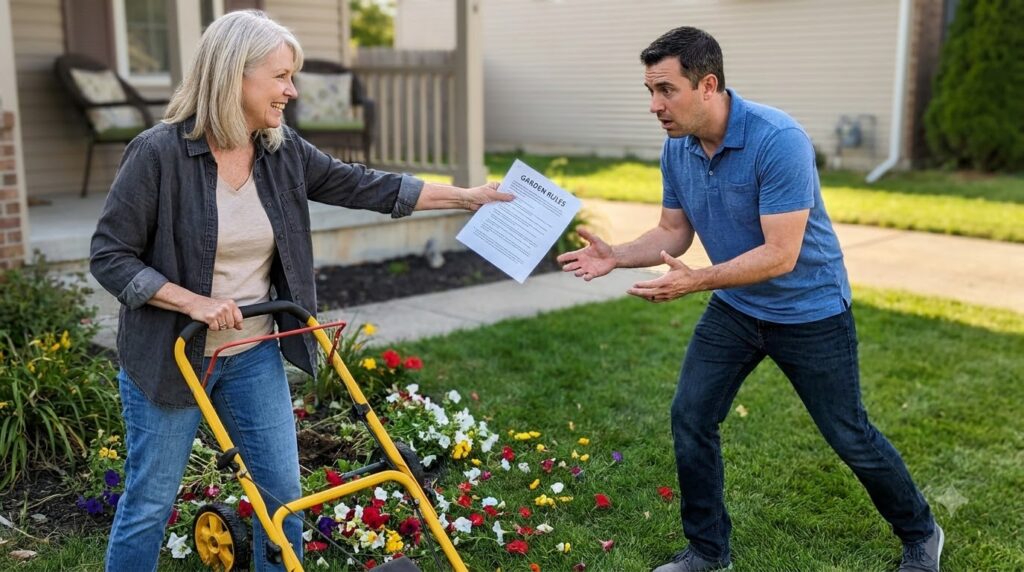
Through the camera’s speaker, a muted thump carries across the digital feed—the heavy, solid impact of wood striking plastic as she drives the first stake into the soil. She places it six inches past the severed stems of the hybrid peonies, well inside the territory she claimed under her fictitious “GARDEN RULES.”
She is establishing physical possession. It is the classic maneuver of the suburban land-grabber: create a visual boundary, let it stand unchallenged for twenty-four hours, and then cite its unresisted presence as tacit neighborhood consent.
Daniel turns back to the desk. He leaves the phone prop-lit against a stack of ledgers, the live video continuing to stream in silent, pixelated color.
His fingers slide beneath the blue-inked rider document—the PROVISIONAL ACCESS DRAFT – DEVELOPER OPTION dated October 14, 1982. Beneath it lies a second sheet, thin and translucent, yellowed around the margins where the glue had dried and failed thirty years ago. It is a carbon-copy surveyor map drawn on architectural vellum.
He brings his face down close to the paper, the desk lamp casting sharp shadows across the gridlines.
The map shows Lot 14—his parcel—highlighted in faint red pencil. Along the eastern edge, a hatched corridor precisely six feet wide cuts from the street curb back toward the rear alleyway. Inside that hatched zone sits the flower bed, the driveway apron, and the electrical junction box for the entire block.
Scrawled in the margin, in the hurried, looping handwriting of the long-deceased original developer, is a pencil notation:
Hold for community pedestrian connector. Pending HOA board vote #4.
Daniel opens the desk drawer, pulls out a magnifying loupe, and sets the glass directly over the signature block at the base of the vellum.
The signature of the developer, Arthur Vance—no relation, simply the man who mapped the subdivision before going bankrupt in the mid-eighties—is crisp. But right beside it, where the municipal registry seal should be embossed into the heavy fibers of the paper, there is only a faint, rectangular outline of dried adhesive, as if a temporary label had been affixed and later violently torn away.
A second thump echoes from the phone screen on his desk.
Daniel looks up. On the monitor, Evelyn is kneeling in the mulch now, her charcoal overshirt dusted with damp soil, driving a second stake into the ground. She is stringing a bright yellow nylon cord between the two white pegs, creating a taut, visible barrier three feet inside his deeded line.
She isn’t just cutting flowers anymore. She is laying down the physical framework for an easement that was never legally created.
Daniel picks up the manila folder, slides the carbon-copy map and the rejected rider into a clear plastic sleeve, and tucks the sleeve inside the inner pocket of his polo shirt.
He knows how Evelyn’s mind works. She had lived in this subdivision since the first foundations were poured in 1983. She had been on the original steering committee when the developer went under, leaving the neighborhood in legal limbo for two years before the county stepped in to establish the modern HOA structure. She remembered the original sales brochures—the ones that promised community parks, shared walking trails, and open green corridors.
When his mother had bought the house in 1989, the developer’s assets were being liquidated by a bankruptcy trustee in the county seat thirty miles away. Evelyn had been at those hearings. She had been the one who took home the leftover filing boxes from the sales office, storing them in her garage for four decades like personal trophies of local history.
She had found the unratified draft. She knew the original plan had envisioned a pedestrian path across Lot 14.
And she was relying on the fact that forty years of forgotten paperwork, combined with the intimidating authority of her printed “rules” sheet, would keep Daniel from looking too closely at the gaps in the record.
Another heavy, dull thud vibrates through the small speaker as Evelyn strikes the third stake.
Daniel checks the time on his phone: 8:42 AM. The County Register of Deeds office opens at 9:00 AM in the city center.
He reaches for his car keys on the brass hook beside the office door, his jaw set in a hard, unyielding line. He doesn’t need to argue with her on the lawn. He doesn’t need to pull up her plastic stakes or snap her yellow string. To fight her on the turf right now would be to accept her choice of battlefield.
He will let her build her fence. He will let her string her line in front of Marcus and Sarah and every neighbor on the block. He will let her lock herself into a physical posture of absolute, unassailable certainty.
Because the higher she builds her claim on a rejected piece of paper, the harder the fall will be when the official seal hits the table.
Daniel opens his front door, stepping out onto the porch into the crisp morning air.
Across the lawn, Evelyn halts mid-swing, the wooden mallet held frozen over her head. She looks up, her silver-blonde hair glinting in the sharp sunlight, her expression instantly hardening into a mask of defiant readiness. She waits for him to shout. She waits for him to cross the grass and demand she stop.
Daniel looks directly at her. His gaze drops to the three plastic stakes sticking out of his dirt, then travels up to the yellow string, and finally settles on the paper sticking out of her handbag.
He doesn’t say a word. He doesn’t gesture.
He simply turns, walks down his driveway steps, unlocks the door of his sedan, and slides into the driver’s seat.
As he turns the key and the engine settles into a smooth, quiet idle, he watches her in his rearview mirror. Evelyn stands alone in the middle of his ruined garden, the mallet still raised, her confident smile slowly faltering as the silence of his departure settles over the street like heavy iron.








