
The Architecture of Scars: A Novel of Modern Warfare and Legendary Reckonings

CHAPTER 1: THE FAULT LINE

The rain did not fall so much as it clung to the galvanized links of the perimeter fence, turning the zinc wire into a line of gray, shivering teeth.

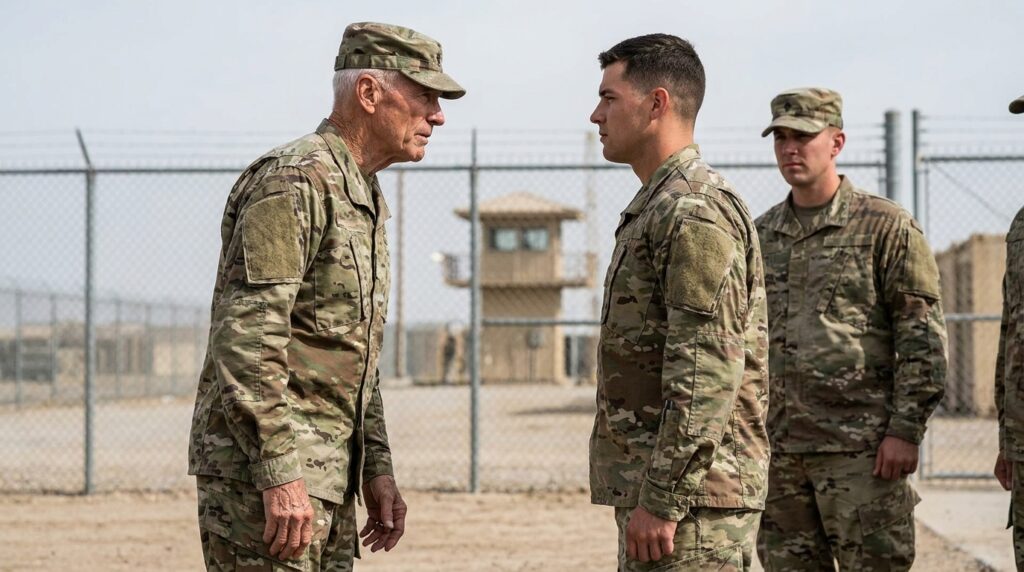
Colonel Jonathan Vance—though the uniform he wore carried no brass, no stars, and no name tape across the crisp digital fabric—did not shift his weight. He stood flat-footed on the crushed river stone of Fort Meade’s northern tactical lane, his palms resting flat against his thighs. To a boy in his late twenties, a man whose muscles were still thick from creatine and the structured violence of the modern infantry pipeline, Vance looked like an old tree that had dried out before it could fall. His hair was a stark, scrubbed white beneath the damp brim of his patrol cap, and the skin around his jawline was webbed with deep, pale creases that looked less like wrinkles and more like old stitch marks.

Ten yards away, across the blacktop of the simulated village breach point, the active-duty squad was resetting. They moved with the aggressive, jerking momentum of men who believed the world was an engineering problem to be solved with hydraulic rams and thermal optics.

“He’s still standing there,” Staff Sergeant Miller muttered, his voice barely lifting above the rhythmic, idling thrum of an armored utility vehicle fifty yards out. Miller kept his head down, pretending to check the battery housing on his night-vision rig, his cap partially obscuring his eyes. “Old man’s been there since the zero-five-hundred muster. He hasn’t taken a drink of water once.”

Captain Cole Vance—no relation, though the shared name had already caused a minor bureaucratic hiccup at the gate—didn’t look up from his tactical tablet. Cole was twenty-eight, his chest broad under the pristine weight of his plate carrier, his jaw locked in the permanent, defensive square of a man who had never lost a peer review. He swiped a thumb across the glass, clearing a smudge of grease.

“He’s a tourist,” Cole said, his tone flat, transactional, and short on grease. “Some retired bureaucrat from Logistics who wanted to see how the active side lives before they hand him his pension watch. Ignore him. We’re running the third ingress in two minutes.”

“He’s not looking at the tablets, Captain,” Miller said. The silence between them grew heavy, filled only by the wet crunch of gravel as a guard tower watchman shifted his boots on the platform above. “He’s watching your heels.”

Cole stopped his thumb. He raised his head slowly, his eyes narrowing through the gray drizzle until they locked on the lean, perfectly vertical silhouette by the wire. The old man hadn’t blinked. His eyes, a pale, washed-out blue that looked almost clear against his wind-burned skin, were fixed precisely on the left flank of Cole’s formation—the exact point where the third fireteam had crossed the threshold three inches too wide, exposing their hips to the dead space of the simulated stairwell.

A minor discrepancy. A micro-metric flaw that modern sensors didn’t register.

Cole handed the tablet to Miller with a sharp, metallic click of the plastic casing. “Hold this.”

He walked across the gravel, his heavy combat boots tearing into the stones with a rhythmic, intentional weight. With every step, he let his shoulders widen, his athletic chest rising against the tactical nylon of his harness. He stopped exactly twenty-four inches from the veteran’s bill, using his height to throw a shadow over the old man’s weathered face.

“Sir,” Cole said, the title carrying the distinct, hollow ring of mandatory military courtesy rather than genuine deference. “This is an active-fire lane. The simulated frag variables are live on the grid. If you don’t have an escort badge visible on your outer layer, I need you to step behind the concrete barriers.”

The Elderly Soldier did not move his hands from his sides. His thumbs remained hooked slightly forward, perfectly aligned with the seam of his trousers—a posture so old-fashioned it belonged in a black-and-white training film from the Monongahela. He looked down at Cole’s boots, then up to the pristine, scratchless finish of the younger man’s helmet.

“Your third man,” the veteran said. His voice was a low, dry rasp, like a piece of heavy canvas being dragged over rough timber. “He’s carrying his weight on his toes when he transitions the frame. If that sill were reinforced timber instead of hollow aluminum, the rebound would have shattered his clavicle before he got the muzzle through.”

Cole’s jaw tightened, a small muscle leaping beneath the skin of his cheek. He let out a short, dry breath that smelled of cold coffee and MRE mints. “With all due respect, pop, things have changed since your time. We don’t clear rooms with timber logic anymore. The pressure wave from the flash-bang renders the threshold soft before the team ever breaks the plane.”

The old man didn’t move. He simply stared into Cole’s eyes, his expression as flat and unyielding as the concrete tower behind them.

“The mud doesn’t care about your flash-bang, son,” the veteran whispered.

Cole stepped closer, his chest nearly brushing the old man’s faded lapel, his eyes dark with the sudden, sharp heat of a younger man whose authority had been clipped in front of his squad. “I hear you,” Cole said, his voice dropping into a hard, competitive edge. “But I still disagree. Now step behind the line.”

The old man reached into his right pocket, his scarred fingers closing around a heavy, silver-plated Zippo lighter. He didn’t strike it. He just let the lid click open and shut once—a small, metallic snap that seemed to stop the sound of the rain entirely.

From the communication shack fifty yards away, a high-frequency siren began to wail, its steady, unbroken scream signaling an unannounced, command-level override of the entire sector’s grid.


CHAPTER 2: THE BLACKOUT PROTOCOL

The siren did not merely sound; it cut through the damp air like an iron blade scraping across stone. The tone was low, a rhythmic, mechanical growl that vibrated through the soles of Captain Cole Vance’s boots long before it registered in his ears. On the surrounding towers, the high-intensity halogen arrays—usually reserved for midnight breaches—flickered once and then died, leaving the training sector bathed in the flat, bruised light of a rainy Maryland afternoon.

“Command override,” Staff Sergeant Miller said, his voice dropping an octave as he moved instinctively toward the Captain’s flank. His boots crunched hard on the wet gravel, a sharp, ragged sound against the uniform wail of the horn. “That’s a tier-one grid isolation, sir. They only pull the plug on the auxiliary lanes if there’s a perimeter breach at the mainframe.”

Cole didn’t answer. His eyes were still pinned to the old man standing twenty-four inches in front of him. The silver-plated Zippo lighter remained flat in the veteran’s palm, its polished casing catching the dim, metallic sheen of the wet fence links. The small click of its lid closing had been perfectly timed with the first pulse of the alarm, a coincidence that felt less like luck and more like a trigger being pulled.

“Your hand,” Cole said, his voice tight, focusing on the sharp edge of the lighter rather than the klaxon overhead. “Where did you get that uniform?”

The Elderly Soldier didn’t flinch from the proximity. The white hair beneath his cap cap rim remained perfectly dry, shielded by an angle of posture that seemed engineered to resist the elements. Up close, Cole could see that the camouflage pattern wasn’t standard active-issue; the digital blocks were smaller, the lines sharper, the fabric carrying the heavy, stiff weight of treated canvas that had been kept in a vacuum seal for decades. There were no unit patches, no airborne tabs, and no name tape across the breast—only the raw, dark green threads where a label had been meticulously picked away with a razor blade, leaving behind a ghost-imprint of stitches.

“The uniform stays the same, Captain,” the old man said, his gravelly tone sliding under the noise of the siren with a practiced, chilling clarity. “It’s the skin underneath that rots. Your men are breaking format. Look at your perimeter.”

Cole tore his gaze away, his jaw working as he looked back at the tactical lane. The three fireteams had abandoned their high-low spacing. They were clustering near the aluminum threshold of the simulated compound, their weapons lowered, their heads turning toward the communication shack where the red warning beacons were spinning in silent, bloody circles. The discipline he had spent six months hammering into them was fraying under the simple pressure of the unknown.

“Miller, get them back into the box,” Cole snapped, the administrative weight of his rank returning in a sharp, defensive burst. “We are in the middle of an evaluation cycle. Until the tower drops the flags, the lane is live.”

“The lane was dead before you stepped onto it,” the veteran whispered flatly. He moved his arm—a single, fluid motion that lacked the jerky speed of youth but possessed the heavy, unyielding momentum of an iron rod. He pointed a scarred index finger toward the northwest corner of the concrete blockhouse. “The drainage grate. Twelve inches of reinforced steel over a six-inch clear channel. If your logistics team had read the structural blue-lines from seventy-four, they’d know that channel connects directly to the sub-station basement. A four-man fireteam with standard oxygen kits doesn’t need to breach your front door. They’re already under your floorboards.”

Cole’s chest hardened against the nylon straps of his plate carrier. “That channel was filled with concrete twenty years ago during the base reconstruction.”

“Then why is the moss on the iron rim green, son?” The old man lowered his hand, his fingers resting steady against his side. “Concrete doesn’t sweat. Water only moves through a clear pipe.”

A cold spike of adrenaline hit Cole’s spine, sharper than the rain. He knew every inch of the Fort Meade training grid—or he thought he did. He had memorized the digital schematics on his tablet until his eyes bled. But looking at the old man’s finger, looking at the dark, wet shadow beneath the concrete blockhouse where the weeds grew thick and undisturbed, he saw the fault line. The old man wasn’t guessing; he was remembering.

Behind them, the gravel exploded.

Miller came sprinting back from the communication line, his face pale under the brim of his helmet, his fingers trembling slightly as he held out a handheld radio that was spitting static. “Captain. We’ve got a problem. The master terminal isn’t accepting our lane logs. When I tried to input the evaluator’s initials from the morning gate manifest, the system locked the whole sector down. The tower sergeant says the order came from the big house. Not the colonel—the general.”

Cole looked from the static-choked radio back to the old man. The veteran hadn’t shifted an inch. He stood against the wire fence like an integrated part of the barrier, his pale blue eyes tracking the clouds rolling in from the east, calculating the barometric drop with the silent precision of an old barometer.

“Who are you?” Cole demanded, his voice losing its transactional edge, replaced by a raw, tactical focus. His fingers hovered instinctively near the side of his belt, his posture shifting from an arrogant officer to a predator realizing he was sharing the pen with something older and much larger.

The old man turned his head slowly, the deep lines around his eyes shadowing his expression until his face looked like it had been carved from the same gray granite as the guard towers. He stepped forward, closing the remaining distance until the bill of his cap brushed the edge of Cole’s helmet, his breath cold against the younger man’s face.

“I’m the man who dug the well you’re drinking from,” the veteran said, his voice dropping below the static of the radio. “And right now, you’re leaning over the edge.”

CHAPTER 3: THE FRICTION LINE

“Back away from the fence, Captain,” Miller said, his boots sliding through the wet gravel as he wedged his physical frame between Cole and the elder. The handheld radio in Miller’s grip was a dead weight now, its speaker humming with a steady, high-frequency whine that set Cole’s teeth on edge. “The command post just blacked out our transponders. We are completely dark to the network.”

Cole did not yield an inch of the blacktop. His eyes remained fixed on the white hairs protruding from the old man’s collar—rigid, needle-sharp, untouched by the freezing rain. Every tactical instinct he possessed told him to seize the old man’s wrist, to locate the entry credentials that had crashed a multi-million-dollar training grid. Yet, the absolute stillness of the veteran’s stance acted like a physical barrier. The old man hadn’t raised his chin, yet he seemed to look down at Cole through the sheer weight of structural dominance.

“The radio,” Cole commanded, his voice cold, stripping away any lingering administrative pretense. He reached out and snatched the plastic receiver from Miller’s hand, his fingers tracking a strange, dark ring of industrial grease near the auxiliary input seal. It was fresh, viscous, and smelled faintly of lithium and cold machinery. “Who gave you access to the northern grid protocols? That’s an off-network sequence.”

The Elderly Soldier allowed a slow, mechanical breath to escape his nostrils. The cold vapor didn’t dissipate; it seemed to cling to the bill of his weathered cap. “You look for a key because you only know how to open doors that have locks, Captain. When we poured the foundations for these blockhouses in the winter of seventy-four, we didn’t use digital relays. We used iron conduits and gravity valves. If you kill the power to the main terminal, the overflow gates default to manual pressure. Your network didn’t crash because of an entry code. It crashed because three thousand gallons of rainwater just hit the intake box behind the guard tower.”

“That’s a classified structural blueprint,” Cole said, his fingers tightening around the radio casing until the composite material creaked. He could feel the eyes of his entire fireteam on his back—nine elite soldiers frozen near the mock compound entrance, their weapons held at a useless low-ready, their confidence dissolving into the dark gray rain. “The only people with access to those schematics are listed under the Department of the Army’s architectural core. You’re an evaluator from logistics. That’s what the gate manifest stated.”

“The gate manifest states whatever the current office clerk needs to see to keep his rubber stamp moving,” the veteran replied flatly. He turned his torso toward the concrete guard tower, his movement deliberate and heavy, like the rotation of an old tank turret. His boots left deep, sharp impressions in the gravel, cutting straight through the shallow mud. “Look up at the second platform. Tell me what you see.”

Cole looked. The tower cut into the low sky like an unpolished tooth. On the narrow metal catwalk, thirty feet above the gravel lane, the silhouette of the watchman was no longer moving along the rail. He was standing completely rigid, his arms pressed tight against his sides, his face obscured by the dark visor of his helmet, but his posture was turned directly toward the old man. Not toward the Captain. Not toward the active-duty squad.

“He’s not checking the perimeter,” Miller muttered from Cole’s flank, his breath hitching. “He’s watching the old man’s hands.”

“Silence, Sergeant,” Cole snapped, though the cold iron in his own stomach was expanding. He stepped into the veteran’s path, his chest carrier brushing against the old man’s faded green lapel. The smell of cold canvas and gun oil rolled off the fabric, sharp and ancient. “You’re disrupting a live operational exercise. If you don’t produce a physical identification voucher within five seconds, I will have my third fireteam detail you to the security detachment by force. I don’t care who you cleared paths for fifty years ago. This is my lane.”

The old man’s mouth didn’t twist into a smile. The lines around his lips merely deepened, catching the gray light like small, dry gorges. He reached down to his belt, his hand moving with a calculated lack of haste that defied the frantic wail of the siren. He didn’t pull a weapon. He didn’t pull a badge. Instead, he gripped the heavy wire of the base fence, his fingers locking around the cold zinc with enough force to turn his knuckles a pale, bone-white.

“You have nine men in the box, Captain,” the veteran said, his gravelly voice dropping into a rhythmic, instructional cadence that felt ancient and absolute. “Their spacing is perfect for a textbook. But this isn’t a book. The wind is coming from the northeast at twelve knots. The exhaust from your utility vehicle is pooling in the dead space between the two storage containers. If a real adversary were sitting in that blockhouse right now, they wouldn’t use lead. They’d drop a thermal canister into the vent, and your entire line would be blind before they could clear their holsters.”

“We carry sealed filters,” Cole countered, his voice rising against the steady hum of the alarm.

“Your filters are rated for sixty minutes,” the veteran whispered, his washed-out blue eyes locking onto Cole’s pupils with a terrifying, unblinking intensity. “But the seals on those modern masks are synthetic rubber. They degrade at one hundred and forty degrees. A standard magnesium flare burns at over three thousand. You’re teaching these boys how to die with style, son. I’m trying to teach them how to walk out of the room.”

Cole opened his mouth to deliver the order to detail the old man, his tongue forming the first syllable of Miller’s name, when the heavy steel security doors of the main command building—three hundred yards down the tarmac—thudded open. The sound was a dull, industrial boom that echoed off the wet concrete walls of the blockhouse, instantly killing the static on Cole’s radio.

Through the rain, four silhouettes emerged, moving not with the tactical haste of an intervention team, but with the synchronized, rigid precision of a ceremonial guard. At the front was a short, thick-shouldered man whose olive-drab trench coat carried three silver stars on the shoulder tabs, glistening like wet ice under the gray sky.

General Vance. The Base Commander.

“Stand down, Captain,” the old man said, his grip releasing the fence with a dry, scraping sound. He didn’t look toward the approaching officers. He kept his eyes on Cole’s face, watching the younger man’s posture crack as the realization began to set in. “The master of the house is coming out to check his traps.”

CHAPTER 4: THE GEOMETRY OF PRESSURE

The boots of the three-star general did not splash through the pooling rainwater. They struck the blacktop with a sharp, flat crack, each heel-strike perfectly measured against the low, heavy hum of the isolation siren. General Vance moved with his chest thrust slightly forward beneath the stiff, wet wool of his trench coat, his eyes locked not on Captain Cole Vance, but on the unyielding spine of the elderly soldier leaning against the chain-link wire.

Cole shifted his weight, his fingers sliding away from his belt line as the proximity of higher command forced his spine into a mandatory, rigid posture. His chest carrier felt suddenly restrictive, the molded composite plates pressing hard against his ribs as he filled his lungs with the damp, iron-scented air.

“General,” Cole began, his voice cutting cleanly through the drone of the alarm as he prepared to offer his formal operational summary. He took one step forward, intending to put his physical frame back between his squad’s training line and the unverified visitor. “We have a structural security anomaly on the northern sector grid. The master terminal rejected the manifest entries, and this individual—”

The general did not pause to acknowledge Cole’s position. He bypassed the captain’s extended shoulder by less than two inches, the stiff edge of his wet sleeve brushing past Cole’s nylon harness with a harsh, dry whisper. The three senior staff officers trailing the general split into a flawless flank formation, their eyes fixed strictly on the gravel beneath their boots, their expressions frozen behind masks of pale, bureaucratic neutrality.

“Get your hands out of your pockets, Jonathan,” General Vance said. His voice was different from the gravelly rasp of the veteran; it was a smooth, heavy baritone that carried the calculated resonance of a man who had spent forty years dictating budgets and deployment schedules from concrete boardrooms.

The elderly soldier did not lower his eyes. He slowly slid his right hand out of his jacket pocket, letting the heavy silver Zippo lighter slip into the palm of his hand with a dull clink against a metal button. The pale blue eyes of the old man remained pinned to the three silver stars resting on the general’s shoulder tabs, tracing the cold, sharp edges of the metal insignia with a slow, discerning gaze.

“The stitching on your coat is off, Arthur,” the veteran said, his voice dropping below the volume of the rain, yet carrying enough weight to make Staff Sergeant Miller freeze behind them. “The quartermaster’s office is using the synthetic nylon thread from the Pennsylvania depot again. It rots under the armpits after three weeks in the humidity. I told you that in eighty-two.”

The general stopped precisely thirty inches from the old man’s bill. For a fraction of a second, the absolute stillness of the courtyard was so absolute that Cole could hear the distinct, heavy drops of water striking the hollow aluminum framework of the simulated blockhouse ten yards out. The general’s jawline, typically set in an unyielding, pristine square, twitched twice, a tiny pocket of tension leaping beneath his sun-baked skin.

Then, with a sudden, metallic snap of leather and brass, General Vance brought his right hand upward, his fingers flattening into a rigid, trembling line against the brim of his starched cap.

He was saluting.

He wasn’t saluting an office. He wasn’t saluting a rank visible on the fabric. He was saluting the lean, weathered frame of a man whose name had been systematically scraped from the base registers before Cole’s father had even signed his initial enlistment contract.

Cole’s breath caught in his throat, a dry, metallic taste rising from the back of his tongue. He looked from the general’s stiff, raised elbow down to the old man’s unadorned chest. The faint ghost-imprint of the picked-away name tape seemed to darken under the rain, the tiny, empty needle holes forming a dark, geometric shadow across the green canvas. He noticed, for the first time, that the pristine double-threaded hem on the general’s custom trench coat utilized the exact same spacing and gauge as the phantom stitches on the old man’s lapel. It wasn’t standard issue. It was a replica.

“The sector is locked down as per your directive, sir,” the general said, his baritone voice tightening, dropping the conversational familiarity entirely. He held the salute, his eyes locked straight ahead, looking over the old man’s shoulder toward the concrete guard tower. “The auxiliary grid has been isolated to Layer One parameters. The active-duty squad is cleared for administrative relocation.”

The old man didn’t return the gesture. He kept his steady, scarred hands held flat against his sides, his thumbs hooked slightly forward along the trouser seams. “The captain thinks the drainage channel under the blockhouse is filled with concrete, Arthur. He tells me his digital filters can handle a magnesium thermal spike.”

The general slowly lowered his hand, his fingers clenching into a fist inside his leather glove, a dull, scraping sound against the wool of his coat. He turned his eyes toward Cole, the cold, administrative gaze of a three-star commander returning with the weight of an anvil.

“Captain,” General Vance said, his voice flat and devoid of warmth. “Your fireteams will immediately cache their live variables and retire to the secondary assembly bay behind the motor pool. You will hand your tactical tablet and the sector gate manifest to Staff Sergeant Miller. You are no longer commanding the evaluation lane.”

Cole felt the muscles in his legs lock, his boots sinking a fraction of an inch into the river stones. “Sir, the squad’s readiness metrics are—”

“Your squad’s readiness metrics are currently being evaluated by the man who calculated the casualty ratios for the entirety of the seventy-four expansion,” the general cut him off, his voice dropping into a hard, competitive register that matched the old man’s logic. “If he says your third man is on his toes, your third man is a liability. Move your people out, Captain. Now.”

Cole didn’t move his head, but his eyes darted to the old man’s face. The veteran was no longer looking at him. He had already turned back toward the blockhouse, his pale blue eyes tracing the sharp, linear shadows of the concrete walls, analyzing the fatal flaws of the structure with the quiet, predatory satisfaction of a chess player who had seen the mate-in-three sequence before the first piece was moved.

“Miller,” Cole whispered, his voice sounding thin even to his own ears against the uniform wail of the siren. “Take the log.”

He unclipped the heavy, composite tablet from his harness, the plastic tabs releasing with a sharp, wet pop that sounded like a bone fracturing in the silence of the rain.

CHAPTER 5: THE PHANTOM ROSTER

The text on Staff Sergeant Miller’s unencrypted sub-terminal didn’t drop out; it vibrated. Across the scratch-resistant glass of the handheld unit, the data lines containing the northern grid manifests began to unspool chronologically, rewritten by an automated cryptographic script that originated from the subterranean server vaults under Building Four.

Cole did not run toward the communications shack, but his stride was long, the rubber heels of his boots slicing through the thin mud layer until they hit the solid, basalt aggregate beneath. He left General Vance and the white-haired phantom standing by the fence line, their silhouettes overlapping like two rusted blades stuck into the same patch of earth.

“Show me,” Cole said, his voice catching the dry, flat rhythm of an officer demanding a localized casualty tally. He reached over Miller’s shoulder, his wet thumb leaving a smear of grease across the edge of the frame.

“It’s not an administrative lock, Captain,” Miller whispered, his teeth clicking together once from the chill. He pointed a flat fingernail at the primary data column. “Look at the master payroll interface. Look at the retirement ledger for the seventy-four construction corps.”

The screen was flashing a single, low-frequency amber warning code: DECEASED / PURGED RECORD FILE-74. Below the alphanumeric designation, where the name, rank, and security clearance of the unannounced evaluator should have been logged into the base housing registry, there was only a flat line of zeroed out binaries. The master registry wasn’t denying the individual’s presence; it was declaring that the individual had ceased to exist within the continental command structure precisely thirty-two years ago, during the quiet decommissioning of the original subterranean testing chambers.

“He’s dead on the books,” Cole said, his voice dropping into the calculated silence of a tactical calculation. His thumb traced the edge of the terminal frame, feeling the tiny, sharp ridges of the casing where the original factory seals had been sheared away by a technician’s pick. “The general isn’t saluting a guest. He’s saluting a ghost that has the authority to drop the grid.”

“The general isn’t the one who initiated the isolation, sir,” Miller said. He held up his secondary radio, its small monochrome display completely blank, showing only the red warning light of a hardware-level battery short. “The signal came from inside the blockhouse we were just clearing. The drainage channel. Someone pulled the physical breaker from the dry well.”

Cole turned his torso sixty degrees, his eyes tracking back across the tarmac toward the simulated concrete compound. His squad had already begun their administrative retreat, their figures moving like dark, geometric shapes through the gray curtain of rain, heading toward the secondary assembly bay by the motor pool. They looked small from this distance, their athletic frames burdened by the dead weight of non-functional gear, their expensive tactical arrays rendered useless by a simple barometric drop and twenty inches of clear iron pipe.

He looked back at the fence line. The old man hadn’t shifted his heels. He stood flat against the wire, his lean fingers still loosely curled around the silver Zippo lighter, while General Vance remained at rigid attention three paces away, his face pale under the brim of his starched cap. The dynamic between them wasn’t one of a commander and a retired subordinate; it was the precise, geometric posture of an apprentice waiting for the final mark from an unyielding engineer.

“He built it,” Cole muttered, the realization hitting his chest with the cold, flat impact of a kinetic round. “The northwest corner. The blind spot in the spacing. He didn’t flag a defect in our training; he flagged a design feature he left in the concrete fifty years ago.”

“Sir?” Miller asked, his fingers tightening on the terminal.

“The decoy,” Cole said, his internal monologue running the strategic variables like chess lines. “The base commander isn’t running an evaluation exercise for the squad’s readiness index. He brought this old man back to see if we’d notice the pipe. If we don’t notice the pipe here, in the mud, under a standard three-knot drizzle, we won’t notice it when we cross the fence line in the dark next week.”

He didn’t wait for Miller to respond. He took the handheld terminal from the sergeant’s hands, his fingers locking onto the cold composite edges as he walked back toward the fence line. The rain was getting heavier now, the water coming down in thick, straight lines that hissed against the hot exhaust vents of the idling utility vehicles fifty yards out.

As he closed the twenty-foot gap between himself and the two elders, Cole didn’t lead with his chin or his rank. He kept his shoulders flat, his posture low and compact, his eyes focused entirely on the old man’s weathered cap brim. He had stopped looking at the veteran as an anachronism; he was looking at him as an operational threat with an infinite range.

“The record was purged in ninety-four, sir,” Cole said, addressing the white-haired soldier directly, his voice clean of any promotional arrogance. He held out the flashing amber terminal, letting the screen reflect against the old man’s clear, washed-out blue eyes. “According to the Department of the Army, the engineer who laid the conduits for Sector Three died during the technical closure of the deep shafts. But you’re standing on my blacktop, and your lighter has the same lithium grease on the hinge as the main breaker link.”

The Elderly Soldier didn’t look down at the glass. He reached out with his left hand, his long, scarred fingers closing around the terminal frame with a grip that was surprisingly heavy, the bone beneath his thin skin as rigid as an iron bar.

“A soldier who looks at a screen to find out if his enemy is alive is already three seconds behind the trigger, young man,” the veteran whispered, his gravelly tone sliding under the roar of the rain with a slow, devastating authority. “Arthur, tell the boy what happened to the last squad that tried to breach the northwest corner without checking the well.”

General Vance didn’t turn his head. His eyes remained fixed on the concrete tower, his jaw locked in a hard, pale line. “They stayed in the shaft, Captain.”

CHAPTER 6: THE COMMAND RECKONING

“They stayed in the shaft, Captain.”

The general’s words did not drop through the rain; they sat on the blacktop with the blunt, cold finality of iron weights. General Vance had still not broken his rigid alignment, his chin held parallel to the wet gravel, but his voice carried a faint, rhythmic tremor that matched the low-frequency drone of the emergency klaxon.

Cole felt his boots go stiff against the stone. He did not look back at Miller, nor did he look toward the motor pool where his squad was vanishing into the gray curtain of the facility’s secondary line. He kept his eyes locked on the space between the general’s starched lapel and the veteran’s shoulder, where a tiny, notched brass key-pin sat tucked behind the collar plate—fused directly into the wool, hidden from any standard inspection protocol. It was the old manual release for the subterranean valves. It wasn’t an ornament; it was a structural tool.

“Nineteen hundred and ninety-four,” Cole said, his voice flat, his internal logic grinding the years down like gears. “The year the deep shafts were sealed with concrete. The official report said it was a gas leakage. An environmental closure.”

“The official report was typed by a clerk who wanted to sleep at night,” the veteran whispered. He stepped away from the chain-link fence, his canvas boots making no sound as they crossed the gravel. He reached out and tapped the glass of the terminal Cole was holding. The amber text—DECEASED / PURGED RECORD—flickered against the scarred skin of his knuckle. “Arthur was a major then. He was the one who turned the manual pressure valve from the observation room. He turned it because I told him to.”

Cole looked at the general. The three stars on the man’s shoulder didn’t move, but a thin line of red water was tracking down the side of his neck, running from the brim of his cap straight down into his wool collar. The commander of the base, a man who held absolute authority over three active brigades, looked entirely paralyzed by the mere physical proximity of the old man.

“He cleared the line, Cole,” General Vance said, his baritone voice dropping into a guarded vulnerability that Cole had never heard in six years of service. “The blueprint you’ve been studying on your digital pads for the upcoming deployment—it isn’t a mock-up of a foreign compound. It’s a direct replication of the blockhouse system we are standing on right now. The original blueprint has seven blind spots. Your tech team only identified six.”

“The drainage channel,” Cole said, his chest carrier tightening as he breathed in the sharp, chemical tang of the facility’s room tone. “The moss on the iron rim. It isn’t an intake overflow. It’s a physical exit point from the lower vault.”

“It was an exit,” the old man corrected, his pale blue eyes narrowing as he looked toward the northern guard tower. “Until the reinforcement teams laid thirty tons of structural slag into the center junction. Now it’s a bottleneck. If you put nine men into that corridor with modern digital packs, the signal reflection off the reinforced walls will fry your transponders in forty seconds. You won’t be blind because of smoke, Captain. You’ll be blind because your own gear will drown you in static.”

Cole felt a heavy, physical exhaustion drop onto his shoulders, the sheer weight of his tactical vanity splintering under the old man’s analysis. The chess match wasn’t happening on the tarmac; it had been played and decided thirty years before he was born. The entire training exercise—the live variables, the high-intensity halogens, the gate manifest—had been a filter. A false flag designed by the general to expose the exact failure point Cole had just demonstrated: structural arrogance.

“Why am I still on the blacktop, sir?” Cole asked, his voice sharp, transactional, directed straight at the old man’s weathered cap. He didn’t ask the general. The three stars on the trench coat had lost their functional leverage. “If my fireteam is a liability, and my spacing is a textbook error, why aren’t we in the brig?”

The Elderly Soldier reached into his jacket, his fingers wrapping around the smooth casing of the Zippo. He didn’t open the lid this time. He just held it flat against his palm, using its hard edge to anchor his balance against the rising wind.

“Because the people inside the actual compound next week aren’t using blanks, son,” the veteran rasping low, his face inches from Cole’s helmet brim. “And the man who built their blockhouse was my sergeant before he went rogue. He knows the seventh blind spot because he helped me dig it.”

Behind them, the high-frequency siren suddenly cut out, leaving a massive, ringing vacuum in the gray afternoon. In that sudden silence, the static on Cole’s handheld terminal cleared, replacing the amber code with a fresh, red-level data feed that began to populate the map grid with thirty-two distinct, unclassified target markers.

CHAPTER 7: THE ENCRYPTED THRESHOLD

The data feed on Cole’s terminal didn’t scroll; it clicked into existence like a row of glass panes shattering in sequence. Thirty-two crimson icons burned against the desaturated mapping grid, each one tagged with a sharp, geometric vector line that pointed back toward the exact coordinates of the mock compound’s northwest corner.

Cole did not drop his eyes from the display. His fingers, numb from the cold rain, tightened around the composite frame of the pad until the plastic seams bit into his palm. “The system isn’t running a projection,” he said, his voice dropping into the flat, hollow tone of a tactical commander recognizing a live threat vector. “These are active transponder returns. Every target is broadcasting on a low-frequency military band—eight-eight-four point two megahertz. That’s an old tactical loop from the expansion era.”

“It’s the loop we used before the satellites were launched, son,” the old man said, his gravelly whisper slicing through the sound of the rain. He stepped closer to the terminal, his shadow falling across the glass like a long, dark beam. He didn’t point at the indicators. He merely stared through them, his washed-out blue eyes focusing on the empty grid lines that represented the subterranean drainage shafts. “The rogue sergeant didn’t change his frequency because he knows the concrete walls down there are too thick for anything else. He’s sitting in the dark, waiting for you to walk into his blind spot with your digital arrays turned on.”

General Vance did not lower his head, but his leather-gloved hands came together behind his back, the fingers interlocking with a dry, scraping sound against the stiff wool of his trench coat. “The evaluation manifest you signed this morning, Captain—it wasn’t an inspection of your administrative readiness. It was an authorization filter. Every squad leader who has run this lane over the last six months has cleared the mock compound using the default textbook mechanics. They used the flash-bangs. They trusted the network. And every single one of them would have been dead within forty seconds of crossing the threshold.”

Cole’s jaw tightened until the muscle in his cheek felt raw. He looked down the long, rain-slicked tarmac toward the secondary assembly bay. His men were still there, clustered under the steel overhang of the motor pool, their digital gear glowing with small, useless blue indicators in the gray mist. They were fast, they were strong, but they were entirely blind to the architecture beneath their heels.

“The real deployment next week,” Cole said, his internal monologue calculating the geometric risks of a deep-shaft entry. “The objective isn’t a foreign installation. We’re going down into the closed sectors under this base. The rogue sergeant never left the wire.”

“He never left his hole,” the veteran corrected flatly. He reached out and snatched the terminal from Cole’s grip with a sudden, metallic force that rattled the younger man’s harness. The old man didn’t look at the tactical vectors. With a single, sharp motion of his thumb, he struck the side of the casing against the heavy zinc latch of the perimeter fence, cracking the plastic shell open until the lithium grease on the inner circuitry was exposed to the rain. “The screen tells you where he was five seconds ago, Captain. The ground tells you where he’s going to be when you open the hatch.”

“Sir,” Staff Sergeant Miller stepped forward, his boots sliding through the wet gravel, his voice trembling slightly as he looked at the shattered remains of the multi-thousand-dollar device in the old man’s hand. “The command grid is completely down. Without those transponder vectors, we have no line-of-sight to the lower corridors.”

“You don’t need sight when the walls are twenty-four inches of solid granite,” the old man said, his gravelly voice dropping below the volume of the wind, carrying the absolute, chilling authority of a master builder. He reached down to his lapel, his scarred fingers tracing the raw, frayed green threads where his legendary citations had once been sewn. “You need to know how the air moves through the pipe. Arthur, tell him what happens when the manual breaker is pulled from the lower well.”

The general turned his pale face toward Cole, his eyes empty under the dark brim of his cap. “The lower level loses its oxygen seal within four minutes, Captain. If you aren’t out of the bottleneck before the pressure drops, the air in your lungs becomes the vacuum.”

Cole looked at the old man’s hands. The silver-plated Zippo lighter was gone, tucked back into the stiff canvas pocket, but the smell of cold iron and dry static lingered on the old man’s fingers like a physical stain. The dynamic had completely shifted. The younger soldier was no longer defending his rank; he was standing on the narrow edge of a paradigm shift that threatened to swallow his entire squad before they could draw their weapons.

“The seventh blind spot,” Cole said, his voice dropping into a hard, competitive register that matched the veteran’s pace. “Show me where it is on the stone. Not on the pad.”

The Elderly Soldier looked at him for three long, unbroken seconds, the pale blue of his eyes as clear and unyielding as ice. “Get your squad out of the motor pool, Captain. Bring your manual tools. Leave the tablets in the mud.”

CHAPTER 8: THE SEVENTH BLIND SPOT

The transition was not marked by a change in location, but by a sudden, violent drop in visibility. Cole did not wait for the rain to slacken; he led the fireteam back toward the concrete blockhouse with his teeth clamped tight against the cold. His squad moved behind him in a low, compressed wedge, their high-tech optic visors flipped up into the wet air, their hands gripping the knurled steel shafts of manual crowbars and iron breaching blocks.

The old man moved at Cole’s left shoulder. He did not carry a tool, yet his long, lean stride carried an innate sense of physical leverage that seemed to split the storm. His white hair was plastered flat against his temples now, his weathered cap held low against a sharp gust of wind that smelled intensely of deep subterranean silt and sulfur.

“The seal isn’t on the rim,” the veteran said, his gravelly rasp dropping into Cole’s ear over the click of boots on basalt. “It’s four inches down, behind the secondary flange. If you try to wrench the top plate from the hinges, you’ll split the internal alignment pins and lock the core from the inside. Arthur, get the torch team to the rear vent.”

General Vance did not reply. He had stripped off his heavy wool trench coat, leaving his three-star insignia exposed to the driving downpour on his wet digital uniform. He was kneeling in the mud beside the blockhouse foundation, his leather-gloved fingers sliding into a narrow, dark crevice where the concrete met the native granite stratum. With a dull, grinding screech of metal against stone, the general pulled back a heavy, rusted plate that had been entirely concealed by layers of wild moss and silt.

“It’s clear,” the general baritone echoed from the ground. “The linkage is still dry.”

Cole dropped onto his knees beside the general, his plate carrier hitting the wet gravel with a hard, flat thud. The interior of the exposed recess didn’t contain wires or electronic terminals. It was a purely mechanical scale—a series of interlocking iron levers, heavy as rail track, covered in a thick layer of dark lithium grease that had turned gray with decades of dust. Scratched directly into the granite wall behind the primary lever was a small, hand-stenciled Roman numeral: VII.

“The seventh,” Cole whispered, his internal monologue matching the geometric precision of the machinery. He didn’t look at his tablet; the broken casing lay twenty yards behind him in the mud. “This isn’t a bypass. This is the master balance for the entire sector’s air pressure.”

“It’s the choke,” the old man said, standing over them like a lean, vertical monument against the gray sky. He reached down and gripped Cole’s shoulder harness with his left hand, his fingers anchoring with a bone-crushing intensity that forced Cole to look up into the clear, washed-out blue of his eyes. “The rogue sergeant didn’t cut the grid because he wanted to hide his position, Captain. He cut it because he’s waiting for you to pull the manual lever. The moment you throw that iron weight, the vacuum switches to the lower vault, and the main hatch becomes an active pneumatic trap.”

Cole’s chest went perfectly still under the nylon webbing. His strategic pursuit logic, the hyper-focused lens through which he viewed every deployment as a chess match, suddenly expanded to encompass the entire design. The red transponder indicators that had populated his screen moments ago weren’t locations of enemy combatants; they were automated pressure sensors. The rogue sergeant wasn’t sitting in a room waiting for an assault; he had turned the entire subterranean facility into a single, kinetic weapon that would crush the fireteam using the weight of their own intrusion.

“The decoy,” Cole said, the words cutting through the rattle of the rain. “The master roster, the amber error code, the red targets—the rogue sergeant wanted us to find them. He wanted us to trace the frequency to this specific blockhouse so we’d throw the manual release to clear the air for our squad.”

“He knows how you think, son,” the veteran said, his voice dropping into a low, terrifying whisper that seemed to stop the wind. “He knows you value an entry metric over a structural truth. If you had run your textbook breach, you’d have thrown the lever from the observation room, and your nine boys would have been dead before their boots touched the third rung.”

Cole looked at the iron lever. The handle was cold, its surface pitted with the deep, fine scars of manual use. He could feel the eyes of Staff Sergeant Miller and the entire squad on his back, their breath coming in short, tense plumes of white vapor against the dark concrete wall. They had spent six months preparing for a war of electronic optics and rapid-fire dynamics, yet they were standing in the mud, waiting for a single, flawed decision on an obsolete piece of cast iron.

“We don’t throw it,” Cole said, his voice hardening as he stood up, his posture squaring directly against the general’s shoulder. He reached down and wrapped his fingers around the knurled shaft of a manual iron block, bypassing the lever completely. “We breach the outer masonry. The wall behind the drainage grate isn’t load-bearing; it’s an acoustic baffle he installed to hide the intake hum in seventy-four.”

The old man’s expression didn’t soften, but the unyielding grip on Cole’s shoulder loosened by a micro-inch. The deep lines around his eyes seemed to settle into a cold, grim satisfaction.

“Miller,” Cole commanded, his voice clean of any promotional hesitation. “Bring the sledge and the wedges. We’re going through the stone.”

Before Miller could step forward, a heavy, dull thud vibrated through the basalt beneath their feet—a deep, pneumatic hiss that originated from the center of the blockhouse floor, signaling that the pressure inside the shaft was already beginning to shift on its own alignment.

CHAPTER 9: THE RETAINED LINE

The hiss was not an escape of air; it was a physical vacuum pulling the wet atmosphere inward.

The heavy, structural steel floor plates of the concrete blockhouse shuddered, a deep, industrial groan vibrating through the basalt aggregate until the vibration struck Cole’s shins like a dull blow. The drainage grate—the six-inch channel he had underestimated—began to draw the pooling rainwater straight down into its iron throat with a wild, gurgling roar.

“The seal has failed,” Miller shouted, his boots slipping as he braced his weight against the exterior masonry wall. He swung the long iron iron breaching bar, its hardened nose striking the acoustic masonry baffle with a sharp, ear-splitting crack. A line of white stone dust erupted from the impact point, mixing instantly with the freezing rain to form a thin, pale sludge that poured down Cole’s knuckles.

Cole did not order his squad into the structural gap. Time seemed to dilate, stretched thin by the relentless tactical calculations spinning in his head. Through the opening fracture in the stone, he saw the ultimate reality of the lane. There were no active targets down there. The crimson vectors that had populated his device were ghosts, automated routines designed by the white-haired man fifty years ago to mirror the exact psychological path of an arrogant officer.

He looked at General Vance. The three-star commander was still standing in the rain, his gloved fingers wrapped flat around the manual lever labeled with the Roman numeral VII. The general wasn’t trying to reset the system. He was holding the counterweight steady with his own muscle, his shoulders trembling beneath his wet uniform as he fought the pneumatic pressure from the lower vault to keep the emergency hatch from snapping shut like a guillotine on Cole’s fireteam.

“He’s holding the door for us,” Cole whispered, the real-world operational weight hitting him with the force of an iron ram. The evaluation was over. The decoy secret—the rogue sergeant, the black-site network override—shattered completely, leaving behind the raw, devastating truth. The general hadn’t brought the old man here to evaluate a unit’s high-tech metrics. He had brought him to find a squad leader who would look at the stone instead of the screen, because next week, the extraction mission wouldn’t afford a second chance to clear a blind spot.

The Elderly Soldier stepped into the center of the threshold, his lean frame silhouetted against the dark opening in the masonry. The wind caught his faded green jacket, flapping the stiff canvas against his ribs, but his boots remained completely locked to the stone. He reached into his pocket and pulled his hand out, his fingers flat.

He didn’t offer a hand to help. He held out a single object.

It was a heavy, unadorned silver-plated cartridge casing, its base stamped with no manufacturer marks, its primer pocket entirely empty. The surface was deeply scratched, the metal holding the cold, desaturated glare of the daylight sky.

“The uniform changes, Captain,” the old man said, his gravelly rasp cutting through the final hiss of the pneumatic line with an absolute, undeniable resonance. “But the dirt out there stays exactly the same. Remember who cleared the path you’re walking on.”

Cole reached out, his wet fingers closing around the cold metal of the casing. The weight of it sat flat in his palm, a physical anchor that felt heavier than his plate carrier, heavier than his rank, heavier than the six months of perfect metrics he had claimed as authority. He looked up, his jaw squaring into a silent, earned deference as he met the pale blue eyes of the legend who had designed the very ground beneath his boots.

“Miller,” Cole said, his voice dropping into a quiet, absolute command that made the sergeant freeze. “Secure the tools. Tell the men to reset the line. We run the lane again from the zero point. Without the pads.”

The old man didn’t nod. He turned his torso back toward the fence line, his stride long and unyielding as he walked through the gray rain toward a black, unmarked command utility vehicle idling by the gate. General Vance slowly released the iron lever, the heavy counterweight clicking into its resting housing with a final, mechanical snap, before he followed three paces behind the veteran, his stars catching the last gray light of the sector.

Cole stood on the basalt, his thumb tracking the deep scratch on the silver casing, watching the tail-lights of the vehicle vanish through the zinc wire of the perimeter fence.

CHAPTER 10: THE COLD IRON DESCENT

The darkness three floors below the basalt aggregate did not feel like the absence of light; it felt like a weight pressing flat against the lenses of Cole’s unpowered tactical goggles.

He had ordered the fireteam to leave their battery housings in the secondary assembly bay. Now, the only illumination inside the narrow, brick-lined utility vault came from a single, low-intensity chemical stick that Staff Sergeant Miller held flat in his palm. The faint, radioactive green glow caught the wet edges of the masonry walls, turning the condensation into thousands of tiny, silver beads that looked like teeth.

“The digital relays died twenty feet above the hatch line, Captain,” Miller whispered. His voice was a flat, dry shadow of its usual administrative clip, bouncing instantly off the low concrete ceiling before dissolving into the steady, distant hiss of water moving through ancient pipes. “The auxiliary transponders are dead. If we blow a knee down here, the command post won’t even see our locator flags drop off the grid.”

“They aren’t looking for our flags, Sergeant,” Cole said. His voice was cold, his internal monologue running the strategic pursuit variables with a sharp, geometric precision that had grown more intense since the vehicle had vanished through the perimeter gate.

He was sitting on a rusted iron battery box, his heavy boots tucked back against the reinforced frame. In his right hand, his fingers were tracing the deep, abrasive scratch on the silver-plated cartridge casing the old man had left behind. In the green chemical light, the blank base of the shell looked almost black, but the density of the metal felt absolute—a heavy, forged truth that didn’t require an interface to verify.

The nine men of his first fireteam were arrayed along the damp walls of the vault like geometric shapes carved from the rock itself. Their athletic frames were hunched, their shoulders narrowed to fit the twenty-four-inch clearance of the old seventy-four corridor. They weren’t checking their tablets; their hands were clamped onto the cold, cross-hatched grips of mechanical trench knives and solid iron prybars.

“Look at the bracket behind the main valve,” Cole commanded, pointing the blunt nose of the silver casing toward the center of the chamber.

Miller shifted his hand, the green chemical stick casting long, vertical shadows across a massive, three-foot iron wheel that controlled the intake line for the lower drainage grid. The metal was covered in a thick, flaking skin of red iron oxide that came away in sharp, razor-like scales whenever the air shifted. Scratched deeply into the center of the mounting plate, beneath fifty years of oil sludge, were two distinct sets of initials: A.V. and J.V.

Cole’s thumb tightened against the cartridge. Jonathan Vance. The old man hadn’t just built the foundations; he had signed the iron before the concrete was poured over his name. And the initials beside his belonged to Arthur—the three-star general who had stood in the freezing rain, holding a manual counterweight until his shoulders shook, just to keep the pneumatic guillotine from cutting his own lineage in half.

“The general didn’t send us down here for a readiness index,” Cole said, his voice dropping into a hard, low register that fixed every head in the room toward his position. “He sent us down here because the rogue sergeant isn’t an intruder. He’s the third man who signed that log. He’s the one who stayed in the shaft when the file was purged in ninety-four.”

“Captain,” a voice cut through the damp silence from the back of the line.

It was Specialist Briggs, the squad’s senior technical advisor—a man whose entire career had been built on the hyper-fast processing speeds of modern encrypted networks. He had a secondary satellite uplink unit strapped to his chest carrier, but the digital display was flickering in rhythmic, useless gray pulses, its internal antenna humming with the dead, blind frequency of the granite walls.

“We have a jurisdictional conflict on the upper line,” Briggs said, his fingers tapping the dead glass of his housing with a defensive, frantic speed. “Before the terminal locked down, a red-level authorization directive was routed through the Washington bureau. They’ve designated an off-site tactical supervisor to monitor the ingress. A civilian contractor from the defense logistics core. He’s already at the primary gate manifest.”

Cole didn’t raise his chin. He let the silver cartridge click once against the iron lid of the battery box—a small, sharp sound that stopped Briggs’s fingers instantly.

“The gate manifest is a piece of paper for clerks, Specialist,” Cole said, his pale eyes catching the green light as he locked his gaze onto the technician’s face. “The man from Washington is looking for an entry metric. He thinks this grid is an engineering problem he can solve with a satellite override. But the walls down here are twenty-four inches of solid granite, and the air moves through gravity valves. If he touches the digital relays from the surface, he won’t open the door for us. He’ll drop the weight.”

He stood up, his boots crunching flatly on the loose rust flakes covering the floor. He walked to the center of the chamber, his shoulder carrier brushing the wet brick until the canvas fabric left a dark, clean track in the slime. He gripped the iron wheel with both hands, his scarred fingers finding the deep, notched grooves where the old man’s palms had once sat.

“Miller,” Cole whispered, his muscles hardening as he prepared to throw his weight against the dead friction of the gear. “Put the chemical stick in your pocket. From here on out, we move by the feel of the iron.”

The green light vanished into Miller’s fist, leaving the chamber in an absolute, suffocating blackness that smelled of cold grease and fifty years of stone.

CHAPTER 11: THE SILENT INGRESS

The pitch-blackness did not yield to the pressure of Cole’s shoulders; it resistance deepened as his boots ground into the loose flakes of rust below.

He did not call for Miller or the torch team. He threw the entirety of his body mass against the left rim of the three-foot iron wheel, his gloved palms catching the sharp, flaking cross-hatching of the casting. For a heartbeat, the dead-weight friction of fifty years of subterranean stasis held firm, the heavy iron spindle locking his elbows until the composite plate carrier on his chest groaned against the nylon straps.

“Hold the flank, Miller,” Cole ground out through his teeth, his internal monologue measuring the mechanical drag with a chess player’s focus. “The shaft isn’t dead yet. The counterweights are moving.”

With a sudden, metallic shriek that sounded like an iron rod splitting down its center, the valve yielded three inches. A rush of foul, freezing air burst through the unsealed packing gland, smelling heavily of sulfur, stagnant river silt, and the unmistakable, sweet chemical signature of old machinery grease. The black-space around them became a chamber of echoes, the sound of water rushing somewhere three levels further down accelerating into a low, uniform roar.

Beside him, the sudden, high-frequency chirp of a digital receiver punctured the silence.

It didn’t come from his fireteam’s cached equipment. It came from the ceiling line behind them—a crisp, synthesized notification tone that signal-pulsed three times before dropping back into static.

“Uplink tracking,” Specialist Briggs whispered, his voice hitching as his body moved instinctively into a defensive crouch in the dark. “That’s not our network, Captain. Someone just pushed an external query through the auxiliary terminal on the surface. The civilian contractor from Washington—he’s forcing the digital relays from the main gate office.”

“He’s tracing the line elements,” Cole said, his knuckles scraping the jagged edges of the wheel as he forced the iron spindle through its second complete rotation. The darkness was no longer a shield; it was a race track. His strategic pursuit logic recognized the signature of an external override. The supervisor from the bureau wasn’t monitoring their progress; he was trying to reset the system to Layer One before Cole’s fireteam could locate the manual bottleneck. If the digital relays fired now, the automated pressure gates would seal the corridor permanently, trapping the squad between thirty tons of concrete and an unyielding vacuum.

“Briggs, find the copper lead behind the primary junction box,” Cole commanded, his breath coming in short, ragged bursts that misted invisibly against the cold iron rim. “Don’t use your blade. Snip the main trunk with your pliers. Kill the signal wire before the surface terminal completes the handshake.”

“I can’t see the casing, sir,” Briggs’s voice carried the sharp, defensive heat of a technician stripped of his optics.

“Feel the weight of the conduit,” Cole snapped, his voice dropping into the gravelly cadence he had stolen from the veteran by the base fence. “The data lines are light, synthetic jacketed. The old command lines are three-quarter-inch galvanized iron pipe. Trace the rust until you find the soft wrap.”

The darkness grew heavy with the kinetic sound of labor—the ragged scrape of nylon gear against wet brick, the wet hiss of water spraying from the unsealed flange, and the rapid, desperate clicking of Briggs’s multi-tool hunting through the dead space behind the junction housing. Every second was a micro-metric calculation of failure.

Above them, through three hundred feet of solid masonry and earth, a dull, subterranean thud vibrated through the chamber walls—the first automated safety latch on the surface gate dropping into its lock sequence as the Washington supervisor’s script overrode General Vance’s manual isolation.

“I have the line,” Briggs grunted. A sharp, metallic snip clipped through the chamber’s roar, followed instantly by the clean, physical drop of the high-frequency hum in the ceiling. The digital pulse died mid-sequence, leaving only the raw, ancient sound of the valve opening into the dark.

With a final, shattering thud of forged iron against the stop-pins, the wheel locked open.

A sharp, linear draft of cold air pulled through the chamber, tearing the heat from Cole’s cheeks as it moved down into the newly opened channel. Through the empty valve sleeve, three levels down, a tiny, steady point of green fire emerged in the absolute blackness.

It wasn’t a chemical stick. It was the glow of an old tactical indicator panel from seventy-four, its manual elements still burning on a closed, non-networked mercury cell. The light didn’t illuminate the path; it merely framed the massive, circular silhouette of the seventh hatch—and the shadow of a man standing completely motionless beside the locking ring.

CHAPTER 12: THE LAST VAULT MATRIX

The green fire of the mercury cell did not illuminate the silhouette’s features; it cast them in sharp, linear blocks of deep charcoal and gray.

Cole lowered his upper body by three inches, his boots sliding through the slick layer of river silt until his heels locked against the final granite threshold. The air down here was different from the storm above; it was thin, sterile, and carried a heavy, freezing pressure that made every inhalation feel like a swallow of dry iron dust. His tactical plate carrier was cold against his ribs, its rigid composite edges pressing into his skin as he centered his weight over his toes.

“Don’t lift the muzzle, Miller,” Cole said, his voice dropping into the flat, unyielding rhythm of an absolute command. He didn’t turn his head. His eyes were pinned to the massive, circular shape of the seventh hatch—and the scarred, flat hand resting on its center locking wheel.

The figure in the dark didn’t shift his stance. He was lean, dressed in the same stiff, digital-free canvas fabric as the old man on the surface, his white hair tucked tightly under a faded patrol cap that threw a long, hard edge across his face. In his right hand, held loose against his trouser seam, was a second silver-plated cartridge casing—a perfect mirror to the one currently tucked inside Cole’s tactical harness.

“You took the long way, Captain,” the rogue sergeant said. His voice was identical to the veteran’s rasp, a dry, sawing sound that seemed to come from the deep fractures in the stone itself rather than human vocal cords. “If you had thrown the manual bypass on the upper level, the air in this chamber would have been gone before your boots hit the third rung.”

“The bypass was a decoy,” Cole replied, his internal logic clicking the final parameters into place with the precision of a master gear. “The supervisor from Washington thought he was running a security override on a broken network. But General Vance didn’t leave the grid active. He let you isolate this sector forty years ago because the containment wasn’t meant to be managed from a screen.”

The rogue sergeant slowly rotated his torso, his canvas trousers scraping against the wet iron casing of the pressure valve with a cold, hollow friction. The green light from the indicator panel caught the pale, unblinking clarity of his eyes—eyes that looked past Cole, past Miller, and anchored onto the dark, empty space of the corridor behind them.

“The bureau wants to reopen the deep shafts because they think the foundation is just concrete,” the rogue whispered, his hand tightening around the locking wheel until the old rust on the threads flaked off in sharp, red needles. “They don’t remember who poured the slag into the core to keep the well from breathing. If you let them complete the digital handshake from the gate office, the pressure defaults to Layer Two. The seal doesn’t open up, Captain. It opens down.”

Cole felt a cold spike of clarity hit his chest. The extraction mission his squad had spent months preparing for wasn’t a tactical deployment against a foreign cell. It was a holding action. An internal containment operation designed by the old guard to select a squad leader who possessed the psychological discipline to leave the network behind and maintain the manual locks by force. The old man on the tarmac hadn’t come to evaluate his tactics; he had come to pass the wrench.

“The wire is cut,” Cole said, his voice hardening as he stepped into the green light of the mercury cell, his hand reaching down to his belt line. He didn’t pull his knife or his sidearm. He drew the first silver cartridge casing, its polished surface catching the pale glare of the panel until the reflections formed a small, clean line across the rogue’s chest. “Briggs killed the data trunk before the handshake could verify. The gate manifest is dead on the surface.”

The rogue sergeant looked down at the silver casing in Cole’s hand, then down at the second shell held in his own fingers. For three long, unbroken seconds, the silence inside the granite vault was so absolute that Cole could hear the distinct, rhythmic thump of the general’s heart matching his own through the vibrating stone walls.

The rogue slowly lifted his hand from the locking wheel, his fingers uncurling with a stiff, dry snap of old cartilage. He dropped his cartridge into the silt by Cole’s boots—a sharp, metallic thud that signaled the official transfer of the post.

“The line is yours, Captain,” the rogue sergeant whispered, his silhouette beginning to recede into the deeper shadows of the unmapped conduits behind the seventh hatch. “Make sure the next generation knows how to turn the wheel.”

Behind them, a dull, physical vibration echoed through the shaft as the upper security doors thudded shut under Miller’s manual block, sealing Cole’s fireteam inside the silent, unyielding architecture of the old guard.

CHAPTER 13: THE ANCHORED GRID

The transition from a training cycle to a permanent watch was not marked by a change in uniforms, but by the smell of graphite and cold grease.

Captain Cole Vance sat behind a steel field desk that had been dragged three levels down from the motor pool and wedged directly into the threshold of the Sector Three vault. The overhead light was no longer electronic; it was a dual-mantle lantern that hissed with a low, predatory whistle, throwing sharp, trembling geometric shadows across the raw granite walls. On the rust-scaled surface of the desk lay a single ledger—its heavy leather spine stamped with the year 1974, its interior pages containing meticulously drawn pencil schematics of the base’s manual hydraulic lines.

“The surface investigators have reached the second gate,” Staff Sergeant Miller said, his boots crunching hard over a pile of loose stone dust as he stepped inside the bulkhead. His plate carrier was coated in a gray layer of pulverized masonry, and his fingers were black from handling the raw iron grease of the manual levers. “They brought a technical team from the bureau, sir. They’re running a continuous high-frequency digital scan from the upper terminal, trying to bridge the gap where Briggs sniped the trunk wire.”

Cole didn’t raise his chin from the ledger. His right thumb was anchored flat against the silver-plated cartridge casing that sat beside his field book like a lead weight. “Let them scan,” he said, his voice dropping into the flat, calculating cadence that had become second nature since the old man left the courtyard. “The signal they’re pushing down the pipe is twelve watts. At that frequency, the reflection off the reinforced copper mesh in the floorboards will bounce the packet straight back to their own receiver. They aren’t mapping our sector; they’re blinding their own sensors with the echo.”

“Briggs says the administrative escort is carrying live variables,” Miller added, his jaw tightening until the muscle beneath his cheek looked like a knot of rope. “They have an executive directive from Washington. If we don’t open the manual hatch before the muster at eighteen hundred, they’re authorized to use a pneumatic cutter on the upper lock-gate pins.”

“If they cut the pins, the counterweight in the tower drops fifty feet into the primary intake box,” Cole said, his internal monologue running the strategic pursuit lines with a chess player’s cold finality. He picked up a thick grease pencil, its black tip leaving a heavy, dark line across the schematic where the seventh blind spot sat locked behind the masonry wall. “They think they’re clearing an obstacle. They don’t know the tower weight is the only thing keeping the drainage channel from back-flowing into the lower vault. If that weight hits the floor, three thousand gallons of stagnant river silt will flood their entry lane before they can clear their holsters.”

He stood up, his canvas uniform stiff with dried mud and sweat, his movements deliberate and clear of any promotional haste. He walked to the edge of the desk, his eyes locking onto the heavy iron bulkhead locker that stood half-open against the granite wall. Inside, the remnant pages of the 1974 ledger showed where a clean razor blade had systematically sliced away every alternative route out of the lower facility. The old guard hadn’t left an emergency exit; they had left a clean choice between total defense and absolute failure.

“Bring the fireteams into the bottleneck,” Cole ordered, his voice carrying the weight of an anchor sliding into the deep. “We leave the lantern here. From this point forward, the squad operates on the physical count. We don’t need a line of sight to the surface to know who’s coming down the lane.”

He reached down and slid the silver cartridge casing into his chest pocket, its cold edge pressing straight against his ribs as he stepped through the bulkhead into the pitch-black corridor where the seventh hatch sat waiting.

CHAPTER 14: THE JURISDICTIONAL STANDOFF

The outer bulkhead door didn’t yield to a key; it buckled under the raw physical thrust of a multi-stroke hydraulic ram.

The three-inch solid steel plate groaned, its original 1974 weld-seams snapping with a series of loud, metallic pops that sounded like high-caliber fire echoing down the stone corridor. A thick cloud of dry, abrasive granite dust exploded into the vault, instantly hanging in the heavy, humid air like a sheet of gray wool. Through the haze, the beams of high-intensity halogen tactical lights sliced through the dark, their cold blue glare reflecting off the pooling black water on the floorboards.

Cole didn’t lift his arm. He stood perfectly vertical behind the iron field desk, his palms resting flat against his thighs, his posture matching the unyielding geometry of the stone walls. His canvas uniform was stiff with dried silt, but his eyes, clear and steady in the harsh glare, locked instantly onto the lead silhouette stepping through the fractured frame.

“Stand down, Captain,” a sharp, administrative voice sliced through the ringing silence left by the breach.

The man who stepped into the center of the vault did not wear digital camouflage. He wore a crisp, tailored foul-weather coat with a high corporate contractor logo stitched neatly into the collar—a sterile, geometric design that looked entirely alien against the rusted iron of the facility’s foundations. Behind him, four administrative escorts in unmarred black tactical armor moved into a tight, professional sweep, their short-barreled carbines held at a rigid low-ready, their movements fluent with the mechanical confidence of men who believed their printed credentials held more weight than structural physics.

The supervisor from Washington, a man whose features were sharp, thin, and entirely devoid of field lines, held out a digital tablet. The screen was flashing a top-tier executive override sequence, its blue light washing over Cole’s weathered boots.

“Your sector authorization was revoked three hours ago by the core bureau,” the supervisor said, his tone carrying the flat, frictionless arrogance of a man who managed deployments from a climate-controlled office in the capital. “You have intentionally compromised a critical infrastructure node by severing the data trunks. Move your men away from the manual levers. My technical team is here to re-establish the Layer One network bridge.”

Cole did not look at the tablet. He reached into his chest pocket, his fingers sliding over the cold, scratched casing of the silver cartridge, using its heavy weight to anchor his pulse against the low-frequency drone of the emergency systems.

“Your technical team hasn’t looked at the pressure lines, sir,” Cole said, his voice dropping into the low, gravelly rasp that belonged to the architecture beneath their heels. “You’re running a continuous high-frequency digital scan on that pad. You think you’re hunting for a network loop. But the old copper mesh inside these floorboards is currently acting as an inductor. Every packet your transmitter throws into the wire is heating the internal solenoid seals on the drainage blockhouse twenty yards behind your heels.”

The supervisor’s brow twitched, a micro-inch of administrative certainty cracking beneath his smooth skin. He didn’t lower the device. “This facility is regulated under the standard military infrastructure act of ninety-four. The overrides are automated.”

“The overrides were automated for a world that stays on the grid,” Cole countered, stepping around the edge of the steel desk. His boots left deep, deliberate tracks in the stone slurry on the floor, his massive frame blocking the civilian’s line of sight to the massive iron wheel of the seventh hatch. “The man who laid this concrete didn’t design a fallback loop for your bureau. He built a manual bottleneck. If your technical team completes that handshake sequence, the pneumatic pressure inside the shaft won’t equalize. It will reverse.”

“He’s stalling,” the lead escort muttered from the supervisor’s flank, his gloved finger tightening slightly against the guard of his carbine, his posture shifting into the aggressive, short-range stance of a close-quarters sweep team. “Captain, step behind the line or my team will detail you under administrative containment protocols.”

Miller shifted his weight behind Cole, his iron breaching bar resting flat against his knee, the raw weight of his squad’s silence hardening the space between the two eras of authority. They were nine elite soldiers who had spent six months learning how to run a textbook ingress, but looking at the civilian’s tablet, looking at the blinking blue light that threatened to drop thirty tons of concrete onto their position, they had stopped calculating their metrics. They were looking at the iron.

“Briggs,” Cole said, his eyes never breaking contact with the supervisor’s face. “Tell the specialist what the barometric pressure in the lower vault is doing right now.”

From the dark corner of the junction box, Specialist Briggs didn’t look up from his manual pressure gauge, his fingers holding a cold mechanical needle steady against the scale. “It’s dropping, sir. Point-four bars every thirty seconds. The upper lock-gate is starting to draw the water.”

The supervisor took one step forward, his polished leather shoe striking a rusted iron bracket with a sharp, hollow clink. “This is your final warning, Captain. Hand over the manual logs.”

Cole let out a short, cold breath that misted in the halogen glare. He didn’t offer the ledger. Instead, he let his hand drop to his side, his fingers brushing the cold, cross-hatched edge of the manual breaker lever.

“The log is locked, sir,” Cole whispered. “And the key is already down the well.”

CHAPTER 15: THE CONTAINMENT CORE

The final movement of the lever was not a smooth mechanical rotation; it was a violent, teeth-grating collision of unyielding cast iron against old bronze stop-pins.

Cole threw the entire mass of his torso downward, his gloved palms riding the cross-hatched grip as the physical counterweight inside the masonry wall severed its connections. Across the threshold, the civilian supervisor’s digital tablet did not fade; the glass screen shattered from the internal overpressure of the localized electromagnetic loop, the blue display bursting into a brief, blinding spray of white-hot silicon sparks that hissed as they hit the wet floorboards.

“Lock the sleeve!” Cole roar-whispered, his internal monologue expanding into the absolute slow-motion of a completed calculation.

The darkness that slammed back into the vault was immediate, thick, and absolute, killing the supervisor’s blue glare and replacing it with the raw, rhythmic scream of the vacuum vents. Three levels down, the seventh hatch dropped into its primary seating ring with a terrifying, pneumatic thud that shook the granite foundations until the stone slurry between Cole’s boots began to dance in geometric ripples.

The civilian supervisor did not deliver a final warning. His polished leather shoes slipped on the wet aggregate as the massive iron blast-doors—the heavy, manual fallback gates Cole’s squad had unlatched from the old-guard locker—slid shut across the entry corridor. The thick rubber seals on the bulkhead frames bit into the stone with a wet, heavy suction, cutting the high-intensity halogen beams down to a thin, vanishing line of blue light before sealing the vault into a permanent, freezing isolation.

The four administrative escorts did not fire their carbines. The sound of their weapons would have been useless against six inches of reinforced seventy-four armor plate. Through the dead steel of the barrier, the muffled, frantic thud of their hydraulic rams striking the exterior face sounded like nothing more than a distant, dying pulse—a small, administrative heartbeat from a surface world that no longer held a single line of leverage down here.

“The seal is flat, Captain,” Miller’s voice emerged from the pitch-blackness beside Cole’s shoulder, his breath coming in heavy, ragged gasps that smelled of iron dust and cold sulfur. The mechanical needle of his manual gauge wasn’t moving anymore; it was pinned flat against the zero-marker, locked into the absolute equilibrium of the deep well. “The upper intake is completely isolated. We are entirely dark to the terminal.”

Cole didn’t move his hand from the iron lever. He stood flat-footed in the deep silt, letting his fingers slide into his uniform pocket until they closed around the smooth, scratched cylinder of the silver cartridge casing. The cold edge of the metal pressed straight through his gloves, a physical anchor that connected his pulse directly to the white-haired phantom who had crossed the wire thirty years before him.

The strategy was complete. The multi-phase evaluation hadn’t been designed to save his squad’s place on the active-duty roster; it had been designed to bury them. The ultimate reality of the extraction mission required a complete, self-inflicted exile from the surface apparatus—a clean break from the network to ensure that the seventh blind spot remained locked from the inside, hidden beneath thirty tons of unmapped concrete and the unyielding silence of the old guard.

“Miller,” Cole whispered into the dark, his voice carrying the calm, predatory certainty of an engineer who had finally mastercoded his own trap. “Light the lantern. We have a lot of stone to map.”

A single spark struck against a flint wheel, its small, orange glare cutting through the blackness to reveal nine elite soldiers standing at rigid attention along the granite walls—their faces smeared with rust, their options gone, their watch officially begun.

CHAPTER 16: THE GHOST CAVITY

The sound did not travel through the air; it rode the internal iron skeleton of the Seventh Hatch, vibrating straight into the bone of Cole’s right temple where he lay pressed against the cold, wet metal of the locking ring.

Thump. Thump. Thump.

Then, a calculated, structural pause that lasted precisely three barometric drops of the drainage line. Then two more—heavier, slower, carrying the distinct, scraping ring of an ungreased iron rod sliding through a dry sleeve.

“It’s been running on that identical interval since zero-three-hundred, Captain,” Staff Sergeant Miller said, his voice dropping into the flat, muted register of a cave-dweller. He stood three paces back on the iron catwalk, holding the dual-mantle lantern low so its pale orange glare didn’t throw a shadow through the newly cleared inspection port. “Briggs ran the acoustic sensors against the facility archive before the batteries oxidized. It doesn’t match the vibration profile of the surface water pumps or the structural settling of the blockhouses above.”

Cole slowly pulled his face away from the rusted steel housing, his jaw tight as he stood up to his full height. The air six months deep into the Sector Three isolation had turned thick, cold, and tasted permanently of damp lime and wet graphite pencil. His canvas uniform was no longer crisp digital green; the fabric had faded into a desaturated, uniform gray, the shoulders stiffened by a crust of calcified stone slurry that had dried into the weave.

He reached into his chest pocket and let his fingers close around the silver-plated cartridge casing. The metal had warmed from his body heat, but the deep, abrasive scratch on its flank felt sharper now, a small knife-edge reminding him of the chess board beneath his boots.

“It’s not a machine, Miller,” Cole said, his voice dropping into the low, gravelly rasp that had completely replaced his former promotional tone. “A hydraulic valve defaults to a harmonic rhythm when the seals degrade. This has a variable drag on the second stroke. Someone is adjusting the packing nut from the reverse side of the bulkhead.”

“The reverse side is dead space, sir,” Miller said, his fingers tightening on the handle of his iron prybar until the dry rust on the tool flaked off onto the grating. “The seventy-four blueprints show nothing behind that masonry wall but thirty tons of solid core-slag and poured concrete. The deep shafts were completely choked during the ninety-four purge.”

“The blueprints we have were typed by clerks, Sergeant,” Cole said. He stepped along the narrow catwalk, his boots leaving clean, dark ovals in the fine white dust that had settled over the iron from the drilling vents. He stopped at the edge of the inspection sleeve, where the internal lead lining of the hatch frame had been scraped raw by recent movement. Deep within the gray metal, five distinct, manual gouges had been cut into the lining—three short, two long.

A manual cipher. The precise operational footprint of an engineer who didn’t trust a network terminal to leave a trail.

Behind them, at the top of the vertical ladder that connected the vault to the upper distribution tier, the iron rungs began to vibrate with a high-frequency, metallic hum. It wasn’t the gravelly rasp of the lower shafts; it was the high-tier, frantic whine of a diamond-tipped rotational drill bit biting into the native granite three hundred yards out on the base’s northern perimeter line.

The surface bureaucracy was finally done with their paperwork. They were starting to bore down into the well.

Cole didn’t look up toward the sound. His strategic pursuit logic, honed by half a year in the dark, immediately ran the geometric vectors of the intrusion. “Briggs,” he called out into the dark space of the junction room. “Tell me where their alignment head is pointing.”

Specialist Briggs emerged from the shadow of the primary battery locker, his eyes bloodshot under the brim of his unadorned cap, his fingers holding a dry graphite stick over a hand-drawn mapping sheet. “They’re skipping the main gate office, Captain. They’ve set up a heavy rig behind the northern fence line near the old guard tower. If they maintain that angle at twelve inches an hour, they’ll break into the secondary intake box before the tomorrow morning muster.”

Cole’s thumbs hooked forward into his belt seams, his posture squaring against the iron bulkhead. “They think they’re drilling a clean ventilation shaft to clear the air for an entry team. They don’t know the rogue sergeant left the manual gravity valves uncoupled right beneath that tower.”

He turned back to the Seventh Hatch, his pale blue eyes tracking the manual gouges in the lead sleeve as the rhythmic thump behind the iron accelerated, matching the exact vibration frequency of the surface drill.

“Miller,” Cole commanded flatly. “Get the fireteams to the auxiliary intake line. We’re going to give the bureau’s drilling team exactly what they’re looking for. We’re going to give them the water.”

CHAPTER 17: THE COUNTERBORE VENT

The iron handle of the auxiliary gravity valve did not turn with a smooth slide; it broke its sixty-day stasis with a sharp, explosive crack that rattled through the bones of Cole’s forearms like a flat hammer blow.

He dropped his weight sixty degrees backward, his faded gray canvas boots locking onto the wet cross-hatching of the steel grating. Above them, through three hundred yards of unyielding granite, the frantic, high-pitched scream of the surface team’s diamond-tipped drill bit suddenly altered its frequency, changing from a dry, rhythmic bite into a heavy, wet choke as the subterranean water columns shifted their direction.

“Valve four is open!” Miller shouted over the sudden, industrial roar of the primary reservoir line clearing its sleeve. He was leaning over the safety rail of the lower tier, his hand-lantern swinging in short, orange arcs that caught the white, violent foam of the overflow water rushing down into the secondary intake box. “The backpressure is climbing on the main sleeve, Captain. The surface rig is taking the whole reservoir straight up their bore-hole.”

Cole did not drop his arms from the iron ring. His tactical logic, calculated through half a year of isolated darkness, anticipated the exact physics of the surface team’s failure. The investigators from the bureau had assumed the northern perimeter was a standard dead zone—a simple patch of dirt they could pierce with digital telemetry and modern mechanical drills. They didn’t know that the white-haired architect had balanced the weight of the old guard towers to act as a physical hydraulic piston over this exact chamber. By throwing the manual valve, Cole hadn’t just flooded their line; he had turned the weight of the surface infrastructure into an unyielding hydraulic ram that would collapse their own drill casing before the morning muster.

“Look at the lock-pin bracket behind the override spool,” Cole ground out, his breath rising in a tight, white plume of vapor against the wet brick ceiling. His fingers were slick with old lithium grease, tracking a small micro-mystery near the structural flange—the heavy manual safety wire had been unclipped and wrapped backward around the brass spool, a deliberate, silent alteration that had to have occurred within the last twelve hours.

The wire was still dry. It hadn’t oxidized from the vault’s ambient moisture.

“Someone was at this station before we cleared the lane this morning, sir,” Miller said, his face darkening under the orange light as his fingers traced the dry copper wrap. “The seals were unbroken when we ran the midnight count, but this wire was cleared by a pair of old-guard service pliers. The cross-hatching on the knot is identical to the stitching on the old man’s cap.”

A cold spike of tactical clarity slid down Cole’s spine, sharper than the vibration of the drill above. The white-haired legend hadn’t just left the facility to his watch; he was still moving through the dead-space cavities behind the masonry walls, adjusting the balance of the valves to match the precise movements of the surface team. The rogue sergeant’s shadow hadn’t been an adversary to hunt—it was a structural counterweight that was still active within the system.

Above them, the scream of the diamond drill bit ceased entirely, replaced by a deep, hollow thump that vibrated through the granite core—the sound of three hundred feet of steel drill casing snapping under twenty-four tons of pressurized water slurry. The surface intrusion had been broken against the architecture of the old guard, leaving the northern lane completely silent once more.

“Briggs,” Cole commanded, his voice dropping back into the hard, transactional register that left no room for administrative hesitation. “Reset the manual pressure gauge. Miller, get the torches to the lower ring. The drill is dead, but the seventh hatch is still breathing.”

He reached into his pocket, his fingertips catching the scratched edge of the silver cartridge shell, using its small, rigid weight to anchor his posture as the lower vault default-shifted back into the absolute blackness of the watch.

CHAPTER 18: THE ARCHITECTS FINAL ALIGNMENT

The silence that rushed into the lower drainage grid after the surface drill snapped did not feel empty; it possessed the cold, immense density of a vault that had finally rejected the sun.

Cole did not drop his arms from the auxiliary valve lever. He stood balanced on the vibrating steel catwalk, the freezing water vapor from the overflow box clinging to the gray canvas of his sleeves until the fabric felt stiff as wood. In the low, orange flicker of Miller’s hand-lantern, the black water churning below the grating began to settle into a flat, glassy sheet that perfectly mirrored the sharp, unpolished edges of the granite ceiling blocks.

“The pressure on the intake line has equalized, Captain,” Staff Sergeant Miller said, his boots leaving dark, wet half-moons in the calcified stone dust as he stepped toward the center of the platform. He lowered the lantern, its flame whistling once inside the glass chimney before dropping into a quiet, uniform hum. “The northern perimeter rig has completely shut down their pumps. They aren’t trying to clear the casing anymore. They’re pulling their steel back to the surface.”

Cole slowly let go of the iron ring, his fingers uncurling with a dry, stiff click of cold joints. He didn’t look up toward the snapped bore-hole. His strategic pursuit logic, tracking the hidden variables across thirty years of systemic purges, was fixed entirely on the narrow shadow behind the seventh hatch.

The rhythmic tapping had stopped. In its place stood a physical presence—a lean, vertical silhouette that had emerged from the dead-space cavity without breaking a single copper trip-wire or displacing a single micro-inch of white stone dust along the structural seam.

The Elderly Soldier did not raise his chin beneath the brim of his faded cap. He stood exactly thirty inches from Cole’s shoulder, his upright stance so rigid it seemed to be carved from the same native rock as the blockhouse foundations. The pale blue of his eyes caught the orange lantern light, clear, unblinking, and entirely devoid of the administrative weariness that had broken the general on the surface.

“You used the weight of the water, young man,” the veteran said. His voice was a low, dry rasp that slid under the sound of the dripping water with an absolute, terrifying resonance. “Most squad leaders try to hold the line with a lock-pin. They think if they use enough steel, the door stays shut. But the ground always finds a way to breathe through a hard pipe.”

Cole reached into his chest pocket, his fingers tracking the scratched cylinder of his silver cartridge shell. As he pulled his hand out, he noticed a tiny, secondary object resting flat against the metal casing—a notched brass key-pin, identical in gauge and gauge-spacing to the phantom needle holes where his name tape had been picked away forty years ago. It had been left inside the auxiliary valve housing during the midnight watch, hidden behind the backward-wrapped copper safety wire.

The old man reached down to his belt, his long, scarred fingers closing around his own silver-plated casing. He didn’t drop it into the mud this time. He held it flat across his palm, his eyes tracking the geometric vector lines Cole had drawn across the leather-bound 1974 ledger on the field desk.

“The third man didn’t leave the shaft because he was ordered to stay, Captain,” the veteran whispered, his gravelly tone dropping the final layer of the decoy architecture into the dark. “Arthur thought he was isolating a threat when he turned the valve in ninety-four. He thought he was saving his career by erasing the file. But the containment wasn’t built to keep an enemy out. It was built to keep the watch alive.”

Cole looked from the brass key-pin in his palm back to the white-haired legend. The true parameter of the self-inflicted exile hit his chest with the cold, unyielding weight of an iron ram. The rogue sergeant wasn’t a rogue; he was the first watchman. And the evaluation that had broken his squad’s administrative status on the tarmac had been the final coordination—a clean, multi-phase handoff designed to ensure that the seventh blind spot would never be opened by a digital command from a surface office.

“The lane is clear, sir,” Cole said, his voice dropping into the hard, competitive register that left no space for administrative compromise. He didn’t look back at Miller or the fireteams frozen along the catwalk. He brought his heels together, his spine snapping into a rigid, vertical line that matched the general’s replica coat on the blacktop six months ago. He brought his right hand upward, his fingers flattening into a sharp, trembling line against the brim of his gray cap.

He was saluting the architect.

The Elderly Soldier did not return the gesture with brass or ceremony. He slowly brought his right hand up to the brim of his weathered cap, his fingers locking into the same cross-hatched alignment for one microsecond before his arm dropped back to his seam with a dry, canvas whisper.

“Keep the iron dry, son,” the old man rasping low.

He turned his torso sixty degrees toward the unmapped conduit behind the seventh bulkhead, his lean form sliding into the absolute blackness of the lower cavity with a fluid, silent momentum that left the white stone dust entirely undisturbed. The orange light of the lantern caught only the empty zinc wire of the safety housing, where the brass key-pin had finally been restored to its original mechanical slot.

Cole lowered his hand, his fingers tightening around the silver cartridge casing as the heavy steel doors of the deep core settled into their final, permanent isolation.

Similar Posts

Leave a Reply

Your email address will not be published. Required fields are marked *






