
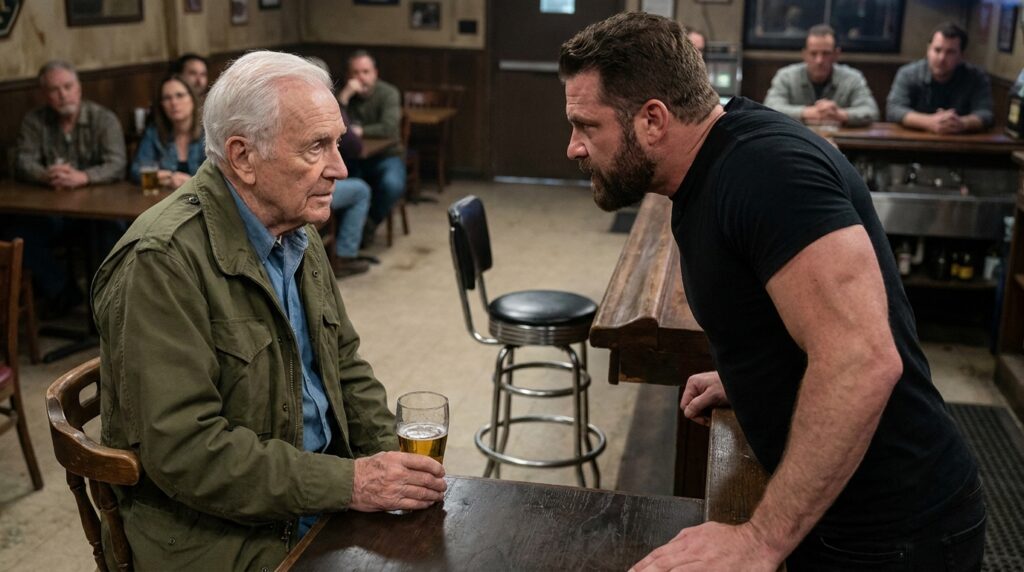
The Weight of Worn Timber and Old Iron on a Cold Tavern Floor
CHAPTER 1: THE TASTE OF ASH AND IRON
The heavy base of a thick glass pint hummed against the scuffed oak, vibrating in perfect, irritating time with the cracked neon sign in the window.
I didn’t touch the beer. The foam had already died down to a thin, sour skim around the rim, leaving a series of pale rings against the glass. In a place like this, you learned to watch the glass rather than drink from it. The light inside the tavern was desaturated, stained a dull amber by decades of cheap tobacco smoke that had settled deep into the grain of the ceiling beams. Everything had a texture of friction. The wood under my palms was tacky with old lacquer that had melted and hardened a thousand times over, and the air smelled faintly of stale grease, damp wool, and the bitter tang of iron dust from the foundry down the road.
My thumb moved over the small, circular grease stain on the right shoulder of my olive jacket. The stain was old—older than the bartender, probably—hardened by years of machine oil until the fabric there felt like stiff canvas. It was a grounding point. Every time the neon hum grew too sharp, or the silence in the room stretched thin enough to snap, my fingers found that patch of rough fabric. It was a habit from the motor pool, a way to remind the skin that things built to last don’t give way just because the weather changes.
The bartender, a man whose sleeves were rolled up to reveal forearms mapped with graying tattoos, was moving a damp rag across the zinc washing sink behind the counter. He wasn’t really cleaning. He was just pushing the gray water around, his movements heavy and repetitive, the product of a life measured in ten-hour shifts. He didn’t look at me. People didn’t look at old men in faded jackets unless they were trying to figure out if they had enough coins left for the tab. To the rest of the room, I was just a fixture, something as inert and unmoving as the cast-iron footrest beneath the stools.
Across the room, the radiator gave a sudden, metallic clank—a bubble of air trapped in the rusted piping. It was the only sound besides the low, flat murmur of a television mounting bracket creaking under the weight of an old tube set in the corner. Then the front door scraped against the threshold.
The latch didn’t clear the frame cleanly; it required a hard, familiar shove that rattled the glass pane. A draft of dry, evening dust tumbled into the room, cutting through the heavy smell of lager. With it came a thick, unhurried stride—the kind of footsteps that belonged to someone who expected the floor to adapt to his weight rather than the other way around.
I didn’t turn my head. In the reflection of the dark mirror behind the liquor bottles, between a dusty bottle of rye and a faded calendar from three years ago, I watched the shape of a large man fill the lane. He wore a black cotton t-shirt that stretched tight across a broad chest, his beard short and thick, his jaw thrust forward as if he were constantly walking into a stiff wind. He wasn’t looking for a seat. His eyes skipped over the empty booths, scanning the dim length of the counter until they locked onto the single, upright shape of my jacket.
He didn’t slow his pace. His heavy boot came down less than three inches from the leg of my stool, the leather scraping hard against the iron floor ring. He leaned in, his forearm dropping onto the wood with a wet slap, entirely invading the space where my glass sat.

CHAPTER 2: THE SCRAPE OF RUSTED IRON
The heavy leather of his boot didn’t just rest near my stool; it ground a stray bit of gravel into the iron floor ring with a dry, crunching whistle. The sound was sharp, vibrating through the metal tube of my seat and straight into the base of my spine. Up close, the aggressor smelled of stale tobacco and grease from a cheap diesel engine—the kind of soot that coats the lungs of men who spend their days fixing broken hydraulic lines on over-worked flatbeds. His broad forearm remained flat on the scuffed oak, his thick wrist twitching slightly as he watched me.
I didn’t blink. Through the dusty mirror behind the bottles of rye, I could see the bartender’s hands freeze entirely. The damp rag stayed pinned under his palm, soaking up the gray, soapy wash water. He didn’t lift his head, but his eyes were fixed on the reflection of the large man’s black t-shirt. There was a sudden, tight silence in the tavern, the kind that usually precedes the snapping of a drive belt or the failure of a structural beam under too much weight.
“You look like you’re in the wrong booth, old-timer,” the man said. His voice wasn’t loud, but it had a heavy, grinding cadence that filled the small space between us. He leaned an inch closer, his shoulder muscles flexing beneath the cotton sleeve. “This end of the bar is reserved for people who actually work for a living.”
I let my fingers trace the circular grease stain on my olive jacket one more time before lowering my hand to my lap. My palm brushed against the underside of the heavy oak bar seat. The wood there was raw, unfinished, and splintered with age. As my thumb slid along the support bracket, it caught on an empty hole. The thick, silver-headed bolt that was supposed to lock the central iron column to the timber seat was gone, leaving nothing but an empty, rusted thread. It was a minor structural failure, a tiny piece of neglect in a building full of it, but my mind logged the geometry of it instantly. Without that bolt, the stool would pivot three inches to the left if the weight wasn’t balanced perfectly.
“I’ve been sitting in this exact spot since before your flatbed had its first oil change,” I said. My voice sounded thin to my own ears, gravelly and dry like a shovel hitting rocky soil, but I kept the rhythm flat. No rise in pitch. No trace of the adrenaline that makes a young man’s throat go tight. “The beer tastes the same everywhere in the room.”
The man gave a short, hard grunt that wasn’t a laugh. He moved his other hand, his fingers curling around the base of my untouched glass pint. He didn’t lift it; he just slid it two inches across the oak, the wet bottom leaving a dark, crescent-shaped track in the dust. It was an old tactic—testing the boundary, seeing if the animal shrinks back when its salt lick is touched.
Out of the corner of my eye, I saw the bartender’s shoulder drop slightly. He reached down into the small, grease-stained pocket of his apron, his fingers brushing against a folded piece of thick, yellowed paper that looked like a legal notice. He didn’t pull it out, but the way his hand lingered there—the nervous, repetitive tapping of his index finger against the stiff crease—told me everything I needed to know about the weight he was carrying. He wasn’t afraid of a bar fight; he was afraid of what happened after the fight, or who this muscular regular represented.
“The beer might taste the same,” the bully muttered, his bearded jaw shifting as he chewed on a piece of tobacco. “But some faces don’t fit the scenery anymore. This town is cleaning up its scrap iron. You should take your jacket and your memories down the road before somebody decides to move you themselves.”
The regulars in the far booths didn’t move. One of them lowered his eyes to his plate of cold fries, his fork hovering an inch above the grease-smeared ceramic. They knew the rules of the dusty gray. When a young man with a wide chest and heavy boots decided to clear a corner, an old soldier was supposed to collect his coins and find a darker place to sit. It was the pragmatism of survival in a place where utility was the only currency that mattered.
I shifted my weight, careful not to let the unbolted frame of the seat list to the left. My right boot found the iron floor ring, locking the heel against the weld. The cold of the metal went right through the thin sole of my shoe. I could feel the tension in the room tightening, a mechanical load increasing pound by pound until the pins were ready to shear. The bully’s breath was hot against my cheek now, smelling of old copper and winter wheat. He thought he was clearing out a piece of dead weight. He thought the silence in the room was his leverage.
“The scrap iron usually stays exactly where it’s dropped,” I said softly, looking at the dead rings of foam inside my glass. “It takes a lot of torque to shift it.”
His grip on the base of my pint tightened until his knuckles went the color of tallow. He didn’t pull back. He was waiting for the flinch, the small hitch in my breath that would give him permission to lift me out of the seat.
CHAPTER 3: THE FRICTION OF THE LINE
The knuckles of his hand didn’t soften. They remained the color of dry tallow, his broad fingers anchoring against the wet base of my beer glass with enough leverage to crush the rim if his thumb drifted an inch higher. I could see the fine grain of black sand and iron dust caught under his fingernails—the signature of the raw yard down by the train tracks where they crushed old engine blocks for scrap. He was breathing through his nose now, a low, rhythmic whistle that forced the smell of cold lard and wet asphalt across the two feet of air separating our faces.
“Torque is cheap when the foundation is rotten, old man,” he muttered. He shifted his weight forward, his heavy leather boot sliding another inch into my lane, his knee nearly brushing the rough weave of my trousers. “You talk like a man who still owns the ground he’s standing on. But the ground in this town changes hands while people like you are sleeping.”
Behind the counter, the bartender didn’t move the washing rag, but his breath caught. The rhythmic tapping of his finger against his denim apron had stopped. The edge of that folded yellow document was sticking out just far enough now for the low amber bulb above the sink to hit it. On the exposed corner of the paper, there was a purple ink stamp—a circular, official seal with three bold letters visible: M-U-N. It was a municipal field notice, the kind the city compliance officers slapped on buildings that had been condemned under the fast-track urban development codes. The bartender wasn’t just sweating from the heat of the glass washer; he was looking at the man who had likely delivered it, or whose father paid the salary of the man who did.
I kept my eye on that reflection in the glass, my spine perfectly straight against the lack of a backrest. My right hand remained in my lap, the fingertips staying light against my knee. “A foundation isn’t rotten just because the paint peels,” I said, keeping my tone within that flat, dead octave where no emotion could find a foothold. “The timber under these floorboards is white oak, six-by-fours, cured before the highway was paved. It takes more than a municipal stamp to rot wood like that.”
The bully’s jaw tightened. He didn’t like the word stamp. His eyes drifted down to the bartender’s pocket for a micro-second, a quick, transactional flicker that confirmed the link between them. Then his gaze snapped back to my face, his short beard twitching as his mouth pulled into a narrow, hard line. He didn’t know how an old man sitting in the dark could read the room without turning his neck, and the uncertainty was beginning to create a drag on his momentum. He was used to people shuffling their boots and looking at their watches when he closed the gap.
“You’ve got a lot of opinions for a guy who spends his afternoons staring at an empty glass,” he said, his voice dropping into a register that was meant to carry to the rear booths where the other regulars sat frozen. “But opinions don’t pay the property tax, and they don’t keep the roof over this bar. This place is done. The contract’s signed, and the clearing crew doesn’t check IDs before they drop the hammer. If you’re smart, you’ll crawl out of this hole while the door is still open.”
He let go of the glass pint with a sudden, intentional jerk, his palm striking the oak counter with a loud thud that caused the liquid inside to slosh over the rim, spilling a dark pool onto the wood. The moisture immediately began to sink into the old, dried-out cracks of the grain, turning the scuffed surface black.
I didn’t flinch from the sound. I watched the dark beer pool spread toward the edge of my jacket sleeve, tracking its path with the same detached calculation I used to monitor fuel lines under a five-ton transport truck. The liquid moved slowly, hindered by the accumulation of dirt and old wax in the wood’s pores. The room remained completely suspended; even the television bracket in the corner had stopped creaking. The regular in the second booth had put his fork down entirely, his hands flat on the laminated tabletop as he waited for the first swing.
“The door has been open for forty years,” I said, my fingers closing around the cold iron ring under my seat, stabilizing the three-inch play of the unbolted stool frame. “And the hammer usually hits the thing that’s making the most noise.”
The bully took a full breath, his chest expanding until the seams of his black t-shirt groaned against his shoulders. He didn’t look at his friends in the back. He didn’t look at the bartender. He was looking at the silver hair at my temples, calculating the exact amount of force required to shift a hundred and sixty pounds of old bone off the wood. He was a professional at this—the slow crowding, the deliberate mess, the verbal weight that forced the victim to make the first frantic move. He was waiting for me to reach for my pockets or pull my shoulders back. He wanted the justification of a struggle.
“Let’s see how much noise you make when you’re sitting on the asphalt,” he whispered, his shoulder dropping into the initial line of a shove.
CHAPTER 4: THE CLOSING INCH OF THE LANE
His shoulder dropped, the thick deltoid beneath the black cotton bunching into a tight, dense knot as his center of gravity shifted forward. He didn’t just lean; he threw the collective momentum of his two hundred pounds into the single inch of space that kept him from my chest. It was the classic, unhurried surge of a yard boss used to shifting jammed rusted gears by brute force alone. The smell of his skin—sharp grease, iron shavings, and cold sweat—blanketed my face like a damp rag dropped onto an engine block.
“You think you’re tough, old man,” his voice barked, no longer a whisper but a raw, grating vibration that rattled the small liquor bottles lined up against the dark mirror. “Get up and prove it.”
My right hand didn’t move from my knee, but my left fingers bit deeper into the cold iron floor ring beneath the seat. The missing silver bolt under the timber frame allowed the stool to lurch exactly three inches to the left, a sudden, structural instability that would have thrown any other man off his balance. I logged the slip instantly, using the tilt to slide my heel down against the weld of the bottom pipe. The room seemed to expand and flatten all at once, the dull amber light of the tavern gathering in the grease-filmed glass of my untouched beer pint.
Behind the bar, the bartender didn’t reach for a glass or drop his cloth. Instead, he pulled his hand entirely out of his apron pocket, but in his haste, his knuckles dragged the edge of his order pad out along with it. The small, cardboard-backed pad fell onto the wet zinc sink with a dull slap. On the gray cardboard backing, a string of numbers was scribbled in heavy grease pencil: CASE #2026-MUNI-7741. It wasn’t an order for draft beer. It was a court file reference, the designation for a disputed title hearing. The bartender’s eyes didn’t fix on me or the bully; they stayed glued to that wet piece of cardboard as the gray wash water began to bleed the ink into a smudge. He knew the legal gears were already grinding, and he knew this confrontation at the counter was just the physical tip of an unseen, institutional blade.
“The proof isn’t something you look for in a bar ditch, son,” I said. The words came out flat, dry, and perfectly paced, with no jump in the rhythm to show the sudden spike of heat in my chest. “And I don’t get up unless there’s a reason to shift the weight.”
The bully’s face went the color of rusted pipe. He didn’t wait for the sentence to clear the air between us. His hand shot forward, his thick fingers curling into a claw that targeted the stiff, frayed lapel of my olive military jacket. He wanted to yank me off the stool, to break the upright posture that seemed to offend his sense of scale. The movement was fast, but it had the predictable trajectory of a man who relied entirely on leverage and mass rather than discipline.
I didn’t pull back. Shrinking from an edge only shortens the distance your enemy has to travel. Instead, I let my torso give way two inches to the left, riding the existing play of the unbolted seat frame. His fingers brushed the rough canvas of my collar but failed to anchor, his knuckles scraping hard against the iron zipper teeth of the jacket pocket instead. The friction made a sharp, metallic zip that cut through the dead silence of the room like a shear blade through tin.
The failure to catch a clean hold threw his balance off by a fraction of an inch. His boots slid slightly on the grit-streaked floorboards, the leather heels making a short, dry screech against the wood. In the far booth, the regular who had been staring at his plate stood up so fast his knee caught the underside of the table, sending a plastic salt shaker rolling across the laminate until it dropped off the edge. Nobody moved to pick it up. The room was no longer just a blue-collar tavern; it had become an narrow, high-stress testing lane where every minor error in movement carried a heavy structural cost.
“You’re done talking, old-timer,” the bully growled, his breath coming in a short, ragged hiss through his teeth as he reset his feet. He didn’t look down at his boots, but his shoulders rose another inch, his arms wide to wall me in completely against the oak counter. “You’re going out the door whether you’re attached to that chair or not.”
I looked past his shoulder, tracking his reflection in the dark mirror between the bottles of rye. The bartender had picked up the wet pad, his thumb pressed so hard against the grease-pencil numbers that the cardboard was buckling beneath his grip. He looked like a man who had been forced to watch an old machine run until its bearings caught fire, helpless to stop the rotation because the switch was locked behind someone else’s desk. The contract he had signed wasn’t just a demolition order; it was a surrender document, and he was realizing too late that the terms didn’t include protection for the fixtures.
My right hand came off my knee, the fingers spreading wide as they hovered two inches above the cold timber seat of the stool. Every muscle in my legs went rigid, the heels of my shoes digging into the iron floor ring until the metal began to groan against the mounting screws. The line had been drawn, the tolerance had reached zero, and the next movement wouldn’t belong to the law or the city code. It would belong entirely to the physics of the barrier.
CHAPTER 5: THE LOCK OF THE TIMBER WALL
The boot leather didn’t slide a third time. The bully planted his heel with a dull, heavy thud that drove a fresh layer of gray foundry grit into the cracks of the floorboards. His shoulder swung forward, his left arm coming up like a sweeping crane arm to close the final pocket of air between his chest and the scuffed edge of the oak counter. The black cotton of his t-shirt strained across his latissimus muscles until the gray industrial thread at the hem began to fray. He was committed now; his center of gravity had passed the point where a simple step could pull him back from the lane.
I didn’t blink. I didn’t reach for the pocket where an amateur would keep a knife, nor did I raise my hands in the soft, defensive posture that gives an aggressor a clear target for a collar grab. My left hand remained wrapped tightly around the cold iron ring under my seat, my fingers using the three-inch lateral play of the unbolted column to tilt the entire frame slightly out of his direct line of sight. My right boot remained locked against the weld at the base, transforming my leg into a rigid steel strut that ran directly into the joists below.
With a single, unhurried contraction of my thighs, I stood up. The movement was perfectly upright, an economy of motion that used the momentum of his own lunge to close the height gap between us. As my hips cleared the scuffed wood, my right hand dropped down onto the raw underside of the oak timber seat. My thumb caught the edge of the unbolted frame while my four fingers hooked the deep grain of the seasoned wood. I didn’t swing it like a baseball bat; I didn’t lift it above my shoulder where the overhead pipes would catch the grain. I simply rose and drew the entire sixty-pound unit upward and outward in a tight, precise radius that tracked the perimeter of my personal space ring.
The heavy iron base ring of the stool scraped against the floor with a screech that sounded like an ungreased brake shoe hitting a freight train wheel. It was a raw, metallic howl that tore through the ambient hum of the tavern’s neon sign. The thick wooden legs swung into the space between his chest and my chin, the unbolted column locking against the metal foot ring with a solid, resonant clack that signaled the absolute end of the stool’s tolerance. The timber seat was now positioned directly across his sternum, a solid, four-inch block of cured white oak that sat perfectly parallel to his collarbone.
The bully’s chest struck the flat top of the wooden seat before his hands could close around my jacket lapel. The impact wasn’t a clean fracture; it was the heavy, dead thud of a horse hitting a timber gate post. The momentum of his lunge died instantly, the energy transferring through the oak frame, down the iron column, and straight into the iron ring my boot was anchoring to the floor. The force was enough to make the joints of my knees pop under the load, but the white oak didn’t give an inch. It remained a static, unyielding partition between the yard boss and the space he thought he could buy with a broad shoulder.
Behind the bar, the bartender’s hand shook so violently that the wet order pad slipped from his grip again, dropping face down into the sink’s zinc wash water. The grease-pencil numbers—CASE #2026-MUNI-7741—were completely submerged now, the gray fluid dissolving the ink into a shapeless cloud of graphite. He didn’t look down to retrieve it. His eyes were wide, locked on the small brass tag stamped with the number 104 that was riveted to the very base of the stool’s iron column—a corporate inventory marker that matched the registration entry on the disputed municipal deed. The realization hit his face like a cold spray: this wasn’t an anonymous regular defending a bar seat; this was the owner of the structure using the building’s own skeleton to hold the line against the buyout.
“Take one more step,” I said, my voice dropping into that low, gravelly lower register that had once commanded four-ton transport rigs across muddy airfields. The tone was completely dry, flat, and devoid of the high-pitched vibration that adrenaline brings to a frightened throat. “And you’ll regret that choice.”
The bully’s fingers stayed frozen in mid-air, his thumbs less than two inches from the edge of the oak wood. His face had gone the color of skimmed milk beneath his short black beard, his teeth clicking together once as the shock of the sudden deceleration traveled up his neck. He tried to draw a breath, but his chest was pinned against the timber barrier, his ribs unable to expand against the rigid resistance of the iron frame below. He looked down at the stool, then up at my eyes, searching for the small twitch or the widening of the pupil that would signal a bluff. He found nothing but the cold reflection of the amber oil lamps in the mirror behind me.
The tavern regulars didn’t stand up. The man in the second booth remained with his palms flat on the laminate, his head tilted downward as if he were looking at the floorboards to see if the nails were beginning to pull from the joists. They knew the rules of the gray road. When an old machine locks its gears, you don’t stick your fingers into the housing to see why the rotation stopped. You stay clear until the torque drops to zero.
The bully’s shoulders began to sag beneath the tight black cotton of his t-shirt. His elbows dropped an inch, the heavy muscles of his forearms going soft as the forward momentum of his lunge dissipated completely into the wood. He was a professional at crowding people, but he didn’t know how to handle a wall that didn’t have a latch or a hinge. The physical reality of the barrier had rewritten the social logic of the counter in less than three seconds.
“Alright,” he muttered, his voice a low, dry hiss that barely carried over the steady hum of the neon sign. His boots took a short, cautious step backward, the leather heels scraping through the fine layer of foundry grit as he sought to establish a safe distance between his sternum and the oak. “I’m backing off.”
I didn’t lower the stool. My fingers stayed locked against the raw underside of the seat, my heel remaining pressed hard against the iron floor ring until the metal felt like an extension of my own skin. The danger hadn’t cleared the doorway yet; it had only paused to calculate the cost of the next turn.
CHAPTER 6: THE FINAL LINE OF THE DEED
“Alright,” he repeated, his chest dropping another fraction of an inch against the rigid wooden partition. “I said I’m backing off.”
The words left his mouth like exhaust from a dying generator—wet, thin, and smelling of sour malt. He didn’t turn his back. A man who relies on bulk never turns his back when his leverage is snapped; he moves in reverse, testing the floorboards behind his heels with short, tentative stabs of his leather work boots. The fine layer of foundry grit groaned beneath his soles, a dry, grating whistle that marked his retreat out of my personal lane and into the deeper shadows near the pool table.
I didn’t let the stool drop. The timber remained locked in my right hand, the heavy base ring suspended six inches above the scuffed oak floor. My left fingers kept their anchor on the lower iron column, holding the three-inch play of the unbolted frame perfectly steady. Adrenaline was an old enemy; I could feel it trying to rattle the small muscles at the base of my neck, but I clamped down on the impulse, forcing my breathing to maintain the same flat, mechanical rhythm it had held since I first pulled up the chair.
Behind the bar, the bartender didn’t move to pull his order pad from the sink. The gray wash water had completely soaked through the cardboard backing, turning the scrawled case reference into a loose, dark smudge that ran toward the drain. He looked up, his face gray beneath the yellow oil lamps, his eyes drifting from the short beard of the retreating bully to the frayed olive canvas on my shoulder.
“Jerry,” I said, my voice cutting through the hum of the neon sign like a dry file across a rusted latch. I didn’t look at him. I kept my eyes fixed on the bully’s hands, ensuring his fingers stayed wide and clear of his belt line. “Get the document out of your apron.”
The bartender flinched, his boots shuffling against the rubber utility mat behind the counter. “Marcus… you don’t understand,” he whispered, his voice cracking like dry kindling. “They’ve got the city seal on it. The compliance office signed off on the fast-track clearance last Tuesday. His old man’s firm bought the structural lien from the tax receiver.”
The bully stopped his backward drift, his heels locking against the base of the cigarette machine. A small spark of the old arrogance flared in his eyes, his broad shoulders trying to reset themselves against the wood casing. “He’s telling you the truth, old-timer. The brick belongs to the demolition pool now. This whole block is coming down for the rail spur expansion. You can hold that chair until the diesel starts, but it doesn’t change the name on the county registry.”
I let the heavy iron base ring of the stool drop back to the floorboards. The impact made a solid, hollow thud that caused the spilled beer on the counter to jump, a small amber ripple cutting across the grain of the oak. I didn’t reach for my wallet, and I didn’t show them a piece of paper with a notary stamp. Instead, my left thumb drifted inside the torn interior lining of my jacket pocket, my skin finding the cold, flat edge of a small brass key attached to a heavy iron ring.
“The county registry doesn’t clear a structural lien unless the primary bond is paid,” I said, looking down at the dark, wet ring my glass had left in the dust. “And the primary bond for this foundation was signed in nineteen seventy-four, under the name of the veteran’s holding trust.”
The bartender froze, his hand remaining stuck halfway into his apron. The silence in the room became absolute, so deep that the rhythmic clank of the radiator in the corner sounded like an axe striking dry timber.
“The number stamped on the bottom ring of this stool column is one hundred and four,” I continued, my fingers keeping the brass key perfectly hidden within the canvas lining. “It matches the equipment schedule filed with the original commercial deed. The city can condemn a roof for peeling tar, but they can’t clear the timber underneath if the holder of the ground-lease refuses the buyout.”
The bully’s jaw shifted, his brow furrowing as he tried to trace the logic through the fog of his own miscalculation. He wasn’t built for title law; he was built for the friction of the yard, for the physical displacement of things that couldn’t talk back. He looked at the bartender, waiting for a denial, but Jerry’s face had gone completely hollow, his mouth opening slightly as his gaze dropped to the small brass tag riveted near my boot.
“The old man…” Jerry muttered, his fingers finally pulling the yellowed paper out of his pocket, his thumb tearing the edge of the official municipal seal without realizing it. “He’s not on the tenant list because he is the trust, Marcus. The company didn’t buy the lien. They just bought the interest on the back-taxes I couldn’t cover.”
I stood up from the stool, my spine straight, the olive jacket hanging from my shoulders with the same heavy, unyielding hang it had possessed forty years ago on the tarmac. I reached out, my hand closing around the untouched glass of beer. I didn’t drink it. I simply tipped the pint forward, letting the remaining sour foam pour directly onto the black, split grain of the oak counter, washing the dust toward the floorboards.
“Tell your father to check the storage vault at the county seat,” I said to the bully, my voice flat, dry, and entirely clear of emotion. “The iron stays exactly where it was dropped.”
The large man didn’t answer. He looked at the wet wood, then at the graying hair at my temples, his boots turning toward the door with a slow, heavy drag that lacked any of the weight he had brought into the lane. The front door scraped against the frame as he pushed it open, letting in a final gust of dry evening dust before the latch clicked shut behind him.







