
The Quiet Resilience of a Fading Sun over the Shattered Concrete of a Forgotten Neighborhood
CHAPTER 1: THE WEIGHT OF THE TIMELESS PALM
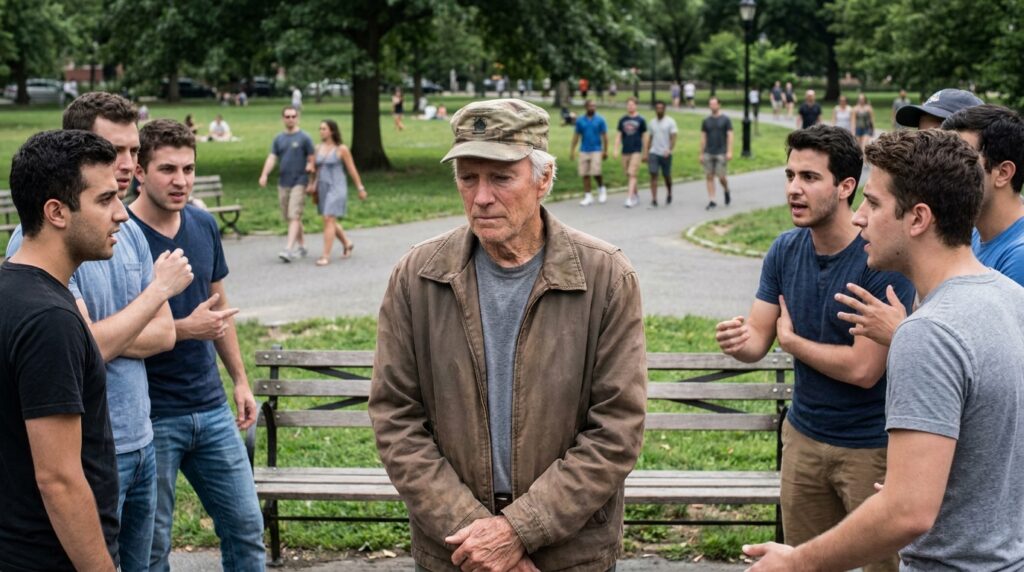
“Hey old man, what’s with the ancient hat? You lost, or just waiting around for history class to start?”
The words cut through the heavy, humid air of the park like a dull blade through wet cardboard. Marcus did not look up immediately. Instead, his eyes remained fixed on the frayed edge of his left canvas jacket sleeve, tracing the loose threads where the hem had given way to years of friction. In his left hand, buried deep inside the pocket, his fingers curled around the smooth, tarnished face of a brass watch casing. The internal gears had rusted tight three decades ago during a monsoon season he no longer named, but the thumb knew exactly how many ridges were etched into the winding crown. He pressed his nail into the metal, counting imaginary beats. One. Two. Three.
The shadows on the cracked concrete walkway shifted, lengthening as three figures stepped between him and the late afternoon sun. The air smelled of stale tobacco and ozone, the distinct, pre-storm pressure that made the city’s concrete hold its heat. The young man in the center—the one with the gold chain tucked beneath a sleeveless jersey—took another half-step forward. His sneakers scraped against the grit of the path, a deliberate, dragging sound meant to signal presence.
Marcus let his gaze rise slowly, not to the boy’s face, but to the position of his feet. The boy’s weight was entirely on his back heel, his posture loose, performative. It was the stance of someone who had never seen an baseline shift, someone who believed a public square belonged entirely to the loudest voice in the room. Behind them, twenty yards out near the rusted swings, a mother pulled her toddler’s stroller toward the gate with an unnatural, hurried stride. A jogger slowed to a rhythmic, heavy-footed trot, his eyes tracking the circle but his body moving away from the friction.
Marcus adjusted the brim of his navy-blue service cap. The fabric was thin, faded by decades of laundry detergent and sunlight until the embroidered insignia was more a shadow than a statement. He felt the cool metal of the park bench’s wrought-iron armrest beneath his right forearm. The paint was peeling in thick, brittle flakes that looked like dark scabs against the gray wood.
“This bench has four slats,” Marcus said, his voice a low, gravelly rasp that seemed to catch on the dust in his throat. He didn’t raise his pitch to compete with the rumble of a passing transit bus on the avenue behind them. He kept it flat, transactional, like a logistics report delivered in an empty tent. “Two of them are split near the bolts. If you lean that far left, the grain is going to catch your shirt.”
The ringleader blinked, his smirk fracturing for a micro-second before his chest rose with a quick, shallow breath. He looked down at the wood, then back at Marcus, his face hardening as he realized his weight had been calculated. He reached out, his hand hovering two inches above the iron armrest, his fingers twitching as if deciding whether to grab the old man’s shoulder or simply block his view.
It was exactly then, through the narrow gap between the boy’s hip and his folded arm, that Marcus saw it—a small, familiar leather satchel dropped carelessly into the deep weeds behind the bench, its brass buckle stamped with an identification number that belonged to a family name Marcus hadn’t spoken since the winter of 1994.

CHAPTER 2: THE ANATOMY OF FRAYING EDGES
“Whose bag is that?”
Marcus did not point. He didn’t lift his fingers from the pocket of his canvas jacket, nor did he break his watch on the back heel of the young man standing in front of him. He simply shifted his eyes down toward the deep dandelion weeds pushing through the cracked footing behind the bench. The movement of his head was minimal—less than an inch—but the precision of the focus drew the ringleader’s attention downward like a weighted plumb line.
The young man with the gold chain hesitated. His hand, still suspended two inches above the rusted iron armrest, dropped a fraction. His weight remained momentarily caught between his heels, his performative swagger interrupted by a question that didn’t fit the script of a standard park-bench shakedown. “What?” he muttered, his eyes darting toward the grass. “The hell you talking about, old man?”
“The leather satchel,” Marcus said. His voice remained in that low, flat register, a sound like gravel being dragged across dry oak. “The one with the double-stitched oilcloth strap and the dull brass buckle. The buckle has a stamp on the inner tongue. 101-B-94. That’s an ordnance supply mark from the winter of ninety-four. It doesn’t belong in the weeds.”
The two boys flanking the ringleader shifted their feet. The one on the left, wearing an oversized gray hoodie despite the June humidity, looked from the bag to his leader’s face. The performative smirks were beginning to sag, replaced by the distinct, heavy silence of an unexpected vulnerability. They weren’t just looking at a piece of discarded luggage; they were looking at something they recognized, something that had been hidden with specific intent.
Marcus watched the skin around the ringleader’s jaw tighten. The boy’s chest took in a deep, sharp breath, the fabric of his sleeveless jersey straining against his collarbone. He wasn’t looking at Marcus with simple, territorial malice anymore. The expression had shifted into something far more dangerous because it was grounded in a primitive, defensive panic. The boy stepped sideways, his sneaker fully flattening a cluster of wild chicory, attempting to obscure Marcus’s line of sight to the weeds.
“You don’t see anything,” the boy said. The tone was sharp now, the calculated arrogance of his first mock inquiry replaced by a hurried, transactional threat. He leaned closer, his shadow completely swallowing Marcus’s lap. “You’re an old man with a broken hat who’s about to get his walk shortened. You take your little history cap, you get off this bench, and you walk toward the avenue. Right now.”
Marcus didn’t move. He let the shadow settle over him, feeling the humid warmth of the boy’s proximity, a heat that carried the sharp, chemical tang of cheap energy drinks and nervous sweat. Through the weave of his gray shirt, Marcus felt the hard, ridges of his own ribs against his lungs. He was seventy-nine years old. His knuckles were thick with arthritic deposits that throbbed whenever a low-pressure system rolled off the river, and his left knee required a deliberate mechanical rotation before it would lock into a weight-bearing stride. To these boys, he was an anomaly—a piece of urban driftwood that had failed to float away with the rest of the neighborhood’s old stock.
But they didn’t see the texture of the silence he lived in. They didn’t understand that when you spend three decades listening to the precise interval between an outgoing mortar ignition and an incoming impact, the loud posturing of a twenty-year-old on a concrete path sounds like nothing more than wind through a broken screen door.
“The strap is dry-rotted,” Marcus observed, his thumb continuing its rhythmic circle over the dead crown of the brass watch in his pocket. “If you pick it up by the handle, the rivets are going to pull clean through the backing. Whoever put it back there was in a hurry. They didn’t want the weight on their shoulder while they were climbing into the old pavilion.”
The ringleader froze. The phrase old pavilion seemed to drop into the space between them like a solid iron ingot. Fifty yards behind the bench, the park’s historic stone pavilion stood like a gray tooth against the green canopy of the oaks. Its arched windows were boarded up with weathered exterior plywood, the edges gray and furry from years of rain, but one of the lower panels had been pried back just enough to leave a four-inch black grin at the foundation level.
The boy in the gray hoodie grabbed the ringleader’s shoulder, his fingers digging into the jersey fabric. “Leo,” he whispered, his voice cracking with the sudden, sharp urgency of a kid who had realized they were standing on a live wire. “Leo, come on. The old man’s a cop. Or he’s one of them city inspectors. Look at the cap.”
Leo didn’t move. He kept his eyes locked onto Marcus’s lined face, searching the deep-set wrinkles around the veteran’s eyes for a sign of leverage, a hint of fear, or the standard bureaucratic tells of an undercover enforcement officer. He found none of it. Marcus simply sat there, a monument of faded canvas and white hair, his presence as immovable as the concrete footer beneath the bench.
A sudden gust of wind rattled the leaves of the overhanging oak, dropping a small, dead twig onto Marcus’s shoulder. The air was turning cooler now, the sky above the tree line bruising into a deep, metallic violet as the storm front finally reached the city limits.
Leo slowly slid his right hand into the pocket of his loose shorts. His knuckles formed a sharp, angular bulge against the thin fabric—a shape that didn’t have the curve of a phone or the flat edge of a wallet. It was a weighted, uniform mass.
“You think you’re smart because you can read numbers off a piece of trash, old man?” Leo said, his voice dropping into a dangerous, quiet rattle that matched the sound of the dry leaves above them. “You don’t know who’s in that pavilion. You don’t know what we’re keeping out of the dirt.”
Marcus let his thumb stop on the watch crown. For the first time since the confrontation began, he allowed his right hand to leave his lap. He placed his palm flat against the weathered green wood of the bench slat, feeling the deep, longitudinal splits in the grain where the winter frost had expanded the moisture. The texture was rough, familiar, and ancient.
“I know exactly what’s in that pavilion,” Marcus said, his eyes rising to meet Leo’s with a cold, unhurried clarity that made the boy’s hand inside his pocket go completely still. “And I know who left the lock off the back basement door twenty years before you were born.”
Marcus began to shift his weight forward, his heels planting into the cracked concrete with a deliberate, bone-deep finality.
CHAPTER 3: THE SEED IN THE CRACKED EARTH
Marcus’s boots did not slide. The thick rubber soles, worn smooth at the heels but still rigid through the arches, bit into the grit of the concrete footer. His old brown jacket groaned slightly at the shoulders as his center of gravity crossed his knees. It was a slow, deliberate levering of bone and sinew—an old man’s movement that carried the strange, unhurried mass of a stone retaining wall giving way.
Leo did not pull his hand out of his pocket. Instead, his knuckles went white against the thin fabric of his shorts, his arm locking straight down as if the weight inside had suddenly tripled. The boy in the gray hoodie stepped back a full yard, his heel striking the iron leg of the next bench with a sharp, metallic clink that sounded like a loose horseshoe on pavement. The bravado that had filled the path three minutes ago was thinning out, draining down into the longitudinal splits of the gray wood beneath them.
“You don’t know nothing about the basement,” Leo said, but the rattle in his voice had lost its edge. It was lower now, defensive, the sound of a kid trying to convince himself that his perimeter wall was still intact. “That door’s been welded since before my brother was born. The city did it.”
“The city brought the torch,” Marcus said, his white hair catching the first dim, blue reflection of the thunderclouds cracking open above the treeline. He didn’t stand all the way up yet. He remained balanced at that threshold where an elder looks either ready to fall or ready to strike. “But they didn’t know the hinge pins on the north grating were set into soft lime mortar. A six-inch iron bar and forty seconds of leverage will drop the whole plate into the drainage well. It’s been that way since seventy-five.”
Marcus let his right hand slide an inch along the bench slat. His skin left a faint smear of old sweat and salt on the dry green paint. He wasn’t looking at Leo’s pocket anymore. He was watching the boy’s eyes, specifically the way the pupils dilated every time the wind rattled the loose plywood sheeting on the pavilion behind them. The boy wasn’t acting like a drug courier or a gang sentry; he was acting like a stray dog guarding a wet blanket under a porch. There was no professional coldness in his stance, only the raw, exhausting friction of a kid trying to carry a secret that was too heavy for his shoulders.
The silence that followed was heavy with the smell of the coming storm—that sharp, metallic scent of ozone mixed with the damp, sour odor of old beer cans rotting in the park trash bins. A single drop of rain, cold and heavy as a lead shot, struck the center of Marcus’s navy-blue cap, soaking instantly into the faded twill.
“Leo,” the boy in the hoodie muttered again, his voice dropping into a flat, frightened whisper. “Leo, look at his hand. He’s got something in his pocket.”
“It’s an old watch,” Marcus said simply, before Leo could shift his weight. He pulled his left hand slowly from his jacket pocket, exposing the dead brass casing resting in his palm. The canvas strap trailed between his thick knuckles like a frayed gray reins. He didn’t lift it like a weapon; he just held it open, letting the grey daylight hit the scratched crystal. “The spring broke when the division crossed the river outside of Da Nang. It doesn’t tell the time, but the weight keeps my wrist from wandering when the wind blows.”
Leo looked down at the brass, his jaw dropping a fraction. His shoulder lost its tension, dropping two inches as the phantom shape of an undercover cop evaporated into the reality of an old man with a pocket full of junk. “You’re crazy,” the boy whispered, though his hand remained buried in his own shorts pocket, his fingers still wrapped around whatever uniform mass he was holding. “You’re just a crazy old bastard who sits in the dirt.”
“I am,” Marcus agreed, his gaze drifting past Leo’s shoulder toward the black opening at the base of the pavilion. “But the girl in the cellar isn’t going to survive the night if that storm drainage line backs up into the foundation. The sump hasn’t run since the city cut the power grid in twelve. When the river rises three feet, that whole lower deck becomes an anchor.”
The ringleader’s entire body seemed to shrink. The sleeveless jersey went slack against his ribs, his mouth opening as if to deny the statement, but no sound came out. The boy in the hoodie didn’t wait for a command; he turned his back entirely on Marcus, his eyes wide and fixed on the gray stone arches fifty yards away.
“How do you…” Leo started, his voice cracking on the first syllable before he clamped his teeth together. He took his hand out of his pocket. There was no gun, no knife—just a heavy, rusted padlock with a snapped shackle that he had been holding like a pair of brass knuckles. His fingers were covered in orange rust dust that mixed with his sweat. “Who told you she was down there?”
“Nobody tells me anything,” Marcus said, his thumb resuming its slow, mechanical rotation against the brass watch crown. “But I know the sound of a ventilation pipe when the screen is pulled out. A girl’s voice doesn’t carry like a boy’s when she’s trying to stay quiet. It rings higher against the iron.”
He looked at Leo then, not with the cold distance of an old soldier, but with the heavy, unblinking empathy of a man who had seen too many small things crushed because someone forgot to check the water level in the trenches. The rain was beginning to come down in earnest now, a steady, gray curtain that blurred the houses across the avenue into gray boxes.
“The leather bag in the weeds,” Marcus said, nodding toward the dry-rotted satchel. “The strap is gone, but the oilcloth will keep the biscuits dry for another hour. You should take it inside before the cellar floor starts to slick.”
Leo didn’t answer. He stood in the downpour, his gold chain plastered to his collarbone, looking at the old man as if Marcus were an ancient oak that had suddenly started speaking English. He didn’t reach for the bag, and he didn’t move toward the bench. He just stood there, his false territory dissolving around his ankles in the grey runoff of the path.
Marcus watched him, his own palm absorbing the damp chill of the wood beneath him, knowing that the first circle had broken, but the water was still rising.
CHAPTER 4: THE THRESHOLD OF STORM AND STONE
The sky did not leak; it split. The gray sheets of summer rain hammered the concrete path with a sound like throwing small gravel against a tin wall. Within ninety seconds, the dry chicory and dandelion weeds behind the bench were entirely submerged, the muddy water swirling around the oilcloth satchel until its dry-rotted leather strap floated like a drowned water moccasin.
Leo did not look down as his shoes filled with runoff. The rusted padlock in his palm slipped through his slick fingers, dropping into the gray puddle between his feet with a soft, hollow plop. He didn’t pick it up. His eyes remained fixed on the line of Marcus’s shoulders, which had finally locked into their full, upright alignment. The old man stood entirely tall now, his lean frame cutting through the curtain of descending water like a rusted iron surveyor’s stake.
“Get the bag,” Leo told the boy in the hoodie, his voice thin and stripped of the rhythmic cadence he had used to claim the path. He didn’t look at his friend. He kept his face tilted slightly downward to keep the rain from blind-siding his vision, but his chin remained pointed toward Marcus. “Get it out of the dirt before the seam splits.”
The boy in the hoodie dropped to his knees, his hands splashing blindly through the flooded weeds until his fingers caught the brass buckle of the satchel. He pulled it up against his ribs, his oversized gray fleece soaking through instantly, turning a heavy, dark slate-color. “Leo,” he grunted, shaking the gray water from his eyes. “The bottom’s rotted out. The grease paper inside is wet.”
“Move toward the arch,” Marcus said. He didn’t wait for them to decide. His boots took the first step forward, the rubber heels striking the concrete with a heavy, predictable rhythm that left two clean ovals of compressed water in the gray silt. He didn’t look back to see if they were following him. In a public park during a June flash flood, authority didn’t belong to the person with the local name; it belonged to the person who knew where the drainage gates cleared.
The three young men fell in behind his brown canvas jacket like a small, disorganized platoon entering a trench. The bravado had completely washed into the storm sewers along the avenue. The park was entirely empty now, the joggers and families long since scattered to the dry interiors of the brick duplexes lining the horizon. The only sounds were the thunder rolling across the river and the steady, rhythmic slap-slap of Marcus’s boots leading them up the incline toward the old stone pavilion.
The stone structure grew larger through the gray haze of the downpour. Built during an era when the city used granite blocks instead of poured concrete, the pavilion’s columns were thick, square, and pitted with sixty years of exhaust soot and river moisture. The arched entryway was blocked by two sheets of half-inch exterior plywood, fixed to the stone with heavy tapcon screws, but the lower right-hand corner had been systematically worked with a crowbar until the wood fibers had splintered into a raw, jagged flap.
Marcus reached the threshold first. He didn’t squeeze through the opening like a boy hiding from the police. He reached his right hand into the gap, his thick knuckles catching the raw edge of the plywood, and pulled back with a slow, mechanical rotation of his shoulder. The wood groaned, the screws stripping another eighth of an inch out of the soft mortar joint between the granite blocks.
“Inside,” Marcus commanded, his voice striking the stone lintel and bouncing back down into the rain.
The boy with the hoodie went first, sliding sideways through the dark slit while holding the oilcloth satchel above his head like an unexploded shell. Leo followed him, his sleeveless jersey catching on a wood splinter with a sharp rip that he didn’t even turn to check. He stood just inside the dark, dry air of the interior vestibule, his chest heaving as he wiped the cold rainwater from his gold chain with a trembling thumb.
Marcus stepped through last, letting the plywood flap snap back into place behind him. The sudden silence of the interior was like a heavy wool blanket dropped over his ears. The rain was still there, but it was a distant, hollow drumming on the slate roof above them, secondary to the deep, cavernous stillness of the granite hall.
The air smelled of dry rot, bat guano, and the distinct, vinegar-sharp odor of damp cardboard. In the dim light that filtered through the cracks in the plywood, Marcus could see the grand hall—a long room filled with broken green park benches stacked like cordwood and old iron trash receptacles from the mid-nineties.
“She’s in the old supervisor’s locker,” Leo said from the darkness near the stairs. He wasn’t looking at Marcus; he was looking down at his own sneakers, his hands tucked into his empty pockets as if he were trying to remember how to look dangerous. “We brought the blankets from my cousin’s basement. We didn’t think the water would come through the lower ventilation line.”
Marcus walked toward the center of the floor, his boots leaving dark, wet prints on the thick layer of grey dust. He stopped beside a small iron casting set into the floor—a circular drain plate with five holes arranged in a star pattern. He knelt down, his brown jacket straining across his shoulder blades, and pressed his bare palm against the metal. The iron was dry, but through the small openings, he could hear the distinct, rhythmic gurgle-gasp of air being pushed upward by an rising column of water.
The lower sump was already full. The river had crossed the secondary levee line ten minutes ago.
“The locker is three feet below the grade,” Marcus said, his eyes tracking a thin line of dampness that was already creeping across the basement stairs from the lower dark. He didn’t look at Leo. He reached into his pocket and pulled out the broken watch casing, using the flat edge of the brass rim to scrape away a thick crust of dried mud from the center of the drain grate. “The city didn’t weld the door to keep people out, son. They welded it because the structural columns are hollow. When the basement fills, the water uses the stone itself like a siphon.”
He rose back to his feet, his left knee popping with a sound like a dry branch snapping underfoot. In the dim light, his eyes looked like two gray stones set deep into his lined face.
“Get the keys out of the satchel,” Marcus told them, his voice dropping into the precise register of a command post during an active mortar sweep. “The inner door has a three-pin barrel lock that hasn’t seen oil since the division gave the keys to the city clerk in ninety-six.”
Leo stared at him, his face going completely gray through the shadows. “The division? What division?”
Marcus didn’t answer. He turned his back on the boys and began walking down into the dark of the stairs, his thumb tracing the worn insignia on his cap as the first black puddle of river water reached the top riser.
CHAPTER 5: THE GRAVITY OF SUBMERGED IRON
The black runoff didn’t trickle down the concrete stairs; it surged. The frozen river water, tasting of clay and dead leaves, already blanketed the fourth riser, swirling in greasy circles around Marcus’s shins. The cold was instantaneous, a sharp, numbing ache that went directly through his trousers and bit into the stiffened cartilage of his bad knee. He didn’t break his stride. He planted his heel into the center of the submerged concrete, his fingers digging into the rough granite wall to balance the sudden, deceptive buoyancy of his boots.
“Keep the bag high,” Marcus commanded without looking back. His voice was compressed by the low ceiling, echoing off the wet stonework with the hard, metallic ring of an empty shell casing dropping onto concrete. “If the paper inside softens, the barrel keys will drop through the mesh. Then we’re cutting iron.”
Behind him, a frantic splash broke the rhythmic drone of the subterranean flood. The boy in the hoodie stumbled on the third step, his shoulder striking the granite blocks with a dull thud. He let out a sharp, ragged gasp as the water line rose past his waist, but his elbows remained locked over his head, the heavy oilcloth satchel clutched against his throat like a flotation device.
“Leo!” he yelled, his teeth clicking together in a sudden, uncontrollable chill. “Leo, it’s up to my chest at the landing. I can’t feel the floor.”
Leo didn’t answer with words. He grabbed the back of the hoodie, his knuckles catching the soaked fleece with a sharp grunt as he dragged the smaller boy down onto the intermediate landing. The performative strength of the street was entirely gone, replaced by the raw, unthinking mechanics of survival. They were huddled together in the narrow, pitch-black throat of the stairwell, their breath coming in short, white puffs that smelled of panic and raw river mud.
Marcus reached the bottom of the flight, the water here rising to his waist, pressing the heavy canvas of his brown jacket flat against his ribs. The pressure of the current was noticeable now, a slow, hydraulic push coming from the north foundation wall where the drainage grate had failed. In the dim, gray light reflecting off the surface of the pool, he could see the supervisor’s locker room—a rusted iron cage set five feet into the masonry. Inside, perched on a stack of rotted canvas equipment bags, a small figure in a oversized yellow windbreaker sat with her knees drawn tightly against her chin, her eyes wide, glassy circles reflecting the dead light of the stairwell.
“The key,” Marcus said, extending his right hand back toward Leo. His fingers were stiff, the skin grey and wrinkled from the sudden drop in temperature, but his palm remained perfectly level. “The long one with the square shoulder. Don’t drop it.”
Leo fumbled with the wet oilcloth strap of the satchel, his fingers shaking so violently that he nearly tore the brass buckle from its rotted backing. He reached inside, his hand dragging through the wet biscuits and old grease paper until his knuckles struck a cold ring of iron. He pulled it out, the single brass barrel key clattering against the rusted padlock he still carried in his shorts.
“Here,” Leo choked out, lunging through the knee-deep silt toward the cage. “Here. Take it.”
Marcus caught the key by its flat bow, his thumb immediately identifying the alignment notch by touch alone. He stepped into the deeper water near the cage door, his boot striking an obstruction beneath the silt—a heavy, rectangular object that didn’t roll like a loose brick. It was fixed to the masonry foundation, its surface smooth, cold, and entirely metallic. Even through the thick rubber of his sole, he recognized the profile. It was an iron dedication plaque, its raised letters long since choked with river silt, marking the boundary line where his old regiment had buried its operational ledger six decades ago.
He didn’t have time to clear the mud. The water line was rising an inch every three minutes now, the gurgle from the floor drains turning into a steady, boiling hiss as the river pressure maximized.
He inserted the brass key into the supervisor’s padlock. The iron barrel was choked with thirty years of scale and dry lime dust. When Marcus twisted his wrist, the metal didn’t budge; instead, a sickening give vibrated through the key’s shank—the soft brass beginning to twist under the resistance of the frozen steel tumblers.
“It’s stripping,” Leo whispered, his face inches from Marcus’s shoulder, his breath hot and ragged against the old man’s neck. “It’s gonna snap. Use the crowbar. Break the latch.”
“The latch is case-hardened three-quarter plate,” Marcus said, his voice dropping into that terrifying, flat register that belonged to an automated warning system. He didn’t increase the pressure on his wrist. He held the key exactly at the point of failure, feeling the structural metal grain stretching through the skin of his thumb. “If I force it, the bit will shear off inside the core. Then she stays in the box.”
He withdrew his hand slowly, his thumb tracing the slight curve that had deformed the brass shank. The key was compromised. One more hard rotation would break the tongue entirely, locking the runaway girl inside an iron cage that was rapidly transforming into a diving bell.
The girl in the yellow windbreaker didn’t scream. She simply watched them through the rusted mesh, her small fingers curling around the wire until her nails went white. The water was already licking the bottom of the canvas bags beneath her sneakers, its black edge carrying a film of old motor oil and dead twigs from the park surface.
Marcus looked at the lock, then down at the submerged iron plaque beneath his boot. The decoy secret—the simple rescue of a neighborhood runaway from a forgotten cellar—had just hit the hard wall of an older, far more devastating architecture. The pavilion wasn’t a shelter; it was a valve. And the key he held didn’t belong to the city clerk at all.
“The satchel,” Marcus said, his hand dropping into the freezing water to find the edge of the iron plaque. “Look at the inner flap again, Leo. Look for the second pocket behind the lining. If your cousin stole this from the old command office, he didn’t just take the gate keys.”
Leo stared at him, the cold water rising toward his ribs as a massive rumble of thunder shook the granite foundation above their heads, sending a shower of loose mortar dust down into their eyes.
CHAPTER 6: THE COLLAPSE OF FALSE FLAGS
The floor beneath Marcus’s boots didn’t merely vibrate; it groaned like an old freighter scraping a sandbar. The sub-surface hydraulic pressure was forcing river silt up through the gaps in the stone masonry, turning the water around his chest into a thick, swirling soup that smelled intensely of iron filings and stagnant earth. A wave of black runoff splashed against the chin of the girl inside the cage, forcing her to tilt her head up toward the concrete ceiling, her small fingers still hooked hopelessly into the rusted mesh.
Leo was up to his chin now. His fingers tore at the wet inner canvas of the satchel with a frantic, uncoordinated desperation, his gold chain slipping entirely beneath the muddy surface. The grease paper and water-logged biscuits spilled out, floating like dead skin around his arms. “There’s nothing else!” he screamed, his voice scraping the wet granite ceiling as he ripped a seam wide open. “There’s just the lining! It’s just cardboard and wire!”
“Feel the spine,” Marcus said, his voice dropping into that rhythmic, low cadence that had once kept young men from running into artillery fire. He didn’t turn to look at Leo. His own fingers remained submerged, locked onto the top edge of the rusted iron cage door, his bad knee absorbing the steady, heavy shudder of the main drainage pipe buckling beneath the park lawn. “The stiffener at the base. It isn’t cardboard. It’s a three-eighths tool-steel drift pin. Pull the canvas down from the copper rivets.”
A sharp crack echoed from the back seam of the satchel. Leo lunged forward through the black silt, his hand extended, his palm dripping dark grey mud. Resting across his fingers was a six-inch bar of dull, unpolished steel, its edges pitted with sixty years of grease-stamped packing compound. It wasn’t a key; it was a manual override pin—an unrefined piece of military surplus designed to bypass the commercial locks the city had installed when they took over the park administration.
“The hole above the cylinder,” Marcus commanded. He reached out and snatched the steel pin from Leo’s wet hand by feel alone. His knuckles were entirely numb, the skin translucent under the cold water, but the muscle memory in his forearm was still intact. “Hold the cage frame, Leo. Don’t let the current shift the hinge alignment while I drive the pin.”
Leo grabbed the iron vertical bars, his shoulders shaking with a bone-deep chill as he threw his entire weight against the cage to counteract the rising force of the river water. The boy in the hoodie had backed all the way up the stairs, his face a pale oval hovering just beneath the dark entrance vestibule, completely paralyzed by the speed at which their simple neighborhood boundary dispute had transformed into a sub-surface lock-in.
Marcus found the small, circular opening drilled into the masonry right above the lock box—a hole that had been plugged with candle wax and painted over three decades ago. He jammed the tool-steel pin through the crust, pressing his palm against the blunt end of the metal. The wax gave way with a soft, hydraulic squish, and then the tip of the pin hit the internal brass shear plate of the old mechanism.
He didn’t have a hammer. The water had reached his collarbone, the cold current tugging at the lapels of his brown jacket like a heavy hand trying to pull him under the silt.
“Leo,” Marcus said, his breath hitching as a fresh wave of brackish water washed over his mouth, tasting of salt and old iron. “The padlock you’ve got in your hand. The heavy one with the broken shackle. Hit the pin.”
Leo didn’t hesitate. He submerged his arm, finding the blunt end of the steel drift pin beneath Marcus’s frozen thumb. He swung the solid iron block of the broken padlock through the dark water, the muffled clank of metal striking metal vibrating directly through the bones of Marcus’s arm.
The pin didn’t move.
“Again,” Marcus growled, locking his teeth together as the current lifted his feet an inch off the concrete footer, threatening to break his leverage against the wall.
Leo swung a second time, a desperate, lunging blow that sent a geyser of muddy water up into the girl’s face. This time, a deep, mechanical thunk echoed from the depths of the masonry column. The brass shear plate inside the wall fractured, the counter-weights dropping into the hollow core of the stone with a sound like a distant iron gate swinging shut in the wind.
The cage door popped open two inches, the rusted hinges screaming against the silt as the weight of the water pushed it outward.
Marcus didn’t wait for the boys to assist. He reached into the dark interior of the enclosure, his hands catching the slippery yellow fabric of the girl’s windbreaker, and hauled her straight out through the opening. She was smaller than he had calculated, her frame light and shivering violently as he slung her across his right shoulder like a piece of wet canvas gear.
“Up the steps!” Marcus shouted, his voice cracking with the physical strain of the lift as his left knee buckled under the sudden, asymmetric mass. “Move!”
Leo didn’t need the command. He scrambled backward up the flooding stairs, his hands slapping the concrete risers as he dragged his body out of the deeper channel. The boy in the hoodie reached down from the intermediate landing, grabbing Leo’s jersey to haul him clear of the black water that was now boiling over the sixth step.
Marcus followed them, his boots dragging through the heavy silt, each step a deliberate, agonizing negotiation between his joints and the rising current. He reached the intermediate landing just as a massive, muffled explosion shook the ground beneath the park—the main storm sewer on the avenue collapsing under the volume of the river’s crest. Behind them, the black water inside the stairwell lunged upward three feet in a single, violent surge, swallowing the cage and the supervisor’s door entirely in a bubbling vortex of foam.
They burst through the splintered plywood flap into the grand hall of the pavilion, tumbling onto the dry, dust-choked granite floor just as the wind outside ripped a loose sheet of slate from the roof, sending it crashing into the oaks.
The girl was coughing, curling into a tight ball on the gray floorboards while Leo and his friend collapsed beside her, their skin blue under the dim light of the high arched windows.
Marcus remained standing. He leaned his back against one of the massive granite columns, his brown jacket dripping a steady, dark circle of river mud onto the floor. His left hand was still buried in his pocket, his thumb moving automatically, searching for the ridges of the dead watch crown. But his pocket was empty. The brass casing had slipped out during the lift at the bottom of the stairs, dropped into the black silt beside the old dedication plaque of his regiment.
He looked down at his bare palm, the skin grey and shaking with exhaustion, and realized that the ultimate final truth of the ground he had protected for fifty years was no longer locked away in the dark. It was rising through the floorboards.
CHAPTER 7: THE WEIGHT OF THE BRASS
Marcus stared at his empty, trembling palm. The deep, intersecting lines of his palm were pale, washed clean of the grit and oil of the city by the freezing river water. For the first time in thirty years, the heavy, familiar weight of the dead brass watch was gone, swallowed by the black silt at the bottom of the flooded stairwell. Without it, his left hand felt strangely hollow, untethered from the invisible anchor that had kept his heart rate steady through decades of civilian noise.
The roar of the collapsed storm sewer had receded into a rhythmic, hollow churning beneath the granite floorboards. The pavilion’s grand hall was steeped in a heavy, bruised twilight. Outside, the torrential downpour was finally softening into a steady, gray mist, the violent energy of the storm bleeding out into the saturated earth of the park.
A ragged cough broke the silence.
Marcus turned his head, the movement slow and agonizingly stiff as the cold settled into the worn cartilage of his neck. Ten feet away, the girl in the yellow windbreaker was huddled on the dusty floorboards. The boy in the oversized gray hoodie had stripped off his soaked fleece and wrapped it around her trembling shoulders, leaving himself in a thin, shivering white t-shirt. He was rubbing her arms frantically, his own teeth chattering in the damp air.
Leo sat slumped against the opposing granite column. He looked entirely broken. The aggressive, performative posture that had commanded the concrete path an hour ago was washed away, leaving only a terrified, exhausted older brother. His sleeveless jersey clung to his ribs, dark with silt and rust. The gold chain hung crookedly against his collarbone, no longer a symbol of street dominance but just a cold piece of metal pulling at his neck.
Marcus didn’t move toward them. He remained braced against his column, his bad knee throbbing with a dull, rhythmic heat that warned of days of swelling to come. He allowed his eyes to close for a fraction of a second, his lungs expanding against the heavy, wet canvas of his brown jacket. They had survived the water. The decoy was safe. But the sanctuary of the basement, and the iron plaque buried beneath the mud, were gone.
“I saw it,” Leo’s voice whispered through the gloom. It was a fragile, scraping sound, stripped of all posturing.
Marcus opened his eyes. Leo wasn’t looking at his sister, nor at the ruined stairwell. He was looking directly at Marcus.
“When you lifted her,” Leo continued, his chest heaving as he swallowed the metallic taste of the river water. “My boot hit the bottom. I felt the iron plate under the mud. I wiped the silt off when I pushed off the floor.” The young man pulled his knees up toward his chest, his hands trembling as he rested them on his kneecaps. “It had a crest on it. An eagle, and a number. One-oh-one.”
Marcus kept his expression perfectly flat, though the mention of the numbers sent a ghost of a tremor through his jaw. He looked out the high arched window toward the green bench, now standing alone in a shallow lake of gray runoff.
“One-hundred and first Logistics and Support,” Marcus said. The words tasted like dry ash, spoken aloud for the first time in a decade. “Company B. They deeded this acreage to the city in the winter of forty-six. The municipality didn’t build the pavilion. The division built it, as a memorial for the boys who didn’t come back from the Ardennes. We kept the ledger in the basement. It was our ground before it was a public park.”
The silence that followed wasn’t the tense, watchful silence of a street confrontation. It was the heavy, absorbent silence of shared understanding. The Kintsugi logic of the moment settled over the granite hall—two generations of broken men, sitting in the ruins of a forgotten sanctuary, recognizing the overlapping shapes of their respective wars. Leo hadn’t claimed the park out of pure malice; he had claimed it because the city had abandoned them, and he needed a fortress for a sister who had nowhere else to hide. Marcus hadn’t defended the bench out of stubborn pride; he was holding the last visible marker of a burial ground the world had paved over.
Leo slowly pushed himself up from the floor. His legs shook, his sneakers squeaking against the wet stone as he crossed the distance between the two columns. He didn’t invade Marcus’s space with the aggressive swagger of a neighborhood warlord. He approached with the hesitant, careful steps of a subordinate entering a command tent.
When he stopped in front of Marcus, Leo didn’t speak. He simply reached into the soaked, muddy pocket of his shorts. His fingers emerged holding a small, tarnished object.
“It hit my boot,” Leo said softly, his voice barely carrying over the sound of the rain. “When you dropped it. I grabbed it before the current sucked it into the drain.”
He extended his hand. Resting in the center of his young, dirt-stained palm was the brass watch casing. The frayed canvas strap hung limply between his knuckles, dripping a mixture of river water and old silt.
Marcus looked at the watch, and then up into Leo’s eyes. The boy’s gaze was steady, stripped of all arrogance, filled instead with a quiet, profound respect. It was the absolute acknowledgment from an unexpected witness—the ultimate status reversal, not earned through violence or humiliation, but through the shared, devastating crucible of survival and sacrifice.
Slowly, fighting the stiffness in his joints, Marcus reached out. He didn’t snatch the object. He let his thick, arthritic fingers brush against Leo’s cold hand as he took the watch. The heavy, familiar brass settled perfectly into the hollow of his palm. He closed his fingers over it, the deep ridges of the winding crown pressing into his skin, grounding him instantly.
“Thank you, son,” Marcus said, his gravelly voice dropping into a tone of quiet grace.
Leo gave a single, sharp nod, stepping back to give the elder his space. “My cousin has a truck,” the boy muttered, turning back toward his shivering sister. “We can get her out of here. Get her someplace warm.”
“Use the north gate,” Marcus advised, his thumb beginning its slow, mechanical rotation over the dead brass crown. The phantom ticking had returned to his pulse, steady and unshakeable. “The avenue will be flooded, but the service road sits on a higher grade. The gravel will hold.”
As the three youths gathered themselves, moving slowly toward the splintered plywood exit, the boy in the hoodie paused. He looked back at the old man standing tall in the shadows of the granite column, the faded military cap still sitting squarely on his white hair. The boy didn’t say a word, but he offered a brief, unmistakable dip of his chin—a silent salute before slipping out into the mist.
Marcus remained in the pavilion for a long time, listening to the rain soften against the slate roof. The park belonged to the city, and the basement belonged to the river, but as the cold brass pressed deep into his steady palm, he knew the boundary lines were finally secure.







