
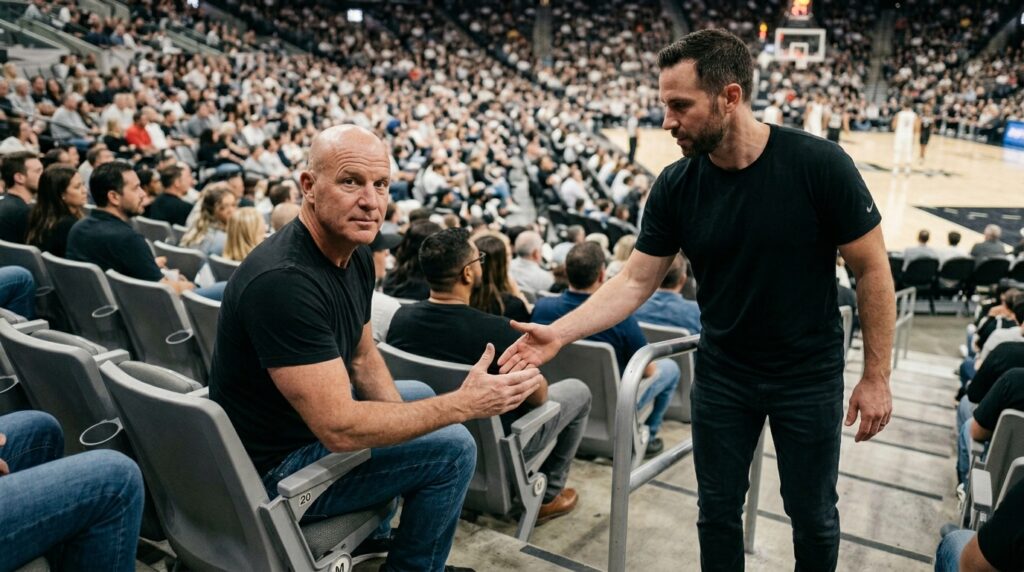
The Weight of the Arena Air and the Gentle Fracture of a Pillar’s Pride

CHAPTER 1: THE ANCHOR ROW

The buzzer tore through the upper bowl of the arena, a sharp, electronic shriek that brought twenty thousand people to their feet in a single, fluid surge.

Marcus stayed down.

He didn’t mean to. His mind had already sent the signal—the same simple command he’ve given his legs for fifty-eight years—but the quadriceps didn’t fire. They just quivered, a useless, hidden vibration beneath the heavy denim of his jeans. Around him, the roar was deafening, a wall of sound built from stomping boots and spilled beer, the desaturated gray light of late afternoon cutting through the high glass panelling of the rafters to illuminate the dust motes dancing in the heat.

To his right, a kid no older than twenty accidentally clipped Marcus’s shoulder while high-fiving a friend. The impact rattled Marcus, shifting the loose gold championship ring on his right ring finger. It slid down to the first knuckle, thin and hollow against skin that used to fill the band completely. He caught it with his thumb, pressing the heavy metal back into the meat of his hand, his jaw locking so tight the muscle along his bald crown twitched.

Just stand up, he told himself. The row anchor is right there. Just lean into the iron armrest.

He gripped the cold, chipped metal of the stadium seat frame. The texture was rough, the paint flaking off in tiny, gray scales under his palm. He shifted his weight forward, trying to use the leverage of his broad shoulders—the frame that had carried him through two decades of competitive sports—but his left knee buckled before his hips even cleared the plastic seat. He dropped back down with a hard, hollow thud, the plastic snapping against his thighs.

Nobody noticed. The crowd was tracking a fast break on the hardwood below, a blur of jersey colors and squeaking sneakers. But Marcus felt entirely exposed, a dark stone sitting static in a rushing river. The isolation he had cultivated for six months inside his small suburban house had failed him the moment he stepped through the turnstile. He was a pillar that had developed a structural crack, and the whole world was about to watch it crumble.

Then the shadow fell over him.

It didn’t come from the row behind. A man stepped directly into the aisle beside the row anchor—a younger man, late thirties, wearing the dark quarter-zip pullover of the arena’s athletic staff. He had short, dark hair and a neat beard, his chest broad enough to suggest he knew exactly what it took to move weight. He wasn’t looking at the court. His eyes were locked on Marcus’s left leg, tracking the small, telltale tremor that Marcus couldn’t stop.

Marcus froze, his face hardening as he looked forward, staring intently at the scoreboard banner. Move along, he thought, weaponizing the silence between them. Don’t look at me.

The stranger didn’t move. He stepped closer, his sneakers squeaking softly against the concrete steps. Without a word of pity, without a single phrase that would alert the spectators in row five, the younger man reached out. His hand was calloused, the skin warm as he placed it firmly under Marcus’s left elbow, providing a solid, immovable fulcrum.

Marcus felt the touch through his jacket. His pride flared, a sudden heat in his chest that told him to yank his arm away. But his body knew better. The grip was an anchor.

“On three,” the younger man murmured, his voice low, barely carrying over the stadium organ.

Marcus didn’t count. He just pulled. He let the stranger take thirty percent of his weight, their breath catching in unison as Marcus’s boots finally found traction on the concrete. They rose together, a slow, heavy resurrection in the middle of the shouting crowd. Marcus’s knees locked into place with a dull ache, his frame swaying slightly before the stranger’s hand tightened on his forearm, stabilizing the drift.

The younger man kept his face close, his eyes scanning Marcus’s eyes, checking the pulse in his temple. He didn’t let go until he was sure the old athlete wasn’t going to drop.

“You good?” the younger man asked softly.

Marcus swallowed the dry copper taste of adrenaline. He went to nod, to give the transactional lie he’ve practiced for months, but his eyes drifted down to the stranger’s hand—the one that had just lifted him.

The younger man’s thumb was pinned tightly against his own thigh, but it wasn’t steady. Beneath the fabric of his staff uniform, the younger man’s hand was locked in the exact same rhythmic, uncontrollable tremor that had kept Marcus trapped in his seat.


CHAPTER 2: THE REARVIEW REFLECTION

“Take the armrest, sir. The grade on this ramp drops quick.”

Marcus didn’t answer the young man—Noah, according to the small silver-plated name tag pinned to his stadium fleece—but he let his right fingers drag along the cool, textured vinyl of the corridor railing. The crowd was filtering out through the main gates, their voices echoing off the concrete ceilings like gravel spinning inside a drum. Every step down the exit ramp was a precise, calculated negotiation with his left quadricep. His thigh felt like a column of sand held together only by the tight fabric of his trousers.

“I’ve got my vehicle in the lower south lot,” Marcus said, keeping his words clipped, his breathing rhythmic to hide the tightness in his chest. “I can manage from the gate.”

Noah walked half a step behind him, his shoulder nearly touching Marcus’s. It was the stance of an off-duty coach or a corner man—close enough to catch a falling body without looking like an escort. “South lot’s a hike today. The pavement’s chewed up from the winter frost. Let me pull a cart around.”

“No.” The word left Marcus’s mouth before he could soften it. He stopped at the glass exit doors, looking out at the sprawling sea of vehicles bathing in the weak, amber glow of the setting sun. The light was thin, filtering through a haze of exhaust fumes, catching the frayed edge of Marcus’s coat cuff. “I’ve taken enough of your clock. Go back to your section.”

Noah paused. He stood under the faded yellow glow of the exit sign, his own right hand tucked deeply into his jacket pocket. Marcus watched the pocket; the fabric was twitching in small, regular intervals, a silent telegraph of the tremors Noah was trying to pin against his hip. For a second, the younger man looked as if he might break the unspoken code—the quiet pact of two men pretending nothing was wrong.

Instead, Noah simply nodded, his features softening with a tired, familiar kind of understanding. “Watch the curb on the second tier, sir. The concrete’s crumbling down to the rebar.”

Marcus turned his back on the arena before the kid could see his hands start to shake again.

The walk to his sedan took twenty minutes. By the time Marcus reached the door, his keys felt like an anvil in his palm. He dropped into the driver’s seat, the old leather groaning under his weight, smelling of stale coffee and the pine-scented air freshener that had lost its oil three winters ago. He didn’t turn the ignition. He just sat in the dimming cabin, letting the vents blow cold air over his bald head while he waited for his legs to stop buzzing.

He reached down to clear his phone from the center console, but his knuckles knocked against something unfamiliar.

A black nylon lanyard was coiled inside the cup holder, wedged beneath his spare change. Attached to it was a laminated plastic parking pass with Staff Member – Tier 1 stamped across the front in fading blue ink. Marcus picked it up, the plastic cool and stiff against his thumb. He hadn’t put it there. The car had been locked since noon.

Then his phone buzzed in his lap.

The screen illuminated the dark interior of the car, casting a desaturated blue light over his lined face. It wasn’t a notification from his doctor, nor was it the automated pharmacy alert he had been dreading. It was a single, long-form text message from his daughter, Sarah, forwarded through an unlisted local number.

Marcus cleared the screen with a trembling thumb and began to read.

Noah—he agreed to go. He’s in Section 114, Row 4, Seat 12. He’s wearing the old varsity jacket from the ’94 championship. He won’t have his cane, and he won’t ask for help if he locks up. Please, just stand near the portal during the fourth quarter. If he looks like he’s sinking, tell him it’s standard protocol to clear the aisle. Don’t let him know I called you. If he thinks I’m managing him, he won’t ever leave the house again.

The words seemed to blur together on the small glass screen. The warmth of the car’s interior disappeared, replaced by a sudden, hollow chill that started at the base of Marcus’s skull. His isolation—the months of meticulously timed grocery trips at 5:00 AM, the skipped family dinners, the carefully worded text responses designed to sound busy—hadn’t been a shield at all. It had been a glass cage. They had been watching him from the outside the entire time, trading notes on his decline like coaches reviewing game tape.

He stared at the black lanyard in his hand. Noah hadn’t been an observant stranger passing by. He had been a deployed asset, a charity worker assigned to a stubborn old man who couldn’t even stand up to cheer for his own legacy.

Marcus gripped the steering wheel, his thumbs digging into the worn, fraying leather until his knuckles turned white. The ring on his finger bit into his skin, a sharp, metallic reminder of a time when people looked at him to carry the weight, not to be carried. He felt a fierce, rising impulse to delete the thread, to drive home and lock the deadbolt until they all grew tired of trying to save him.

But his eyes drifted back to the bottom of the text message. Below his daughter’s frantic instructions, there was a single reply from Noah’s number, sent three hours before the game started.

I’ll find him, Sarah. Don’t worry. I know exactly what the early stages look like. My father lasted five years before the legs went entirely. I’ll make sure he keeps his feet.

Marcus let the phone slide from his fingers onto the passenger seat. The silence inside the sedan was total, broken only by the distant, rhythmic thud of car doors slamming across the parking lot as twenty thousand people began their journey home. He didn’t turn the key. He just stared into the rearview mirror, watching the shadow of the arena grow longer and darker until it swallowed his car completely.

CHAPTER 3: THE KITCHEN TABLE CONFRONTATION

The key scraped against the brass locking mechanism of the front door, a dry, metallic screech that sounded too loud in the suburban quietness of nine o’clock. Marcus pressed his weight into the wood, letting his shoulder take the burden of forcing the warped frame open. The hallway smelled of cedar lining and cold floorboards. It was the specific scent of a house that had been lived in by one person for too long with the windows shut tight.

He walked with an exaggerated rhythm, lifting his left boot an inch higher than necessary to ensure the heel cleared the edge of the braided welcome mat. Every step was a performance for an audience he didn’t want to admit was listening.

Sarah was sitting at the oak kitchen table.

She didn’t rise when he entered. A ceramic mug sat between her hands, the porcelain glazed in a faded slate blue, steam no longer rising from the rim. The kitchen was illuminated by a single overhead fluorescent bulb that hummed on a low, vibrating frequency, casting sharp, pale shadows across the linoleum floor. On the table, resting beneath her mug, was a small, hand-carved wooden coaster. Marcus noticed a fresh hairline fracture splintering through the center of the grain—a clean, white split that hadn’t been there when he left that morning.

“You’re late,” Sarah said. Her voice lacked the sharp edge of anger; instead, it carried the flat, exhausting weight of a rehearsal. She was wearing an old knit wool sweater, the gray cuffs slightly frayed, loose threads clinging to the fabric near her wrists.

Marcus did not drop his keys onto the counter. He kept them enclosed within his palm, the iron edges biting into his skin to counter the dull numbness rising through his forearm. “Traffic out of the south lot was choked. Some fender bender near the bypass.”

“You always park in the North Deck, Dad. You have for twenty years.”

The lie hung between them, thin and brittle like old parchment. Marcus reached out to pull the chair opposite her, his fingers sliding along the polished wood of the backrest. He lowered himself slowly, his joints clicking in the silence, a sound like dry twigs snapping underfoot. He placed the black nylon lanyard he had taken from his cup holder directly onto the center of the table. The plastic parking pass slid an inch before stopping against the cracked wooden coaster.

Sarah looked at the pass. She didn’t flinch. Her grip merely tightened on the slate blue mug until her knuckles matched the pale shade of the fluorescent light above.

“He’s a good kid, Sarah,” Marcus said, his voice dropping into a register that was low and flat. “But I don’t pay forty dollars a ticket to have a handler assigned to row four.”

“He wasn’t a handler,” she whispered, her eyes remaining fixed on the fading blue ink of the staff credential. “He was insurance.”

“I don’t need insurance to sit in a plastic chair.”

“You couldn’t get out of the chair, Dad.” Sarah finally looked up, her eyes wide and rimmed with a dull, red exhaustion. She reached across the gap between them, her hand hesitating for a fraction of a second before covering his right wrist. “The neighbors called me three weeks ago. They saw you trying to haul the trash bins up the driveway. It took you forty minutes to move two plastic cans twenty yards. You sat on the curb for twenty more before you could walk back to the porch.”

Marcus tried to pull his hand back, a reflexive jerk of his shoulder, but her fingers held fast. The loose gold championship ring on his finger shifted with the movement, sliding down toward his knuckle, its heavy weight listing to the side. With a soft, wet sound, the band slipped entirely over the joint, dropping onto the table with a hollow, brassy rattle. It rolled twice before striking the slate blue mug and coming to a rest in the middle of the cracked coaster.

Both of them stared at the ring. It looked incredibly small resting on the worn oak, stripped of the stadium lights and the roar of the crowd that had defined its origin.

“You’re shrinking, Dad,” Sarah said, her voice cracking on the final syllable. “And you’re doing it in the dark. You think you’re protecting us by locking yourself in this house, but you’re just forcing me to guess how much of you is left every time I call.”

Marcus looked at the ring, then at his own hand. Without the gold band, the skin at the base of his finger was pale, indented, a deep groove marking where the metal had lived for three decades. The hand was shaking now, the tremor unpinned by his anger, a steady, rhythmic pulsing that moved from his wrist down through the tips of his fingers. He couldn’t stop it. The illusion of his isolation had been completely shattered, leaving behind nothing but the raw, unpolished truth of his physical decline.

“Noah’s father had it,” Marcus said after a long silence, his voice barely louder than the hum of the fluorescent bulb. He was remembering the text message, the final sentence that had stayed behind his eyes during the entire drive home.

Sarah blinked, confusion crossing her face. “What?”

“The boy at the stadium,” Marcus said, his thumb tracking the deep indentation on his ring finger. “His father had the same thing. He told you that?”

“No,” Sarah said, her brow furrowing as she let go of his wrist. “He didn’t tell me anything about his father. He just said he worked the lower bowl and that he’d keep an eye out because he knew how crowds get during the fourth quarter. He was just being neighborly, Dad. He’s a friend of a friend from the local league.”

Marcus looked up sharply, his eyes locking onto hers. Sarah’s expression was entirely open, filled with the simple, desperate worry of a daughter who had engineered a clumsy intervention. She didn’t know. She hadn’t seen the final line of the text thread, or she hadn’t understood the implication. She thought Noah was just a healthy, athletic young man doing a favor for a fractured family.

Marcus looked back down at the black lanyard. The micro-mystery of Noah’s hyper-vigilance wasn’t born out of professional courtesy or a simple promise to a friend. The stranger had looked at Marcus in that stadium aisle and seen a mirror.

“He’s not just a coach, Sarah,” Marcus murmured, his fingers closing around the gold ring, lifting it from the cracked coaster and slipping it back onto his trembling finger, where it hung loose and heavy. He stood up, his knees groaning under the sudden shift in weight, but this time he didn’t care about the performance. He needed to find the younger man before the arena closed its doors for the season. “He’s something else entirely.”

CHAPTER 4: THE SUBTERRANEAN SHADOW

The community gym smelled of old chlorine and unwashed canvas, a damp, heavy scent that clung to the back of the throat. It was past ten, and the main lights had already been killed, leaving only the amber security panels and a single row of fluorescent bulbs buzzing over the training turf. Marcus pushed the heavy metal fire door open, the hydraulic arm groaning a long, high-pitched note that echoed off the concrete blocks.

His left boot dragged. He didn’t try to hide it anymore. In this empty space, the scraping sound of leather against rubber matting was his only companion.

He found Noah at the far end of the facility, near the iron racks. The younger man was alone, stripped of his arena fleece, wearing only a faded gray tank top that showed the heavy roping of muscle across his back. He wasn’t lifting. He was sitting on a low flat bench, his elbows resting on his knees, staring down at a pair of thick, black canvas wrist wraps discarded on the floor between his sneakers. The wraps were stiff, stained with salt rings from old sweat, curling into themselves like dried leather.

Marcus didn’t call out. He let his uneven footsteps announce him.

Noah didn’t look up until Marcus’s shadow fell across the white chalk bin. When he raised his head, the amber light caught the dark hollows beneath his eyes. He didn’t look like an athletic coordinator or a coach anymore; he looked like a man who had spent the last three hours calculating an equation that refused to balance.

“The doors lock at ten, sir,” Noah said. His voice was gravelly, stripped of the easy professionalism he’d used in row four.

“You left your parking pass in my car,” Marcus lied, his voice flat. He stepped closer, his right hand gripping the steel upright of an iron rack to anchor his balance. The cold metal felt grounding against his bare palm. “Along with a thread of messages to my daughter.”

Noah looked at Marcus’s hand on the steel, then down at the black nylon lanyard Marcus had tossed onto the bench next to him. A small, humorless smile touched the corner of the younger man’s mouth, but it vanished as quickly as it came. He didn’t apologize. He didn’t try to smooth it over.

“Sarah was worried,” Noah said softly. “She’s right to be. You’re a big man, Marcus. When a man your size goes down in a crowd that dense, people get crushed. Including you.”

“I don’t need a shadow,” Marcus snapped, the heat in his chest cracking through his guarded composure. “And I don’t need a man who can barely hold his own thumb still trying to act as my crutch.”

Noah’s posture shifted. It was subtle—a tightening of the shoulders, a slight drop of the chin—but the young man didn’t look away. Instead, he reached down, picked up one of the stiff canvas wrist wraps, and began to slowly bind his right wrist. He pulled the fabric so tight the skin turned a mottled purple, pinning the thumb loop over his knuckle.

When he lifted the hand, the thumb wasn’t just twitching. It was jumping, a sharp, violent lateral spasm that defied the muscular thickness of his forearm. It was an erratic, permanent pulse, entirely separate from his body’s will.

“It’s not my father,” Noah said, his voice dropping into the hollow vault of the gym. “The text message I sent Sarah… I told her it was my father because she couldn’t handle the other version. People don’t want to hear that the guy running the youth league is falling apart from the inside out.”

Marcus’s hand tightened on the iron rack until his championship ring pressed deeply into his flesh. The air in the facility felt frozen, holding the floating white specks of lifting chalk in suspension between them. “How long?”

“Fourteen months since the tremor started in the index finger,” Noah said, his fingers tracing the frayed border of the wrap. “Six months since the left hip began to catch on the stairs. The doctors call it atypical onset. A nice, clean clinical phrase for a slow eviction from your own bones.”

He stood up from the bench. He did it slowly, his right leg hitching slightly, a mirror image of the exact hesitation Marcus had lived through in the stadium seat. He stood half a step from Marcus, the two of them under the buzzing bulb, a broken pillar and its echo.

“I didn’t take her money to watch you,” Noah whispered, his eyes boring into Marcus’s with a fierce, burning clarity that lacked any trace of pity. “I took the assignment because I wanted to see how a man like you handles it. A man who won the state title in ’94. A man whose name is still painted on the gymnasium wall down the road. I wanted to see if the pride actually keeps you warm when the dark sets in.”

Marcus stared at him, the anger dying in his throat, replaced by a sudden, terrifying realization. He had thought Noah was a decoy, a well-meaning intrusion orchestrated by a panicked daughter. But Noah wasn’t a buffer between Marcus and the truth. He was a glimpse over the edge of the cliff. He was what five years down the line looked like when the muscle finally surrendered to the nerve.

Before Marcus could answer, the industrial fan at the back of the turf paddock kicked on with a loud, mechanical wallop, sending a gust of cold, dust-laden air rushing through the weight floor. The sudden vibration traveled up through the rubber mats, and Marcus felt his left knee loosen—the old, familiar betrayal.

He didn’t fall, but he swayed, his fingers slipping an inch down the steel upright of the rack.

Noah didn’t reach out this time. He didn’t offer a hand under the elbow. He just stood there, his own wrist wrapped tight against the tremor, watching Marcus with a cold, desperate intensity. The dynamic had shifted completely; the conflict wasn’t about a daughter’s secret or an arena aisle anymore. It was about whether either of them could survive the look in the other man’s eyes.

“We aren’t clearing the aisle next season, Marcus,” Noah said, his voice barely cutting through the drone of the fan. “So you need to decide right now what you’re going to do when the whistle blows.”

CHAPTER 5: THE UNPOLISHED AGREEMENT

“The frost doesn’t lift from the cinders until eight,” Marcus said.

He didn’t look at Noah as he spoke. He kept his eyes fixed on the low white perimeter fence that wrapped around the high school athletic field. The morning was vast and quiet, the sky a flat, unpolished silver that bled into the damp ground mist. Dew clung to the frayed wool collar of Marcus’s jacket, tiny translucent beads turning the gray fabric dark and heavy across his shoulders. He stood at the gate of the track, his right hand buried in his coat pocket, curled into a tight, immovable fist around his car keys to anchor the shaking.

Noah arrived thirty seconds later. He wasn’t wearing his arena uniform or his lifting gear. He wore an old varsity sweatshirt from a school three districts over, its faded blue letters cracked and splitting along the seams. He stopped at the edge of the asphalt apron, his left hip hitching noticeably as he brought his feet together.

The two men stood in the gray stillness, the distance between them filled only by the rhythmic, mechanical click of a distant lawnmower and the wet crunch of their own breath in the cool air.

“Sarah thinks you’re at the pharmacy,” Noah said, his voice flat, stripped of the defensive edge from the night before. He didn’t look at Marcus either. He looked down at the track, where the dark red cinders met a small patch of unpaved gravel. The stone was stained with white mineral salt, a jagged, uneven fracture in the lane marking where the winter ice had split the earth.

“I don’t care what she thinks,” Marcus murmured, though the lie felt thin, dissolving into the mist before it could reach the fence line. He shifted his weight to his right leg, his left knee giving a tiny, familiar throb that resonated deep within the bone. “I didn’t come here to talk about my daughter.”

“Then why are we standing by the gate?”

Marcus looked down at his own boots. The leather was scuffed at the toe, gray lines showing through the black polish where his stride had grown lazy, dragging along the concrete thresholds of his house. For months, he had treated his body like a secret transaction, something to be hidden, budgeted, and tucked away from the light until there was nothing left but an empty vault. But looking at Noah—seeing the slight, rhythmic tremor that caused the younger man’s sweatshirt sleeve to ripple like water under a light breeze—the secret felt small. It felt useless.

“The lane line is uneven near the back stretch,” Marcus said, his voice dropping an octave, finding the steady, methodical rhythm he used to use when addressing a locker room. “If you hit the turn too tight, the hip catches.”

Noah’s jaw tightened. He looked at the track, then back at Marcus, his eyes searching the older athlete’s face for any sign of the defensive pride that had defined their meeting in row four. He found none. There was only the raw, unpolished reality of two men standing on a field that didn’t care about their old scores.

“I know,” Noah said softly. “I usually take the outer ring. The stride length is wider, but the grading is flatter.”

“The outer ring is four hundred and forty yards,” Marcus noted, his chest expanding slightly as he drew in the cold, damp scent of the earth. “That’s a long way when the wind comes over the bleachers.”

“Then we go slow.”

Noah stepped onto the cinders first. His boot sank slightly into the damp, dark red earth, leaving a deep, clear impression with a blurred edge where his heel had dragged. He didn’t wait for Marcus to catch up, but he didn’t accelerate either. He maintained a measured, transactional pace—a stride designed for endurance rather than speed, his right wrist wrapped tightly in its black canvas band, held rigid against his chest.

Marcus watched him for three breaths. His left quadricep quivered, a dull warning signal that shot from his hip down to his ankle. He could turn back to the sedan right now. He could drive home, lock the cedar door, and let Sarah guess how much of him remained.

Instead, Marcus leaned forward. He let his weight carry him past the rusted gate post, his left boot striking the red cinders with a heavy, unpolished thud. The texture of the ground was soft, forgiving, absorbing the shock of his uneven stride like an old mattress. He moved into the lane beside Noah, leaving a matching set of tracks in the damp earth—two irregular, trailing paths cut into the gray morning.

They walked in silence. They didn’t trade diagnostic terms, they didn’t talk about the doctors or the formulas that had failed to fix the wiring inside their limbs. The movement itself became the subtext. Every joint that clicked, every slight corrections of their shoulders to maintain their balance against the tilt of the track, was an unspoken acknowledgment of the shared burden. They were two broken pillars supporting the same invisible roof, moving forward through the silver light because the only other option was to sit down and let the dust settle over them.

As they cleared the first turn, the sun began to break through the upper glass panels of the high school gymnasium down the road, casting a long, pale amber beam across the cinder lane. The light didn’t erase the tremor in Noah’s hand, nor did it magically restore the strength to Marcus’s knee. It simply illuminated the texture of the path ahead—cracked, uneven, and marked by frost, but wide enough for both of them to walk together until the whistle blew.

CHAPTER 6: THE CLINICAL SCALE

The crinkle of the white paper lining the examination table was the loudest sound in the small room. It was a sharp, disposable noise that occurred every time Marcus shifted his weight, a fragile barrier between his heavy wool trousers and the cold, seamless vinyl beneath him.

“Left foot down, Marcus. Let it hang natural.”

Dr. Vance didn’t look up from his tablet. The room smelled faintly of lemon-scented disinfectant and the sharp, chemical sting of isopropyl alcohol lingering on the stainless steel trays. The light here wasn’t the soft, unpolished silver of the morning track; it was an aggressive, clinical white that hummed inside the ballast, exposing every deep line on Marcus’s bald head and the slight, silver stubble along his jaw.

Noah sat in the corner on a low stacking chair, his knees drawn up toward his chest. His faded varsity sweatshirt looked out of place against the sterile cabinets. On his lap, his right hand was pinned beneath his left forearm, a human vice designed to keep his thumb from rattling against his thigh.

“The resistance in the patellar reflex is duller this morning,” Vance murmured, tapping a small rubber hammer against Marcus’s left knee. The joint didn’t bounce; it gave a small, lazy twitch, a half-hearted gesture that died before the foot could swing. “We’re seeing the expected plateauing of the medication. The neural pathways are finding the new baseline.”

Marcus pulled his leg back, the white paper tearing beneath his heel with a dry rip. “I’m still walking the outer ring. Three laps every dawn.”

“The stride is changing, Marcus,” Vance said, finally setting the tablet down on the steel cart. He reached out, his fingers cool and dry as he took Marcus’s right hand. He didn’t look at the championship ring; he looked at the skin beneath it, checking the muscle density in the web between the thumb and index finger. “You’re dragging the heel to compensate for the drop in the lift. If we don’t adjust the dosage, the hip is going to pay the price for the knee’s stubbornness.”

Marcus looked over at Noah. The younger man wasn’t watching the doctor. His eyes were locked on a small shelf near the sink, where an old mechanical stopwatch with a cracked crystal face sat inside a plastic bin. The second hand was skipping, jumping two seconds at a time with a faint, metallic tink-tink that didn’t match the digital clock on the wall. It was a leftover piece of athletic gear, likely used for lung capacity tests, now gathering dust in a tray of tongue depressors.

“He’s running the same schedule I am,” Marcus said, nodding toward the corner. “Only his thumb is jumping twice as fast as my knee.”

Noah’s shoulders tightened. He didn’t move his arm from his lap, but his head snapped up, his eyes narrowing under the fluorescent light. “My timeline isn’t the issue here, Marcus. We came to get your script cleared.”

Dr. Vance looked between the two men, his expression remaining perfectly flat, the practiced mask of a man who had delivered the same structural report to a hundred different bodies. He reached into his pocket and pulled out a small silver tuning fork. He struck it against his own palm, the metal emitting a low, clear vibration that made the air in the small room feel thick.

“Hold out your hand, Noah,” Vance said.

The younger man hesitated, his jaw locking until the muscle along his ear turned white. Slowly, he unpinned his right arm. The moment the limb cleared his lap, the hand went wild—the tremor a rapid, lateral vibration that caused his fingers to blur under the white light. He held it out anyway, his chest rising and falling in shallow, ragged intervals.

Vance pressed the base of the vibrating fork against the joint of Noah’s thumb. “Can you feel the pitch?”

“It feels like ice,” Noah muttered, his teeth clicking slightly. “It feels like the bone is spinning.”

Marcus watched the interaction from the height of the examination table. From this vantage point, the predatory calculation he used to apply to opponents on the court came back to him, but it was inverted. He wasn’t looking for a weakness to exploit; he was reading the structural failure of a man who was supposed to be his buffer. Noah’s frame was thicker than his, the muscle fresher, but the disease was working with a different kind of velocity inside that young tissue. It wasn’t the slow, eroding tide Marcus had been fighting for six months; it was an aggressive, tearing current.

Vance pulled the fork away. The silence returned, heavy and damp.

“I can adjust the script for both of you,” the doctor said, turning back to his tablet with a quick, efficient swipe of his finger. “But the clinic won’t sign off on Noah’s coordinator clearance for the arena next month if the baseline tests drop another ten percent. The liability on the floor is too high.”

Noah stood up from the stacking chair. He didn’t hitch his hip this time; he forced the leg straight through sheer, violent compression of his core. He reached down, snatched the black nylon lanyard from the desk where he’d dropped it, and walked toward the door without looking back.

“The lane lines are still open at dawn, doctor,” Noah said, his hand catching the brass handle of the exit door. His fingers were shaking so hard the metal rattled inside the wood. “We don’t need a clearance to walk on the cinders.”

The door clicked shut behind him, the small glass window in the frame rattling for three seconds after he was gone.

Marcus stayed on the table, the torn white paper shifting under his palms. He reached down, took his gold ring between his thumb and forefinger, and twisted it until the heavy metal dug into the indented scar on his knuckle. He looked at Dr. Vance, who was already compiling the digital files for the next case.

“He’s not going to make it to the winter tournament, is he?” Marcus asked.

Vance didn’t look up from the screen, but his fingers paused on the glass for a single, telltale micro-second. “The velocity is different for every body, Marcus. You know that from the track. Some men find the wall early.”

Marcus lowered himself from the vinyl table, his left boot striking the floor with a dull, heavy thud that sounded like an anchor dropping into the mud. He didn’t care about the script anymore. He needed to get to the truck before Noah cleared the parking lot.

CHAPTER 7: THE LEGACY HANDOFF

The banquet hall of the civic center smelled of staled grease and cheap floral centerpieces. Hundreds of heavy porcelain plates rattled against long tables draped in starch-stiffened white linen, a collective, rhythmic din that rose toward the high wood-beamed ceiling. On the raised dais at the front of the room, the glare of the track lighting hit the brass trophy casings, sending long, sharp reflections cutting across the crowd of familiar faces.

Marcus adjusted his tie. The silk was old, a dark maroon pattern that had grown stiff over years of sitting in his cedar chest. His fingers were thick, uncooperative as he tried to flatten the knot.

“They’re waiting for the key presentation, Dad.”

Sarah stood beside his chair, her hand resting lightly on the padded shoulder of his suit jacket. She was wearing a soft knit shawl that kept catching on her silver bracelet, creating a small, rhythmic ticking sound every time she moved. Her eyes weren’t on him; they were scanning the floor, tracing the path toward Section B where Noah sat alone at the edge of the arena staff table.

Marcus looked down at his right hand. Resting against the white linen tablecloth was a heavy brass key tag, its face stamped with the numerals 1994—the year he had anchored the foundation’s first youth development program. Someone had taken a file to the edge of the tag, cutting a deep, jagged groove into the metal to distinguish it by touch alone from the rest of the facility keys.

“He hasn’t touched his water,” Marcus observed, his voice low, vibrating beneath the clink of silverware.

“He’s nervous,” Sarah said softly, her fingers tightening on his shoulder. “The board had to rush the transition vote after what happened at the medical center. Everyone knows his father’s history, Dad. They think Noah’s just stepping up early to carry the name before the foundation’s funding cycle closes.”

Marcus didn’t reply. He took the brass key tag between his thumb and finger, feeling the jagged notch. The lie was working exactly as it was designed to. The community saw a natural, generational shift—a healthy, athletic young protégé picking up the torch from an aging legend. It was a clean, comfortable script that protected everyone’s dignity under the bright banquet lights.

The master of ceremonies cleared his throat into the microphone, a sharp burst of static that brought a sudden, heavy silence over the room.

“And now, to hand over the stewardship of the Tri-County Youth Foundation, we call to the stage our founding director, Marcus Vance.”

The applause started at the front tables and rolled back through the hall like a wave of dry leaves scraping over asphalt. Marcus stood up. He did it by leaning his weight heavily into his right hip, using the solid edge of the oak table to stabilize his posture before his left knee could flag his intent. He kept his stride short, his boots making a dull, sliding sound against the thin industrial carpet as he crossed the platform.

Noah met him at the center of the stage.

Under the direct glare of the spotlights, the younger man’s gray suit looked tight, almost restrictive around his broad chest. His right arm was tucked inside his jacket pocket, the fabric jumping in small, rapid jerks that looked like a trapped bird trying to clear its cage. When he reached out his left hand to accept the key, Marcus didn’t let go immediately.

The two men held the brass tag between them, their fingers overlapping on the cool metal.

“You’re shaking through your teeth, son,” Marcus murmured, his lips barely moving as he maintained a practiced, stoic smile for the local photographer standing below the dais.

“The script is cleared, Marcus,” Noah whispered back, his breath coming short, smelling of the bitter espresso he had been nursing all evening. “Just give me the key so I can sit down.”

Marcus looked past Noah’s shoulder toward the back of the room, where the light faded into the shadows near the exit doors. He could see the structural reality of the moment with total, predatory clarity. Noah wasn’t just hiding a tremor; he was losing his grip on his center of gravity. His left shoulder was leaning a full two inches lower than his right, his body tilting against the stage floor like a listing ship trying to make port before the hull split.

Marcus let his hand slide from the brass tag, but instead of stepping back into the shadow of the podium, he moved half a step closer. He planted his own broad shoulder against Noah’s flank, providing a solid, immovable wedge that caught the younger man’s drift before the crowd could notice the lean.

“Keep your heels dug into the carpet,” Marcus said, his voice dropping into the authoritative tone he had used thirty years ago in the championship huddles. “We walk off on my count. Left side first.”

Noah didn’t nod, but Marcus felt the sudden, heavy pressure of the younger man’s weight shifting against his side. The handshake became a brace. For three long minutes, while the applause died down and the council members stepped up to offer their hollow congratulations, the two athletes stood locked together under the white heat of the lights—a broken pillar and its fading echo, holding each other upright in full view of the town that had spent decades relying on their strength.

When they finally cleared the steps of the dais, Sarah was waiting near the curtain line, her hands clasped tightly against her knit shawl. Her face was pale, her eyes moving between her father’s steady grip and the rigid, frozen posture of Noah’s wrapped arm. She didn’t say a word about the transition. She just reached out and took the brass key tag from Noah’s left hand, her fingers tracing the jagged, filed notch in the metal with a slow, trembling motion.

“The tournament starts tomorrow morning at eight,” Noah said, his voice gravelly as he stepped away from Marcus’s side, his boots sliding unsteadily toward the dark corridor leading to the locker rooms. “The arena’s going to be packed by seven. Make sure you use the south entrance, Marcus. The main stairs are going to be too steep for us.”

Marcus watched the younger man’s shadow disappear into the desaturated gray of the back hallway. The victory of the evening felt like a false flag, a decorated performance that had solved nothing but the community’s need for a clean story. The real conflict was still waiting for them in the narrow concrete corridors of the stadium, where the crowd would be deafening and the exits would be choked with the weight of twenty thousand people.

CHAPTER 8: THE RUSTED LOCKER

“The pressure on the lower lower ring is holding, but the side stairs are blocked.”

Marcus didn’t turn around when the stadium security door thudded behind him. He stood in the narrow alley of the home team locker room, his eyes fixed on locker forty-two—Noah’s locker. The room was cold, smelling of ancient floor wax, damp canvas wraps, and the distinct, sulfurous scent of municipal pipes. Above him, through six feet of solid steel-reinforced concrete, the arena crowd was already beginning to gather, a low, vibratory thudding that sounded like the baseline of a distant storm.

He had bypassed the main entrance. His left boot made a sliding, rubbery squeak against the green-painted concrete as he stepped up to the rusted metal door of the locker. The latch was broken, hanging by a single oxidized screw, a tiny, jagged tooth of silver steel keeping the door from swinging wide.

Marcus pulled the door open.

Inside, dangling from a plastic coat hanger, was Noah’s spare arena staff shirt, its white fabric slightly yellowed at the collar line, lint clinging to the shoulders like small gray burs. On the lower shelf, resting between a half-empty tub of athletic grip powder and an old leather weight belt, sat a blue aluminum clipboard.

Marcus reached out, his thumb dragging across the cold metal casing. His right hand was relatively steady now—the morning dose of Vance’s script had settled the nerves into a hard, rigid numbness—but his fingers felt clumsy as he lifted the top sheet of paper.

It wasn’t a schedule for the tournament bracket.

It was a series of printed clinical assessment sheets, dated exactly three weeks apart, stretching back across the winter. The top left corner bore the watermark of the state neurological center, but the patient name hadn’t been blacked out cleanly. The marker had faded, leaving the letters N. VANCE visible under the harsh glare of the utility bulb.

Marcus’s thumb traced the line graph on the second page. The curve wasn’t a plateau; it was a vertical drop, a jagged staircase where every step down represented a ten percent reduction in motor control velocity. At the bottom of the log, written in Dr. Vance’s small, angular handwriting, was a final note dated two days before the legacy dinner:

Patient demonstrating accelerated degradation of the lower motor columns. Anticipated loss of unassisted ambulation within forty-five to sixty days. Standard medication therapy showing zero efficacy. Recommend transition to manual mobility aids before the close of the current quarter.

Marcus let the clipboard drop against the metal shelf with a loud, hollow clack.

Forty-five days. Noah wasn’t looking over the edge of a cliff five years down the line; he was already in freefall. The whole performance at the banquet hall—the starch-stiff tablecloths, the brass key handoff, the proud generational script—wasn’t a transition plan. It was a barricade built out of pure desperation, a temporary wall erected to hide a collapse that was happening in real time.

“You shouldn’t be down here, Marcus.”

Noah stood at the entrance of the locker aisle. He was holding an old canvas chalk bag in his left hand, the drawstring loose, white powder dusting his dark trousers like frost. He looked smaller inside the narrow corridor, his shoulders leaning heavily into the green concrete wall to take the pressure off his left leg. His skin was pale, matching the sickly tone of the fluorescent tubes, a thin sheen of sweat catching the light at his temples.

Marcus gripped the rusted edge of the locker door, his ring finger pressing into the iron until the gold band bit into his knuckle. “You told me you had time, son.”

“I told you what you needed to hear to get on that stage,” Noah said, his voice dropping into a flat, dry rattle that didn’t have the strength to echo. He stepped into the aisle, his left boot making the same sliding, leaden sound Marcus’s had made an hour earlier. He didn’t look at the clipboard. “The foundation needed a name to secure the winter lease. If the town thought the new director was going to be using a chair before the tournament finished, the sponsors would have pulled out by noon.”

“This isn’t about the lease,” Marcus said, his step forward deliberate, heavy, his frame towering over the younger man in the narrow space. “You’re burning through your columns, Noah. You can’t even clear the portal without leaning into the bricks.”

“Then I’ll lean into the bricks,” Noah snapped, his right arm jumping violently inside his jacket pocket, the fabric tearing at the seam where his thumb had been pinning it. He pulled the hand out, revealing a plastic medical bracelet with a serrated clasp tucked into the palm of his hand, its surface stamped with an emergency admission code. He dropped it into the chalk bag, his features hardening into a fierce, ugly mask of pride. “The arena is full, Marcus. There are six thousand kids out there who think this foundation is still a pillar. I’m not going to be the one who tells them the concrete is hollow.”

Above them, the storm broke.

The low roar of the crowd suddenly spiked into a high, piercing scream as the stadium speakers kicked on for the opening introductions. The vibration was so intense that a layer of white dust filtered down from the concrete seams in the ceiling, settling over the yellowed collar of Noah’s shirt and Marcus’s bald head. The floorboards beneath them seemed to shift, a subtle, undulating wave of energy that traveled up through their boots.

Noah’s left knee gave out instantly.

He didn’t make a sound—no grunt, no exclamation of surprise. His frame simply dropped, his shoulder scraping down the green concrete wall as he went down, his fingers catching the latch of locker forty-two. The metal groaned as the remaining screw ripped free from the iron, the door swinging wide with a sharp, industrial shriek.

Marcus didn’t calculate the risk. The predator lens evaporated, replaced by the muscle memory of an anchor who had spent his life waiting at the rim.

He dropped his weight into his right hip, his own bad knee locking with an audible click as he reached out his broad arms. He caught Noah before the younger man’s head could strike the concrete floor, his hands wrapping around the sweat-stained fabric of the varsity sweatshirt, hauling him back against his chest.

The impact rattled Marcus’s teeth. He felt the rapid, electrical twitching of Noah’s muscles through the fabric—a furious, chaotic vibration that felt like a dying machine running at top speed.

“I’ve got you,” Marcus growled, his jaw clamped so tight his teeth ground together. “Don’t move. Just keep your heels flat.”

They sat together in the dust of the locker row, the broken locker door swinging lazily between them like a pendulum. Above them, the screaming of the stadium grew louder, a wall of sound that seemed to lock them inside the subterranean dark, two broken pieces of a single legacy trying to find an angle that would hold.

CHAPTER 9: THE CONCRETE CORRIDOR

The floor beneath them didn’t just vibrate; it heaved.

A sharp, electric pop sounded from the main breaker panel down the hallway, and the overhead utility lights blinked out, plunging the lower locker aisle into an absolute, suffocating dark. The low roar of the twenty thousand people upstairs didn’t stop, but its pitch changed—mutating from the rhythmic chant of a basketball crowd into a chaotic, scrambling wall of noise that leaked through the concrete ventilation shafts like rushing water.

“Electrical fire in the lower service level,” a mechanical voice squawked from a security guard’s lost radio near the door. “Clear the north and east tunnels immediately. The exhaust fans are down.”

Marcus kept his shoulders pinned against locker forty-two. In the blackness, he couldn’t see Noah’s face, but he could feel the rapid, desperate heat of the young man’s breathing against his collarbone. The frantic twitching in Noah’s right arm had locked up entirely, turning the limb into a rigid, unyielding piece of iron that pressed into Marcus’s ribs.

“Can you find the latch line?” Noah whispered, his voice thin, whistling through his teeth as he tried to force his left leg to catch traction on the slick floorboards.

“Forget the latch,” Marcus growled. “We go out through the service ramp. The main stairs will be a bottleneck within two minutes.”

He didn’t wait for Noah’s agreement. Marcus dug his own blunt fingers into the wool fabric of the younger man’s sweatshirt, pulling him upward until their heads cleared the locker frames. Marcus’s left knee gave an immediate, violent pop—a sickening, hollow sound that traveled up his spine—but he didn’t allow his weight to drop. He shifted Noah’s broad shoulder over his own neck, locking his right hand around Noah’s belt line.

They began to move down the alleyway, a heavy, uncoordinated mass scraping along the green cinder blocks.

The air in the corridor was already changing. The cool scent of municipal pipes was fading, replaced by a thin, bitter haze of burning insulation that stung the eyes and tasted like copper on the tongue. In the dim amber glow of the emergency exit strips at the floor level, the hallway looked desaturated, a narrow gray tunnel filled with drifting patches of white chalk dust.

When they reached the auxiliary exit gate, the crisis became visible.

A massive crowd from the lower bowl sections had bypassed the main concourse, flooding down into the service lane to escape the smoke filling the upper rafters. They were packed shoulder-to-shoulder—parents holding children, spectators clutching concessions—shoving against a heavy steel fire door that had dropped down automatically to seal off the utility bays. The handle of the door was pinned open by a frayed blue gym towel someone had used to wedge it during the game, but the weight of the crowd had jammed the latch inside the frame.

“It’s stuck!” a man shouted from the front, his palm slamming against the reinforced glass panel. “The manual release isn’t catching!”

“Back up!” Marcus roared. His voice, trained to cut through the acoustics of old fieldhouses, cleared a two-inch gap in the panic.

He didn’t let go of Noah. He couldn’t. If he dropped the younger man now, the crowd would filter over him like sand over a stone. Instead, Marcus drove his broad chest into the back of the front-row spectators, forcing a wedge through the press of bodies until he and Noah were flush against the cold iron of the fire door.

“The pin’s jammed under the frame compression,” Noah said. Despite the rapid, chaotic short-circuiting of his legs, his eyes were clear, tracking the mechanical linkages of the lock with a coach’s cold precision. He reached out his left hand—the steady one—and gripped the frayed edge of the blue towel, pulling it down with a sharp, heavy snap. “Marcus… the lower hinge. You have to take the weight off the lock line.”

“I’ve got the lock,” Marcus said, his teeth grinding until his jaw muscles throbbed. “You take the bar.”

Marcus dropped his center of gravity six inches. The movement was pure agony; his left leg felt as if it were being bored into by a hot drill, the muscle fibers screaming against the medication Vance had given him. He wedged his scuffed boot beneath the bottom edge of the heavy steel door, using his entire leg as a lever. He didn’t use his hands—they were busy holding Noah’s torso stable against the pressure of the crowd behind them.

“Now!” Marcus bellowed.

Noah didn’t use his arms to push the door. He couldn’t force the power through his shoulders. Instead, he threw his entire athletic frame forward, using his shoulder as a battering ram against the manual push-bar, his body weight colliding with the steel plate at the exact micro-second Marcus lifted with his boot.

The latch gave a loud, metallic crack as the compression broke.

The door swung wide into the cool, damp air of the south parking lot, and the crowd surged forward, a human river emptying out into the gray afternoon light. They flowed past the two men, a blur of colorful team jerseys and wide, frightened eyes, completely blind to the fact that the two figures holding the iron frame open were entirely incapable of running themselves.

Marcus and Noah stayed pinned to the brick molding until the last of the crowd cleared the portal.

The afternoon sun was weak, filtering through the exhaust haze of the escaping cars, casting long, faded shadows across the crumbling concrete curb. Marcus lowered himself slowly until he was sitting flat on the cold asphalt apron of the ramp, his back against the brickwork. His left leg was entirely dead now, a heavy, static weight that refused to register any command.

Noah dropped down beside him, his gray suit jacket torn at the armpit, his right hand resting openly on his knee. The thumb was still jumping, a rhythmic, tireless vibration that matched the ticking of the cooling arena vents above them.

Sarah came through the gate three minutes later, her knit shawl gone, her silver bracelet clicking frantically as she sprinted down the concrete lane. She stopped when she saw them, her face pale, her chest heaving as she looked at the two athletes sitting side-by-side in the dirt.

She didn’t ask if they were good. She didn’t offer a clumsy lie to save their pride. She simply stepped between them, her warm palms coming down onto their shoulders, anchoring them both against the cold brick of the stadium.

“The buses are lined up near the lower loop,” she said softly, her eyes moving between her father’s indented ring finger and Noah’s wrapped wrist. “We can walk down together once the smoke clears.”

Marcus looked at Noah, then down at his own scuffed boots. The illusion of the unshakeable pillar was gone, buried under the white chalk dust and the black soot of the corridor fire. But as he reached out his shaking hand to help Noah steady his wrapped wrist against the asphalt, Marcus felt a different kind of structure hardening in his chest. It wasn’t built out of muscle density or state titles or the pristine lines of a gymnasium wall. It was the unpolished, enduring grace of two men who had looked into the dark of their own decline and found a way to keep each other’s feet.

“The cinders will be wet tomorrow morning, Noah,” Marcus said, his voice low, steady, carrying over the distant shriek of the emergency sirens.

Noah didn’t look up, but his thumb paused its frantic movement for a single, fleeting second as his fingers closed around the brass key tag in his pocket. “Then we’ll use the long spikes, Marcus. We’ll just take the outer ring.”

Similar Posts

Leave a Reply

Your email address will not be published. Required fields are marked *






