
The Weight of Salt and Iron: A Narrative of Legacy and Broken Discipline
CHAPTER 1: THE FRICTION OF THE LINE
“Move along, old man, you’re holding up the whole line.”
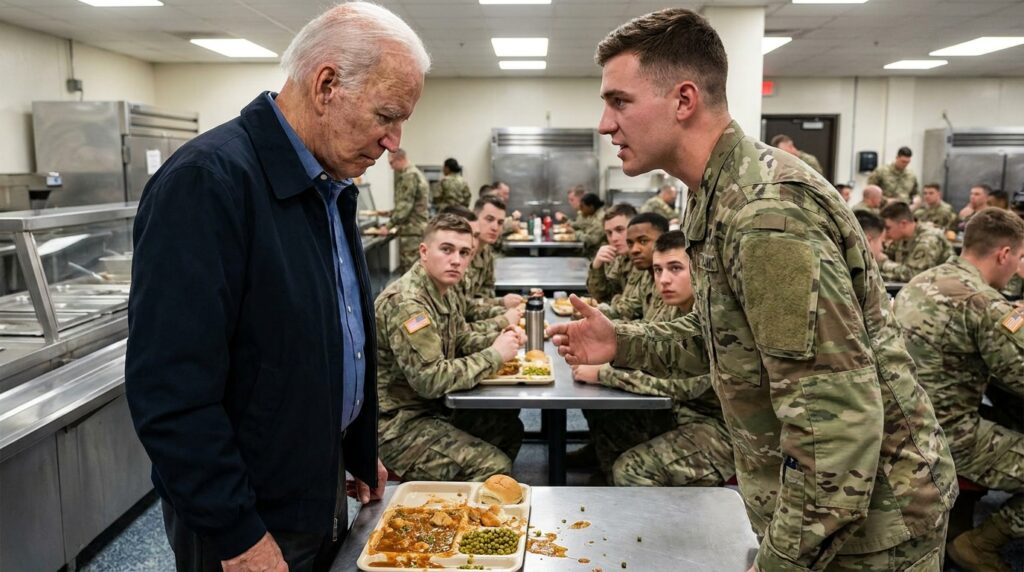
The words weren’t just spoken; they were spat, dropped like hot brass into the dull roar of the Fort Meade mess hall. Then came the palm—flat, sweaty, and heavy with the thoughtless momentum of a twenty-two-year-old who had spent six months learning how to break things. The impact hit the dark wool of my jacket, a dull thud that rattled the cheap plastic tray against the stainless-steel serving rail.
The tray buckled. A bowl of lukewarm hominy tipped over the edge, spilling a gray, starchy slick across the metal counter.
Around us, the room didn’t go completely quiet—a base cafeteria never does—but the texture of the noise changed. The scraping of heavy plastic chairs slowed. The rhythmic, transactional clink of forks against tin partitions died out in a widening perimeter. Two dozen recruits in desaturated digital camouflage uniform stayed frozen, their mouths closed, eyes tracking the grease on the counter, waiting for the old civilian to shrink.
I didn’t shrink. My joints didn’t allow for fast retreating movements anymore; they were stiff, filled with the grinding ache of seventy-eight winters and the dry grit of places this kid hadn’t even read about in his tactical manuals. I looked down at the spilled hominy first. The steam rising from it smelled faintly of tin and cheap lye.
“Look at me when I’m talking to you,” the soldier muttered. His breath smelled of sour coffee and tobacco. He was leaning in, his clean-shaven jaw twitching with the specific, fragile arrogance of a private who thought the uniform made him six inches taller than the man wearing the old wool coat.
My right hand was still gripping the cold edge of the tray. My thumb felt the small, jagged notch in the plastic—a tiny physical imperfection. I didn’t think about the physics of it. I didn’t calculate the leverage. The movement was just old iron sliding into a groove it had worn fifty years ago.
I dropped my left shoulder, letting his forward lean carry his center of gravity over the slick of the counter. My right hand left the tray, fingers locking onto the stiff, coarse fabric of his uniform collar right where the seam met the throat. I didn’t pull him. I simply pivoted my heel into the concrete floor, letting the weight of my own age—the heavy, unyielding mass of an old man who refused to tip—become an anchor.
The private’s boots lost purchase on the greasy red tile. His eyes went wide, a sudden, animal panic short-circuiting his face as his own forward momentum turned against him. There was a sharp, brief scuffle of rubber soles, the hard clack of his elbow catching the edge of the line, and then he was down.
He hit the floor hard, flat on his back in the center aisle, the wind whistling out of his teeth in a short, wet gasp.
The mess hall went absolutely still. Nobody moved to help him. The silence was heavy, smelling of scorched grease and the desaturated musk of a hundred tired bodies.
I stood over him, my hands returning to my sides. My right forearm was trembling slightly from the sudden exertion, a cold vibration running through the bone, but I kept my fingers flat against the wool of my trousers. I looked down at his short, prickly hair, the neat camouflage pattern of his chest rising and falling as he tried to find his breath.
“You picked the wrong man to disrespect today,” I said. My voice was lower than the room tone, a gravelly rasp that felt dry in my throat, completely stripped of heat.
The young soldier stayed there, his back pressed against the cold red tile, his fingers twitching against the floor. The arrogance had drained out of his eyes, replaced by the deep, flushing heat of public humiliation. He looked at the boots of his peers at the surrounding tables, then up at my lined face. His jaw moved once, twice, before the discipline of the pipeline finally overrode his pride.
“Sir,” he whispered, his chest tightening as he forced the words past his teeth. “I went too far.”
I didn’t answer. I reached down, took my wallet out of the dark wool jacket, and looked at the blue visitor’s pass tucked behind the plastic screen. Underneath the laminated edge, a small, hand-drawn red cross was marked on the corner of the card—a detail that hadn’t been there when the front gate clerks logged me in an hour ago.

CHAPTER 2: THE COMMAND ISOLATION
The green paint on the concrete wall was flaking in long, jagged scabs, revealing the damp, rusted iron rebar beneath it. The holding room smelled of floor wax, dry earth, and old starch—the specific, stagnant odor of an institutional cage that hadn’t changed since the Berlin Wall was standing. My hands were finally steady, but the knuckle of my left index finger throbbed where it had caught the coarse fabric of the private’s collar.
The heavy steel door didn’t click when it opened; it groaned on dry hinges, a harsh metal-on-metal scrape that vibrated right through the small of my back.
Two base security MP escorts stood in the threshold, their desaturated digital camouflage pristine, their faces perfectly blank under the fluorescent light. They didn’t look at my face; they looked at my hands. Between them stood a sergeant first class with a clipboard, his thumb pinning down my leather-bound wallet and the blue visitor’s pass.
“Stand up, sir,” the sergeant said. The command wasn’t loud, but it had the transactional coldness of a man who spent his days processing human cargo through a logistical pipeline. “Leave the coat on the chair.”
I didn’t move immediately. I let the silence stretch until the sergeant’s eyes flicked from the clipboard up to my lined face, his jaw tight with the sudden friction of an old man who didn’t follow the rhythm of the base. I stood up slowly, my knees popping with a sound like dry twigs, but I kept my spine straight. I didn’t leave the coat. I wore it, pulling the dark wool tight across my chest as I stepped into the gray-lit corridor.
The air in the administrative wing was colder, filled with the hum of server racks and the distant, rhythmic thud of boot heels on linoleum. They marched me past rows of frosted glass offices where young clerks sat before glowing monitors, their eyes tracking data fields, completely insulated from the physical reality of the mud and iron outside. We stopped before a solid oak door marked Commanding Officer – Authorized Personnel Only.
The sergeant didn’t knock. He punched a five-digit code into the mechanical lock, the tumblers falling with a heavy, metallic sequence that sounded exactly like the action of an M14 rifle locking into battery.
The office inside was larger, but the air was just as dry, smelling of old paper and gun oil. A desk made of dark, military-issue mahogany occupied the center of the room, its surface desaturated under a single desk lamp. On the green blotter lay my personal leather kit bag, its brass zipper forced open, its contents arranged in a neat, clinical line: three graphite pencils, a pocketknife with a three-inch carbon steel blade, a worn silver pocket watch with a cracked glass face, and a thick, canvas-bound ledger with a faded serial number stamped on the spine.
A man in a field uniform stood by the narrow window, his back to me, his hands clasped behind him. The silver oak leaves of a lieutenant colonel gleamed on his collar, catching the desaturated light from the courtyard outside.
“That’ll be all, Sergeant,” the officer said. His voice was lighter than mine, but it carried the same flat, unyielding rhythm—the specific cadence of a man who spent his life inside the structure.
The door clicked shut behind me, the lock engaging with that same heavy, mechanical finality.
The lieutenant colonel didn’t turn around immediately. He stayed by the glass, his eyes tracking a squad of recruits marching across the desaturated asphalt below, their boots striking the pavement in a ragged, exhausted cadence. When he finally pivoted, his face was in shadow, but the sharp edges of his jaw and the slight asymmetry of his nose were identical to the reflection I saw in the mirror every morning when I shaved.
He didn’t call me by name. He didn’t offer a hand. He walked to the desk, his fingers brushing the canvas-bound ledger with a slow, calculated curiosity.
“The gate manifest logs you as a civilian contractor checking the inventory at the old logistics depot,” he said, his voice dropping into a transactional register that didn’t match the hard line of his mouth. “But the depot has been cold since ninety-two. And this ledger didn’t come from any civilian office.”
He picked up the canvas book, turning it over so the faded stenciling faced me. The letters UNIT 77 – OP-ECHO were barely legible against the frayed olive cloth, but beneath them, a hand-drawn red cross had been inked into the fabric with a fine-tipped pen—the exact same mark that was currently drying on my visitor’s pass in the sergeant’s pocket.
“The private you broke in the mess hall is currently in the infirmary with a hairline fracture in his radius,” the officer continued, his eyes locking onto mine with an equal, probing intellect that searched for weakness. “He thinks he ran into a stubborn old civilian. But the computer doesn’t find any record of your civilian employment after seventy-six. It just finds a blank space where a service record used to be.”
I looked at the canvas book in his hand, then at the silver oak leaves on his collar. The mechanical watch on the desk gave a stiff, grinding tick that seemed to fill the silence between us.
“The private was soft,” I said, my voice a low, desaturated rasp against the clean walls of the office. “He was leaning too far forward. If you’re going to deploy them to the ridge next month, you should teach them how to balance their weight.”
The lieutenant colonel froze. His fingers tightened against the canvas ledger until the knuckles turned white, his eyes narrowing as he realized I knew the exact destination of the unit’s upcoming, classified transfer orders—a logistical detail that hadn’t been printed on any manifest in this office.
CHAPTER 3: THE COLD LIAISON
“You shouldn’t have come here,” the lieutenant colonel said. He dropped the canvas-bound ledger onto the desk. The heavy thump puffed a small cloud of dry, yellow dust into the light of the desk lamp, a desaturated haze that smelled of old mildew and decayed glue. “The Unit 77 roster was purged from the federal registers before I was commissioned. Carrying this onto a modern installation isn’t just an infraction. It’s an invitation for a quiet disappearance.”
I leaned my weight back onto my heels, my hands still thrust into the pockets of the dark wool coat. Through the lining, my fingers grazed the loose brass locking screw I had slipped from the knife casing on the desk while his back was turned. It was cold, its threads caked with a fine, green residue of oxidized copper.
“I didn’t bring it to read it to the clerks,” I replied. My voice maintained its slow, gravelly rasp, scraping against the clean, sterile hum of the air conditioning. “I brought it because the logistical depot at the ridge isn’t cold. The automated transport lines are pulling power from the grid. Two hundred thousand kilowatt-hours a month don’t disappear into an empty warehouse, Vance.”
The use of his first name—the name I had given him before the service swallowed him whole—made his jaw lock. The lieutenant colonel walked around the mahogany desk, his boots striking the floor with a calculated, rhythmic precision that attempted to reassert the authority of his rank. He stopped a mere foot away, his breath cold, his eyes drilling into mine with that same stubborn, unyielding density we both carried in our bones.
“The ridge is under my operational control now,” Vance whispered, his hand coming down flat on the desk blotter, right next to the worn silver pocket watch. “Whatever happens out there is sanctioned by the Department of the Army. Your old unit’s coordinates are dead. The field journal is a decoy, an antique artifact from a border skirmish that never existed on paper. If security finds you with it outside this room, I can’t protect you.”
“I didn’t ask for protection,” I said, leaning in just enough to let him smell the rain and old wool on my coat. “I asked why the transfer orders for that boy in the mess hall are marked with the same red cross as my retirement manifest from seventy-six. You’re preparing his squad for a clearance run at the old border sector. The same run that left sixteen of my people in an unmarked ditch near the salt flats.”
Vance didn’t flinch. His face remained a mask of hardened military discipline, desaturated and pale under the fluorescent glare. He turned slightly, picking up the canvas book and flipping it open to the back cover. His finger tapped an iron-rimmed grommet hidden inside the spine—a structural anchor point meant for a carrying strap, but inside the hollow cylinder, a thin strip of silver micro-film gleamed like a snake’s scale.
“The red cross isn’t a manifest marker,” Vance said, his voice dropping into a flat, transactional drone that sent a sudden, icy needle of awareness down my spine. “It’s a biological quarantine flag. The boy in the cafeteria wasn’t soft because he lacked training. He was suffering from early-stage peripheral degradation. The same degradation that started in your fingers forty years ago.”
The room seemed to shrink, the dry smell of paper and gun oil suddenly turning thick and metallic, like blood drying on a hot radiator. I looked at the silver micro-film, then down at my own hand inside the wool pocket, my fingers tightening around the cold brass screw until the metal bit into my palm.
“You’re using them as filters,” I muttered, the realization hitting me not as a shock, but as a heavy, exhausting weight. “You’re sending his unit down into the old storage vaults to see if the modern seals hold against the rot.”
“I am executing orders,” Vance said, his face entirely devoid of color now, a statue of absolute compliance. “The same way you did when you crossed the flats. The only difference is, this time, I know exactly who is going into the hole.”
Before I could speak, a sharp, electronic buzzer tore through the silence of the office. The small red light above the oak door began to blink in a rapid, frantic rhythm, and the heavy tumblers of the mechanical lock began to slide back with a series of frantic, wet clicks.
CHAPTER 4: THE HORIZON OF DUST
“Sit down, Private,” Vance commanded, his voice slicing through the mechanical whine of the fading security buzzer.
The heavy door ground backward against its hinges, and the young soldier from the mess hall stepped into the office. His right forearm was wrapped tight in a stiff, desaturated white splint, his utility jacket slung loosely over his left shoulder. His face was pale, the skin around his eyes bruised with an exhaustion that didn’t match a simple base training schedule. Behind him, an MP sergeant held his military credentials, dropping them onto the mahogany desk next to my silver watch.
I didn’t turn around, but I watched the private’s reflection in the narrow window pane. He looked at the back of my wool coat, his shoulders tightening as the realization of where he had been brought settled into his chest.
“The log shows your transfer orders were processed through the ridge logistics hub at midnight,” Vance said, his fingers trailing down the canvas-bound ledger, resting on the microfilm strip hidden inside the split seam. “The same hub this civilian was investigating. Tell him what you found in the lower containment cells during your guard rotation, Miller.”
The private didn’t speak immediately. His left hand drifted down to his trousers, his fingers twitching against the coarse fabric, tracing a faint smudge of dark red ink that stained the edge of his pocket—the exact shade of the cross on my visitor’s pass.
“We didn’t find crates, sir,” Private Miller whispered, his voice cracking against the dry air of the room. “The automated lifts were pulling containers out of the bedrock. They were marked with old serial codes from seventy-six. When we tried to inventory the seals, the lieutenant colonel’s signature was already on the clearance manifest. He didn’t order us to secure the facility. He ordered us to drill the valves.”
The cold iron screw in my pocket felt heavier now, its threads digging into the flesh of my thumb. I pivoted slowly, my boots clicking against the linoleum, my eyes shifting from the private’s fractured arm to the man standing behind the mahogany desk.
“You didn’t execute orders from the Department of the Army, Vance,” I said, the gravel in my throat turning into a hard, unyielding edge. “The Department doesn’t know the vaults are active. You engineered the breakdown in the mess hall to pull Miller’s squad off the line before the automated system released the pressure. You knew his hands were failing him, just like mine did when you were a boy.”
Vance met my gaze, his features completely frozen under the flat glare of the overhead tubes. The silence stretched between us, thick with the weight of fifty years of institutional deception. He didn’t deny it. He didn’t look at the private. He simply reached down, took the silver watch from the desk blotter, and turned the rusted winding stem until the mechanical tick stopped entirely.
“The pipeline requires efficiency,” Vance said softly, the words dropping like lead weights onto the desaturated wood. “But the pipeline doesn’t know what is buried under the salt. If I hadn’t triggered the quarantine protocol through Miller’s incident, the deployment orders would have cleared the gate by sunrise. They would have gone into the hole without the serum, Father.”
The word hung in the room, stripping away the rank, the uniforms, and the desaturated walls of the station until there was nothing left but two generations of broken men and the modern sacrificial lamb sitting between them. Private Miller looked between us, his mouth opening slightly as he recognized the shared asymmetry of our jaws, the identical curvature of the spine that the service had attempted to straighten and break in turn.
“The ledger stays here,” Vance continued, pushing the canvas book toward me. “The microfilm contains the original filtration formulas from your unit’s deployment. The modern engineers can’t replicate the stability without the log numbers from seventy-six. You didn’t come here to save a logistics depot. You came to see if I would let them repeat the purge.”
I reached out, my old, trembling hand taking the weight of the book off the cold mahogany. The canvas felt dry, smelling of the earth we had buried our comrades in so many decades ago. I tucked it into the deep interior pocket of my wool coat, next to the brass screw and the marked visitor’s pass.
“The valves are already venting,” I said, looking out the narrow window toward the desaturated gray horizon where the ridge line met the sky. “The air will reach the main perimeter before the morning shift change. If you’re going to hold this base, you better find more than one squad of broken boys to clean the filters.”
Vance didn’t answer. He turned his back to us once more, his hands clasped behind his uniform, his reflection disappearing into the darkening glass as the shadow of the ridge swallowed the remaining light in the courtyard.
CHAPTER 5: THE RIDGE BREACH
The air down here was different. It didn’t have the clean, recycled chill of Vance’s office; it was thick, wet, and tasted distinctly of copper filings and wet lime. The sub-surface corridor beneath the logistics hub was narrower than the blueprints in my coat pocket indicated, its walls formed from rough, unpolished concrete that sweated a desaturated white crust of saltpetre.
“Keep your weight on the left side of your boot,” I muttered. My voice didn’t echo; the low, rhythmic hum of the automated lines overhead swallowed the sound before it could travel ten feet. “The drainage channels on the right are slicked with machine lard. If you slip with that splint, you won’t get back up.”
Private Miller didn’t answer with words. His breath came in short, shallow hitches behind me, the hard plastic of his arm cast scraping against the cold iron conduits that ran along the ceiling. Under the desaturated yellow glow of an emergency bulkhead lamp, his face looked completely drained, the skin around his jawline showing a faint, gray discoloration—the unmistakable shadow of peripheral degradation beginning to constrict the tissue.
The steel deck plates beneath our feet didn’t just vibrate; they pulsed, a deep, sub-audible thrum that matched the mechanical heartbeat of the automated lifts three levels below us.
“How much further to the valve junction, sir?” Miller asked. He stopped, his left hand locking onto a rusted water pipe to steady himself. His fingers were stiff, moving with a jerky, uncoordinated friction that reminded me of my own hands during the winter of seventy-six. “The grease… it smells like burnt hair up ahead.”
“Two hundred yards,” I said, my own fingers reaching inside the wool coat to touch the canvas ledger. The frayed olive cloth was warm against my ribs, an antique anchor in a space that was rapidly converting into a tomb. “The old filtration hub is right behind the backup generator vault. If Vance’s lockdown sequence held the primary dampers, the gas shouldn’t have broken the secondary seals yet.”
A loud, metallic clack echoed from the vertical access ladder behind us—the distinct, heavy drop of a security hatch being slammed shut from the clean world above.
The yellow emergency lights didn’t fail, but they flared once, their filaments whistling with a sudden spike in the auxiliary power line. Then came the sound: a low, wet hiss that vibrated through the steel conduits, followed by the sharp scent of dry ozone. It wasn’t the sound of an explosion; it was the sound of a system breathing out, a deliberate, pressurized venting from the deep containment cells.
I didn’t wait for Miller to adjust his balance. I reached back, my old fingers locking onto the dry fabric of his utility jacket with the same unyielding muscle memory that had broken him in the cafeteria.
“Move,” I said, the rasp in my throat hard and dry as bone. “The automated system just cleared the first stage. If we aren’t past the generator block before the secondary vents cycle, we won’t need the filtration formulas anyway.”
We broke into a limping, uneven stride, our boots striking the wet concrete in a ragged cadence. The tunnel began to slope downward, the desaturated yellow light giving way to a dense, desaturated fog that rolled off the drainage gutters, carrying the weight of a forty-year-old secret that had finally rusted through its cage.
CHAPTER 6: THE QUARANTINE LOCKDOWN
“Don’t touch that line,” I snapped, my hand reaching out to strike Miller’s uninjured arm away from the copper housing.
The young soldier froze, his left fingers hovering three inches from a distribution box where the steel conduit had been violently split down its seam. A single, heavy gauge copper lead hung from the fracture, wrapped in thick, non-regulation black tape that still smelled of fresh solvent. Underneath the desaturated yellow emergency light, the tape was sweating a thin, slick oil that didn’t match the dry rust of the rest of the sub-station.
“The block… it’s already dead, isn’t it?” Miller asked, his teeth clicking together as the tremor in his jaw widened. He backed up until his shoulder blade hit the damp concrete wall, his eyes tracking the low, rhythmic vibration of the main intake pipe. “The fans up there… they stopped five minutes ago. The air is just sitting.”
“The fans didn’t stop,” I said, my old fingers tracing the ragged edge of the torn metal housing. “Vance didn’t just pull your squad off the line. He grounded the ventilation grid manually from the command room. He’s sealing the administrative floors to keep the pressure from equalizing before the federal teams clear the main checkpoint.”
I leaned my ear against the iron junction box. The sound inside wasn’t the clean, spinning hum of operational turbines; it was a heavy, wet gurgle, the sound of fluid rising through the lower containment valves as the automatic pumps choked on their own silt. It was the exact same sequence that had locked the hatch on my crew at the salt flats forty years ago, a mechanical throat closing up to save the surface while the basement filled with rot.
“If he kills the air down here,” Miller muttered, his fingers clawing at the canvas of his utility jacket, leaving faint, desaturated gray smears on the fabric, “the serum won’t reach the barracks anyway. We’re just sitting in the trap.”
“Vance isn’t trying to save the barracks,” I said, my voice dropping into that flat, gravelly rasp that felt like stone scraping stone. “He’s waiting to see which side of the seal leaks first. He’s using this sub-station as a sieve to determine if the modern containment cells are as clean as his logs claim.”
I pulled the canvas-bound ledger from my coat, using my teeth to clamp down on the loose brass screw I had carried from his desk. My left hand, stiff and trembling with the cold damp of the floor plates, forced the frayed olive cover open to page forty-eight. The old ink was faded to a dull charcoal, but the logistical notes from seventy-six were clear: Sub-level 3 bypass requires manual weight-drop on the primary counter-balance.
“The counter-balance is behind the main generator block,” I told him, pointing with the pencil stump toward a low, iron archway where the desaturated yellow fog was turning a dark, heavy gray. “But the linkage is old iron. It hasn’t been greased since the year your father was born. If we force it, the hinge will snap.”
“I can use the splint,” Miller said, his face hardening as the fear finally burned down into a desperate, pragmatic focus. He stepped forward, his broken right arm held rigid against his chest like an iron bar. “The plastic is high-impact. If I wedge it between the housing and the lever, we can drop the weight without hitting the secondary trip.”
“If the trip clicks, the command room locks the lower gate permanently,” I replied, my eyes locking onto his with an equal, unyielding intellect that weighed his endurance against the closing window of the vault. “You won’t get your arm back out of that seam, Miller.”
“The lieutenant colonel said I was soft,” the boy whispered, his eyes desaturated and wide under the flickering bulb, looking less like a soldier and more like a ghost that had already crossed the border. “He engineered this to see if I’d crack. Let’s see if his leverage holds.”
Before I could grab his shoulder, a high-pitched, pneumatic scream tore through the conduit lines overhead. The black electrical tape on the distribution box began to smoke, its edges curling away from the split metal as a wave of hot, ozone-heavy air rolled out of the dark archway, turning the damp saltpetre on the walls into a wet, yellow grease.
CHAPTER 7: THE IRON SIEVE
“Do not let the lever kick back,” I barked, my boots sliding across the grease-slicked concrete as the weight of the primary counter-balance began its downward plunge.
Miller didn’t answer with a voice. He gave a sharp, animal grunt as he rammed his high-impact plastic splint directly into the throat of the valve housing. The sound of the impact was a flat, wet crack—the modern fiberglass composite shearing against forty-year-old iron teeth. The desaturated yellow smoke was rolling out of the archway in thick, greasy waves now, smelling of burnt oil and the cold, institutional rot that had been trapped beneath the salt flats since seventy-six.
The steel lever buckled. The missing identification plate rivet on the side of the casing left an exposed, ungreased hole that shrieked as the metal ground downward, throwing a fine shower of orange rust into the heavy air.
“The trip… it didn’t click,” Miller gasped, his left arm shaking with a high-frequency tremor as he threw his entire torso against the iron bar. His face was gray, the skin around his eyes desaturated to the color of wet slate under the flickering emergency bulb. “The line… it’s still holding.”
“It’s not holding,” I said, my own hands locking onto the rusted linkage right above his split fiberglass cast. My fingers were nearly numb, the old nerve damage from my own deployment forty years ago flaring into a white-hot spike of agony that ran straight to my shoulder. “The counter-weight dropped far enough to isolate the command deck. Vance is cut off from the main vents now. The system is filtering through us.”
I used my teeth to rip the canvas ledger from my pocket, dropping it onto the shuddering casing of the generator block. The frayed olive cloth began to char instantly against the hot iron, but the log numbers on page forty-eight were fully visible, catching the desaturated light. I reached down, my thumb forcing the loose brass screw into the exposed rivet hole, jamming the gear teeth before the mechanical trip could reset the quarantine lock.
The scream of the pneumatic lines stopped. It didn’t fade; it was severed instantly, a sudden, heavy silence slamming down into the sub-station like a concrete slab. The yellow fog stopped its forward crawl, hanging suspended in the damp air between the rusted conduits like a frozen curtain.
“The air,” Miller whispered, his fingers slowly loosening their grip on the iron bar. He looked down at his splint, which was now melted into the teeth of the gear, a jagged wedge of black plastic binding the mechanism. “It tastes… clean.”
“It’s not clean,” I said, my voice returning to that slow, desaturated rasp as I looked down at the charred canvas of the book. “It’s just cold. The original formulas from seventy-six didn’t eliminate the rot; they just lowered the temperature until the molecules settled into the silt. We didn’t clear the base, Private. We just froze the timeline again.”
A heavy, mechanical thud resonated from the ceiling plates above us—the unmistakable sound of a secondary security hatch being uncoupled from the outside with a manual hydraulic jack.
I didn’t move away from the lever. I stood there, my old wool coat stained with grease and the yellow dust of the vaults, my hand still resting on the hot iron housing where the brass screw had locked the gear. Through the narrow gap in the iron archway, the desaturated gray light of the early morning shift change was beginning to bleed down through the ventilation shaft, illuminating the dust motes that floated in the stagnant air.
The steel door at the end of the corridor groaned open, its dry hinges screaming one last time. Vance walked into the sub-station alone, his field uniform stripped of its silver oak leaves, his face completely pale and desaturated under the raw daylight breaking through the upper grates. He didn’t look at the ledger or the split conduits; he looked at my hands, which were now perfectly steady, locked onto the iron that had defined our family since the first deployment to the flats.
“The federal investigators cleared the main gate three minutes ago,” Vance said, his voice flat, completely stripped of the institutional cadence he had worn like a shield in his office. “They found the manifest anomaly in the logistics hub. The unit transfer orders have been canceled.”
“The boy stays here,” I told him, my hand remaining on the mechanism. “He knows how the balance works now. He’s not going into the hole.”
Vance looked at Miller, then back at my lined face. The asymmetry of our jaws was identical in the gray morning light, two mirrors reflecting the same rusted truth that the service had spent half a century trying to bury under the asphalt.
“The hole is closed,” Vance whispered, his fingers brushing the cold mahogany handle of his sidearm before letting his hand fall empty to his side. “For now.”
I took my hand off the lever. The brass screw remained wedged inside the iron teeth, a tiny, glittering fragment of old metal holding the entire weight of the installation in place as the sounds of boots from the surface began to echo down the concrete line.







