
The Weight of Fraying Canvas and the Friction of Dust Along a Tiled Floor
CHAPTER 1: THE FRICTION OF GIVEN GROUND
“Touch someone weaker again, you’ll answer to me.”
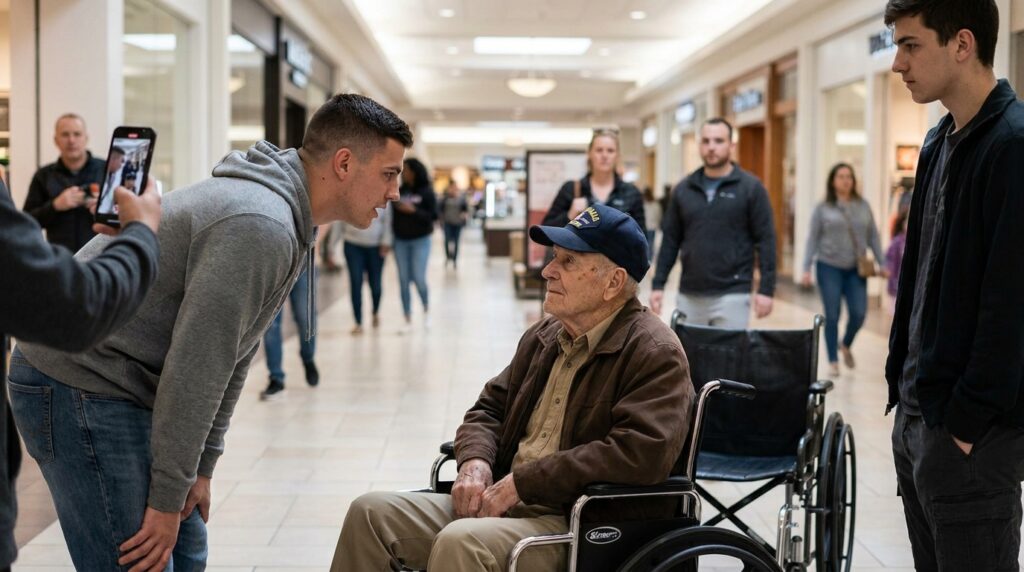
The words smelled of cheap vape juice and sour energy drinks, cutting through the lukewarm air of the corridor. The young man in the gray hoodie didn’t move his hands from his pockets, but his shoulders rolled forward, casting a sharp shadow over the small, vinyl-padded seat of the wheelchair. He was leaning so close that the metal grommets of his hood drawstrings clicked faintly against one another. To his right, his companion stood like an unblinking fence post, arms crossed over dark casual canvas, eyes scanning the scattered afternoon shoppers who instantly adjusted their walking lines to bypass the sudden pocket of heat.
Marcus kept his fingers flat against the fraying brim of his navy cap. He didn’t look up at the gray fleece or the athletic chest hovering inches from his face. Instead, his gaze remained fixed on the floor—on the exact spot where a square of linoleum had yellowed worse than the others around a rusty brass expansion joint. The mall was old, the sort of place where the air always carried a faint smell of burnt cinnamon and damp floor mops, a structure slowly giving up its grip on the earth. He understood that kind of giving up. He had spent three years inside the geometry of this chair, mapping every crack in the tile, learning how to exist exactly at eye-level with other people’s belt buckles.
“You hear me, old man?” The shadow leaned an inch lower. A sneaker squeaked against the floor, a sharp, rubbery sound that carried an edge of impatience. “I saw how you talked to the girl at the counter. You think because you’re sitting in that rig, nobody’s going to call you on your garbage?”
Marcus let out a slow, measured breath through his nose, his chest barely rising beneath the stiff weight of his brown utility jacket. The fabric was heavy, smelling faintly of garage dust and old grease—the remnants of a life spent turning wrenches before the joints refused to clear the morning cold. He could feel the pulse in his throat, steady and dry, like an engine ticking over on its last half-gallon of fuel. The boy in front of him had the clean, unblemished skin of someone who had never had to pick his teeth up off a concrete floor, yet he carried himself with the heavy, unearned authority of a playground marshal.
The silence between them stretched, thick and gritty as sand caught in a bearing. Marcus didn’t answer. He didn’t shift his hips. In the reflection of the glass across the corridor, past the display of cheap luggage, he watched the companion’s eyes dart toward a security guard three hundred feet away, who had stopped near an escalator to talk into a small black radio. The boy in the gray hoodie didn’t see the guard. He was too locked into the theater of his own chest, waiting for the flinch, the apology, or the pathetic reach for the wheels that would signal total submission.
Instead, Marcus let his hands leave the brim of his cap. They slid down to the cold, rusted steel of the armrests, his palms cupping the metal until the chill of the iron seeped directly into his calluses. He felt the specific friction of the bolts beneath his thumbs—the small, loose washer on the left side that always rattled when the floor got rough. He didn’t look at the gray hoodie. He looked at the floor between the boy’s shoes, where a tiny, blue plastic cap from a prescription vial lay forgotten in the dust. It hadn’t been there twenty minutes ago.

CHAPTER 2: THE LEVERAGE OF OLD IRON
The steel armrests felt ice-cold under Marcus’s palms, a sharp, unyielding contrast to the lukewarm breeze drifting from the mall’s ventilation shafts. He didn’t look up at the gray hoodie, nor did he acknowledge the silent shadow hovering to the right. Instead, he simply allowed his weight to shift forward, his boots planting flat against the yellowed linoleum. The small, loose washer on the left side of his wheelchair gave a single, distinct rattle—a metallic click that sounded tiny in the vast, vaulted corridor, yet it carried the finality of a firing pin dropping into an empty chamber.
Then, he began to stand.
It was not a sudden, explosive movement. His body no longer possessed that kind of elasticity; the cartilage in his knees had long since worn down to a dry, grinding friction that felt like gravel turning in an unlubricated casing. It was an exercise in leverage, a calculated distribution of mass that he had practiced in the privacy of his small, concrete-floored kitchen. His shoulders rose first, the stiff canvas of his utility jacket groaning against the strain as his back straightened. The movement was fluid, uninterrupted, and heavy with the inertia of a man who had spent decades lifting things the earth wanted to keep.
The boy in the gray hoodie didn’t move at first, his jaw remaining slightly slack as his mind struggled to reconcile the slight, seated figure with the torso that was suddenly rising past his chest. As Marcus’s head cleared the level of the wheelchair’s headrest, the physical geometry of the lane transformed completely. The young man instinctively took a full step backward, his rubber soles dragging across the tile with a dry screech. His athletic posture, previously coiled like a spring over what he assumed was a helpless target, collapsed into an awkward, defensive hunch. His hands remained inside his pockets, but the fabric bunched tightly around his knuckles as he lowered his center of gravity, suddenly hyper-aware of the space he had so easily invaded.
Marcus stood fully upright now, his slight frame appearing taller than it had in years under the desaturated light of the skylights. He did not step away from the chair. The wheels remained pressed firmly against the backs of his calves, a physical anchor he refused to abandon. His weathered face remained entirely expressionless beneath the shadow of his navy cap, his gray eyes locked onto the bridge of the younger man’s nose. He didn’t breathe heavily; his respiration remained low and transactional, the steady cadence of an old machine that knew exactly how much fuel it had left in the tank.
The companion observer on the right had frozen entirely, his arms dropping to his sides as his gaze shifted rapidly between Marcus and the gray hoodie. The passive compliance that had sustained his presence moments ago had evaporated, replaced by the distinct, pale stillness of a witness who realized the script had been completely flipped.
“You picked the wrong man to threaten today,” Marcus said.
The voice was a low, gravelly rasp, scraping against the walls of the corridor like an iron spade hitting frozen ground. It wasn’t loud—it didn’t need to be. The sound carried the dead weight of absolute certainty, devoid of the performance or the frantic posturing the youth had brought into the lane. Marcus didn’t raise his chin, nor did he ball his fists. His arms hung loose and still at his sides, his thumbs lightly brushing the seams of his trousers, tracking the familiar, reinforced stitching of his work clothes.
The young man in the hoodie swallowed hard, his Adam’s apple bobbing behind the frayed edge of his collar. The mocking curve of his mouth had flattened into a thin, tight line, the blood draining from his lips until they were nearly the same color as the concrete pillars behind him. He looked down for a fraction of a second, his eyes tracking the distance between Marcus’s boots and his own, measuring the ground he had so carelessly given up. The space between them felt different now—no longer an open corridor for a public display of dominance, but a narrow, high-pressure trench where every micro-movement carried a heavy consequence.
Marcus didn’t give him the satisfaction of an aggressive stride. He simply stayed where he was, a vertical column of weathered skin and oil-stained fabric, letting the silence work like water under a cracked foundation. In the periphery, the scattered shoppers continued their slow, rhythmic drift around the pocket of tension, their faces turned away, ignoring the small, private war that had just been won without a single blow being struck. But beneath the silence, Marcus’s eyes remained fixed on the tiny blue cap on the floor, and the faint, hand-written ink across its side that he was finally close enough to read.
CHAPTER 3: THE RECOIL OF RUSTED GROUND
The young man in the gray hoodie lowered his chin, the bravado draining from his chest like water down a rusted pipe. He took a second small step backward, his shoulder brushing against a circular clothing rack of clearance jackets, setting the metal hangers into a frantic, rhythmic clicking. The sound was thin and hollow, a minor distraction in the heavy silence that had settled over the lane. His companion was already moving, his heels tracking a quiet, shuffling path toward the wider pedestrian intersection by the food court, clearly wanting no part of whatever weight the old man had just brought to the surface.
“Alright,” the aggressor muttered, his voice dropping into a flat, defensive register that lacked any of its prior edge. He lifted his hands from his pockets, fingers spread open in a brief, performance-staged gesture of surrender. “Alright. We got the message.”
He didn’t look Marcus in the eye again. He turned on his heel, his rubber-soled sneakers scraping the yellowed linoleum as he accelerated his stride, catching up to his companion within three paces. They didn’t run, but their movements were hurried, their heads bent close together as they dissolved into the shifting stream of weekend shoppers under the distant, hazy skylights.
Marcus didn’t watch them go. His knuckles remained white where they rested against the dark canvas of his trousers, his chest rising and falling in shallow, deliberate increments as his knees sent a hot, throbbing reminder of his physical limits straight up his spine. The adrenaline was a cold, metallic taste at the back of his throat. He remained perfectly upright, his calves still pressed against the rear vinyl padding of the chair, refusing to give up the single foot of territory he had reclaimed.
The small crowd of secondary witnesses had already unfreezed, their faces smoothing over with the practiced indifference of modern consumers as they filled the space the young men had abandoned. Nobody approached Marcus. Nobody offered a nod or a word of validation; in this corridor, trouble was an infectious agent, and the old man standing beside an empty wheelchair looked like a carrier.
Slowly, the joints in Marcus’s fingers unlocked. He looked down at the floor between his boots, his gaze finding the small cylinder of blue plastic that had fallen during the initial confrontation. It sat in the shadow of the wheelchair’s left footrest, its translucent walls catching the low-grade light of the corridor.
He bent his knees, a sharp, grinding ache blooming in his lower back as he reached down. His calloused fingers closed around the plastic container. The surface was smooth, slightly scratched from the grit on the floor, but the white paper label stuck to its side was clean enough to read under the direct glare of the fluorescent tubes.
The prescription wasn’t for the boy in the gray hoodie.
Printed in faded, standard dot-matrix ink was a name Marcus hadn’t spoken aloud in thirty-six months: David Miller. And below it, a handwritten notation in black ballpoint pen, scrawled across the warning text: Thursday. Back lot. Bring the rest.
The plastic felt dangerously light in his palm. Marcus turned the bottle over, his thumb tracing the ridged edge of the blue cap. This wasn’t a random encounter. The boy hadn’t targeted a vulnerable stranger out of a simple, aimless desire for dominance; he had been looking for a leverage point. He had been looking for the grandfather of the boy who owed him ground.
The realization settled into Marcus’s bones with the heavy, dry friction of an iron door latch dropping into place. The isolation he had built around himself over these three years—the meticulous routine of the chair, the calculated immobility that kept him from hunting for ghosts in the bad parts of the city—had just been breached in the middle of a brightly lit shopping center. The boy in the hoodie hadn’t backed down because he was broken; he had backed down because he had delivered the package.
Marcus looked up, his eyes scanning the dense flow of winter coats and strollers forty yards out, but the gray hoodie was gone, swallowed entirely by the desaturated landscape of the retail floor. His hand tightened around the bottle until the thin plastic groaned against his calluses, the sharp edge of the cap digging into his thumb. The false peace of the corridor had cracked wide open, leaving him standing on two feet, surrounded by strangers, holding a piece of paper that pulled him right back to the edge of the dark road he had spent three years trying to forget.
CHAPTER 4: THE HARD OUTCOME OF AN ANCHORED LINE
The blue plastic cylinder sat heavy in Marcus’s palm, colder now than when it lay on the grit-dusted tile. He stood perfectly still beside the empty wheelchair, the metal frame casting a long, angular shadow that looked like a cage split wide open. His knees burned—a deep, rhythmic ache that throbbed in time with the distant, mechanical thud of an escalator three corridors over. He had spent three years believing that if he simply stayed small, if he anchored his weight into the vinyl padding of that seat and refused to move, the world would leave the rest of his name alone.
It was a lie he had constructed out of grease and loose washers. The immobility hadn’t been an infirmity; it was a self-imposed penance, a heavy anchor dropped into the floorboards to keep himself from running after David into the gray, needle-strewn alleys of the city’s North Side. He had told himself that by staying in the chair, he was keeping a vigil, a quiet center that his grandson might one day find when the streets finally broke him. Instead, the streets had simply used the old man’s stillness to calculate his coordinates.
The white paper label on the bottle was thin, its edges slightly frayed where it had scraped the linoleum. Marcus turned it over, his thumb tracing the blue-black ink of the handwritten note: Thursday. Back lot. The letters didn’t shake. They were written with the sharp, precise block cadence of a kid who had learned his penmanship from a probation officer’s ledger. The young man in the gray hoodie wasn’t an enforcer; he was a courier delivering an invoice to the only person left who still carried the Miller blood.
Marcus looked down at the wheelchair’s stamped steel footrests, his gaze catching the dull glint of the nickel plating. For thirty-six months, he had let his boots rest on those plates, letting the world believe the strength had drained from his legs, because it was easier to be an old man in a rig than a grandfather who had survived a war only to lose his house to a ghost. The stillness had been a shelter. But looking at the small plastic vial, he realized the shelter had turned into a target.
He didn’t return to the seat. With a slow, deliberate movement that made the iron brackets of his utility jacket groan against his shoulders, Marcus pushed the wheelchair backward. The small, loose washer gave one last, brittle rattle before the caster wheels spun around, the entire assembly rolling three feet into the recess of an alcove beside a closed shutter. It sat there, empty and small, looking less like a lifeline and more like an abandoned piece of industrial junk left behind by the morning maintenance crew.
He slipped the prescription bottle deep into the pocket of his brown jacket, his fingers brushing past a small, brass split-ring holding two keys—one to his kitchen door, the other to a rusted metal toolbox in his basement that hadn’t been opened since David left. The iron key felt cold against his knuckles, its teeth sharp and familiar. The boy in the hoodie had given him a choice, but the choice had already been made three years ago when he chose to survive the first text message, the first police knock, the first long night spent listening to the police scanners over an untouched plate of supper.
Marcus turned away from the alcove, his boots striking the floor with a heavy, flat cadence that echoed off the glass storefronts. He didn’t have the fluid stride of the younger men, nor did he have the light, unburdened posture of the shoppers drifting toward the exit signs. Each step was an effort of pure mass—a hard, mechanical labor of bone pressing against bone, paid for in small, hot increments of pain that radiated up through his hips.
He walked past the luggage display, past the faded plastic planters filled with dusty silk ferns, his eyes fixed on the glass double doors at the end of the corridor where the winter light was already dying into a flat, desaturated gray. The world outside the mall didn’t look like an open horizon; it looked like a dark road lined with rusted surfaces and sharp edges, waiting to see if the old man could still carry his own weight without the iron wheels behind him. He pushed through the heavy glass bar, the cold air hitting his face like a slap of wet canvas, and stepped out onto the concrete apron of the lot, his boots crunching lightly into the gray grit of the salt.
CHAPTER 5: THE TEMPERATURE OF GROUND SALT
The wind off the river carried the smell of diesel exhaust and frozen mud, cutting straight through the heavy canvas of Marcus’s brown utility jacket. It was Thursday, precisely four in the afternoon, and the light over the industrial back lot had already flattened into a bruised, chemical purple. He stood in the narrow gap between two decommissioned shipping containers, his boots planted in a ridge of frozen slush that had turned the color of iron filings under the weight of passing trucks.
He wasn’t sitting. His knees were stiff, locked into a rigid, defensive posture that sent a dull, throbbing ache straight to his lower back, but he didn’t lean against the corrugated metal. The steel behind him was coated in a thin sheen of frost that would have torn the skin right off his knuckles if he touched it bare.
Forty yards across the cracked asphalt, near a chain-link gate that hung crooked on its hinges, the gray hoodie was waiting. The young man had his hands shoved deep into his pockets, his shoulders hunched against the wind as he stamped his sneakers to keep the blood moving. Next to him stood the same silent companion from the mall, his dark casual jacket zipped up to his chin, his eyes tracking the occasional delivery van that rumbled past the outer perimeter wall. They looked exactly like what they were—kids trying to look like fixtures of a landscape that didn’t care if they froze to death.
Marcus reached into his right pocket, his fingers curling around the small brass ring of keys. His palm was slick with sweat despite the sub-zero chill, the metal biting into his calluses with a familiar, heavy pressure. He had spent the last forty-eight hours in his basement, cleaning the grease off the old iron tools he hadn’t touched since the winter David left. He hadn’t brought the wheelchair. He had left it exactly where he rolled it in the mall alcove, a piece of abandoned theater that had served its purpose. Standing on his own feet felt like a violation of the quiet safety he had spent three years paying for, but the white prescription label in his pocket had left him no room to negotiate.
A dark figure stepped out from the shadow of the concrete warehouse across the lane, his stride irregular and heavy, his boots dragging through the salt crust. Even from this distance, Marcus recognized the hitch in the right hip—the residual mark of a high school football injury that had never healed right because there was never enough money for the physical therapy.
David was smaller than he had been three years ago. His shoulders were narrow beneath a thin, denim jacket that offered no protection against the river wind, and his hands were tucked into his armpits to keep them from shaking. He stopped five feet from the gray hoodie, his head down, his posture completely drained of the defiance that had once made him slam the kitchen door and walk out into the dark.
Marcus didn’t move from the gap between the containers. He watched the gray hoodie pull a hand from his pocket, his fingers holding a small, brown paper bag that caught the low light. David reached out, his bare wrist showing white and thin against the dark denim, but the young man jerked the bag back, his mouth moving in a short, transactional sentence that didn’t carry across the wind.
The silence of the lot felt thick, greasy with the scent of old oil and road salt. Marcus let his hands drop from his pockets, his fingers straightening inside his heavy work gloves as he prepared to step out onto the open asphalt. The illusion of his immobility was officially gone; there was only the cold ground beneath his boots and the debt that had finally come due at the edge of the city.
CHAPTER 6: THE INTERVENTION OF HEAVY IRON
The crusted salt snapped under Marcus’s work boots with a sound like dry bone splintering. He didn’t offer the advantage of a warning call or a hurried stride; he simply moved into the open lane of the back lot, his tall, unbent frame cutting across the purple dusk. His gaze never left the brown paper bag held between the gray hoodie’s fingers. The hot, metallic ache in his knees had gone completely numb, replaced by a cold, transactional focus that narrowed the sixty feet of open asphalt down to a single point of impact.
David heard the crunch first. His head jerked up, his gaunt face hardening into a look of sheer panic as his hollow eyes found Marcus. His pale lips parted, but no sound came out, his throat locking against the unexpected silhouette of the old man walking on his own two feet. He instinctively reached toward his denim jacket pocket, his knuckles bunching against something small and heavy that gave a dull, metallic click against a lighter—a sound that didn’t escape Marcus’s ears.
The boy in the gray hoodie turned slower, his shoulders rolling back with a defensive twitch until he recognized the weathered face under the navy cap from the mall corridor. A sharp, mocking grin tried to form on his mouth, but it died before it reached his eyes. The physical reality of Marcus standing upright in the freezing wind, stripped of the metal wheels and the safety of the public corridor, changed the math of the encounter.
“You’re a long way from the food court, old man,” the youth said, his hands remaining outside his pockets now, fingers twitching against the seam of his jeans. “We didn’t say anything about a family reunion.”
Marcus stopped ten feet out, exactly where the oil from a rusted drum had leaked into the gravel, turning the frozen mud into a black, glassy glaze. He didn’t look at David. He kept his gray eyes fixed on the bridge of the hoodie’s nose, his arms hanging loose and still at his sides. The work gloves he wore were stiff, stained with thirty-year-old motor oil from the toolbox he had hauled out of his basement that morning.
“The bag goes back in your pocket,” Marcus said. His voice was the same low, gravelly rasp that had cleared the mall corridor, completely untouched by the sub-zero wind. “The boy isn’t buying anything from you today. Not with what’s left of my name.”
The companion observer shifted his weight, his sneakers grinding a patch of black ice into gray slush. His arms were no longer crossed; he had let them drop to his sides, his eyes darting toward the open gate behind them, calculating the escape lane before the first word was even paid for. He knew the old man wasn’t a tactical threat in a sprint, but the sheer lack of fear in the veteran’s posture suggested a reserve of violence that didn’t belong in a simple collection dispute.
“He owes for three months of the blue bottles,” the gray hoodie said, his voice rising slightly to fight the wind, though his feet remained planted. He didn’t raise the bag higher; instead, he lowered it toward his waist, his thumb hooking into the twine handle. “He told us you were tucked away in that rig for good. Said the house was clear.”
Marcus finally let his gaze drop to David. His grandson looked worse up close—the skin around his cheekbones was tight and gray, his lips split from the frost, his entire body shivering so hard the metal zipper of his jacket rattled against its track. The boy was looking at Marcus’s boots, his mind still visibly spinning around the fact that the anchor had cleared the floor. He looked like a machine with its gears stripped out, waiting for someone else to turn the crank.
“Go to the truck, David,” Marcus said softly, his voice dropping below the register of the wind. “The blue one by the hydrant. The keys are in the visor.”
David didn’t move immediately. His eyes flicked from Marcus to the gray hoodie, his fingers still buried in his pockets, tracking the hidden weight that had clicked against his lighter. He was caught between two different kinds of leverage—the immediate, sharp threat of the street and the heavy, unyielding inertia of the old kitchen he had fled. But the absolute stillness of Marcus’s posture left no room for a third option. With a short, ragged breath that came out as a plume of white steam, David turned his shoulder and began a slow, hitching walk toward the outer gate, his boots dragging through the crusted salt.
The gray hoodie took a half-step forward as if to intercept, but Marcus simply adjusted his line, his broad shoulder closing the gap before the youth could finish the stride. The distance between them was less than four feet now, close enough for Marcus to smell the sour energy drink on the boy’s breath again, close enough to see the small, pale scar where a ring had been torn out of his left eyebrow. Marcus didn’t raise his hands, but his knuckles remained flat against his thighs, his thumbs hooked lightly into the reinforced fabric of his work pants. He was an iron post sunk deep into the asphalt, and the young man would have to break him to get past.
CHAPTER 7: THE RUSTED WEIGHT OF NEGOTIATION
“He doesn’t walk until the book is clear, old man.”
The gray hoodie didn’t take his hand out of his jacket pocket, but the fabric stayed bunched, the blunt silhouette of a short iron rod pressing against the seam. His breath plume cut through the sub-zero air, ragged and thin, while his companion shuffled another two inches backward toward the broken security fence. They weren’t looking for a war, but they had a quota to maintain for the people who supplied the blue bottles, and a missing runner was a hole in the ledger they couldn’t afford to carry back to the North Side.
Marcus didn’t flinch. He reached down with his left hand, his old work gloves creaking against the frost, and lifted a heavy, oil-stained canvas tool roll from where it had been resting near the tire of the shipping container. The canvas was thick, stiffened by thirty years of industrial grease and the grey grime of shop floors. As he lifted it, the contents shifted with a deep, dense metallic clink—the specific, unmistakable acoustic signature of professional-grade American iron.
“There is no money in the house,” Marcus said, his gravelly voice dropping below the rattle of the distant highway. “David spent the last of the pension three months ago. You know that because you took it.”
He unbuckled the cracked leather strap of the roll with a single, blunt movement of his thumb. The flap fell away, revealing a row of heavy, cast-iron combination wrenches, their polished flats pitted with rust spots but their jaws completely clean. At the center lay a vintage Starrett micrometer and three heavy socket drivers, their ratchets sealed with thick, black machinist’s grease that smelled of ancient mineral spirits and dead labor.
“You want something to show your people,” Marcus continued, his eyes remaining locked on the young man’s eyebrow scar. “Take the steel. That’s three hundred pounds of drop-forged industrial tools from the old assembly line. The pawn shops on Elm Street know exactly what they’re worth. It clears the ledger, or we find out how much ground you can actually keep out here in the cold.”
The gray hoodie looked down at the open canvas, his mouth twitching as he calculated the weight. He was a modern creature of small transactions and plastic vials; he didn’t understand the value of tools that didn’t require a battery, but he understood the physical authority of the old man holding them. The companion observer took another step back, his heel catching on an old oil filter, his mouth leaning close to the hoodie’s ear.
“Take it,” the companion whispered, his breath a fast white cloud. “The old man isn’t going down. The guard at the escalator was already looking at the cameras when we left the corridor. We’re burning daylight.”
The young man in the hoodie stayed quiet for three long breaths, his sneakers grinding a small patch of frozen road salt into gray dust. His athletic frame looked rigid, but the bravado that had sustained him when Marcus was seated in the vinyl chair was completely gone, replaced by the pragmatic survival logic of a street runner who knew when a target was too expensive to break.
He reached out his left hand, his fingers closing around the stiff canvas handle of the tool roll. As he took the weight, his shoulder dipped three inches, his face tightening at the unexpected mass of the iron. He didn’t offer a final threat, and he didn’t look toward the outer gate where David’s shadow had already vanished behind the blue truck.
“We’re even for the month,” the hoodie muttered, his posture instantly collapsing into an awkward, lopsided hunch as he swung the heavy tool roll toward his hip. “But if the boy comes back to the corner, the tools won’t cover it.”
Marcus didn’t answer. He stood perfectly still as the two younger men turned and began a fast, shuffling walk toward the gap in the chain-link fence, their boots kicking up small sprays of gray grit as they disappeared into the industrial gloom of the back lot. He didn’t watch them exit; his gaze remained fixed on the spot where the tool roll had been, his bare right hand tracing the small brass padlock key still tucked into the seam of his glove—the key to a cellar door he would never need to lock again.
CHAPTER 8: THE DOMESTIC REALITY OF AN OLD KITCHEN
The cab of the blue truck smelled exactly like 1994—stale tobacco, dried pine needles from an air freshener that had long since turned into a brittle strip of brown cardboard, and the faint, sweet tang of anti-freeze leaking somewhere behind the dashboard. Marcus climbed into the driver’s seat, his movements slow and methodical, his heavy work boots dragging across the rusted door sill. Each joint in his lower back gave an independent, dull pop as he settled his weight onto the cracked vinyl bench. He didn’t turn the key immediately. He simply sat in the cold, letting his hands rest on the steering wheel, his split leather gloves matching the worn, black rubber of the rim exactly.
To his right, David sat pressed against the passenger door, his head slumped down so low his chin was buried under the collar of his denim jacket. He was still shivering, his thin shoulders jerking in small, irregular increments that made the rusted springs inside the bench seat click softly beneath him. His bare wrists were red, chafed raw by the dry salt wind of the back lot, and his fingers were tucked away, hidden from view as if he could conceal the tremors that had brought him to the edge of the river lot.
“You left the chair,” David said. His voice was small, dry, and hollowed out by months of bad meals and worse choices. It was the first time he had looked Marcus in the face since the crunch of salt broke the exchange. “They said you couldn’t even make it to the porch without the rig.”
Marcus turned the key. The starter gave a long, heavy groan, a mechanical struggle of old iron pistons moving through cold grease, before the engine caught with a loud, irregular thud that sent a vibration straight through the floorboards. He slotted the lever into gear, the linkage clicking into place with a dry, metallic notch that he knew by feel alone.
“The chair was for me, David,” Marcus said softly. His rasp was lower now, muffled by the rattle of the heater fan as it began to push cold, dusty air over their boots. “Not for my legs.”
He let the clutch out slowly, the truck creeping past the crooked chain-link gate and onto the gray asphalt of the perimeter road. In the rearview mirror, the industrial back lot began to shrink, its pitted drums and corrugated containers fading into the uniform gloom of the midwestern twilight. The empty wheelchair was two miles behind them now, sitting in a dark mall alcove, an abandoned monument to a penance that had finally run out of ground to keep.
The drive back to the house was silent, defined only by the rhythmic thump of the tires over the frost-heaved lanes and the dim, yellow glare of the dashboard gauges reflecting off David’s gaunt cheekbones. Marcus kept his eyes on the road, his hands steady on the wheel, tracking the familiar potholes of a neighborhood that had spent forty years giving up its edges to the rust. He knew the tools were gone—the drop-forged iron jaw wrenches he had carried since his first day on the assembly line were currently sitting in the trunk of a gray hoodie’s car—but the loss didn’t carry the weight he thought it would. The steel had been paid for decades ago; the boy next to him was the only invoice that still required a signature.
When the truck finally idle-rattled to a halt in the driveway, the small frame house looked smaller than Marcus remembered, its white clapboards yellowed by chimney soot and old rain. He killed the ignition, the sudden absence of the engine’s rumble leaving a deep, ringing vacuum inside the cab.
“Come inside,” Marcus said, his gloved hand reaching for the door latch. “The kitchen’s cold, but the stove still works.”
David didn’t move for a long second, his eyes fixed on the dark windows of the porch, looking for the ghost of the boy who had walked out that same door three winters ago. But as Marcus stepped out onto the concrete apron, his boots striking the ground with that same flat, unyielding cadence, the younger man finally unlatched his side, his slight frame following the old man’s shadow up the steps and into the quiet gray of the interior.







