
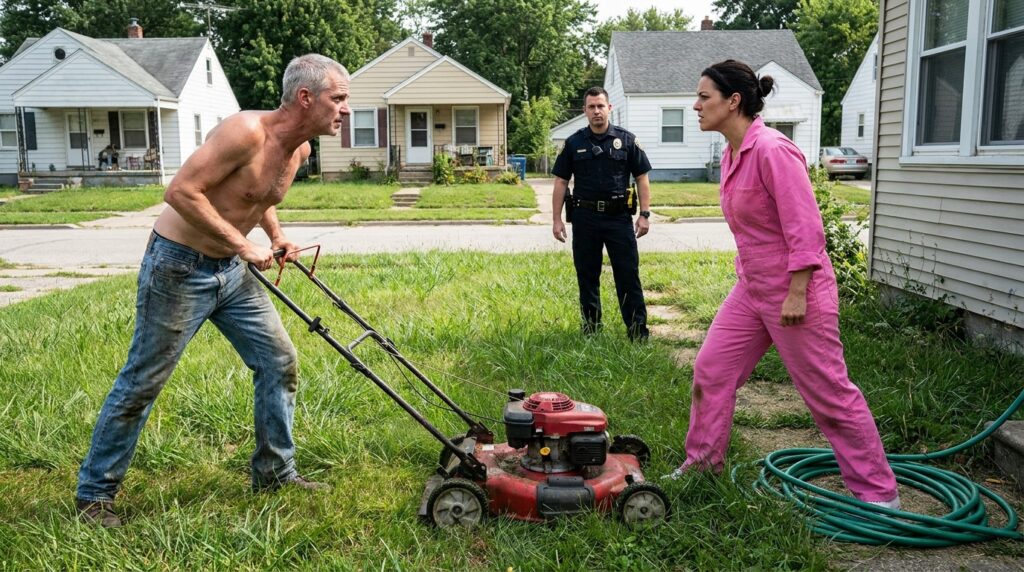
The Iron At The Grass Edge Where The Sovereign Lines Hold Firm Against The Noise

CHAPTER 1: THE WEIGHT OF THE BLADE

The two-stroke engine coughed once, spitting a gray plum of exhaust into the midday heat, before settling into a loud, skull-rattling roar that cut straight through the neighborhood’s manufactured silence.

The vibration traveled instantly through the black rubber grip, rattling the bones in my forearms and setting a familiar ache into my shoulders. I didn’t look at the house across the blacktop. I didn’t look at the pristine, golf-course turf of the property directly to my left, where the blades were cut to an exact two and a half inches every Wednesday at dawn. I kept my eyes down, watching the uneven, overgrown crabgrass choke the rusted steel deck of the old craftsman mower. The grass was too tall—nearly eight inches of wild, coarse stalks baking in the harsh Indiana sun—but the heatwave didn’t care about town ordinances, and neither did my twelve-hour shifts at the water treatment facility.

My bare chest was already slick with a sheen of grease and sweat, catching the stray bits of green mulch flying out from the side discharge chute. Every step forward felt like shoving a boulder through wet cement. The air tasted of unburned gasoline and dry, powdered dirt.

Then the shadow broke the glare.

A sharp, unmissable flash of hot-pink polyester cut into my peripheral vision. Amanda was already across the line. She marched through the high weeds with a stiff, military stride, her dark hair pulled back into a knot so tight it seemed to pull the skin of her cheekbones backward. At her feet, trailing behind her like a dead snake, was a heavy, faded green garden hose. She dropped it with a dull thud right onto the center of my yard, her foot coming down directly over the coil as if she were planting a flag on a newly conquered hill.

I slowed my advance but didn’t kill the throttle. The mechanical hum strained, the belt squealing low against the thick stalks as the front wheels stopped exactly three inches from her sneakers.

Amanda squared her shoulders, her chin tilting upward to cast a long glance down her nose. Her lips moved, her chest heaving with the force of a public declaration, but the engine drowned out the opening volley. She pointed a manicured finger straight at the turf beneath her feet, then toward the street where the screen doors of the neighboring split-levels were already starting to click open. Porch watchers were emerging, their silhouettes leaning over wooden railings to catch the first real entertainment of the afternoon.

I pulled back on the handle, keeping the deck hovering just above the green coil of her hose. My knuckles were white against the rubber. I could feel the heat radiating off her skin, the raw, frantic panic disguised as civic duty.

She leaned forward, her voice finally breaking through the high-pitched shriek of the machinery as she shoved a laminated folder into the narrow space between us. It wasn’t an official township warning. Bound inside the plastic sleeve was a printed satellite image, heavily marked with thick, black permanent marker lines that sliced my front yard completely in half, renaming the very ground I stood on as a common municipal easement.

But it wasn’t the map that made my grip freeze on the throttle. Tucked behind the clear plastic, visible beneath her thumb, was a waterlogged, dirt-stained piece of official city parchment—a residential survey from 1996 bearing a property identification number that matched my own house, but the signature at the bottom belonged to a man who had died five years before the foundation was ever poured.


CHAPTER 2: THE FORGED PERMIT

“You’re standing on township dirt, Arthur,” Amanda said, her voice dropping into a low, jagged rasp that barely cleared the heavy, mechanical pulse of the idling Craftsman. She didn’t blink. The pink polyester of her jumpsuit looked chalky under the blinding midday glare, coated in a fine layer of gray road dust and dried grass clippings. She tapped the laminated folder against her thigh, a sharp, rhythmic snap that sounded like a small bone breaking over and over. “Look at the signature. Civil Engineer Vance. 1996. This whole corner pocket—the grass, the ditch, the space beneath your mailbox—it belongs to the association’s drainage easement. You don’t get to touch it.”

I kept my palms flat against the black rubber handle of the mower, letting the heat of the engine bay cook the skin of my shins. The iron deck was rattling against a buried limestone rock, a dull, metallic clank that vibrated through my work boots.

“Arthur Vance died in the winter of ninety-five,” I said. My voice was flat, dry as the sun-scorched clay beneath our feet. I didn’t reach for the folder. I didn’t have to. I knew every line of the real deed; I’d spent three years paying down the principal with forty-four hours a week at the chemical tanks. “The county records office doesn’t accept signatures from the cemetery, Amanda. Whoever inked that sheet for you didn’t check the obituaries.”

The color didn’t leave her face—it fixed into a dark, blotchy red along her jawline. Her fingers tightened around the edge of the plastic sleeve, the material crinkling under the pressure of her grip. To our left, the white-and-black door of the county cruiser didn’t open yet, but the reflection of the sun off the chrome spotlight shifted. The officer inside was watching through the tinted glass, waiting to see if the heat would make one of us break first.

“The board approved the utility access three weeks ago,” she hissed, stepping closer. The smell of her cheap floral perfume mixed with the sour stench of boiling oil from the mower’s crankcase. She tilted the folder toward me, her fingernail digging into the margin of the paper. “We are putting the high-volume collector line through this strip whether you like it or not. The county needs the runoff space. Your overgrown weeds are clogging the drainage flow, and I have every right to preserve the value of this block.”

I looked past her shoulder toward the curb. A standard green utility box sat crookedly in the ditch, its metal base rusted through where the salt trucks spit their brine every January. There were no yellow flags in the dirt. No white spray paint marking the excavation path. In Indiana, you don’t bring a commercial project to a residential lot without a state-certified dig number pinned to the post, but Amanda’s hands were completely empty of county seals.

The silence between us stretched, thick and heavy with the smell of parched earth. From three doors down, the high-pitched squeak of an old aluminum screen door signaled another spectator joining the porch line. Old man Miller was out on his steps, his arms folded across a grease-stained mechanics apron, watching the pink jumpsuit block the shirtless man with the machine.

“The association didn’t vote on a collector line,” I said, my knuckles locking against the mower handle. “Because a collector line on this grade would back up into Miller’s cellar before it ever hit the main culvert. You’re trying to divert the retention pond overflow away from your own foundation, aren’t you? You dug out your crawlspace last spring without a structural permit, and now the south wall is weeping.”

Amanda’s chin dropped half an inch. The bravado didn’t vanish—it weaponized. She reached into the deep pocket of the jumpsuit and pulled out her phone, her thumb sliding across the glass with a wet, aggressive snap.

“The officer isn’t here to debate zoning with a water-plant laborer, Arthur,” she said, her voice rising just enough to carry toward the idling cruiser. “I called in a hostile obstruction of a public right-of-way. He has the order on his dash. If you don’t kill that engine and pull this junk back to your garage, you’ll be explaining your engineering theories to a magistrate in the county seat.”

As if on cue, the heavy steel door of the police cruiser swung open with a long, ungreased groan. The responding officer stepped out into the shimmering heat waves rising from the asphalt. His black uniform was crisp, his duty belt popping with the dry friction of molded leather as he adjusted his posture. He didn’t draw a baton, and his hand stayed clear of the Glock at his hip, but his boots made a heavy, deliberate crunch against the gravel shoulder of my driveway.

He didn’t look at Amanda first. He looked at the green hose she had dragged across my property line, its brass nozzle resting deep in the tall, uncut clover of my private lot.

I kept my hands where they were. The engine gave one final, ragged sputter as the fuel line coughed against the heat lock, dropping the entire front yard into a sudden, suffocating quiet that made the birds in the maple trees sound ten times louder. The weight of thirty years of bad concrete and hidden developer shortcuts was sitting right there in the dirt between us, waiting for someone to clear the weeds away from the iron.

CHAPTER 3: THE HIGH WEEDS LINE

“Keep your hands right where I can see them on that handlebar, sir,” the officer said. His boots found the soft, yielding edge of the drainage ditch, the dry clay crumbling into gray powder under his weight. He didn’t take his eyes off my chest, his gaze mapping the sweat-slick lines of my shoulders before dropping to the rusted metal deck of the Craftsman. “Ma’am, you take two steps back toward the blacktop. Now.”

Amanda didn’t move her feet, but her weight shifted backward onto her heels, her bright pink jumpsuit rustling with high-pitched friction. “Officer, thank goodness you’re here. This is Arthur. He’s been intentionally blocking our community maintenance crew for three weeks, and now he’s threatening to damage association property with that machine.”

I didn’t answer her. I didn’t take my hands off the black rubber grip. The silence of the dead engine was heavy, broken only by the thin, metallic ping-ping-ping of the hot exhaust manifold cooling down in the weeds. A lone sweat drop ran down the bridge of my nose and splattered onto the yellowing gas cap.

The officer stopped three feet from the front wheels of the mower, his shadow falling across the tall clover like a dark tarp. His badge read K. Vance. The ironies in this county didn’t take long to find their teeth. He looked down at the faded green garden hose Amanda had dropped over the property line, then reached into his uniform pocket for a small notepad.

“We had a call about a verbal dispute over an easement violation,” Officer Vance said, his voice flat, rhythmic, and worn thin by hours of dealing with subdivision boundary squabbles. He looked at Amanda’s laminated folder, his fingers tapping the heavy leather of his flashlight holster. “You have the paperwork from the county board, ma’am?”

“Right here,” Amanda said, her arm snapping forward with aggressive confidence. She rattled the plastic sleeve against the officer’s chest. “Zoning map revision from ninety-six. Signed by the chief engineer. It clearly shows the drainage right-of-way extends eight feet into this parcel. This entire strip is common ground, and his refusal to keep it clear is causing water to pooling at the base of the access hill.”

Vance took the folder, his thick thumb sliding over the plastic surface. He didn’t look at the map first; he looked at the name printed at the bottom of the ledger sheet. His eyebrows leveled out into a straight, hard line.

“Arthur Vance,” the officer read aloud, his eyes shifting from the paper to my face, then back down. “That’s my uncle’s name. He ran the county survey team for twenty years.”

“Then you know his authority is absolute,” Amanda said, a tight, triumphant smile pulling the skin across her teeth. “He locked these coordinates in before the secondary foundations were ever poured. Arthur here thinks he knows more than the original civil assessment.”

I let go of the left handlebar grip, slowly, keeping my right hand pinned to the safety bar so the machine wouldn’t look like an active threat. I pointed toward the green utility box sitting crookedly in the overgrown weeds behind her.

“Ask your uncle why the iron boundary stake is buried four feet to the west of that box, Officer,” I said. My voice was rough from the dirt, but it carried across the ditch to old man Miller’s porch. “Ask him why the residential plats recorded at the courthouse in ninety-six used a pre-dated signature block from a time when he was already in a recovery ward up in Indianapolis. Your uncle didn’t sign that layout sheet, Vance. The developer did. They used an old stamp to clear the lot lines before the county inspectors could flag the grade error.”

Amanda’s hand dropped back to her side, her fingers curling into a tight fist against the hot pink fabric of her thigh. “That’s a lie. He’s just trying to dodge the fine for the unmaintained easement. Look at the lawn, Officer. It’s an eyesore. It’s a health hazard.”

Officer Vance didn’t look at the lawn. He held the laminated folder up to the light, his eyes tracking the dark, heavy permanent marker lines Amanda had drawn over the original grid map. With his index finger, he peeled back the top layer of tape holding the sheet inside the plastic sleeve. The paper inside was dry, but the edges were ragged, as if they had been cut from a larger ledger book with an unsharpened razor blade.

“This isn’t an official certified copy from the recorder’s office,” Vance said, his tone dropping into a deeper, cooler register that made Amanda’s posture stiffen. He turned the sheet over, revealing a faint, purple carbon stamp on the back that read Preliminary Draft – For Review Only. “This is a working blueprint from the old construction office. Where did you get this ledger sheet, Amanda?”

“The association files,” she said quickly, her chin lifting as she tried to claw back her position. “Every board member has access to the structural records. It’s standard documentation for neighborhood maintenance.”

“The board files don’t override the master deed filed with the county clerk,” I said, my boots sinking an inch into the dry loam as I leaned my weight forward against the dead machine. “And they don’t cover the fact that someone used an old surveyor’s layout to hide where the main line actually splits. Look behind the box, Officer. The ground’s already sinking.”

Vance stepped past Amanda, his heavy boots crushing the tall clover as he walked toward the rusted green utility unit. He reached down into the high weeds, his leather-gloved hand brushing aside the thick stalks of wild mustard until his fingers caught on something solid and metallic hidden in the dark dirt near the base. It wasn’t the clean, galvanized steel of a new county marker. It was a jagged piece of old, unpolished iron pipe, caked in thick gray clay and pitted with decades of deep red rust.

He pulled his hand back, his glove stained with a streak of dark orange powder. He didn’t look at Amanda, and he didn’t look at me, but his hand stayed on his notepad as he turned back toward his cruiser.

“Neither of you touches this dirt until I call the dispatcher for the county plat reader,” Vance said, his voice dropping the standard procedural cadence. He pointed a finger at Amanda’s garden hose. “Ma’am, get that line off his property right now. We’re going to find out exactly whose iron is holding up this block.”

CHAPTER 4: THE PROPERTY STANDOFF

The cruiser’s radio burst to life with a blast of sharp static that cut through the midday heat like a rusted blade. Officer Vance didn’t take his glove off the rusted iron rod hidden in the weeds. He leaned back toward his open driver-side door, his uniform fabric stretching tight over his shoulders as the dispatcher’s metallic, digitized voice echoed across my front yard.

“Unit Two-Four, county recorder has a data match on that residential ID plat. Be advised, the master file for the block shows a secondary utility re-zoning clearance recorded late yesterday afternoon. The digital ledger carries an emergency infrastructure signature. The homeowner’s current boundaries are under an active regional injunction for storm-water diversion.”

Amanda’s chest hitched, the hot-pink polyester of her jumpsuit tightening as she let out a short, jagged laugh. Her posture snapped back into alignment, her chin lifting as she locked eyes with me over the handle of the dead mower.

“I told you, Arthur,” she said, her voice rising to make sure old man Miller could hear every word from his porch steps. “You thought you were being clever with your historical research, but the neighborhood board doesn’t operate in the past. The county paperwork caught up with you. That drainage lane is officially active, and your machine is sitting right in the middle of a municipal construction corridor.”

I didn’t take my boots out of the dry loam. My right palm was sweating against the black rubber grip of the Craftsman, the internal engine block ticking as the metal slowly cooled under the baking sun. The dispatcher’s words hit like a physical blow to the ribs, but the math didn’t add up. You don’t clear a secondary infrastructure injunction in twenty-four hours without bypassing three separate public hearings at the township hall—unless the board had filed under a false emergency declaration to protect a commercial asset.

“Officer,” I said, keeping my gaze locked on the black leather of Vance’s utility belt. “A secondary clearance requires an engineer’s on-site seal. Look at the dirt around that utility box. There hasn’t been a truck down this ditch since the winter salters. If someone logged a digital signature yesterday, they did it from an office five miles away without looking at where the old stakes are sitting.”

Vance didn’t answer right away. He stood up slowly, his boots grinding a pocket of loose gravel into the edge of my driveway. He held Amanda’s laminated map folder in his left hand, his eyes tracking the fresh permanent marker lines she had drawn across the layout sheet. He looked at the radio speaker on his dash, then back down at the rusted pipe protruding from the weeds.

“The injunction means the township has the right to secure the easement strip until a formal hearing is scheduled, sir,” Vance said. The procedural flatness had returned to his voice, but his fingers were working the snap on his notebook case with a slow, deliberate friction. “By law, if the association claims an active block to maintenance, I have to order you to leave the machinery idle and clear the right-of-way. If you advance this mower into the ditch line, it’s considered a civil violation of an active order.”

“He needs to take the whole thing inside his garage,” Amanda interjected, stepping forward until her sneakers touched the outer edge of my lawn mower’s discharge chute. She pointed her phone directly at my chest, the glass lens catching the brutal glare of the sun. “I’m recording this for the board record. Every second he leaves this mechanical junk on the easement path is another fifty-dollar fine for the property file.”

The heat waves rising from the blacktop made her pink silhouette look jagged, wavering against the gray backdrop of the subdivision houses. Behind her, across the street, another front door clicked open. Two more neighbors stepped onto their concrete porch, their faces shadowed under baseball caps as they watched the uniform line up against my yard.

I looked down at the Craftsman deck. The grass beneath the rusted steel housing was still tall, green, and wild, a thick patch of uncut chicory and dandelion roots that marked the absolute boundary of my domestic labor. If I pulled the machine back now, if I retreated to the shelter of the garage ceiling, Amanda’s green hose would stay planted in my dirt. By tomorrow morning, the construction crews would have their stakes driven into the lawn, and once the concrete was poured over the baseline, the truth of the developer’s layout would be buried under four inches of commercial stone.

“I’m not moving the mower backward, Officer,” I said. My voice didn’t rise, but I let my left hand return to the rubber grip, my knuckles locking hard against the metal framework. “The injection sheet says they have a right to secure the easement, but it doesn’t say they own the title to the grass beneath the wheel track. If the county surveyor wants to verify the baseline, he can find the machine right here where the old developer left the error.”

Vance’s face darkened under the brim of his uniform hat. He took a single step closer, his solid frame blocking Amanda from my line of sight as his hand came down flat on the black handle of my machine, his leather glove gripping the metal right next to my white-knuckled fingers.

“Arthur,” the officer said, his voice dropping low enough that the microphone on Amanda’s phone wouldn’t catch the gravelly rasp of his tone. “Don’t push a township deputy into a corner over a strip of weeds. If I have to call a flatbed to clear this lot, the tow charge comes out of your pocket before the sun goes down.”

I leaned my weight into the handle, feeling the resistance of his arm through the cold steel of the frame. The micro-tension between his leather glove and my bare skin was the only thing moving in the yard.

“Then call the flatbed, Vance,” I whispered back. “But tell the operator to bring a spade. Because when they winch this deck out of the ditch, they’re going to tear up the fraudulent marker your own department logged into the county register forty-eight hours ago.”

CHAPTER 5: THE DIGGING EDGE

The pressure of Officer Vance’s gloved hand on the handlebar didn’t loosen, but I didn’t pull back. Instead, I reached down with my left hand, my fingers bypassing the mechanical throttle completely to unclip the rusty trenching trowel pinned to the side of the mower’s steel deck. The metal tool was pitted with orange scale, its edge chipped from three seasons of digging out valve boxes at the municipal plant.

“Arthur,” Vance warned, his boots shifting heavily in the dry weeds as his grip tightened on the frame. “I told you to let go of the machine. You’re executing an active non-compliance block in front of a recording device.”

“I’m clearing my line, Officer,” I said.

I dropped to one knee on the parched earth, the dry, coarse stalks of crabgrass poking into my bare skin as I drove the blunt steel tip of the trowel straight into the baked clay behind the green utility box. The ground was hard as brick, resisting the blade with a high-pitched, metallic scritch that sent a jarring shock up my wrist. I leaned my shoulder into the wooden handle, using my body weight to fracture the top layer of packed topsoil.

Amanda stepped closer, her phone held high as her shadow fell across the hole, cutting off the blinding glare of the sun. “Look at him, Officer Vance. He’s destroying the easement right-of-way. He’s deliberately tampering with the municipal grade infrastructure. This is destruction of public property.”

I didn’t look up at her pink jumpsuit. I dug faster, the rusty trowel scooping out chunks of gray, root-choked dirt, throwing the loose debris across the green coil of her garden hose. Three inches down, the blade hit something unyielding with a sharp, iron-on-iron clack. It wasn’t the soft, hollow pop of a plastic utility conduit. It was the solid, unmoving resistance of an old industrial anchor pin.

“Watch the blade, Vance,” I muttered, scraping the edge of the trowel across the buried metal to clear away the wet, caked clay.

The officer leaned over my shoulder, his heavy leather duty belt creaking under the weight of his stance as he peered into the narrow trench. The top of the buried iron pipe was exposed now—a thick, four-inch structural collar caked in dark rust. But as the dirt cleared, a series of deeply stamped, archaic alphanumeric characters appeared along the ridge of the iron. It wasn’t a modern county utility code. The markings read DEV-B1-1994.

Vance froze. His gloved hand slowly lifted off the lawn mower handle. He reached down, his thumb rubbing against the stamped lettering, clearing a long smear of orange oxidation from the steel.

“Ninety-four,” Vance murmured, his voice losing its automated regulatory tone. He looked from the buried pipe to Amanda’s laminated map folder, which was still resting on the hood of his cruiser. “The subdivision plats weren’t even filed until January of ninety-six. This pin was set before the main road was ever cut.”

“It’s a secondary marker,” Amanda said, though her voice hitched on the high note, her thumb wavering slightly against the glass of her phone screen. She didn’t lower the camera, but her feet edged three inches back toward the asphalt shoulder. “The board records show all preliminary anchors were integrated into the final utility grid. It doesn’t change the status of yesterday’s emergency injunction.”

“The injunction was pulled using the ninety-six layout,” I said, driving the trowel deeper into the side wall of the trench until the metal scraped a second, lower ridge of the pipe. “But look at where the casing runs, Officer. This isn’t a drainage pipe. This is the heavy-walled baseline jacket for the original main water line. The developer laid it four feet off the county grid to save on the rock excavation costs along the south hill. If Amanda’s maintenance crew brings a high-volume collector drill down this ditch based on her modern map, they aren’t going to clear an easement—they’re going to pierce the main pressurized line for the entire block.”

Vance stood up completely, his face gray under the brim of his hat. He looked down the street, his eyes tracking the long, uneven line of front yards where every mailbox and fence post sat aligned with my mower’s current track. If my line was wrong by four feet, every single boundary on the subdivision block was built over a structural lie.

The radio on his shoulder clicked again, a low hum of static signaling the dispatcher’s return, but before the voice could break through, a heavy, black commercial utility truck rounded the far corner of the street. It didn’t have county decals on the door; it carried a magnetic sign for Horizon Excavation, and strapped to its bed was a heavy, hydraulic trenching auger.

Amanda’s phone dropped to her side. She didn’t look at the officer or me; she looked straight at the approaching truck, her fingers twitching against the pink fabric of her pockets as the heavy diesel engine rumbled down the quiet street, its steel tracks rattling against the blacktop.

“Arthur,” Vance said, his hand dropping slowly to his side as he turned toward the road. “Get your machine out of the path of that truck. Not because of the order. Because if that rig drops its outriggers on this soft shoulder before I check the sub-surface log, the whole ditch line is going to cave into Miller’s cellar.”

I didn’t pull the mower back. I stood up, wiping the wet clay off my bare palms onto my blue jeans, keeping my body directly between the Craftsman deck and the advancing commercial grill. The decoy map in Amanda’s folder had just shattered under the scratch of a rusty trowel, but the true weight of the developer’s thirty-year-old error was rolling right toward my lawn, and the ground beneath our boots was already starting to give way.

CHAPTER 6: THE TRUE BOUNDARY

The diesel exhaust from the Horizon Excavation truck rolled across the overgrown lawn in greasy, black pillows, mixing with the static-choked bark of Officer Vance’s radio. The driver didn’t slow down for the curb. The steel tracks of the trenching auger ground into the asphalt, spitting chunks of loose aggregate before the heavy front blade dipped into the soft, sun-baked clay of my drainage ditch.

“Hold up! Kill the rig!” Vance roared, his arm slamming down hard against the air as he leapt across the open trench I had cleared with the trowel. His boots skidded through the loose topsoil, his standard-issue leather glove pointing straight at the exposed iron baseline jacket. “Operator, drop the anchors right there and kill the ignition! We have a baseline structural discrepancy on this entire grade!”

The operator, a heavy-set man wearing a sweat-stained high-visibility vest, yanked his levers back. The massive hydraulic tracks locked with a high-pitched metallic shriek, the full twenty-ton weight of the rig tilting forward into the ditch. The soft earth gave way beneath the left track with a deep, sickening thud. A two-foot fracture line zipped across the dry turf, tearing through the clover directly beneath Amanda’s feet and continuing straight toward old man Miller’s property line.

Amanda didn’t scream, but her phone slipped from her hand, hitting the grass with a dull pop as she scrambled back toward the road. The bright pink fabric of her jumpsuit was instantly stained with gray dust as the shifting ground sent a small tremor through the curb.

“Arthur, what did you do?” she gasped, her voice cracked, stripping away the last remnant of her practiced, board-certified authority. She looked at the yawning gap where the ground had dropped four inches, exposing the raw, unpolished iron pipe stamped DEV-B1-1994. “The map… the township files said this was standard structural fill.”

I kept my grip tight on the handle of the Craftsman, letting the seismic vibration of the idling diesel truck rattle through my boots. The whole street had gone completely silent. Across the blacktop, three more screen doors clicked open. Neighbors stood frozen on their front steps—porch watchers turned witnesses to the sudden structural collapse of the street’s common layout. Old man Miller was already running down his driveway, his grease-stained apron fluttering in the hot wind as he pointed toward the weeping stone wall of his cellar entry.

“The fill is hollow, Amanda,” I said, my chest heaving against the dust-choked heat. I stepped around the front wheels of the mower, my boots dropping into the fresh fault line. “The developer didn’t just misalign the easements thirty years ago to bypass the rock shelf. They built every house on this side of the lane four feet further back than the legal county plats show. Your house, Miller’s house, my house—none of our fences match the paper titles. If you force this collector line through my grass, you aren’t digging up a township easement. You’re cutting the high-pressure water main that feeds every kitchen on this block.”

Officer Vance stood between the trenching rig and the exposed iron, his hand resting flat against his utility belt as he used his radio to override the dispatcher.

“County Dispatch, this is Unit Two-Four,” Vance barked, his eyes scanning the long, crooked row of mailboxes stretching down the subdivision. “Get a structural engineer and the county surveyor out to the Hidden Oaks subdivision immediately. Cancel the Horizon project code. We have an unauthorized layout deviation dating back to the primary phase. The whole block is legally compromised.”

The operator shut down the engine. The sudden silence that followed was suffocating, broken only by the low, regular hiss of hydraulic fluid cooling in the truck’s cylinders. The heavy-set man climbed down from the cab, looked into the hole I had dug with the rusty trowel, and spat a dark stream of tobacco juice onto the dry clay.

“He’s right, Officer,” the operator said, shaking his head as he pulled a brass rule from his vest pocket. “This pin doesn’t match the digital grid by a mile. If we had dropped the auger here, we would’ve blown the main line before the teeth hit six inches. The whole system would’ve backed up into every basement within ten seconds.”

Amanda stood on the crumbling asphalt of the shoulder, her fingers twisting the pink polyester of her sleeves into tight, wrinkled knots. The laminated folder with the fraudulent map lay forgotten in the weeds, its plastic sleeve catching a stray splash of black crankcase oil from the idling cruiser. She looked up at old man Miller, who was glaring at her from across the line, his jaw set in a hard, unforgiving ridge. Then she looked at the other neighbors gathered at the edge of the road, their silent, disapproving stares locking her into place.

The performance of authority was over. The false boundaries she had spent weeks weaponizing had vanished under the weight of an old iron pipe and thirty years of unyielding truth.

Vance walked back toward me, his boots heavy and deliberate as he stopped beside the dead Craftsman. He reached down, picked up Amanda’s green garden hose by the brass nozzle, and tossed it across the ditch, where it landed in a tangled heap at her feet.

“Ma’am,” Vance said, his voice carrying clearly to every porch on the block. “Take your equipment back across the asphalt. The county will be handling the adjustments from here, and I suggest you don’t file any more complaints until the surveyor redraws every deed on this street.”

Amanda didn’t answer. She gathered the green hose in her arms, her head low, and retreated toward her pristine, two-and-a-half-inch lawn without looking back once. The screen doors down the street began to click shut, one by one, the public shame settling over her pink silhouette like the afternoon heat.

I pulled back on the starter cord of the old mower. The two-stroke engine flared to life on the first pull, its loud, skull-rattling roar reclaiming the yard as I guided the rusted deck through the remaining high weeds, cutting a clean, true line straight down the edge of my sovereign ground.

Similar Posts

Leave a Reply

Your email address will not be published. Required fields are marked *






