CHAPTER 8: THE RETREAT FROM THE SOD
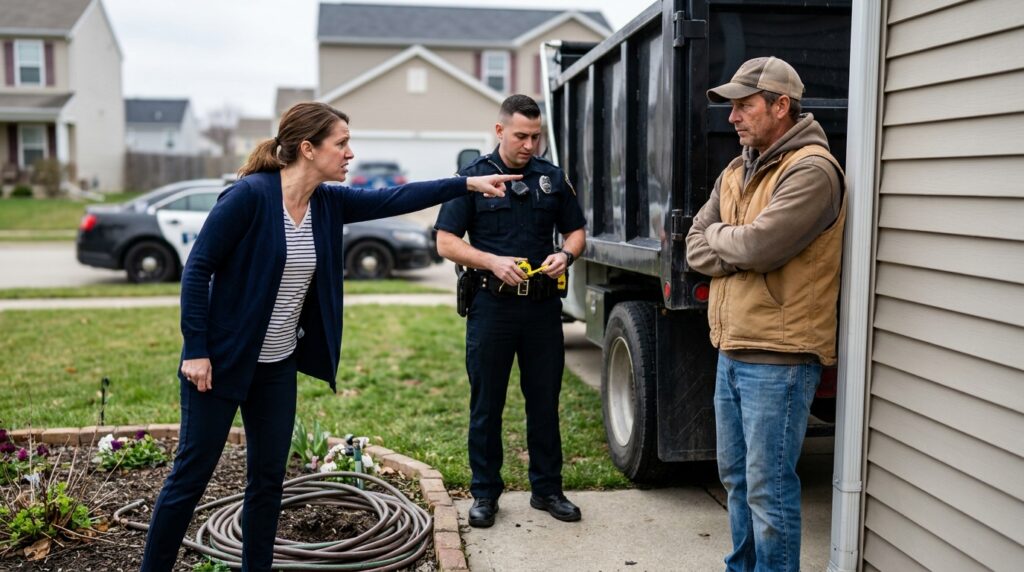
The heavy iron levers inside the truck cab jammed into place with a violent, mechanical slam that sent a shiver through the aluminum gutters overhead. Elena didn’t drop her eyes from the contractor’s face as the massive black chassis began its backwards crawl, the deep-treaded rubber tires groaning as they unseated themselves from the trenches they had gouged into her lawn. The suction of the wet clay made a thick, tearing sound, releasing her crushed garden hose and the flattened roots of the hydrangeas with a dull smack that smelled of anaerobic soil and old iron.
The contractor stood motionless for three seconds, his boots remaining pressed into the mud directly beside the newly exposed surveyor’s pin. The yellow copy of the citation was tucked tightly into the palm of his grease-stained hand, the paper wrinkling under the pressure of his thick fingers. His canvas vest didn’t rustle; his wide shoulders remained hunched against the settling mist as he watched the officer roll the yellow steel measuring tape back to its leather pouch.
“This slot won’t stay blank for long, lady,” the contractor said, his voice dropping into a flat, transactional rattle that was dry as wood shavings. He didn’t look at her; he looked at the wet, black scar his machine had left across her property line. “The transit syndicate already paid for the deep-well conduit down at the junction. My crew might be pulling back to the asphalt seam today, but the city council doesn’t hold the title to the main utility lateral. The freight corridor is already locked into the regional transport register.”
“The register doesn’t change the county plat,” Elena said. Her words were sparse, balanced on the chill air between them. She reached down and picked up the broken plastic nozzle of her garden hose, the split green casing rough and cold against her bare fingers. “And the freight syndicate doesn’t own the dirt under my cellar stairs. If the logistics office wants to move sixty tons of gravel down this block tomorrow, they can build an access road through the commercial marsh behind the river.”
The contractor let out a short, dry grunt that ended in a cough. He pulled his baseball cap lower over his forehead, his weathered face disappearing into the shadow of the brim as he finally took a slow step backward out of her garden bed. His heavy leather heel left a deep, water-filled imprint over the ancient iron pin, but the marker remained upright, its oxidized head cutting cleanly through the grey clay like an anchor point.
Across the asphalt, old man Miller stood perfectly still on the curb, his crossed arms slowly relaxing as the black tailgate of the dump truck cleared his line of sight. Down the block, the woman by the mailbox picked up her bundle of flyers, her eyes lingering on the white police cruiser as its blue strobe lights clicked off with a faint mechanical snap. The physical pressure that had held the narrow street in a vice for two hours was dissolving into the overcast morning, leaving only the smell of raw earth and hot exhaust.
The officer didn’t offer a hand to either of them. He clicked his ballpoint pen one final time, sliding his carbon pad back into the vertical door slot of his vehicle. His upright posture didn’t soften; he treated the conclusion of the standoff with the same rhythmic indifference he had brought to the opening measurement.
“Keep the lane clear until the township surveyor checks the grade markers on Friday, Frank,” the officer said toward the contractor’s profile. “If that bumper crosses the gravel shoulder before the formal boundary report is logged at the county hall, the personal misdemeanor bond doubles automatically at the clerk’s desk.”
The contractor didn’t give a nod. He simply raised his left arm toward the cab, a short, dismissive wave that told the driver to pull the rig entirely out of the residential corridor. The machine hissed once more—a long, controlled release of air pressure that cleared the grit from the brake drums—and then the massive black steel frame rolled backward into the street, leaving the narrow mud lane open to the slate-colored sky.
Elena walked back up her small brick path, her slip-on shoes slick with wet clay. She stopped on the top concrete step of her porch, her hand resting on the iron railing as she looked down at the straight line the officer’s tape had verified. The house didn’t shake anymore. The water glass inside the front window had settled into absolute stillness, its surface no longer ringing with the low-frequency rumble of the commercial engine. The boundary was clean, paid for in twenty inches of recovered sod and a yellow slip of paper that remained clamped in the contractor’s fist as he retreated toward the bypass line.