CHAPTER 2: THE SPLITTING OF THE TURF
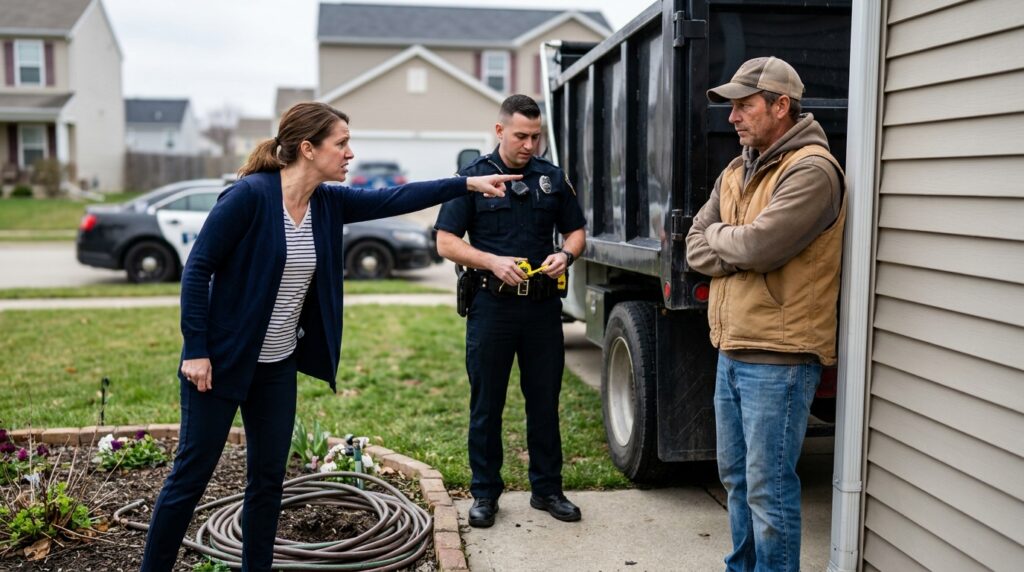
“Shut it down!” Elena’s voice was a flat rasp, cutting through the low-frequency rumble of the eight-cylinder engine. She didn’t look at the driver perched high behind the mirrored glass of the cab; she kept her eyes locked on the contractor’s weathered face, her boots sinking an inch into the freshly turned clay of her garden bed. “Shut it down before that gutter shears off.”
The contractor didn’t move his hand from his utility vest. He stood with his boots planted wide apart on the cracked edge of the asphalt, his silhouette dark against the grey morning light. The smell of hot hydraulic fluid and burnt diesel oil was thick between them now, a greasy film that seemed to coat the damp leaves of the privet hedge.
“I told you, lady,” he said, his voice dropping into a register that was completely transactional, the tone of a man who used regulations like a blunt instrument. “We’re within the line. If your drainage pipe is inside the county’s utility corridor, it’s unpermitted obstruction. My driver’s got six more loads to drop before the morning shift switches, and I’m not losing two grand an hour while you stand there crossing your arms.”
He reached into the deep pocket of his canvas vest and pulled out a small, heavy object—a steel plumb bob, its brass tip nicked and dulled from years of rough handling. He didn’t drop it to measure anything; he just let it swing on its braided nylon cord, a short, heavy pendulum ticking against his thigh. It was a calculated gesture of ownership, an implicit statement that he governed the physics of this particular piece of earth.
Elena took a step forward, her slip-on shoes squelching softly in the wet earth. The edge of her cardigan brushed the wet, grit-blasted steel of the truck’s rear bumper. She could feel the heat bleeding through her clothes from the massive exhaust pipe, the metal ticking as it expanded in the cool mist.
“The county corridor doesn’t touch the foundation,” she said, her voice tight, dropping into the sparse, targeted rhythm of someone who had memorized her deed line during the winter the mortgage was re-drawn. “Look down at your boots, mister. You’re six inches past the gravel line. You’re on my sod.”
The contractor let out a short, dry grunt, his gaze finally shifting down to the grass. Beneath the heavy, deep-tread tires, the wet earth was turning into a grey slurry. The thick green braided drainage line was flattened now, its structural ribs crushed into the mud, a small pool of dirty water rising around the puncture point. But as his boot shifted, Elena caught a glimpse of something else—a small, dark point of oxidized iron protruding from the torn roots of the grass.
It was a rusted surveyor’s pin, ancient and bent, its head nearly buried under twenty years of decaying mulch. It sat four inches inside the massive tire’s current track. The contractor saw it too. His eyes lingered on the dark metal point for a fraction of a second, his stubbled jaw tightening just enough to betray the recognition. Then, without a word, he brought his heavy work boot down directly over the pin, grinding it into the mud until the iron tip disappeared beneath a layer of grey clay.
“I don’t see a pin,” he said, looking back up, his eyes steady under the frayed brim of his cap. “I see a residential obstruction in a municipal right-of-way.”
Across the asphalt, the front door of the Miller house clicked open. Old man Miller stepped onto his concrete porch, holding a ceramic mug, his eyes fixed on the massive black tailgate that now blocked three-quarters of the street’s sightline. He didn’t shout; he just stood there, a silent witness to the weight of the machinery. Further down the block, a garage door groaned as it began to lift, the sound flat and hollow in the overcast air. The pressure wasn’t coming from a crowd yet, but the street was filling with eyes.
The contractor turned his back to her, lifting his left hand to signal the cab again. “Bring it back another two feet, Carl!” he shouted over the engine roar. “We need the tailgate clear of the main lateral!”
“Don’t you dare,” Elena muttered, her voice dropping into a hard, quiet line that didn’t travel past the space between them. She didn’t retreat. She placed her palm directly against the wet, vibrating steel of the truck’s side panel, feeling the massive friction of the transmission engaging through her bones. Her fingers left clean streaks in the film of road grime. “You move this truck another inch, and you’re going through the brickwork of my cellar stairs.”
The driver in the cab tapped the horn—a sharp, deafening blast that made the window panes behind them rattle in their wooden frames. The huge machine groaned, its tires spinning for a split second in the ruined flower bed, throwing a spray of black earth and shredded hydrangea roots against Elena’s dark pants. The frame shifted, the upper edge of the steel dump bed coming within two inches of the white aluminum gutter that drained her roof.
Then came the sound of a different engine—the low, distinct whine of a municipal alternator approaching from the western intersection. A single white sedan with a blue strobe bar on the roof rounded the corner, its tires clicking against the wet asphalt as it slowed, drawing to a halt directly behind the massive dump truck.
The driver in the cab killed the engine. The sudden silence that followed was heavy, broken only by the drip of moisture from the trees and the low, wet gurgle of the ruined drainage hose.