
CHAPTER 3: THE BLUE ENVELOPE
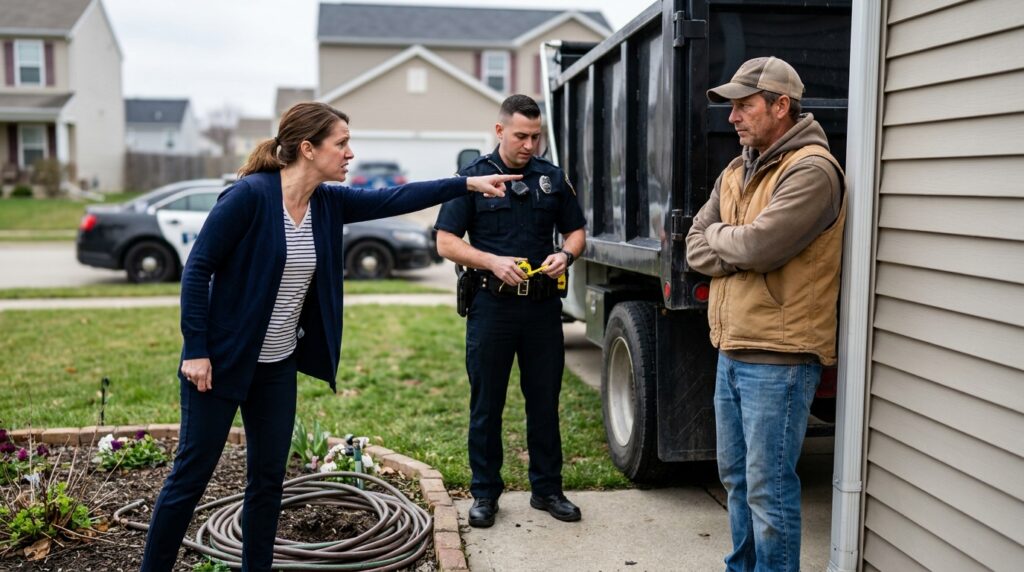
The sudden absence of the eight-cylinder rumble left a hollow ringing in the damp air. The hiss of the truck’s cooling manifold sounded thin, almost mechanical, against the quiet of the street. Elena didn’t drop her hand from the truck’s side panel until the metal vibration stopped entirely, leaving only the cold film of road salt and soot beneath her fingers.
The contractor didn’t look at the white cruiser parking fifty feet behind his tailgate. He deliberately folded his yellow legal pad, sliding the stub of grease pencil into a small slot stitched inside his utility vest. His movements were slow, calculated to show the porch watchers across the street that his timeline wasn’t dictated by a flashing blue strobe. He reached under his arm and produced the thick blue folder, its heavy plastic cover popping as he unsnapped the brass fastener.
“We’re going to clear this up right now, lady,” he said, his voice flat, dropping into the dry cadence of a court clerk. He didn’t step back from her porch line; he moved closer, using the bulk of his canvas vest to block her view of the ruined sod beneath his boots. “I don’t have time to wait for a municipal surveyor to tell me what I already have stamped in ink.”
He pulled a folded sheet of heavy ledger paper from the folder, the crisp bond rattling like dry corn husks in the wind. He didn’t hand it to her. He held it out between his large hands, the paper graying slightly under the fine mist. At the top of the sheet, the words County Department of Public Works: Variance Directive were blocked out in heavy, unadorned typeface. Beneath the text was a hand-drawn diagram showing the intersection, the narrow asphalt lane, and her own house lot, marked out with bold red ink lines that didn’t match the old deed map in her dining room cupboard.
Elena leaned in, her eyes tracing the red ink. The line didn’t stop at the curb. It carved a clean, six-foot crescent directly through her flower bed, swinging inward until it clipped the corner of her stone cellar steps. It was a formal, stamped document, complete with a purple municipal seal in the lower corner, but the seal looked off—the edges were crisp, entirely free of the typical ink-smudges found on standard county paperwork, and the date at the bottom was stamped from less than forty-eight hours ago.
“This is a regional access lane,” the contractor said, pointing a calloused finger at the red crescent. His nail was split down the middle, blackened by grease. “The county variance board cleared the expansion on Tuesday. The main utility lateral has to clear the foundation by four feet, which means the right-of-way extends six feet past your old curb line. The city didn’t just give us permission; they ordered the staging.”
“The variance board doesn’t meet on Tuesdays,” Elena said. Her voice was steady, the words sparse. She had spent three months in the basement of the town hall the previous winter, digging through the old drainage records when the county had tried to reroute the creek overflow. “They meet on the first Thursday of the month. And they don’t issue red-ink adjustments without a public notice pinned to the telephone pole at the corner.”
The contractor’s eyes narrowed slightly, the loose skin around his temples tightening beneath the brim of his frayed cap. He didn’t offer a defense. Instead, he folded the ledger paper back along its sharp creases, the sound clean and decisive in the damp silence.
“The clerk signed it, lady. That’s all that matters to my crew,” he said, his voice dropping into a low, transactional growl. “We don’t check the calendar at the county hall. We look at the stamp, and we follow the iron. If you’ve got a problem with the ink, you take it up with the desk in the morning. Today, this truck stays pinned until the lateral is dropped.”
Elena looked down at his boots again. He was still standing directly over the rusted surveyor’s pin he had ground into the clay, his heavy leather heel obscuring the iron marker completely. She could see a white grease-pencil mark he had drawn across the asphalt earlier—a rough line that aligned perfectly with his new map but left her small plot completely exposed to the heavy tread of the trailer waiting at the corner.
Behind them, the door of the white sedan opened with a heavy mechanical click. A pair of polished black work boots stepped into the puddle at the curb, the water splashing against the clean trousers of a local officer. The patrolman didn’t rush; his duty belt gave a dry, rhythmic creak as he walked past the massive black tailgate, his eyes fixed on the blue folder still gripped in the contractor’s hand.
The neighbors across the lane hadn’t moved. Old man Miller had set his mug down on the porch railing, his head tilted slightly to catch the dialogue, his grey cardigan matching the tone of the morning sky. Elena could feel the cold dampness of the lawn soaking through her thin slip-on shoes, but her posture remained locked, her arms tightly crossed against the chill as the officer stepped into the narrow space between the metal siding and the truck’s massive grill.
The contractor didn’t flinch as the officer approached. He simply held the blue folder out like a shield, his fingers covering the lower edge where the purple seal sat in its clean circle of dry ink.








