CHAPTER 7: THE ISSUANCE OF THE CITATION
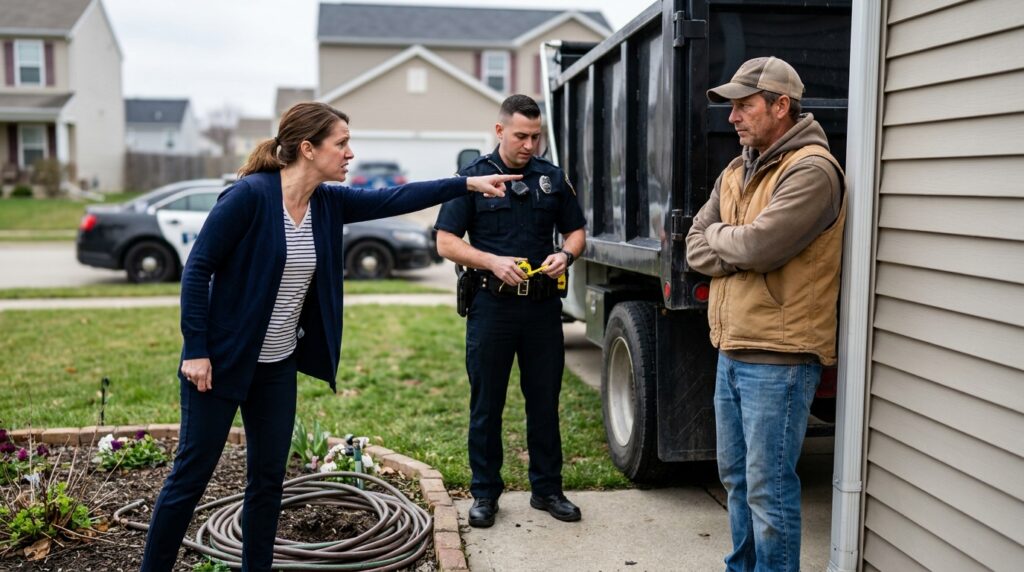
The carbon-copy pad gave a stiff, dual-layered snap as the officer unclipped the metal retaining bar against his chest. The smell of chemical ink and damp paper was sharp in the cold slate air, cutting through the oily residue of the truck’s cooling manifold. He didn’t look at the contractor’s clenched jaw; he clicked his heavy-barrel ballpoint pen twice, the sound metallic and isolated in the quiet of the lawn strip.
“You’re going to pull the vehicle back to the center of the asphalt seam right now, mister,” the officer said, his voice dropping into a rhythmic, practiced cadence. He leaned his citation pad against the wet steel paneling of the truck bed, his gloved fingers pinning the top sheet against the wind. “I am entering a structural property damage citation under municipal code section twelve. The infraction covers unauthorized heavy equipment deployment on a verified residential deed, unpermitted destruction of drainage infrastructure, and obstruction of a private boundary.”
The contractor didn’t pull his hands from his utility vest pockets, but his wide frame rigidified against the front tire, his heavy work boots staying anchored over the buried iron marker. The silver plumb bob remained completely motionless against his canvas seam now, a dead weight in the grey morning fog.
“The regional firm handles the city citations through the corporate desk,” the contractor muttered, his face darkening beneath the frayed brim of his cap. “You can write whatever numbers you want on that yellow slip, officer. The project manager clears the city ledger before the morning shift hits the terminal. It’s a cost-of-doing-business line item. It doesn’t halt the machinery.”
The officer didn’t stop writing. The tip of his pen dragged across the carbon sheets with a harsh, scratching hiss, transferring the fine text down through the purple layers.
“The corporate desk handles municipal ordinance fines,” the officer said smoothly, his eyes staying fixed on the paper. “They don’t handle personal civil liability for structural foundation compromise. This citation doesn’t name your logistics firm, mister. It names you as the operator on-site who knowingly ground an official county survey pin into the clay to bypass an easement check. That’s a personal misdemeanor liability, and it carries an uninsurable personal bond requirement at the district court.”
Elena stepped closer to the edge of the trench, her fingers tightening around the damp wool of her navy cardigan. She could see the numbers the officer was entering at the top of the form. The transaction sequence didn’t match standard county code violations; the officer had carefully cross-referenced the citation number with the small, octagonal freight terminal index—TR-LINK-SOUTH—she had pulled from the back of the false variance map.
The officer was deliberately logging the contractor’s actions not as a standard construction mistake, but as an active, documented compliance failure inside a private commercial developer’s routing file. The financial risk hadn’t just shifted; it had been isolated and pinned directly to the man standing in her garden bed.
“The clerk told me the corridor was cleared,” the contractor said, his voice losing its flat, bureaucratic confidence, dropping into a sparse, defensive rasp. He looked down at the grey clay covering his boot heel, then at the small pool of clear water still bubbling from her crushed green drainage hose. “I’m five days behind on the phase-one vault. If the logistics coordinator pulls my crew off the slot because of a residential line dispute, the independent subcontract is terminated by the end of the week. I don’t own the trucks, lady. I just own the delay.”
Across the lane, old man Miller took two slow steps into the road, his scuffed work shoes coming to a halt on the wet center seam of the asphalt. His arms were tightly crossed over his grey cardigan, his head tilted downward as he watched the officer strip the top yellow copy off the pad with a sharp, ragged tear. The neighbor down the block hadn’t moved from her mailbox either; she had set her flyers down on the metal lid, her attention locked onto the small slip of paper now held out between the officer’s gloved fingers.
The neighborhood wasn’t a passive audience anymore; their silent, physical alignment at the curb line was forming a human boundary that matched the steel line of the tape measure. The contractor was completely exposed—trapped between an unyielding property deed, an official municipal citation, and the cold eyes of the people who lived on the street.
The driver inside the high cab didn’t wait for a hand signal this time. The glass of the side window slid down with a wet screech, his weathered face appearing in the gap. “The terminal manager is calling the office, Frank,” the driver shouted down, his voice tense against the low hum of the generator. “They’re pulling the gravel trailers back to the bypass line. They say the slot is red-flagged on the terminal board.”
The contractor didn’t look up at the cab. He slowly reached out his calloused hand, his grease-blackened fingernails catching the edge of the yellow citation slip as the officer released it into the damp slate air.