CHAPTER 6: THE DISCREPANCY IN THE INK
The blue plastic spine of the folder split with a sharp, hollow pop as the officer turned the page back against the engine grill. A fine spray of grey road grit flaked off the cardstock, settling into the damp creases of the variance blueprint. The officer didn’t offer to hand the paper back; his gloved thumb remained pinned against the lower margin, right over the clean, purple municipal seal that had looked so absolute five minutes before.
“Look closely at the lower coordinates, mister,” the officer said. His tone remained flat, ground down by years of checking commercial freight manifests at the state scales. He shifted his weight slightly, the heavy leather holster at his hip scraping the matte black finish of the truck’s front fender. “Your paperwork cites an authorized utility drop under Ordinance 44. But the topographical layout printed on this sheet isn’t configured for water or gas line laterals. These grid markings are scaled for an industrial grade-four reinforcement.”
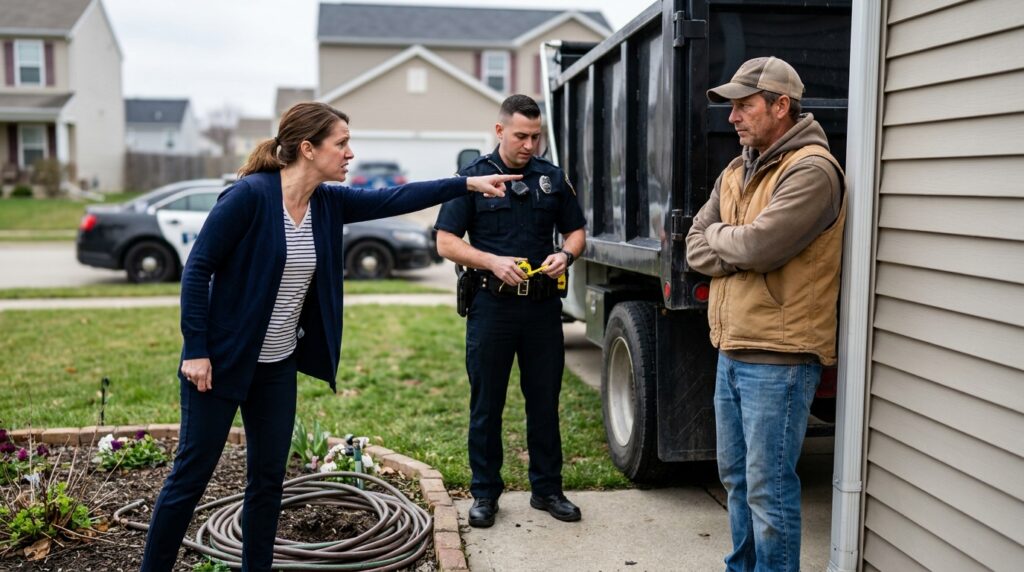
The contractor didn’t reach for the folder. He stood with his thumbs hooked into the raw canvas seams of his utility vest, his heavy work boots still grinding the wet clay directly over the buried iron marker. The rhythmic ticking of the brass plumb bob against his thigh had stopped, his entire frame freezing into an rigid, defensive column in front of the front tire.
“A county print is a county print,” the contractor said, his voice dropping an octave into a low, metallic growl that barely cleared the idling hum of the generator. “My contract says trench the block. It doesn’t tell me to audit the drafting desk at the county hall. If the engineering clerk put the wrong grid line on the template, that’s an administrative issue for the county lawyers after the asphalt is poured.”
Elena stepped closer to the line, her slip-on shoes sinking past the ankle into the grey slurry of her ruined garden bed. The damp chill of the morning air was cutting through the thin knit of her navy cardigan, but she didn’t close her arms. She reached down and pointed directly at the lower border of the map sheet, where a small, secondary ink stamp had bled through from the backing paper.
It wasn’t a standard public works emblem. It was a small, octagonal mark containing a freight terminal routing code—TR-LINK-SOUTH. It was the exact designation used by the private commercial developer who had been buying up the old warehouse parcels along the river line for the past six months.
“The county didn’t draft this map,” Elena said. Her words were short, sparse, hitting the silence like small stones falling into a well. She looked up from the paper straight into the contractor’s grey-stubbled jaw. “This is a private commercial site plan. The town council rejected this specific industrial shortcut three months ago because the subsoil won’t support forty-ton freight rigs without cracking every residential cellar wall on the lane.”
The contractor’s eyes didn’t widen, but the skin across his jawline hardened, turning the color of old stone. He didn’t look at Elena; he kept his gaze fixed on the officer’s hand, his fingers subtly tightening against the utility vest’s pockets.
Across the lane, the silence had turned heavy. Old man Miller had stepped down off his porch, his scuffed work shoes stopping at the very edge of his own curb line. Two more doors down, a woman in a heavy winter coat stood motionless by her mailbox, a bundle of unopened flyers gripped in her hand as she watched the officer’s yellow tape casing remain dangling from his belt like a plumb line. The neighborhood wasn’t gathering to shout; they were locking themselves into a silent, observation loop that was freezing the crew’s operational space yard by yard.
The officer let the blue folder drop shut with a heavy, flat thud against the truck’s radiator shell. He turned his face toward the high cab, his eyes locking onto the driver behind the mirrored glass until the man shifted his gaze down toward the steering column.
“The layout is a false flag, mister,” the officer said smoothly. He didn’t raise his voice, but the calm authority in his cadence was absolute. “You don’t have a valid public works waiver for this parcel. You have an unapproved private easement application that was stamped by a low-level clerk before it ever cleared the zoning board. If that machine stays parked inside this residential boundary line for another sixty seconds, it’s not a county delay anymore. It’s a criminal trespass on a documented private deed.”
The contractor let out a short, dry breath that smelled of cold grease and stale chicory. He looked from the officer’s silver shoulder patch down to the wet iron pin protruding from the mud by his boot heel. The bluff had run out of dirt, ground down by eight feet of yellow steel tape and a purple ink stamp that didn’t belong to the city.
“The rig stays where it is until the supervisor arrives,” the contractor muttered, but his posture had already dropped a notch, his shoulders tightening as he reached toward his tool pouch to unhook his grease pencil.