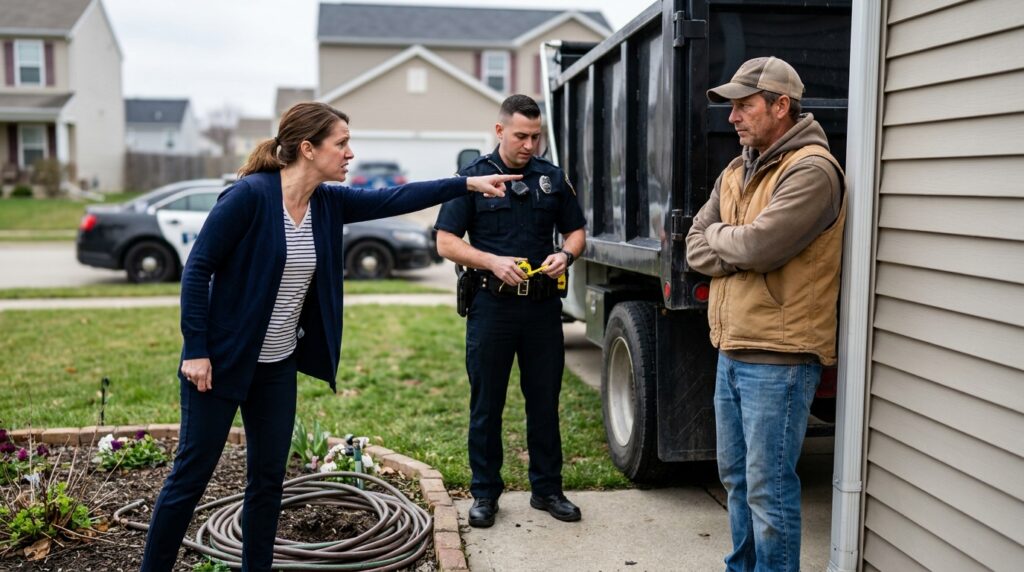
CHAPTER 4: THE UNCLIPPING OF THE TOOL
“Keep the folder open right where it is,” the officer said. His voice had the flat, unhurried weight of a state ledger book. He didn’t unholster his sidearm, but his right forearm rested naturally across the dull plastic grip of his duty weapon, his thumb hooked into the heavy leather of his utility belt.
The contractor didn’t pull the blue binder back, but his thick fingers tightened against the plastic edges until the knuckles turned white under the grey morning light. He remained wide-legged over the hidden surveyor’s pin, his heavy work boots anchored deep into the muddy clay of the destroyed garden bed.
“The paperwork is straight from the regional office, officer,” the contractor muttered, his eyes tracking the silver patch on the patrolman’s shoulder. “We’ve got a tight window on the main lateral drop. If we don’t have the heavy equipment positioned before the transit authority shift changes at nine, the county fines my firm back to the stone age.”
The officer didn’t look at the paper. He looked at the massive black steel tire of the dump truck, which sat six inches past the gravel shoulder, its heavy lugs dripping with black garden mulch and shredded roots. The steel body of the machine hummed with a low, post-ignition tick, heat still radiating off the massive manifold like oil over a stove.
“I don’t enforce county deadlines,” the officer said smoothly. He reached down to his hip, his gloved fingers finding the brass snap of a small, vertical leather pouch. The click of the metal fastener was sharp and distinct in the cold fog, a small sound that made old man Miller lean forward over his porch railing across the street. “I enforce the physical boundary of the municipal plat. If your tires are sitting on residential sod without a structural waiver signed by the township magistrate, the truck is a public obstruction.”
He pulled a heavy, chrome-plated casing from the pouch. It wasn’t an instrument of force; it was a heavy-duty, five-eighths-inch professional steel measuring tape, its casing scratched down to the raw zinc from years of road construction duty. The small yellow hook at the tip of the blade rattled against the housing with a clean, metallic ding.
Elena stood three feet back, her arms locked hard against her chest, her navy cardigan damp from the settling mist. She watched the contractor’s jaw shift. The man didn’t move his boots, but his shoulders sank half an inch, his wide stance subtly shifting as he tried to mask the precise spot where the iron marker lay buried under his heel.
“The variance map shifts the corridor six feet east,” the contractor said, his voice dropping into a transactional rasp. He finally held the ledger paper out, the crisp sheets trembling slightly as the wind caught the edges. “Look at the ink. It’s got the purple seal from the clerk’s office. It’s a legal easement modification.”
The officer didn’t take the document. He pulled three inches of the yellow steel tape from the casing, the spring mechanism clicking like a small ratchet inside the steel housing. “Maps don’t dig trenches,” the officer said, his grey eyes settling directly on the contractor’s cap brim. “The stakes do. And until I see where the corner pin sits relative to the curb line, this truck doesn’t shift into reverse.”
He turned his back to the machine, his boots stepping over the split green drainage hose that continued to gurgle clear water into the dirt. He didn’t look at Elena for permission; he treated the ground like a sterile grid, a surface to be calculated by inches and friction. He dropped to one knee near the foundation wall of her cellar steps, the stiff leather of his duty belt groaning against his uniform trousers as he reached down toward the concrete base.
“Hold the zero end against the masonry,” the officer directed, his eyes fixed on the gap between the brickwork and the sod. He wasn’t speaking to the contractor; he was looking directly at Elena’s scuffed slip-on shoes.
Elena stepped into the mud, her fingers leaving her crossed arms to take the cold, heavy brass loop at the end of the steel line. The metal felt wet, smelling faintly of machine oil and old earth. She pressed the flat tab hard against the cold stone of her foundation wall, her thumb catching on a rough edge of lime mortar.
The contractor stood motionless beside his front wheel, his blue folder lowered against his thigh like a discarded tool, his weathered face darkening as the yellow steel line began to hiss out across his boots.