CHAPTER 5: THE MEASURING LINE
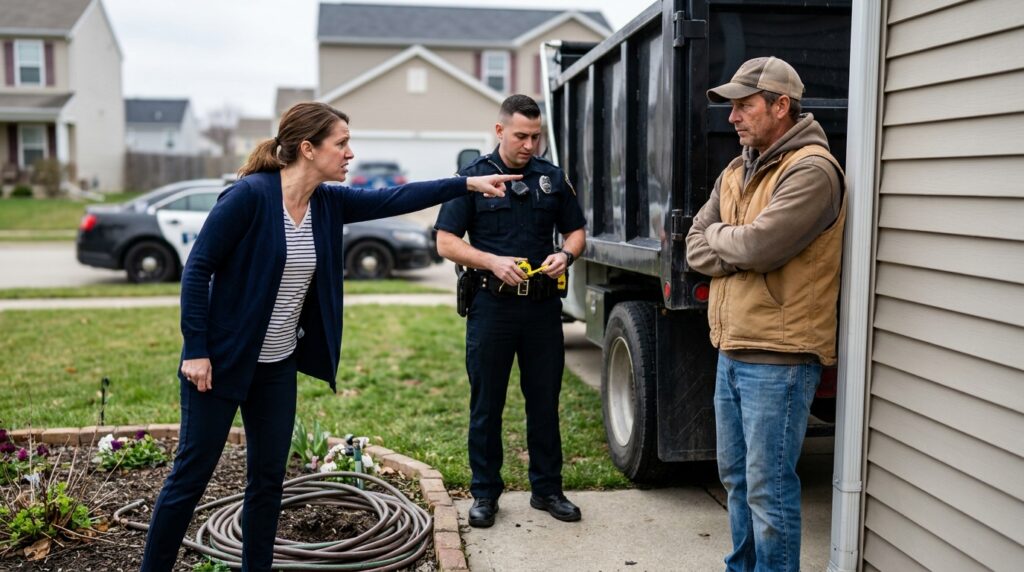
The yellow steel blade hissed through the wet clover, a thin ribbon of painted zinc that sliced a clean track through the muddy water. The friction of the metal tape dragging across the grit made a sound like a low, persistent rasp—the sound of a sharp edge finding a solid boundary. Elena braced her thumb hard against the brass loop at the foundation corner, the rough lime mortar of the wall scraping the skin of her palm as she held the zero mark steady against the grey stone.
The officer didn’t stand up. He moved down the length of the lane on his knees, his heavy black uniform trousers dragging through the torn roots of the hydrangeas. His hands were steady as he guided the housing, his index finger riding the spring-loaded brake to keep the blade from snapping or whipping in the wind. The numbers on the steel line rolled past—four feet, five feet, six feet—each digit stamped in crisp black block ink that stood out sharply against the dark clay.
“Hold it right there,” the officer said, his voice flat. He didn’t look up at the contractor. He reached down with his left hand, his fingers dipping into the grey mud where the driver’s leather boot had been ground into the earth three minutes ago. His knuckles hit something solid with a dull, iron click. He scraped away a thin layer of wet clay, revealing the ancient, bent head of the rusted surveyor’s pin.
The yellow tape crossed directly over the iron point at exactly seven feet, two inches from the foundation wall.
The contractor didn’t move his legs. He stood with his hands rammed deep into his canvas utility vest, the brass bob still ticking against his thigh like a heavy pendulum. His eyes stayed fixed on the number under the officer’s finger, his weathered forehead tightening beneath the frayed brim of his cap. Beyond his shoulder, the driver in the high cab turned his face away from the side mirror, his silhouette frozen against the glass.
“Your track is sitting at seven feet, eight inches, mister,” the officer said smoothly, his fingers resting on the muddy steel line. He didn’t rise from the ground; he stayed on one knee, his posture locked into a strict geometric assessment that ignored the rumble of the nearby idling convoy. “The standard municipal right-of-way for a secondary residential corridor is eight feet from the center of the asphalt seam. That puts your maximum allowable encroachment at precisely six feet from the curb marker. You are twenty inches onto this private parcel.”
“The variance map overrides the municipal plat,” the contractor growled, his voice dropping into a transactional rasp that didn’t carry past the truck’s massive grill. He reached out with his left hand, thrusting the blue plastic folder toward the officer’s face. The crisp sheets inside rattled against the plastic rings. “Look at the ink on page three. The Department of Public Works adjusted the boundary line to allow for the heavy concrete conduit vault at the corner. The signature is right there on the blue line.”
The officer stood up slowly, his duty belt groaning as his weight shifted. He didn’t take the folder from the contractor’s grip. Instead, he reached out with his gloved hand and flipped the top ledger sheet over, his eyes scanning the reverse side of the thick bond paper.
In the grey morning light, a faint, purple alphanumeric code was visible through the grain of the sheet—a double-stamped transit tracking code that read C-DEV-LINK-4. It wasn’t a standard county department inventory index; it was the specific filing prefix used by the commercial freight syndicates that operated the deep-water container terminal three miles south of the river.
Elena watched the officer’s face. His jaw didn’t drop, but his grey eyes lingered on that small sequence of ink for three seconds before he reached down and tapped the metal housing of his measuring tape, the spring mechanism drawing the line back into the zinc casing with a sudden, metallic scream.
“This variance isn’t an infrastructure order,” the officer said, his voice dropping into a low, quiet register that made old man Miller shift his weight on the porch steps across the lane. “The county didn’t sign off on a public utility shift. They signed a private construction waiver for a commercial transport lane. The clerk who stamped this sheet doesn’t have the legal authority to alter a residential deed without a magistrate’s eminent domain warrant.”
The contractor didn’t look at the paper. He didn’t defend the stamp. He simply pulled the blue folder back against his chest, his large fingers covering the purple ink code completely. His wide stance didn’t break, but his boots sank another quarter of an inch into the wet sod, the heavy leather absorbing the moisture of the split turf.
“The work order is still active on the city terminal,” the contractor muttered, his face turning the color of wet slate under his cap brim. “If I pull this machine out of the slot before the main trench is dug, the project manager clears my bond by noon. I’ve got sixty tons of gravel waiting at the county line, and I’m not turning those drivers back because an old survey pin is sitting four inches out of line.”
He stepped forward, his heavy frame crowding the narrow inspection lane between the truck panel and the foundation wall, his hand moving toward the leather pouch on his hip as if reaching for his timber crayon.
Elena didn’t step back toward her porch. She kept her scuffed shoes planted in the muddy trench, her hand remaining on the cold stone of her cellar steps as the distance between the law and the machinery ground down to nothing.