A Dollar’s Worth of Dust and the Reckoning at Register Five
CHAPTER 1: THE WEIGHT ON THE BELT
The fluorescent tubes overhead buzzed with a low, sixty-hertz vibration that lived behind Maya’s ears by six o’clock every Tuesday. It was the hour when the floor smelled of damp winter coats, crushed produce near the entry bays, and the sour tang of spilt milk drying under the register kickplates.
Maya Lin kept her thumb pressed against the rubber edge of the scanner wand, feeling the plastic ridge worn smooth by seven years of ten-hour shifts. Across the black belt, a six-pack of store-brand seltzer slid forward, bumped the light-sensor, and stopped with a soft mechanical squeak.
“Twenty-four fifty-eight,” Maya said. Her voice didn’t rise above the register’s electronic chime. She didn’t look at the customer’s eyes—she looked at the hands. In retail, hands told you everything before the mouth opened. Tired hands fumbled for exact change; impatient hands tapped car keys on the stainless divider; trouble hands stayed flat on the edge of the counter, leaning their weight into your space.
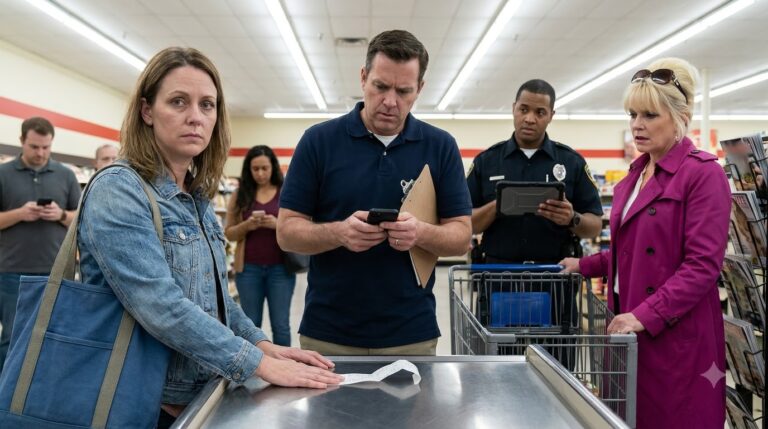
Brenda Caldwell’s hands were flat on the stainless steel.
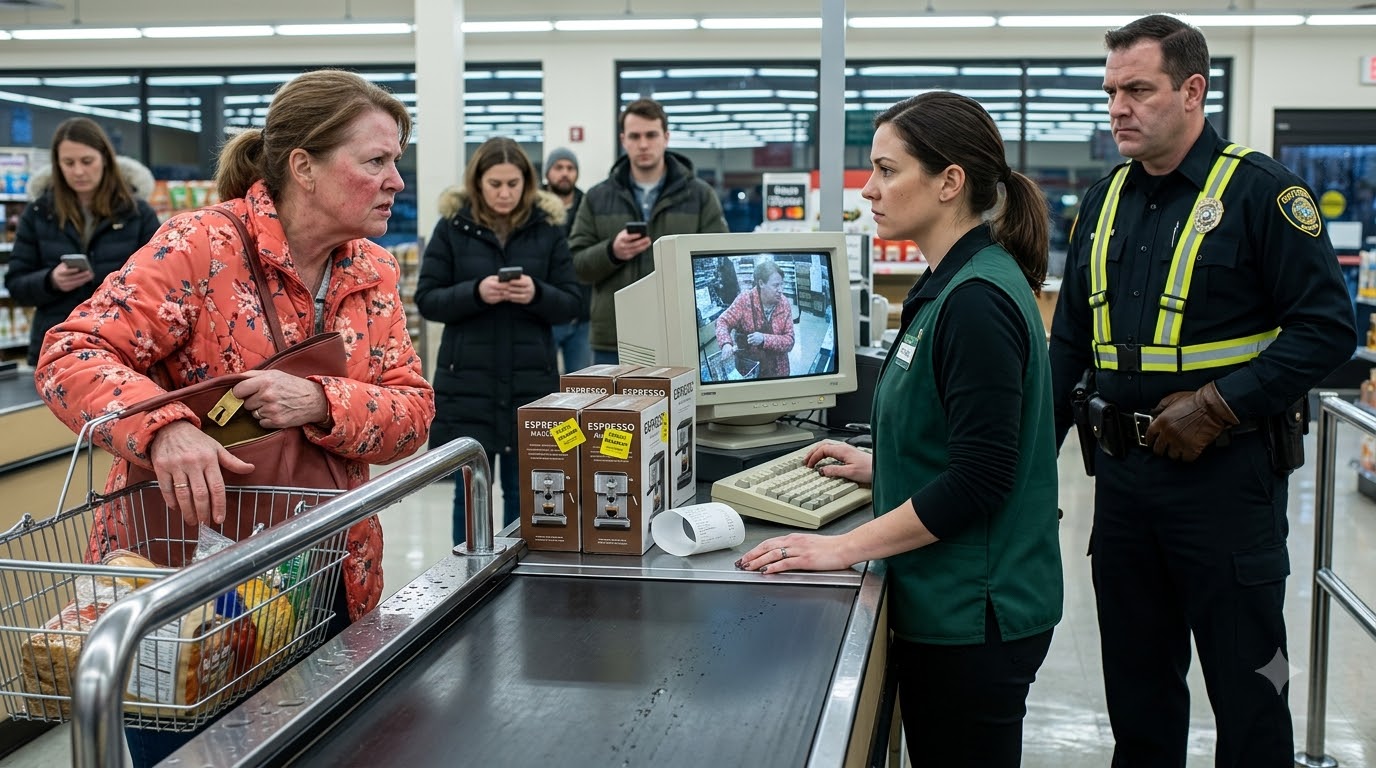
The wire basket sat between them like a barricade, blocking the lane so completely that a mother pushing a double stroller two yards back had to pull her cart onto its rear wheels to detour toward lane seven. Inside the basket sat two chrome-and-black espresso units, their factory seal tape still rigid and unmarred, alongside a cluster of yellow clearance tags that had no business being on box corners that sharp.
“The sign at the door says seasonal cookware is seventy-five percent off,” Brenda said. She didn’t whisper. She spoke with the practiced, projected cadence of someone who chaired municipal zoning subcommittees and knew exactly how sound bounced off cinderblock walls. “You have these tagged at forty-nine dollars each. My cashier told me your system rang them up at one-ninety-nine. I want the override.”
Maya didn’t reach for the key turn. She leaned slightly over the register hood, her dark green vest tightening across her shoulders. She smelled the cold air Brenda had brought in from the parking lot—a mix of damp asphalt and heavy lavender perfume.
“The seasonal clearance is restricted to aisle four, Mrs. Caldwell,” Maya said softly. She reached out, her fingers touching the corner of the top box. The paper tag wasn’t glued; it was pressed down with a thumb mark, the adhesive pulling away at the edge where the white store stock met the box’s glossy laminate. “These came off the distribution pallet in the back bay forty minutes ago. They aren’t open-box stock.”
“They were on the cart,” Brenda shot back. Her chin tilted up, the sharp acrylic nails on her left hand tapping three rapid beats against the register’s glass display. “The cart was standing by the display. If your staff leaves inventory where the public walks, the advertised price stands. State consumer trade law, section four.”
Two lanes over, young Jimmy stopped sweeping up a broken jar of kosher dill pickles. His broom handle leaned against his shoulder as he watched. A line of six commuters holding frozen dinners and boxed soup began to condense behind Brenda’s cart, their eyes shifting from the glowing price display up to the brass name tag pinned over Maya’s heart.
Maya didn’t argue the statute. She slid her key into the register lock, turned it ninety degrees to the left, and pulled up the diagnostic overlay on the graying CRT monitor.
“The system updates stock timestamps automatically,” Maya said, her eyes tracking the blue lines of text scrolling across the screen. SKU 4409-B. Received: 17:12. Location: Bay 2 Unprocessed. “These machines haven’t been indexed for display yet. I can offer you a ten percent courtesy adjustment for the placement error on the floor, but I cannot override a clearance code on unindexed stock.”
Brenda leaned closer, her shadow falling across the rubber belt. “You think I don’t know how this works?” she murmured, lowering her pitch just enough to make it feel confidential, though her eyes remained wide and fixed on the gathering crowd. “You keep the high-ticket items behind the swinging doors until five minutes before closing, mark them down for your friends on the night crew, and tell the tax-paying public the shelf is empty.”
Maya felt the cold metal of her name tag pressing through her cotton shirt as her posture straightened. She didn’t pull her hands back from the counter.
“The items stay on the pallet until the system clears the manifest, ma’am,” Maya said quietly.
“Call the police,” Brenda said suddenly, turning ninety degrees to face the crowd of shoppers now blocking the central walkway. She raised her voice back to its public register, sharp and echoing off the rafters. “Officer! Right over here, please!”
Near the deli counter, thirty feet away, Officer Raymond Briggs paused with a plastic container of potato salad in his left hand. His yellow high-visibility harness gleamed under the central strip lights as he looked up, his brow furrowing as he noticed twenty pairs of eyes turning simultaneously from Register Five to him.
Brenda turned back to Maya, a thin, triumphant line forming where her lips met. “Let’s see what the county record says about inventory fraud.”
Maya didn’t turn off the monitor. She reached under the edge of the register frame, found the small black toggle for the central terminal network, and pressed her thumb against the scanner wand until it beeped twice.
CHAPTER 2: THE BARRIER AT AISLE FOUR
Officer Briggs’s boots squeaked against the freshly mopped tile in aisle three before he even reached the metal divider of Register Five. The sound was rhythmically slow, a deliberate weight meant to settle a room before a single word was spoken.
Maya didn’t shift her feet. Her hands remained flat against the black conveyor belt, right where the cold steel rim met the rubber. Under her palm, the faint vibration of the motor under-housing thrummed through her bones—a constant, mechanical pulse that reminded her the building was still running, regardless of who stood on the public side of the counter.
“Problem here, Maya?” Briggs asked. He didn’t look at Brenda first; he looked at the register screen, his eyes tracking the glowing blue lines of inventory code before settling on the thick wire basket wedged between the divider bars.
“Mrs. Caldwell is requesting a manual price override on unindexed merchandise,” Maya said. Her tone stayed flat, stripped of edge or defense. She reached down with two fingers and picked up a scrap of paper that had been tucked under the register frame—a yellow backing strip from a clearance tag roll, its wax surface smeared with a smudge of black grease. “The items pulled from the cart were logged off the delivery bay pallet forty minutes ago. They haven’t passed secondary processing.”
“That is a complete fabrication,” Brenda said. Her voice didn’t rise in pitch, but it tightened, taking on the clipped, precise authority of a county official reading an eviction notice. She stepped forward until her floral jacket brushed the stainless steel guardrail. “Officer, I am a member of the Westside Commerce Oversight Committee. I know standard retail compliance. When a store places promotional signage at the main entrance and leaves marked merchandise on an accessible floor cart, those items are legally offered at the displayed rate.”
Briggs took a slow breath, the nylon of his utility belt creaking as his posture shifted. He pulled a small, spiral-bound notepad from his breast pocket, though he didn’t open it yet. His eyes flicked to the small gathering of shoppers three yards back. A man in a grease-stained mechanics jumpsuit had set his basket of canned beans on the floor; two women with matching commuter lanyards were holding their phones at waist height, screens dark but angled forward.
“Is the cart marked as restricted stock, Maya?” Briggs asked softly.
“It was parked inside the yellow floor hatch behind the swing door,” Maya replied. She didn’t look at Brenda. She looked at the heavy brass ring of Briggs’s key keeper. “The latch was thrown from the bay side. The only way to pull that cart into the main walkway is to push past the hinged gate.”
“The gate was standing open,” Brenda interrupted, her hand coming down hard on the edge of the basket. The wire frame groaned under the pressure. “It was standing wide open, unlatched, with no sign, no tape, and no employee present. This young woman is attempting to cover for a procedural failure on her shift by accusing a customer of improper entry.”
Maya looked down at the yellow backing strip in her fingers. The grease mark wasn’t oil from a shopping cart axle; it was dark, tacky, and smelled faintly of industrial lithium lube—the specific compound the night crew used on the roller tracks of the overhead bay doors.
“The swing door latches automatically when the bay lights are set to evening mode,” Maya said, her voice dropping a fraction lower, steady as a falling plumb line. “It requires a key card swipe to release from the public side.”
Brenda’s eyes narrowed, the skin around her high cheekbones turning a mottled, pale red under the glare of the fluorescent tubes. “Are you implying I broke into your storage room?”
“I’m stating the door doesn’t swing free,” Maya said.
Briggs stepped between them, his broad shoulder cutting off Brenda’s direct line of sight to Maya’s face. He looked at the espresso machines, then reached out with a gloved thumb to turn one of the boxes sideways. The yellow clearance sticker on the side panel was crooked, the corner folded over itself. Beneath the yellow vinyl, a sliver of white paper showed—a secondary barcode, but not the standard store SKU.
“Where’d this tag come from, Maya?” Briggs asked, tapping the yellow edge.
“It’s an internal markdown series,” Maya said. She keyed three digits into her terminal. “Series 800. Those are only printed on the handheld terminal in the supervisor’s cage.”
“And who had the handheld today?” Briggs asked.
Maya looked at the terminal monitor. The audit trail on the lower left quadrant showed the print authorization for Series 800 tags issued at 2:14 AM that morning. The user ID stamped beside the log wasn’t hers. It belonged to Arthur Vance—the overnight floor supervisor who had been with Horizon Foods for twenty-two years and hadn’t missed a shift since the blizzard of ’09.
Brenda crossed her arms, her chin lifting as she caught the hesitation in Maya’s eyes. “Well?” she demanded, her voice cutting through the hum of the compressors. “Who printed the price? Or are you going to tell this officer that your own system is lying, too?”
Maya didn’t answer immediately. She traced the tacky smudge of grease on the yellow paper scrap. Arthur didn’t work Tuesdays. His card hadn’t been swiped at the front desk since Sunday night, but his ID was currently sitting on the live log of a clearance print run executed while the store was locked down in the dark.
“The tag was generated under an administrative account,” Maya said carefully, her eyes meeting Briggs’s steady gaze. “Officer, I need to run a system audit on the terminal before I can process or override these items.”
“You don’t need an audit,” Brenda snapped, pulling her phone from her purse with a sharp, leather-on-leather slide. “You need to honor the price or give me the regional manager’s direct line. I am not standing in this lane while you attempt to shift the blame onto an overnight stocker.”
Briggs didn’t draw his notepad this time. He rested his forearm on the register counter, his weight leaning slightly toward the terminal screen. “Run the log, Maya,” he said quietly. “Let’s see what the system says happened at two in the morning.”
Brenda’s phone screen lit up, illuminating the sharp, unnatural angles of her face as she tapped a number, but her thumb paused above the call button as Maya’s fingers hit the mechanical keys of the register keypad.
CHAPTER 3: WEAPONIZED AUTHORITY
The CRT monitor clicked, a high-pitched whine echoing inside the housing as line after line of pale green text cascaded down the black screen.
Maya’s fingers stayed locked over the key bank, her index finger resting on the heavy mechanical ENTER key. Her eyes scanned the administrative authorization log, reading the raw hex codes that the system compiled before formatting them for human viewing.
USER_ID: AVANCE-04
AUTH_TYPE: OVERNIGHT_BATCH_OVERRIDE
STATION: CAGE_TERM_02
TIMESTAMP: 02:14:09 EST
PRINT_QTY: 24 (SERIES 800 – DISCOUNT_75)
Briggs leaned closer over the conveyor rail, his high-visibility harness straining against his chest as he squinted at the monitor. “Is that Arthur’s code?”
“Yes,” Maya said. The single word felt heavy, like lead shot dropped into cold water. She hit the terminal function key to pull the secondary verification string—the badge proximity record that was supposed to trigger whenever a physical card was swiped at the cage terminal.
The secondary line appeared beneath the timestamp: PHYSICAL_SWIPE_VERIFIED: CARD_SN_9942.
Maya’s jaw tightened. Arthur’s card number was 9942. It was the same worn piece of laminated plastic he had carried on a beaded steel chain around his neck since Horizon Foods opened its doors in 2004. Arthur, who spent his lunch breaks eating egg salad sandwiches out of a dented Tupperware box while reading regional train schedules, had supposedly walked into the building at two in the morning on his night off, printed two dozen illegal clearance tags for four-hundred-dollar espresso units, and walked out.
“There it is,” Brenda said. Her voice didn’t just carry; it slashed across the front-end lanes, high and triumphant. She pulled her phone back from her ear and held it toward the gathering ring of onlookers like a microphone. “You see that, officer? Your own computer shows those tags were generated and authorized by store management hours before I ever stepped foot into this building.”
“Mrs. Caldwell, please step back behind the rail,” Briggs said, his tone dropping into the measured, heavy register reserved for official warnings.
“I will do no such thing!” Brenda raised her left hand, her sharp acrylic nails pointing straight at the glowing terminal screen. “You are watching a corporate employee attempt to manipulate internal records to frame an innocent customer for theft! The system proves the clearance price is valid and authorized! I demand that you enforce the transaction, or I am calling the District Attorney’s municipal liaison directly from this floor!”
A murmur rippled through the line behind her. The mechanic in the grease-stained jumpsuit adjusted his posture, leaning against a display of cheap batteries as he whispered to a woman holding a box of frozen waffles. Two teenagers near aisle six raised their phones higher, their camera lenses glinting under the harsh overhead lighting.
Maya didn’t look at the crowd. She looked at Brenda’s purse—a structured, pebbled leather shoulder bag resting against the stainless steel divider. Tucked into the side exterior pocket, barely visible beneath a folded sheaf of printed municipal committee agendas, was a thin strip of black nylon webbing attached to a notched brass keycard clip.
It wasn’t a standard retail lanyard. It had a rusted steel ring holding a small, blue plastic fob stamped with the emblem of the Westside Commerce Oversight Committee—the same civic group that held its monthly town hall meetings in the Horizon Foods community room every second Sunday.
Maya looked up from the purse to Brenda’s eyes. Brenda didn’t flinch. Her smile was tight, razor-thin, and perfectly secure behind the mask of public indignation.
“Officer,” Maya said, her voice remaining low and level despite the pulse hammering in her throat. “Arthur Vance did not print these tags.”
“The screen literally says his name, Maya,” Briggs replied, his brow heavy with genuine confusion. He pulled his spiral notebook open and unclipped a click-pen from his breast pocket. “If his card swiped at two in the morning, that’s a corporate policy violation, but it gives her a paper trail.”
“It’s an authorized override!” Brenda declared loudly to the aisle at large. “The manager signed off on the markdown! This woman is refusing to honor a valid price because she wants to keep the inventory for herself!”
“The proximity reader in the cage doesn’t just read the card ID,” Maya said, her fingers moving across the mechanical keypad with cold, deliberate speed. She bypassed the standard point-of-sale interface, dropping down into the terminal’s system diagnostic sub-directory—a black-and-green matrix that hadn’t been updated since the store installed its first network server in the late nineties. “It logs the access protocol. Arthur uses a physical swipe card. But the cage terminal also accepts a manual bypass code if the magnetic strip fails.”
Maya hit EXECUTE.
The screen flickered. A new line of administrative data unrolled across the CRT, replacing the simple user authorization with a raw system diagnostic dump:
ENTRY_METHOD: MANUAL_PIN_FALLBACK
PIN_ENTERED: 9942-AUTH
OVERRIDE_KEY_ID: EXTERNAL_COMM_GUEST_CARD
Briggs froze, his pen hovering a quarter-inch above his notepad. He looked at the screen, then at Maya. “Manual PIN?”
“Someone used Arthur’s administrative user number,” Maya said, her thumb tapping the cold metal frame of the terminal monitor. “They didn’t have his physical card. They used the guest access override protocol that’s only assigned during off-hours civic events.”
Brenda’s posture didn’t collapse, but her left hand shifted, her fingers tightening around the strap of her leather purse, pulling the side pocket flush against her coat so the notched brass clip vanished from sight.
“This is ridiculous,” Brenda said, her voice dropping an octave, losing its performative chime and taking on a hard, metallic edge. “You’re making up technical jargon to confuse this officer. Officer Briggs, this is employee misconduct, plain and simple. Are you going to take my statement, or do I need to file a formal complaint against both this store and your precinct?”
Briggs didn’t answer her. He reached out and placed his broad, leather-gloved palm flat against the edge of Brenda’s shopping cart, blocking it from moving an inch in either direction.
“Nobody is filing anything just yet, Mrs. Caldwell,” Briggs said quietly. He turned his head toward Maya. “Maya, if someone used a guest override at two in the morning, the building alarm logs would have recorded the entry at the side doors.”
“They would,” Maya said. She reached for the yellow backing paper scrap on the counter, holding it up so the tacky grease mark caught the harsh glare of the overhead lights. “And so would the overhead security camera covering the bay two staging lane.”
Brenda took a single step back from the rail, her heel striking the bottom runner of a magazine rack with a dull metallic thud.
CHAPTER 4: THE TERMINAL AUDIT
Maya’s thumb hit the terminal key function labeled CAM_LINK_02.
The CRT screen flickered, a line of white static cutting horizontally across the green monochrome grid before resolving into a grainy, wide-angle feed. The date stamp in the upper right corner read MON_19:42:10.
Briggs shifted his weight, his heavy leather belt creaking as he leaned straight over the register counter to stare into the tube display. Beside him, Brenda didn’t move toward the screen, but her head tilted back, her jaw tight, eyes fixed on the ceiling tiles as if calculating the precise angle of the lens housing mounted near the bay doors.
“The store security DVR runs on a twenty-four-hour loop,” Maya said, her voice steady against the hum of the register fan. “It indexes automatically whenever a cage override code is entered.”
On the monitor, the grainy image showed the back staging area near the heavy rubber impact doors. The space was dim, lit only by the amber emergency exit lamps. The time code ticked forward: 19:41:02. A figure in a dark floral jacket stepped out from behind the cardboard bailer, carrying a small leather purse slung over one shoulder.
The crowd around Register Five went dead silent. The cashier in lane four held a jar of marinara sauce suspended two inches above the scanner glass, her eyes glued to the grey screen.
On the video feed, the figure reached into her coat pocket, pulled out a small plastic card attached to a black nylon lanyard, and pressed it against the cage terminal reader. The red light on the door housing flickered once, then turned solid green. The figure didn’t hesitate—she pushed through the swinging door, walked directly to the staging pallet where the new espresso inventory sat wrapped in black shipping film, and pulled two boxes onto a floor flatbed.
“Pause it right there, Maya,” Briggs said softly.
Maya hit the spacebar. The image froze. On the screen, the figure was caught in profile under the amber exit light. Her right hand was holding a roll of yellow clearance stickers, pressing one onto the corner of the top espresso box. Her left hand was holding the notched brass keycard clip that was currently tucked inside Brenda’s purse.
“That’s a security breach,” Briggs said. He didn’t raise his voice, but the tone carried across the three nearest lanes. He turned slowly to face Brenda. “Mrs. Caldwell, do you have an explanation for why you were in the restricted receiving bay at seven-forty-one this evening?”
Brenda’s mouth opened, then closed into a paper-thin line. Her chest rose and fell in rapid, shallow breaths. She reached down, her fingers clutching the leather strap of her handbag so hard the material creaked.
“That footage is unverified,” Brenda said, her voice dropping into a harsh, rasping whisper that cut through the silence. “Anyone could be wearing a jacket like this. It’s dark in that hallway. The resolution is completely substandard for legal identification.”
“The system logs the specific RFID chip in the card, Mrs. Caldwell,” Maya said, her fingers remaining flat on the mechanical key bank. “It doesn’t just record a face. The card used at seven-forty-one was the guest override badge issued to the Westside Commerce Oversight Committee during their Sunday meeting in our community room.”
Maya pressed one more key sequence, pulling up the secondary master log:
CARD_ID: COMM_GUEST_01
REGISTERED_TO: CALDWELL_B
LAST_SWIPE_LOCATION: BAY_2_CAGE
TIME: 19:41:05
A quiet gasp rippled through the onlookers. The mechanic in the grease-stained jumpsuit let out a low whistle, shaking his head as he stepped back to give Officer Briggs room.
“You took Arthur’s administrative PIN from the committee desk folder on Sunday,” Maya continued, her eyes locking onto Brenda’s pale, rigid face. “He keeps a reference list in the community room podium for emergency access during civic events. You used his login number to print the tags, then swiped your committee guest card to bypass the door lock tonight.”
Brenda’s hands began to tremble, but her eyes flashed with a cold, desperate fury. “You have no authority to access municipal committee records! This entire store system is compromised! I am a member of the commerce board, and I demand—”
“Mrs. Caldwell,” Officer Briggs interrupted, his voice cutting through her tirade with the weight of an anvil dropping on marble. He stepped around the stainless steel rail, placing his broad frame directly between Brenda and the exit doors. “Keep your hands where I can see them, please.”
He pulled his cuffs from his belt loop, the steel links clinking against his utility buckle with a sharp, final ring that echoed down the entire length of aisle four.
“Maya,” Briggs said without turning his head. “Print out that diagnostic audit log and the video timestamp manifest.”
“Already printing,” Maya said softly, as the impact printer beside the terminal began its sharp, rhythmic clicking.
CHAPTER 5: PUBLIC CORRECTION
The impact printer chattered like a pneumatic rivet gun, its sharp metal pins driving ink through two-part carbon paper. Two inches. Four inches. Six inches of narrow white tape spewed from the terminal housing, folding itself in crisp, mechanical zig-zags across the black rubber conveyor belt.
Maya didn’t tear the tape right away. She let the paper gather against the stainless steel rail until the last line of hex code printed, its final dot-matrix strike vibrating through the floorboards under her feet.
Brenda stood motionless between the cart and the magazine rack. The bright coral pattern of her floral jacket, which twenty minutes ago had looked like a banner for municipal authority, now seemed loud and absurd under the harsh white fluorescent tubes. Her mouth worked silently, her lips parting as if to summon a phrase from a zoning handbook or a procedural ordinance, but no sound came out. The air in aisle four was too thick, filled with the hum of thirty people watching her hands.
“Mrs. Caldwell,” Officer Briggs said, his right hand resting lightly on his belt beside the open cuff pouch. He didn’t unclip the steel. He didn’t have to. The physical threat was secondary; the room itself had already passed judgment. “I need you to step out of the checkout lane and slide that shoulder bag onto the service desk.”
Brenda’s shoulder twitched. “This is a private purse. You have no warrant to search my personal property.”
“I don’t need a warrant to secure physical evidence attached to a live criminal trespass complaint, ma’am,” Briggs said smoothly. His voice stayed level, conversational, and devoid of heat—the voice of a county deputy who had written three thousand citations and knew that shouting only gave people something to argue with. “You can set the bag on the counter, or we can walk out through those sliding doors right now and handle the inventory logs down at the precinct.”
A teenager in the third row of onlookers lowered his phone, turning the screen slightly toward his friend so they both could rewatch the camera loop playing on the CRT monitor. A woman holding a toddler shifted her weight, setting her basket on a register shelf with a soft, decisive plastic click. Nobody spoke up for Brenda. Not one person in the crowd offered a word about community rules or customer rights.
Brenda looked at the mechanic in the grease-stained jumpsuit. The man crossed his arms over his chest and looked straight past her shoulder at the ceiling tiles.
Slowly, her fingers uncurled from the leather shoulder strap. She lifted the bag with two fingers, as if the pebbled hide were covered in engine grease, and set it on the stainless steel ledge right next to the wire basket. The side exterior pocket gaped open under the overhead lights. Tucked deep in the seam, the black nylon webbing of the committee lanyard lay exposed, its notched brass clip catching the blue glare of the terminal screen.
Briggs didn’t reach into the purse. He pulled a yellow-and-black paper citation book from his rear pocket, placed it on top of the register hood, and looked at Maya.
“Maya, hand me the transaction audit trail and the timestamp printout.”
Maya tore the long paper strip from the impact feed with a single, sharp diagonal tug. The carbon paper rasped against the tear-bar. She smoothed the paper flat against the black conveyor belt, verifying the final line of data—RECORD_EXPORT_COMPLETE: CASE_REF_0214—and passed the strip to the officer.
Briggs laid the printout inside his citation book, clicked his ballpoint pen twice, and began writing. The rasp of his pen tip against the official NCR paper was the only sound in the front of the store.
“Brenda Caldwell,” Briggs said as he wrote, his voice reading the lines for the room to hear. “You are being cited for misdemeanor criminal trespass in a restricted commercial area, alongside making a false report to a law enforcement officer. The municipal prosecutor’s office will receive a full copy of this system audit and the security video file by nine o’clock tomorrow morning.”
Brenda’s posture finally broke. Her shoulders dropped three inches, the sharp, rigid line of her spine softening into the slouch of an exhausted woman standing on wet linoleum. She didn’t look at Officer Briggs. She didn’t look at the crowd. Her eyes stayed locked on the yellow clearance tag stuck to the side of the espresso machine—the tag she had peeled off a six-dollar plastic bowl in aisle two.
“You’re making a mistake,” Brenda whispered, her voice barely audible over the hum of the refrigeration units. “I was only trying to prove a point about how this store manages its resources.”
“The state doesn’t write citations for points, Mrs. Caldwell,” Briggs said. He tore the top yellow copy from his book with a sharp snap and held it out to her. “They write them for facts. Sign the bottom line, please. It’s not an admission of guilt—it’s your promise to appear in municipal court on the fourteenth.”
Brenda took the pen with trembling fingers. Her signature was jagged, a messy scrawl that looked nothing like the sweeping cursive she used on neighborhood notices. She handed the pen back, pulled her purse off the ledge, and turned toward the glass entrance doors.
The crowd parted silently before her. Nobody made a path with enthusiasm, but nobody blocked her either. They simply stepped back, leaving a three-foot gap of polished tile that led straight out into the cold rainy night. Brenda walked through it without looking back, her heels clicking a frantic, uneven beat against the floor until the automatic double doors slid shut behind her, cutting off the sound of her exit.
Briggs folded his citation book and tucked it into his breast pocket. He looked at Maya, his expression relaxing into a weary, sympathetic smile.
“Sorry about the circus, Maya,” he said softly, leaning his elbow on the register rail. “I’ll stop by tomorrow afternoon to collect the official thumb drive with the camera file for the court packet.”
“I’ll have it ready at the service desk, Officer,” Maya said. She reached out, grabbed the wire basket containing the two espresso units, and pulled it back behind the register counter onto the storage shelf. “Thank you.”
Briggs nodded once, touched the brim of his cap, and turned toward the exit, his heavy boots squeaking rhythmically on the damp floor mats.
The gathering crowd began to disperse, shoppers picking up their baskets and moving back into their respective lanes. The mechanic set his canned beans on the conveyor belt in lane four, muttering something quiet to the cashier, who nodded as she picked up her scanner wand.
Maya stood behind Register Five. She pulled her key from the terminal lock, turned the display back to the standard point-of-sale interface, and wiped down the stainless steel counter with a blue paper towel. The grease smudge was gone. The yellow backing paper was in the trash bin under the counter.
She looked at her hands—they were steady, resting flat against the black rubber belt. The fluorescent lights overhead still buzzed with their sixty-hertz hum, and the store still smelled of wet coats and drying floor cleaner, but the air felt clear.
“Next in line, please,” Maya said, her voice quiet, clear, and perfectly steady.