
The Rust at Oakridge Pass: A Novel of Boundaries, Pride, and the Iron on the Asphalt

CHAPTER 1: THE CHAIN ON THE RAIL

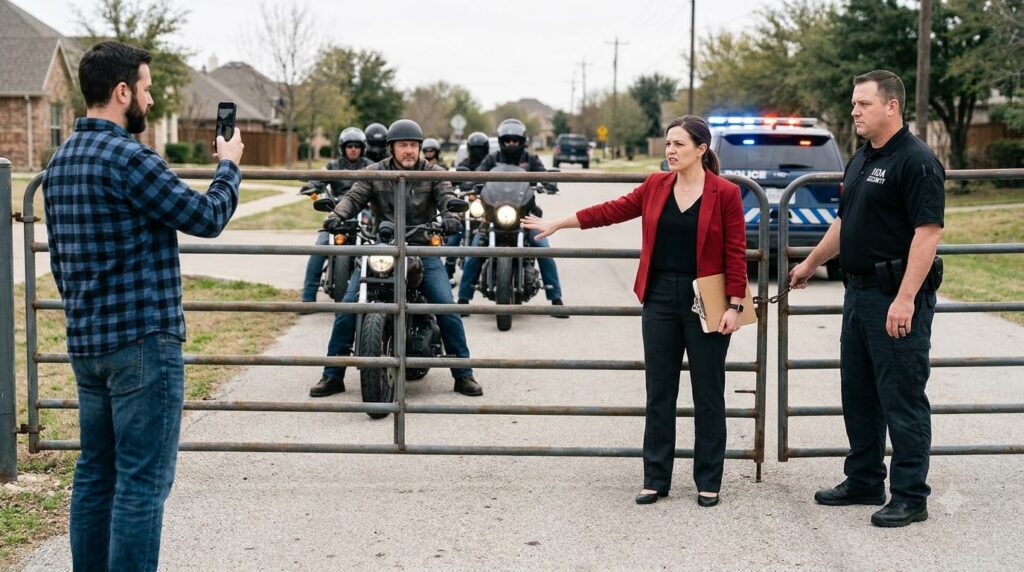
The brass padlock made a dull, heavy clink as it hit the lower rail of the iron ranch gate.

Mark Miller didn’t turn off the truck’s engine. He left the air conditioning humming against the dry August heat and stepped out onto the coarse, sun-baked asphalt of Oakridge Pass Road. The air smelled of hot pine needle mulch, exhaust, and cured dust.

Standing dead center in the access lane was Evelyn Vance.

She wore a bright red blazer that looked stiff in the noon sun, dark slacks dusted with fine road grit at the cuffs, and oversized sunglasses that mirrored the pine trees along the easement. Clamped under her right arm was a thick wooden clipboard. Beside her stood Harris—a man built like a concrete pillar, wearing a dark contract security polo shirt that strained against his shoulders, a heavy duty belt, and a plastic ID badge flapping against his chest in the thermal breeze.

“Turn the truck around, Mark,” Evelyn said. Her voice didn’t carry panic; it carried the cold, bureaucratic certainty of someone who believed the paper in her hands ruled the earth. “This access point is closed to non-permitted traffic as of eight this morning.”

Mark didn’t reach for his keys. He stopped three feet short of the iron gate, his boots planting firmly on the cracked centerline of the asphalt.

“You don’t have the authority to padlock a county access road, Evelyn,” Mark said. His voice was low, flat, scraped raw by months of petty violation notices left under his windshield wiper. “This easement has been open since seventy-six.”

“The board voted in executive session on Thursday,” she replied, her hand coming up in a sharp, slicing motion that cut through the air between them. Her clipboard snapped tight against her hip. “We own the road improvement rights. That gives us the right to secure the perimeter. You don’t have authorization to use this lane anymore, and this gate stays locked until the board approves your clearance.”

Behind the iron bars, down the gravel approach that snaked up from the public creek road, the low, guttural thrum of idling motorcycle engines began to reverberate off the rock cuts. Three, then five, then eight machines rounded the bend—Dave Kowalski at the front, his dark visor down, his broad shoulders squared over the handlebars of his touring bike. They slowed, bunching tightly together in the narrow cut just outside the locked iron barrier, their headlights reflecting off the hot iron rails.

Harris shifted his boots, planting his right heel directly over a weather-worn silver cap stamped into the asphalt near the gate latch. His hand rested casually near his belt, not on a weapon, but close enough to signal physical intent.

“You’re standing on a county survey pin, Harris,” Mark said softly, his fingers reaching into his plaid shirt pocket and coming away with his black smartphone. He didn’t unlock it yet; he just held the heavy glass rectangle flat against his palm, letting the heat of the casing warm his skin. “Enforcing an illegal obstruction makes you personally liable when the deputy gets here.”

Evelyn let out a thin, sharp laugh that cut through the low rumble of the idling engines beyond the fence. “Call the sheriff. Please. I’ve already dispatched a unit for trespassing and unlawful assembly.” She pointed a manicured finger toward the bend behind her, where a white-and-blue county cruiser was already slowing down, its roof lights casting soft, rhythmic pulses of red and blue across the dry pine trunks. “Fine, let the officers handle it now.”

Mark unlocked the screen with a swipe of his thumb, lifted the camera lens to chest height, and pointed it straight at the red blazer.
CHAPTER 2: THE COLD IRON

“Put the phone down, Mark,” Evelyn said. Her voice didn’t pitch up; it dropped into a flat, practiced register—the tone of a woman used to getting people to sign petitions at the end of a driveway. “You’re escalating a simple access verification into a public nuisance.”

Mark didn’t lower the glass. The camera lens stayed level with the center of her red blazer, catching the glare of the noon sun off her plastic lapel pin.

“You chained a public road, Evelyn,” Mark said. The words came out slow, rhythmic, measuring the distance between his boots and the heavy iron rail. “That’s not verification. That’s obstruction.”

To his right, Harris shifted his weight. The leather of his duty belt creaked—a dry, stiff sound like an old saddle—and the thick rubber soles of his work boots ground a handful of loose granite chips into the soft asphalt. He didn’t look at Mark’s face. He kept his eyes fixed on the motorcycle riders bunched outside the gate, his large, sun-reddened hands resting near his waist.

Mark stepped closer to the barrier, the toes of his work boots stopping an inch from the iron frame. He reached down with his off-hand and picked up the heavy brass padlock hanging from the galvanized chain.

The lock was hot to the touch, scorched by the midday sun, but what caught his eye wasn’t the heat—it was the shackle. The dull brass plating had fresh, bright silver gouges near the tumbler, as if someone had used a pair of locking pliers to force the latch closed over a chain link that was too thick for it. The plastic keyhole shield was missing entirely, exposing the dark, grease-stained brass underneath. This wasn’t an official county lock. It was a hardware-store heavy-duty special, slapped on in a hurry before the morning commute.

“Where’s the key, Harris?” Mark asked softly.

Harris swallowed. His throat moved behind the tight collar of his black polo shirt, but he didn’t answer. He looked at Evelyn.

“He doesn’t answer to you, Mark,” Evelyn snapped. She stepped up to the inside of the gate, her red blazer brushing against the rusted iron pickets. She brought her clipboard up, tapping the metal clip with a manicured thumbnail—click, click, click—a sharp, rhythmic tick that sounded like a dying clock. “He answers to the board. And as the designated director of perimeter safety, I am instructing him to hold this line until the county deputy arrives to clear these vehicles off private property.”

“Private property,” Mark repeated. He turned his phone slightly, capturing the stretch of road behind her—the two narrow lanes of cracked asphalt, the gravel shoulders, the pine trees growing right up to the drainage ditches. “You’ve lived here six years, Evelyn. You know as well as I do that the subdivision plat ends fifty yards back at the stone pillars. This stretch here? This is the pass.”

“The board amended the perimeter boundary in ninety-eight,” she said, her voice tightening around the dates like she was reading from a holy text. “We hold the maintenance contract. We pave it, we clear the fallen timber, we manage the brush. That gives us operational control.”

“Operational control isn’t ownership,” Mark said.

Behind the gate, Dave Kowalski cut the engine of his touring bike.

The sudden silence was heavy, dropping over the road like a wet wool blanket. The idle of the other seven bikes died one by one, leaving only the high, dry buzzing of cicadas in the canopy overhead and the distant, rhythmic thump of the approaching police cruiser’s tires over the asphalt expansion joints.

Dave swung a heavy leg over his saddle, his leather riding jacket creaking as he stood up. He walked to the center of the locked gate, his dark helmet visor flipped up just enough to reveal a pair of tired, dust-rimmed eyes. He didn’t look at Evelyn. He looked directly at Harris.

“My boy’s got a insulin delivery coming up this road at one o’clock, Harris,” Dave said. His voice was low, gravelly, carrying the thick, flat vowels of a man who had worked thirty years in the county quarry down in the valley. “The pharmacy van uses the pass because the highway bridge is down to one lane for paving. You planning on turning the pharmacy van around too?”

Harris’s mouth tightened into a thin, pale line. “I’m just enforcing the posted notice, Mr. Kowalski.”

“You’re standing on public dirt,” Dave said quietly. He placed one heavy, gloved hand on the top rail of the gate, his fingers curling over the iron. He didn’t push. He just let the weight of his arm rest there. “Evelyn doesn’t pay your legal defense if you block a medical delivery. The HOA insurance policy explicitly excludes criminal obstruction.”

Evelyn’s face flushed a deep, mottled crimson under her light brown hair. “That is a mischaracterization of our legal coverage! The board has full indemnity—”

“The board has three people and two thousand dollars in a reserve account, Evelyn,” Mark interrupted, lowering his phone just an inch to stare straight into her mirrored sunglasses. “And when the deputy steps out of that car in ten seconds, he’s not going to ask about your reserve account. He’s going to ask who put the chain on the gate.”

The white-and-blue county SUV rounded the final curve, its tires crunching onto the loose gravel shoulder fifty feet back. The red and blue strobe lights flashed against the dusty glass of the windshield, washing over the iron gate, the red blazer, and the tight, silent knot of men standing on the asphalt.

The driver’s door swung open. A pair of worn leather service boots hit the ground first, followed by the tall, rounded frame of Deputy Miller—no relation to Mark, but a man who had patrolled this district long enough to know every unpaved boundary line between the river and the ridge. He adjusted his heavy duty belt, his thumb hooking casually into his buckle as he took in the scene: the locked iron barrier, the bunched motorcycles, Mark’s raised phone, and Evelyn Vance standing behind her clipboard like a shield.

Deputy Miller didn’t hurry. He walked with the slow, deliberate pace of a man who knew that running only made people panic faster. He stopped three feet from the gate, his gaze dropping briefly to the brass padlock hanging from the rail, then moving up to Evelyn’s face.

“Evelyn,” the deputy said, nodding once. “Mark. Dave.” He looked at Harris’s black shirt, taking in the generic security patch. “Afternoon.”

“Deputy,” Evelyn said immediately, her voice rising half an octave as she stepped forward, her hand reaching through the iron bars to point a finger toward the motorcycles. “I called dispatch twenty minutes ago. I need these men cited for unlawful entry and failure to disperse. They are obstructing a private residential access lane and refusing to clear the turn-around area.”

Deputy Miller didn’t look at the motorcycles. He looked down at the road beneath his boots, then looked at Mark.

“What’s the situation here, Mark?” the officer asked quietly.

Mark held up his phone, his thumb tapping the screen to bring up a split view: the live camera feed on top, and a high-resolution PDF document on the bottom—a blue-lined county tax map with a bright yellow highlight running right through the center of the Oakridge Pass gate.

“The situation, Deputy,” Mark said, his voice steady against the heat, “is that Evelyn put a hardware store lock on a deeded county emergency easement. And she’s using contract security to keep twenty residents from reaching their homes.”

Evelyn slammed her clipboard against the iron rail with a loud, metallic clack. “That map is outdated! We have a signed agreement from ninety-eight!”

Mark didn’t argue. He simply angled his phone screen toward the deputy’s eyes, pointing to a single, stamped silver seal in the lower corner of the digital document.

“Look at the recording date, Deputy,” Mark whispered. “Ninety-eight doesn’t touch it.”

CHAPTER 3: THE RUSTED THREADS

Deputy Miller didn’t lean over the gate. He reached out with two thick, leather-gloved fingers, took the edge of Mark’s phone casing, and pulled the glass three inches closer to his face.

The heat radiating off the phone screen joined the sun beating down on Mark’s forearms. Beyond the iron bars, Dave Kowalski’s motorcycle engine gave a sharp, metallic pop as the cooling fins contracted in the afternoon heat.

“Zoom in on that lower right corner, Mark,” Deputy Miller said. His voice was flat, unhurried, carrying the dry rasping texture of a man who spent eight hours a day swallowing highway dust.

Mark tapped the glass. The high-resolution scan enlarged, bringing into focus a blue-ink county recorder’s stamp dated June 14, 1984. Right below it, etched in fine serif type, was the legal designation: Permanent Public Emergency Egress & Utility Easement, Parcel 402-A.

“That’s a forty-year-old filing,” Evelyn snapped, stepping sideways so her red blazer jammed against the iron latch assembly. She opened her thick wooden clipboard, grabbing a multi-page document printed on heavy bond paper. She thrust the top page straight through the iron pickets, the paper fluttering sharply in the thermal wind blowing off the asphalt. “This is the 1998 Covenant and Maintenance Transfer, signed by the county commissioner’s office and the Oakridge Board! Page three explicitly grants exclusive gate rights to the HOA!”

Deputy Miller didn’t reach for the paper. He let it hover two inches from his uniform chest. “Evelyn, I’m not reading a contract through a fence rail.”

“It’s a legally binding neighborhood agreement!” her voice spiked, the calm corporate veneer cracking to reveal the sharp, jagged pride underneath. “We paid sixteen thousand dollars out of the improvement fund to resurface this approach six years ago! The county hasn’t poured a single load of cold-patch on this road since the ninety-something floods! You can’t tell me we don’t own the barrier!”

“Paving a road doesn’t buy you the dirt under it, Evelyn,” Mark said softly.

He didn’t lower his camera. The lens stayed trained on the paper in her hand. From three feet away, his eye caught a detail that made his thumb freeze on the screen’s recording control: on the corner of the 1998 document Evelyn was waving, right over the blue-ink notary stamp, a heavy line of black ballpoint pen had been dragged back and forth across a handwritten amendment clause. It wasn’t an official revision. It looked like someone had tried to scratch out a conditional footnote before running the page through a copier.

“Look at the margin on page three, Deputy,” Mark said, angling his smartphone camera down to catch the paper in focus. “Third paragraph down. Someone tried to cross out the secondary access clause.”

Harris shifted his feet again. The heavy rubber soles of his boots slid across the loose gravel shoulder, revealing a bright silver circle set flush into the asphalt—the county survey pin. He looked down at his own toes, then back at Deputy Miller’s face, his shoulders drooping half an inch inside the black contract shirt. He knew what a survey pin meant. Every security guard who ever worked a gated site knew that standing on a county monument while refusing a deputy’s query was a fast track to losing a state license.

“Harris,” Deputy Miller said, his gaze shifting slowly from the phone screen down to the security officer’s boots. “Take two steps back from the latch.”

“Deputy—” Evelyn began, her voice turning sharp enough to strip paint.

“I said take two steps back, Harris,” Miller repeated, his voice dropping an octave into pure authority. He didn’t unholster anything, but his left hand rested flat against his duty belt right beside his flashlight ring. “I’m not asking you a second time.”

Harris didn’t hesitate. He stepped back two paces, his boots crunching off the asphalt and into the dry weeds bordering the drainage ditch. He left the heavy brass padlock hanging alone from the galvanized chain, its freshly scraped shackle glinting under the glare of the noon sun.

Dave Kowalski stepped up to the outer side of the gate rail. He didn’t pull on the iron. He just set his heavy, leather-clad forearm across the top bar, looking down at Evelyn with eyes that had seen forty years of local weather and fifty miles of local disputes.

“My boy’s insulin van is at the bottom of the hill, Evelyn,” Dave said. The sound of a small diesel motor was growing louder down in the cut—a white delivery truck crawling up the switchbacks, its tires humming against the hot pavement. “You want to explain to the driver why his route is blocked by a hardware store padlock?”

Evelyn clutched her wooden clipboard against her chest like a breastplate. Her face was flushed, dark blotches of crimson spreading up her neck from the collar of her red blazer. She looked at the approaching white delivery truck, then at the deputy, then at Mark’s phone, which was still recording every breath, every twitch, every line of sweat running down her temple.

“This isn’t over,” she whispered, her voice trembling with a mixture of rage and wounded pride. “The board will file an injunction before the courthouse closes today.”

“You can file whatever you want at four o’clock, Evelyn,” Deputy Miller said, reaching into his back pocket and pulling out a heavy, double-bitted key ring. He didn’t use the key on the brass padlock; instead, he hooked his gloved fingers around the top loop of the galvanized chain where it wrapped through the iron pickets. “But right now, this chain comes off.”

He looked directly at Mark, then at Evelyn.

“Evelyn, hand me the key to this lock.”

Evelyn didn’t move. Her thumb pressed so hard against the wooden edge of her clipboard that the knuckle turned white as bone. “I don’t have the key on me.”

Mark let out a single, dry breath. “She doesn’t have the key because she didn’t buy it. The HOA didn’t buy it either.” He looked at the scraped brass tumbler on the lock. “Ask her who put it on at six this morning, Deputy.”

CHAPTER 4: THE PAPER SHIELD

“Who bought the padlock, Evelyn?” Mark asked again, his phone camera lowering half an inch to capture the twitch in her jaw.

Evelyn didn’t look at Mark. She turned her head straight toward Deputy Miller, her oversized sunglasses reflecting the blue-and-red strobe flashes dancing across the white hood of the patrol vehicle. Her throat worked against the collar of her red blazer, a tight, dry swallow that made her plastic name badge shift against her lapel.

“The board authorized operational security measures at our July meeting, Deputy,” she said, her voice dropping into a tight, clipped drone. “The purchase was processed under administrative maintenance.”

“Administrative maintenance doesn’t buy hardware without an invoice number,” Dave Kowalski said from the outer rail. He leaned his heavy torso over the iron bar, pointing a thick, leather-gloved index finger toward the back of Evelyn’s wooden clipboard. “Look at the corner of her board, Mark. She’s got the receipt tucked right under the spring clip.”

Evelyn’s hand snapped back, slapping flat over the top edge of the clipboard. The wooden board gave a sharp thwack against her palm, but not before Mark’s eye caught the unmistakable corner of a thin, yellow carbon copy sheet sticking out from under the heavy metal clamp. The top line bore a printed red vendor code from Pass Valley Hardware & Supply, dated yesterday afternoon at four-fifteen.

Mark stepped sideways, keeping his boots inside the dirt shoulder while angling his camera to catch the edge of the yellow paper.

“Read the line item, Evelyn,” Mark said. “Did the HOA buy that lock, or did you put it on your personal card because the board treasurer wouldn’t sign off on a gate closure?”

“My personal finances are none of your concern!” Evelyn barked, her arm stiffening as she clutched the clipboard against her side like a shield. She turned her back slightly on Mark, focusing entirely on the officer. “Deputy, I am requesting that you clear these motorcyclists from the approach immediately. They are idling on an emergency turnaround, creating an active hazard for emergency vehicles.”

Deputy Miller didn’t look toward the road or the idling pharmacy van crawling up the switchback below. He took a single step toward Evelyn, his heavy duty boots grinding two gravel stones together with a harsh, crushing crunch.

“Evelyn,” Miller said, his tone entirely devoid of patience. “I asked you for the key to the padlocked chain.”

“I told you, I do not have the key in my possession,” she insisted, her shoulders rigid. “The key is held in the HOA administrative office for authorized personnel.”

“Where’s the administrative office?” Dave called out, a rough, barking laugh escaping his throat. “Her kitchen counter! She lives at 112 Oakridge Court!”

Deputy Miller turned his head toward Harris. The contract security officer was standing two yards back in the dry weeds, his hands flat against his thighs, his chin tucked down toward his chest.

“Harris,” Deputy Miller said. “Did you place this chain on the gate?”

Harris cleared his throat, a dry, raspy cough that sounded like sandpaper on plywood. “I was instructed to secure the latch at 0745 hours by Mrs. Vance, officer. I was handed the lock and chain upon arriving at the shift post.”

“Did she give you a key?”

Harris hesitated. His eyes flicked to Evelyn’s back, then down to the badge pinned to his black shirt. “No, sir. I was told the key remained with the board director for perimeter control.”

“So if a fire truck came up this pass right now,” Deputy Miller said, his voice deadly quiet, “you couldn’t open this gate if your life depended on it.”

“I… I was told to contact dispatch in the event of an emergency, sir,” Harris muttered, his voice barely audible over the hum of the approaching delivery truck.

“You’re standing on an active county easement with a locked barrier and no key on-site,” Deputy Miller said. He reached down to his belt, unbuttoned a leather pouch, and pulled out a heavy pair of steel bolt cutters with twelve-inch rubber handles. He held them by his side, the forged jaw tips glinting dull gray in the harsh sunlight. “That is a Class B misdemeanor under County Code 44-A: Intentional Obstruction of Emergency Ingress.”

Evelyn’s head snapped around, her mouth opening in genuine shock. “You can’t cut that lock! That is HOA property!”

“It’s a five-dollar hardware store lock sitting on public asphalt,” Deputy Miller replied calmly. He stepped right up to the gate, positioning the steel jaws of the cutter around the scraped brass shackle. “Mark, keep that camera running. Evelyn, step back from the rail.”

“This is an outrage!” Evelyn shouted, her voice breaking into a high, raspy register as she took two reluctant steps back into the access lane. “I have the 1998 Maintenance Transfer right here! It gives us full authority over road fixtures!”

She shoved the heavy bond paper toward Mark’s face, trying to block his phone camera with the thick packet. Mark didn’t flinch. He held the phone steady with his right hand, using his left hand to take the paper by the top margin.

As he held the page flat under the sun, the harsh light shone straight through the thick stock, revealing something that made Mark’s breath catch in his throat.

Underneath the heavy black ballpoint pen lines that had tried to scratch out the margin footnote on page three, the original typewriter impression was still visible from the back side of the paper. It didn’t mention exclusive gate rights. It was a standard five-year county maintenance allowance—one that had expired in June of 2003.

“Look at the back of the page, Deputy,” Mark said, his voice dropping into a hard, cold register. “She didn’t just scratch out a clause. She’s been using an expired twenty-five-year-old road maintenance contract to pretend the HOA owns this pass.”

Evelyn reached out sharply to snatch the document back, her fingernails scraping against the heavy paper, but Mark held it firm, letting the camera capture every scratched-out line under the noon glare.

CHAPTER 5: THE ANCHOR IN THE DUST

Mark held the paper firm against the glare, refusing to let Evelyn yank the sheet from his grip.

Under the direct overhead sun, the heavy bond paper turned semi-translucent. The black ballpoint ink meant to obscure the margin footnote couldn’t hide the crisp indentations of the original typewriter keys. The text was plain: Temporary Maintenance Grant — Terminating automatically upon expiration of five (5) calendar years unless renewed by public vote.

“Twenty-three years expired, Evelyn,” Mark said, keeping his voice strictly level. “You didn’t just lock a gate today. You’ve been issuing fines and enforcing access restrictions based on a agreement that died before most of the trees along this easement were planted.”

The discovery hit the crowd like a dry spark dropped in brush. Dave Kowalski pulled off his heavy riding gloves, throwing them onto his bike tank with a soft leather thud.

“Twenty-three years?” Dave growled, his boots crunching two heavy steps toward the iron rails. “I paid two hundred bucks last spring for a ‘recreational gate permit’ because her office told me the road was private property under that ninety-eight document!”

Evelyn’s red blazer jerked as she finally managed to tear the page from Mark’s fingers. Her hands trembled so hard the wooden clipboard rattled against her belt buckle. “That… that clause was superseded by administrative practice! The county allowed us to maintain it, which creates a prescriptive right!”

“Prescriptive rights don’t apply to a municipality or a public easement, Evelyn,” Deputy Miller said smoothly. He didn’t raise his voice, but the steel bolt cutters in his right hand swung forward, their forged jaws resting right against the top curve of the brass padlock. “And as of right now, you are holding a physical document that you knew was non-binding to justify blocking a public thoroughfare.”

“I am the Board President!” she shouted, her voice echoing off the dry cut-bank across the lane. “I acted in good faith to protect this community!”

“You acted under color of authority you didn’t possess,” Mark replied, raising his smartphone lens straight to her face, capturing the dark flush of sweat breaking through her foundation makeup.

Right then, the white pharmacy delivery van pulled up to a complete stop ten feet behind the motorcycle group. Its air brakes let out a loud, pneumatic hiss that sent a cloud of fine gray gravel dust over the shoulder. The driver, a young man in a blue uniform shirt, stuck his head out the window, looking at the squad car, the locked gate, and the growing knot of neighbors with wide eyes.

“Hey!” the driver called out over the idling diesel engine. “Is this Oakridge Pass? I’ve got a refrigeration unit for Kowalski that’s gotta be in a fridge by twelve-thirty or the whole batch spoils!”

Dave turned his head toward the truck, then back to the officer. “You hear that, Deputy?”

Deputy Miller didn’t waste another second on words. He set his feet, braced the handles of the heavy steel cutters against his thigh, and squeezed.

The sound of the shackle snapping wasn’t a clean metallic ring; it was a dull, heavy crunch as the cheap brass casing gave way under six thousand pounds of leveraged steel. The severed loop of the padlock popped outward, tumbling through the hot air and hitting the coarse asphalt with a dry clack.

The galvanized chain slid through the iron pickets with a harsh, raspy rattle, uncoiling like a dead snake onto the dirt shoulder.

Evelyn gasped, stepping back as if the metal itself had struck her. She looked down at the severed padlock lying in the dust at Deputy Miller’s boots, her mouth opening and closing without a sound.

“Harris,” Deputy Miller commanded, pointing a gloved finger at the heavy iron gate. “Swing it open.”

Harris didn’t look at Evelyn. He didn’t ask for permission. He stepped forward, caught the top bar of the ranch gate with both hands, and pulled. The heavy iron hinges, dry from thirty years of summer sun, screamed a long, rusty protest as the barrier swung wide into the Oakridge Pass lane, opening a clear twelve-foot gap straight through the boundary.

Mark kept his camera running as the open road lay clear. But as his lens followed the arc of the swinging gate, his gaze dropped to the binding margin of the document Evelyn was still clutching against her stomach.

There, written vertically along the torn stapled edge in faded red fountain-pen ink—a detail he hadn’t noticed while holding the page up to the sun—was a second archived reference code: Cross-Ref: County Deed Book 312, Pg 88 — Permanent 1984 Egress Seal.

The 1998 agreement wasn’t just expired—it was a red herring. It was a decoy document the HOA had relied on for decades to hide the fact that the county had locked the real, unalterable land deed thirty miles away in the basement vault of the county recorder’s office.

Mark lowered his phone an inch, his mind calculating the friction of that red-ink number. The 1998 paper had just been shattered, but the real fight for Oakridge Pass was written in ink that neither Evelyn Vance nor the HOA board had ever wanted anyone to trace.

CHAPTER 6: THE FLASHING STROBES

The gate swung wide, the rusted iron hinges groaning as Harris pushed the frame all the way back into the roadside brush. Gravel crunched under the rubber tires of Dave Kowalski’s touring bike as he dropped it into gear, but Evelyn Vance stepped directly into the open lane, her red blazer rigid, her arms spread wide across the cleared asphalt.

“You are not driving through this boundary!” Evelyn screamed over the low thrum of the diesel delivery truck. She turned toward Deputy Miller, her oversized sunglasses reflecting the strobe lights of the patrol car. “Deputy, I am formally demanding an injunction under civil trespass! You saw him record me without consent! You saw him destroy private HOA hardware!”

Deputy Miller slid the bolt cutters back into the side bracket of his utility belt. He didn’t raise his voice, but his boots didn’t move an inch off the survey pin. “Evelyn, I just removed an illegal hazard off a public easement. If you stand in the middle of this lane, I will cite you for pedestrian obstruction of a roadway.”

Mark kept the smartphone steady at chest level, recording her shadow stretched across the hot pavement. “You called the sheriff’s department to enforce a gate closure, Evelyn,” Mark said softly. “The officer is here. The chain is off. What’s your next move?”

Evelyn’s chest rose and fell in short, jagged gasps. She looked at Mark’s phone lens, then at the line of riders idling behind Dave Kowalski, their visors up, their expressions cold and unyielding.

“You think this smartphone video makes you bulletproof, Miller?” she hissed, stepping closer to Mark until the lapel of her blazer almost brushed his plaid sleeve. Her voice dropped into a sharp, venomous whisper intended only for him. “The board meets tonight. We hold the maintenance accounts for the entire water district valve station at the top of this ridge. You want to see what happens to your business lot when we shut off the low-pressure bypass?”

Mark didn’t flinch. He leaned in just enough to keep his face level with hers, letting the camera capture the tight, furious twitch beneath her eye. “That valve station sits on Parcel 402-A, Evelyn. Same parcel as this gate. You cut the bypass, and it’s not an HOA civil fine—it’s county sabotage.”

Dave Kowalski let out a low, gravelly whistle, twisting his throttle once. The sudden roar of the motor echoed off the rock wall behind them, drowning out Evelyn’s reply.

Deputy Miller walked between Evelyn and Mark, placing a gloved palm lightly against the red fabric of her shoulder, guiding her back toward the gravel shoulder without applying force. “Step back to the ditch, Evelyn. Let the pharmacy van through.”

“I am filing an official complaint with the Sheriff’s Standards Bureau,” she stated, her knuckles turning white around her wooden clipboard as she allowed herself to be maneuvered off the pavement. “Every officer involved in this illegal entry will be named.”

“You do that,” Deputy Miller said mildly. He pulled a yellow carbon receipt book from his vest pocket, flipped it open, and began clicking a ballpoint pen. “While you’re doing that, I’m writing a citation for County Code 44-A: Unauthorized Encroachment on a Deeded Public Right-of-Way. Who should I make the civil summons out to? You personally, or the Oakridge Board of Directors?”

Evelyn froze. The red flush on her neck faded instantly into a dull, chalky gray. “You… you can’t issue a personal summons to a board officer.”

“I can if the signature on the hardware receipt belongs to an individual cardholder,” Deputy Miller replied, glancing over at the yellow paper still pinned under her clipboard clamp.

Harris, standing ten feet back in the shade of a scrub pine, took his plastic ID badge off his shirt pocket, unclipped his radio, and set both neatly on the metal post of the open gate. “My shift is done, Mrs. Vance,” he said quietly, walking right past her toward a beat-up sedan parked down the shoulder. “Call the agency if you need someone for tomorrow. I’m off the detail.”

Evelyn stood alone on the gravel, her red blazer bright against the dusty brown pine needles, as the white delivery truck rumbled past her into the open pass, its tires throwing up a fine cloud of grit that settled over her polished black shoes.

Mark didn’t stop recording until the last motorcycle cleared the gate line. He saved the video file, synced it to the cloud, and locked his phone screen.

As Deputy Miller handed Evelyn the yellow copy of the citation, Mark noticed a small, notched brass key ring hanging off the deputy’s belt rig—one stamped with the very same red code he’d spotted in the document margins: CR-84. The officer wasn’t just enforcing a nuisance call; he knew exactly what deed was sitting in the county vault thirty miles away.

CHAPTER 7: THE MAP ON THE GLASS

Deputy Miller tore the yellow citation slip from his pad and held it out toward Evelyn Vance.

She didn’t take it with her hands. She stood motionless on the gravel shoulder, her red blazer pulled tight across her ribs, her knuckles bone-white around her wooden clipboard. The officer let the paper flutter down, where it caught on the wire rim of her clipboard before sliding flat against the dust.

“You’ve got twenty-one days to answer the summons, Evelyn,” Deputy Miller said, stepping back into the access lane. He didn’t check his watch; he looked past her, toward the white delivery van that was already disappearing around the pine-lined curve of Oakridge Pass.

Mark didn’t pocket his smartphone. He stepped right up to the driver’s side of the patrol SUV, where Deputy Miller was sliding his steel bolt cutters back into the rear floorwell.

“Deputy,” Mark said, his voice dropping below the whisper of the thermal wind blowing off the asphalt. “You had that key ring out before you even looked at my GIS map.”

Deputy Miller paused, his hand resting on the top edge of the open driver’s door. He looked at Mark over the roof of the squad car, his eyes narrowing slightly behind his dark uniform aviators.

“I’ve been patrolling this district twenty-two years, Mark,” Miller said softly. “You think this is the first time the Oakridge board tried to chain a county boundary?”

“The margin on her agreement had a reference stamp,” Mark said, leaning in closer to the hot steel door frame. “CR-84. Same stamp on that brass tag hanging off your belt duty ring.”

Deputy Miller’s mouth twitched into a hard, razor-thin line. He reached down, unclipped the brass key ring from his web belt, and let it rest in the palm of his gloved hand. The stamped numbers—CR-84-0991—glinted dull gold under the relentless afternoon sun.

“Evelyn thinks she’s fighting over an expired ninety-eight maintenance contract,” Deputy Miller said, his voice flat, stripped of all official officer tone. “She thinks if she gets her HOA lawyer to petition the circuit judge by four o’clock, she can claim prescriptive usage and padlock this gate again by Friday.”

“And can she?” Mark asked.

“She would,” Miller said, “if the ninety-eight agreement was the only paper in the building. But that ninety-eight document was a compromise drawn up by an old board president who wanted to keep the county from paving a two-lane bypass through the timber lot. The county signed it to keep the peace, but they never relinquished the primary title.”

Mark tapped his phone screen, bringing up the county GIS tax portal again. “The GIS map shows Parcel 402-A as a dedicated emergency route, but the title link on the portal leads to a dead server file. Every time I try to pull the original eighty-four grant, the system kicks back a vault restriction.”

“Because it’s not digitized, Mark,” Deputy Miller said quietly. He held out the brass key ring, the notched tip of the oldest key pointing straight at Mark’s chest. “The original deed isn’t sitting on a cloud server. It’s sitting in a fireproof steel drawer in the basement of the county courthouse in Pine Creek. Box eighty-four, folder nine-nine-one.”

Across the road, Evelyn had finally moved. She snatched her yellow citation slip off the gravel, shoved it into her blazer pocket, and began marching down the hot asphalt toward her silver sedan parked at the subdivision turn-around. Her heels clicked against the pavement in a hurried, furious rhythm—a woman who wasn’t retreating, but driving straight to an attorney’s office.

“She’s heading for the court clerk right now,” Mark said, watching her car door slam shut fifty yards away. “If she files an emergency injunction before I can get the certified copy of that eighty-four deed in front of the judge, the court will issue a temporary hold. She’ll have a new lock on this iron by sundown.”

“The courthouse closes at four,” Deputy Miller said, tossing the brass key ring once in his palm before clipping it back onto his duty belt. “And the clerk in Pine Creek doesn’t open the basement vault for anyone without a stamped search requisition or a deed holder on the title.”

Mark looked down at his phone, then at his work boots planted on the cracked centerline of Oakridge Pass. “The original ninety-eight agreement was co-signed by my grandfather when he owned the timber parcel.”

Deputy Miller looked at Mark for three long seconds. The blue strobe lights on his patrol car roof gave one final automated pulse before cutting out, leaving the sun-baked road in stark, unblinking daylight.

“Then you’d better get down the mountain before her lawyer reaches the clerk,” Miller said.

CHAPTER 8: THE STAMP IN THE DUST

Mark didn’t move toward his truck immediately. He stood in the hot center lane of Oakridge Pass, the heat radiating off the tar seams soaking straight through the leather soles of his work boots.

Deputy Miller climbed into the driver’s seat of the patrol vehicle, the heavy door slamming shut with a solid, pressurized thud that vibrated through the frame. The engine turned over with a deep, mechanical hum, and the cruiser pulled onto the gravel shoulder, its rear tires spraying a fine shower of granite dust over the dry weeds as it headed down toward the valley road.

Mark walked three paces to the right, stopping where Security Guard Harris had been standing moments before.

He dropped to one knee on the scorching asphalt. The smell of hot pitch and pulverized limestone filled his nostrils as he brushed away a loose layer of road grit with his bare fingers. Right there, set perfectly flush into the pavement where the gate post met the dirt ditch, was a circular silver survey cap the size of a silver dollar.

The metal was hot enough to sting his fingertips. Scratched across its face by a surveyor’s scribe forty years ago were five digits: MON-402-A.

Dave Kowalski stepped up beside him, his heavy riding boots coming to a stop six inches from the marker. “That’s the county pin,” Dave said, his voice gravelly against the quiet hum of the pine forest. “Evelyn’s spent three years telling every new homebuyer in the Pass that the boundary starts twenty feet down the slope.”

“She knew where the pin was,” Mark said, his fingers tracing the cold indentations in the metal cap. “That’s why she had Harris stand right on top of it. If the deputy didn’t see the monument, he would’ve had to treat this as a civil boundary dispute and walk away.”

Dave looked down the winding asphalt path where Evelyn’s silver sedan had disappeared toward the highway. “She’s going to the county clerk in Pine Creek, Mark. Her brother-in-law sits on the planning commission. If she gets a temporary injunction signed by a magistrate before you prove the eighty-four easement is un-privatized, the sheriff’s office will be forced to re-lock this iron by five o’clock.”

Mark stood up, wiping his dusty palm against the thigh of his denim jeans. He pulled his smartphone out, opened the camera, and took three crystal-clear macro photos of the stamped survey cap—one straight down, one showing the open metal ranch gate in the background, and one with his thumb resting beside the stamped code.

“She relied on the ninety-eight paper because nobody ever checked the basement vault,” Mark said, his voice flat with the hard certainty of a man who spent his life measuring land lines. “The ninety-eight agreement was just a maintenance deal. It didn’t transfer title, and it didn’t extinguish the eighty-four deed.”

“You going to Pine Creek?” Dave asked.

“I’m going to the courthouse,” Mark said, turning toward his idling pickup truck. “She thinks she can hide behind an expired agreement and a wooden clipboard. But an iron gate doesn’t mean a thing when the dirt under it belongs to the county.”

Dave swung a heavy leg over his motorcycle, reaching down to flip up his kickstand. “I’ll stay at the gate line with three of the guys until you call. If Harris comes back with another padlock before four o’clock, he’ll have to cut through eight thousand pounds of idle iron to put it on.”

Mark gave a single, sharp nod. He climbed into the cab of his truck, dropped the gear shift into drive, and pulled onto the open asphalt of Oakridge Pass, heading down the mountain toward the county seat.

CHAPTER 9: THE SEAL IN THE VAULT

The basement corridor of the Pine Creek Courthouse smelled of damp limestone, motor oil, and forty years of decomposing paper.

Mark’s boots squeaked against the freshly mopped linoleum as he pushed through the heavy oak double doors of the County Recorder’s Vault. The clock on the plaster wall read three-fifteen. Forty-five minutes before the filing window closed.

Behind the high oak counter sat Martha Gable, a deputy clerk whose spectacles hung from a beaded silver chain around her neck. She didn’t look up from her ledger until Mark’s hand hit the polished wood of the counter.

“I need a certified true copy from Deed Book 312, Page 88,” Mark said, his voice quiet, echoing off the high, arched ceiling of the vault room.

Martha lifted her head, her sharp blue eyes scanning Mark’s dust-streaked flannel shirt, worn denim, and the sweat drying along his hairline. “That’s in the ninety-eight historical archive, son. You got a parcel ID or a property owner’s signature?”

Mark laid his driver’s license on the oak counter alongside his phone screen, which displayed the high-resolution photo of the survey monument: MON-402-A.

“Parcel 402-A. Oakridge Pass Easement,” Mark said. “Co-signed by Arthur Miller in June of eighty-four.”

Martha’s eyes flicked to the phone screen, then to the surname on his license. Without another word, she turned her chair, unlocked a heavy iron accordion gate behind her desk, and walked down the narrow aisle of floor-to-ceiling metal shelving.

Mark waited, his knuckles resting against the oak rim. The low, electric hum of the basement dehumidifier was the only sound in the room, ticking away the minutes.

Three minutes later, Martha returned carrying a heavy, leather-bound folio with brass corner guards. The cover was scuffed, the dark brown leather flaking along the spine where decades of fingers had pulled it from the steel rack. She laid it flat on the counter with a heavy, hollow thud that kicked up a faint cloud of dry paper dust.

She flipped through the yellowed linen pages until her thumb stopped at Page 88.

“Here it is,” she said softly. “Deed Book 312, Page 88. Filed June 14, 1984.”

Mark leaned over the counter, his eyes scanning the faded black fountain-pen ink. The document was titled in bold calligraphic lettering: PERPETUAL PUBLIC EMERGENCY EGRESS & INFRASTRUCTURE GRANT.

Right below the legal description of Parcel 402-A was the crucial clause that the 1998 HOA agreement had tried to obscure:

“This grant constitutes an irrevocable, un-severable public easement running with the land in perpetuity. No subsequent private covenant, homeowner association rule, or administrative agreement shall alter, restrict, or encumber the public right of ingress and egress.”

In the lower right corner, pressed deep into the heavy linen stock, was the raised, embossed gold seal of the County Board of Commissioners, untouched by time, rot, or pen lines.

“Can you certify this right now, Martha?” Mark asked.

“Takes five minutes and a three-dollar state seal stamp,” Martha replied, pulling a heavy cast-iron embossing press toward the edge of her desk.

The frosted glass door at the entrance of the vault room clicked open.

Mark turned his head. Standing in the doorway, her red blazer rumpled, her shoulder-length light brown hair disheveled from the mountain wind, was Evelyn Vance. Clutched in her right hand was a fresh white envelope stamped with the emblem of a Pine Creek legal firm. Beside her stood a young attorney in a gray suit carrying a leather briefcase.

Evelyn stopped dead in her tracks when she saw Mark standing at the counter with the open leather folio between his hands.

“Mark,” she breathed, her voice raspy, stripped of its corporate authority.

“You’re too late, Evelyn,” Mark said, his tone flat and unyielding as iron.

The attorney stepped forward, opening his briefcase on the counter three feet from Mark. “I am representing the Oakridge Homeowners Association. We have filed an emergency motion for a temporary restraining order regarding the boundary gate at Parcel 402-A.”

Martha Gable didn’t even look at the attorney. She pulled the heavy iron handle of the embossing press down with a sharp, heavy clack, stamping the county seal directly over the gold foil on the certified copy.

She slid the certified document across the oak counter to Mark.

“That’ll be three dollars, Mr. Miller,” Martha said calmly. “And for your information, counselor, an emergency motion cannot override an active, un-severable county easement without a full circuit court hearing.”

Evelyn looked at the gold seal on the paper in Mark’s hand, then down at the open 1984 ledger on the counter. The red flush on her face drained completely, leaving her staring at the forty-year-old ink like a woman watching a foundation collapse under her feet.

“The county owns the easement, Evelyn,” Mark said, picking up the certified copy and folding it neatly into his pocket. “Not your clipboard. Not your board. And the gate stays open.”

CHAPTER 10: THE UNBROKEN PASS

The glass doors of the courthouse vault clicked shut behind Mark Miller, leaving Evelyn Vance and her attorney standing in the dim limestone corridor beside the heavy oak counter.

Outside, the late-afternoon sun had softened into a deep, amber haze that stretched across the valley floor. The air coming off the mountain carried the scent of dry pine sap, hot asphalt, and cooling earth. Mark climbed back into the cab of his truck, slid the heavy, glassine-encased certified deed into the glove compartment beside his registration, and turned the ignition.

The engine rumbled to life, smooth and steady. He drove up the winding switchbacks of Oakridge Pass Road, watching the mile markers blur past in the golden light.

When he reached the boundary line at four-forty, the scene had completely transformed.

The heavy iron ranch gate stood wide open, pushed all the way back against the pine timber with a wooden wedge jammed under the lower rail to keep the wind from moving it. There was no chain, no brass padlock, and no contract security guard standing in the drainage ditch.

Parked along the gravel shoulder were six pickup trucks and five motorcycles. Dave Kowalski sat on an inverted five-gallon paint bucket near the edge of the pavement, a thermos of black coffee resting between his boots. A dozen neighbors—men and women from down the pass who had spent years turning their cars around or paying unapproved HOA tolls—stood in quiet groups along the asphalt, talking in low, easy tones as the evening breeze rustled the canopy overhead.

As Mark’s truck pulled to a stop beside the county survey monument, the crowd went silent.

Mark stepped out of the cab, shutting the heavy door behind him. He didn’t say a word. He reached into his flannel shirt pocket, pulled out his phone, and tapped the screen to open the neighborhood community portal—the same digital bulletin board Evelyn had used for three years to post violation notices, access bans, and threats of legal fines.

He attached the unedited video recording of the morning confrontation, followed by the high-resolution scan of the certified 1984 County Egress Deed, complete with Martha Gable’s raised gold seal glowing under the screen’s back-light.

He typed a single line above the attachment:

Parcel 402-A is a permanent, un-severable public emergency easement. The gate at Oakridge Pass is open, and it stays open.

He hit send.

Dave Kowalski stood up from his paint bucket, setting his thermos aside. He walked over to the open gate rail, resting one heavy, gloved hand against the dark iron pickets that had blocked his boy’s medicine five hours earlier.

“She back yet?” Dave asked, looking down the empty asphalt lane toward the valley.

“Her lawyer’s reading the deed,” Mark said, his voice quiet, carrying the dry, grounded weight of a man who had defended his dirt without throwing a single punch. “She won’t be putting another lock on this iron.”

A silver sedan turned the corner three hundred yards down the pass, its headlights cutting through the growing shadows under the trees. It slowed as it approached the open barrier, taking in the gathering of neighbors, the open iron frame, and the small, severed loop of the brass padlock still resting in the dust by the road edge.

The car didn’t stop at the gate line. It didn’t pull into the turnaround. It kept moving, creeping slowly through the twelve-foot gap in the fence, its tires humming softly over the stamped survey monument set flush in the asphalt.

Inside, behind the tinted glass, Evelyn Vance kept her eyes fixed straight ahead. Her hands were tight on the steering wheel, her red blazer shadowed in the twilight, her wooden clipboard lying flat and forgotten on the passenger seat floorboard.

Mark stood on the centerline of the road, his hands tucked casually into his denim pockets, watching the red taillights of her sedan fade into the pine woods toward the upper development.

Beside him, Dave Kowalski let out a low, satisfied breath. The pharmacy delivery van was long gone, the insulin was in the fridge, and the air coming down the pass was cool, clear, and unburdened by paper.

Mark looked down at his boots, where the silver cap of MON-402-A glinted under the rising moon. The chain was gone. The road belonged to the dirt, the county, and the people who lived along it.

Similar Posts

Leave a Reply

Your email address will not be published. Required fields are marked *






